Showing posts with label Ottawa Film Review. Show all posts

Wednesday, May 19, 2010

Radical Polish Video Art

The Films of Artur Żmijewski (Artur Żmijewski, 1998 - 2007)
**** (Masterpiece) *Daniel Baird will be introducing the films.


Artur Żmijewski’s Them is a social experiment in a large warehouse flat that documents the archetypization of individuals into groups (i.e. conservatives, humanist, nationalist, liberals) and the confrontations that arise between each other. Each group consists of 4 or 5 members. Their tasks being to paint on a large white canvas a symbol of their collective groupthink. The groups paint a church, the word Poland in Hebrew, the Szczerbiec “the Jagged Sword” – a symbol of Polish Nationalism - with the Polish-flag colors across it in tape, and the word freedom. Each group member is then given a t-shirts to wear of their sign. In the following meetings - there are around five - each group is given access to alter one another’s paintings. These groups are providing their own portraitures of a nation with honesty through their rivalries and chaos.

It is noted in the Peter Kilchmann Galerie (Zurich, Switzerland) text for Them:
“In “Them” Artur Zmijewski refers to experiences from his time as a student of Professor Grzegorz Kowalski’s famous Kowalnia studio where he participated in an exercise called “The exercise” which taught dialogue and collective task solving using the language of visual symbols. Artur Zmijewski transforms this formula into an instrument where visual language illuminates social diversity and reveals pathological tendencies.”

Them in itself purports an opposition as the video is about the tearing apart of four groups of Poles and simultaneously about the groups being brought together on video. Mr. Żmijewski is the sovereign within this experiment as he creates these camps of people; extending himself into their everyday through his instructions. He gives the right to create and to destroy the art works. There is a recurrent demonstration of Mr. Żmijewski’s speculation on the administration and regulation of a population. This theme is noticeable in his earlier film In Eye for an Eye where he shatters the notion of normality as he purports it as a social construct by meshing the abled with the disabled.

The societal crosses into the private as the Polish youth confront the seniors on the virtues of the church, deriding them, to the point that they leave one of the meetings early. The youth cannot understand this emphasis on the church due to it contributions/ignorance to the mass termination of the Jewish population during the WWII (similarly to the title of Mr. Żmijewski’s book If it happened only once it’s as if it never happened [2005]; referring to the Holocaust). This is emphasized with the cameras lingering on a painted swastika. The confrontation comes to a climax as the participants start cutting – and not cutting - each other’s t-shirts and making large-scale canvas fabric airplanes and throwing them out of the window.


The diversity really challenges the notion of a national Polish history, as for each group, Poland, represents something entirely different. This is telling especially for a country known for its endurance with dealing with hardships, which includes the death of Polish President Lech Kaczyński and other parliament members in the aircraft crash on April 10th 2010, the Katyn forest Stalin led execution of 20,000 military officers and intelligentsia, the Nazi Germany Invasion of Poland on September 1st 1939 that marked the start of WWII, and its perseverant Medieval Age period that included an unstable sense of selfhood due to invasions by Germany, Austria, and Russia.

Art critic Daniel Baird is astute in his observation on Poland and the films of Artur Żmijewski when he writes “The tragedy of Jewish history in Poland often seems to be an affront to Poles’ own well-developed sense of betrayal and victimhood” and “national identity, religion, and what can only described as the palpable absence of Jews are divisive themes in contemporary Polish art, and no one has confronted them with the boldness, rigor, and simplicity of Artur Zimijeski.”

Mr. Żmijewski does not really fall into easy categorization relative to Polish cinema, say, compared to people like Andrzej Wajda or Krzysztof Kieślowski, as though they all deal with similar themes like moral anxiety, cultural complexity, and soviet occupancy; he does so abstractly and through termite art tactics and aesthetics. With his handheld camera with a naturalistic non-manipulated setting, mixture of bitter comedic irony mixed with detached social criticism; Mr. Żmijewski aligns himself more to the Dogme 95 movement, specifically the Dane Lars von Trier and his film The Idiots (1998). While Mr. Żmijewski undermining of the idea that Poland is a land of brotherhood and unity as he showcases a more multifaceted portrait is similar to the subversive Yugoslavian Black Wave director Karpo Godina whose aims run parallel in Litany of Happy People (1971), which is set it Vojvodina, Serbia.


While Mr. Żmijewski’s easily malleable camera, experimental nature of his body of work, use of shock tactics and fragrant use of nudity, and overall sense of controlled disturbance puts him, I think, as the Polish counterpart to the Montreal experimental-documentarist Donigan Cumming. Both of their latest work, Mr. Żmijewski’s Them and Donigan Cumming’s Too Many Things (2010), are natural progressions of their radical approach as they intensely render their interested in art history, experimenting with new approaches, and surrogating their position through their collaborators. While Mr. Żmijewski interest in the body and rituals is reminiscent, and extends the work, of 1960s Polish performance artist Zbigniew Warpechowski; the avant-garde artist from the marshy plains of Volhynia.

Another focal interest of Them is the idea of art in Poland, from past generations onto the present. With new generations picking up paintbrushes – or video cameras – the work of the past gets reevaluated and meanings changed from a contemporary perspective. Mr. Żmijewski physically demonstrates this shift as his exercise takes national art-history proportions as the canvas’s get defaced through scissors and fire and then reconstructed with new layers of paper on top of the old.


These works have the quality of mythologizing Polish social consciousness. In The Game of Tag half-a-dozen naked people slap each other in a concrete den; the setting of the unmarked den shifts from a gas chamber and a basement. In KR WP former national guards march by a war memorial and then naked in a aerobics room; a historical undressing of sorts, that critics posit to represent that the WWII soldiers and war criminals were normal people who were following a set of rituals. These videos if not anything else really problematize Polish art and Polish society as it presents a micros-cosmos of the country. Mr Żmijewski mechanically captures this national discourse, and the fun and unease arise from seeing his participants loose themselves in his trap.

*****

The films of Artur Żmijewski (not to be mistaken for the Polish actor who shares the same name) were projected at the Library and Achieves Canada, hosted by Saw Video, introduced by David Bairns, and included Them (2007), The Game of Tag (1999), KR WP (2000), and An Eye for an Eye (1998); Mr. Żmijewski newest film Democracies (2009) was not screened. Born in Warsaw in 1966, Mr. Żmijewski has studied extensively throughout Europe, his breakout film being An Eye for An Eye, which won the first prize in 2000 at the Guarene Arte.-David Davidson

(Canadian Film Institute, Library and Archives Canada, 395 Wellington Street, 21/04, 8PM)

Tuesday, May 11, 2010

CinemaScopic

Cinema Scope and Film Criticism
It is rewarding, personally and for film culture, to compare Mark Peranson’s editor’s note in Cinema Scope issue 42 with Positif’s March 2010 editor’s note. In Positif’s, Franck Kausch pits Positif’s decade review list against the one by Cahiers du Cinéma and Film Comment while Cinema Scope opposes specifically me, David Davi(d)son from Ottawa, Ontario. This acknowledgment re-emphasizes Cinema Scope’s interest in film culture esoterica and it expresses the generous personality behind the magazine that is willing to extend itself to mention one of its keen readers. This interest in the esoteric is demonstrated anew with each issue with its up-to-date content that brings to attention upcoming trends on obscurantist art films that do not get enough coverage in mainstream press.


Cinema Scope’s strategy is simple: to have an in depth analysis on relevant filmmakers and global cinéphilia while effusing a frontal attack on world cinema’s fraudulent and pundit attachés who easily fall prey to journalistic shorthand’s. Their eclectic film reviews are a formation in the avant-garde, artistic, intellectual, humanistic, and political cinema of the present day. Cinema Scope’s championing of these films has to do with their quality not their cultural presence, which is something that is usually based on “apparent” mainstream importance (i.e. advertising budgets), which is accentuated by a megaplex cultural conformism. In a Hollywood driven North American film-industry market, economic privilege, for Cinema Scope, is usually a factor to negate a film. Mr. Peranson describes his position in Cinema Scope (N.06) “Being contrarian – never a be all and end all – means giving more slack and more coverage to alternatives to multiplex fare.” Unlike other contrarians like, lets say, Armond White or Pauline Kael, you can actually agree with the films and filmmakers Cinema Scope champions as they provide an overview and insight on exciting world-cinema that otherwise might be overlooked.


Some of Cinema Scope’s preferred directors include: James Benning, Jia Zhangke, Pedro Costa, Guy Maddin, Corneliu Porumboiu, Apichatpong Weerasethakul et al. These filmmakers are not too common in mainstream Canadian-American press, which leads to Cinema Scope’s side-taking of the position of you-don’t-like-us-and-we-don’t-like-you. Their feuds can get pretty nasty and their tone certainly aggressive. Cinema Scope’s use of polemics and attacking the exterior is worth saluting as their contrarian stance and rivalry choices have a cathartic quality.

The magazine’s interviews with directors showcase a convergence of the technical, personal and social aspect of films; and the film reviews come from the film festival circuit, which includes Cannes, Toronto, Vancouver, Venice, Sundance, Rotterdam, and Berlin. This immediacy, fresh from the festival screens, is maintained by a critical analysis - something that is usually missing in the writing of rushed bloggers. The magazines book reviews can lead to interesting spinoff readings, while the documentation of installation art provides a better perspective of the visual context surrounding innovation with sights and sounds.


There are similarities between the wide-screen anamorphic process CinemaScope and the magazine Cinema Scope. The CinemaScope process arose from Hollywood’s search in the early 50s for a product to counter the threat of television, which it did with its two and a half times wider image (an aspect ratio of 2.35:1). This is similar to the magazine’s subtitle “expanding the frame on international cinema.” The first film made with CinemaScope, Henry Koster’s biblical epic The Robe (1953) expressionistically utilizes the new medium, with similarities to the approach of the magazine Cinema Scope, that includes attentiveness to fine detail, an attuned sense of art history, innovation, context, politics, role in cult-cinéphilia, (techni)color, and the ability to spread people apart.

Cinema Scope tries to answer the Bazinien question of “Qu'est-ce que le cinema?” which André Bazin’s talks about categorically: ontology and language, an art form distinguished amongst others, sociological, and a realist aesthetic. In a global film culture, Cinema Scope projects itself as a cinema and the reviewers are actors in its flickering. It creates an unseen cinema in the mind, that is imagined through its readers image-reservoir; a cinema of amour fou. The reviewed films become real through their description and analysis. These films present alternative narratives while simultaneously providing a means to explore and understand another culture.


In the “Decade in Review” issue (N.42) the centerpiece is a panoptic address on cinema in the first decade of the third millennium. The word “cinema” is derived from the Greek word for movement and it is the ancient Greek mathematician Ptolemy who invented the precursor apparatus that would latter me referred to as the Zoetrope; the cylinder with related pictures that during rotation gives the impression of succession. The moving-pictures have gone a long way since Edward Muybridge’s series on racehorses and it now shows itself to be ever changing within an international context in a period of new possibilities with new technologies like 3D films, performance capture, digital, and celluloid; and mutating methods of production, filming and distribution.

Alongside Other Film Editorials
The Toronto-based international film quarterly Cinema Scope is ahead of most trends relative to other well-worth reading film criticism editorials that include Positif, Cahiers du Cinéma, 24 Images, Film Comment, Sight & Sound, Cineaste, and Film Quarterly. Cinema Scope is also readily accessible as the magazine can be easily found at local (upscale) newsstands unlike other film-criticism rarities like Trafic, Video Watchdog or Framework. A lot of these magazines share the same writers and there is a charm to follow their idiosyncratic taste. Cinema Scope has an underdog quality as it is a relatively new publication and its contrarian stance reacts, though sometimes builds upon, the tastes of these other magazines.


The French magazines Cahiers du Cinéma and Positif usually review the more interesting foreign films before the English language magazines. This is partly due to distribution, as their headquarters in Paris - the “unofficial” film capital of the world – receives these films earlier then their North American counter parts. Cinema Scope’s content competes with their proficiency while being more accessible to a western hemisphere audience, due to the fact that it is an English publication.

Canadian Cinéphilia
Cinema Scope has a tendency towards a nationalist Canadian cinema with reviews of the Can-Con and the Can-Cult, and content varying like the Toronto Images Festival and Montreal’s social-documentarist Donigan Cumming. This is done without falling prey to isolationism unlike many of the other Canadian film criticism magazines. Some of the strongest vocationers for Canadian cinema can be found within Cinema Scope’s archives and it should be considered among other Canadian film publications like CineAction (which was co-founded by Robin Wood) as well alongside Canadian film book-publishers like TIFF, University of Toronto Press, Canadian Film Institute, and Caboose Books.


The moving images - particularly the newsreel and the documentary - are part of a long tradition in Canadian identity that goes back to the National Film Board’s (NFB) inception by John Grierson in 1938. A running theme of Canadian national cinema is its citizen’s sense of identification with its country, made even more eclectic by the diversity of its ingrained multiculturalism. Cinema Scope extends the notion of film as part of Canadian identity by positing that cinéphilia is part of the Canadian experience. This idiosyncratic cinéphilia is part of a tradition, I think, of an unleashed cinéphilic repression caused by an isolating landscape - that consists of ten provinces and three territories - which for approximately four months leads to hibernation due to the snow and coldness. This sense of hibernation – which itself is similar to the film-going experience – is accompanied by extraneous free time which accentuates these outlier cinéphiles.

Though an easy word to throw around, what exactly is a cinéphile, the implications of classifying oneself as such, and its relevance? The suffix –phile specifies an attraction to something, and cine being an abbreviation for cinema. It implies a holistic passion for film and its relevance arriving from a threefold illumination: (1) a source of pleasure, (2) psychological development (akin to Jacques Lacan’s mirror phase), and (3) in its political quality in portraying subtleties and viable social options.


The omnivorous-cinephile’s scopophilia - Freud’s psychoanalytic term for those that take a general pleasure in looking – accentuates the viewing of the esoteric, which includes, lets say, 1920s Italian diva films, the somber world of Robert Bresson or the soft-core erotic Emmanuelle series. I would classify Mr. Peranson into this category alongside other idionsyncratic Canadian cinephiles including the Winnipeg-based prairie fabulist Guy Maddin, who appropriates a silent-film syntax and whose experiences and thoughts are so anxiously and passionately confessed in his book “From the Atelier Tovar: Selected Writings”; James Quandt, the senior programmer at the TIFF Cinematheque, who is from a village in northern Saskatchewan where he grew up with no television; and Lee Demarbre who grew up outside of Ottawa and as a youth went to New York City to see exploitation films; his professional history in Ottawa includes filmmaking, running a film radio-talk show Drunken Master Revue on CKCU-FM on Wednesday evenings, and he has worked at the repertories Bytowne Cinema, the CFI and is currently the programmer at the Mayfair Theater.

Cinema Scope’s History
Cinema Scope’s history starts with its venturesome chief-editor and publisher Mark Peranson creating the film-review periodical as a zine in 1999 – the first issue consisted of over 100 reviews of films from the 1999 Toronto International Film Festival. As Mike White writes “It boasted reviews of nearly all of the entries to the Toronto International Film Festival and proved to be among the most valuable possessions of folks attending the fest that were lucky enough to score a copy.” The magazine headquarters initially begun in Vancouver and then later moved to Toronto. The format of the magazine has not changed too much (at least since the 6th issue, the earliest one I have encountered) and the small noticeable change is in the title, as earlier magazines were entitled cinéma scope (with an é and the o is flanned between two lines). Other then that Cinema Scope’s proportions have remained consistent. Jonathan Rosenbaum’s indispensable Global Discoveries on DVD must have been added somewhere between the 6th and the 21st issue. And the invaluable website - that had major renovations in the last year - provides a wonderful database of archival features, spotlights, columns, and currency and is interweaved with facilitating keys to share pages on Facebook and Twitter.


Cinema Scope’s film critics present tastes and choices with an absolute enthusiasm, brilliance, provocation, and erudition. It is a breath of fresh air to read they’re blending of research, intelligent journalism and criticisms - and there are many of them - especially in an oversaturated journo-advertising industry. Some note worthy Cinema Scope forum colleagues and contributors include film critics Tom Charity, Jason Anderson, Robert Koehler, Scott Foundas, Andréa Picard, Christoph Huber, Andrew Tracy, Michael Sicinski (though his review of Philip Hoffman’s All Fall Down is unfair; Phil’s independent imaging retreat “Film Farm” in Mount Forest, ON is a considerable force in grassroots Canadian experimental cinema), Olaf Möller, Jonathan Rosenbaum, Quintín, Geof Pevere, Kent Jones, Liam Lacey, Jerry White, James Quandt, Noel Vera, Don McKellar, James Benning, Richard Porton, Adam Nayman, David Walsh, Tom McSorley, Serge Daney, and David Borwell.


On Cinema Scope’s Editor Mark Peranson
Cinema Scope’s publisher Mr. Peranson’s - born in Canada in 1968 - career history includes being an industrious film critic (e.g., The Believer, Moving Image Source, Film Reference Library), director of the film Waiting for Sansho (2008), actor in Albert Serra’s Birdsong (2008), writer on the Canadian TV series “On Screen” (2005), and worked as the programming and promotions associate for the Vancouver International Film Festival. Mr. Peranson’s Waiting for Sancho is about Albert Serra’s filmmaking process during the shooting of Birdsong. Mr. Peranson himself stars in Birdsong as the Hebrew-speaking Joseph, Jesus’s Father, from the tale of the Journey of the Magai. Mr. Peranson is insightful about Birdsong when he highlights in Cahiers du Cinéma’s (N.634) the films use of varying ethnicity, religion and dialects; and when he cites Albert Serra from a Catalan television interview that Birdsong consist of “filming people that I like, the ways that they move, their gestures, and the way they talk” a comment Mr. Peranson appropriates as also a definition of the essence of cinema.

Mr. Peranson’s editors notes includes social-politics as he provides his support to director and program manager Quintín and Flavia de la Fuente of the Buenos Aires International Film Festival against getting fired by government bureaucrats, he stood behind Barack Obama in the 2009 American presidential elections, and he wrote a heart-felt eulogy for Alexis Tioseco and Nika Bohic after their brutal murders.

Mr. Peranson’s writing is characterized by a joyful cynicism (similar to his defense of David Wain’s Role Models (2008) in his analysis of a film of 00’s) and is a pleasure to read. Hi shake-ups are equivocal to François Truffaut’s early Cahier du Cinéma’s polemic “Une certaine tendence du cinéma francais” (1954). Mr. Peranson’s dismissive comments like “Cannes 2005 appeared as if Thierry Frémaux and string-puller Gilles Jacob were assembling a loosely organized community college Intro to Cinema 101 class,” or “”you know, Loach-Almodovar-Campion-Giannoli-Ang Lee middlebrow, to which I now feel secure in adding the name of Michael Haneke” are refreshing to hear as they are an expression of an uncompromising dedication to a particular type of cult-art cinema as well it extends the magazines reputation of enraging and educating eager cinéphiles on opposing views.


To Conclude
Mr. Peranson’s iconoclastic Cannes reviews are one of the quarterly publications highlights. In them, Mr. Peranson rebels against the mistrials in the international film community, sometimes with a dogged humorous undercurrent other times with a disappointed moodiness. Mr. Peranson writes in the 25th issue “The one thing that connects all the issues of Cinema Scope together is a focus on films that are overlooked, undeservedly—those films that fall through the cracks.” It is always a pleasure to catch up with the films written about in Cinema Scope when they arrive in theaters or on DVD as they reveal surprises and unsuspected discoveries waiting ahead.

Cinema Scope is a fruitful magazine, ten years ago Mr. Peranson wrote, “The longer one is involved in this industry – and by comparison, I’m pretty much a child actor – the harder it is to avoid becoming jaded and/or cynical.” Mr. Peranson might be sometimes cynical but it is with resiliency and enthusiasm. Cinema Scope is now a carrying symbol of cinéphilia and with its unchangeable unruly taste it contributes to an increased scope and discourse on a transnational film culture to the benefit of film enthusiasts everywhere.

*****


My Introduction to Cinema Scope
In the latest issue of Cinema Scope “Decade in Review” Mr. Peranson mentions me, David Davidson, in regards to “editorial compromises of the greatest films of the last decade.” In the previous issue (N. 41) Mr. Peranson writes “Perhaps an outpouring of support from the readership will sway things one way or the other, but I’m not holding my breath on that one either.” After reading that I emailed Mr. Peranson with my support and I attached my own list. The title of that post is now, and has been for a while, “great films of the last decade”, and the inclusion of the word “greatest” – an overgeneralization and an unproductive concept - was a typo that I shortly changed at the time. Either way, let me be clear, I am honored to be mentioned in Cinema Scope. Thank you Mark. I did not think my personal list would get much attention. My great film of the 00’s list, which could be found here, is basically a reiteration of what a lot of other critics have been saying – that the decade is a reflection of the zeitgeist – except for a few highlights of mainstream Canadian filmmakers (e.g., Maddin, Egoyan, Kunuk) that were not mentioned other places.


I picked up my first copy of Cinema Scope in Berlin’s central station Hauptbahnhof at a magazine store by the railway. I was on my way to Vienna, Austria on a 6 hour train ride. It was entirely by coincidence that I found Cinema Scope, I also picked up The New Yorker and the French Premiere. At the time I just finished reading Thomas Pynchon’s behemoth Gravity’s Rainbow and it was an appropriate book to anticipate finding Cinema Scope, as personally, I was sharing the book’s German setting, and Cinema Scope’s “Cannes 2009 Bloody Hell” issue was very unconventional, similarly to Gravity’s Rainbow protagonist Tyrone Slothrop, as the magazine seemed like a mixture between traditional film criticism, paranoia, pot, and encyclopedic trivia with articles like “A Weave of his Stories Rediscovering Vittorio Cottafavi” or “Contact High A Stoner’s Movie Journey from A to Z.”

On the train-ride, in an experience that made me think of the trip in Jim Jarmusch’s The Limits of Control [2008, (which the magazine reviews, and that I drove to Montreal to go see at the Cinéma du Parc)], reading the magazine made me well aware of the transcontinental context of “cinema” and where I stand within it as a bilingual Canadian somewhere between Germany and Austria. In my compartment there was a little girl making noise by banging on her toy piano as her elderly sun-burnt Teutonic parents were bickering in a language I could not understand.


In the Cannes spotlight Mr. Peranson highlighted Quentin Tarantino’s Inglorious Basterds (2009) focus on language and semantics. Inglorious Basterds, though, should really be discussed with it’s Nazi-occupied France French counterpart Robert Guédiguian’s The Army Of Crime (2009). Anyways, I saw Inglorious Basterds at the Hackesche Höfe filmtheater in Berlin and even though I thought the killing was morally ignoble there was something about the films use of multiple languages and dialects, especially in a foreign context, which resonated. In Inglorious Basterds when the actor spoke either German or Italian (except for Lt. Aldo Raine and his minions) I had very little or no idea of what was being said, emphasizing an un-American context and the films international market. This also happened in Berlin when I saw Jim Jarmusch’s Night on Earth (1991) at the Babylon Filmtheater, but at least there, luckily, I had a friend to translate some Italian, at least, when she was not laughing so hard with Roberto Benigni.


*****

Personal Background
I am twenty-two-year-old and I have been running Ottawa Film Review since 2008. My writing has definitely improved as I have started to mature and find my own voice. My tastes have been refined from reading film criticism collections and anthologies (e.g., Rosenbaum, Sarris, Godard, MacDonald, Agee, Farber, Britton) from the University of Ottawa Morisset Library and through mulling about films over beers with friend Scott Birdwise - the assistant programmer at the CFI and who also got me a part-time job there; dropping by Invisible Cinema to chat with Wyatt, and the participation on the threads at davekerh.com. This has lead to perspective taking and evolving views. I have had an omnivorous diet of videos, some purchased from the used DVD store Tuning Point (411 Cooper St), Tony Daye’s regrettably now-closed Sounds Unlikely (5 Arlington Avenue, the store that introduced me to films of the French-, and Iranian-New-Wave; Samuel Fuller and Michelangelo Antonioni), and bargain bins at chain music-video stores. I saw current releases and classic films projections at the Bytowne Cinema programmed by Bruce White, the new Mayfair Theater programmed by Lee Demarbre, and films at the Library and Achieves Canada programmed by the Tom McSorley from the CFI. And I have written for the student paper University of Ottawa’s Fulcrum Volume 69 Issue 24, 20, 9, and Volume 70 Issue 14, 19, 22, 23, 24, 25, 27.-David Davidson


Tuesday, May 4, 2010

Moviephile May Listings

May Film Listings

Bytowne Cinema
The Young Victoria (Jean-Marc Vallée, 2009) 23/05 & 24/05.
Mother (Bong Joon-ho, 2009) 28/05 – 3/06.
The Red Shoes (Michael Powell & Emeric Pressburger, 1948) 28/05 – 3/06.

Mayfair Theatre
La Dance (Frederick Wiseman, 2009) 7/05 - 9/05 & 12/05.
Canadian Cult Revue 19/05.
Carmen, Baby (Radley Metzger, 1967) 29/05.

Movie Night at the Imperial
Sunrise (F.W. Murnau, 1927) 25/05.

Cinémathèque Québécoise (Montreal, QC)
Le Documentaire Utilitaire d’Après Gierson 13/05.
Précurseurs des Nouvelle Vague 20/05.

Carleton University
Scott Birdwise's Thesis Dissertation on Donigan Cumming 12/05, 10:00AM.

Tuesday, April 6, 2010

Interview with Lee Demarbre

This is an interview I have been working on for a while with Lee Gordon Demarbre. Part of a series of interviews and list from local film experts to increase awareness of Ottawa cinéphiles and to bring them together online. Thanks again Lee for contributing to Ottawa Film Review and for making Ottawa a lot more exciting with your eclectic programming at the Mayfair Theatre.-D.D.


OFR: So Lee, what is your next project?

Lee Demarbre: I'm developing a film project now based on an idea from Sasha Gr-y, to star Sasha Gr-y. Ian Driscoll is hoping to have the script finished by mid-February.

OFR: What is it about this disturbed behavior that interest you so much? And is there anything you learnt from exploring this subject matter so closely, apparently you continue pursuing this interest in Summer’s Blood (2009)?

Lee Demarbre: I don't think I'm really exploring all this on purpose. I'm not setting out to say something about the disturbed mind. It just turns out this is a subject matter of many of my films. I think that's because I'm taking a lot from genre; and genre deals a lot with violence, as a result disturbed minds become my antagonists.

OFR: Why did you pick to film The Dead Sleep Easy (2007) in Mexico?

Lee Demarbre: I was already in Mexico shooting a documentary on Mexican wrestling entitled Vampiro: Angel, Devil, Hero (2008). It was a dream to make a movie about Mexican wrestling in Mexico -- so I jumped at the chance. Mexico is so bad-ass. The landscape of the country is like a modern day wild-west; no set dressing necessary. I'd do it again in a heart beat - it's dangerous at times but worth it.


OFR: What are the charms of filming in Ottawa? I imagine your crew must pretty tightly knit? Do you guys feel like you have reached a celebrity status?

Lee Demarbre: Ottawa's charm is the fact that the film industry doesn't really exist in this city. So when you approach someone about shooting in their restaurant, shop or cinema; most times they let you do it for next to nothing because they're so excited you're shooting a film. That wouldn't happen if people were shooting here all the time. And no I don't feel the sense of celebrity. It's always nice to have someone tell you how much they like your film, but there really isn't a sense of being famous. Just the sense that the movies are out there and some people have seen them; which is rewarding.


OFR: I am wondering what are your views on Canadian cinema? Is it lacking anything? What is that you like about it?

Lee Demarbre: Canadian cinema is looked down upon by many people because our films hardly resemble what people are use to watching; Hollywood movies. And I think the current state is on a down low. In the 90's there was a better sense of new Canadian films and filmmakers. The new films from Atom Egoyan, David Cronenberg, Bruce McDonald were exciting ten or more years ago. But these guys are still really the only "names" in the business, and now they're lesser filmmakers. We need a new wave of young Canadian filmmakers to come along and put a sense of excitement back into Canadian films.

OFR: Are there any prints you wish were still around or were more easily attainable? Have you created any fond relationships with other people distributors through running the cinema?

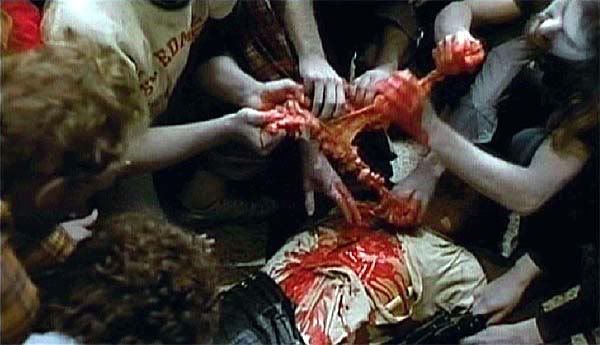
Lee Demarbre: I can't figure out why there aren't prints of the original Dawn of the Dead (1978) or Day of the Dead (1985) still kicking around. I wish I could show them again and again. The best part of my job is tracking down older prints (16mm or 35mm) and showing them. I'm still not sure if people really dig seeing original prints of movies; but for me it's like going to a concert to see your favorite old band. It's like a music fan saying "there's Kiss, live on stage" and me coming to the Mayfair and saying "there's an original print of that old movie that I've never seen before." For me it's that visceral.


OFR: How do you guys at the Mayfair feel about the Lansdowne Live decision and will it affect the cinema? Is there anything regular moviegoer should know or do?

Lee Demarbre: People should realize what an original film print is. That like still photography what we're showing is a positive of the negative that was in the camera on set when the movie was being shot. Seeing a movie in the theatre on 35 mm is like going to a museum and seeing a real life painting, opposed to seeing a copy of the painting printed in a magazine. And with the major studios witching over to digital projectors and showing movies downloaded onto a server; the idea of seeing a print is more real then ever. Forget about watching your DVD's, Blurays or whatever at home -- seeing an original print of your favorite movie is really like seeing it for the first time. If you don't get this -- then please stay at home.

OFR: What would you say were your favorite ten movies that came out in 2009?

Lee Demarbre: Here's my list

- Red Cliff: Part II (John Woo)
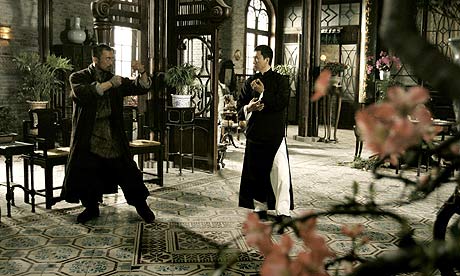
- Ip Man (Wilson Yip)
- Inglourious Basterds (Quentin Tarantino)
- Bronson (Nicolas Winding Refn)
- The Fantastic Mr. Fox (Wes Anderson)
- Invictus (Clint Eastwood)
- Che (Steven Soderbergh)
- Star Trek (J.J. Abrams)
- Whatever Works (Woody Allen)
- The Girlfriend Experience (Steven Soderbergh)


Tuesday, March 30, 2010

Upscale Mariage Qualms

Chloe (Atom Egoyan, 2009)
*** (A Must-See)


In fifty-year-old bespectacled director Atom Egoyan’s new film Chloe there isa chilling story of marital dysfunction and intrigue between a charming music professor David (Liam Neeson) and his gynecologist wife Catherine (Julianne Moore). The film is about life and death, language and perceptions, orgasms and music, personal obsessions and Canada. Catherine suspects David of extramarital affairs after finding a picture of him with a younger student the night he missed his surprise birthday. Catherine self-destructive paranoid fantasy leads her to hire a young prostitute Chloe (Amanda Seyfried) to pursue her husband. From there it is ambiguous if Chloe is fulfilling her duties or just leading Catherine on, the sexual adventures eventually involve the couples son Michael (Max Thierriot).

Chloe is successful at presenting its contemporary period as it showcases Torontonians interconnectivity with new media, urbane privilege, alienation, infantilization of adults, the growing indie-rock movement, transcontinental airplane travel and heath care. The film Chole is attuned to women high fashion. The women are dressed beautifully and revealingly from see-through white t-shirts to dresses to high heels, these items represent gender expectations that are placed on women. The level of success and physical appearance exuded by Catherine makes her plight all the more desperate when Catherine suspects her husband of infidelities. Jonathan Rosenbaum writes about Chloe “I think what’s sneaky and deliberately misleading about the story is that is starts off pretending to be a movie about a husband’s midlife crisis and then winds up as a movie about his wife’s midlife crisis.” The thematic gravity and psychological depth, linear narrative and star power are a mélange of Atom Egoyan’s art-house sensibilities and the Reitman’s populism. Chloe is partly funded by Ivan Reitman’s production company Montecito and Ivan’s son Jason Reitman is executive producer and there was collaboration with Studio Canal and Sony distributions.


Atom Egoyan describes Chloe as “the anti-Adoration” as Adoration (2008) - a film about the stigmatization of ethnic minorities - presented a more desperate Toronto landscape while Chloe – which was supposed to be set in San Francisco - is a travelogue of Toronto’s luxuries. While in Egoyan’s earlier films Toronto was seen as a non-place. The cultural tourism in Chloe is overt as the city is an inherit part of the story from Yorkville and Queen Street, the CN Tower skyline presence, the AGO, the ROM, Allen Garden, Cafe Diplomatico (594 College Street), Rivoli’s (332 Queen Street), and the Royal Conservatory.

Assimilation has been a longstanding theme in the oeuvre of the Armenian-Canadian director. Atom Egoyan was born in Cairo, Egypt and at a young age was relocated with his family to Victoria, British Columbia. Egoyan habitually includes the casting of his wife Arsinee Khanjian in his films. Through the 80s, 90s, 00s the director has been dealing with ethnicity and assimilation, and private obsessions and public issues. Since Next of Kin (1984) - with an Armenian protagonist and a cameo by Atom Egoyan, Family Viewing (1987), The Adjuster (1991), Calendar (1993), Ararat (2002), to Adoration Egoyan has been dealing with what it means to be a foreigner in Canada. This is epitomized in the angry sequence in Family Viewing where a waving Canadian flag is cross-edited alongside an Armenian elderly mother committing suicide through swallowing pills while her daughter prostitutes herself to raise money to take care of her medical expenses. In Calendar there are clear distinctions between the Armenian positions of nationalism, Diasporan, and assimilationist. These ethnic positions have been lost from Chloe as it shows Egoyan assimilated and making a film about hegemonic Anglo-Saxons. Similarly to Egoyan’s non-Canadian productions Felicia’s Journey (1999), his most Antonioniesque film, and Where the Truth Lies (2005). Though, in a Q & A session at the Canadian Film Institute, Mr. Egoyan dismissed the “auteur” theory in which for him would include looking at the themes in work that he has no creative input like his directed late 80’s TV fare of Friday the 13th, Alfred Hitchcock Presents and The Twilight Zone.

A defining trait in Atom Egoyan oeuvre is the perfuming of scenes with a “cerebral musk”. Even though this is his first film where he did not co-write the screenplay, which is credited to Erin Cressida Wilson as a remake of Anne Fontaine’s French erotic thriller Nathalie... (2003). This brainy tendency comes from Egoyan’s interest in theatre that was apparent since his stint at the University of Toronto. His interest in theater is reiterated in his direction in the Samuel Beckett series of Krapp’s Last Tape (2000) with John Hurt, as well his short film Howard in Particular (1979) seems rooted between the Theater of the Absurd and Maya Deren. The emphasis of his cerebral musk is on psychoanalyticism and language. In the introduction of the Chloe, the prostitute in a voice-over says “I have always been good with words”, this scene and many others are characterized by a meta-discourse of character motivation, which sometimes can seem a little clunky as people are talking about things that people typically do not address in conversation. So even if Chloe appears more as an enigma then a fully rounded character, she confronts Catherine with an alternative position and forces her rationalize the absurd situation.

Reviews of Chloe have already been written in several Canadian publications. In the Katherine Monk’s Ottawa Citizen review she is eagerly positive as she writes “the movie hits a sustained eerie note” and raves of Amanda Seyfried’s performance. In Liam Lacey’s Globe and Mail review he is condescending towards the film, not biased by sharing the filmmakers hometown, he writes “Chloe is director Atom Egoyan’s foray into the realm of what might be called artful trash” and finishes his review with “Chloe has an awfully corny ending, including some lurid high-jinks and shocks that teeter on genre satire”. In the Montreal Gazette John Griffin writes naively “You’re forgiven for failing to realize Chloe is the first Atom Egoyan picture that isn’t an Atom Egoyan picture”. While Brian Johnson’s review in Macleans emphasizes the surprise emerging career of Amanda Seyfried “Hollywood’s new It Girl.” There has also been several critical analyses on Atom Egoyan by writers including Jonathan Romney, Emma Wilson and Tom McSorley.


The casting is spectacular, the acting is titillating, the architecture is sinisterly photographed, and the themes are relevant. One of my problems with this art-house production is its voyeurism. It condones David for cheating and flirting all the while the providing the viewer with enjoying lesbian fantasies. These sexual sequences seduce the audience similarly to the stripteases in Exotica (1994). Chloe is a mixture of pornography, as Amanda Seyfried is frequently naked, and stylization as the film exist in a realm of heightened realism. With Chloe, Atom Egoyan has created a substantial film about extramarital-confusion and it proves to be a really interesting addition to the Egoyan universe.-David Davidson

(Bytowne Cinema, 324 Rideau Street, 26/03 - 8/04)

Sunday, March 28, 2010

Studious April Distractions

April Film Listings

Canadian Film Institute
Le Jour Avant Le Lendemain (Marie-Hélène Cousineau & Madeline Ivalu, 2009) 11/04.
Contes de l'Age d'Or (Cristian Mungiu et al, 2009) 17/04.
Revanche (Götz Spielman, 2008) 24/04.

Bytowne Cinema
Les Vacances de M. Hulot (Jacques Tati, 1953) 9/04 - 13/04.

The Mayfair Theatre
The Robe (Henry Koster, 1953) 3/04.
Army of Darkness (Sam Raimi, 1992) 10/04.
Naked Lunch (David Cronenberg, 1991) 25/04.

Cinémathèque Québécoise (Montreal, QC)
Greed (Erich von Stroheim, 1924) 23/04.
Greed: Reconstruction (Erich von Stroheim, 1924) 25/04.
Blind Husbands (Erich von Stroheim, 1919) 30/04.

Wednesday, March 24, 2010

An Unfortunate Kinship

J'ai Tué Ma Mère (Xavier Dolan, 2009)
*** (A Must-See)


J'ai Tué Ma Mère is the first feature of actor-writer-director-coproducer Xavier Dolan-Tadros who completed the project at the age of nineteen years old. This is a thinly veiled autobiographic film where French-speaking Xavier Dolan plays Hubert, an on-screen alter ego, who is a queer Montréal high school adolescent who gets sent off to a boarding school without his consensus.

The conflict in the film arises between Hubert and his Quebecois mother Chantal (Anne Dorval, who looks surprisingly like Shirley MacLaine) and what makes the story so moving is Hubert’s incapability to understand that no matter how badly his mother treats him that it is done out of unconditional love. No matter how tacky is her dress or how safari is her taste or how bland is her cooking. Chantal is irritated by Hubert’s dependency and rejection and easily looses her temper. Her husband left both of them at young age. What increases Hubert’s sense of dismay towards his mother is his jealousy towards his boyfriend Antonin mom who leads an exciting life with young lovers, take-out, and who commissions Hubert to paint her office. What is so contradictory of Hubert’s, and Dolan’s, matricidal urges is that he uses these intense emotions as a source of creativity. In the film, one of his painting’s is entitled “The Son”, interlaced throughout the film are his b/w personal monologues of his yearning to communicate about his love/hate relationship with his mother, and he also writes a story named J'ai Tué Ma Mère.

The closest relationship Hubert seems to have is with his schoolteacher Julie. For a classroom assignment he lies to her stating that his mother is dead and later she picks him up after his mother chases him at school, and later he chooses to stay with her when he runs away. Julie and Hubert similarly have had poor relationships with their parents and they had close relationships with their grandparents. As well they both express a pervading wanderlust. Julie’s comforting of Hubert epitomizes the tenderness of their platonic friendship.


J'ai Tué Ma Mère is similar to Francois Truffaut’s directorial debut Les Quatre Cents Coups (1959) - a film that Xavier included in his personal top ten film list - which is the story of a child Antoine (Jean-Pierre Léaud) and his matriarchal issues who decides to run away from the detainee center he is put into and the film ends with a freeze-frame of him on a beach. Xavier transcends any similarities as the films concluding return to his childhood beach house seems fresh and unpredictable. It is also part of the Quebecois tradition of returning to nature and to rural traditions - like Gilles Carles’s La Vraie Nature de Bernadette (1972). J'ai Tué Ma Mère mixes between the lowbrow and highbrow with references to Jean Cocteau, Marquis de Sade, Jackson Pollack, and Leonardo DiCaprio.

Some criticisms of J’ai Tué Ma Mère include the narrowness of its scope, as it is limited to individuals’ feelings that are void of politics and social realities. There are only slight suggestions of poverty, as outside a Blockbuster are two homeless men rifling amongst the trash – for creative representations of the Montreal socially assisted poor see the work of Donigan Cumming - and homophobia as Hubert once gets beaten. Dolan grew up as a child actor, had been in TV series, commercials, acted in Pascal Laugier’s Martyrs (2008) and has just completed Les Amours Imaginaire (2010). The world of the actor-director tends to verge on sublime narcissism as the surroundings are seen negatively and it is the protagonist who is the victim. Dolan's smarmy wink’s to the audience eventually gets annoying as he implies his own cleverness in the ways in which he looks at his mother with self-evident disgust and insults her for the most superficial reasons, like the way she eats a bagel and then has cream cheese stuck on the corner of her mouth.

Mark Peranson’s editor’s note in CinemaScope issue 39 writes “Québec’s wunderkind Dolan whose incredibly overrated Quinzaine debut strikes me as a case of mass hysteria” and later in the same magazine Jason Anderson contradictorily writes “should there be more who are as bold and brazen as Dolan”, Atom Egoyan personally expressed admiration for the film, and in the magazine 24 Images Issue 146 Marie-Claude Loiselle writes that Dolan film stands out from his contemporaries because he creates a language of his own that fits his personality, that at times J'ai Tué Ma Mère is border lining disequilibrium, and that hopefully with maturation Dolan films will increase in mastery hopefully without loosing his singularity and to not try to please everyone. Loiselle includes Dolan amongst other contemporary French-Canadian film chroniclers, or the “Nouvelle Vague Québécoise”, that includes Simon Galiero, Denis Côté, Rafaël Ouellet, Robin Aubert, Micheline Lanctôt, Sophie Deraspe, Bernard Émond, Marie-Hélène Cousineau and Madeline Ivalu.


J'ai Tué Ma Mère is similar to Ryan Arnold’s Skidlove as the two 2009 actor-director first-features both reflect the period and present particular youthful experiences of early adulthood and the conflicts between identity and role confusion, intimacy and isolation. Both features are partly co-produced which enables them to be full-length features of home movies material. As such they represent an expansive personal creative expression that is rarely seen is the privatively financed Canadian film industry. The films are painfully personal recognitions of deep feelings of anger, fear, and melancholy. In Skidlove, Ryan's character reaches out to others whether it is to his girlfriend Jaymee or to his friends, people are framed together. In J'ai Tué Ma Mère there are isolating close-ups always distancing Hubert from others. In both films the protagonist present a form of alternative lifestyles that includes smoking pot and painting. In Skidlove, Ryan is a heterosexual and deals with contemporary relationships once in the working world and his solace come from friends and girlfriend. In J'ai Tué Ma Mère, Hubert is 16 and wants to move out. Hubert has an intense Oedipus complex shown threw a fall orange-maple-leaf dream sequence where Hubert chases his mother who is dressed in a wedding gown. Through a Langian dream analysis, which emphasizes that dreams bring out underdeveloped aspect of the psyche, it reveals that Hubert complex desire to be closer to his mother.

The two films together present a diptych of English and French-speaking Canadian cinema of the 2010s as did the 1964 films by Don Owen's Toronto based Nobody Waved Goodbye, and Montrealer Gilles Groulx’s Le Chat Dans Le Sac did for their period. Stylistically Xavier Dolan is closer to someone like the expressive Arnaud Desplechin while Ryan Arnold seems more like the evovative Takashi Miike, though they present a sensibility that is rooted in a local cultural heritage. Ryan Arnold’s Skidlove has not attained the same successes as J'ai Tué Ma Mère that won three prizes at the Director’s Fortnight at the 2009 Cannes but it is a must-see and Skidlove will be having its Toronto premiere in May 2010 at The Royal Cinema.-David Davidson

(Bytowne Cinema, 324 Rideau Street, 19/03 - 25/03)

Friday, March 12, 2010

On the Tuesday Night Movies at the Imperial

There is a local film club that gets together Tuesday night at 8PM at the Imperial Food & Beverage (329 Bank Street, http://the-imperial.com/). Prior to the screening you can get food at the restaurant and the selection varies from burgers to wraps and pizzas. The beer is good and the local brews vary from Heritage Brewing, John By and Beau’s. The décor is cool and the walls are covered with cult movie posters including snob-worthy titles like Taxi Driver, The Big Bird Cage, Shaw Brother’s films etc.

The Imperial is in the Barrymore’s Music Hall which itself originated as a film theater in 1914. Alain Miguelez in his book “A Theatre Near You: 150 Years of Going to the Show in Ottawa-Gatineau” elaborates on the Imperial. Miguelez reveals interesting facts about the "Imp" including that in its hey-day the theater had a 1200 seat auditorium and its own pipe organ. It closed in 1955. Since then it has gone through several owners and now part of it is a live-music nightclub.

The Imperial Food & Bevarage reopened in November 2008. The movie night at The Imperial resumed July 2009 by Katherine Eastwood, though now it is organized by Rene Kayser. In the future Rene will be collaborating with local film-type and kitchen staff Megan. The future screenings have yet to be determined and for more information you can contact Rene (renepook@gmail.com). The free film screenings are Tuesdays at 8PM once the kitchen closes.

Rene is the programmer of Tuesday Night Movies at the Imperial and a long-term Ottawa resident. When he used to live in Saint John’s, New Brunswick he started exhibiting films with Scott Preston organizing the Saint John’s Avant-Garde Film Festival, it was a success. Previously to the Imperial, Rene ran a film club from his apartment. He started it November 2008 and it ran for about eight months. Turnout varied and if too many people showed up it got cramped.

I recently sat down with Rene Kayser at the Bank and Gilmour Street Bridgehead – where he works – to talk to him about the Tuesday Night Movies at the Imperial. Before each film Rene synopsizes the movie and brings up interesting facts pertaining to the filmmaker, though before that he is very approachable and walks around the restaurant talking to friends and first-timers. Rene describes the movie nights as a way to “present some total of the cinematic experience, from the high point to the low point and everywhere in between, movies with distinctive qualities”. Invisible-Cinematically speaking, Rene’s film affinities lean more towards Nick then Wyatt.

On discussing the Ottawa film-going community, Rene thinks that “you get more enthusiasm from grass-root films, you know people like Lee Demarbre.” And I will add that people are receptive to Rene's own movie nights. When I saw Sam Peckinpah’s Bring Me the Head of Alfredo Garcia (1974) on March 3rd the restaurant was packed.

You can spot posters for Tuesday Night Movies at the Imperial at a few center-town establishments such as the Bridgehead at Bank & Gilmour, Turning Point (411 Cooper St) and Invincible Cinema (319 Lisgar St). Finally, Rene had to say: “I like it when people are moved by the films I show, in some way, or are really entertained. I love it when people come up to me afterwards and say things like: I have never seen anything like that before”.

On March 16th at 8PM Tuesday Night Movies at the Imperial will be playing Russ Meyer’s Beyond the Valley of the Dolls (1970).-David Davidson

Saturday, February 27, 2010

Anonymous Ten Great Films of the 00's, On Ottawa Film Review

This is a 10 favorite films list of the 00’s from my friend and local Ottawa film type A&W. My friend, who would like to be credited as A&W, accompanied his list with “If I were able to have seen Dying at Grace it would probably be on there as well”.


A&W’s Ten Favorite Films of the 00’s
1. Tropical Malady (Apichatpong Weerasethakul, 2004)
2. The Intruder (Claire Denis, 2004)
3. Life Without Death (Frank Cole, 2000)
4. Inland Empire (Davie Lynch, 2006)
5. A Certain Kind of Death (Grover Babcock & Blue Hadaegh, 2003)
6. Following Sean (Ralph Arlyck, 2005)
7. Trouble Every Day (Claire Denis, 2001)
8. Memories of Murder (Joon-ho Bong, 2003)
9. Billy The Kid (Jennifer Venditti, 2007)
10. Nathan Barley (Christopher Morris, 2005) "TV series"


*****

On Ottawa Film Review

This overt shift from a film listing or review to a submitted top ten list – hopefully I can get a few others – is part of the new direction for Ottawa Film Review. This online film editorial, for me, provides a diary-like tally of the films I see in Ottawa film theatres. In the future, I might have to reevaluate the title as I am planning to move to Montreal, Toronto, or Paris in the upcoming September or October. What I really want to do from now on with this space is to engage in a greater discourse of the experiences of being a cinephile in Ottawa – the nations capital – and expose a certain grain of worthwhile Canadian cinema. This is being accentuated by now working for the Canadian Film Institute. Thanks again, Scott.

I do not include my personal video consumption and I purposely avoid writing about each week new Hollywood releases as (1) I am usually disappointed by most of Hollywood’s sup-par escapism output - I tend to prefer a select handful of filmmakers who usually imprint their personality onto their material and that generally have a humanistic and generous world view, with exceptions - and (2) most major distributed films are already so publicized that anything said about them is overshadowed by the vast writing, critical and non-critical, already available.

What to expect in the upcoming month of March, potentially a few interviews and I plan on writing about Allan King; his film Dying at Grace is playing at the Library and Achieves Canada March 14th at 7PM, Donigan Cumming; whose recent work will be projected at the Cinémathèque Québécoise in Montreal March 17th at 6:30PM, and Atom Egoyan; his new film Chloe which will be premiering at the Bytowne Cinema March 26th.-David Davidson

Tuesday, February 2, 2010

Great Films of the 00's


Passing Time
by David Davidson


The films on my top twelve of the 00’s list are serious, original and daring works of art. They are not necessarily non-fiction but they are all somehow are drenched in reality, whether that means being based on actual historical events or newspaper headlines, being city symposiums, history revisionism, or just grass root stories of people and their daily realities. These films layer fiction with non-fiction to come up with a piece of work that is evocative of the first decade of the third millennium. These films take place in the present-day or in the historical film genre and through them contemporary film-artist emphasize the importance of geography and history. The list is a good accumulation of moods and experiences of the first decade of the 21st century.


The decade of the 00’s in North America for Canadians meant living under the Liberal Prime Minister Paul Martin (2003-2006) and the Conservative Primer Minister Stephen Harper (2006-?) government and south of the border in the United States of America there was the George W. Bush (2001-2009) administration. The films made in both those countries are social documents and they reflect zeitgeist issues prominent of our times by addressing how people are relating to the world. The foreign films on the list are interesting for a greater understanding of world developments from an insider point of view. They are about social realities and hardships, globalization, living with the consequences of an unfavorable history, the effects of government policy etc. Essentially these films are a humanizing experience that present a different world then ours, creating sympathy for characters that we might not otherwise thing of. Some films achieve what Howard Zinn would advise to people that is to “learn a different history that will make them skeptical of what they hear from authority”. These works are the antithesis of the “authority” which consists of the dominant media portrayal of North-American culture and the abroad. The films emphasis on the life of the working class and the details surrounding them are a testament to the great possibilities of what can be accomplished with a video camera.


The Canadian director David Cronenberg’s A History Of Violence (2005) has marked the top ten film list of the decade for both Film Comment (#7 on their list) and Cahiers du Cinema (#5 on their list) and the film critic Jonathan Rosenbaum included in his personal top ten list the Canadian experimental filmmaker Michael Snow’s *Corpus Callosum (2002), a film which I regrettably have not yet seen. These are two isolated exceptions in what is a non-Canadian dominant international film community recounting of the decade. A History of Violence is a thrilling action film and also a complex critique of the action genre and American society (i.e. violence and war is a passed down trait from one generation to the next. Probably the closest thematic adaptation of the Marxist historian Eric Hobsbawm’s On Empire: America, War and Global Supremacy). It is also a radical departure from the typical Canadian social-realist films. My problem with A History of Violence is that it is complicated to assess how the film is actually Canadian other then the criteria that the birthplace of David Cronenberg is Toronto. The inclusion of this film creates an overarching blanket that reduces and removes other national filmmakers, who are engaging in a discourse of local issues, from the international film community. Other important Canadian filmmakers include the prairie fabulist Guy Maddin, the Armenian assimilationist Atom Egoyan, and the Inuktitut speaking Zacharias Kunuk. I have not yet seen any films by John Greyson or Philip Hoffman, two other Canadians filmmakers that have been recommended to me. The Canadian films on my list My Winnipeg (2007), Atanarjuat (2001), Ararat (2002) and Adoration (2008) are works whose settings remain within our ten provinces and three territories. They are bold and innovative narratives that showcase our national artistry. I have not included Frank Cole’s magnum opus Life Without Death (2000) about his solitary excursion through the Sahara desert as it does not deal with societal issues which is the criteria for my list.


The films on the list take place around the world and back. This includes: Poland during WWII following a Jewish pianist who is in hiding from the death camps (The Pianist); Los Angeles, California during the 1920’s with an investigation of police and psychological institution corruption (Changeling); New York and in a few other American states and cities during WWII with a intricate meditation on the war and its current and later effects on American society (Flags of our Fathers); Paris, France in 1936 with a tale of a crisscrossing Russian agent in one of Eric Rhomer’s last and more political films (Triple Agent); Winnipeg, Manitoba with a meditation on the lack of substance that comes with the demolishing of cultural heritage which includes tearing down the cities old Hockey Arena and Eaton Center (My Winnipeg); A meditation on the Armenian genocide that took place in the beginning of the 20th century (Ararat), a tour de force guide through Russian history in the Hermitage in St. Petersburg (A Russian Ark); a compelling narrative of people searching for former lovers as well as an examination of the effects of the Three Gorges Dam in China (Still Life); a look at London’s working class and the area around their housing complex (All or Nothing); a modern day reworking of Dostoyevsky’s Crime and Punishment in Belgium (L’Enfant); a presentation of the effects of the glass ceiling on a Senegalese taxicab driver in Winston-Salem, North Carolina (Goodbye Solo); a devastating critique of American arrogance in New Jersey (Storytelling); a tale about the effects of living in an inextricable digital age set in Toronto, ON (Adoration); and finally set in the Canadian North a recounting of an Inuit legend (Atanarjuat).


Truthfully the majority of these films were only watched later after their initial release on video, some did not even have a theatrical distribution here. I have not yet seen the 2000 output of all the film festival circuit favorites including Apichatpong Weerasethakul, Jean-Luc Godard, Roy Andersson, Corneliu Porumboiu; filmmakers who have gathered much praise and critical attention. This just shows there is much richness in contemporary filmmaking and I continue to look forward to watch new movies.


The Top Twelve Films of the 00’s
1. Still Life (Jia Zhang-Ke, 2006)
2. Russian Ark (Aleksandr Sokurov, 2002)
3. My Winnipeg (Guy Maddin, 2007)
4. L’Enfant (Dardenne Brothers, 2005)
5. Changeling (Clint Eastwood, 2008) & Flags of Our Fathers (Clint Eastwood, 2006)
6. Triple Agent (Eric Rhomer, 2004)
7. The Pianist (Roman Polanski, 2002)
8. Adoration (Atom Egoyan, 2008) & Ararat (Atom Egoyan, 2002)
9. Storytelling (Todd Solondz, 2001)
10. Goodbye Solo (Ramin Bahrani, 2008)
11. All or Nothing (Mike Leigh, 2002)
12. Atanarjuat: The Fast Runner (Zacharias Kunuk, 2001)