Slowly rolling out to magazine and book stores in the upcoming week, the new Cinema Scope offers a great survey of the Fall new releases, festivals titles and other cool movie stuff. Pick it up if you can!
Showing posts with label Cinema Scope. Show all posts
Wednesday, September 14, 2016
Tuesday, June 21, 2016
Cinema Scope’s Covers
Every June
for cinephiles who read Cinema Scope
the same questions are always asked: When does it come out? What’s
going to be on the cover? It has become almost like a game. Though there are always some
hints. Like what has the Cinema
Scope account and its regular contributors tweeted from the
Croisette? From there it’s a process of
elimination with usually two or three strong contenders. After that it's
a guessing game until the cover is finally revealed. With the new summer issue it’s Maren Ade’s Toni Erdmann that makes the final cut. But it’s not just the
summer issue that’s important as with an exclusive four issues a year the
quality and the anticipation value of these cover films are trusted more so
than even each year’s Palme d'Or.
After having
already covered the nationality and age of the filmmakers that have made it onto
their yearly top ten lists, the following is a study of their covers since the famous Fifty Filmmakers Under Fifty issue from Spring 2012. That was an
important issue for the magazine as it represents a milestone since its inception in 1999. For that issue they got fifty past
contributors and fellow traveler filmmakers to write on a respective director.
This offered Cinema Scope the opportunity to strongly reaffirm the taste of the magazine and
suggest future support for their following films. As well the magazine seemed
to have matured as it evolved its formatting from the casual loose stapled binding
to a more prestigious firm one. (As well issue 50 is as far back as its online
archive goes up to).
A short
description of their covers seems due: its trademark title and subtitle
(usually in white, though this can vary) can be found in the top left corner,
there’s a still from recent favored film that adorns the cover (with the
memorial Akerman and the Hong Sang-soo as exceptions), then
there is around seven full names to promote the other filmmakers discussed in the issue, and there’s also an inside-cover picture. The films
on its cover and its graphic design recalls those of high quality art journals
as they aim for a contemporaneity, striking designs, beauty and that of
surprise.
To better
understand the filmmakers behind these cover films the following is some brief
context of where they were at in their oeuvre (though for simplicity gathered
from IMDb):
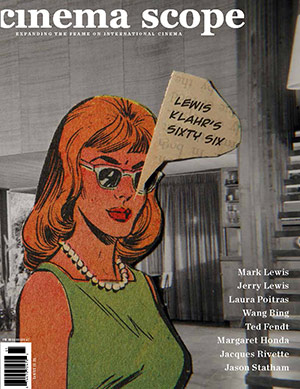
N.67: Maren Ade’s Toni Erdmann (2016) is her 3rd feature in an oeuvre that goes back to 2003 (The Forest for the Trees) and with two shorts going back to 2000.N.66: Lewis Klahr’s Sixty Six (2002-2015) is his 17th work in a oeuvre of mostly short- and medium-length work that goes back to 1987.N.65: A memorial Chantal Akerman cover. An oeuvre of 47 credits with a wide-ranging variety of works that goes back to 1968.N.64: Hong Sang-soo’s Right Now, Wrong Then (2015) is his 21st credit (mostly of features) that goes back to 1996.N.63: Miguel Gomes’ the Arabian Nights trilogy (2015) is his 4th-5th-6th feature with his earlier short-films going back to 1999.N.62: Guy Maddin and Evan Johnson’s The Forbidden Room (2015). Maddin’s 13th feature with a total of 54 total credits that goes back to 1985. Johnson’s 1st feature with 5 shorts going back to 2014.N.61: Christian Petzold’s Phoenix (2014) is his 7th feature with a total of 14 credits, which includes television work, that goes back to 1992.N.60: Pedro Costa’s Horse Money (2014) is his 8th feature in an oeuvre that includes 16 credits (with shorts and contributions in omnibus projects) that goes back to 1984.N.59: Lisandro Alonso’s Jauja (2014) is his 5th feature with 7 total credits (including short-films) that goes back to 1995.N.58: Corneliu Porumboiu’s The Second Game (2014) is his 5th feature in an oeuvre that goes back to 2000 (including 6 short-films).N.57: Jodie Mack’s New Fancy Foils (2013) is her 27th work in a career of experimental short films that goes back to 2003.N.56: Albert Serra’s Story of My Death (2013) is his 7th features in an oeuvre that goes back to 2003.N.55: Alain Guiraudie’s Stranger by the Lake (2013) is his 7th feature, along with some television work and short-films, that goes back to 1990.N.54: Denis Côté’s Vic + Flo ont vu un ours (2013) is his 7th feature and with his earliest work going back to 2005.N.53: João Pedro Rodrigues and João Rui Guerra da Mata’s The Last Time I Saw Macao (2012). It is Rodrigues’ 4th feature with his first being from 2000 (O Fantasma) and earlier short-films and documentaries going back 1988. It is João Rui Guerra da Mata 1st feature in an oeuvre that includes 4 short-films that go back to 2007.N.52: Lucien Castaing-Taylor and Véréna Paravel’s Leviathan (2012). It is Castaing-Taylor’s second feature after Sweetgrass from 2009. Also Paravel’s second feature after Foreign Parts (which was made with J.P. Sniadecki) from 2010.N.51: David Cronenberg’s Cosmopolis (2012) and Leos Carax's Holy Motors (2012). Cronenberg’s 20th feature film with his first Stereo from 1969 and earlier short-films going back to 1966. Carax’s 5th feature since 1984 (Boy Meets Girl) along with a short-film in 1980.N.50: Miguel Gomes’ Tabu (2012) is his 3rd feature since 2004 (The Face You Deserve) with 5 earlier shorts going back to 1999.
Of these
eighteen covers that spans a bit more than four years: fifteen of the films can be classified as world cinema, two of them as experimental
(Klahr, Mack) and one as a documentary (Leviathan). With a caveat being that they are all somewhat hybrid as they take up forms proper to a variety of types of filmmaking. Of this list there is only one returning filmmaker which is Miguel Gomes for Tabu and Arabian Nights. The cover status of these films arrive at different stages in the filmmakers' oeuvre: there were eleven filmmakers which the film is
between their 1st
to 5th
film, five which the film is between
their 6th to 10th, three between their
10th
and 20th (Klahr, Maddin, Cronenberg), and finally three with more than 20 (Akerman, Hong Sang-Soo, Mack).
Any reader of Cinema
Scope already knows that it’s a serious film magazine that builds upon a rich history of film criticism (far from the gossip, reviewing
and hot-takes of most contemporary journalism). The feature
cover essays and interviews provide a model of both the type of privilege forms of filmmaking and
of writing at the magazine. The highest amount of cover feature essays are by its chief editor Mark Peranson with six of them (Ade, Gomes, Maddin, Costa, Serra) which strongly dictate the editorial line of the magazine and
then all with two of essays there's Adam Nayman (Cronenberg, Petzold), Jordan Cronk (Klahr, Poromboiu), and Phil Coldiron (Mack, Leviathan).
But finally it's the filmmakers themselves who propel themselves to the covers - making work that's relevant, challenging, productive, invigorating, troubling, beautiful, affective. A glimmer of hopeful light for troubling times.
Wednesday, May 25, 2016
Cinema Scope’s New Screening Series
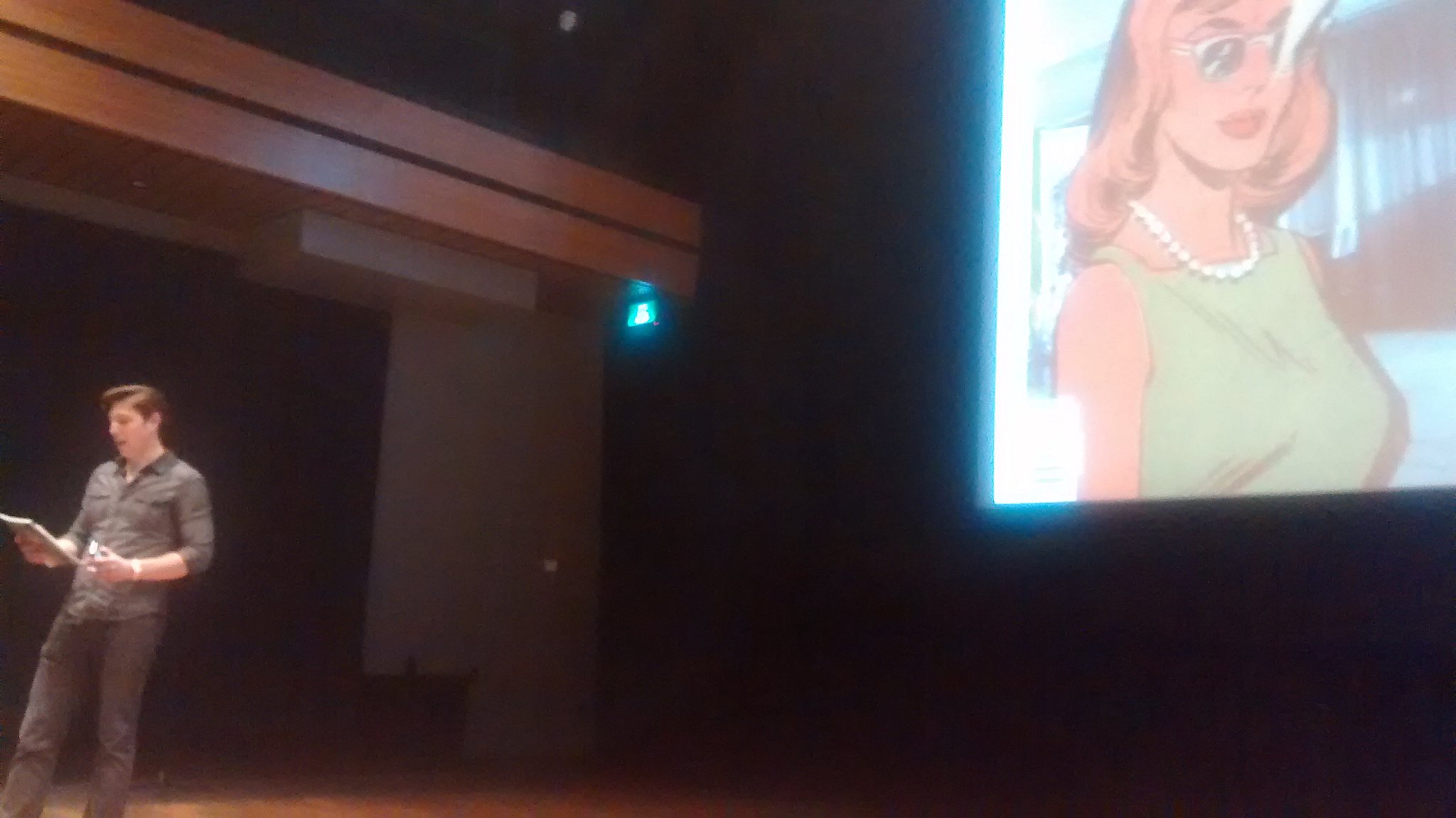
Exciting news! The Toronto-based film magazine Cinema Scope held its first public
screening of its current cover-issue film Lewis
Klahr’s Sixty Six (which is reviewed
by Jordan Cronk in the issue) on Tuesday, May 24th. Cinema
Scope has always been visible in the city with its issues in the good
magazine stores, some of its critics being public film figures (regularly
introducing films or moderating panels or director interviews), and a regular booth at Word On The Street and mutually
beneficial sponsorship screenings at the Images Festival and the Cinematheque. But with this new series, by its managing editor Andrew Tracy and regular
contributor and projectionist Sean Rogers, it’s taking further steps to make
the city its more visible physical home. This is instead of its critics, programmers and fellow filmmakers and comrades being more spread
out and disperse throughout the world and the internet. This new Cinema Scope screening series is not the only
exciting screening series in the city – the MDFF screening on Sunday of Matt Porterfield’s
Take What You Can Carry, also comes
to mind – but these type of special events help remedy some of the major
distribution and exhibition problems plaguing the world of art and independent film. Once the problems are identified and with Cinema Scope the exciting new films apparent then there can be the emergence of these micro-network showcases to best be able to see the work of these artists and their images of the world. Everybody wins.Monday, March 21, 2016
Cinema Scope and The World
For Cinema Scope
issue number sixty-six a beautiful still from Lewis Klahr’s Sixty Six graces its cover. In its annual, though perhaps begrudgingly,
tradition of organizing a top ten list with its contributors (to be eligible
they must have contributed to each of its quarterly issues) the elected
titles combined tend to offer a representative survey of the major films and
the new cinematographic trends of that previous year. Perhaps to celebrate this new
issue, and with the pass of the half-way mark of the 2010 decade, it’s as good a
time as any to look back and reflect on these lists, going as far back as 2010. These lists for the 2015 to 2010 years appear in the issues number sixty-six, sixty-two, fifty-eight, fifty-four, fifty and forty-six.
This would provide a broader view of the cinematographic preferences of the
magazine, the directors that they feature, their average age, and the countries that
they’re from – essentially what constitute the creators of the most exciting films of this period.
Excluding
their yearly special mentions, all of the films that made their top ten lists
so far (since 2010) include (in alphabetical order): A Touch of
Sin, Adieu au langage, Arabian Nights, Attenberg, autrement, la Molussie,
Cemetery of Splendour, Computer Chess, Django Unchained, Dreileben, Film
Socialisme, From What Is Before, Holy Motors, Horse Money, I Wish I Knew,
Inherent Vice, Inside Llewyn Davis, It’s the Earth Not the Moon, Jauja, Journey
to the West, Kaili Blues, Kill List, L'Apollonide: Souvenirs de la maison
close, L’inconnu du lac, Le gamin au vélo, Leviathan, Lost and Beautiful,
Maidan, Meek’s Cutoff, Moonrise Kingdom, Mysteries of Lisbon, Neighboring
Sounds, No Home Movie, Norte, the End of History, Once Upon a Time in Anatolia,
P’tit Quinquin, Phoenix, Right Now, Wrong Then, Sleeping Sickness, Story of My
Death, Stray Dogs, Tabu, The Assassin, The Autobiography of Nicolae Ceaușescu,
The Forbidden Room, The Ghost Writer, The Kindergarten Teacher, The Last Time I
Saw Macao, The Master, The Strange Case of Angelica, The Strange Little Cat,
The Treasure, The Tree of Life, The Turin Horse, The Wolf of Wall Street, This
is Not a Film, Uncle Boonmee Who Can Recall His Past Lives, Viola, Visit, or
Memories and Confessions, What Now? Remind Me, Winter Vacation.
For the sake of neatness the following summary might include
a few helpful generalizations: where the director might have associations with
more than one country, the specific country of the film or which they are more
identified with will be highlighted (e.g. Godard and Paravel with France,
Loznitsa with Ukraine, da Mata with Portugal, and Zürcher with Germany). Manoel
de Oliveira made Visit, or Memories and
Confessions when he was eighty-three so it would be inputted at that age.
And when the directors work in pairs or with the inclusion of an omnibus film,
each of the individuals would be properly inputted (which might lead to
potential over-representation).
The directors who reoccur on these lists, all with a maximum
of two inclusions, are: Apichatpong Weerasethakul (Cemetery of Splendour, Uncle Boonmee Who Can
Recall His Past Lives), Christian Petzold
(Phoenix, Dreileben), Jean-Luc
Godard (Adieu au langage, Film
Socialisme), Jia Zhangke (A Touch of
Sin, I Wish I Knew), Lav Diaz (From
What Is Before, Norte, the End of History), Manoel de Oliveira (Visit, or Memories and Confessions, The
Strange Case of Angelica), Miguel Gomes (Arabian Nights, Tabu), Paul Thomas Anderson (Inherent Vice, The Master), Tsai Ming-liang (Journey to the West, Stray Dogs). That some directors don’t
(re-)appear more frequently on these lists during this six year period might have more to do with the precariousness of producing these more challenging type of films and
certain curating trends of the film festival circuit.
Of the
sixty-eight directors on the list: fifteen of them are under the age of forty,
twenty-two of them are in their forties, twenty-four of them are between fifty
and seventy, and the remaining six of them are older than seventy.
The most reoccurring countries are the United States (with eleven
titles), Portugal (with nine titles), France (with eight titles), Germany (with
six titles), China (with four titles), and so on.
One of the great film magazines, a convergence point for contemporary
cinematographic trends, and always an interesting and stimulating read. Here’s
to a good 2016 year for Cinema Scope!
Tuesday, January 5, 2016
Toronto DIY Filmmakers in Cinema Scope 2015
Cinema Scope, perhaps the best film magazine, has had a good year in 2015. Four
issues, four covers: Guy Maddin and Evan
Johnson’s The Forbidden Room, Miguel
Gomes for the Arabian Nights trilogy,
a portrait of Hong Sang-soo after Right
Now, Wrong won the Pardo d’oro at
Locarno, and a portrait of a young Chantal Akerman in response to the news of
her tragic death. A familiarity with at least these four figures provides a
good base for an understanding of contemporary cinema, which can only be enriched by
exploring some of the other titles and reviews throughout the magazine.
Cinema Scope is typically ahead of film reviewing
trends as it publishes its critiques of new films straight from their festival
premieres whether it is Berlin, Cannes, Locarno or Toronto. Throughout their
yearly output several narratives can be traced: New directors that emerged, aesthetic
trends in world cinema, new works by major directors, experimental films and
video art, a reflection on film history, and the year’s release of DVDs and
film books.
The year 2015
was interesting at Cinema Scope for
their coverage of the Toronto DIY filmmakers. It’s a broad label to
describe young filmmakers from the Greater Toronto Area who are making more
independent and artisanal films. The films are mostly shot digitally and most of the
directors are from one of Toronto’s film production schools, such as York
University and Ryerson. The young directors offer a new perspective on the
Canadian experience, which typically are more raw and melancholic, vital and full of life than some of
the nation’s more ‘official’ media output. It’s origins can be traced back to
2009 with Kazik Radwanski’s MDF Trilogy:
Assault, Princess Margaret Blvd, Out In That Deep Blue Sea, Simon Ennis’ You Might as Well Live and Matt
Johnson’s Nirvana The Band.
In the spring
issue of Cinema Scope (N.62) Shelly
Kraicer has a feature essay on Luo Li, Of
Time and the River: Mapping the Cinema of Luo Li, to promote Li’s newest
film Li Wen at East Lake. In
Toronto it premiered at the Images Festival before Li would go on to have a
retrospective at the TIFF Cinematheque. Kraicer describes Li’s films as being,
“Marked by narrative playfulness, implicitly subversive formal innovation and
elegant, beautifully crafted images, and pervaded by a remarkably gentle,
unassuming confidence.” Li, a York film production graduate, is typically grouped
with the new generation directors
sub-category of the Toronto DIY filmmakers, which are first- and
second-generation immigrants to Canada, who reside in and around Toronto, but
whose films are set back in their home country. These directors include Li, Nicolás
Pereda, Igor Drljaca, Albert Shin, Simone Rapisarda Casanova and Lina
Rodriguez.
In the summer
issue (N.63) Jason Anderson spotlights from the Cannes Critic’s Week Andrew
Cividino’s Sleeping Giant, a
coming-of-age story of three boys set in Thunder Bay, which he describes as
coming, “far closer than most teen-centric dramas to conveying the damage that
young people can inflict on each other as they constantly jockey for power.” Sleeping Giant would go on to join Canada’s Top Ten. In the fall issue (N.64) Phil Coldiron interviewed
Isiah Medina, who just moved to Toronto earlier in the year, for his
experimental film 88:88. Coldiron
wrote about how it “necessitates the creation of a new experimental form of
the system composed of cuts and frames which we generally refer to as montage,”
while Medina compares it to a Moebius strip.
And in the most
recent winter issue (N.65) Sean Rogers reviews both Igor Drljaca’s The Waiting Room and Radwanski’s How Heavy
this Hammer for their spotlight on fall festival films. Rogers wrote about
them, “I considered the way they made the city feel: anonymous, provisional,
somewhere to wait. In the drearier moments of this place that I live, that
certainly seems like Toronto, all right.” Prior to this their films would have been only reviewed on Cinema
Scope Online for their festival premiere, with Christoph Huber reviewing
Radwanski’s Tower and Angelo Muredda How Heavy This Hammer, and John Semley reviewing Drljaca’s Krivina and Adam Nayman The Waiting Room. Though Radwanski was featured
in print in the fall 2012 issue (N. 52) with a conversation with Pereda, Unexpected Textures, moderated by
Christopher Heron.
Though it’s a
shame that Blake Williams (an experimental filmmaker, who also writes for the
magazine) wasn’t included in their coverage of 'The Third Image: 3D as
Experiment' at the Oberhausen Short Film Festival where his work was playing.
But it’s the first time that Cinema Scope
has featured a young Toronto director in every of their quarterly issues.
Previous Toronto DIY filmmaker's films reviewed at the magazine include an interview with Matt Johnson by Calum Marsh for The Dirties in the
summer 2013 issue (N.55), Robert Koehler wrote about Pereda’s work as early as
Summer 2010 (N.43) before he would go on to be included in their ‘best fifty
filmmakers under fifty’ issue, Anderson wrote on Simone Rapisarda Casanova’s The Creation of Meaning in the fall 2014 issue (N.60), and Adam
Nayman reviewed Daniel Cockburn’s You
Are Here in their fall 2010 issue
(N.44). There’s been also some online reviews of the Toronto DIY films like
Nayman’s review of Simon Ennis’ Lunarcy!, Jason Anderson on Yonah Lewis and
Calvin Thomas’ The Oxbow Cure, and Michael
Vass interviewed Antoine Bourges regarding East Hastings Pharmacy.
It’s the
first time that the Toronto DIY film community has received so much positive
exposure and it’ll be great to see it keep continuing. The quantity and
diversity of the directors is growing and their films are getting better and
receiving more exposure. So what to do next? How to get
more attention for these films? First off: The filmmakers need to give their films their all - make them count, aim for the stars, and make sure to do everything possible to conserve their vision. The MDFF series has been great
so far at creating a community of filmmakers and an audience to create an interest in these more different types of films. Things are looking good and there is an interest.
The future of Canadian cinema is in the hands of these young directors. Many of the above mentioned films will be
getting a theatrical release in the upcoming months so it would be important to
go see them and show an interest to support the filmmakers. Other new projects include: Nadia Litz’ The People Garden, Daniel Cockburn has been preparing a project for
a while (in 2015 he made a short-documentary on Atom Egoyan) and it looks like
Rebeccah Love has a few projects also in the works. Calvin Thomas and Yonah and Lev
Lewis still need to release Spice it Up and
Lev Lewis is currently finishing Sublet. There's curiosity about what new projects Sofia Bohdonowicz, Pavan Moondi and
Brian Robertson have to offer in 2016. Daniel Warth and Miles Barstead’s Dim the Fluorescents looks interesting
and so does Fantavious Fritz’ Lewis. But most importantly what
everyone wants to see is Matt Johnson’s Operation
Avalanche which will premiere in the Next Program at Sundance. Here's to 2016!
Thursday, April 16, 2015
A Must-Read: Shelly Kraicer on Luo Li
"Over the last six years, Luo Li has established himself as one of the most interesting young Canadian directors on the international festival circuit, and one of the most promising Chinese independent directors to emerge in the last decade. Marked by narrative playfulness, implicitly subversive formal innovation, and elegant, beautifully crafted images, and pervaded by a remarkably gentle, unassuming confidence, his four features have already staked out something like a Luo Li universe."
Follow the link to read Shelly Kraicer's essay Of Time and the River: Mapping the Cinema of Luo Li in the new Cinema Scope.
Thursday, March 26, 2015
A Must-Read: Cinema Scope (N.62)
So the new Cinema Scope is now out and it’s a great
overview of what’s been going on in film culture since their Winter issue (whose cover film Pheonix is still a couple months shy of
getting a theatrical release). In it there’s coverage of the Sundance, Berlin
and Rotterdam film festivals, new releases, more obscure films (Nils Malmros),
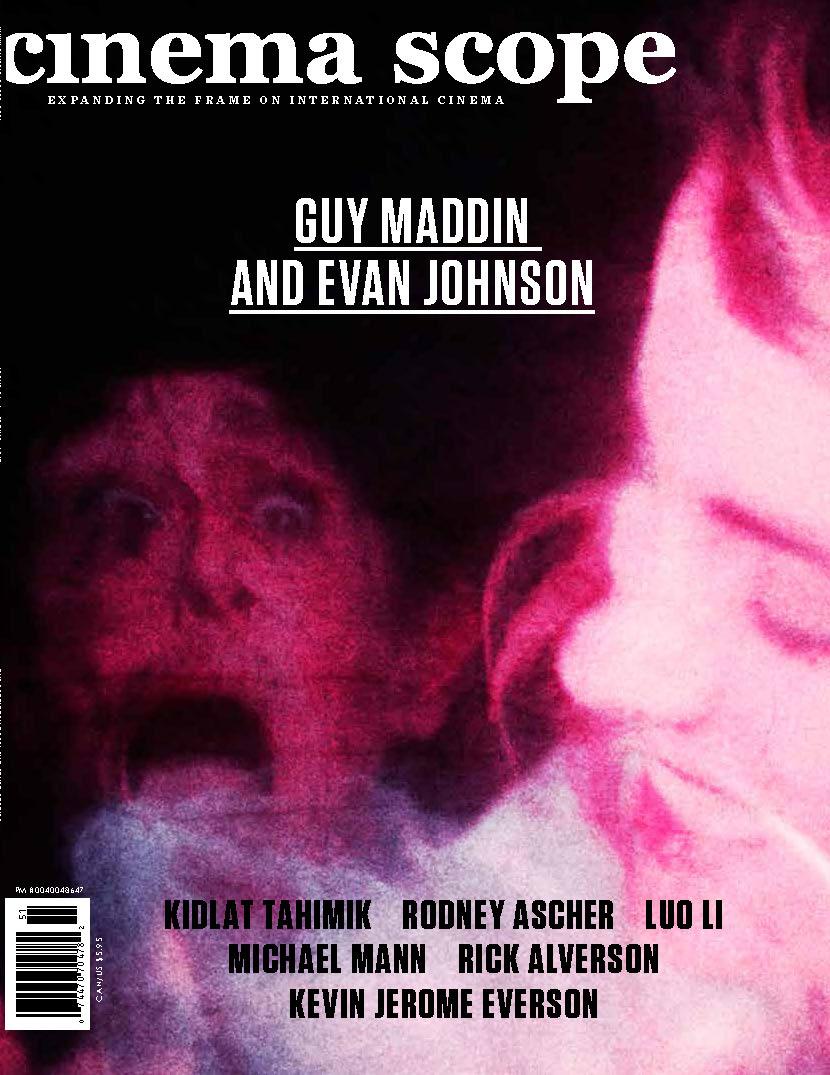
and what’s exciting in the world of DVD releases (Don’t Look Now, Sauve qui peut (la vie)) and film book publishing. Guy Maddin and Evan Johnson’s The Forbidden Room gets the cover, and
in Mark Peranson’s introduction to his interview with them he describes it as,
“With few points of comparison, it stands as a proposition for what cinema is
right now and what it can be, a fully digital work that resembles some (mostly)
imaginary past as processed through the human mind and machine software – like
sands in an hourglass, these are the days of our lives.” Andrew Tracy, in his
characteristic way, analyzes the cult of personality around Michael Mann and
problematizes Blackhat. The Mubi guys Adam Cook and Daniel Kasman
interview Kidlat Tahimik for Balikbayan
#1 Memories of Overdelopment Redux II. Blake Williams writes about his
recent experience in Park City, “In fact, against all odds, with over a third of the
works I saw on my trip meeting the minimum requirements of being “good,” the
overall quality of the films in Sundance 2015 was, even shockingly, tolerable.”
My only concern is his description of the new Ross Brothers picture, Western, as “the only film to genuinely disappoint… I’m chalking
this one up to a belabored post-production marathon rather than a creative
regression.” Well I was really looking forward to it! And Sean Rogers continues to bring his comic-book sensibility to the magazine: after an interview with
Blutch, a look at its aesthetic in the films of Alain Resnais,
he now reviews the new Criterion Designs.
And this is among many other equally interesting articles.
The upcoming
spring festivals in Toronto have their own anticipatory pieces:
Michael Sicinski reviews Kevin Jerome Everson’s Park Lanes and Shelly Kraicer discusses Luo Li’s Li Wen at East Lake which are both playing at Images. And Adam
Nayman interviews Rodney Ascher for The
Nightmare and Williams brings up Western,
which both will be playing at Hot Docs.
Cinema Scope continues to provide an excellent window into contemporary film culture by isolating what's really
exciting about it.
Monday, December 22, 2014
Cinema Scope
As I said in my Wild review: the old way of doing
things is over, and in place there has to be the creation of a new world. It’s
2014 and it would be delusional to think that humanity can keep going the same
way as it has done in the past. The world isn’t a pretty place. For a key image
of this - cinema's uncertain fate, environmental destruction - an example comes from Mark Peranson’s Editor’s Note in the new Cinema Scope, of Jessica Chastain,
anticipating the planet’s destruction, stuck in a shot from Interstellar, which was 'paused' in the
middle of the film.
But what to do? For
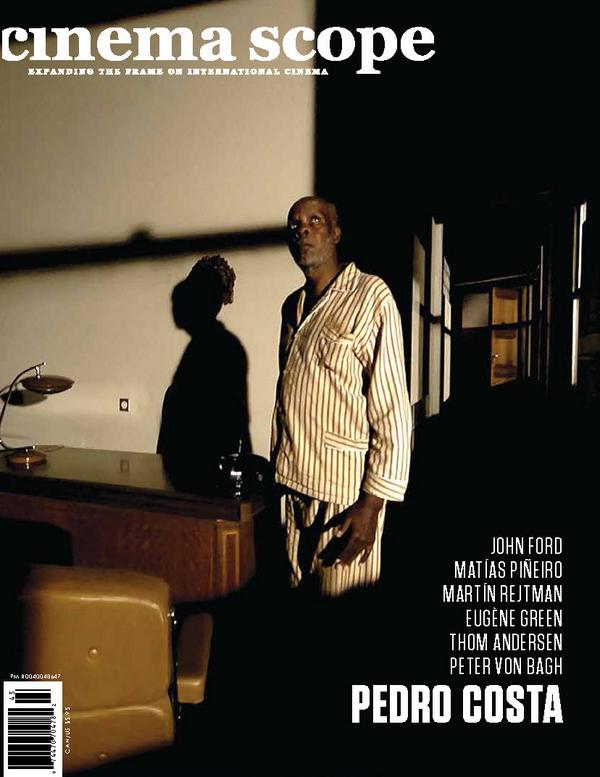
filmmakers there’s Pedro Costa that leads by example. In Horse Money Costa remains loyal to the now old and sick Ventura,
a Cape Verdean immigrant, and the disappearing Fountainhas neighborhood as
Lisbon, and the world, continue onward towards its terminal state in the name
of Capitalism and ‘progress’.
And for film
criticism? Attempt relevancy, be open to new forms, and explore new territory.
In the new Cinema Scope (N.61), and
in every one of their issues, they propose one of the best indicators of what’s
exciting in contemporary cinema. And, if some of these films haven’t yet been
released, it’s for the sake of helping raise awareness about them and to get them a distribution. For example, the
new featured film on its cover is Christian Petzold’s Phoenix (which is written about by Adam Nayman) and is distributed by Filmswelike. So hopefully by highlighting it would raise more awareness about it and increase its eventual theatrical attendance. And in the
magazine each film review (well they’re actually more like essays) propose a
unique approach to understanding cinema, a director, and film history. For examples
in the new issue: Andrew Tracy examines Olivier Assayas's work in genre, Blake
Williams looks at Paul Thomas Anderson’s artistic progression and relation to Robert
Altman, and Jordan Cronk highlights the new Sensory Ethnography Lab film The Iron Ministry. There’s also a
social aspect to the magazine. Cinema
Scope is like a password to bond certain cinephiles and film studies
students; and is the starting point of many serious film discussions. Its
dedicated readership wants to meet its film critics and participate in this
conversation (luckily many of them are on Twitter).
Pedro Costa might have said in his Horse Money interview (N.60) that Cinema Scope might not have a home, but its cast is international, and if these individuals might be alone, they quickly form allegiances, to fight for an idea.
Wednesday, September 3, 2014
Monday, July 14, 2014
Declarations of Independence
" I can say this, and I want to keep this all focused on generalities that appeal to all readers of Cinema Scope and not just those trying to navigate breaking out of the American independent film box, is that everybody I’ve met, spoken with, hung out with at festivals all over the world has the same exact problems. Filmmakers who have premiered their films at Cannes say they can’t get enough money. Legends and heroes of mine can’t get financing for their dream projects. So when us Americans romanticize this European mold of “the state finances films” I want to remember my conversations with amazing international filmmakers who have the same “they don’t want me” problems from time to time, no matter how many logos their films have."
A must-read! A Conversation Between Alex Ross Perry and Joel Potrykus in the new summer issue of Cinema Scope.
Wednesday, June 25, 2014
Monday, March 31, 2014
Wednesday, December 25, 2013
New Cinema Scope
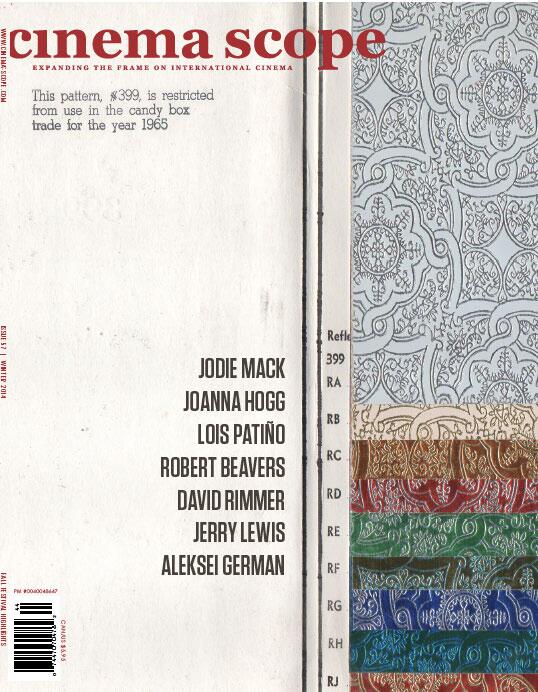
It's that time of year again when Cinema Scope puts out their new winter issue. Just from the looks of the director's listed on the cover, and what I know, the issue will feature essays on Jodie Mack, Joanna Hogg, Lois Patiño, Robert Beavers, David Rimmer, Jerry Lewis, Aleksei German, the Coen brothers and Philippe Garrel. In it you can expect high quality film criticism from an array of writers from Toronto and abroad on a variety of films that are expanding the frame on international cinema. From the looks of its beautiful Jodie Mack cover the issue will heavily feature experimental filmmakers. The new issue should be available for purchase in the next couple of weeks or better yet you can have it delivered to your house if you get a subscription!
Tuesday, September 24, 2013
Unfuckable: Waiting for Sancho, La última película
Waiting for Sancho
is the making of Albert Serra’s Birdsong.
It’s comprised of footage from the set, the cast in preparation to be filmed,
and thoughts from the director. The documentary by Mark Peranson shows the
amount of work that goes into the making of a small-scale independent film.
Peranson, who has a small role in Birdsong,
has a privileged position within the crew, and his personal footage attest to
this friendly relationship. By making this documentary he’s emphasizing the
importance and value of this kind of radical filmmaking, which is a world away
from the norms of commercial Hollywood storytelling, and it also provides
first-hand access to the artistic ambitions of its director.
A great counter-example to these claims is La última película, which recent premiere in 35mm is one of this year's important film events. La última película affirms cinema's capabilities to reinvent itself. It's directors are worth mentioning: the lauded Filipino auteur Raya Martin and the Canadian film-critic turned filmmaker Mark Peranson. What they create reflects a mixture of their two individual styles (more on this below) and its a brilliant piece of alchemy. It's an ode to film that simultaneously burns the last film strips. It's shot with a variety of film stocks that in a way calls attention to itself.
The film is a hybrid of both Martin and Peranson’s filming styles. There are some similarities between La última película and Martin’s Buenas noches, España, which in a experimental register, with shifting film stock and industrial music, a young couple go off on a road trip, where they experience some really intimidate moments, as they go deeper into nature and visit some local tourist sights. The Peranson qualities come across by the film-within-the-film's director who speaks at length about his lofty aims (though presented in a self-critical register), and the making-of quality of La última película that recalls Waiting for Sancho.
This making-of quality of La última película is important because now with it contemporary festival cinema has its Singin' in the Rain. Just like how in Cinema Scope they publish great director interviews, which are lengthy conversations about the filmmaking process, now with La última película this rarely shown aspect of filmmaking has returned into the construction of the film, which is in some ways similar to what Singin' in the Rain did by bringing a reflexivity to its presentation of cinema's transition to the talkies.
In Phil Coldiron’s review of La última película, The End of Cinema (Cinema Scope N.56) he speaks about the kinds of films that the free-form of La última película is reacting against,
Waiting for Sancho is,
in some ways, similar to other ambitious making-of documentaries like Chris
Marker’s A.K., Les Blank’s Burden of Dreams, and Keith Fulton and
Louis Pepe’s Lost in La Mancha. The
Los Angeles film critic Robert Koehler suggested at the recent MDFF screening
of Waiting for Sancho that it would
be an apt centerpiece to any potential “making-of” film festivals.
But Waiting for
Sancho is different than these other films. In these other making-of documentaries, one
gets the impression that their whole raison
d'être is the problems that arise on the sets and to see familiar directors
trying to overcome them. As well, since these documentaries are not created in
the publicity mold, their third-party perspective usually offer an implicit
critique of these megalomaniac projects and the hubris of the directors and the
industry that sustains them.
How is Waiting for Sancho different? First off: it’s very funny. What makes
it stand out are the eccentric personalities of the actors and how they all get
along with each other, along with the larger-than-life personality of its
director Albert Serra.
Waiting for Sancho
is more like a Serra film with its focus on characters and their gestures. There
isn’t the typical over-exposition that one might find elsewhere. The cast and
crew are just there, and Waiting for Sancho
attests to this egalitarian spirit. This emphasis on the people and gestures can
be illustrated by a quote from Serra about his most recent film Story of my Death,
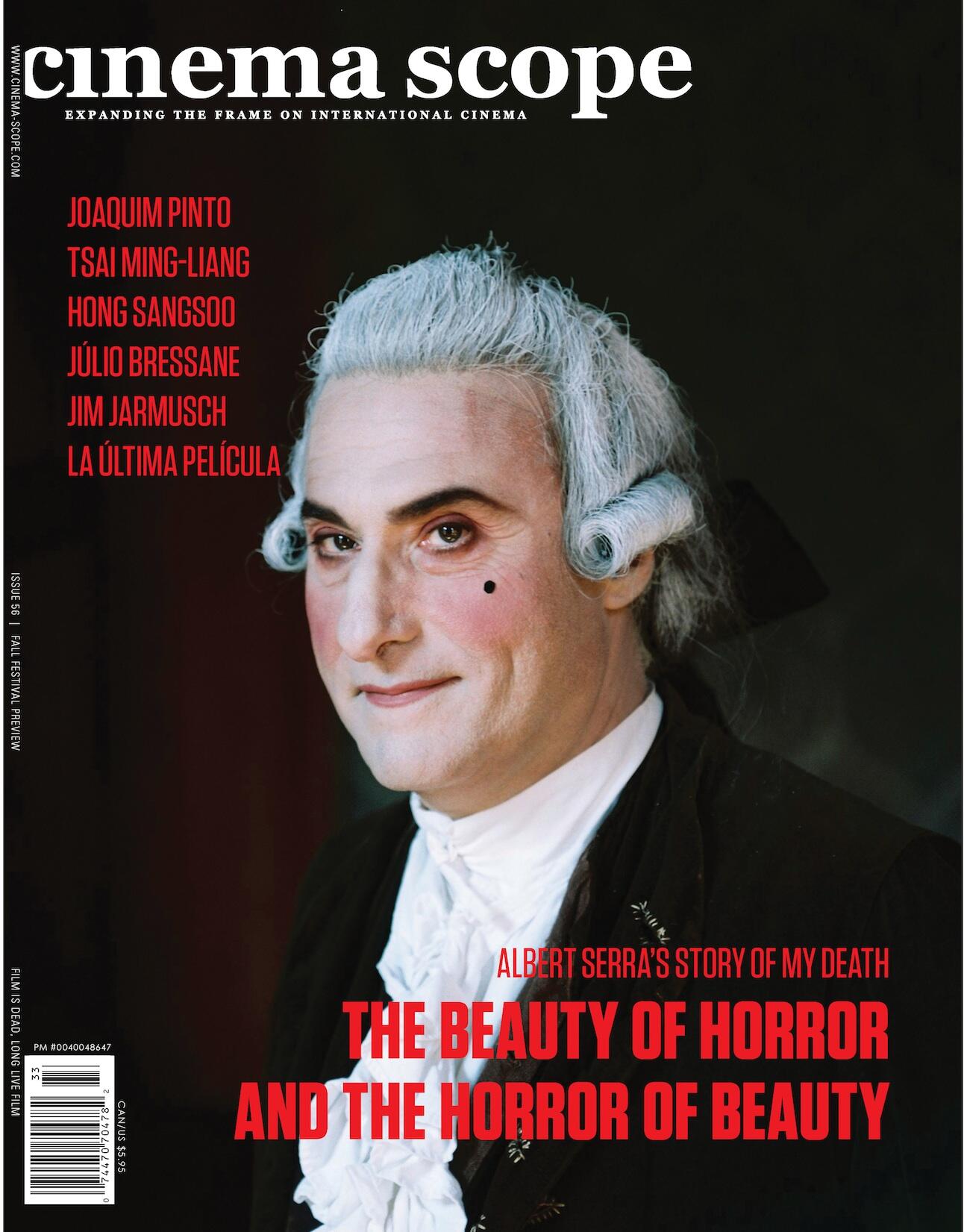
“It was simply easier for me to work with historical and literary figures … so I could focus on atmosphere, on details, on things I love better than just showing the plot or trying to give information about the characters. With these characters you have more or less all the information and, well, then I can do whatever I want, I am free and I don’t care about being more or less faithful to the original source or character that comes from literature or history.” (The Beauty of Horror and the Horror of Beauty, Cinema Scope N.56).
But Waiting for Sancho is different then Serra’s films. In
Serra’s cinema the framing is incredibly precise and, like with Bresson, he
aims to get at the essential of the characters. The settings that Serra films, whether it is a forest, desert or castle; becomes a sparse canvas for
this essential of the characters to
emerge out of and for them to react against. The historical specificity of Serra’s
films, which evolves with each new film, are also really unique as they provide a
context for the character’s spiritual crisis as well as they provide a unique and
captivating “look” in regards to the film’s costume and production design.
All of this to say that it is really interesting to see how
Serra brings all of these filmmaking elements together in Waiting for Sancho.
The digital image of Peranson’s hand-held video frames the
cast in long shots, which emphasizes the scale of the filmmaking. As well Waiting
for Sancho is in color and uses natural sounds which differs from the black
and white cinematography and non-diegetic sounds of Birdsong. This access to the original location provides a better
understanding of the final film’s artistic manipulations. The regular casting of Serra’s
friends Lluis Carbo, Lluis Serrat Masanellas, and Lluis Serrat Batlle provide Waiting for Sancho with its primary
subjects: they are all great together, and continue, though in a different
register, the dynamics that they have in Birdsong
and Serra’s other films. There is something intrinsically interesting about these
guys being together, and watching them respond to the world around them, brings
to mind what makes Serra’s films so interesting: life, people and the world
itself.
***
The filmmaker in La última película
is played by
Alex Ross Perry, who at times recalls the sarcastic Paul Rudd (Role Models), and his
accompanying guide is played by Gabino Rodríguez, the lead of Nicolás Pereda's
films. In it the filmmaker goes to Yucatán, Mexico to make the last film on film-stock, and he suggests that it might be the last film ever made since the Mayan apocalypse is around the corner.
Isn't this a beautiful and romantic prospect? To finish everything off with this one last gesture: to give back to cinema everything that it has ever meant: pleasure, humor, melancholy, friendship, beauty, violence. This epic finale is symbolically similar to Pynchon’s Gravity’s Rainbow, where Tyrone Slothrop is in a movie theater waiting for the world to end, and Tarantino's Inglourious Basterds, where the destruction of film stock in a movie theater can rid history of Hitler.
La última película is ostensibly a remake of the Dennis Hopper’s The Last Movie with hints of that film's making-of, The American Dreamer. But similarities to other films come to mind: Godard’s Contempt, Rivette’s Celine and Julie Go Boating (two films by other film-critics turned filmmakers) and iMDb lists many other possible movie connections. La última película is similar to Contempt as they are both about a director abroad who is trying to make, what seems to be, an unrealizable film; and it’s similar to Celine and Julie for its use of self-referential and distancing effects. But these effects aren't necessarily Brechtian as much as they call into question ideas of medium specificity, narrative illusion, and the creative impetus.
The Adieu 35 issue of Cahiers (N.672) announced that the digital revolution is over. What more does the future of cinema have to give us? Is film going to become solely a historical artifact in a world of digital cinema projections? What's going to happen to the production and distribution platforms which even has Spielberg confused? Has Carax given cinema its last breath with Holy Motors?
Isn't this a beautiful and romantic prospect? To finish everything off with this one last gesture: to give back to cinema everything that it has ever meant: pleasure, humor, melancholy, friendship, beauty, violence. This epic finale is symbolically similar to Pynchon’s Gravity’s Rainbow, where Tyrone Slothrop is in a movie theater waiting for the world to end, and Tarantino's Inglourious Basterds, where the destruction of film stock in a movie theater can rid history of Hitler.
La última película is ostensibly a remake of the Dennis Hopper’s The Last Movie with hints of that film's making-of, The American Dreamer. But similarities to other films come to mind: Godard’s Contempt, Rivette’s Celine and Julie Go Boating (two films by other film-critics turned filmmakers) and iMDb lists many other possible movie connections. La última película is similar to Contempt as they are both about a director abroad who is trying to make, what seems to be, an unrealizable film; and it’s similar to Celine and Julie for its use of self-referential and distancing effects. But these effects aren't necessarily Brechtian as much as they call into question ideas of medium specificity, narrative illusion, and the creative impetus.
The Adieu 35 issue of Cahiers (N.672) announced that the digital revolution is over. What more does the future of cinema have to give us? Is film going to become solely a historical artifact in a world of digital cinema projections? What's going to happen to the production and distribution platforms which even has Spielberg confused? Has Carax given cinema its last breath with Holy Motors?
A great counter-example to these claims is La última película, which recent premiere in 35mm is one of this year's important film events. La última película affirms cinema's capabilities to reinvent itself. It's directors are worth mentioning: the lauded Filipino auteur Raya Martin and the Canadian film-critic turned filmmaker Mark Peranson. What they create reflects a mixture of their two individual styles (more on this below) and its a brilliant piece of alchemy. It's an ode to film that simultaneously burns the last film strips. It's shot with a variety of film stocks that in a way calls attention to itself.
The film is a hybrid of both Martin and Peranson’s filming styles. There are some similarities between La última película and Martin’s Buenas noches, España, which in a experimental register, with shifting film stock and industrial music, a young couple go off on a road trip, where they experience some really intimidate moments, as they go deeper into nature and visit some local tourist sights. The Peranson qualities come across by the film-within-the-film's director who speaks at length about his lofty aims (though presented in a self-critical register), and the making-of quality of La última película that recalls Waiting for Sancho.
This making-of quality of La última película is important because now with it contemporary festival cinema has its Singin' in the Rain. Just like how in Cinema Scope they publish great director interviews, which are lengthy conversations about the filmmaking process, now with La última película this rarely shown aspect of filmmaking has returned into the construction of the film, which is in some ways similar to what Singin' in the Rain did by bringing a reflexivity to its presentation of cinema's transition to the talkies.
In Phil Coldiron’s review of La última película, The End of Cinema (Cinema Scope N.56) he speaks about the kinds of films that the free-form of La última película is reacting against,
“World cinema today finds itself in much the same place: films must dress up their culture of origin in the same ways that will most appeal to the cultural elite who make up film festival selection committees and audiences, a situation which has hardened into a set of rules that are every bit as dogmatic as those kept in place to ensure Hollywood blockbuster turn appropriate profits on their nine-figure investments.”
Olivier Père in his review of La última película also elaborates on the aesthetic rewards of these Cinema Scope films (my translation),
“Those that lament about the death of cinema, decry its rigid formatting and lack of audacity and freedom, ignore or refuse to see the films and the methods of Miguel Gomes, Albert Serra and Lisandro Alonso and a few other young cinéastes who for them the cinema is a collective experience that is vivifying and intrepid. Mark Peranson knows this. In his role as a film critic he has followed and brilliantly commented upon this fringe «jeune, pure et dure» of the cinema for these last ten years in his magazine Cinema Scope, which is actually the best one in the world. It's a sign-post for the creation and defense of these of new cinematographic forms."
Since Peranson’s Cinema Scope editorials are usually critical of current practices
around cinema, it is a breath of fresh air to see how in the newest issue, Film
is Dead, Long Live Film (N.56), it includes solely three screen grabs of La última película. It is a beautiful, passionate and modest gift to the world of
cinephilia.
Sunday, September 22, 2013
Friday, September 6, 2013
Waiting for Sancho at The Coffin Factory (Friday, September 6)
In anticipation for Raya Martin and Mark Peranson's La última película, on Friday September 6th at 9:45pm MDFF is presenting at The Coffin Factory a special screening of Peranson's Waiting for Sancho, a making-of documentary of Albert Serra's Birdsong (who also has a new film, Story of my Death). And while you are it, to read while you are waiting in lines, might as well pick up the great new issue of Cinema Scope!
Tuesday, May 11, 2010
CinemaScopic
Cinema Scope and Film Criticism
It is rewarding, personally and for film culture, to compare Mark Peranson’s editor’s note in Cinema Scope issue 42 with Positif’s March 2010 editor’s note. In Positif’s, Franck Kausch pits Positif’s decade review list against the one by Cahiers du Cinéma and Film Comment while Cinema Scope opposes specifically me, David Davi(d)son from Ottawa, Ontario. This acknowledgment re-emphasizes Cinema Scope’s interest in film culture esoterica and it expresses the generous personality behind the magazine that is willing to extend itself to mention one of its keen readers. This interest in the esoteric is demonstrated anew with each issue with its up-to-date content that brings to attention upcoming trends on obscurantist art films that do not get enough coverage in mainstream press.

Cinema Scope’s strategy is simple: to have an in depth analysis on relevant filmmakers and global cinéphilia while effusing a frontal attack on world cinema’s fraudulent and pundit attachés who easily fall prey to journalistic shorthand’s. Their eclectic film reviews are a formation in the avant-garde, artistic, intellectual, humanistic, and political cinema of the present day. Cinema Scope’s championing of these films has to do with their quality not their cultural presence, which is something that is usually based on “apparent” mainstream importance (i.e. advertising budgets), which is accentuated by a megaplex cultural conformism. In a Hollywood driven North American film-industry market, economic privilege, for Cinema Scope, is usually a factor to negate a film. Mr. Peranson describes his position in Cinema Scope (N.06) “Being contrarian – never a be all and end all – means giving more slack and more coverage to alternatives to multiplex fare.” Unlike other contrarians like, lets say, Armond White or Pauline Kael, you can actually agree with the films and filmmakers Cinema Scope champions as they provide an overview and insight on exciting world-cinema that otherwise might be overlooked.


Some of Cinema Scope’s preferred directors include: James Benning, Jia Zhangke, Pedro Costa, Guy Maddin, Corneliu Porumboiu, Apichatpong Weerasethakul et al. These filmmakers are not too common in mainstream Canadian-American press, which leads to Cinema Scope’s side-taking of the position of you-don’t-like-us-and-we-don’t-like-you. Their feuds can get pretty nasty and their tone certainly aggressive. Cinema Scope’s use of polemics and attacking the exterior is worth saluting as their contrarian stance and rivalry choices have a cathartic quality.
The magazine’s interviews with directors showcase a convergence of the technical, personal and social aspect of films; and the film reviews come from the film festival circuit, which includes Cannes, Toronto, Vancouver, Venice, Sundance, Rotterdam, and Berlin. This immediacy, fresh from the festival screens, is maintained by a critical analysis - something that is usually missing in the writing of rushed bloggers. The magazines book reviews can lead to interesting spinoff readings, while the documentation of installation art provides a better perspective of the visual context surrounding innovation with sights and sounds.

There are similarities between the wide-screen anamorphic process CinemaScope and the magazine Cinema Scope. The CinemaScope process arose from Hollywood’s search in the early 50s for a product to counter the threat of television, which it did with its two and a half times wider image (an aspect ratio of 2.35:1). This is similar to the magazine’s subtitle “expanding the frame on international cinema.” The first film made with CinemaScope, Henry Koster’s biblical epic The Robe (1953) expressionistically utilizes the new medium, with similarities to the approach of the magazine Cinema Scope, that includes attentiveness to fine detail, an attuned sense of art history, innovation, context, politics, role in cult-cinéphilia, (techni)color, and the ability to spread people apart.
Cinema Scope tries to answer the Bazinien question of “Qu'est-ce que le cinema?” which André Bazin’s talks about categorically: ontology and language, an art form distinguished amongst others, sociological, and a realist aesthetic. In a global film culture, Cinema Scope projects itself as a cinema and the reviewers are actors in its flickering. It creates an unseen cinema in the mind, that is imagined through its readers image-reservoir; a cinema of amour fou. The reviewed films become real through their description and analysis. These films present alternative narratives while simultaneously providing a means to explore and understand another culture.


In the “Decade in Review” issue (N.42) the centerpiece is a panoptic address on cinema in the first decade of the third millennium. The word “cinema” is derived from the Greek word for movement and it is the ancient Greek mathematician Ptolemy who invented the precursor apparatus that would latter me referred to as the Zoetrope; the cylinder with related pictures that during rotation gives the impression of succession. The moving-pictures have gone a long way since Edward Muybridge’s series on racehorses and it now shows itself to be ever changing within an international context in a period of new possibilities with new technologies like 3D films, performance capture, digital, and celluloid; and mutating methods of production, filming and distribution.
Alongside Other Film Editorials
The Toronto-based international film quarterly Cinema Scope is ahead of most trends relative to other well-worth reading film criticism editorials that include Positif, Cahiers du Cinéma, 24 Images, Film Comment, Sight & Sound, Cineaste, and Film Quarterly. Cinema Scope is also readily accessible as the magazine can be easily found at local (upscale) newsstands unlike other film-criticism rarities like Trafic, Video Watchdog or Framework. A lot of these magazines share the same writers and there is a charm to follow their idiosyncratic taste. Cinema Scope has an underdog quality as it is a relatively new publication and its contrarian stance reacts, though sometimes builds upon, the tastes of these other magazines.

The French magazines Cahiers du Cinéma and Positif usually review the more interesting foreign films before the English language magazines. This is partly due to distribution, as their headquarters in Paris - the “unofficial” film capital of the world – receives these films earlier then their North American counter parts. Cinema Scope’s content competes with their proficiency while being more accessible to a western hemisphere audience, due to the fact that it is an English publication.
Canadian Cinéphilia
Cinema Scope has a tendency towards a nationalist Canadian cinema with reviews of the Can-Con and the Can-Cult, and content varying like the Toronto Images Festival and Montreal’s social-documentarist Donigan Cumming. This is done without falling prey to isolationism unlike many of the other Canadian film criticism magazines. Some of the strongest vocationers for Canadian cinema can be found within Cinema Scope’s archives and it should be considered among other Canadian film publications like CineAction (which was co-founded by Robin Wood) as well alongside Canadian film book-publishers like TIFF, University of Toronto Press, Canadian Film Institute, and Caboose Books.


The moving images - particularly the newsreel and the documentary - are part of a long tradition in Canadian identity that goes back to the National Film Board’s (NFB) inception by John Grierson in 1938. A running theme of Canadian national cinema is its citizen’s sense of identification with its country, made even more eclectic by the diversity of its ingrained multiculturalism. Cinema Scope extends the notion of film as part of Canadian identity by positing that cinéphilia is part of the Canadian experience. This idiosyncratic cinéphilia is part of a tradition, I think, of an unleashed cinéphilic repression caused by an isolating landscape - that consists of ten provinces and three territories - which for approximately four months leads to hibernation due to the snow and coldness. This sense of hibernation – which itself is similar to the film-going experience – is accompanied by extraneous free time which accentuates these outlier cinéphiles.
Though an easy word to throw around, what exactly is a cinéphile, the implications of classifying oneself as such, and its relevance? The suffix –phile specifies an attraction to something, and cine being an abbreviation for cinema. It implies a holistic passion for film and its relevance arriving from a threefold illumination: (1) a source of pleasure, (2) psychological development (akin to Jacques Lacan’s mirror phase), and (3) in its political quality in portraying subtleties and viable social options.

The omnivorous-cinephile’s scopophilia - Freud’s psychoanalytic term for those that take a general pleasure in looking – accentuates the viewing of the esoteric, which includes, lets say, 1920s Italian diva films, the somber world of Robert Bresson or the soft-core erotic Emmanuelle series. I would classify Mr. Peranson into this category alongside other idionsyncratic Canadian cinephiles including the Winnipeg-based prairie fabulist Guy Maddin, who appropriates a silent-film syntax and whose experiences and thoughts are so anxiously and passionately confessed in his book “From the Atelier Tovar: Selected Writings”; James Quandt, the senior programmer at the TIFF Cinematheque, who is from a village in northern Saskatchewan where he grew up with no television; and Lee Demarbre who grew up outside of Ottawa and as a youth went to New York City to see exploitation films; his professional history in Ottawa includes filmmaking, running a film radio-talk show Drunken Master Revue on CKCU-FM on Wednesday evenings, and he has worked at the repertories Bytowne Cinema, the CFI and is currently the programmer at the Mayfair Theater.
Cinema Scope’s History
Cinema Scope’s history starts with its venturesome chief-editor and publisher Mark Peranson creating the film-review periodical as a zine in 1999 – the first issue consisted of over 100 reviews of films from the 1999 Toronto International Film Festival. As Mike White writes “It boasted reviews of nearly all of the entries to the Toronto International Film Festival and proved to be among the most valuable possessions of folks attending the fest that were lucky enough to score a copy.” The magazine headquarters initially begun in Vancouver and then later moved to Toronto. The format of the magazine has not changed too much (at least since the 6th issue, the earliest one I have encountered) and the small noticeable change is in the title, as earlier magazines were entitled cinéma scope (with an é and the o is flanned between two lines). Other then that Cinema Scope’s proportions have remained consistent. Jonathan Rosenbaum’s indispensable Global Discoveries on DVD must have been added somewhere between the 6th and the 21st issue. And the invaluable website - that had major renovations in the last year - provides a wonderful database of archival features, spotlights, columns, and currency and is interweaved with facilitating keys to share pages on Facebook and Twitter.


Cinema Scope’s film critics present tastes and choices with an absolute enthusiasm, brilliance, provocation, and erudition. It is a breath of fresh air to read they’re blending of research, intelligent journalism and criticisms - and there are many of them - especially in an oversaturated journo-advertising industry. Some note worthy Cinema Scope forum colleagues and contributors include film critics Tom Charity, Jason Anderson, Robert Koehler, Scott Foundas, Andréa Picard, Christoph Huber, Andrew Tracy, Michael Sicinski (though his review of Philip Hoffman’s All Fall Down is unfair; Phil’s independent imaging retreat “Film Farm” in Mount Forest, ON is a considerable force in grassroots Canadian experimental cinema), Olaf Möller, Jonathan Rosenbaum, Quintín, Geof Pevere, Kent Jones, Liam Lacey, Jerry White, James Quandt, Noel Vera, Don McKellar, James Benning, Richard Porton, Adam Nayman, David Walsh, Tom McSorley, Serge Daney, and David Borwell.


On Cinema Scope’s Editor Mark Peranson
Cinema Scope’s publisher Mr. Peranson’s - born in Canada in 1968 - career history includes being an industrious film critic (e.g., The Believer, Moving Image Source, Film Reference Library), director of the film Waiting for Sansho (2008), actor in Albert Serra’s Birdsong (2008), writer on the Canadian TV series “On Screen” (2005), and worked as the programming and promotions associate for the Vancouver International Film Festival. Mr. Peranson’s Waiting for Sancho is about Albert Serra’s filmmaking process during the shooting of Birdsong. Mr. Peranson himself stars in Birdsong as the Hebrew-speaking Joseph, Jesus’s Father, from the tale of the Journey of the Magai. Mr. Peranson is insightful about Birdsong when he highlights in Cahiers du Cinéma’s (N.634) the films use of varying ethnicity, religion and dialects; and when he cites Albert Serra from a Catalan television interview that Birdsong consist of “filming people that I like, the ways that they move, their gestures, and the way they talk” a comment Mr. Peranson appropriates as also a definition of the essence of cinema.
Mr. Peranson’s editors notes includes social-politics as he provides his support to director and program manager Quintín and Flavia de la Fuente of the Buenos Aires International Film Festival against getting fired by government bureaucrats, he stood behind Barack Obama in the 2009 American presidential elections, and he wrote a heart-felt eulogy for Alexis Tioseco and Nika Bohic after their brutal murders.
Mr. Peranson’s writing is characterized by a joyful cynicism (similar to his defense of David Wain’s Role Models (2008) in his analysis of a film of 00’s) and is a pleasure to read. Hi shake-ups are equivocal to François Truffaut’s early Cahier du Cinéma’s polemic “Une certaine tendence du cinéma francais” (1954). Mr. Peranson’s dismissive comments like “Cannes 2005 appeared as if Thierry Frémaux and string-puller Gilles Jacob were assembling a loosely organized community college Intro to Cinema 101 class,” or “”you know, Loach-Almodovar-Campion-Giannoli-Ang Lee middlebrow, to which I now feel secure in adding the name of Michael Haneke” are refreshing to hear as they are an expression of an uncompromising dedication to a particular type of cult-art cinema as well it extends the magazines reputation of enraging and educating eager cinéphiles on opposing views.

To Conclude
Mr. Peranson’s iconoclastic Cannes reviews are one of the quarterly publications highlights. In them, Mr. Peranson rebels against the mistrials in the international film community, sometimes with a dogged humorous undercurrent other times with a disappointed moodiness. Mr. Peranson writes in the 25th issue “The one thing that connects all the issues of Cinema Scope together is a focus on films that are overlooked, undeservedly—those films that fall through the cracks.” It is always a pleasure to catch up with the films written about in Cinema Scope when they arrive in theaters or on DVD as they reveal surprises and unsuspected discoveries waiting ahead.
Cinema Scope is a fruitful magazine, ten years ago Mr. Peranson wrote, “The longer one is involved in this industry – and by comparison, I’m pretty much a child actor – the harder it is to avoid becoming jaded and/or cynical.” Mr. Peranson might be sometimes cynical but it is with resiliency and enthusiasm. Cinema Scope is now a carrying symbol of cinéphilia and with its unchangeable unruly taste it contributes to an increased scope and discourse on a transnational film culture to the benefit of film enthusiasts everywhere.
*****

My Introduction to Cinema Scope
In the latest issue of Cinema Scope “Decade in Review” Mr. Peranson mentions me, David Davidson, in regards to “editorial compromises of the greatest films of the last decade.” In the previous issue (N. 41) Mr. Peranson writes “Perhaps an outpouring of support from the readership will sway things one way or the other, but I’m not holding my breath on that one either.” After reading that I emailed Mr. Peranson with my support and I attached my own list. The title of that post is now, and has been for a while, “great films of the last decade”, and the inclusion of the word “greatest” – an overgeneralization and an unproductive concept - was a typo that I shortly changed at the time. Either way, let me be clear, I am honored to be mentioned in Cinema Scope. Thank you Mark. I did not think my personal list would get much attention. My great film of the 00’s list, which could be found here, is basically a reiteration of what a lot of other critics have been saying – that the decade is a reflection of the zeitgeist – except for a few highlights of mainstream Canadian filmmakers (e.g., Maddin, Egoyan, Kunuk) that were not mentioned other places.


I picked up my first copy of Cinema Scope in Berlin’s central station Hauptbahnhof at a magazine store by the railway. I was on my way to Vienna, Austria on a 6 hour train ride. It was entirely by coincidence that I found Cinema Scope, I also picked up The New Yorker and the French Premiere. At the time I just finished reading Thomas Pynchon’s behemoth Gravity’s Rainbow and it was an appropriate book to anticipate finding Cinema Scope, as personally, I was sharing the book’s German setting, and Cinema Scope’s “Cannes 2009 Bloody Hell” issue was very unconventional, similarly to Gravity’s Rainbow protagonist Tyrone Slothrop, as the magazine seemed like a mixture between traditional film criticism, paranoia, pot, and encyclopedic trivia with articles like “A Weave of his Stories Rediscovering Vittorio Cottafavi” or “Contact High A Stoner’s Movie Journey from A to Z.”
On the train-ride, in an experience that made me think of the trip in Jim Jarmusch’s The Limits of Control [2008, (which the magazine reviews, and that I drove to Montreal to go see at the Cinéma du Parc)], reading the magazine made me well aware of the transcontinental context of “cinema” and where I stand within it as a bilingual Canadian somewhere between Germany and Austria. In my compartment there was a little girl making noise by banging on her toy piano as her elderly sun-burnt Teutonic parents were bickering in a language I could not understand.

In the Cannes spotlight Mr. Peranson highlighted Quentin Tarantino’s Inglorious Basterds (2009) focus on language and semantics. Inglorious Basterds, though, should really be discussed with it’s Nazi-occupied France French counterpart Robert Guédiguian’s The Army Of Crime (2009). Anyways, I saw Inglorious Basterds at the Hackesche Höfe filmtheater in Berlin and even though I thought the killing was morally ignoble there was something about the films use of multiple languages and dialects, especially in a foreign context, which resonated. In Inglorious Basterds when the actor spoke either German or Italian (except for Lt. Aldo Raine and his minions) I had very little or no idea of what was being said, emphasizing an un-American context and the films international market. This also happened in Berlin when I saw Jim Jarmusch’s Night on Earth (1991) at the Babylon Filmtheater, but at least there, luckily, I had a friend to translate some Italian, at least, when she was not laughing so hard with Roberto Benigni.
.jpg)
*****
Personal Background
I am twenty-two-year-old and I have been running Ottawa Film Review since 2008. My writing has definitely improved as I have started to mature and find my own voice. My tastes have been refined from reading film criticism collections and anthologies (e.g., Rosenbaum, Sarris, Godard, MacDonald, Agee, Farber, Britton) from the University of Ottawa Morisset Library and through mulling about films over beers with friend Scott Birdwise - the assistant programmer at the CFI and who also got me a part-time job there; dropping by Invisible Cinema to chat with Wyatt, and the participation on the threads at davekerh.com. This has lead to perspective taking and evolving views. I have had an omnivorous diet of videos, some purchased from the used DVD store Tuning Point (411 Cooper St), Tony Daye’s regrettably now-closed Sounds Unlikely (5 Arlington Avenue, the store that introduced me to films of the French-, and Iranian-New-Wave; Samuel Fuller and Michelangelo Antonioni), and bargain bins at chain music-video stores. I saw current releases and classic films projections at the Bytowne Cinema programmed by Bruce White, the new Mayfair Theater programmed by Lee Demarbre, and films at the Library and Achieves Canada programmed by the Tom McSorley from the CFI. And I have written for the student paper University of Ottawa’s Fulcrum Volume 69 Issue 24, 20, 9, and Volume 70 Issue 14, 19, 22, 23, 24, 25, 27.-David Davidson


It is rewarding, personally and for film culture, to compare Mark Peranson’s editor’s note in Cinema Scope issue 42 with Positif’s March 2010 editor’s note. In Positif’s, Franck Kausch pits Positif’s decade review list against the one by Cahiers du Cinéma and Film Comment while Cinema Scope opposes specifically me, David Davi(d)son from Ottawa, Ontario. This acknowledgment re-emphasizes Cinema Scope’s interest in film culture esoterica and it expresses the generous personality behind the magazine that is willing to extend itself to mention one of its keen readers. This interest in the esoteric is demonstrated anew with each issue with its up-to-date content that brings to attention upcoming trends on obscurantist art films that do not get enough coverage in mainstream press.

Cinema Scope’s strategy is simple: to have an in depth analysis on relevant filmmakers and global cinéphilia while effusing a frontal attack on world cinema’s fraudulent and pundit attachés who easily fall prey to journalistic shorthand’s. Their eclectic film reviews are a formation in the avant-garde, artistic, intellectual, humanistic, and political cinema of the present day. Cinema Scope’s championing of these films has to do with their quality not their cultural presence, which is something that is usually based on “apparent” mainstream importance (i.e. advertising budgets), which is accentuated by a megaplex cultural conformism. In a Hollywood driven North American film-industry market, economic privilege, for Cinema Scope, is usually a factor to negate a film. Mr. Peranson describes his position in Cinema Scope (N.06) “Being contrarian – never a be all and end all – means giving more slack and more coverage to alternatives to multiplex fare.” Unlike other contrarians like, lets say, Armond White or Pauline Kael, you can actually agree with the films and filmmakers Cinema Scope champions as they provide an overview and insight on exciting world-cinema that otherwise might be overlooked.


Some of Cinema Scope’s preferred directors include: James Benning, Jia Zhangke, Pedro Costa, Guy Maddin, Corneliu Porumboiu, Apichatpong Weerasethakul et al. These filmmakers are not too common in mainstream Canadian-American press, which leads to Cinema Scope’s side-taking of the position of you-don’t-like-us-and-we-don’t-like-you. Their feuds can get pretty nasty and their tone certainly aggressive. Cinema Scope’s use of polemics and attacking the exterior is worth saluting as their contrarian stance and rivalry choices have a cathartic quality.
The magazine’s interviews with directors showcase a convergence of the technical, personal and social aspect of films; and the film reviews come from the film festival circuit, which includes Cannes, Toronto, Vancouver, Venice, Sundance, Rotterdam, and Berlin. This immediacy, fresh from the festival screens, is maintained by a critical analysis - something that is usually missing in the writing of rushed bloggers. The magazines book reviews can lead to interesting spinoff readings, while the documentation of installation art provides a better perspective of the visual context surrounding innovation with sights and sounds.

There are similarities between the wide-screen anamorphic process CinemaScope and the magazine Cinema Scope. The CinemaScope process arose from Hollywood’s search in the early 50s for a product to counter the threat of television, which it did with its two and a half times wider image (an aspect ratio of 2.35:1). This is similar to the magazine’s subtitle “expanding the frame on international cinema.” The first film made with CinemaScope, Henry Koster’s biblical epic The Robe (1953) expressionistically utilizes the new medium, with similarities to the approach of the magazine Cinema Scope, that includes attentiveness to fine detail, an attuned sense of art history, innovation, context, politics, role in cult-cinéphilia, (techni)color, and the ability to spread people apart.
Cinema Scope tries to answer the Bazinien question of “Qu'est-ce que le cinema?” which André Bazin’s talks about categorically: ontology and language, an art form distinguished amongst others, sociological, and a realist aesthetic. In a global film culture, Cinema Scope projects itself as a cinema and the reviewers are actors in its flickering. It creates an unseen cinema in the mind, that is imagined through its readers image-reservoir; a cinema of amour fou. The reviewed films become real through their description and analysis. These films present alternative narratives while simultaneously providing a means to explore and understand another culture.


In the “Decade in Review” issue (N.42) the centerpiece is a panoptic address on cinema in the first decade of the third millennium. The word “cinema” is derived from the Greek word for movement and it is the ancient Greek mathematician Ptolemy who invented the precursor apparatus that would latter me referred to as the Zoetrope; the cylinder with related pictures that during rotation gives the impression of succession. The moving-pictures have gone a long way since Edward Muybridge’s series on racehorses and it now shows itself to be ever changing within an international context in a period of new possibilities with new technologies like 3D films, performance capture, digital, and celluloid; and mutating methods of production, filming and distribution.
Alongside Other Film Editorials
The Toronto-based international film quarterly Cinema Scope is ahead of most trends relative to other well-worth reading film criticism editorials that include Positif, Cahiers du Cinéma, 24 Images, Film Comment, Sight & Sound, Cineaste, and Film Quarterly. Cinema Scope is also readily accessible as the magazine can be easily found at local (upscale) newsstands unlike other film-criticism rarities like Trafic, Video Watchdog or Framework. A lot of these magazines share the same writers and there is a charm to follow their idiosyncratic taste. Cinema Scope has an underdog quality as it is a relatively new publication and its contrarian stance reacts, though sometimes builds upon, the tastes of these other magazines.

The French magazines Cahiers du Cinéma and Positif usually review the more interesting foreign films before the English language magazines. This is partly due to distribution, as their headquarters in Paris - the “unofficial” film capital of the world – receives these films earlier then their North American counter parts. Cinema Scope’s content competes with their proficiency while being more accessible to a western hemisphere audience, due to the fact that it is an English publication.
Canadian Cinéphilia
Cinema Scope has a tendency towards a nationalist Canadian cinema with reviews of the Can-Con and the Can-Cult, and content varying like the Toronto Images Festival and Montreal’s social-documentarist Donigan Cumming. This is done without falling prey to isolationism unlike many of the other Canadian film criticism magazines. Some of the strongest vocationers for Canadian cinema can be found within Cinema Scope’s archives and it should be considered among other Canadian film publications like CineAction (which was co-founded by Robin Wood) as well alongside Canadian film book-publishers like TIFF, University of Toronto Press, Canadian Film Institute, and Caboose Books.


The moving images - particularly the newsreel and the documentary - are part of a long tradition in Canadian identity that goes back to the National Film Board’s (NFB) inception by John Grierson in 1938. A running theme of Canadian national cinema is its citizen’s sense of identification with its country, made even more eclectic by the diversity of its ingrained multiculturalism. Cinema Scope extends the notion of film as part of Canadian identity by positing that cinéphilia is part of the Canadian experience. This idiosyncratic cinéphilia is part of a tradition, I think, of an unleashed cinéphilic repression caused by an isolating landscape - that consists of ten provinces and three territories - which for approximately four months leads to hibernation due to the snow and coldness. This sense of hibernation – which itself is similar to the film-going experience – is accompanied by extraneous free time which accentuates these outlier cinéphiles.
Though an easy word to throw around, what exactly is a cinéphile, the implications of classifying oneself as such, and its relevance? The suffix –phile specifies an attraction to something, and cine being an abbreviation for cinema. It implies a holistic passion for film and its relevance arriving from a threefold illumination: (1) a source of pleasure, (2) psychological development (akin to Jacques Lacan’s mirror phase), and (3) in its political quality in portraying subtleties and viable social options.


The omnivorous-cinephile’s scopophilia - Freud’s psychoanalytic term for those that take a general pleasure in looking – accentuates the viewing of the esoteric, which includes, lets say, 1920s Italian diva films, the somber world of Robert Bresson or the soft-core erotic Emmanuelle series. I would classify Mr. Peranson into this category alongside other idionsyncratic Canadian cinephiles including the Winnipeg-based prairie fabulist Guy Maddin, who appropriates a silent-film syntax and whose experiences and thoughts are so anxiously and passionately confessed in his book “From the Atelier Tovar: Selected Writings”; James Quandt, the senior programmer at the TIFF Cinematheque, who is from a village in northern Saskatchewan where he grew up with no television; and Lee Demarbre who grew up outside of Ottawa and as a youth went to New York City to see exploitation films; his professional history in Ottawa includes filmmaking, running a film radio-talk show Drunken Master Revue on CKCU-FM on Wednesday evenings, and he has worked at the repertories Bytowne Cinema, the CFI and is currently the programmer at the Mayfair Theater.
Cinema Scope’s History
Cinema Scope’s history starts with its venturesome chief-editor and publisher Mark Peranson creating the film-review periodical as a zine in 1999 – the first issue consisted of over 100 reviews of films from the 1999 Toronto International Film Festival. As Mike White writes “It boasted reviews of nearly all of the entries to the Toronto International Film Festival and proved to be among the most valuable possessions of folks attending the fest that were lucky enough to score a copy.” The magazine headquarters initially begun in Vancouver and then later moved to Toronto. The format of the magazine has not changed too much (at least since the 6th issue, the earliest one I have encountered) and the small noticeable change is in the title, as earlier magazines were entitled cinéma scope (with an é and the o is flanned between two lines). Other then that Cinema Scope’s proportions have remained consistent. Jonathan Rosenbaum’s indispensable Global Discoveries on DVD must have been added somewhere between the 6th and the 21st issue. And the invaluable website - that had major renovations in the last year - provides a wonderful database of archival features, spotlights, columns, and currency and is interweaved with facilitating keys to share pages on Facebook and Twitter.


Cinema Scope’s film critics present tastes and choices with an absolute enthusiasm, brilliance, provocation, and erudition. It is a breath of fresh air to read they’re blending of research, intelligent journalism and criticisms - and there are many of them - especially in an oversaturated journo-advertising industry. Some note worthy Cinema Scope forum colleagues and contributors include film critics Tom Charity, Jason Anderson, Robert Koehler, Scott Foundas, Andréa Picard, Christoph Huber, Andrew Tracy, Michael Sicinski (though his review of Philip Hoffman’s All Fall Down is unfair; Phil’s independent imaging retreat “Film Farm” in Mount Forest, ON is a considerable force in grassroots Canadian experimental cinema), Olaf Möller, Jonathan Rosenbaum, Quintín, Geof Pevere, Kent Jones, Liam Lacey, Jerry White, James Quandt, Noel Vera, Don McKellar, James Benning, Richard Porton, Adam Nayman, David Walsh, Tom McSorley, Serge Daney, and David Borwell.


On Cinema Scope’s Editor Mark Peranson
Cinema Scope’s publisher Mr. Peranson’s - born in Canada in 1968 - career history includes being an industrious film critic (e.g., The Believer, Moving Image Source, Film Reference Library), director of the film Waiting for Sansho (2008), actor in Albert Serra’s Birdsong (2008), writer on the Canadian TV series “On Screen” (2005), and worked as the programming and promotions associate for the Vancouver International Film Festival. Mr. Peranson’s Waiting for Sancho is about Albert Serra’s filmmaking process during the shooting of Birdsong. Mr. Peranson himself stars in Birdsong as the Hebrew-speaking Joseph, Jesus’s Father, from the tale of the Journey of the Magai. Mr. Peranson is insightful about Birdsong when he highlights in Cahiers du Cinéma’s (N.634) the films use of varying ethnicity, religion and dialects; and when he cites Albert Serra from a Catalan television interview that Birdsong consist of “filming people that I like, the ways that they move, their gestures, and the way they talk” a comment Mr. Peranson appropriates as also a definition of the essence of cinema.
Mr. Peranson’s editors notes includes social-politics as he provides his support to director and program manager Quintín and Flavia de la Fuente of the Buenos Aires International Film Festival against getting fired by government bureaucrats, he stood behind Barack Obama in the 2009 American presidential elections, and he wrote a heart-felt eulogy for Alexis Tioseco and Nika Bohic after their brutal murders.
Mr. Peranson’s writing is characterized by a joyful cynicism (similar to his defense of David Wain’s Role Models (2008) in his analysis of a film of 00’s) and is a pleasure to read. Hi shake-ups are equivocal to François Truffaut’s early Cahier du Cinéma’s polemic “Une certaine tendence du cinéma francais” (1954). Mr. Peranson’s dismissive comments like “Cannes 2005 appeared as if Thierry Frémaux and string-puller Gilles Jacob were assembling a loosely organized community college Intro to Cinema 101 class,” or “”you know, Loach-Almodovar-Campion-Giannoli-Ang Lee middlebrow, to which I now feel secure in adding the name of Michael Haneke” are refreshing to hear as they are an expression of an uncompromising dedication to a particular type of cult-art cinema as well it extends the magazines reputation of enraging and educating eager cinéphiles on opposing views.

To Conclude
Mr. Peranson’s iconoclastic Cannes reviews are one of the quarterly publications highlights. In them, Mr. Peranson rebels against the mistrials in the international film community, sometimes with a dogged humorous undercurrent other times with a disappointed moodiness. Mr. Peranson writes in the 25th issue “The one thing that connects all the issues of Cinema Scope together is a focus on films that are overlooked, undeservedly—those films that fall through the cracks.” It is always a pleasure to catch up with the films written about in Cinema Scope when they arrive in theaters or on DVD as they reveal surprises and unsuspected discoveries waiting ahead.
Cinema Scope is a fruitful magazine, ten years ago Mr. Peranson wrote, “The longer one is involved in this industry – and by comparison, I’m pretty much a child actor – the harder it is to avoid becoming jaded and/or cynical.” Mr. Peranson might be sometimes cynical but it is with resiliency and enthusiasm. Cinema Scope is now a carrying symbol of cinéphilia and with its unchangeable unruly taste it contributes to an increased scope and discourse on a transnational film culture to the benefit of film enthusiasts everywhere.

My Introduction to Cinema Scope
In the latest issue of Cinema Scope “Decade in Review” Mr. Peranson mentions me, David Davidson, in regards to “editorial compromises of the greatest films of the last decade.” In the previous issue (N. 41) Mr. Peranson writes “Perhaps an outpouring of support from the readership will sway things one way or the other, but I’m not holding my breath on that one either.” After reading that I emailed Mr. Peranson with my support and I attached my own list. The title of that post is now, and has been for a while, “great films of the last decade”, and the inclusion of the word “greatest” – an overgeneralization and an unproductive concept - was a typo that I shortly changed at the time. Either way, let me be clear, I am honored to be mentioned in Cinema Scope. Thank you Mark. I did not think my personal list would get much attention. My great film of the 00’s list, which could be found here, is basically a reiteration of what a lot of other critics have been saying – that the decade is a reflection of the zeitgeist – except for a few highlights of mainstream Canadian filmmakers (e.g., Maddin, Egoyan, Kunuk) that were not mentioned other places.


I picked up my first copy of Cinema Scope in Berlin’s central station Hauptbahnhof at a magazine store by the railway. I was on my way to Vienna, Austria on a 6 hour train ride. It was entirely by coincidence that I found Cinema Scope, I also picked up The New Yorker and the French Premiere. At the time I just finished reading Thomas Pynchon’s behemoth Gravity’s Rainbow and it was an appropriate book to anticipate finding Cinema Scope, as personally, I was sharing the book’s German setting, and Cinema Scope’s “Cannes 2009 Bloody Hell” issue was very unconventional, similarly to Gravity’s Rainbow protagonist Tyrone Slothrop, as the magazine seemed like a mixture between traditional film criticism, paranoia, pot, and encyclopedic trivia with articles like “A Weave of his Stories Rediscovering Vittorio Cottafavi” or “Contact High A Stoner’s Movie Journey from A to Z.”
On the train-ride, in an experience that made me think of the trip in Jim Jarmusch’s The Limits of Control [2008, (which the magazine reviews, and that I drove to Montreal to go see at the Cinéma du Parc)], reading the magazine made me well aware of the transcontinental context of “cinema” and where I stand within it as a bilingual Canadian somewhere between Germany and Austria. In my compartment there was a little girl making noise by banging on her toy piano as her elderly sun-burnt Teutonic parents were bickering in a language I could not understand.

In the Cannes spotlight Mr. Peranson highlighted Quentin Tarantino’s Inglorious Basterds (2009) focus on language and semantics. Inglorious Basterds, though, should really be discussed with it’s Nazi-occupied France French counterpart Robert Guédiguian’s The Army Of Crime (2009). Anyways, I saw Inglorious Basterds at the Hackesche Höfe filmtheater in Berlin and even though I thought the killing was morally ignoble there was something about the films use of multiple languages and dialects, especially in a foreign context, which resonated. In Inglorious Basterds when the actor spoke either German or Italian (except for Lt. Aldo Raine and his minions) I had very little or no idea of what was being said, emphasizing an un-American context and the films international market. This also happened in Berlin when I saw Jim Jarmusch’s Night on Earth (1991) at the Babylon Filmtheater, but at least there, luckily, I had a friend to translate some Italian, at least, when she was not laughing so hard with Roberto Benigni.
.jpg)
Personal Background
I am twenty-two-year-old and I have been running Ottawa Film Review since 2008. My writing has definitely improved as I have started to mature and find my own voice. My tastes have been refined from reading film criticism collections and anthologies (e.g., Rosenbaum, Sarris, Godard, MacDonald, Agee, Farber, Britton) from the University of Ottawa Morisset Library and through mulling about films over beers with friend Scott Birdwise - the assistant programmer at the CFI and who also got me a part-time job there; dropping by Invisible Cinema to chat with Wyatt, and the participation on the threads at davekerh.com. This has lead to perspective taking and evolving views. I have had an omnivorous diet of videos, some purchased from the used DVD store Tuning Point (411 Cooper St), Tony Daye’s regrettably now-closed Sounds Unlikely (5 Arlington Avenue, the store that introduced me to films of the French-, and Iranian-New-Wave; Samuel Fuller and Michelangelo Antonioni), and bargain bins at chain music-video stores. I saw current releases and classic films projections at the Bytowne Cinema programmed by Bruce White, the new Mayfair Theater programmed by Lee Demarbre, and films at the Library and Achieves Canada programmed by the Tom McSorley from the CFI. And I have written for the student paper University of Ottawa’s Fulcrum Volume 69 Issue 24, 20, 9, and Volume 70 Issue 14, 19, 22, 23, 24, 25, 27.-David Davidson


Subscribe to:
Posts (Atom)