Showing posts with label Atom Egoyan. Show all posts

Tuesday, March 30, 2010

Upscale Mariage Qualms

Chloe (Atom Egoyan, 2009)
*** (A Must-See)


In fifty-year-old bespectacled director Atom Egoyan’s new film Chloe there isa chilling story of marital dysfunction and intrigue between a charming music professor David (Liam Neeson) and his gynecologist wife Catherine (Julianne Moore). The film is about life and death, language and perceptions, orgasms and music, personal obsessions and Canada. Catherine suspects David of extramarital affairs after finding a picture of him with a younger student the night he missed his surprise birthday. Catherine self-destructive paranoid fantasy leads her to hire a young prostitute Chloe (Amanda Seyfried) to pursue her husband. From there it is ambiguous if Chloe is fulfilling her duties or just leading Catherine on, the sexual adventures eventually involve the couples son Michael (Max Thierriot).

Chloe is successful at presenting its contemporary period as it showcases Torontonians interconnectivity with new media, urbane privilege, alienation, infantilization of adults, the growing indie-rock movement, transcontinental airplane travel and heath care. The film Chole is attuned to women high fashion. The women are dressed beautifully and revealingly from see-through white t-shirts to dresses to high heels, these items represent gender expectations that are placed on women. The level of success and physical appearance exuded by Catherine makes her plight all the more desperate when Catherine suspects her husband of infidelities. Jonathan Rosenbaum writes about Chloe “I think what’s sneaky and deliberately misleading about the story is that is starts off pretending to be a movie about a husband’s midlife crisis and then winds up as a movie about his wife’s midlife crisis.” The thematic gravity and psychological depth, linear narrative and star power are a mélange of Atom Egoyan’s art-house sensibilities and the Reitman’s populism. Chloe is partly funded by Ivan Reitman’s production company Montecito and Ivan’s son Jason Reitman is executive producer and there was collaboration with Studio Canal and Sony distributions.


Atom Egoyan describes Chloe as “the anti-Adoration” as Adoration (2008) - a film about the stigmatization of ethnic minorities - presented a more desperate Toronto landscape while Chloe – which was supposed to be set in San Francisco - is a travelogue of Toronto’s luxuries. While in Egoyan’s earlier films Toronto was seen as a non-place. The cultural tourism in Chloe is overt as the city is an inherit part of the story from Yorkville and Queen Street, the CN Tower skyline presence, the AGO, the ROM, Allen Garden, Cafe Diplomatico (594 College Street), Rivoli’s (332 Queen Street), and the Royal Conservatory.

Assimilation has been a longstanding theme in the oeuvre of the Armenian-Canadian director. Atom Egoyan was born in Cairo, Egypt and at a young age was relocated with his family to Victoria, British Columbia. Egoyan habitually includes the casting of his wife Arsinee Khanjian in his films. Through the 80s, 90s, 00s the director has been dealing with ethnicity and assimilation, and private obsessions and public issues. Since Next of Kin (1984) - with an Armenian protagonist and a cameo by Atom Egoyan, Family Viewing (1987), The Adjuster (1991), Calendar (1993), Ararat (2002), to Adoration Egoyan has been dealing with what it means to be a foreigner in Canada. This is epitomized in the angry sequence in Family Viewing where a waving Canadian flag is cross-edited alongside an Armenian elderly mother committing suicide through swallowing pills while her daughter prostitutes herself to raise money to take care of her medical expenses. In Calendar there are clear distinctions between the Armenian positions of nationalism, Diasporan, and assimilationist. These ethnic positions have been lost from Chloe as it shows Egoyan assimilated and making a film about hegemonic Anglo-Saxons. Similarly to Egoyan’s non-Canadian productions Felicia’s Journey (1999), his most Antonioniesque film, and Where the Truth Lies (2005). Though, in a Q & A session at the Canadian Film Institute, Mr. Egoyan dismissed the “auteur” theory in which for him would include looking at the themes in work that he has no creative input like his directed late 80’s TV fare of Friday the 13th, Alfred Hitchcock Presents and The Twilight Zone.

A defining trait in Atom Egoyan oeuvre is the perfuming of scenes with a “cerebral musk”. Even though this is his first film where he did not co-write the screenplay, which is credited to Erin Cressida Wilson as a remake of Anne Fontaine’s French erotic thriller Nathalie... (2003). This brainy tendency comes from Egoyan’s interest in theatre that was apparent since his stint at the University of Toronto. His interest in theater is reiterated in his direction in the Samuel Beckett series of Krapp’s Last Tape (2000) with John Hurt, as well his short film Howard in Particular (1979) seems rooted between the Theater of the Absurd and Maya Deren. The emphasis of his cerebral musk is on psychoanalyticism and language. In the introduction of the Chloe, the prostitute in a voice-over says “I have always been good with words”, this scene and many others are characterized by a meta-discourse of character motivation, which sometimes can seem a little clunky as people are talking about things that people typically do not address in conversation. So even if Chloe appears more as an enigma then a fully rounded character, she confronts Catherine with an alternative position and forces her rationalize the absurd situation.

Reviews of Chloe have already been written in several Canadian publications. In the Katherine Monk’s Ottawa Citizen review she is eagerly positive as she writes “the movie hits a sustained eerie note” and raves of Amanda Seyfried’s performance. In Liam Lacey’s Globe and Mail review he is condescending towards the film, not biased by sharing the filmmakers hometown, he writes “Chloe is director Atom Egoyan’s foray into the realm of what might be called artful trash” and finishes his review with “Chloe has an awfully corny ending, including some lurid high-jinks and shocks that teeter on genre satire”. In the Montreal Gazette John Griffin writes naively “You’re forgiven for failing to realize Chloe is the first Atom Egoyan picture that isn’t an Atom Egoyan picture”. While Brian Johnson’s review in Macleans emphasizes the surprise emerging career of Amanda Seyfried “Hollywood’s new It Girl.” There has also been several critical analyses on Atom Egoyan by writers including Jonathan Romney, Emma Wilson and Tom McSorley.


The casting is spectacular, the acting is titillating, the architecture is sinisterly photographed, and the themes are relevant. One of my problems with this art-house production is its voyeurism. It condones David for cheating and flirting all the while the providing the viewer with enjoying lesbian fantasies. These sexual sequences seduce the audience similarly to the stripteases in Exotica (1994). Chloe is a mixture of pornography, as Amanda Seyfried is frequently naked, and stylization as the film exist in a realm of heightened realism. With Chloe, Atom Egoyan has created a substantial film about extramarital-confusion and it proves to be a really interesting addition to the Egoyan universe.-David Davidson

(Bytowne Cinema, 324 Rideau Street, 26/03 - 8/04)

Sunday, January 24, 2010

In Case of a Fire

This article was originally published November 27th 2009 here on Ottawa Film Review. It is slightly modified.-D.D.

The Adjuster (Atom Egoyan, 1991)
*** (A Must-See)


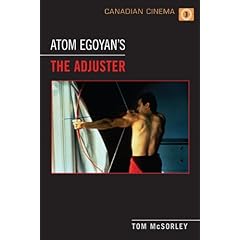
The internationally known Canadian artist and filmmaker Atom Egoyan will be in Ottawa on Thursday January 28th at 7PM at the Libary and Archieves Canada to introduce his 1991 fourth feature The Adjuster to accompany the official book launch of Tom McSorley's monograph Atom Egoyan's: The Adjuster (University of Toronto Press, $16.95).

Tom McSorley’s new book is a revealing examination of Atom Egoyan’s fourth feature The Adjuster. McSorley describes The Adjuster as “a dark drama about the complex and intense relationships between an insurance adjuster and his clients”. As the executive director of the Canadian Film Institute in Ottawa, Tom McSorley in the last couple of years has helped program screenings at the Library and Archives Canada of Atom Egoyan’s first and latest feature: Next of Kin (1984), and Adoration (2008). The book is part of the Canadian Cinema series whose goal is to “bring scholarly reflection on Canadian cinematic tradition and contemporary Canadian film”.

McSorley’s monograph on The Adjuster begins with a short history of Canadian cinema. The 1982 government Capital Cost Allowance (CCA) lead to the post-tax shelter generation of Canadian filmmakers who would spearhead a creative resurgence in national film. The Toronto Festival of Festivals - now more commonly known as the Toronto International Film Festival (TIFF) - emphasis on Canadian content (e.g., “The Northern Light”, “Perspective Canada”) was a launch pad for the Toronto New Wave filmmakers emerging work, Atom Egoyan at the frontline. McSorley connects The Adjuster with Egoyan’s first three films Next of Kin, Family Viewing (1987) and Speaking Parts (1989) emphasizing thematic continuity, an expansion from video to a Cinemascope widescreen and growing international attention. The analysis of the film is illuminating. Specifically its examination of the fire motif, the influence of the Italian director Michelangelo Antonioni, the absurdist theatre tradition, and finally pinpointing what exactly is the integral aspect of The Adjuster viewing experience. The quality of not knowing.

Tom McSorley’s monograph on The Adjuster came out in September and feels really fresh with its references to Adoration that was released in May 2009. The book launch at the 2009 TIFF, the programming of The Adjuster as part of the festivals “Open Vault” retrospective and an upcoming film Chloe emphasize Atom Egoyan importance as a Canadian filmmaker and rich body of work that has consistently been getting more international attention and quality appraisals. If you have not yet seen The Adjuster, it is well worth seeing. If you want to better appreciate it and understand its role in the context of Canadian cinema, read this book.-David Davidson

(Canadian Film Institute, Library and Archives Canada, 395 Wellington Street,28/01 & 6/02)

Friday, November 27, 2009

Recommended Reading: Tom McSorley on The Adjuster


Clearing Up the Adjuster
By David Davidson

Atom Egoyan's: The Adjuster By Tom McSorley, 128 pp.,University of Toronto Press, $16.95.

Tom McSorley’s new book is a revealing examination of Atom Egoyan’s fourth feature The Adjuster (1991). McSorley describes The Adjuster as “a dark drama about the complex and intense relationships between an insurance adjuster and his clients”. As the executive director of the Canadian Film Institute in Ottawa, Tom McSorley ,in the last couple of years, has helped program screenings at the Library and Archives Canada of Atom Egoyan’s first and latest feature: Next of Kin (1984), and Adoration (2008). The Canadian Cinema series, published by the University of Toronto Press, goal is to “bring scholarly reflection on Canadian cinematic tradition and contemporary Canadian film”.

McSorley’s monograph on The Adjuster begins with a short history of Canadian cinema. The turning point is 1982 with the Capital Cost Allowance (CCA). This lead to the post-tax shelter generation of Canadian filmmakers who would spearhead a creative resurgence in national film. The Toronto Festival of Festivals - now more commonly known as the Toronto International Film Festival (TIFF) - emphasis on Canadian content (e.g., “The Northern Light”, “Perspective Canada”) was a launch pad for the Toronto New Wave filmmakers emerging work, with Atom Egoyan at the frontline. McSorley thematically connects The Adjuster with Egoyan’s first three films Next of Kin, Family Viewing (1987) and Speaking Parts (1989) emphasizing the formers continuity, its Cinemascope widescreen, and growing international attention. The analysis of the film is illuminating. Specifically its examination of the fire motif, Michelangelo Antonioni’s influence, the absurdist tradition, and finally pinpointing what exactly is the integral aspect of The Adjuster viewing experience. The quality of not knowing.

Tom McSorley’s monograph on The Adjuster came out in early September and feels really fresh with its references to Adoration that was just released this year. The book launch at the 2009 TIFF, programming of The Adjuster as part of the festivals “Open Vault” retrospective, and an upcoming film Chloe emphasize Atom Egoyan strong oeuvre that has consistently been getting more international attention and quality appraisals. If you have not yet seen The Adjuster, it is well worth seeing. If you want to better appreciate it and understand its role in the context of Canadian cinema, read this book.

Tuesday, May 19, 2009

Restaurant Confessions

Adoration (Atom Egoyan, 2008)
*** (A Must-See)


Writer and director Atom Egoyan's Adoration is a Canadian social drama which questions the notion of community, family and personal identity in a deindividualizing metropolitan in a inextricably digital age. Egoyan one of the fore-front Canadian auteur is a cerebral filmmaker whose films sometimes have more to say about the society we live in then it does on getting great performances out of actors. But if compared to last weekend latest escapism Hollywood release, Ron Howard's Angels & Demons, it is a welcome relief to have a film that is willing bring up themes that matter socially then to uncritically entertain. Adoration is a zeitgeist film which critiques upon many contemporary social issues including terrorism, xenophobia, social constructs and alienation. A few of Egoyan's signature touches which are visible in his 11th feature include a national backdrop; Toronto city, Canadian multi-ethnicity, traumatic life experiences and their emotional baggage, digital medias, classical guitar, and the casting of his wife Arsinée Khanjian.

Similar to Egoyan's The Sweet Hereafter the film gyrates over a fatal car crash. In the latter on a brightly lit day in a remote snow-covered Canadian landscape the automobile was a large yellow elementary school bus full of children where the plunge lands the bus into a frozen river and the deaths devastate a small community. In Adoration it takes place at the dead of night leaving a argumentative family dinner, the driver Sami (Noam Jenkins), fuming with rage after indicting the patriarch for his social prejudices, and his wife Rachel (Rachel Blanchard), who is now intoxicated and drowsy, drive off into the night and accidently hit a transport truck head on.

The son of these two passed away lovers is a high school student Simon (Devon Bostick), a spinner of tall tales, who gets involved in appropriating a story of a failed martyr terrorist attack and attributes it to his dead parents for a class dictée. His french/drama teacher Sabine (Arsinée Khanjian) prods him into prolonging the original assignment by revising it and reading it to his classmates. This creative endeavor feeds his need for attention which leads to the online broadcasting of this story on the World Wide Web. Alienated in his dark bedroom he has a multitude of conversation on his MacBook. His videocast then spurs a backlash of indiscriminate responses. Without providing any moral value to each opinion Egoyan is posing a sublime question towards the internet generation. How are unknowledgeable adolescent supposed to differentiate and acknowledge morality, when there are models from all over the spectrum to be chosen from. This anonymous and opaque form of communication is contrasted when Sabine, who has now been laid off for ethically exceeding her performance as a teacher, car gets towed away by Simon's caretaker and Uncle Tom (Scott Speedman) and they both reveal their history and cultural background in a extremely revealing dialogue. In a shoddy Toronto diner their conversation, and confessions, resonate of real emotion and humanity that acknowledges that life is, and will always be, more personal in a physical surrounding then in a virtual window.-David Davidson

(Bytowne Cinema, 324 Rideau Street, 15/05-24/05)