Showing posts with label Tom McSorley. Show all posts

Saturday, December 5, 2009

Recommended Reading: 2009 Canada Survey (and my 10 best films of 2009 list)


Overview of this years Canadian Cinema
By David Davidson


International Film Guide 2009: The Definitive Annual Review of World Cinema
Edited by Ian Haydn Smith
Wallflower Press, 2009

I was late to pick up the International Film Guide 2009 which came out in March. The IFG is a high standard publication that overviews almost every film-producing country. The Canadian survey by the expert local correspondent, Tom McSorley, showcases both populist and esoteric films while missing a few targets. However, I am still at odds with what exactly this is an overview of. If it is an overview of Canadian films released in 2009, wouldn’t the publication early in the year prevent the writer from knowing what exactly is going to be released? If it is an overview of Canadian films released in 2008, how come these films, if released at all, only got a distribution this year?

To define Canadian film and Canadian cinema I am including the following personal definitions. A Canadian film is: "a film whose creative vision (e.g. director, scriptwriter) is dictated by a long-term Canadian resident." The Canadian-ness is relative to its presentation of a Canadian citizen experience at a particular time on our fine Canadian soil. Canadian Cinema – this is geography specific – are Canadian films that are projected on local screens with a regular audience. If I cannot see the film, I would not classify it in the Canadian film canon. Canadian cinema living in Ottawa, Ontario – the capital city of Canada – is defined by the projections at the Bytowne Cinema, the Mayfair Theatre, the Library and Achieves Canada, or the Empire 7. Gatineau 9, which plays French dubbed or subtitled Hollywood films, elliptically receives French-Canadian films that do not get screened at the other film theatres (e.g. J'ai Tué Ma Mère). An adventurous cinéphile can always go to Montreal or Toronto to see films that do not get a local distribution. As well there is the second-rate video substitute, if that is even available.

The IFG Canadian survey brings up many familiar mainstream films and some non-distributed films while lacking a few noteworthy Canadian films and institutions. There is no mention of Xavier Dolan’s J'ai Tué Ma Mère which was a huge commercial and critical success at the Cannes film festival and in the province of Québec. The most important Ottawa Filmmaker Lee Gordon Demarbre in this year alone released two films Smash Cut and Summer’s Blood. Finally there is no mention of Canadian film festivals (e.g. Nouveau Cinema, Fantasia, TIFF) as being great showcases for the many independently financed Canadian films. These exclusions are only a few squabbles in what is a condensed overview in an exhaustive guide to world cinema.


*****


This year has been my first entire year of film reviewing and documenting. Last year in May, I started Ottawa Film Review. My writing from 2008 was a trial run for the structure and writing that I would produce this year. Realizing the hegemony of Hollywood movies on our culture – much thanks to the writing of film critic Jonathan Rosenbaum – my affinities this year was a reaction against the mainstream which led towards a discovery of more personal and rich films.

The first four films on my list; Skidlove, Trees of Syntax, Leaves of Axis, Smash Cut, and Adoration, are by Canadian filmmakers. This shift towards independent Canadian films emphasize being more attuned to the works of local filmmakers. This summer I was even captured on Super 8 celluloid in my friend Scott Birdwise submission in the IFCO Dogme 95 challenge. But not all Canadian films are worth promoting. The Necessities of Life and One Week, two heavily advertised “good” Canadian films, were entirely forgettable. I have yet to seen J'ai Tué Ma Mère, but I think if I had, it would have been included on my list. A non-contender is Guy Maddin’s National Film Board commercials Night Mayor, which are terrific surreal period explorations of the start of the NFB, as well I still anticipate maybe one day seeing his short Send Her to the Electric Chair which screened at the Rotterdam film festival.

Two Lovers and A Serious Man, are terrific films which mean a lot to me as I can identify with their Jewish protagonist and how they relate to the world and history.

I thought Waltz with Bashir was the best national film that came out this year. Other notable contenders include Youssef Chahine’s final film Le Chaos, Jacques Audiard’s Un Prophète, and Laurent Cantet’s Entre les Murs, and Ramin Bahrani's Goodbye Solo.

The Limits of Control is, for me, the best recession film with its concern of alternative lifestyles and preoccupations to counter balance the dominating capitalist worldview held in the United States. Other important recession films include Michael Moore’s Capitalism: A Love Story and Kelly Reichardt’s Wendy and Lucy.

Tetro is Francis Ford Coppola latest film and the filmmaking is revelatory. Other exciting films include Spike Jonze’s furry Where the Wild Things Are, Wes Anderson’s stop motion Fantastic Mr. Fox, Werner Herzog's head trip The Bad Lieutenant: Port of Call - New Orleans, Judd Apatow's personal Funny People, and Chan-wook Park’s maniac Thirst.

The final spot on my list goes to Frank Cole’s Life Without Death which screening and book launch, Life without Death: The Cinema of Frank Cole, was organized by the Canadian Film Institute. The film changed my perception on Canadian film history and personal filmmaking. This might not have been a 2009 release but the reason for its inclusion is that I rather incorporate Frank Cole's work then this years Frank Cole documentary The Man Who Crossed the Sahara.

Finally I have to add that the most important cinema related event in Ottawa was the reopening of the Mayfair Theatre last January. It is such a pleasure to see programming that express a passion and love for movies anew every month. With eclectic taste and original showtimes the Mayfair Theatre redefined cinema experiences in this town.-David Davidson

The Ten Best Films of 2009 (in no particular order)
1. Skidlove (Ryan Arnold, 2009)
2. Trees of Syntax, Leaves of Axis (Daïchi Saïto, 2009)
3. Smash Cut (Lee Demarbre, 2009)
4. Adoration (Atom Egoyan, 2008)
5. Two Lovers (James Gray, 2008)
6. A Serious Man (Joel & Ethan Coen, 2009)
7. Waltz with Bashir (Ari Folman, 2008)
8. The Limits of Control (Jim Jarmusch, 2009)
9. Tetro (Francis Ford Coppola, 2009)
10. Life Without Death (Frank Cole, 2000)

Friday, November 27, 2009

Recommended Reading: Tom McSorley on The Adjuster


Clearing Up the Adjuster
By David Davidson

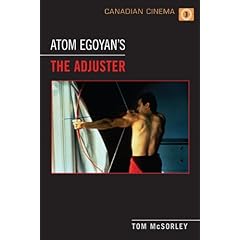
Atom Egoyan's: The Adjuster By Tom McSorley, 128 pp.,University of Toronto Press, $16.95.

Tom McSorley’s new book is a revealing examination of Atom Egoyan’s fourth feature The Adjuster (1991). McSorley describes The Adjuster as “a dark drama about the complex and intense relationships between an insurance adjuster and his clients”. As the executive director of the Canadian Film Institute in Ottawa, Tom McSorley ,in the last couple of years, has helped program screenings at the Library and Archives Canada of Atom Egoyan’s first and latest feature: Next of Kin (1984), and Adoration (2008). The Canadian Cinema series, published by the University of Toronto Press, goal is to “bring scholarly reflection on Canadian cinematic tradition and contemporary Canadian film”.

McSorley’s monograph on The Adjuster begins with a short history of Canadian cinema. The turning point is 1982 with the Capital Cost Allowance (CCA). This lead to the post-tax shelter generation of Canadian filmmakers who would spearhead a creative resurgence in national film. The Toronto Festival of Festivals - now more commonly known as the Toronto International Film Festival (TIFF) - emphasis on Canadian content (e.g., “The Northern Light”, “Perspective Canada”) was a launch pad for the Toronto New Wave filmmakers emerging work, with Atom Egoyan at the frontline. McSorley thematically connects The Adjuster with Egoyan’s first three films Next of Kin, Family Viewing (1987) and Speaking Parts (1989) emphasizing the formers continuity, its Cinemascope widescreen, and growing international attention. The analysis of the film is illuminating. Specifically its examination of the fire motif, Michelangelo Antonioni’s influence, the absurdist tradition, and finally pinpointing what exactly is the integral aspect of The Adjuster viewing experience. The quality of not knowing.

Tom McSorley’s monograph on The Adjuster came out in early September and feels really fresh with its references to Adoration that was just released this year. The book launch at the 2009 TIFF, programming of The Adjuster as part of the festivals “Open Vault” retrospective, and an upcoming film Chloe emphasize Atom Egoyan strong oeuvre that has consistently been getting more international attention and quality appraisals. If you have not yet seen The Adjuster, it is well worth seeing. If you want to better appreciate it and understand its role in the context of Canadian cinema, read this book.