Showing posts with label Book Review. Show all posts

Thursday, December 18, 2014

Book Reviews: Cronenberg & Spielberg

Consumed by David Cronenberg (Hamish Hamilton, 2014)

 “I’m a very sick woman. Does that turn you on?” Dunja, a Slovenian woman at the Molnár clinic in Budapest, asks the New York journalist Nathan Math. “Well, I told you. I’m a failed medical student. Now I’m a medical journalist. So, yes, I guess sickness does turn me on in a way.” (Pg. 30). A sick woman, who is about to get an illegal radioactive treatment for her breast cancer, tries to seduce a medical journalist, and they end up having sex. She transmits to him a rare STD, the Roiphes disease, which he ends up also passing to the women that he’s seeing, Naomi Seberg. Naomi, also in the field, is researching to write a book on the case of Aristide Arosteguy, a famous philosophy professor, who left his native France for Japan, after being investigated for cannibalism, eating his wife Célestine. The title of the book comes from Barry Roiphes, the now-retired doctor famous for discovering the disease, who wants collaborate with Nathan to tell his life story, work history, and his experiments on his daughter, Chase, who is now dealing with some mysterious form of post-traumatic stress.
Surrounding all of this is the ghost of the Simone de Beauvoir-like Célestine, who’s never encountered because she was supposedly eaten (the description of the photographic death scene is nightmarish), but who prior was sexually promiscuous with her disciples, who Naomi is now interviewing. Célestine and Aristide describe themselves as open to ‘philosospams’, episodes of obsessive behavior involving sexual affairs or political activity. After the two professors attend the Cannes film festival as a jury members, Célestine becomes obsessed with a controversial North Korean film, The Judicious Use of Insects, which she suspects her former lover Romme Vertegaal made under a pseudonym, specifically for her. This experience causes in her a rare form of apotemnophilia, and she starts to believe her left breast is infected with bugs and would stop at nothing to get it removed. (The diagnosis scene appears in a slightly altered form in the EYE Film Institute commissioned Cronenberg video, The Nest starring the raw Evelyne Brochu).
What is it about episodes like these – typical of Consumed in their mixture of Eros and Thanatos – that draws people towards the works of David Cronenberg? Sex, disease and death. Journalism, cameras, and social media. This is the shadow world of Consumed. It’s these taboo themes and obsessions, which are typically repressed in everyday life, that are brought out into the open and freely indulged. In Cronenberg’s world, more general human experiences like relationships, education, professions, growing old, diseases and death are heightened towards an extreme, parasitical level.
This theme of the parasitic and infections is everywhere in Consumed. Nothing is safe from it. If something bad could happen, then it will. No wonder Stephen King praises the book. But there is almost a mathematical and scientific structure to how it unfolds, just like in a Cronenberg films. After Cronenberg’s more recent gangster films (A History of Violence, Eastern Promises) and probing the subconscious (A Dangerous Method), now he’s returning to the original body horror of his early career, but the world is different and its implications scarier. So similarly to Maps to the Stars, Cronenberg’s most romantic film in the Goethien sense, or Cosmopolis, in Consumed and in these recent works, the worlds, both individual and social, end up falling apart. For example, Agatha is scarred with burn wounds (among her other psychological and physical problems), Eric Packer has an asymmetrical prostate, and in Consumed bodily mutations and deviations are rampant. But even if the world is dark, there is still a beauty to this gesture of showing it fall apart and disintegrate in its multifaceted forms.
There are many episodes from Consumed that bring to mind ones from other Cronenber films. The journalist protagonists and their globetrotting adventure recalls Naked Lunch, the medical setting and the procedures that go awry makes one think of Dead Ringers, the carnal love affair that takes place in Asia is reminiscent of M. Butterfly, and the mad scientist character could be right out of The Fly.
Cronenberg had always wanted to write. Originally, after his first two underground films (Stereo, Crimes of the Future) he moved to Tourrettes-Sur-Loup, France to try to become a novelist. But he would return to filmmaking, as he tells Serge Grünberg, because it was “a ‘modern’ way of writing.” And with his filmmaking practice he would remain loyal to writing: creating his own stories, writing his own screenplays, and adapting novels. And in this period he would have close working relationships with many esteemed novelist including King, William S. Burroughs, J.G. Ballard, and Don DeLillo.
            It’s worth noting Cronenberg’s popularity and relevance. Where other older directors like Peter Bogdanovich or John Sayles can no fund their films and start taking up other projects like film blogging or novel-writing, with Cronenberg there isn’t the sense that he ‘lost it’ with the mass public. In the ten years since the president of the publishing house Hamish Hamilton, Nicole Winstanley, asked him if he wanted to write a book, throughout his sixties he was able to artistically reinvent himself, working with some of the most famous young stars, Robert Pattinson and Mia Wasikowska, on the two critical successes Cosmopolis and Maps to the Stars.
So the next question: is David Cronenberg a good novelist? Yes. With Consumed, at a length of 284 pages, he crafted a gripping page-turner, which isn’t clumsy in its prose, and in it he creates both a world distinct to itself, and one that is in parallel to his body of work as a filmmaker. Though let me said, if it wasn’t written by him it would probably have received a lot less attention. But Cronenberg is still great at creating interesting characters, atmosphere, dialogue, and intrigue. There are two parallel stories that take place and the switching between them is never awkward. Though there is a section where Aristide is describing what has happened to Célestine, which goes on for too long at 50 pages, and lacks the multi-character energy of the rest of the book.
The Nabokov influence, which Cronenberg speaks of, is there, as they are both cerebral writers that regularly bring up major ideas of continental philosophy and psychoanalysis, along with a wider openness towards the arts and culture. Cronenberg is especially fond of describing cameras and lenses, though maybe too much.
Naomi is as complex and fascinating as Maxine Tarnow from Thomas Pynchon’s Bleeding Edge, both young women investigators. And there are also similarities between Consumed with the world of Infinite Jest, as in both works the authors critique the growing use of technology to mediate interpersonal relations, and the role of entertainment in our culture and its ability to become a gross obsession. As well Dr. Roiphes’ project seems similar to James Incandenza’s, and Consumed bleak and ambiguous cliffhanger ending also recalls David Foster Wallace’s.
On a potential adaptation of Consumed, Cronenberg has said: “I’ll let David Fincher or Neil Jordan destroy my novel.” And he presently does not have any new projects in the works.

***
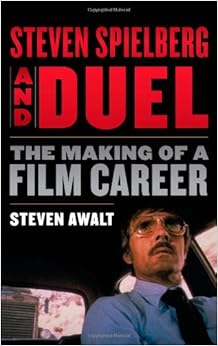
Steven Spielberg and Duel: The Making of a Film Career by Steven Awalt (Rowman & Littlefield, 2014)

Steven Awalt's new book, Steven Spielberg and Duel: The Making of a Film Career, is about a little-known period in the director’s career. For an older generation, the film might be known for its acclaimed television screenings, for a younger one it might not be that familiar as Spielberg is now more associated with his classics like Jaws, the Indiana Jones films or Jurassic Park. What is it about Spielberg’s early career that demands re-evaluation? Even the author of Steven Spielberg and Duel doesn’t deny that the film is “a somewhat forgotten work.” But according to Spielberg himself, Duel is “the key to unlock a career for me.”  So with that, the book’s aims are two-fold: it explores Spielberg’s early television career at Universal, and it tells the equally gripping narrative of the film’s production.
While Spielberg’s early career is usually treated cursorily, in Steven Spielberg and Duel Awalt does it justice by making it the subject of his book. Awalt, who is a scholar on this period in Spielberg’s career, focuses on Universal’s television production and Duel’s many collaborators that would lead to make the film a reality through its different stages of production. The television dramas that Spielberg worked on, and which are discussed in depth, include his episode Eyes starring Joan Crawford for Night Gallery, LA 2017 for Name of the Game, and Murder by the Book for Columbo. In this period the economic restrictions of the productions instilled in Spielberg a quick working practice. Spielberg was working with a lot of older technicians, many from the classical studio era (and was sometimes in conflict with them), which led to a rich collaborative atmosphere. The many collaborators of Duel include its lead actor Dennis Weaver (Spielberg was a big fan of his performance in Touch of Evil), author and screenwriter Richard Matheson (whose screenplay is included in the book), director of photography Jack Marta, stunt coordinator Carey Loftin (Bullitt), editor Frank Morriss, composer Billy Goldenberg, producer George Eckstein, and studio executive Sid Sheinberg. This impressive group led to a creative atmosphere that gave Spielberg the creative freedom to make Duel especially cinematic. It’s practically a non-verbal sensorial experience as its story is told through ambitious filmmaking techniques more so than the conventional ones associated with the television of this period, which includes impressive mobile shots following the car, a long-take into a café, and dramatic staging during the confrontations.
The origins of Duel begin with Richard Matheson who was inspired to write the original short story after a similar experience happened to him. The murderous truck of Duel, which pursues David throughout the film, is a significant villain for multiple reasons. First off, he is significant as a faceless antagonist, which is the catalyst for the film’s Hitchcockian wrong man narrative. Secondly, the chase story would become a regular structural trademark for Spielberg. And thirdly, as a symbol of an environmental problem, as its petrol freight reflects a natural resource that is constantly and recklessly exploited under industrial capitalism.
Also related is Duel’s critique of patriarchy. The film begins with a travelling salesman named David Mann driving down a desert highway. He is listening to the radio where on a talk-show a caller is discussing a survey where he admits that he’s no longer “the head of the family.” Shortly after the driver stops at a roadside Laundromat to call his wife in which they continue their argument from the previous night. Like the son Michael Brody from Jaws who can’t connect with his father, or Roy Neary in Close Encounters of the Third Kind who runs off from his family, or lonely Elliott in E.T.; Spielberg is presenting the disintegration of the nuclear family. And as he expands upon in his Suburban trilogy (Close Encounters, E.T., Poltergeist), Spielberg in this early stage of his career is chronicling issues surrounding Fordism and the growing class of American society and especially the complexity of their emotional lives.
In the book, Awalt engages with the discourse around Duel by employing a close reading of every scene in the film. Awalt is especially critical of Andrew M. Gordon’s contentious psychoanalytic reading of the film. The side-bars and footnotes in the book offer a wealth of supplementary information regarding the film. There are side-bars that focus on the swearing that had to be censored, harbingers, its class consciousness, and how some of its footage would be used in an episode of Hulk (to Spielberg’s chagrin). Awalt debunks the myth of a young Spielberg escaping the Universal Bus Tour and setting up shop, as the truth is that his father knew a librarian that sponsored him as an intern. And there is a fascinating footnote of Spielberg’s rare cameos in his own films.
In terms of Spielberg making-ofs, Awalt’s book isn’t as richly illustrated and colorful as some of the other ones (The Complete Making of Indiana Jones, Memories from Martha's Vineyard). But it’s as gripping and informative as either Carl Gottlieb’s The Jaws Log or any of Laurent Bouzereau’s special features. There is a charm to the modesty of the project, in comparison to more theoretical film books, and Awalt’s sense of story-telling is open, fun and generous. For example, if in Ray Morton’s book on the making-of Close Encounters of the Third Kind he makes the argument that it’s Spielberg’s first personal film because it owed to his earlier teenage film Firelight. (Spielberg himself typically identifies his first personal film as E.T.). Awalt pushes this intertextuality even further by arguing that Duel owes to Spielberg’s earlier train-crash home movies that he’s famous for bringing up. It’s the casualness and insight of observations like these that reflect a deep knowledge and contemplation of Spielberg’s cinema, which makes Awalt’s analysis so pleasurable to read.
Steven Spielberg and Duel: The Making of a Film Career stands alongside the other note-worthy recent Spielberg books that includes: James Kendrick's reconsideration of Spielberg’s oeuvre which argues for the persistence of his pessimistic themes and the complexities of its ideological incoherence (Darkness in the Bliss-Out), Richard Schickel's general overview and interview with the director (Spielberg: A Retrospective), and the official book on Schindler's List and the USC Shoah Foundation.

Monday, July 18, 2011

Jean Pierre Lefebvre's video work (a book by Peter Harcourt)

Title: Jean Pierre Lefebvre: Vidéaste*
Series: Canadian Directors**
Author: Peter Harcourt
Publisher: Toronto International Film Festival Group (2001)
Pages: 91
Price: $9.95
*****
“Once we understand its conventions, it can inspire the human delight that we feel for the best of folk art.” – Peter Harcourt

It is topical to review a book on an important Canadian director after writing a post on contemporary Canadian cinema as a way to contextualize today's output alongside its heritage. Peter Harcourt writes that “the films of Jean Pierre Lefebvre helped consolidate a sense in Québec of an emerging national cinema.” And his career begins as a film-critic, like those New Wave guys, though, unlike them, he's still one with regular contributions to 24 images; his latest entry was on Serge Giguère (N. 151). Inspired by Gilles Groulx's Le chat dans le sac (1964), Lefebvre's first film Le révolutionnaire (1965) was one of the first landmarks of Québécois cinema. His National Film Board work is as innovative and beautiful as anything by Gilles Carle and Il ne faut pas mourir pour ca (1967) was the first Canadian film to premiere at Cannes. The Harcourt-Lefebvre book explores the L’Âge des images*** (1994-1995) series that was made after Le fabuleux voyage de l’ange (1991), which was aggressively rejected by the critics, and before his lastest effort the TV movie Le manuscrit érotique (2002). Pertaining to his influence, Piers Handling notes, “Many of the new generation of Anglophone filmmakers – among them Atom Egoyan, Jeremy Podeswa, Bill MacGillivray and Bruno Pacheco – have cited Lefebvre as a formative influence.”

Lefebvre’s examines his early film-going experiences in the ‘40s and ‘50s in Snapshots from Québec and discusses them with warmth and passion; the essay itself is divided into helpful sub-headings which themselves form a narrative: Chance and Neccesity, Candid Eye, Cinema Direct, Cinema Verite, Time/Money, Form/Content. Lefebvre speaks kindly of his mother who “judged films on only on criterion: the film was good if it made her laugh or cry.” After the NFB reign of propaganda and folkloric images, according to Lefebvre, “If the pot began to simmer in 1956, especially at the NFB, it was in 1958 that it boiled over with thirteen short films for the television series Candid Eye on the one hand, and the film Les Raquetteurs shot by Gilles Groulx in collaboration with Michel Brault and Marcel Carrière on the other." The most representative film of the cinema direct period is Gilles Groulx’s Golden Gloves (1961) and for cinéma vérité there is Pierre Perrault’s Pour la Suite du Monde (1963) and Claude Jutra’s A Tout Prendre (1964), according to Lefebvre.

Peter Harcourt’s The Music of Light: The Video Work of Jean Pierre Lefebvre is the centerpiece of the book and it is an analysis of the five episode series L’Âge des images; the episodes are Le Pornolithique, L’Écran invisible, Comment filmer Dieu, Mon chien n’est pas mort, and La Passion de l’innocence. Harcourt examines the genesis of Lefebvre aesthetic approach and its impact - “His films combine the formal authority of Michael Snow with the compassionate humanity of Jean Renoir” - and divides his work into three categories: the personal, the political, and the pastoral. Harcourt compares Lefebvre with Jean-Luc Godard as, at the time, they both had difficulty financing films, which result is a turn towards video, and L’Âge des images is contrasted with Histoire(s) du cinema (1988-1998). The comparison is apt though it might be pushing it as Lefebvre is not as epochal as Jean-Luc Godard, who is described by Raymond Bellour (Trafic) as, “It is through the filmmaker Jean-Luc Godard that the history of cinema - understood as the history of the twentieth century – was forever divided.” And on Godard’s magnum opus Histoire(s) du Cinema, Antoine de Baecque writes, “Unrivalled in terms of its ambition, and aesthetically peerless, it is the culmination of our time.” It is worth mentioning here that the Godard lectures at the Conservatory of Cinematographic Art at Concordia University in the late 1970s, which Lefebvre brings up, are in the process of being put together in a book by the publisher Caboose in Montreal.

The videos in the L’Âge des images seem both narratively and thematically interconnected and the scope is as broad and diverse as an examination of the origins of cosmological time to the Clarence Thomas versus Anita Hill sexual harassment hearing (in the interview it is discusses how this came to be). There are appropirations of Stan Laurel and Oliver Hardy’s Babes in Toyland (1934) and intertextual references to the Group of Seven. L’Écran invisible is about potential and family, in Comment filmer Dieu Lefebvre interviews his cameraman Lionel Simmons, Mon chien n’est pas mort is about Lefebvre's family pup Kathy, and La Passion de l’innocence is described as being “full of longuers,” which are “quiet, slow moments of contemplation that invite participation by the audience.” In the special 100th issue of 24 Images one of the features got ten Québécois directors to expand on the one film that most marked them: Lefebvre answer is Umberto D. for its humanity in harsh circumstances, its focus on ordinary people, and its emphasis on regular gestures.

Some interesting comments from Lefebvre from the interview include: Lefebvre says that, “I’ve always loved wrestling,” which is strange as it is presented almost as one of the most nauseating activities imaginable in Le Pornolithique where, “I also tried to see things through the eyes of Sammy, my newborn baby." While the idea for La Passion de l’innocence came from what was not happening, "I was waiting to shoot a feature film, waiting and waiting and nothing was happening.”

Like all books on Canadian cinema, Lefebvre provides his own perspective on its necessity,
“Consider as well all the filmmakers who personify the concept of national cinema: Renoir, Ford, Hawks, Buñuel (three nations), Eisenstein, Mizoguchi, Kobayashi, Bergman, Lang, Wenders, Renais, Griffith, De Sica, Fellini … you will notice that not only do the stories they recount originate in their environment, but also the form through which they transmit those stories is a perfect amalgam of the specifics of that envinroment and the attendant emotion: the emotion of belonging to a corner of the world, a river bank, a mountain, a lake, an ocean, a season, another human being.”
The reoccurring complaint is there that “either the Canadian cinema would survive or it will become American.” Harcourt and Lefebvre, in short, argue for a stronger presence of experimental cinema against that of the entertainment ideology of Hollywood and this can viewed by the important role experimental film has in Canada from Café Ex in Ottawa to the Winnipeg Film Group to the Images Festival in Toronto to Media City in Windsor to Phil Hoffman's Film Farm and to Isuma Productions. Lefebvre says it best, “Beyond all doubt, the concept of a national creation, and a national cinema, is of great importance as it is linked to the nation of belonging, which is in turn linked to the instinct for survival.”

*****
“Although Robin didn’t much care about the new cinemas that were emerging [in the 1960s] from, say, the previously invisible cultures of Latin America or Canada, the work he was doing on largely the Hollywood product was all part of the burgeoning excitement of the times…. But we continued to have our quarrels. I would get annoyed at some of the more pompous assertions he would make in CineAction!, especially if related to Canadian film.” - Peter Harcourt

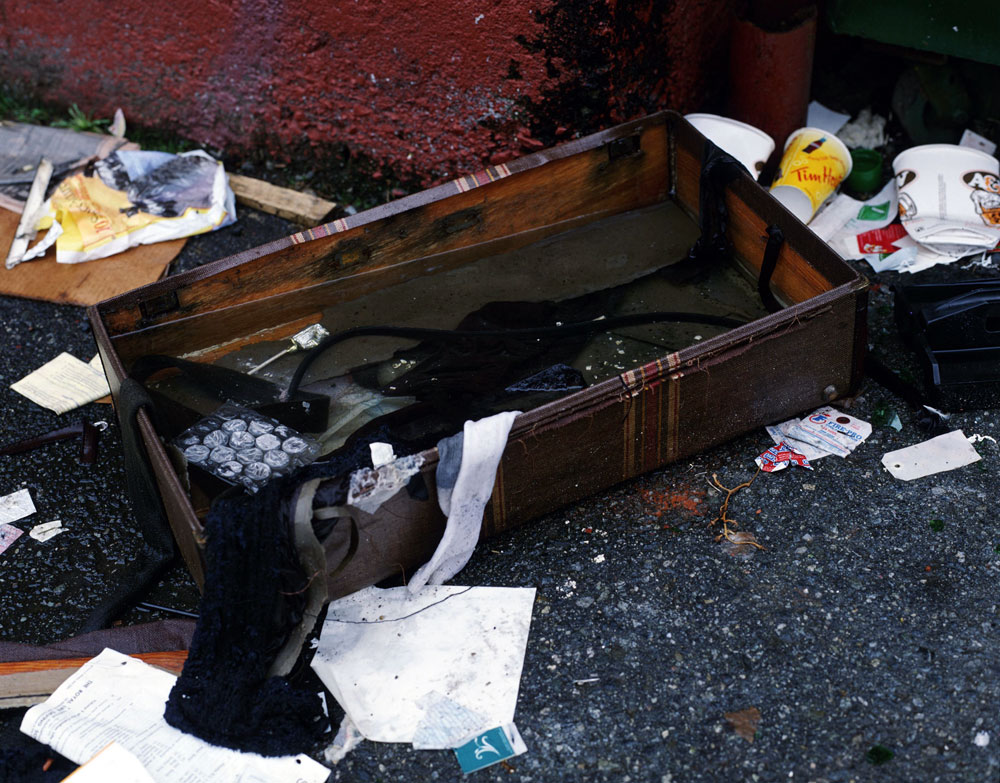
This quote from the latest issue of CineAction (N.84) - whose feature is Robin Wood in Celebration, which includes pieces by William MacGillivray (whose Life Classes was important to Wood) and Olof Hedling - asserts a strong impulse to support a burgeoning and over-looked national cinema in opposition to Hollywood. Even though after reading the Lefebvre book one can get the impression that Harcourt feels that cinema both begins and ends with Lefebvre - he even has another book on Lefebvre (Canadian Film Institute, 1981) – my point is that the endeavor is honorable. I first discovered Harcourt as he was already a recognizable name (I remember seeing one of his books at the CFI office in Ottawa) and, what really caught my eye, is that he is the only Canadian brought up in Raymond Durgnat’s seminal text Films and Feelings. There is this sense of validation associated with seeing Canadians positively recognized in the international film community. Like how in the photographer Jeff Wall’s Rainfilled Suitcase (2001), which mounted light-box can be seen in its vivid glory at the Art Institute of Chicago, where the vintage yellow Tim Hortons coffee cup – Timmy’s being one of Canada’s most identifiable products – becomes a symbol of Canadiana within a nondescript scene. Spotting this detail, like noticing the Harcourt reference, is a pleasant recognition of seeing even just a small part of Canada within great work being discussed in a more international setting. The same applies to Timothy Barnard’s introduction to the new edition of André Bazin’s What is Cinema? where he discuses the peculiarities of reading and translating Bazin into French- and English-Canadian.

Not that people have an aversion to Canadian films, well, maybe they do. It is just that it is rarely discussed by the heavyweight film-critics. An example of a ‘heavyweight’ is Dave Kehr who on his indispensable blog contributors from around the world put in their two cents on his “weekly column on film history.” His background as discussed in the long-awaited When Movies Mattered is a post-Sarris focus on the transition from classical to post-classical Hollywood with an emphasis on “filmmakers who built on the past, who seemed dedicated not to trampling on the classical model but trying to reconfigure it,” like Cassavetes, Demme, Scorsese, Schrader and Brooks. It’s almost funny how the “uncharted territory” of his DVD reviews includes Swedish silent-films, the long unavailable work of Naruse Mikio and even in his new “Further Research” column in Film Comment – which features un-canonized directors like John H. Auer - there is hardly ever any references to Canadian cinema. On that note I would like to highlight some note-worthy Canadian DVDs that have recently come out: the Eclipse box set The Actuality Dramas of Allan King, Patricia Rozema’s I've Heard the Mermaids Singing, the long unavailable work of Joyce Wieland on a 5-DVD box set by CFMDC, and Daruma Pictures release of Midi Onodera’s video work.

Even as I write this I realize that maybe the lack of serious critical reflection has to do with both relevancy and quality of Canadian cinema. After attending all of the João Pedro Rodrigues films as part of the New Auteurs series at the TIFF Cinematheque and watching Terrence Malick’s The Tree of Life; it is obvious that they are more formally invigorating and conversation worthy. In To Die Like a Man when Tonia (Fernandos Santos) goes off into the fairytale forest with her boyfriend and the two cross-dressers where they sit down – the screen becomes a roseate tableaux - and listen to Baby Dee’s Cavalry; the effect is hypnotizing. As Brad Deane puts it, it’s cinema. This is a long way away from watching an old tape and sitting on an uncomfortable chair with big clunky headphones at the Film Reference Library. Even Lefebvre writes about his work “What I’ve wanted to insist upon and to apply to my films… is the right to adopt a small scale, to make films that don’t claim to be absolute masterpieces.”

I guess what I am trying to advocate for, at least in my own writing, is a mediation between art-house, Hollywood and Canadian cinema. But my only concern is that I hope studies in it can become a marketable asset, as say, that of being an expert on Blake Edwards as is the friendly Sam Wasson who has two popular books on the subject and who recently came to the Lightbox to introduce Breakfast at Tiffany's. I want to eventually apply to do my Masters in Film Studies at the University of Toronto in the hopes, for now at least, to write about the renegade Québécois filmmaker Gilles Carles; as well, I would like to explore certain key Québécois films and their similarities with the work of Robert Altman; and, what exactly constitutes Québécois film language. I would hope that it would be a rich experience for both myself and for other people to hear and read about. – David Davidson

*****
*Jean Pierre Lefebvre: Vidéaste is divided into the following sections: a preface by Handling; two articles by Lefebvre, the autobiographical Snapshots from Québec and The Concept of National Cinema. The centerpiece of the book is Harcourt’s essay The Music of Light: The Video Work of Jean Pierre Lefebvre on L'Âge des images and there is an interview with the director, his filmography and a selected bibliography.

**The Canadian Director series is part of the TIFF Cinematheque publications that includes books on Jean Pierre Lefebvre, Don Owen, Pierre Perrault, Michel Brault and Allan King; as well, in a different series, books on Jack Chambers, Peter Mettler, and Joyce Wieland. While the Canadian Cinema series, which are extended textual analysis of key Canadian films, has books so far on A History of Violence, Le Déclin de l'empire américain, The Adjuster, A Married Couple, The Far Shore and My Winnipeg. These books are available at the TIFF.Shop.

***The Film Reference Library at the TIFF Bell Lightbox has L'Âge des images I, III, IV and V. Though the FRL will be closed for July and August, you can always set up an appointment with Eve to view their collection. The NFB Mediatheque has both of Lefebvre’s NFB films: Mon amie Pierrette (1967) and Jusqu’au Coeur (1968).

Wednesday, July 6, 2011

Photographing Directors (and Cannes Cinema)

Title: Magnum Cinema - photographs from over 50 years of movie-making
Series: Phaidon
Author: Alain Bergala
Publisher: Phaidon Press Limited* (1995)
Pages: 360
Price: $59.95
*****
I am not quite sure if the 2005 English language re-print of Magnum Cinema is the same one Mr. Toubiana** highlights as one of the many accomplishments of the recently deseased Claudine Paquot (I do not see her name in the credits) but it is a gorgeously put-together book. Toubiana's post from his magnificent blog, which since then he wrote about Pierre Cottrell and the arrest of Mahnaz Mohammi, highlights the important back-stage role Pacquot had at the world's best film magazine Cahiers du Cinéma and there are some moving comments from the old Cahiers writers Nicolas Saada, Jean-Michel Frodon and Bill Krohn as well as one from the filmmaker Chantal Akerman. The personal anecdotes describe a singular and wonderful women who help shaped Cahiers for what it is now.

On the front cover of Magnum Cinema Elli Wallach is in the front seat of a car driving Marilyn Monroe. The black-and-white photograph which is drabbed in shadows with the azure blue title in the top left corner is an unassuming beginning to this beautiful documentation of the seventh art through different behind the scene film shoots. The book comprises of a small selection of Magnum Photos seven-thousand photograph collection which are spread throughout the sections: The Movie Nomads, Preparing for the Shoot, The Shoot, In the Edit Room, Film Festivals, The Stars, Cinema in the Street. The index of films and personalities at the back of the book make it easily navigable.

Alain Bergala opens the book with his essay Magnum meets the Cinema where he writes an abridged history of the photography agency which was spear-headed by Roger Capa, who was originally renowned for his war-time photographs, and Henri Cartier-Bresson and George Rodger who started Magnum in 1947. Their first photograph is of Alfred Hitchcock filming Ingrid Bergman's hand on the set of Notorious. Capa brought a magnetisms to the agency while their executive editor John G. Morris, who would use his connections from his stint at Life Magazine, was able to guarantee magazine purchases of the backstage photo shoots that reeled them in a higher income as well as more prestige. Though sometimes acquiring contracts through personal connections prevented certain openings, as well some studios were not receptive, which is one of the reasons for the exclusion of some directors in the book. The photographers talked about the difficulty and restrictions about their work on set, yet, as Bergala notes, "Yet the greatest strength of Magnum's photographers in dealing with set photography has been both their ability to maintain artistic freedom with subjects that were not necessarily of their own choosing, and their strength of character in not giving in to market demands." The golden age of the agency seemed to have reached a climax with The Misfits which was to become a symbol of the gloriousness of the Studio Era as well of the changing of a time as Clark Gable and Marilyn Monroe died shortly afterwards. The Misfits, which Phaidon has another book dedicated too, with its iconic images of Monroe, Gable and Montgomery Clift captures, as Bergala notes, "the legacy of a dying dynasty and of a woman who was its last tragic embodiment." The crisis and turning point for Magnum on acquiring contracts had to do with the rising competition from television on the studios which lead to lesser interest in both the films and for coverage by prestigious photographers.

The subjects of the photographs in Magnum Cinema include stars, directors, technicians, screenplay writers, authors, film critics and philosophers; and some photographers are a better match for particular subjects. Some noteworthy affiliations include: Antonioni saw Bruce Davidson, who took the pictures of Zabriskie Point, as his alter ego. Eli Reed shoots John Singleton. Erich Solomon's in situ photographs of Eisenstein and Lubitsch. Other note-worthy talents include Guy Le Querrec and Philipp Halsman whose pictures are both innovative and ambitious. Eve Arnold has a good eye. Ernst Hass did well with his subjects. And from all their photographers the one that successfully moved onward to feature film is Raymond Depardon.

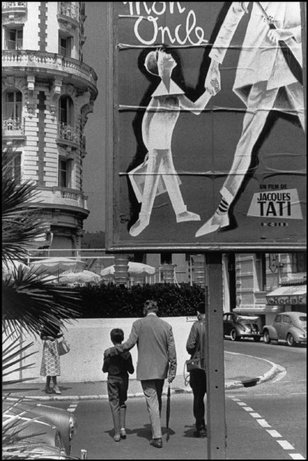
There is a great photograph of the white-haired bearded older man John Huston, who has a major presence in Magnum Cinema as Capa and him were friends, who is filming Under The Volcano. Thierry Jousse writes in Cannes Cinema, "Huston was one of the last superstars of American Cinema." Orson Welles appears almost God-like. The Italians Visconti, Rosselini and De Sica are there. Truffaut and Godard have a big presence and so does Renoir. As well many other directors sporadically pop up: Kusturica, Wajda, Ray, Allen, Fuller, Mankiewicz, Angelopolous, Chaplin, Wilder, Wise, Yimou, Robson, Renais, Wenders, Hartley, Cronenberg, De Palma, Tarantino, Ferrara, Eastwood, Rivette and Garrel. One of the most gorgeous images is of Jacques Tati walking with a boy with a Mon Oncle poster in the background. There is part of the set of Carax's Les Amants du Pont-Neof. There is also a focus on actors and actresses like Isabelle Hupert and Jane Birkin, Elizabeth Taylor and Humpthrey Bogart, Edward G. Robinson and Audrey Hepburn. Some writers that are photographed include Jacques Prevert, Margarite Duras and William Faulkner. As well you can see Henri Langlois and a Cahiers chief editor boardroom.

Magnum Cinema is at its most interesting when there is more descriptions and commentary, which it is lacking, as one wishes it had even more text kind-of like the Cannes Cinema book. And the book appears almost dated, as the latest in art cinema seems incarnated by Kusturica, Hartley and Angelopoulos. When was the last time these guys even made a movie? I would have liked to seen some photographs of Terrence Malick, Apichatpong Weerasethakul and James Gray. Anyways, for more recent trends there are the film magazines: Cahiers, Positif and Cinema Scope. I really liked in Cahiers the pictures of Gregg Araki in a tanktop and big head-set directing two chicks on the set of Kaboom, Wes Craven almost-looking like a devil directing My Soul to Take or Philipe Garrel with some of his friends making Un Été Brûlant. And for photography, last years out-of-series issue of Positif Portfolio: 80 cinéastes vus par… Positif & Nicolas Guérin is one of the best collections of director portraits mixed with serious film-criticism that’s out there.

Though in the other book Cannes Cinema: a visual history of the world’s greatest film festival the film festival is documented through the local Traverso family over four generations of photographers starting with Auguste Traverso, the founder of Traverso Maison, to the Traverso that is still working today Henri. The book is similar to Kieron Corless and Chris Darke’s Cannes: Inside the World's Premier Film Festival (Faber and Faber, 2007) as they both expand on the same stories. Toubiana writes about the raison d'être of Cannes that in the wake of the catastrophic Second World War,
"Thus the festival was about demonstrating, in the most visible and impressive way possible, the desire on nations to gather together around the idea of peace. Cinema became the vehicle for this recovered ideal. And the festival would continue to fly the many flags of the nations that presented their films in competition."
Cannes Cinema is better at chronologically documenting the history of cinema then Magnum Force as it encompasses a wider subject as well the bottom of each page is filled with interesting observations from the perspective of Cahiers with the contributors Serge Toubiana, Joël Magny and Thierry Jousse. You can even see the Cahiers and Cannes ties from the photographs of Godard, the discussion of Hitchcock as a serious artist, and photographs of the writers, directors and programmers all together. The connection between Cahiers and Cannes is still present in the lastest issues (N. 667, 668) as the magazine covers the competition, discusses four French films that played at the Directors’ Fortnight Après le sud, La Fin du silence, My Little Princess and 17 Filles; as well Cahiers has a feature on the Palme d'Or winner Tree of Life with multiple interviews with everyone involved, except for the elusive Mallick. Even the chief editor Stéphane Delorme has been on the selection of Directors’ Fortnight since 2004.

Like the crisis for Magnum there came a time when photography at Cannes changed; in terms of both approach and style, the media accreditations and restrictions in the 1980s, around the time of the expansions of the Palais des festival, shifted the tone from casual to more restrictions. The golden age of the photography encapsulated within these pages makes the book a pleasure to go through. Magnum Cinema and Cannes Cinema are also necessary illustrations of film-history, similarly to Gallimard’s publishing of Godard’s Histoire(s) du cinema, as these documents put a face and a context on film history, as they expand on the backstage presence of the stars as well it illustrates the convergence between the studio era and a prestigious photography agency. – David Davidson

*Other books from Phaidon Press includes Truffaut at Work, Hitchcock at Work and Welles at Work. They have two film-festival books Take 100 - The Future of Film and Gilles Jacob’s Citizen Cannes. As well Cinema Today, Seen Behind the Scene, Musée du Cinema and Movie Book. They are also responsible for the Masters of Cinema series and a Clint Eastwood and Martin Scorsese interview book with Michael Henry Wilson.

**Serge Toubiana was the Cahiers chief editor from 1981 to 2000 and he is now the director general of the Cinémathèque Française. Here is Toubiana’s Top Ten list of films from the 2000s from Cahiers (N. 652):
- Million Dollar Baby (Clint Eastwood, 2004)
- The Departed (Martin Scorsese, 2006)
- Tetro (Francis Ford Coppola, 2009)
- Three Times (Hou Hsiao-Hsien, 2005)
- Coeurs (Alain Resnais, 2006)
- Catch me if you Can (Steven Spielberg, 2002)
- Volver (Pedro Almodovar, 2006)
- Les destinées sentimentales (Olivier Assayas, 2000)
- The Queen (Stephen Frears, 2006)
- A Christmas Tale (Arnaud Desplechin, 2008)
- Saraband (Ingmar Bergman, 2003)

Thursday, June 16, 2011

Francis Ford Coppola (and Stéphane Delorme at Cahiers du Cinéma)


Title: Francis Ford Coppola
Series: Masters of cinema
Author: Stéphane Delorme
Publisher: Cahiers du cinéma Sarl (2010)
Pages: 103
Price: $11.95

*****
“If we were stuck in a blazing building, I’d sneak down the back stairs and Francis would leap off the top at the front!” – George Lucas

“Coppola had achieve what he had been trying to do from the beginning, to be a director free of attachments, directing and producing personal stories of which he was the sole creator. It was quite a journey to get there.” – Stéphane Delorme.


Francis Ford Coppola is an omnipresent figure in film history with masterpieces that include The Godfather I & II, The Conversation, Apocalypse Now, One for the Heart, Rumble Fish and Tetro. The films in his oeuvre are tightly knit worlds with paralleling characters and reoccurring images. The main subject is time which is pursued through stories of individuals and families in a changing world. This subject is explored in how time is used, gained, created, lost, held onto, the nostalgia for it and how it changes people and places. The director adapts his style to the subject of each new film, though they generally share a theatricality. And, there is something about the above Lucas quote that seems particular apt to describe Coppola’s attitude to filmmaking; whether it is the singular drive to take risks, the ambitiousness of the undertaking, or the glorious images that it conjures. Coppola is a natural storyteller whose varying projects, however impersonal, cannot help but reflect some aspect of its creator.

The story starts off when he was born on April 7th, 1939 in Detroit, Michigan. His Italian parents were Italia and Carmine Coppola, a flautist and conductor, he had an older brother August and a younger sister Talia. He would graduate in theatre studies from Hofstra University, New York in 1960 before going to UCLA to join its emerging film school. This background in theater will later come to shape his aesthetics. In these years he made a short-film Aymonn the Terrible and two ‘nudies’: Tonight for Sure and The Bellboy and the Playgirls. He also wrote a few good screenplays.

It continues with Roger Corman at American International Pictures where he made Dementia 13 and also worked on The Terror (both 1963). His work on The Terror, especially the women apparition seems like an inspiration for the elusiveness of the wife at the French plantation in Apocalypse Now Redux. Coppola also did some editing at AIP. You’re a Big Boy is his ‘official’ directorial debut: a young man in search of a hot blonde. New York nightlife at its most complicated. Then there is the Fred Astaire and Petula Cark musical Finian’s Rainbow: a father and daughter go from Ireland to Kentucky to find the girl an ideal husband, with a dollop of African American protest. If One From the Heart will emphasize Coppola’s interest in the musical, which is further confirmed in Tetro, with its references to The Tales of Hoffmann, then Finian’s Rainbow is the beginning of Coppola’s relationship with that old classical Hollywood genre. With the leprechaun’s lustrous green garments and the films anything-goes magical lyricism, the title could have easily been called The Tales of Finian.

His next film The Rain People is one of his little-known masterpieces. A pregnant woman (Shirley Knight) drives off and leaves her husband. She picks up a hitchhiker (James Caan), a former college football player, hoping for a one-night stand before she figures out that he’s brain damaged and she debates if she should take care of him or leave him. The feelings that come from watching the film are overwhelming, everyone is treated with such simpathy. The reoccurring motif of water and rain, how the characters always seem isolated in the frame, the subconscious flash-backs and a exotic, yet familiar, setting all contribute to an atmosphere of regret, melancholy, yearning and unfulfilled desire. It’s also the first mark by Coppola to distance himself from the studios.

The Godfather trilogy is the black hole of Coppola’s oeuvre, everything revolves around it. From the opening marriage celebration and the Don (Marlon Brando) attending appointments in his office engulfed in Gordon Willis’ dark shadows to an aged Michael Corleone (Al Pacino) sitting alone on his property with all of his humanity drained from him, the trilogy offers a generational epic family saga in the tradition of The Leopard, East of Eden, and Gone with the Wind. It explores the inner-dynamics of the family through an America that is geographically expanding from that of the communal to the international. The Godfather was edited together piecemeal, with certain scenes added after principal shooting, which leads Delorme to call it, “A self-styled masterpiece of impassivity, The Godfather is like a necklace made up of stones of different sizes and colors, and is reminiscent of the cobbled-together methods of the Corman school.” Robert A. Harris recently digitally restored the three films for DVD.

Harry Caul (Gene Hackman) in The Conversation seems like commentary on Michael from The Godfather, as did the anxieties and trajectory of The Rain People. Caul is a surveillance expert; isolated from his peers he becomes even more reclusive as the film progresses, though reserved to brief moments of satisfaction playing the tenor saxophone. Though a complete film, the screenplay was not entirely filmed and it is Walter Murch that edited together the final product as Coppola was elsewhere filming.

Coppola would make two Vietnam War films: Apocalypse Now and The Gardens of Stone. Apocalypse Now is an adaptation of Joseph Conrad’s Heart of Darkness by Coppola and John Millius, originally offered to Dušan Makavejev to direct, set in the late 1960s a captain (Martin Sheen) is sent on an assignment up a river in Cambodia (filmed in the Philippines) to kill a rogue dissident general (Marlon Brando). One of its co-producers Mike Medavoy will be getting the Raimondo Rezzonico Prize at the Locarno Film Festival 2011. Where Apocalypse Now turns the war into a spectacular disaster, The Gardens of Stone turns it into a complex human drama. Dedicated to Coppola’s eldest son Gian-Carlo who had then recently died. An American sergeant (James Cann) works at the Arlington National Cemetery and tries to protect this young man from going off to war. Angelica Huston is moving as the romantic interest.

The electronic-neon musical One From the Heart is unforgettable, Coppola at his best. The story of a woman who leaves her boyfriend for a night gets a Busby Berkeley treatment in a stylized replica of Las Vegas with a whispering soundtrack by Tom Waits and Crystal Gayle. Nastassja Kinski is just magical. And everything contributes to a haunting beauty. Delorme writes, “It’s a reversal that typifies the spirit of the 1980s, years of a retreat from the epic to the personal, but also, in parallel with that, a period of expansion of the image towards a mythology of the image (…) At the very moment when he was extolling the virtues of electronic transformation, what Coppola really wanted was to make theatre.” One From the Heart would be major inspiration for Claire DenisFriday Night.

Then there are the two greaser films: The Outsiders and Rumble Fish. “Stay Gold” says Ponyboy, which seems an apt tagline to describe the sunset engulfed The Outsiders based on S.E. Hinton book for high-schoolers. On Rumble Fish, from a Serge Daney extract (which is included in the book): “This mistake would be to think that Coppola is simply content to add his hypertrophied style to themes that are in and pretty much worn out. That is not entirely true (…) It is clear that Rumble Fish is the story of lost illusions (…) At bottom, the world barely exists. Coppola only works its material to regain a little of his soul.”

The Cotton Club is a hired-gun job, with some nice moments, such as the romance and comedy between the black Cotton Club dancers, but otherwise, like The Outsiders, is a disinterested illustration of a generic screenplay. Coppola made some short-films and commissions: there is Rip Van Winkle, Captain Eo and Life without Zoe (which he made with his talented daughter Sofia). There was a Megalopolis project, which was abandoned.

On Peggy Sue Got Married, a story of a middle-age woman who becomes a teen again just-in-time for the prom. She reconsiders her relationship with her goofy husband (Nicolas Cage). In a recent interview in Cahiers (N.665), Dean Tavoularis:
“I think Tucker and Peggy Sue Gets Married and Rusty James are under-valued. They are films that are strange (…) Peggy Sue was only a contract film for Coppola for him to repay his depts (...) On reading the script he told me: “what can we do to make it more interesting?” We decided on painting everything, the streets, the grass. (…) This gives it its aura, even if we do not notice it consciously.”
Bram Stoker’s Dracula and John Grisham’s The Rainmaker are two more successful attempts at literary adaptation. The Dracula film continues Coppola’s interest in the horror genre which started with Dementia 13, also in Rumble Fish the guys watch a Bela Lugosi film, where the frights come from old-fashion special effects, a heightened sense of atmosphere and an eerie score. Like how The Gardens of Stone aesthetic was inspired by Japanese Kabuki Theater, Jack seems partly inspired by the philosophy and stories of Aristotle and Socrates. Delorme writes about the film, “Jack fufills Coppola’s dearest wish: to travel across time without losing one’s integrity.”

Then there is the Tucker Automobile creator biopic, which has similarities with Welles’ The Magnificent Ambersons as it is nostalgic for a vanished time and there is an inventor who gets spurned. And Youth Without Youth with its theme of the unraveling of a person identity is his Mr. Arkadin. Peter Cowie writes: “The two directors are tightly linked, however by their fascination with the exotic and the diabolical, the notion of Man as a fallen angel.” Delorme at Cahiers (N.651) on Coppola’s newest film, “Tetro gives the sentiment of a little film indie transforming itself, without us knowing about it, into an ‘epic’.” Coppola with Tetro, starts again from scratch. (I wrote about the film here).

*****
In 1969 Coppola set up American Zoetrope in the Sentinel Building, San Francisco. Earlier on the successes fluctuated between outright flops (THX1138) and success (Coppola’s screenplay for Patton). Coppola is also known for his screenplays, like the ones he wrote for René Clément, Sydney Pollack and Jack Clayton. Coppola would buy the General Studios in Hollywood in 1980, when he returned from the Philippines, where he transplanted his Zoetrope Studios to make the ‘electronic’ film One from the Heart, where through his Silverfish viewing system, he was able to see the rushes as he was working. This pre-visualizing system would eventually become the norm. One From the Heart bankrupted Coppola and he would spend the two subsequent decades making up for the losses. Though he made up for it financially on other fronts: he opened a vineyard in Napa Valley, California (purchased in 1975) where he creates the appellation Rubicon and he also owns a vacation retreat. Coppola worked with some European auteurs through his Zoetrope studio like Werner Herzog, Wim Wenders, Dušan Makavejev and Hans-Jürgen Syberberg as well he produced some films like Kurosawa’s Kagemusha and did some distribution of Abel Gance’s Napoleon.

His wife Eleanor Coppola has a couple of books: Notes on a Life and Notes on the Making of Apocalypse Now; and she also worked with Fax Bahr and the late George Hickenlooper on a documentary Hearts of Darkness: A Filmmaker’s Apocalypse, which Jonathan Rosenbaum argues quite persuasively in his book Movies as Politics has little to do with the actual Vietnam (“But the biggest absence in Hearts of Darkness is not Vietnam itself, but the shadow of any awareness that it’s missing”). While for more biographical information on Coppola, a good resource is Peter Cowie’s book Coppola (the latest entry is The Godfather III). There is also a documentary Inside the Coppola Personality by Monte Hellman.

*****
“I not only always admired Orson Welles, I always was drawn to the kinds of things he seemed to have been interested in – the theatre, magic, cinema, as having powerful illusion-creating abilities. And just innovation in general, to be able to use the tools of theatre or radio in a new way, that’s a most wonderful thing.” - Francis Ford Coppola

The career and films of Coppola and the earlier maverick filmmaker Orson Welles share many similarities which are worth exploring as a way to measure their accomplishments and to examine their innovations in relation to film history. Delorme would contrast The Godfather and Citizen Kane in his book’s introduction while Peter Cowie explicitly argues the link between them in his book Coppola and Rosenbaum compares Apocalypse Now to Othello and The Trial. Coppola and Welles most renowned films opened up new eras in American Cinema. André Bazin wrote, “The two most important events in film history since 1940 are the films Citizen Kane and Paisan.” According to Bazin, from Timothy Barnards’s recent translation of What is Cinema? (Caboose books 2009), the innovative use in Citizen Kane of Gregg Toland’s cinematography through depth-of-field and long single-takes changed the traditional decoupage into mise-en-scéne. As well it brought the director to the fore-front of public consciousness. Welles not only contributed to the screenplay and directed the film; he was its star.

Welles technological revolution involved bridging the effects of the silent-era into the sound age and this evolution will be furthered by Coppola through the possibilities of the Dolby Laboratories. While in the 1970s Coppola and his contemporaries (Lucas, Friedkin and Spielberg) changed the way movies were made as the old studio system was crumbling as this generation of young filmmakers found success in mediating personal impulses through commercial projects. This eventually led to Coppola getting the reputation of a megalomaniac who makes these commercial flops, with a public response of anticipation and scorn of his self-indulgence. This reception was also shared by Welles, who later on in his career found it difficult to get financing. And for Coppola and Welles, after baroque masterpieces so early in their careers, where do they one go from there? Coppola not only grew with the evolution of cinema from celluloid to digital, he predicted it, shaping it as it were evolving to standing at its forefront today. Though he took on director-for-hire projects and pursued business endeavors, his desire to refuel his utopian cinema production company Zoetrope got him to work better with others and make more financially sound choices.

On a mere surface level, one can spot Copolla’s dept to Welles like Don Corleone's make-up which resembles the older Charles Foster Kane, the short-focus black-and-white smoky cinematography of Rumble Fish seems in dept to Welles RKO productions and the Mercury Theater group performed Heart of Darkness on the radio which is one of the sources for the screenplay of Apocalypse Now. And also there are the earlier comparisons between the two brought up in this review. Just as Coppola is in dept to Welles, according to Bazin, Welles was only one director in a tradition of realist-humanism already set up by Von Stroheim and Renoir.

Welles background in theater is more readily known, especially since Linklater’s Me and Orson Welles with the titular lead putting on Julius Ceasar in 1937 at the newly opened Mercury Theatre, but Coppola also studied drama before film-school. And this background with the stage is a reoccurring base for his films whether in inspiration, technique, setting or through the casting of his regular repertoire of actors. This background in theater is shared with other directors like James Bridges, Ingmar Bergman, and John Cassavetes. Bazin also championed Olivier and discussed at length cinemas relationship with theater, for Bazin, ‘filmed theater’ was as an admission of the mediums theatrical origins: faithfulness to its aesthetic specificity as an increase in its theatricality.

*****
The Masters of Cinema series, which "presents an excellent introduction to the life and work of the greatest directors from around the world,” by Cahiers du Cinéma originated in the earlier French language series Collection Grands Cineastes and so far the titles that have been translated include books on Allen, Almodovar, Burton, Coppola, Eastwood, Hitchcock, Kubrick, Lynch, Scorsese, Spielberg and more recently Bergman, Chaplin, Fellini, Welles and Wilder. The books incarnate a way of looking at the film that is near to Bazin’s politique des auteurs which, “consists, in short, of choosing the personal factor in artistic creation as a standard of reference, and then assuming that it continues and even progresses from one film to the next.” The extracts of pieces by Nicolas Saada and Serge Toubiana are of great interest. The Grands Cineastes series seems like a modern incarnations of Cahiers older Cinema d’Aujourd’hui series which had some titles by some cool contributors like Luc Moullet on Fritz Lang, Georges Sadoul on Georges Méliès, and Henri Agel on Robert Flaherty. The differences between the French and the English series are: one major criticism, is that some parts of the English translation do not read as smoothly as the French books. I preferred the spines on the French books, as when they are shelved together, in numerical order, they form director portraits (book 8-11 form Spielberg’s face). Though the design of the English books seems more pop and colorful. The books are not all text, they include a profuse use of large-format color illustrations of film stills and behind-the-scenes activities, without ever depending entirely on them, like do the cheap Tashen books on actors and directors. Cahiers will also be putting out a couple of monographs: Cannes Cinema with text by Serge Toubiana and photographs by Traverso; and two interview books by Michael Henry Wilson (Positif) on Eastwood and Scorsese.

*****
“Cahiers is fifty-eight, it has changed ten times, it is great and vital that it keeps changing. To change to remain the same Cahiers.” – Jean-Michel Frodon

The Frodon quote is from his editorial Tournant in Cahiers July-August 2009 (N. 647), after writing 66 editorials, the magazine was purchased by Phaidon Press and Stéphane Delorme was given the role of chief editor starting in the next issue (N. 648). Since then Delorme supervised 20 issues and wrote all of their editorials (except for one that he reserved for an Akira Kurosawa re-print, which was related to the recent earthquake in Japan). When Delorme first got to the helm of the magazine, in the editorial (N.648), he asked himself, “How do you put together a film magazine today?” and answers the question, “le cinema fait parler” [“movies make you speak”]. On the role of Cahiers, Delorme emphasizes that it will “provide different perspectives on film.” The provision of a different perspective on film is important to re-iterate as, I think, Cahiers provides alternative readings of commercial American films, usually in response to simplified reviews the films received in North America. This revisionism hawks back to the Hitchcocko-Hawksiens.

Other then editing Cahiers, since 2004 Delorme has been on the selection committee of the Quainzaine des Realisateurs (Director’s Fortnight), mostly under the Artistic Director Olivier Père (2004-2009) and now Frédéric Boyer. An earlier president of the Cannes sidebar, Pascal Thomas describes the festival as “ The Director’s Fortnight confirms its role year after year as a manifesto of youth, vitality, and insubordination in filmmaking.” And their primary concerns that guide their selection, according to Olivier Père are: discovery, surprise, admiration, audacity and emotion.

Delorme is actually a fun and smart writer. His taste is both auteurist and mainstream. He usually discusses French cinema more in depth, highlights the crème de la crème of French cinema, as well he provides a revisionist take on American directors. He gave both of de Oliveira newest films (Eccentricities of a Blonde-haired girl and The Strange Case of Angelica) the ranking of a chef-d’oeuvre, the biggest compliment a film can receive (and should not be used lightly). Some filmmakers that are hated (“inutile de se déranger”) include Tsai Ming-Liang, Jacques Doillon, Hong Sang-soo, Amos Gitai, François Ozon and Benoît Jacquot. Delorme’s style of writing is inspirational and some things that he does: he builds upon the existing literature whether it is Cahiers history, major works (i.e. 50 Ans de Cinéma Américain) and the writer Serge Daney. Subjects that interest him are brought up in other reviews as a way to reiterate his taste as well he cross-references. He has an interest in politics and classic literature. He knows that italics are a great way to put an emphasis and brackets are use to input self-questions. As well he shares with his readers some of his concerns and anxieties that go with putting together a new Cahiers every month, it is an immense responsibility and should not be taken lightly.

These great skills would be enough, but to make matters better, they are genuinely shared amongst the magazines regular writers. The ten writers that make up le conseil des dix are Sophie Avon, Laurent Delmas, Jacques Morice, Jean-Baptiste Morain, Isabelle Regnie, Stéphane Delorme, Jean-Philippe Tessé, Joachim Lepastier, Vincent Malausa, and Nicolas Azalbert. The le conseil des dix (the equivalent of Film Comment’s critics choice) at the back of the magazine is an easily navigable way to see the magazines taste. Other contributors include Clélia Cohen, Nicole Brenez, Ariel Schweitzer, Charlotte Garson, Nicholas Elliot, Bill Krohn and Charles Tesson. The individual writers all seem to have their specialty and Delorme, as a good chief-editor, knows how to best utilize them. Charles Tesson, who used to be an editor, frequently contributes, either Cinema Retrouvé or Portfolio, which are reviews of special presentations at either the Centre Pombidou or the Cinémathèque Française, as well the magazine covers other art gallery/cinema hybrids wherever and whenever they pop-up. Nicolas Azalbert is great at shooting down films, the ones that are too simple or too arty, as well as championing punk auteurs (i.e. MacKay, Rodriguez). Joachim Lepastier is great at discussing film technique. Essays and think pieces are elaborations on the magazines aesthetic and moral position, such as guest contributions from philosophers like Žižek and Badiou. The Nouvelle Vague bunch, the post-New Wave Cahiers-critics-turned-filmmakers (From Téchiné and Assayas to Jousse and Saada), the past Cahiers editor Serge Toubiana that is now the director general of the Cinémathèque Française and Emmanuel Burdeau at Capprici France all contribute to the magazines charm of inherent cinephilia, where the movies, and their discussion, is part of a pleasurable life burden. The magazines back-issues are an unquestionably important resource for the scholarship of cinema, for example one of Durgnat’s sections in his in-depth article on Bresson in James Quandt’s tome is Bresson at Cahiers.

The Le Journal are sort of random going-about related to the cinema. In the magazine there are short reviews of new books and DVDs. The Cine-Clubs des Cahiers, where the magazine puts on a screening, sound like a lot of fun and I find Julia Hasting covers to be nice. Their advertisement for hair-products are sometimes a little corny, but not a big deal (though the Vincent Cassel one was cool). Cahiers use of pictures, both the selection and placement, should be an example to other film-magazines.

Cahiers is the contemporary cinema magazine.

*****
A Short – and point form – History of Delorme at Cahiers du Cinema
Cahiers (N.648) there is a special on de Oliveira and Hellman (Brad Stevens has a contribution); Cahiers (N.649) Delorme mobilizes his troop and Apatow and Fellini don’t make the cut; Cahiers (N.650) Alain Resnais; Cahiers (N.651) Tetro is championed and Delorme brings the year to an end (Les Herbes Folles, Vincere, and Inglorious Basterds are the trop three films); Cahiers (N.652) a decade is finished (Mulholland Drive is number one); Cahiers (N.653) in memoriam to Eric Rohmer (Cahiers ed. 1957-63), the magazines old American correspondent Kent Jones has a contribution; Cahiers (N.654) Bad Lieutenant: Herzog gets the cover. Madness. And, Delorme meditates on the future of 3D technology and how it will affect cinema, he quotes Chris Marker: “but we finally have had, the sentiment of captured space, and we know that this could be used for a cinematographic worth.” Cahiers (N.655) Alice in Wonderland, with a piece by Antoine de Baecque, who also just wrote a book on Tim Burton, just in time for the Burbank Goth Cannes Jury presidency. Delorme also champions the brothers Josh and Benny Safdie and Xavier Dolan, young and personal filmmakers: “It is vital that these really young filmmakers pick up the camera without waiting for financing or permission to film.” Cahiers (N.656) Delorme’s first Cannes issue, “Every year, there are the same laments, “Cannes does not look to good this year.” While they play the best movies that will come out in the following year.” As well, Delorme likes Certified Copy and the mainstream director Doug Liman; Cahiers (N.657) Apichatpong (“un des plus grands cineaste aujourd’hui”); Cahiers (N.658) the feature is American television series (Mad Men) and Delorme writes about the Louxor cinema in Egypt; Cahiers (N.659) Nouvelles utopias du cinema Francais and Shyamalan’s The Last Airbender is written about at length, though is generally seen as a disappointment (nobody will like Devil); Cahiers (N.660) like Rohmer seven magazines earlier, a Nicolas Guérin portrait of the New Wave Cahiers-critic-turned-filmmaker Claude Chabrol sits on the cover; Québec cinema is looked at (see: Denis Côté); Cahiers (N.661) French cinema, alt; Les Beaux Gosses and Belle Épine are greeted with welcome. Cahiers (N.662), for Delorme's second year end round-up he seems to be more strongly embracing the magazines direction, embracing its variability; Cahiers (N.663) Aronofsky’s casting in Black Swan, Le Guay, Hongqi and Brooks; Krohn elaborates on Hitchcock’s unrealized project Frenzy (before he made the other one); the most anticipated films of 2011 are looked at; while Charles Tesson has a dossier on Mexican cinema (See: Nicolás Pereda); Cahiers (N.665) Delorme includes Cahiers on a national debate through discussings forms of represention and identity in French cinema; Cahiers (N.666) the devil issue with Hark, Craven and Kubrick; Cahiers (N.667) there are some notes about Cannes; and positive reviews of Hall Pass and Sucker Punch as well a focus on Libyan cinema. Cahiers (N.668), the feature is Terrence Mallick’s Tree of Life. - David Davidson

*All of the English translations from French were done by myself.

Sunday, May 8, 2011

Murch and Ondaatje on Art and Editing

Title: The Conservations: Walter Murch and the Art of Editing Film
Author: Michael Ondaatje
Publisher: Knopf (1999)
Pages: 339
Price: $29.95
*****
“Bach at the organ, admired by a pupil, answered: “It’s a matter of striking the notes at exactly the right moment.”” - Robert Bresson

The Conservations: Walter Murch and the Art of Editing Film by Michael Ondaatje has a candid introduction and then progresses through five interviews with Mr. Murch, which took place between 2000 and 2001. In the first conversation Murch talks about working with Francis Ford Coppola and in particular the DVD re-edits of Apocalypse Now. In the second conversation the focus is on sound design and some of the films Murch worked on over the years, the Italian writer Curzio Malaparte comes up. In the third conversation the focus is on The Conversation and Murch’s re-editing of Welles’ Touch of Evil. In the fourth conversation Murch theorizes (something on the Negative Twenty Questions game) and they talk about Fred Zinnemann and astrology. In the fifth, and last, conversation the subject ranges from I Ching and Rilke to Murch’s own writing and his directorial work on Return to Oz, which was inspired by Wisconsin Death Trip. One is fortunate as Ondaatje is interesting, which isn't the case for all interviewers, and there is an enthusiasm in the responses, each participant wants to share their craft and working methods, they also bring up their perspective on each other’s work.

Ondaatje met Murch during the filming of The English Patient* (1996), when Murch was editing the film. They became friends. Ondaatje would appear on Muriel Murch’s radio show on KPFA in Berkeley, California as part of a three-way conversation, which sparked Ondaatje's interest to explore Murch and film-editing as a preoccupation. After Ondaatje finished Anil’s Ghost (2000), which took seven years, and the book tour ended, he wanted to sit down with Murch to start this series of interviews. It is interesting to note, as the interviews progress, it seems like Ondaatje is absorbing the importance of sound, he starts including more descriptions of it in his own writing.

Ondaatje mentions that Murch likes to quote Robert Bresson on how a film is born three times, here it is, from Notes on the Cinematographer, “On two deaths and three births. My movie is born first in my head, dies on paper; is resuscitated by the living persons and the real objects I use, which are killed on film but, placed in a certain order and projected on to a screen, come to life again like flowers in water.” It’s a nice thought, and I think Bresson is also relevant to the discussion of Murch by what he has to say about music, “The noises must become music.” And, “Be sure of having used to the full capacity all that is communicated by immobility and silence.” It seems like Murch also arrived to this conclusion as in his sound-designs he builds numerous layers of tracks, all with different sounds, to give off the feeling of being trapped within a cave-like room. Murch even provides sounds taking place outside the room, while he also leaves the soundscape room for silence. Here is Murch on the subject, “Music functions as an emulsifier that allows you to dissolve a certain emotion and take it in a certain direction. When there’s no music, the filmmakers are standing back saying, simply, Look at this. Without appearing to comment.” One of Murch’s tricks is the insertion of a metaphorical sound, an intimidate noise that will anticipate an important event. In The English Patient there is a distant bell before the patient eats a plumb, “It was to hint at a memory opening up.” Or in The Godfather, before Michael Corleone performs his first murder, there is the subway train screech from outside the Bronx restaurant.

In describing his childhood, Murch brings up a certain cartoon character that went by the nickname Gerald McBoing-Boing “who spoke in sound effects instead of words.” Murch would adopt 'McBoing-Boing' as a nickanme. Some terms that are relevant to the trade of a sound designer are: acoustic envelope, worldizing sound, atmosphere sound, musique concrete, the aphasic, the Avid, and Dolby Stereo. While some important composers include David Shire, John Cage, Miles Davis and Glenn Gould. And some renowned sound designers and effects guys include Randy Thom, Les Hodgson, Alan Splet and Leslie Shatz. And on the exaggeration of sound in film, it seems like it were the cartoons by the Fleischer brothers and Walt Disney during the advent of the Talkies that had the biggest impact on its early metaphorical uses, with an influence on people as diverse as René Clair, Cecil B. DeMille, Fritz Lang and Sergei Eisenstein.

One thing the book tries to highlight are the marginalized editors of film history, some of the famous editors that are brought up, and others, include Dede Allen, who worked on Robert Rossen’s The Hustler and some Arthur Penn films; Anne Coates, whose career spanned Lawrence of Arabia to Erin Brockovich; Cécile Decugis, who did a lot of the French New Wave stuff; Richard Chew, who did Star Wars; Gerry Hambling who mostly worked for Alan Parker; Thelma Schoomaker who works with Scorsese.; Ralph Rosenblum’s who did Woody Allen’s early stuff, and gave the films their shape; and others like Richie Marks, Barry Malkin, William Chang, Margaret Booth, and Steve Rotter. And on the subject of film-editors it is worth bringing up editors-turned-directors like Donald Siegel and Robert Wise, Larry Fessenden and Monte Hellman. David Lean also started out as an editor and continued to work on the editing of the films he directed, though he never took credit.

On editing Murch writes,
“You see them [actors] forwards, backwards, at twenty-four frames per second, at forty-eight frames a second, over and over and over again. You are studying them the way a sculptor studies a piece of marble before deciding to chisel it – here. So I have to know all the hidden veins and strengths and weaknesses of the rock that I’m working with, in order to know where best to put the chisel.”

“What you do as an editor is search for patterns, at both the superficial and ever deeper levels – as deep as you can go.”

“The editor works at both the macroscopic and the microscopic level: ranging from deciding how long precisely each shot is held, to restructuring and repositioning scenes, and sometimes to eliminating entire subplots.”
This goes to demonstrate to what extent the editor’s job is an intimate relationship with the source material and how they can play an important role in molding the final product. The two major approaches to reducing the length of a film, which are discussed, is the spaghetti-sauce method, gradually eliminate bits, and the Procrustes method, which involves larges chops. A comic aside, Albert Brooks in the terrific Modern Romance plays an editor and he demonstrates how editors are at the whim of directors, illustrates the repetitiveness of their tasks and shows their odd resourcefulness which goes into creating perculiar foley sounds - all of this for a goofy sci-fi film!

On the early influences on the Cinema, Murch posits “The three fathers of film: Edison, Beethoven, Flaubert!”, which he further expands upon: Edison for the technical stuff, Flaubert for the idea of realism, and Beethoven for the dynamism he brought to music and the composition. This classicism in approach will seep into Murch’s own European filmmaking influences, which includes Godard, Kurosawa, Bergman, Fellini, Truffaut, and Pontercorvo. Murch is linked into film history, primarily due to his collaboration with the Movie Brats, but he runs deeper, much deeper. Murch was given the assignment of reconstructing a seventeen-second Kinetoscope recording that Edison made in 1894, apparently the first known recording of the moving-pictures with accompanied sound. Murch also collaborated with Rick Schmidlin on implementing Orson Welles notes towards the new ‘Director’s cut’ of Touch of Evil, one of the other great sound-recording films with Blow Out and The Conversation. And Murch worked with Fred Zinnemann on Julia, and he would make a short film, As I See It, on Zinnemann after he died. On Zinnemann, Murch writes, “He was a member of cinema’s second generation. First were the Griffiths and the Chaplins, the people who started making film just after the turn of the century. They were the ones who got him [Zinnemann] intrigued by cinema when he was in his teens. He started making with Billy Wilder in 1925, as a teenager, in Berlin. Then there was third generation – Welles, Kubrick, Stanley Donen, Arthur Penn – and I guess my generation was the fourth.” My only problem with this general and respectable approach to film-history is that it leaves out such eccentricities like Fernando Di Leo, Sean Cunningham, and the late Irvin Kershner (who pops up late in the book as The Conversation, which first appeared as an article in Life magazine, was brought by him to Coppola’s attention).While some of Murch’s contemporaries that are discussed include Michael Mann, Robert Parrish, Wong Kar-Wai, and Robert Duvall.

Finally, The Conversations offers much to savor. There are guest contributions by George Lucas, Francis Ford Coppola (that bearded filmmaking entrepreneur), Rick Schmidlin, and Anthony Minghella. Between Ondaatje and Murch they discuss their work with collaborators and peers and the differing working processes out there, which makes part of the book read like Sidney Lumet’s Making Movies. The two offer different perspective on a work of art – the difference between the interpreter and the creator where one is more interested in analysis and the other on the technical aspect. Their influences and knowledge derive from each other’s resumes and background. Murch has also worked on all of The Godfather’s, The Talented Mr. Ripley, American Graffiti, K-19: The Widowmaker, The Unbearable Lightness of Being, the late Coppola films, and also has another book on editing, The Blink of an Eye. – David Davidson

* Michael Ondaatje will be introducing The English Patient at the TIFF Bell Lightbox on Monday, May 9th at 7PM as part of the Books on Film club series.

Thursday, March 10, 2011

Road to Nowhere (Monte Hellman book review)


Title: Monte Hellman: His Life and Films
Author: Brad Stevens
Publisher: McFarland & Company Inc (2003)
Pages: 212
Price: $47.31

Likewise, in many ways all my films are autobiographical. This is partly because I believe that the only way to be universal is to be specific and personal, and partly because it's the only story I know and thus can tell.” – Monte Hellman

The seventy-nine-year-old director Monte Hellman recently completed his latest feature film Road to Nowhere and it has been twenty-one years since his last full-length Silent Night, Deadly Night 3: Better Watch Out, though in 2006 he contributed the short Stanley’s Girlfriend to the omnibus Trapped Ashes. Whether receiving a Special Lion Award at the Venice Film Festival for Road to Nowhere in 2010 or receiving a lifetime achievement award at the Whistler Film Festival in 2011, Hellman has always had a close relationship with the film festivals. The programmers, film-critics and cinephiles have always been the ones championing his work. Emmanuel Burdeau recently published Monte Hellman: Sympathy for the Devil in one of his terrific interview series for the publisher Capricci to accompany the French premiere of Road to Nowhere at the Centre Pompidou, while the Cineteca in Bologna in 2009 published a valuable study by Michele Fadda American Stranger: The Cinema of Monte Hellman. Hellman started his career by studying Speech and Drama at Stanford and then completed his graduate work in Film at UCLA, and I quote, “the film that most made me want to direct was George Stevens’ A Place In the Sun.” He now teaches film direction at CalArts

On Hellman’s career trajectory, Brad Stevens writes in his terrific book Monte Hellman: his life and films,
“It is impossible to say whether the vicissitudes of Hellman’s career shaped or were shaped by the director’s existential philosophy, but the fact that he has made not one film in the last decade while Steven Soderbergh has made at least ten tells us all we need to know about the kinds of art that are currently considered viable.”

After university Hellman did some theater work where one of his standout productions include Waiting for Godot as a western with a Texas Ranger and Native Americans – Brad would quote passages from Godot at the start of each chapter to accentuate Hellman everlasting state of waiting and the films continuation of the absurd tradition. Robert Lippert (who would produce two of Hellman’s films) purchased Hellman’s theater to turn it into a cinema, which is still running today as the New Beverly Cinema. Hellman then worked for the American Broadcasting Company as an apprentice editor on the television series Medic (1956) and he writes about his experience, “this was when I learned most of what I know about both editing and film directing.” One of his friends Roger Corman got him work at his company Film Group and it was there where Hellman made his first full-length feature Beast From Haunted Cave in 1959. “I was present in the editing, that’s where I learned the rest of what I know about film directing, from seeing my mistakes.” And he describes the movie, “Key Largo with a monster added to it.” The movies screenplay by Charles Griffith is a lot of fun and Hellman uses it as a base to create these moments of intrigue between actors and space especially through the use of glances. Even though Stevens’ does not see the film as personal and he does this by quoting Charles Tatum Jr. (who wrote the first Hellman book in 1989), “ trying to see Beast From Haunted Cave as a personal film by Monte Hellman would be a form of pathological auteurism.” There are two versions of Beast from Haunted Cave: a TV print that is 71m 56s and a theatrical print that is 76m 30s. The additions were part of the Filmgroup expansions in 1962 and 1963. Corman was stretching his films for commercial time slots to seal a deal with Allied Artists television, so Hellman expanded Beast from Haunted Cave, Ski Troop Attack, Last Woman on Earth, and Creature from the Haunted Sea. In the extended print of Beast Hellman padded new sequences of narrative standstill and personal reflections, for example the protagonist says, “I like what I’m doing. I think that’s about as easy as you can take it.”
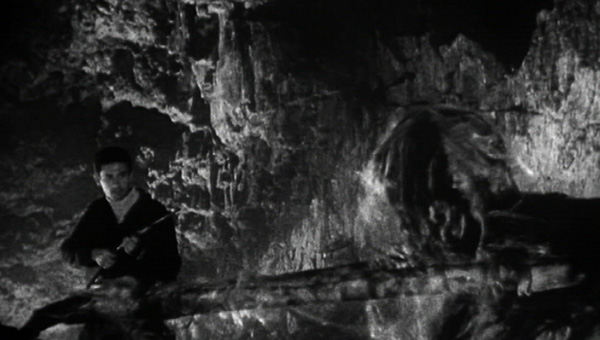
Stevens’ is able to articulate Hellman’s intentional sense of “stasis” in only a couple of brief additional scenes Hellman added to another director’s films in particular to his work on The Terror (1963) with his ”precise use of camera-movement and cutting,” that contributes to “Hellman’s theme of transferred identity”. On Hellman’s aesthetic advancement, Stevens’ writes, “the Filmgroup expansions enabled him to create scenes whose functions was to stall rather then advance the narrative… The Terror demonstrated just how flexible plot markers could be and how they need not lead to anything, but could simply function as free-floating signifiers.”

Hellman met Jack Nicholson working on Harvey Berman’s The Wild Ride (1960), which is a movie the Hellman edited but whose editing is surprisingly credited to a William Mayer (“I don’t think William Mayer was a real person”). They then went on to collaborate together in four pictures Back Door to Hell, Flight to Fury (both 1964), The Shooting and Ride in the Whirlwind (both 1966). The first two are the producer’s Fred Roos Philippines pictures. Back Door to Hell was filmed before Flight To Fury, which has a screenplay by Jack Nicholson (a homage to Houston’s Beat the Devil) and it includes four of the same actors as Back Door to Hell. Quentin Tarantino’s article on Hellman (Sight & Sound, Feb. ‘93) aligns his films in a strong American anti-tradition that includes the masterpieces Kiss Me Deadly, Taxi Driver, and New Rose Hotel. Tarantino refers to Ride in the Whirlwind as one of his favorite Westerns and posits that Flight to Fury is the first of the great Monte Hellman picture.
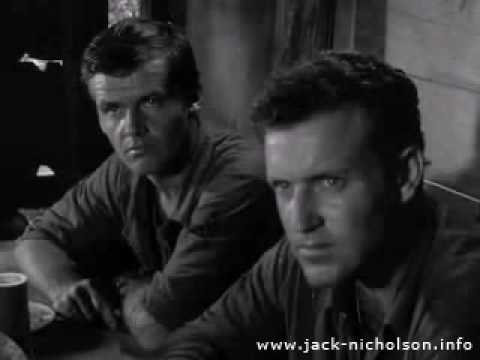
Roger Corman produced The Shooting with a script by Carole Eastman (Five Easy Pieces), under the pseudonym Adrien Joyce, and the film was shot in Kanab, Utah by the Zion National Park. It stars Will Hutchins, Millie Perkins, Jack Nicholson, and Warren Oates (Hellman’s first film together). The Shooting is an abstract work as its richness is in the subtext, in what isn’t said but in what is felt. Two guys pick up a girl and are off to find a man. Nicholson is a black-gloved gunslinger whose eyes hide under his high-crowned wide-brimmed black hat, he begins to follow them. Everything about this western is dark, tormented and austere especially as the girl never reveals her name or intentions or motivations. A child was killed. It is suggested that the woman is the mother out for revenge. The mountains look like hell. The last scene is sublime: it is filmed in slow motion, there are gunshots and Oates whispers his identical brothers name.

Hellman’s Ride In the Whirlwind was shot by regular cinematographer Gregory Sander with a score by Robert Drasnin and a screenplay by Jack Nicholson, which was inspired by Vittorio de Seta’s Bandits of Orgosolo (1960). Robbers harmlessly steal very little loot from a stagecoach, they find a hanging man, there is little talking and a black westerner is in the background. Two opposing groups are in a state of accommodation with a dormant conflict looming. There is a disparate sense of atmosphere, especially as Hellman films people waste down and figures elude a sense of mystery and enigma that are never explained. Hellman’s stylistic decision to create a sense of disparity has a Bressonian quality whether it is through a close-up of a horse’s head or a following mule (an allusion to Balthasar) or through a rhythmic editing style.

Hellman’s early films have the specific quality of capturing Jack Nicholson as star-to-be. Before his mainstay in mainstream Hollywood, before Jack Nicholson became ‘Jack’ as introduced by Billy Chrystal introduced him at the 1993 Oscars. Jack Nicholson was just another actor, a good one, whose titles include Five Easy Pieces, The Last Detail, One Flew Over the Cuckoos Nest, Chinatown, and some art movies like The Passenger and The Shining. In the Corman-Hellman films you see the debut of a would-be-star with the face of an implacable dissatisfaction and a will of non-conformity. Just like Hellman’s cinema where main characters can depart in a passive and nonchalant manner, Stevens’ discards Nicholson casually, though poetically, somewhere in a footnote at the back of the book.

These films are also notable for the casting of the terrific Harry Dean Stanton, whether it is as the eye-patched Blind Dick with a red scarf around his neck or as a wolf-faced hitchhiker slowly moving across the United States. Harry Dean Stanton has been in too many great films as a supporting actor by too many great directors with his apotheosis role being the lead as a romantic loner in Paris Texas. It is worth highlighting his efforts.

In Jonathan Rosenbaum’s BFI Modern Classics Monograph (a series edited by Rob White) on Jim Jarmush’s Dead Man, Rosenbaum furthers a sub-genre: the acid western. According to Rosenbaum, acid westerns are,
“‘revisionist’ westerns where American history is reinterpreted to make room for peyote visions and related hallucinogenic experiences…both ‘acid Westerns’ and ‘pot Westerns’ depend on re-evaluation of white and non-white experiences that view certain counter-culture habits and styles in relation to models derived from westerns but where they differ most, perhaps, is in their generational biases, which leads them respectively to overturn or ironically revise the relevant generic norms”
The westerns typical East-to-West journey is no longer one towards enlightenment and conquest but one of a long stand still, leading to death. Jim Jarmush uses the term “peripheral Westerns.” Though Ride in the Whirldwind and The Shooting have little to do with the indulgence in narcotics, they do revise what is typically expected from a Western as they are more existential fables.

Stevens’ dedicates chapters equally to what Hellman is doing between projects to the films themselves. These ‘In Between Projects’ chapters (they add up to 33 years of waiting) reflect projects Hellman was thematically attracted to, who were his many collaborators, and what movies he worked on (usually as an editor) among other things. Some information that is brought up is contradictory to general record whether it is Peter Bogdanovich claiming he edited part of Roger Corman’s The Wild Angels though Hellman, who actually edited the film, says that that he didn’t. Hellman also edited Bob Rafelson’s Head, though he is now uncredited, and he was supposed to make a movie about a black sheriff in the South, that was cancelled the day before filming.

Hellman is most known for his existential road-movie Two-Lane Blacktop (1971) with Laurie Bird, James Taylor, Warren Oates and Dennis Wilson with a screenplay by Rudolph Wurlitzer (Nog) and the cinematographer is Gregory Sandor (I have written more about the film here). The film is about Driver and Mechanic as they pick up Girl in their Chevrolet 1955 as they move Southwestward from California racing G.T.O who drives a Pontiac GTO. Stevens’ describes Two-Lane Blacktop theme, “that it is the inescapable fact of our ultimate demise which reveals how random contests of chance or skill function as substitutes for more meaningful action.” Hellman uses an interesting approach to actors in this film. He only gave them the script the previous night and as the shooting was in sequence, it meant, that the actors did not know what will happen until the previous night before shooting when they would get their script. Lew Wasseman, who was the head of Universal at the time, did not like the films producer Ned Tanen and gave Two-Lane Blacktop a Fourth of July opening without any advertisement. It did poorly at the box-office.

Next up is the little-known Shatter (1974) which was a co-production between England’s Hammer films and Hong Kong’s Shaw Brothers studio. It stars Stuart Whiman as the entitled character Shatter with a Don Houghton screenplay and John Wilcox as the director of photography. Hellman was fired after two weeks on the job as the producer was disgruntled. There is a LaserDisc with a director commentary by Hellman.

When talking to cinephiles about Hellman there are usually two of his films that immediately come up in conversation that captures the Hellmanesque beauty, exhistentialism and strangeness. These two films are: Two-Lane Blacktop and Cockfighter (1974; which was released on DVD by Anchorbay in 2000). Cockfighter is based on a Charles Willeford novel with screenplay revisions by Earl Mac Rouch and Hellman. The great Néstor Almendros is the director of photography. In Cockfighter, Frank Mansfield (Warren Oates) has sworn a vow of silence after his big mouth on a couple of occasions lost him his chickens and property. He is now trying to qualify for the Southern Cockfighting Conference Tournament. One night he stays with Judge Ed Middleton (Charles Willeford) at a hotel that is later robbed by Steven Gaydos wearing a Richard Nixon mask (Gaydos, is described as Hellman’s “most important collaborator”). Stevens’ describes one aspect of what makes Cockfighter and Hellman’s art so indelible, “For Hellman provides the chickens with a wealth of meanings, working through a whole series of figural possibilities… but if Hellman’s film teaches us anything, it is surely the necessity of abandoning such reductive modes of thinking, where by behavior can be explained or explained away.” And the best description of Cockfighter has been “chicken-sploitation”, which were in the liner notes to its screening at the Mayfair Theater, Ottawa on February 26th, 2011.

Hellman worked on a pre-credit for the television network ABC version of Fistful of Dollars (“While Leone’s protagonist had no name, Hellman’s has no head, face or voice!”) and he would re-make this introduction in China 9, Liberty 37 and that John Carpenter would remake in Escape from New York (1981). The producer Elliot Kastner gave Hellman a screenplay by Larry Cohen entitled A Man for Deajum’s Wife, which eventually mutated into China 9 Liberty 37 (a title that came to Hellman when he saw a sign with the postings on it). Hellman describes the working process as, “This is the only movie I’ve directed where we re-wrote the script as we went along.” As it includes a lot of inserted jokes, like the gag, “show him your nuts” and then Jenny Agutter sticks out her tongue to the man sitting on her right at the carnival. China 9 Liberty 37 is a mixture of a euro-western like the Django series and exploitation cinema as Fabio Testi, Warren Oates and everything else creates a potpourri of acting styles and situations, which show how commercial restraints can impede itself onto the art and affect the final product. The brilliant stylistic decision to use superimpositions will be further executed in Stanley’s Girlfriend and small details like Warren Oates leaving the house to kill a chicken connects the film within the Hellman oeuvre.

Between 1978 and 1987, Hellman finished editing Avalanche Express after the director Mark Robson died. He has a cameo in Michael Ritchie’s An Almost Perfect Affair (1979), which was filmed at the Cannes Film Festival and also set at Cannes he tries to answer, “is cinema becoming a dead language, an art which is already in the process of decline” in Wim Wender’s Chambre 666. While he also appears in Henry Jaglom’s Someone to Love (1987). Hellman would direct, Inside the Coppola Personality, which is a short documentary on the making of One From The Heart. He married documentary filmmaker Emma Webster. While in 1982, Warren Oates died of a heart attack and in the book Hellman contributes a heart-felt eulogy, “He had a quality that hawked back to the great western actors like Gary Cooper, the silent man whose honesty and integrity were apparent from his face.”

Iguana (1988) is based on the 1807 real life figure Patrick Watkins who pirated in the Galapagos that was elaborated by Herman Melville in The Encantadas, which inspired Alberto Vázquez Figueroa’s novel La Iquana, which Steven Gaydos and David M. Zehr’s script is based on. The actors are Everett McGill and Fabio Testi and it was shot in Lanzarote, Canari Islands. Hellman discusses the difficulty of getting the project going and working with an uncooperative producer. The filming circumstances were undesirable as the lighting has yet to arrive and trouble ensued even with the small things like organizing a boat ride or just doing lunch. Stevens’ describes the problematic of the film, when Carmen’s experiences an orgasm while being raped by Oberlus, “Foreground those internalized power structures to which her behavior refers and of which we are all victims… Hellman does not explore the ramification of God’s silence, but rather accepts this silence as a given, depicting the world as an absurd place in which actions have no meaning… whereas Bresson repeatedly expressed his belief in transcendence, the concept has no meaning for Hellman who regards humanity as something to be celebrated rather than transcended.” Oberlus’ face after he sees the new-born child as “the silent equivalent of Laurie Bird’s “No Good” or Jaclyn Hellman saying “I am no good at games.” Hellman is a terrific creator of last moments and phrases as characters depart from the film. Just like how China 9 Liberty 37 is dedicated to Hellman’s father who then recently passed away Iquana is dedicated to Warren.
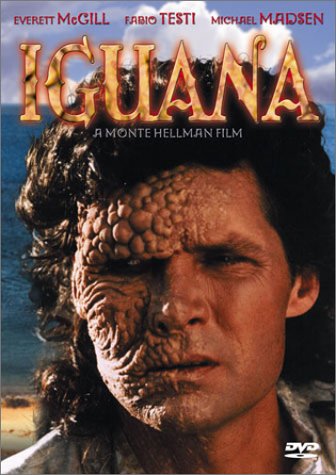
Hellman made Silent Night, Deadly Night 3: Better Watch Out (1989) for a producer friend Arthur Gorson, it is a made-for-TV horror film for Live Entertainment. It includes a lot of in-jokes (i.e. people watching The Terror) and Stevens’ comments that “the feminist aspect of Hellman’s oeuvre tends to become clearer with each succeeding film.” Stevens’ quotes Bill Krohn’s Cahiers du Cinema review of the film who writes, “for whom Newbury’s conflict with Connelly suggests a debate between two different attitudes to Hollywood’s sequel-mania… Newbury, who thinks he was right to awaken Rickey from his coma, wants the sequel to be made, while Connelly who would prefer that he hadn’t does not.”
*****
The book Monte Hellman: his life and films begins with two quotes. The first is by Jean-Luc Godard from Two American Audiences and the second is by Gilles Deleuze from The Movement-Image:
“Before World War I, Eisenstein and Griffith made completely different films, even though Eisenstein learned from Griffith. And Murnau in Germany and Chaplin in Hollywood – they all made different films. But it was all cinema. Where as the Eisenstein’s, Chaplin’s and Murnau’s of today are kept from doing films by people who demand a single universal cinema – which is a dead cinema.”
“The history of the cinema is a long martyrology”.
To expand on these thoughts, here are two other quotes by the same authors. The first is Godard’s manifesto from the press-book of La Chinoise and the second is a larger batch of the paragraph from where the Deleuze quote originated.
“Fifty years after the October Revolution, American cinema reigns globally. There is not too much to add to this. Except at our modest level, we need to create two or three Vietnams at the breast of the immense empire Hollywood – Cinecitta – Mosfilms – Pinewood – etc… and, financially, aesthetically, its-to-say by revolting on two fronts, creating some national cinemas, free, of brotherhood, and of friends.”
“One cannot object by pointing to the vast proportions of rubbish in cinematographic production – it is no worse than anywhere else, although it does have unparalleled economic and industrial consequences. The great cinema directors are hence merely more vulnerable – it is infinitely easier to prevent them from doing their work. The history of the cinema is a long martyrology.”
These quotes resonates the ideological conflicts Hellman’s cinema has been at odds at for some time. On the screenplay of Road to Nowhere, the films producer and screenwriter Steven Gaydos has said,
“I knew one truth about Hollywood… If I put another name on the list of possible directors, they would go past Monte to that other name. And I didn’t want to hear, ‘Oh yeah, Monte Hellman, a genius, a brilliant guy, one of the great American filmmakers, a poet, a fantastic talent, ‘Two-Lane Blacktop,’ a masterpiece. But don’t we have someone else more bankable?’”
The book includes an introduction by Hellman, an exhaustive note section, an annotated project list and filmography, behind-the-scenes pictures of Hellman, and a drawing of Hellman by Joe Sison. It is the history of a career. As Noel King at Sense of Cinema has mentioned in his own book review of Monte Hellman: his life and films, “the book is, among other things, a triumph of e-mail auteurism.” Stevens’ wonderfully examines the effect of camera placement, angle of the frame, concession of scenes, acting, and noise. He quotes Roland Barthes and Robin Wood. And Stevens’ uninhibited enthusiasm for Hellman is admirable.

Over the years, Brad Stevens has created his own cannon of films (I first heard of Stevens from reading Rosenbaum’s review of his Ferrara book), his own ‘Essential Cinema’, if you may, which does not look like any other list out there. He has written two books, Monte Hellman: His Life and Films and Abel Ferrara: The Moral Vision, and is a contributor to the print-publications Sight & Sound, Video Watchdog (which is available in Toronto at Suspect Video) and the online site Undercurrent. His writing only pops sporadically, though I am not too sure, I assume, it has do with either a lack of content he wants to write about or a limitation of what he can write about (Stevens’ also frequents the Dave Kehr forums). While singular reviews might be of interest, what is truly fascinating is how they fit within a larger framework of film-appreciation. This framework comes across in the book and it leads to his helpful grouping of filmmakers, here is Stevens on ‘America’s marginalized filmmakers’:
“Hellman is only one (though certainly among the most important) of America’s marginalized filmmakers: Erich von Stroheim, Orson Welles, Albert Lewin, Nicholas Ray, John Cassavetes, Elaine May, Charles Eastman, Stanton Kaye, Sam Peckinpah, Donald Cammell, Michael Cimino, Abel Ferrara, and so on… All of them were to greater or lesser degrees victims of those financial institutions which theoretically exist to enable the production of films, but actually create obstacles for artist who refuse to conform with the dominant ideology.”
Stevens’ has also championed Spike Lee, James Toback, George Romero, and to include my own additions to the list of ‘victims of those financial institutions’ there is Todd Solondz - who in an interview in Positif with Michel Ciment discusses the difficulty of financing and how he teaches at the NYU Grad Film program to sustain himself, and Whit Stillman - whose new film Damsels in Distress is currently in production as it has been thirteen-years since his last feature. Stevens’ further elaborates on the Road to Nowhere Facebook page, “As usual, all my choices [on his 2010 Sight & Sounds Top Ten list, which has Road to Nowhere as number one] have pretty marginal distribution… It seems that serious cinema is now something that can only happen in the margins.” And I cannot help it, here is Stevens’ introduction to The History of Cinema According to Monte Hellman which a piece he contributed to Cahiers du Cinema (which included interesting observations on Hellman by Nicole Brenez),
“To begin with a proposition: Monte Hellman and Abel Ferrara are the most important working American directors. And if anything could be said to link these two otherwise very different artists, it is surely their lack of neuroticism, their ability, in a culture dominated by the life-denying obsessions of consumerism, to unblinkingly confront the beast in its lair without being captivated by its insidious charm. The result has, of course, been predictable, with Ferrara turning to Europe for financing, and Hellman, like Michael Cimino (now apparently retired from filmmaking), sentenced to increasingly lengthy periods of inactivity. As capitalism enters its crisis stage, it seems that the only position America currently deems permissible in its artists is that of fiddling while Rome burns, the most we can legitimately expect being the work of Friedkin or De Palma, who at least insist on fiddling with (to quote George Orwell's remark about Henry Miller) their faces to the flames.”
*****
Roland Barthes’ discusses in his book The Pleasure of the Text the notion of semantic pleasures that arise from discovering new words while reading, I want to posit, that there are also cinephilic pleasures, which is in writing the discovering of an unknown filmmaker or a positive assessment of a director that has been long dismissed. Stevens’ writing is full of these auteurs. The ones that are either generally over-looked or ones that have received negative scorn critically or lack of visibility due to distribution, he flips those negative or non-perceptions by championing them, some examples, include Marco Bellochio, Otar Iosseliani, Theo Angelopoulos, and, more recently in the Sight & Sound’s 2010 review, he champions Naruse Mikio, whose films, he highlights, are available online for free via the film-sharing websites like karagarga.

In the book Defining Moment in Movies (edited by Chris Fujiwara), Stevens entries include the Key Events; “Alfred Hitchcock sent to prison”, “John Cassavetes appears on the radio show Night People”, and “Jean-Luc Godard punches Iain Quarrier”; as well Key Scenes from the following films: Gilda, The Postman always rings twice, Monsieur Verdoux, Ikiru, Lola Montes, I Live in Fear, Lolita, Lawrence of Arabia, The Leopard, Mouchette, Face to Face, Le Revelateur, Performance, Two-Lane Blacktop, To Die in the Country, The Story of Joana, Mickey and Nickey, Renaldo & Clara, The Shining, Bad Timing, Dr. Jekyll et les Femmes, Star 80, The Beekeeper, The Sicilian, The Caine Munity Court-Martial, King Of New York, Pulp Fiction, Vive L’amour, New Rose Hotel, Adieu Plancher des vaches, Water and Salt, Café Lumiere, and The New World. Some reoccurring themes, from the book and in his writing in general, includes the chiding of “the overwhelming majority of ‘serious’ critics”, the inseparableness of style and meaning, personal projects, Hollywood’s representation of sexuality, social protests, and cinematic humanism.

Another thing that is impressive is the authoritative tone and lack of self-doubt (no, “I think”), clear articulation, and there is no necessity for him to have to defend his views. He does bother to contextualize some of these filmmakers: either you know about them or you do not. This is up to you. These qualities make Stevens one of those film-critics that cinephiles cherish as he communicates through writing what good film-criticism can be and of the possibility of what film can, and ought to, do.

*****
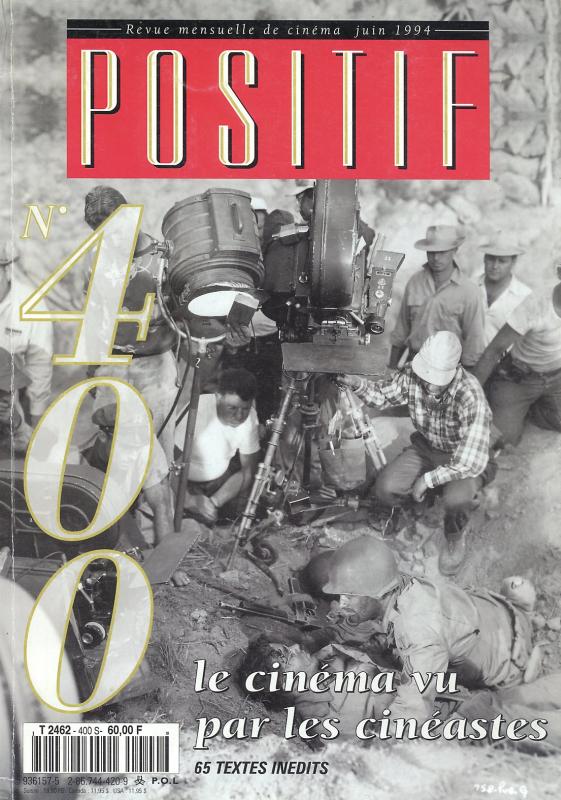
In the 400th issue of Positif (“Cinema seen by the filmmaker”) Hellman writes about his admiration of Víctor Erice’s The Spirit of the Beehive and to describe it he quotes Jean Cocteau, “Un oeuvre d’art devrait en meme temps etre un object difficile a saisir” [“A work of art must at the same time be an object difficult to grasp”]. A film Nestor Almendros, the cinematographer on Cockfighter, recommended Hellman to see, he has now seen it more then a dozen times (another film Hellman greatly admires is Nikita Mikhalkov's Slave of Love). Sometime Hellman receives scorn (and those guys are hacks), like here is a segment from a capsule on Ride in The Whirldwind, “presented at the San Francisco Film Festival’s afternoon under the mistaken notion that Hellman’s lack of experience constituted a naturalistic style… what unreels is a flat, woodenly acted western with mild suspense.” What some film-critics do not see under this ‘flat, woodenly acted’ is its dreamlike wandering and existential aimlessness. It is about people in desperate situations that calmly accept their faiths and an exploration of the typical Hellman milieu. Hellman treats the characters with great sensitivity with acting that suggests ambiguities. And it is appropriate that the title of Hellman’s latest film Road to Nowhere can be a descriptor of all the neurosis driven pursuits that came before them, which never got its hero anywhere.

Stevens’ elaborates Hellman’s fringe cinema-career as “the more restricted his credit, the freer he seems to become,” and, “Hellman’s cinema is a cinema of outcasts, of societal rejects who, however else they might differ, exist outside the mainstream.” Neither of his Westerns The Shooting or Ride in the Whirlwind had an American theatrical distribution until five years after they were made and Hellman’s masterpiece Two-Lane Blacktop was released in the United States on the weekend of the Fourth of July with no publicity, doomed to fail –the studio hated the film.

Steven’s references an intertitle in Buster Keaton’s The High Sign, “Our Hero came from Nowhere – he wasn’t going Anywhere and got kicked off Somewhere.” This is the cinematic lineage that Hellman will be incorporated in. Other masters include: John Huston (one of Hellman’s favorite filmmakers, “I guess every film I’ve made has either been The Maltese Falcon or Outcast of the Island”), Don Siegel (another director that started off being an editor), and Sam Peckinpah (who acts in China 9 Liberty 37 and was also in Siegel’s Invasion of Body Snatchers). Hellman acted with Jean Renoir in James Frawley’s The Christian Licorice Store (1971).

And his influences are lasting on people like Quentin Tarantino (Hellman produced Reservoir Dogs), Vincent Gallo (Hellman was supposed to direct Bufallo ’66), Gus Van Sant, Hal Hartley, Win Wenders, Mika Maurismaki (Hellman appears in L.A. without a Map), Jim Jarmusch and Terrence Malick. While contemporary directors that Hellman admires include Victor Erice (“of course”), Nuri Bilge Ceylan, Fatih Akin, Tsai Ming-liang, and his friends P.T. Anderson, Wes Anderson and Rick Linklater (who programmed Two-Lane Blacktop at TIFF 2001). If you pay special attention in Robocop you might see Monte Hellman in a brief cameo, where he was an uncredited 2nd-unit director. There are also two film documentaries on him Paul Joyce’s Plunging on Alone: Monte Hellman’s Life in a day and Romuald Karmaker’s Hellman Ride which are supposed to be quite good.

Since then Hellman contributed Stanley’s Girlfriend for the omnibus Trapped Ashes, which the Maples Pictures DVD includes isolated as a directors cut. The characters are Stanley (Tygh Runyan), Leo (Tahmoh Penikett), and Nina (Amelia Cooke). Everything takes places slowly, with a romanticisms. Jazz. In a long take, two guys have intellectual conversations within the setting of a b-film directors home. They play chess and the moves are both sexual and deadly. Overexposed lighting contributes to a dream-like quality. There is a moviola. Images of an unrealized Napoleon project. There are precise parallels to the life of Stanley Kubrick at the time that he was marrying the pretty brunette Ruth Sobotka, who he will divorce two years later. But there are also similarities between Stanley’s Girlfriend and some experiences described in the Stevens’ book.

There has been much said about Monte Hellman from people like Quintin at Cinema Scope Online, Olivier Père who reviews Burdeau’s new Monte Hellman book, the New York Times had a piece on Road to Nowhere, Olaf Möller praises Road to Nowhere in his 2010 Venice Film Festival coverage for Film Comment, an interview in Filmmaker Magazine, Kent Jones has an essay The Cylinders were whispering my name (S&S Winter 70/71), Dave Kehr reviewed Two-Lane Blacktop when it was released on DVD by the Criterion Collection and Richard Combs, Richard Jameson and Peter Matthiessen have nice things to say about the guy.

As Tarantino said, “Movie theatres would be much happier places with a new Monte Hellman movie playing in them.” And as Stephen Gaydows graciously brought to my attention, the Road to Nowhere Entertainment One Canadian release is set for May 2011, here is the trailer.

David Davidson