Showing posts with label Steven Spielberg. Show all posts

Sunday, June 21, 2026

Disclosure Day

I couldn’t help but think of Fritz Lang’s Moonfleet (1955) watching Disclosure Day.

Spielberg returns to the contemporary world to continue his alien-films that span from Close Encounters of the Third Kind (1977), E.T. the Extra-Terrestrial (1982) and War of the Worlds (2005), a touchstone subject for him that you can even find in A.I. Artificial Intelligence (2001) and Indiana Jones and the Kingdom of the Crystal Skull (2008). 

The references in the film are to today: it starts at a wrestling match full of MAGA fans, the local Kansas news channel keeps reporting on the escalations of conflict by Russia, there’s an oppressive government-adjacent agency trying to conceal the truth, and the whole revealing to the public of confidential material brings to mind the Epstein files. 

In all of this: Daniel “Danny” Kellner (Josh O’Connor) is responsible for leaking these private documents and videos of concealed historic alien footage; the Kansas City network meteorologist Margaret Fairchild (Emily Blunt), who had contact with them, now has supernatural powers and is acting as a vessel for them; Hugo (Colman Domingo) is the wise director of this “disclosure” movement; Noah (Colin Firth) is the opposition leader that would do anything for this information not to be revealed; and, Jane (Eve Hewson), who is Danny’s girlfriend, a former nun-in-training, is there to experience and both help and hinder in this disclosure project.

The film got me thinking of something I asked Brian de Palma at the TIFF premiere of Passion in 2012. Still green, along with one of my best friends at the time Nick L., after previously seeing de Palma get a ticket to Premium Rush by David Koepp (who wrote the screenplay of Disclosure Day) that he was going to watch during the screening, in the q-and-a, I remarked to him (naively) that I found the film Hitchcockien. De Palma laughed it off, saying that after forty-years making movies that he hopes that he has his own signature on his films.

In interviews for Disclosure Day, Spielberg brought up two autobiographical anecdotes that I was perhaps unaware of prior: that early on in his career he would have loved to make a James Bond film and how once he crashed an Alfred Hitchcock set, who courtly got him kicked out of it (without even an introduction).

After having seen Dr. No (1962) recently you can clearly see the influence of the 007 franchise on how Spielberg films action scenes (notably the car-chases and the kinetic momentum in these sophistic set-pieces) and for Hitchcock in how he builds suspense, balancing the characters and narrative in a constant mode of action.

But obviously Spielberg is more than just his influences, and you feel the last forty years of his cinema in the background of Disclosure Day through the images and scenes from his previous films that reappear. With the emphasis on surveillance, it recalls Minority Report (2002), and through the power of journalism, The Post (2017). 

As if it was a last breath, highlighting the poignancy of previous utterances, repeating them anew and differently, to stress a point. 

Post-WWII footage even harkens back to his previous generation models, that he revered, such as George Stevens and Sam Fuller. 

A recurrent image in late-Spielberg films is the childhood home. That of being a child in one’s bedroom. The riff is obviously to Kubrick’s 2001: A Space Odyssey (1968) and how the astronaut David (Keir Dullea) ends up after a psychedelic episode in this renaissance bedroom. But for Spielberg, it’s the suburban personal space of his youth, a kid’s bedroom. Previously he does it at the end of A.I., Ready Player One (2018) and The Fabelmans (2022). 

There’s something both beautiful and mysterious of the gesture. In Disclosure Day, all the while the chase to get Danny and Margaret together, Hugo almost randomly appears like a filmmaker on a set as in an empty Kansas warehouse where he’s rebuilding Margaret’s childhood home (where the film will climax).

And this close encounter with a third kind, that both Margaret and Danny need to recall, isn’t that of a metaphor for sexual trauma (like in Araki’s great Mysterious Skin, 2004; and who’s new I Want Your Sex I really want to see), but is more mystic and empathic in nature.

Where someone like Eastwood we’re now discovering is retiring after Juror No. 2 (2024), Spielberg is somehow still persisting. And with Disclosure Day we see how he imagines, if they were real (“I want to believe”), how the acknowledgements of extraterrestrials would be done today, in real-time. Through a unique regional broadcaster and then its spreading to all sorts of other channels and international networks. Seeing him play out this challenge is really interesting, I think.

And Spielberg is dropping signs of autobiography. Even though we’re not in the realms of The Fablemans anymore, but in Margaret’s childhood home when there’s a shot of a table with a book on French cooking or in another room a wall of pianos, these are clearly personal cues that are resurfacing.

The French film critic Serge Daney (whose last name has a correspondence with the Danny named character of Disclosure Day) talked about his role as a critic as that of a passeur, the French word for that of a transmitter. In Disclosure Day, Danny and Margaret describe their powers as that of being transmitters. Their powers are that of an intense understanding, empathy and communication that goes beyond any reasonable limits. 

And that’s a beautiful gift, and it’s one worth cherishing. 

Lengthy scenes between Danny and Jane discussing faith, Noah and Hugo discussing humanity disrupt the action, but are fascinating, and are essential at creating a dialogue between two opposing views and for Spielberg to communicate his views on life at this mature time in his life (not since Cosmopolis, 2012, have I found these type of philosophical conversations so well filmed).

The cliché of Spielberg is that he not only sees the best of humanity but also its worst, and that equally applies to his filming where there can be some of the best and worst shots.

Perhaps a little unfair, maybe there’s still a bit of truth of that in Disclosure Day, even though I loved it very much.

I don’t really review films anymore, but my love for Disclosure Day inspired me to do so.

Saturday, October 31, 2015

Spielberg-O-Rama Vol. IV

 
For the publication of Spielberg-O-Rama Vol. IV on Bridge of Spies they'll be a launch on Thursday, November 5th at 7PM at Ronnie's in Kensington Market. I need to thank John Semley, Will Sloan, Alan Jones, Ethan Vestby, and Mitch Ariel again for contributing. Here's a sneak preview, the full articles are only available in print. Hopefully I'll see some of you there!

***


Tuesday, April 28, 2015

Hot Docs 2015: Raiders!


“Did you get the shot?,” asks an explosive technician after he regains consciousness after being knocked out by a plane that blows up five-feet away from him. Growing up in a middle-class household in Mississippi in the Eighties two teenagers, both from divorced parents, escape the sadness and boredom of their lives by deciding to re-create shot-by-shot Raiders of the Lost Ark. What’s so incredible is, with the help of many other kids in the neighborhood, they actually manage pull it off, even though by the end of filming the two friends had stopped talking to each other. Now that they’re both older and they’ve have the chance to reunite they decide to take time off from their work and live to recreate the ending that they couldn’t have filmed at the time: a huge brawl in front of a plane and camel which involves some serious pyrotechnics.

It goes without saying that Steven Spielberg has influenced countless people worldwide throughout successive generations. What’s so impressive here is to see how even when his earlier films were just getting released that they could so profoundly affect these boys and affect them for life. For a few scenes alone this documentary is worth seeing: after sending Spielberg a VHS tape the principal creators of the Raiders Adaptation are invited to Universal Studios to meet the master. This is every Spielbergian dream and you can live it vicariously for a few minutes. 

Thursday, December 18, 2014

Book Reviews: Cronenberg & Spielberg

Consumed by David Cronenberg (Hamish Hamilton, 2014)

 “I’m a very sick woman. Does that turn you on?” Dunja, a Slovenian woman at the Molnár clinic in Budapest, asks the New York journalist Nathan Math. “Well, I told you. I’m a failed medical student. Now I’m a medical journalist. So, yes, I guess sickness does turn me on in a way.” (Pg. 30). A sick woman, who is about to get an illegal radioactive treatment for her breast cancer, tries to seduce a medical journalist, and they end up having sex. She transmits to him a rare STD, the Roiphes disease, which he ends up also passing to the women that he’s seeing, Naomi Seberg. Naomi, also in the field, is researching to write a book on the case of Aristide Arosteguy, a famous philosophy professor, who left his native France for Japan, after being investigated for cannibalism, eating his wife Célestine. The title of the book comes from Barry Roiphes, the now-retired doctor famous for discovering the disease, who wants collaborate with Nathan to tell his life story, work history, and his experiments on his daughter, Chase, who is now dealing with some mysterious form of post-traumatic stress.
Surrounding all of this is the ghost of the Simone de Beauvoir-like Célestine, who’s never encountered because she was supposedly eaten (the description of the photographic death scene is nightmarish), but who prior was sexually promiscuous with her disciples, who Naomi is now interviewing. Célestine and Aristide describe themselves as open to ‘philosospams’, episodes of obsessive behavior involving sexual affairs or political activity. After the two professors attend the Cannes film festival as a jury members, Célestine becomes obsessed with a controversial North Korean film, The Judicious Use of Insects, which she suspects her former lover Romme Vertegaal made under a pseudonym, specifically for her. This experience causes in her a rare form of apotemnophilia, and she starts to believe her left breast is infected with bugs and would stop at nothing to get it removed. (The diagnosis scene appears in a slightly altered form in the EYE Film Institute commissioned Cronenberg video, The Nest starring the raw Evelyne Brochu).
What is it about episodes like these – typical of Consumed in their mixture of Eros and Thanatos – that draws people towards the works of David Cronenberg? Sex, disease and death. Journalism, cameras, and social media. This is the shadow world of Consumed. It’s these taboo themes and obsessions, which are typically repressed in everyday life, that are brought out into the open and freely indulged. In Cronenberg’s world, more general human experiences like relationships, education, professions, growing old, diseases and death are heightened towards an extreme, parasitical level.
This theme of the parasitic and infections is everywhere in Consumed. Nothing is safe from it. If something bad could happen, then it will. No wonder Stephen King praises the book. But there is almost a mathematical and scientific structure to how it unfolds, just like in a Cronenberg films. After Cronenberg’s more recent gangster films (A History of Violence, Eastern Promises) and probing the subconscious (A Dangerous Method), now he’s returning to the original body horror of his early career, but the world is different and its implications scarier. So similarly to Maps to the Stars, Cronenberg’s most romantic film in the Goethien sense, or Cosmopolis, in Consumed and in these recent works, the worlds, both individual and social, end up falling apart. For example, Agatha is scarred with burn wounds (among her other psychological and physical problems), Eric Packer has an asymmetrical prostate, and in Consumed bodily mutations and deviations are rampant. But even if the world is dark, there is still a beauty to this gesture of showing it fall apart and disintegrate in its multifaceted forms.
There are many episodes from Consumed that bring to mind ones from other Cronenber films. The journalist protagonists and their globetrotting adventure recalls Naked Lunch, the medical setting and the procedures that go awry makes one think of Dead Ringers, the carnal love affair that takes place in Asia is reminiscent of M. Butterfly, and the mad scientist character could be right out of The Fly.
Cronenberg had always wanted to write. Originally, after his first two underground films (Stereo, Crimes of the Future) he moved to Tourrettes-Sur-Loup, France to try to become a novelist. But he would return to filmmaking, as he tells Serge Grünberg, because it was “a ‘modern’ way of writing.” And with his filmmaking practice he would remain loyal to writing: creating his own stories, writing his own screenplays, and adapting novels. And in this period he would have close working relationships with many esteemed novelist including King, William S. Burroughs, J.G. Ballard, and Don DeLillo.
            It’s worth noting Cronenberg’s popularity and relevance. Where other older directors like Peter Bogdanovich or John Sayles can no fund their films and start taking up other projects like film blogging or novel-writing, with Cronenberg there isn’t the sense that he ‘lost it’ with the mass public. In the ten years since the president of the publishing house Hamish Hamilton, Nicole Winstanley, asked him if he wanted to write a book, throughout his sixties he was able to artistically reinvent himself, working with some of the most famous young stars, Robert Pattinson and Mia Wasikowska, on the two critical successes Cosmopolis and Maps to the Stars.
So the next question: is David Cronenberg a good novelist? Yes. With Consumed, at a length of 284 pages, he crafted a gripping page-turner, which isn’t clumsy in its prose, and in it he creates both a world distinct to itself, and one that is in parallel to his body of work as a filmmaker. Though let me said, if it wasn’t written by him it would probably have received a lot less attention. But Cronenberg is still great at creating interesting characters, atmosphere, dialogue, and intrigue. There are two parallel stories that take place and the switching between them is never awkward. Though there is a section where Aristide is describing what has happened to Célestine, which goes on for too long at 50 pages, and lacks the multi-character energy of the rest of the book.
The Nabokov influence, which Cronenberg speaks of, is there, as they are both cerebral writers that regularly bring up major ideas of continental philosophy and psychoanalysis, along with a wider openness towards the arts and culture. Cronenberg is especially fond of describing cameras and lenses, though maybe too much.
Naomi is as complex and fascinating as Maxine Tarnow from Thomas Pynchon’s Bleeding Edge, both young women investigators. And there are also similarities between Consumed with the world of Infinite Jest, as in both works the authors critique the growing use of technology to mediate interpersonal relations, and the role of entertainment in our culture and its ability to become a gross obsession. As well Dr. Roiphes’ project seems similar to James Incandenza’s, and Consumed bleak and ambiguous cliffhanger ending also recalls David Foster Wallace’s.
On a potential adaptation of Consumed, Cronenberg has said: “I’ll let David Fincher or Neil Jordan destroy my novel.” And he presently does not have any new projects in the works.

***
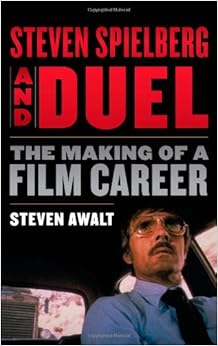
Steven Spielberg and Duel: The Making of a Film Career by Steven Awalt (Rowman & Littlefield, 2014)

Steven Awalt's new book, Steven Spielberg and Duel: The Making of a Film Career, is about a little-known period in the director’s career. For an older generation, the film might be known for its acclaimed television screenings, for a younger one it might not be that familiar as Spielberg is now more associated with his classics like Jaws, the Indiana Jones films or Jurassic Park. What is it about Spielberg’s early career that demands re-evaluation? Even the author of Steven Spielberg and Duel doesn’t deny that the film is “a somewhat forgotten work.” But according to Spielberg himself, Duel is “the key to unlock a career for me.”  So with that, the book’s aims are two-fold: it explores Spielberg’s early television career at Universal, and it tells the equally gripping narrative of the film’s production.
While Spielberg’s early career is usually treated cursorily, in Steven Spielberg and Duel Awalt does it justice by making it the subject of his book. Awalt, who is a scholar on this period in Spielberg’s career, focuses on Universal’s television production and Duel’s many collaborators that would lead to make the film a reality through its different stages of production. The television dramas that Spielberg worked on, and which are discussed in depth, include his episode Eyes starring Joan Crawford for Night Gallery, LA 2017 for Name of the Game, and Murder by the Book for Columbo. In this period the economic restrictions of the productions instilled in Spielberg a quick working practice. Spielberg was working with a lot of older technicians, many from the classical studio era (and was sometimes in conflict with them), which led to a rich collaborative atmosphere. The many collaborators of Duel include its lead actor Dennis Weaver (Spielberg was a big fan of his performance in Touch of Evil), author and screenwriter Richard Matheson (whose screenplay is included in the book), director of photography Jack Marta, stunt coordinator Carey Loftin (Bullitt), editor Frank Morriss, composer Billy Goldenberg, producer George Eckstein, and studio executive Sid Sheinberg. This impressive group led to a creative atmosphere that gave Spielberg the creative freedom to make Duel especially cinematic. It’s practically a non-verbal sensorial experience as its story is told through ambitious filmmaking techniques more so than the conventional ones associated with the television of this period, which includes impressive mobile shots following the car, a long-take into a café, and dramatic staging during the confrontations.
The origins of Duel begin with Richard Matheson who was inspired to write the original short story after a similar experience happened to him. The murderous truck of Duel, which pursues David throughout the film, is a significant villain for multiple reasons. First off, he is significant as a faceless antagonist, which is the catalyst for the film’s Hitchcockian wrong man narrative. Secondly, the chase story would become a regular structural trademark for Spielberg. And thirdly, as a symbol of an environmental problem, as its petrol freight reflects a natural resource that is constantly and recklessly exploited under industrial capitalism.
Also related is Duel’s critique of patriarchy. The film begins with a travelling salesman named David Mann driving down a desert highway. He is listening to the radio where on a talk-show a caller is discussing a survey where he admits that he’s no longer “the head of the family.” Shortly after the driver stops at a roadside Laundromat to call his wife in which they continue their argument from the previous night. Like the son Michael Brody from Jaws who can’t connect with his father, or Roy Neary in Close Encounters of the Third Kind who runs off from his family, or lonely Elliott in E.T.; Spielberg is presenting the disintegration of the nuclear family. And as he expands upon in his Suburban trilogy (Close Encounters, E.T., Poltergeist), Spielberg in this early stage of his career is chronicling issues surrounding Fordism and the growing class of American society and especially the complexity of their emotional lives.
In the book, Awalt engages with the discourse around Duel by employing a close reading of every scene in the film. Awalt is especially critical of Andrew M. Gordon’s contentious psychoanalytic reading of the film. The side-bars and footnotes in the book offer a wealth of supplementary information regarding the film. There are side-bars that focus on the swearing that had to be censored, harbingers, its class consciousness, and how some of its footage would be used in an episode of Hulk (to Spielberg’s chagrin). Awalt debunks the myth of a young Spielberg escaping the Universal Bus Tour and setting up shop, as the truth is that his father knew a librarian that sponsored him as an intern. And there is a fascinating footnote of Spielberg’s rare cameos in his own films.
In terms of Spielberg making-ofs, Awalt’s book isn’t as richly illustrated and colorful as some of the other ones (The Complete Making of Indiana Jones, Memories from Martha's Vineyard). But it’s as gripping and informative as either Carl Gottlieb’s The Jaws Log or any of Laurent Bouzereau’s special features. There is a charm to the modesty of the project, in comparison to more theoretical film books, and Awalt’s sense of story-telling is open, fun and generous. For example, if in Ray Morton’s book on the making-of Close Encounters of the Third Kind he makes the argument that it’s Spielberg’s first personal film because it owed to his earlier teenage film Firelight. (Spielberg himself typically identifies his first personal film as E.T.). Awalt pushes this intertextuality even further by arguing that Duel owes to Spielberg’s earlier train-crash home movies that he’s famous for bringing up. It’s the casualness and insight of observations like these that reflect a deep knowledge and contemplation of Spielberg’s cinema, which makes Awalt’s analysis so pleasurable to read.
Steven Spielberg and Duel: The Making of a Film Career stands alongside the other note-worthy recent Spielberg books that includes: James Kendrick's reconsideration of Spielberg’s oeuvre which argues for the persistence of his pessimistic themes and the complexities of its ideological incoherence (Darkness in the Bliss-Out), Richard Schickel's general overview and interview with the director (Spielberg: A Retrospective), and the official book on Schindler's List and the USC Shoah Foundation.

Sunday, November 30, 2014

Godard ≠ Spielberg ?

"Although Godard an Spielberg certainly differ on a number of points, it is easy to see from a brief glimpse at their respective filmographies that it is easy to see from a brief glimpse at their respective filmographies that the two, in fact, share a common interest in film history and twentieth-century history. When Godard first clearly depicted his interest in World War II in hi short film Le Dernier mot (1988), Spielberg was filming his Empire of the Sun (1987). Furthermore, Hanns Zischler, an actor who plays a dual role in Le Dernier mot as a German officer and his son, also cooperated closely with Godard's Allemagne année 90 neuf zéro (1991) and played the role of a document forger named Hans in Spielberg's Munich (2005). In addition, Godard's preparation and production periods for Histoire(s) du cinéma (1988-98), which features the death and resurrection of cinema during World War II, particularly the Holocaust, overlap with those of Spielberg's Empire of the Sun, Schindler's List (1993), and Saving Private Ryan (1998), all of which also focus on World War II. For that matter, it is almost as if Spielberg's filmography was moving upstream against Godard's filmography. For instance, the Black September Organization links Spielberg's Munich (2005), whose story begins from the terrorist incident caused by this group, and Godard and Jean-Pierre Gorin's project Jusqu'à la victoire, which was left unfinished because of the Black September incident of September 1970. It is also true that the 1968 Chicago Conspiracy Trial, the subject matter for one of Spielberg's new projects, is a thme also handled by Godard and Gorin's film Vladimir et Rosa (1971).
            If we keep in mind this affinity between the two directors, Godard's repeated criticisms of Spielberg come to resemble a type of defense mechanism. For instance, take the 1998 interview conducted by the magazine Les Inrockuptibles. From the very outset, Godard tossed around remarks such as "I can't say that I'm envious of Spielberg" and "There's no need for me to get on my knees for him." And, aside from the opening scene depicting the invasion of Normandy, he leveled a negative evaluation toward the then just-released Saving Private Ryan in the name of Anthony Mann's Men in War (1957). Psychoanalytically speaking, it is not difficult to note a sort of denial on Godard's part when he abruptly mentions a famous commercial director's name without being asked about it, and avoids the confrontation with the recent film by taking refuge in the cinephilic past.
            We focus here on the fact that this kind of rash and even envious renouncement of Spielberg by Godard was rather pronounced in the 1990s, when his critical rhetoric against the United States was also prominent. For example, the question of why people would prefer to go watch a bad American movie rather than a bad Bulgarian movie - a clever quip that only Godard would make regarding the overwhelming supremacy that Hollywood enjoys in the global market - frequently came up during interviews at the time. In fact, Godard's criticisms of Spielberg were singled out by Godard as the representative of insincere filmmakers who naively cling to the circumstances surrounding the hegemony of Hollywood (recall that Godard has always been interested in the economic, cultural, and political situation of film production). This connection reached its peak in Godard's Éloge de l'amour (2001) in which Godard attacks Spielberg almost farcically as a representative of a Hollywood/America that appropriates other people's memories - memories of the Resistance in particular. However, viewed from a different perspective, Godard's complacency here in simply providing sarcastic banter prevents him from directly facing Spielberg's films.
            It does not require psychoanalysis to recognize that Godard denies Spielberg because, for him, the latter's films are objects of desire. For Godard, the most haunting object of desire is almost certainly Schindler's List. In 1995, when the New York Film Critics Circle attempted to bestow a special award upon him, he rejected it. The foremost reason for doing so was that "JLG was never able through his whole movie maker/goer career to prevent M. Spielberg from rebuilding Auschwitz." Why in the world would Godard express such heated animosity - an animosity close to an infantile aggression - towards Schindler's List?" Perhaps it is because, in a manner of speaking, Schindler's List was a film that usurped some of Godard's ideas as to how to represent concentration camps."
An extract of Junji Hori's Godard, Spielberg, the Muselmann, and the Concentration Camps from The Legacies of Jean-Luc Godard (WLU Press).

Wednesday, November 5, 2014

Spielberg on Kubrick

"For such a rational man, 2001: A Space Odyssey was a step beyond rational. It was all very ordered - maybe his most ordered film until the very end. He let you see that all of this order was leading to something you could not comprehend but was experiential: it was illustrating emotionally what the next evolutionary step was going to be - and you can't do that rationally. 2001 is the emotional illustration of the terrible limits of intelligence, and it's ironic that this most intellectual of American film-makers is the one who succeeded in allowing the irrational to be grasped by audiences of all ages. The Star Child at the end of 2001 is to me the great moment of optimist and hope for mankind that has ever been offered by a modern film-maker." - Steven Spielberg
***

Monday, July 7, 2014

On Firelight

Like all children of the 1950s, young Spielberg was captivated by the flying saucer craze and wished desperately to see one for himself. He didn't, but some of his friends did. While on a Boy Scout camping trip that Steven missed, his troopmates reported seeing a brilliant circle of red light rise up over the desert and fly off into the sky. When Steven learned that he had missed out on seeing a genuine UFO, he was devastated. He vented his frustration by writing a sixty-seven-page screenplay called Firelight - the story of three mysterious balls of light that descend on a small Arizona town and begin kidnapping the inhabitants. A team of scientist investigates the mystery and eventually discovers that the kidnappings are being perpetrated by members of an alien race called the Altarians, who transport the humans to their home planet and place them in a zoo. Typical for the era, the aliens are portrayed as menacing creatures who intend to have their way with the human race by brainwashing it into submission. 
To produce Firelight, Arnold and Steven founded a partnership capped American Artist productions, with both chipping in to cover the $600 dollar cost of filming. Steven once again recruited family members, friends, and classmates to work on the movie and to perform in it. Beginning in June 1963, Steven shot scenes in his home, in the homes of friends and neighbors, and in a variety of locations around Phoenix, including Camelback Mountain, Sky Harbor Airport (where Steven managed to persuade American Airlines to allow him to film on board one of its planes in between flights), and in a variety of locations around Phoenix, including Camelback Mountain, Sky Harbor Airport (where Steven managed to persuade American Airlines to allow him to film on board one of its planes in between flights), and in the Baptist Hospital (where he was given the use of an empty room and an oxygen tank). The production attracted a great deal of attention, and the Arizona Republic published two articles and a photo spread about the movie. Steven used a wide range of effects, from miniatures to stop-motion animation to some simple but effective opticals (e.g., the firelights were created by putting gels over lights and then superimposing them on the live-action footage) to bring his story to life.
Filming wrapped in December 1963, after which Spielberg began four months of post-production. He edited all of his footage into a 135-minute final cut, often (with his mother's permission) faking sick and staying home from school to do so. He created a sound effects track and then recorded the actors' dialogue over it. Finally, he composed a score on his clarinet, which he then got his high school band to play while he taped it. By March 1964, the film was finished. Through a family friend, Steven arranged to premiere Firelight at the Phoenix Little Theatre. An extensive publicity campaign was mounted, programs were prepared, and a spotlight was borrowed from a local merchant. Steven and the cast arrived at the theater in a limo. The screening sold out (grossing an estimated $800 for a net profit of approximately $200 - Steven Spielberg's first box office success). The film made a tremendous impact, earning cheers and applause from the enthusiastic audience.

By the time Firelight was finished, Steven knew that he had found his calling. He had become enthralled with the medium of film and the power it had to grab viewers and involve them in an immediate and visceral way. Moreover, he loved being the person who made that happen ("I love to grip an audience and watch them lean forward in theirs seats.... I like involving the audience on a level of total participation") and wanted to make doing so his life's work. "I knew after my third or fourth little 8mm epic that this was going to be a career, not just a hobby...."
An extract from Close Encounters of the Third Kind: The Making of Steven Spielberg's Classic Film by Ray Morton (Applause, 2007) on Spielberg's first full-length feature, Firelight.

Our hero

Monday, June 2, 2014

Steven Spielberg at Cahiers du Cinéma (70s & 80s)

Where North Americans tend to denigrate their popular and low culture, in France, in some circles, there is almost an opposite tradition of appreciating the popular forms of American life (cf. their well-known interest in crime thrillers, Faulkner, Poe or Jerry Lewis). This gesture proposes a different way to look at a familiar subject, is genuine, and is iconoclastic against a rigid academicism. Cahiers has only done two 'best of the decade' group lists and those were in the 90s and 2000s (cf. their lists), and one thing that distinguishes them from other forms of film criticism, however much their editorial team changes, is their constant interest in film as an art and in particular their interest in popular American cinema to illustrate this. On their 90s list the American directors that were included are De Palma, Eastwood, Kubrick, Lynch, Cronenberg, and Burton. On their 2000s list it included Lynch, Van Sant, Cronenberg, Spielberg and Malick. If one looks at the activity of all of these directors since they started filmmaking, being received at Cahiers, and where they are at now... it would look like Steven Spielberg has reached the point of being one of the most important American directors at the magazine. For one to get Cahiers one must get Spielberg. He’s an important director. Here are the early Cahiers reviews of Spielberg’s films as he was making them. – D.D.
 
***
Jaws. l’écran du fantasme, Cahiers Critique by Pascal Bonitzer and Serge Daney (Cahiers, March-April 1976, N.265).

Bonitzer’s review is in three parts: Splash, Jaws, and Catch.
“1. Splash. “It shakes you, and grinds and then… eats you!” It’s the shark, the great white, described by Quint at the first apparition of it. We are tempted to also see this as a definition for this type of cinema. This scene illustrates: it shakes you, this is its first degree, the suspense and how it scares you; it grinds you, this is its second degree, the sympathy for its hero in face of danger, the human community who, in a dark cinema, in front of this horizon of water and the tension from the beast within it, who are being united; and then it jumps outs! One more time the law of the Heart, a social paranoid, a familial petit bourgeois that is insidiously bitten, to the rhythm of the great jaws of the shark. We can then apply the phrase of Quint more largely to the entire social system, to the society of the great white (the shark isn’t called this for no reason), to the society, this “fleur carnivore”, which was one the slogans of May ’68.”

“The power of the metaphor: the shark’s jaws opens the film towards multiple interpretations. The social impact of this kind of cinema is like a fishing hook to catch phantasms, deliberately mythic, resolutely epic (in comparison, to European cinema, and even more so to French cinema, which for the majority, appears like a cinema of the bedroom, and especially when it wants to be mysterious a la Melville, Verneuil or Labro).”
In conclusion Bonitzer writes,
“What exactly is it in definitively? Exactly what it is in The Exorcist (where there were three priests) but where Jaws is much more closer to The Birds: it’s the sensory pleasure of sexual attraction that it knows how to conjure, and the great shakes that that panic has on the body.”
**
Daney in his review brings up the connection between the violence in Jaws and pornography through Jacques Lacan’s concept of jouisansse (Daney and the magazine in this period is still under the spell of psychoanalytic analysis). Like the English critic Robin Wood, Daney’s writing is characterized by a military-vest wearing social criticism. Jaws is compared to other catastrophe films like The Infernal Tower. Of note is how Daney begins his review by describing a production still (an issue for him throughout his career) of Richard Dreyfuss during the making of the film,
“The smile of its star Richard Dreyfuss justifies itself. Jaws is first off the biggest commercial success of the cinema. But paradoxically, in terms of the Parisian box office, in its four week run, has lowered incredibly. 309 158 spectators in its first week (including myself, S.D.), 241 160 in its second, 177 785 in its third, 124 144 in its fourth. This free fall is just another aspect of its program: the vision of the film is nothing but part of its ultimate operation of the process of becoming a brand (publicity, style, t-shirts etc.). It is, in itself, an indifference.”

“The smile of Dreyfuss has other reasons. It’s a smile for a behind-the-scenes photograph. Its function is to be distributed to film magazines, which is a derisory support, because the magazines would prefer a photograph of a scene from the film, or even better, a photogram of the film itself. Its function is to say, with a smile, that the underwater cage that he’s in (special effects, décor) put in place in the film is real, that the cage is a real one. The photo during the film’s making, it’s the way for Hollywood to give a way to see, not the process of the making of the film, but the reality of the troubles of production, and through this, and these troubles is the last word from this imperial metropolis in terms of images and sounds.”
***
Close Encounters of The Third Kind. Cahiers Critique by Jean-Claude Biette (Cahiers, April 1978, N.287).

A mixed review of the film, Biette compares it to Hitchcock’s North by Northwest and emphasizes its use of the cinema screen in relation to the televisions that are included within the film (“Beyond the class fights, wars, and massacres that each tele-spectator incessantly sees images of, it is finally possible to see, with total fidelity to its presentation and realization of the big screen, that the terrestrial humanity has a purpose and that its History, however delirious it may appear, has a sense.”), and he notes the subtlety of Francois Truffaut’s acting in the film.

***
1941. Notes sur d’autre films review by Serge Daney, (Cahiers, May 1980, N.311).

The highlight of Daney’s review,
“The best Spielberg film? … From its original concept, 1941 has an ambitious tentative, of being a burlesque super-production that, in its own failure (the film isn’t that funny), is more interesting than any other Spielberg film. For one reason because the burlesque, better than terror (Jaws) or science-fiction (Close Encounters), allows Spielberg’s misanthropy to be free (without saying anything about his misogyny) … And for other reasons because the burlesque allows Spielberg to reflect on cinema, and his own cinema.”
***
Raiders of the Lost Ark. A dossier Lucas/Spielberg: Raiders of the Lost Ark with three texts: George Lucas, un cineaste conceptual by Olivier Assayas, an interview with Lucas by Mitch Tuchman and Anne Thompson (originally published in Film Comment), and La grace perdue des aventuriers by Olivier Assayas (Cahiers, October 1981, N.328).

Olivier Assayas begins his essay on Lucas as a conceptual filmmaker,
“There is a Cioran aphorism that I can’t seem to find its original trace that said something like: “one must be worried about what one wants to become because we will become just that.” It would be hard to find a better application of this than in the trajectory that has brought George Lucas from the editing table to his present situation as the chief of a powerful counter-point to Hollywood.”
Assayas discusses Lucas. His most conventional film, American Graffiti; his coldest film, THX 1138; and that, “Since his beginnings, Lucas has never wanted to do like other people.” Assayas discusses Lucas in relation to the other cinephile-directors of his generation and that he is distinguished from them by not revering classical Hollywood or the false radicalization of the times.

Lucas is seen as a constant experimenter. Assayas highlights the radicalness of American Zoetrope with Coppola and Lucasfilm, and their conviction of creating an alternative system. And with his renewing, changing entirely the industry. This is in contrast to other directors of his generation like Friedkin, de Palma, Scorsese, Schaffner and Spielberg.
“His quintessential disdain for content in favor for formal and structural preoccupations used to be typically associated with the underground filmmakers that Lucas voluntarily cites as influences. Therefore the giant machine that he is today trying to create is in this respect comparable to the micro-systems of the avant-garde in that it is destined not for the production of works but towards the delimitation of an autonomous place of survival.”
Assayas concludes,
“George Lucas is foremost a conceptual artist. He learnt quickly that in the system that he has created there was only enough place for one filmmaker: himself, an auteur whose dispositive prioritized his own oeuvre. A creator of machine, a creator of objects. The others can deal with films.”
**
In the interview between Lucas and Tuchman and Thomson (which is translated by Assayas) they discuss Industrial Light and Magic, Lucas’s role as a producer, relationship with Coppola, work on Star Wars: Empire Strikes Back, ideas on experimental films, work on Raiders of the Lost Ark, what he likes, realities of filmmaking, and watching rushes on cassettes.
**
Assayas was an important voice in this post-Maoist period and whose reviews and ideas reflect an important transition at Cahiers (cf. his de Palma review as well). The Positif review by Robert Benayoun is also incredible, where he, in a good Surrealist tradition, describes the film in terms of the pleasure it invokes, how the French intellectuals are better at appreciating this than Americans ones, and its relation to the silent films serials.

In his review of Raiders of the Lost Ark, The lost grace of the adventurer, Assayas describes the influence of TV’s seriality on these Lucas-Spielberg films, and how this is re-stabilizing cinema, which for a long time has been unstable. If cinema is an industry than it needed entrepreneur’s to believe in it. Raiders is contrasted to Franklin Schaffner’s Sphinx (with Raiders being the better of the two).
“George Lucas founded in one part his success on this rather simple idea, which is that the cinema-going public, which has been educated by television and comic books, wanted to find on the big screen the habits of their reading patterns. Where the cinema continues to persist to draw its inspiration from a Romanesque form, which was the dominant form for the previous generation – who were still reading – Lucas, not without being demagogic, captures a fundamental attachment of the adolescent spectator for a structure of episodes and of familial characters that constitutes the connection between one film and another.”
“In short, if the screenplay of this exotic adventure is presently dead in its contemporary form, its cadaver still needs to be torn apart. Raiders of the Lost Ark does not refer to these adventures as they are, neither to the dreams of a generation who saw the explorer or archeologist as a modern hero, but instead more to the references and accessories of its cinematographic tradition, which it exhaustively exploits.”

On the film’s final shot Assayas writes,
“The last shot of the film shows the ark of the film’s title put enclosed in a wooden box and that is transported on a Fenwick, and the camera pulls back and we discover a bunch of identical cases archived ad infinitum in a giant hangar. Its difficult not to say that this is a great metaphor for the cinema of adventure as Lucas and Spielberg sees it: a studio a little dusty where one must just enter and open up a few cases that have been closed for too long to give life again to these emotions that have been forgotten.”
***
E.T. – The Extra Terrestrial. The cover and featured dossier, Spielberg, E.T. and Comics: The E.T. Summer by Bill Krohn, and Peut-on etre et avoir E.T. by Jean Narboni (Cahiers, December 1982, N.342).

Krohn, the new American correspondent in this period, discusses E.T. in relation to its American reception and distribution. The piece is part journalistic - it reads more like Variety than Cahiers - and its more observation than criticism. Krohn cites the reception of the film by the general press, and contextualizes the difference in reception by the Americans from the French. Krohn sees how E.T. is already a more personal film for Spielberg than was Raiders. He emphasizes the Disney (Fantasia) and Chuck Jones (Duck Dodgers) influence on Spielberg and E.T., and there are striking illustrations to back up his points. Krohn also brings up for the first time Spielberg’s earlier films, Sugarland Express and Duel, which were never reviewed in Cahiers.

Part of Krohn’s review is transcribed in Clelia Cohen’s nice Masters of Cinema book on Spielberg (which I’m citing below),
“Perhaps the best way to get at what is new about the film is to look at the tradition it grows out of. Where does Spielberg come from? From animated cartoons – he has never made a secret of it in his interviews… the names he most frequently mentions are Walt Disney (‘The first film I remember seeing was Snow White and the Seven Dwarves’) and Chuck Jones, a maverick Disney animator who became the undisputed master of animated slapstick at Warner Bros., where he directed Bugs Bunny and Daffy Duck in some of their best films, and created Wile E. Coyote and the Roadrunner. Jones, whom Spielberg invited to act as ‘technical consultant’ on 1941, seems to be the primary influence… E.T. is a Chuck Jones character living out a Disney scenario – orphaned, adopted, dead and resurrected, rescued at the end – without ever losing his anarchic comic energy, or the touch of mystery that all Jones’s ‘special’ creations share. (The children in the film are also the kind of children – hip and foul-mouthed – that Jones, but certainly not Disney, might have imagined watching his work. (Morphologically, E.T. is distantly related to the Martin character in Duck Dodgers in the 24 1/2th Century, who consists of a bowling ball with huge expressive eyes, a spindly body and an oversized pair of tennis shoes, but his nearest ancestor is probably the Magic Frog in Jones’s masterpiece, One Froggy Evening (1956). In that cartoon, a construction worker who unearths a frog from the cornerstone of a condemned building is startled when the creature breaks into a high-stepping rendition of ‘Hello, My Honey’ in a voice like Al Jolson’s. Sure that his fortune is made, the man rushes to a theatrical agent with his find, but the frog refuses to sing for anyone but him. By the end of the film his greed and the frog’s obstinate refusal to perform have reduced him to penury and landed him in the madhouse. The ending of E.T. is more optimistic. Elliott’s first response when he finds his Magic Frog is selfish – ‘I’m going to keep him,’ he says fervently – but E.T., on the point of death, is able to teach him the necessity of sooner or later letting go … Spielberg’s hands, Jones’s dark fable has become edifying, sentimental; it has been re-Disneyfied, and this does not necessarily imply a criticism. Spielberg’s strategy is the strategy of a whole generation, who have created a cinema haunted by modernism (Jones, for example, or Welles) and aspiring to classicism (Disney or, for example, Ford): their Masters’ Masters, to put it very schematically.”
**
While Narboni, a Seventies Cahiers writer, discusses E.T. more in terms of its marketing and distribution in France (this is probably how its current editor Stéphane Delorme must have saw it, which he remembers nostalgically) and he argues for the necessity of a film criticism that can look beyond this promotion and omnipresence. The title of the piece, Can one be and have E.T.? comes from a question Narboni asks himself, “Childhood, can one both experience and have it?”, which will also be referenced when Cahiers would get more into Spielberg in the 2000s in particular by Jean-Sébastien Chauvin. Narboni calls E.T. a mature film and he describes it in philosophical terms with references to Nietsche and Lyotard.
“I would say without any doubt that E.T. is an intelligent film, inventive, emotive and sly, and the best Spielberg film in my opinion, as it fulfills every checkmark of the cinematographic machine, and its much superior, for example, to not go too far back, to the falsely lucid Raiders of the Lost Ark and even to Poletergeist, whose splendid original idea, exploited by Tobe Hooper with the intelligence and delicacy of a chainsaw, gets worse with each minute of the film.”
Narboni concludes,
“In one way, the story of Spielberg’s film resembles a poem: fantasies and the fears of solitary children, many years later, are remembered by the filmmaker who he would later become, manipulated, poeticized, illuminated by a blue night – all of this makes this golden dream, E.T., a beautiful film."
***
Indiana Jones and the Temple of Doom. Cahiers Critique, Photocopie, by Charles Tesson (Cahiers November 1984, N.365).
Tesson's review is short enough and is pretty negative. It is as well the first reference in Cahiers between Spielberg and Indiana Jones to Tintin, which Spielberg would later make into a film. Tesson is also critical of what he sees as the film’s “Yankee imperialism” and is disgusted by its dinner sequence.
“For the first time in Spielberg’s career, there is a following up to the original, a reprisal, a regression... The conception that governs this new film is summed up in its entirety by this: to offer a re-duplication of an original (Raiders) which was already a copy. The problem is that Indiana Jones has no ambition to be demystified... Temple of Doom is to Raiders what an ice-cube is to a diamond... But what ever happened to Tintin? Of Tintin's spirit, of his taste to travel and of exotic adventures, Spielberg only held on to, without even worrying about it, his worst qualities: an afflicting colonialism."
***
The Color Purple. Cahiers Critique, Notre père, le ciel, by Iannis Katsahnias (Cahiers October 1986, N.388).

Katsahnias, one of the great Cahiers writers of the 80s (cf. his de Palma reviews, whose reviews make an interesting comparison point to those of Spielberg) makes an interesting case for The Color Purple. Katsahnias focuses on the film’s emotional charge, its nostalgia, its cartoon-like qualities, and Spielberg's use of wordplay. Katsahnias compares the start of The Color Purple to that of E.T. and how the close relationship between the sisters are deeply rooted in childhood. Katsahnias is already citing Narboni's previous article on Spielberg (cross-referencing in Cahiers’ post-80s would become a staple). Other references that Katsahnias bring up in relation to the film include Ingmar Bergman, Marvin Gaye, Andrei Tarkovsky (The Sacrifice), King Vidor (Hallelujah), Blues Brothers, and Prince.
“More then ever, Spielberg is loyal to himself. Like always, Spielberg has always practiced an adult cinema along with the seriousness of a child. Because the films of Spielberg are first off nostalgic and nostalgia only aims towards subjects after they have reached a certain age. Who can say, for example, that Marcel Proust's childhood memories (yes, I know, the comparison is uneven) constitute a book for children?”
It is also worth noting that Thierry Cazals would review in the Notes sur d’autres film section, Amazing Stories, which Spielberg contributed to.
***
Empire of the Sun. Notre Mere, L’Amerique, Cahiers Critique by Joël Magny (Cahiers, March ’88, N.405).
Magny, who recently published a great interview book with Jean Douchet L'Homme cinéma, describes Empire of the Sun as one of Spielberg's "adult films", along with The Color Purple. It is the story of a British family in Japan who experience WWII first hand, as seen from the perspective of their child, Jim Graham. The film’s interest lies in its contradiction between its childhood universe (e.g. its story and screenplay) and its transition from childhood to adulthood. Spielberg is re-doing the post-war Romanesque and melodrama. By substituting the main character to that of a child, Spielberg is able to emphasize the hermeneutics of the world, its heroism and naivety. The rupture of the Second World War is symbolically represented by a child being separated from his parents, which is the inverse of Sugarland Express. Magny emphasizes Spielberg's reoccurring tropes, use of light, moral forces, and the airplanes (Spielberg’s own father was a pilot in WWII). Magny, though, is very critical of the conclusion of Empire of the Sun,
“The cinema of Spielberg is closing in on itself. Childishness takes its rights all over again. There is a superficial aesthetic, full of sappy hearts, like America itself, re-isolates itself, closing the parentheses of war: just like the Force (God or the Bomb) is on their side, the little Americans can continue to suck their maternal milk and their Spielbergian chocolate.”
***
Indiana Jones and the Last Crusade. Le Cinema de papa, Cahiers Critique by Nicolas Saada (Cahiers, October ’89, N.424).
Saada highlights how this film is the most ambitious, sympathetic, and moving one of the trilogy - it's conclusion (before the unnecessary fourth contribution) -, as it humanizes the character with the father relations. It is more adult than the others, as it builds on Lucas's Empire Strikes Back. There is a new melancholy in the film since the franchises started, they’ve grown. Saada highlights the light tone of the film, but how it lacks a visual imagination and the special effects of Lucas’ ILM. This disappoints Saada.
Saada provides an interesting reading of the Sean Connery character,
“When Indie addresses his father and asks him: “Where were you? Why did you never take care of me?” It's also Spielberg who is addressing Sean Connery, the first James Bond, (the series that Indiana Jones was giving a retro homage to): “Where were you, during the ten years of Spielberg's career, the elders of Hollywood?” Spielberg has for a while been treated like a clever child, “strong in themes”, he gets into subjects and makes people cry. At the time though, Spielberg consciously picked up the mantle of the old Hollywood cinema of the Forties, the one of Michael Curtiz and the first Walt Disney films, only to be railed against by the majority of American film critics, that only saw him as a small-time filmmaker.”
In conclusion, Saada writes,
“With this last film, Spielberg and Lucas rejoins their fathers: Indiana Jones and the Last Crusade then marks the end of a period, that of a brilliant childhood of the two wonder-boys of the American box-office.”
**
Saada also has a piece La couleur de l’argent (N.434) on the state of American cinema, which addresses a changing taste in American cinema at the magazine, where Spielberg comes up (and is compared again to Michel Curtiz) and is said that he stands out due to the general mediocrity of most of Hollywood’s output. In the article Saada also praises McTiernan’s Die Hard, which he sees as a contraband, where a director subverts the genre-projects assigned to him. And Saada speaks of the changing filmmaking realities in the U.S. since Cahiers did their Made in U.S.A. special issue at the beginning of the decade. Saada speaks of the decline of the Lucas-Spielberg duo, and the influence of the work of their screenplay writer Lawrence Kasdan on them. Instead Saada champions as an alternative Carpenter-Landis-Dante. The text concludes the decade, a summing up of sorts, which prophesizes the rise of the super-productions and new young directors taking over. 
***
Always. Notes sur d’autres film by Iannis Katsahnias (Cahiers, March 1989, N.429).

Katsahnias asks why would Spielberg want to remake Victor Flemming’s A Guy Named Joe? Today even though there are many fans of Always (cf. Delorme, Berthomieu) it is still generally overlooked by most Spielberg fans or seen as corny. Katsahnias highlights that the difficulty of heroes in American cinema is that there are so many parodies of them. Katsahnias’s review of Always is pretty negative. 

The conclusion is especially painful,
“In this reversion in his own filmography, Spielberg appropriates a subject to publicly acknowledge his incapacity to be a part of this world of adults. It is sad and pathetic to see his powerlessness.”
Up next Spielberg will re-invent himself in the Nineties with the impressive double-bill of the devastating Schindler's List and the awesome Jurassic Park. More on this later…