Showing posts with label Jean-Luc Godard. Show all posts
Showing posts with label Jean-Luc Godard. Show all posts
Tuesday, March 24, 2015

Saturday, March 21, 2015
One A.M.
"Pennebaker continued on his path of Rock music films and McMillen imported Jean-Luc Godard’s Le Grand Meauln, which had done well in France but was a disaster in America. He also bought the US rights to Godard’s A Movie Like Any Other; we showed it at Lincoln Center and half the audience walked out. He then set up the deal with PBS for Jean-Luc to make 1-AM (one American Movie) with us as producers.
Pennebaker and I filmed and Godard directed us in his first US feature film. We hired the actors he wanted, we traveled with him to the West Coast, we had great fun filming whatever he wanted, wherever... There were no arguments and he seemed delighted with the results. But when he sat down to edit with his associate and adviser on Marxist doctrine, Jean-Pierre Gorrin (the political mentor of the “Group Dziga Vertov” and co-director of Tout-va Bien), there was a lengthy silence which culminated in his announcing that the film had political flaws that could not be overcome... and left. Leaving our company holding the bag, and broke.
When Godard walked out without completing the film we were about $500,000 in debt and the Bank of Boston closed in; we went broke (Chapter 11 is the polite term). McMillen still claims that he was “pushed out” by us, which caused the disaster...
My “friend” Jean Luc Godard wrote later that if you want to learn about the Primary process, don’t look at Primary, read Theodore White’s book; if you want to understand the American legal system don’t look at The Chair, look at The Anatomy of a Murder, the Hollywood movie directed by Otto Preminger. Godard was making La Chinoise, a veiled defence of Mao Tse-Tung’s “cultural revolution”. He was guided in his Marxist principals by his friend, his “Expert on Marxism” Jean-Pierre Gorrin, a fellow member of the Dziga Vertov group. Jean Luc even used my name in a film, Le Grand Escroc: Jean Seberg plays a mindless American girl who always caries a little 16mm. camera and films every thing around her -- mindlessly... her name is Ricky Leacock, the “mindless” filmmaker. This was not the view of Henri Langlois, creator and head of the Cinematheque, who introduced Primary as “perhaps the most important documentary since the brothers Lumiere....” After that screening, a monk in robes came up and said to us “you have invented a new form. Now, you must invent a new grammar!” Right on! The best advice I ever got and we’re still at it.
In my opinion, Godard is not mindless; he is an obscurantist; far more dangerous but very popular among modern academics who think they are “intellectuals”; who revel in obscurantism often citing Heisenberg’s “Indeterminacy Principal” in support of the not knowing anything. That principal addresses problems of investigating subatomic particles and has nothing to do with the bickering of filmmakers. French and other intellectuals of today love obscurantism. As Marxists, whenever we didn’t understand something some one would invoke the principal of the “unity of opposites” or the “dialectic”. - Richard Leacock
Monday, March 16, 2015
Saturday, March 14, 2015
Now What Is Michel Ciment Doing Talking About Godard ?

Michel Ciment on Projection privée invites Zoé Bruneau (En attendant Godard), Chantal Pelletier (Et elles croyaient en Jean-Luc Godard), Olivier Séguret (Godard Vif) and Anne Wiazemsky (Un an après) to discuss Jean-Luc Godard.
It's a strange subject for Ciment to tackle especially since Godard seems to be his sworn rival and enemy.
But any chance to listen to Bruneau is an opportunity to rejoice!
Monday, March 9, 2015
Wednesday, December 3, 2014
Zoé Bruneau’s En Attendant Godard
 Zoé Bruneau, when
she was in her early twenties, would meet Godard for the first time in 2002, for
an audition for Notre Musique,
which she didn’t get. After working in theater for around ten years, she would meet
him again, and after some initial indecisiveness on Godard’s part, would get
casted for Adieu au langage. Barely
registered in cinephile circles, her book on this period and working on the film, En attendant Godard, clears up many
confusions regarding Adieu’s
narrative, offers a unique window into Godard’s filmmaking approach, and
extends further the pleasures of the film.
Zoé Bruneau, when
she was in her early twenties, would meet Godard for the first time in 2002, for
an audition for Notre Musique,
which she didn’t get. After working in theater for around ten years, she would meet
him again, and after some initial indecisiveness on Godard’s part, would get
casted for Adieu au langage. Barely
registered in cinephile circles, her book on this period and working on the film, En attendant Godard, clears up many
confusions regarding Adieu’s
narrative, offers a unique window into Godard’s filmmaking approach, and
extends further the pleasures of the film.
It’s a modest
book at around 140 pages where Bruneau recounts in a diary form her experiences
getting to meet Godard for an audition, getting casted for the film,
frustrations never knowing when the next acting sessions will be, eventually
filming in Rolle, and all of the way to the announcement that it will premiere in the
Official Selection at Cannes. The little book is itself experimental in form as within this intimate diary there are coloured illustrations, maps and personal pictures. And
it’s full of intimate reflections that deal just as much with the filmmaking as
it does with life, ambitions, relationships and family. The book’s full title
is En attendant Godard: Chapitre I and
Chapitre II and which with its dual chapter title, appropriately, recalls
the coming of age story of La vie
d'Adèle by Abdelatif Kechiche.
Even though with
Adieu Godard has been a lot more
giving, and open to interviews, than the ‘No Comment’ of Film Socialisme Bruneau still offers many new fascinating comments
regarding the premise of the film, its making, and changes that occurred while
filming.
Bruneau had to
send Godard a naked photograph of her after the audition, it was this
picture that he walked around with which inspired him to finish writing her
role. Godard’s defense of the nudity is, “And The Origin of the World, this painting, it is plainly the sex of the
woman, no? The world, this bush, a forest, it is these hairs!” Godard
supposedly gave out scripts that recalls its press material but in a large
binder which includes dialogue, quotations and pictures. The actors and
actresses had to take a train to Switzerland to see Godard and were accommodated
there in the same hotel from King Lear.
The assistant director Jean-Paul Battaggia played a huge role in the filmmaking
as he took care of all of the day-to-day logistics and especially for taking
care of Godard whose health is starting to fail him. The actresses were
supposed to memorize their lines as well as know them without proper
punctuation, then broken up, and then in sign language! This is one of the
reasons they were asked to watch the documentary on deaf children, Nicolas
Philibert’s Le Pays des Sourds. Godard
worked closely with the actors (the scene of Bruneau behind a fence, it is his
hand holding it) and gave them room to improvise, even though at other times he
was quite firm with what he wanted. Bruneau describes journalist coming to
visit the set – for example, Olivier Séguret from Libération – which gives a
lighter counter-part to the actual, more serious articles that were written. The films that Godard watched and talked about during production
include Alain Guiraudie L'Inconnu Du Lac,
Justine Triet’s La Bataille de Solférino,
Antonin Peretjatko’s, La fille du 14
juillet, and La
Vie d'Adèle. Godard showed Bruneau and Richard Chevallier his Dans le noir du temps, which made Bruneau
cry, and which he gave her as gift once they finished filming. As well it is
interesting that the Bruneau-Chevallier couple’s encounter with the dog Roxy, which was supposed
to be the source of their happiness, never really occurred, because Godard was
too anxious of them meeting her. Bruneau on this, “He thinks that the scene
isn’t necessary any more and he’s pleased with the idea that their key to
happiness will never come.” What one really gets the sense of from En attendant Godard are the imperfections
in the final product, and one becomes fascinating with the idea that Battaggia was able to film a making-of of Adieu which is now one of the holy grails.
Bruneau’s first hand descriptions of Godard add to his character:
- “His voice is calm, but soft and
short. The words are meticulously chosen.”
- “What equally hits you, is how much he
lives in the present. Like totally. So much so that he’s in the future.”
- “His curiosity remains that of seven
year old kid, principally in regards technology. Which is certainly why he
decided to film in 3D.”
- “Godard works a lot. Though, it’s not
that he works a lot, it’s that he lives he his work. He sees everything.”

En attendant Godard is important as it extends Godard’s work
outwards. It deserves to be contextualized alongside the book versions of Histoire(s), Godard’s ECM CDs, and the
recent short-film Les Trois Désastres
(which is an important to watch to as it dialogues with Adieu). En attendant Godard is less a commodity than it is an idea. Just like Annick Bouleau’s Passage du cinéma, 4992, which equally
deserves an important place in the Godardian cannon, Bruneau similarly takes her experience with him to heart and the
thought of the writing in the book attests to this. These two books show the strong impact
Godard has on his devotees and collaborators. Bruneau’s book can be naïve, honest,
personal, frank, youthful, brave – attributes that are hard to come by these days. During the
filming Bruneau had both her father (the book is dedicated to Philippe) and grandfather
Maurice Nadeau die. En attendant Godard was
even published by édition Maurice Nadeau. It is this artistic, personal and
challenging legacy that Bruneau is paying an homage to, from Godard to her
family, and then outwards. Creating a utopia space of high, artistic, and
complex ideals that can only be attained through an intimate and personal
reflection.
Sunday, November 30, 2014
Godard ≠ Spielberg ?
"Although Godard an Spielberg certainly differ on a number of points, it is easy to see from a brief glimpse at their respective filmographies that it is easy to see from a brief glimpse at their respective filmographies that the two, in fact, share a common interest in film history and twentieth-century history. When Godard first clearly depicted his interest in World War II in hi short film Le Dernier mot (1988), Spielberg was filming his Empire of the Sun (1987). Furthermore, Hanns Zischler, an actor who plays a dual role in Le Dernier mot as a German officer and his son, also cooperated closely with Godard's Allemagne année 90 neuf zéro (1991) and played the role of a document forger named Hans in Spielberg's Munich (2005). In addition, Godard's preparation and production periods for Histoire(s) du cinéma (1988-98), which features the death and resurrection of cinema during World War II, particularly the Holocaust, overlap with those of Spielberg's Empire of the Sun, Schindler's List (1993), and Saving Private Ryan (1998), all of which also focus on World War II. For that matter, it is almost as if Spielberg's filmography was moving upstream against Godard's filmography. For instance, the Black September Organization links Spielberg's Munich (2005), whose story begins from the terrorist incident caused by this group, and Godard and Jean-Pierre Gorin's project Jusqu'à la victoire, which was left unfinished because of the Black September incident of September 1970. It is also true that the 1968 Chicago Conspiracy Trial, the subject matter for one of Spielberg's new projects, is a thme also handled by Godard and Gorin's film Vladimir et Rosa (1971).

If we keep in mind this affinity between the two directors, Godard's repeated criticisms of Spielberg come to resemble a type of defense mechanism. For instance, take the 1998 interview conducted by the magazine Les Inrockuptibles. From the very outset, Godard tossed around remarks such as "I can't say that I'm envious of Spielberg" and "There's no need for me to get on my knees for him." And, aside from the opening scene depicting the invasion of Normandy, he leveled a negative evaluation toward the then just-released Saving Private Ryan in the name of Anthony Mann's Men in War (1957). Psychoanalytically speaking, it is not difficult to note a sort of denial on Godard's part when he abruptly mentions a famous commercial director's name without being asked about it, and avoids the confrontation with the recent film by taking refuge in the cinephilic past.
We focus here on the fact that this kind of rash and even envious renouncement of Spielberg by Godard was rather pronounced in the 1990s, when his critical rhetoric against the United States was also prominent. For example, the question of why people would prefer to go watch a bad American movie rather than a bad Bulgarian movie - a clever quip that only Godard would make regarding the overwhelming supremacy that Hollywood enjoys in the global market - frequently came up during interviews at the time. In fact, Godard's criticisms of Spielberg were singled out by Godard as the representative of insincere filmmakers who naively cling to the circumstances surrounding the hegemony of Hollywood (recall that Godard has always been interested in the economic, cultural, and political situation of film production). This connection reached its peak in Godard's Éloge de l'amour (2001) in which Godard attacks Spielberg almost farcically as a representative of a Hollywood/America that appropriates other people's memories - memories of the Resistance in particular. However, viewed from a different perspective, Godard's complacency here in simply providing sarcastic banter prevents him from directly facing Spielberg's films.
It does not require psychoanalysis to recognize that Godard denies Spielberg because, for him, the latter's films are objects of desire. For Godard, the most haunting object of desire is almost certainly Schindler's List. In 1995, when the New York Film Critics Circle attempted to bestow a special award upon him, he rejected it. The foremost reason for doing so was that "JLG was never able through his whole movie maker/goer career to prevent M. Spielberg from rebuilding Auschwitz." Why in the world would Godard express such heated animosity - an animosity close to an infantile aggression - towards Schindler's List?" Perhaps it is because, in a manner of speaking, Schindler's List was a film that usurped some of Godard's ideas as to how to represent concentration camps."
An extract of Junji Hori's Godard, Spielberg, the Muselmann, and the Concentration Camps from The Legacies of Jean-Luc Godard (WLU Press).
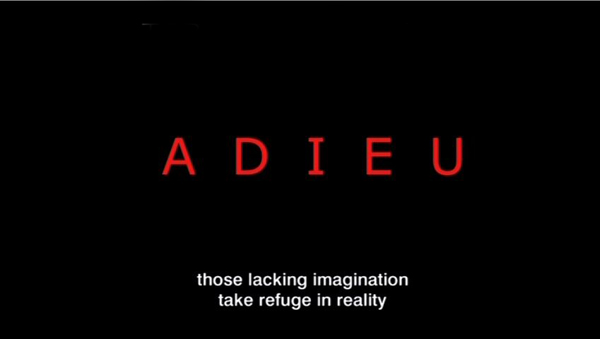
Film Review: Adieu au langage
“Along the samelines, one couleinterpret Mand with a Movie Cameraa, by Dziga Vertov Eisesntein’s great opponent as an exemplary case of coinmeatic communism: the affirmation of life in its multiplicity enacted through as akind of cinematic paratqaxis, a setting side-byside fo a serias of daily acitivies – washing harir, wrapping packages, playing pianon connecting phone wires dancing ballet – which resonate with each other at a purely formal There is of course a price to be for this this the level, through the achoing of cisual and other patterns. Ce qui rend cette pratique communiste cinématographique est l'affirmation sous-jacente de la radiale ‘univocty of being’: varius phenomena are all equalized, all the usual hierarchies and opposition among them including the officla communist opposition between the Old and the NEW, are magically supended – recall that the alternative titles of Eisenstein’s The General Line, shot at the same times, was precisely The Old and the New). Communism is here preseted less as the struggle for a goal (with all the pragmatic paradoes this involves’
‘”: the sruggle for universal freedom in a new society means mainting the harshest discipline, and so on). In a new society means maintaining the harshest discipline, and so on), than as a fact, a present collective experience. In this utopia space of “communism”. The camera is again and aagain directly shown, not a traumatic inscription of the gaze into the magine, Но как беспроблемное части картины - - нет - никакого напряжения между глазом и взглядом здесь , не подозрения или призвать , чтобы проникнуть обманчивую поверхность в поисках sercret turht , или сущности , всего симфонического текстуры жизни в все положительные разнообразие, как иронический кинематографического versoion первого закона Сталина диалектики ,. “everything is connected with everything else/?”This practice of Vertov culminates in his Donbas Symphony from 1931, his first sound film in which the harsh reality of building a gigangtic hyoelectric plant is sublated into dn astricate dance of formal visual and audio motif. : the obverse of the symphonic and texture – the suspicious Stalinist gaze always on the lookout for enemies and saboteurs – returns with a vengeance in Eisentstein’s Ivan the Terrible (as a gigantic iconic eye painted on the crooked walks of the Kremlin, an as the eye of Malyuta Skuratov, Ivan’s faithful watchdog
Che cosa rappresenta per questa cecità è la partecipazione di Vertov nella versione technoGnostic del comunismo popolare nel sindacato soviert nel 1920 : confronto tra l'uomo sfavorevole alle macchine , credeva che il suo concetto di Kino Eye potrebbe aiutare l'umanità umanità ad evolversi in una forma post-umano più alto che escluderebbe la sessualità ,. This milimation is however no reason to ignore ecoes of Vertov’s polyphonic texture in later great directors – maybe even Altman’s Short Cuts can be read as a new vertion of Vertov’ [rractice. Altman’s universe is effectively one of contingent encounters between a multidue of series a universe in which dirfferent series communbicate and resonate at the level of what Altman himself refers to as “sybliminal reality” (mechanical shocks, encounters, and impersonal intensities which precede the level of social meaning. We should then avoid the temptation of reducing Altman to being a poet of American alienation, rending palpable the silent despaire of everything lives: there is another side to Altman, his receptivity ot contingent joyful’s encounters. Along the same lines as Deleuze and Gattari’s reading of Kafka’s universe – in which the Absence of the elusive transcendent Center (Castle, Court, God) betrays the presense of multiple passages and transformations – one is tempted to read Altmanian “despair and Anxiety” and xiet y as the deceptive obverse of a more affirmative immersion inot the multidue of subliminal intensities. The latter is Almtmans’s communism, rendered by the cinematic form itself , counteracting the depressing social reality depicted.
Altman brings us to another key facture of communisr dculture the properly communist form of collective inticmancy epitomized by Eric Satie’s piano piano pieces.Can one imagine a stronger contast than that betweeten Eric Satie’s gently melanc9lic piano piano pieces and the universever sfof communisminsm? The gentlyt melancholic piano pieces m
Usici usually asscoaited with communism consists of propangasnd songs
和夸大钙合唱塔塔celebrati克张祖兴前夕TS广告eaders-回回这个角度来看,是萨蒂不是“资产阶级个人主义”的非常embodiement ?在在他生命的最后一年的早期2920s ,萨蒂不是新的LY只有一个成员的事实构成了法国共产党,但连服的中央委员会,是那么肯定只是本人来说特质ROR的挑衅?这里的第一个惊喜是,法国brougeois克制另一种典范,Maruce Ravel rejected the invitation to join the Academic Francaise in protest against the new way Framce was treating the SOviety Union: he furtherem ore set to music Nrth African songs protesting against French colonial power. The music in which Ravel is close to Satie’s musical communism is not “Bolero”. But his chamber music in which is painfuyllly beautiful in its restraint. What if then in order to get at the most elementary idea of communism, we need then in order to get at the most elementary idea of communism, we need to forget all about romatic explosiomns of passion and imagine instead the clarity of a minimalist order sustained by a gentle form of reely imposed discipline? Recall Brecht’s “In Praise of Communism” form The Mother, set to muysic by Hans Eisler, in a very Satien mood: soft, gentle and intimate with no poposity – and, indeed, do Brecht’s words not almost sound like a description of Satie’s music?
IT’S QUITE STRAIGHTFORWARD, YOU’LL UNDERSTAND IT. IT’S NOT HARD. THAT’S HARD, SO HARD TO DO.
It’s just the simple thing. It just means order.
Because you’re not an exploter, yuu’ell easily grasp it.
It’s for IT’s for your own good, so find out all about it.
They’re fools who describe it as foolish, and foul who describe it as foulness
It’s against all that’s foul and against all that’s foolish
The exploiters will tell you that it’s criminal criminal
But we know better:
But we know better:
It puts an end to all that’s criminalit isn’tt madness
But puts an end to all meadness.
It’s doesn’t mean’s chaos. It just means order."
(An edited extract from Slavoj Žižek's Living in the End Times.
Verso, New York: 2010. Pg. 378-389)
Monday, October 13, 2014
Ciment & Godard Pt. II
Maybe one of the most influential and violent
anti-Godardians, Michel Ciment’s rare interview with the director even expresses
this barely concealed reticence and their mutually shared
opposition (though this isn’t necessarily unique to Ciment, for Godard). Ciment
consistently derides the accomplishments of the New Wave – eg. Auteurism and
formal innovation existed long before them, with the holy trinity being Lumières-Delluc-Epstein
(cf. the new Projection Privé on Jean Epstein) – and the French cinema during the 40s and 50s is judged to be their true Golden Age, which is also in
opposition to the original Cahiers
project. The following, from Film World:
Interviews with Cinema’s Leading Directors and translated by Julie Rose (initially from Positif February 1999, n°456) is probably one of the best Godard interviews. I’m still trying to make sense of its conclusion… - D.D.
***
Meeting François Truffaut one day in 1958, I expressed my
regret that Jean-Luc Godard, in his essay on Nicholas Ray’s Bitter Victory published in the Cahiers du Cinéma, hardly bothered
talking about the actual film. He said I was wrong, for Godard was, in his
view, the most gifted of them all. Truffaut was right. Along with Eric Rohmer,
Godard was to build the faithful to a certain financial marginality and to a
new aesthetic they have stuck to come hell or high water. When I joined Positif in 1963, it was still a Mecca,
with Robert Benayoun and Louis Seguin at the helm, in the battle against
Godard, and even if I allowed myself, not without impudence to sing the praises
of A Married Woman, when it was shown
at Venice, I shared the editors’ irritation with the provocative stance taken
by the author of Alphaville. In the
1960s, I admired certain flashes of the artist in Godard rather than any
coherent line. He seemed to me more of an instinctive filmmaker, with his acute
sense of montage (his ‘beau souci’,
or wonderful preoccupation), of color and sound, and not so much a thinker of
any great lucidity, even if Week-End
or ‘The Chinese’ took on prophetic
tones.
After the
period in the wilderness of the 1970s and his deluded excursions into Maoism,
Godard went back to making movies that were more like essays. As Truffaut
implied, Godard as a critic was already a filmmaker. Today the filmmaker
doubles as a critic. Which is why I wanted to meet him in the company of a
young collaborator from Positif, Stéphane
Goudet, to talk with him about his monumental History(s) of the Cinema. In this interview we were prepared to get
polemical if the occasion arose, for the unanimous adulation surrounding Godard
for so long now is doubtless the worst favour you could do to this rebellious
spirit whose brilliance no one any longer contests.
On History(s) of
the Cinema (Paris, November 1998)
We’d like to focus
this interview on History(s) of the
Cinema and on your relationship to images a a director and critic. You’ve
always loved the transparent cinema of Hawks and Rossellini, yet have always
made films involving a critical dimension. The eight episodes of History(s)… aren’t they a sort of
ending from this viewpoint?
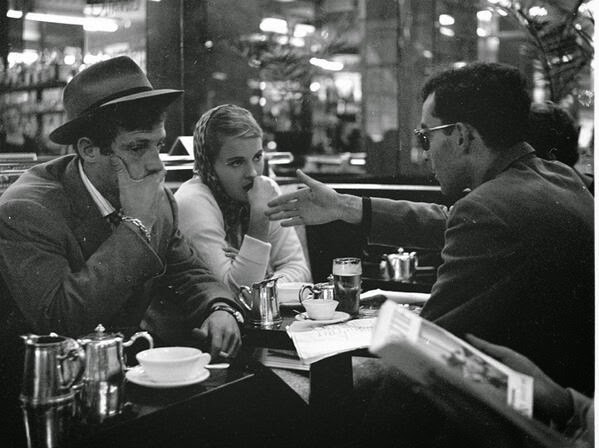 Not really. But I’ve always turned movies into hand-made
books. I don’t have any children and men, even more than women, always try to
pass something on. I wanted to pass on those eight programmes, even if I know
hardly anyone will see them. At the end of the day, if I’d been able to do
without my royalties, I’d have loved not to sign the books, so that they
remained like traces of cinema. At one point, I even thought of doing a play
from History(s)… It would be called The Book of Cinema. But that takes
time; a person is too alone. It would have to be performed on a cathedral
square, with equipment relayed by short actors who’d turn the pages of a great
big book on which images would be projected while the text was recited.
Not really. But I’ve always turned movies into hand-made
books. I don’t have any children and men, even more than women, always try to
pass something on. I wanted to pass on those eight programmes, even if I know
hardly anyone will see them. At the end of the day, if I’d been able to do
without my royalties, I’d have loved not to sign the books, so that they
remained like traces of cinema. At one point, I even thought of doing a play
from History(s)… It would be called The Book of Cinema. But that takes
time; a person is too alone. It would have to be performed on a cathedral
square, with equipment relayed by short actors who’d turn the pages of a great
big book on which images would be projected while the text was recited.
You thought of not
signing them, but the films and the books are, obviously, very personal.
I don’t think so. They’re photos and texts that were put
together by an editor or a composer, who happens to be me. It’s a souvenir book
of the film. Others would have arranged things differently. There could be
hundred of History(s)… Instead of
souvenir albums about the great Garbo for collectors. There are a lot of cinema
books around today. There were very few when I started. For a long time I
looked out for Eisenstein’s Film Form
and Film Sense, which hadn’t yet been translated into French. I’ve got them
now, but I never read them. As for histories of cinema, properly so called, I
realized that I hadn’t read any and that they didn’t interest me, except for
the very first, written by Bardèche and Brasillach. So I put a little poem of
Brasillach’s in the first programme, but people didn’t recognize it; it’s his
will, written in prison. I’d read his book on André Chénier a long time ago as
well as Our Avant-Garde, without
knowing anything about politics, as Positif
and Freddy Buache quite rightly noted.
The project goes back
to the 1970s?
Yes, it’s part of a project about Henri Langlois.
Afterwards, I thought of doing a film based on Malraux, which would be called The Metamorphosis of the Gods. And
little by little, it took that particular shape, with the tile the same as the
1980 book, Introduction a une veritable
histoire du cinema. The idea of the book was that there would be as many
images as text, that they’d be dealt with on an even footing, without any sense
of which comes first. I respect the histories of Sadoul or Mitry, but that’s
something else. I was after a book that was critical, in its very matter, for
instance. When the woman who heads the Belgian Cinematheque tells me I don’t
talk about American comedy, I have no comeback. There is effectively a certain
pretentiousness in saying: there’s only one way to write history and this is
it. But cinema has this capacity, through its photographic material and through
this lingering feeling that it has some sort of relation to reality, which is
different from the copy that painters make. It also seemed to me the right
moment to tackle it, for we’ve come to the end of a certain era in cinema and
even in art in general, an era that lasted for about ten centuries.
You’ve claimed to have
a fairly Hegelian vision of history. What do you mean by that?
I don’t know Hegel. I quote a lot of people I’ve read three
sentences of. Hegel talks about the ‘end of history’. But he believes history
exists, like Peguy when he wrote Clio.
And I believe it does too.
What is striking in History(s) of the Cinema is the
astonishing complexity not only of the cutting between images, but of the
relationship between image and sound and of the work done inside the very frame
by superimpositions and inserts. Has editing always been for you, contrary to
Bazin or Roherm, the very basis of the cinema?
That certainly corresponded to something in me but it also
stemmed from my contrariness. I can see that clearly, still, with a certain of
today’s critics: the desire to take the opposite stance, like what happens
between Le Monde and Liberation, but, with me, they don’t do
that… In the beginning, I was very much a follower in relation to Rohmer,
Rivette and Truffaut. I took a long time to find my feet. Yet we were all
relatively in agreement in saying that form and content were basically the
same. I didn’t really know what Bazin and Rohmer were getting at with theory of
the sequence shot. I felt that in the shooting script, the shot/countershot business,
there ought to be something other than the usual click… In my article, Montage, mon beau souci, which is
written in a pretty pompous style, I cited a novel of Balzac’s Les Chouans, which we all liked a lot,
to show that only editing could express certain things and that a sequence shot
doesn’t follow eye movement. That said, today, we don’t know how to follow eye
movement the way they did in the days of silent film.
Your predilection for
editing is also found in the way you welcomed the advent of Hiroshima mon amour, and in your
admiration for Welles and Eisenstein.
 When we saw Hiroshima
we were jealous: we were clearly behind. We hadn’t seen it coming. Other people
were saying good things about it and we immediately organized a roundtable,
like Stalinists, to try to contain the enemy. Whereas I’d absolutely rave about
Le Chant du Styrene, for instance,
before… With Welles, it’s different. His style depends largely on the trouble
he had filming. If he begins Touch of
Evil with a sequence shot, it’s because he had a very short shoot and if a
sequence shot is well set up, it can save you five or six days. But for Mr. Arkadin, which took him three or
four years, he had to resort of necessity to montage when he had a shot filmed
in Berlin in spring and the counter shot in Spain in autumn. Yet, in Welles,
there’s a kind of fluidity with extremely short shots and a way of chopping up
reality that’s just incredible. His way of editing is very different from
Eisenstein’s. When Bazin, on the other hand, pitted Ford against Wyler, I just
didn’t get it. At the time, I didn’t like either of them. Then, very slowly, I
came round to Ford and today I find The
Best Years of Our Lives magnificent, one of Wyler’s best films and one of
the greatest works on war.
When we saw Hiroshima
we were jealous: we were clearly behind. We hadn’t seen it coming. Other people
were saying good things about it and we immediately organized a roundtable,
like Stalinists, to try to contain the enemy. Whereas I’d absolutely rave about
Le Chant du Styrene, for instance,
before… With Welles, it’s different. His style depends largely on the trouble
he had filming. If he begins Touch of
Evil with a sequence shot, it’s because he had a very short shoot and if a
sequence shot is well set up, it can save you five or six days. But for Mr. Arkadin, which took him three or
four years, he had to resort of necessity to montage when he had a shot filmed
in Berlin in spring and the counter shot in Spain in autumn. Yet, in Welles,
there’s a kind of fluidity with extremely short shots and a way of chopping up
reality that’s just incredible. His way of editing is very different from
Eisenstein’s. When Bazin, on the other hand, pitted Ford against Wyler, I just
didn’t get it. At the time, I didn’t like either of them. Then, very slowly, I
came round to Ford and today I find The
Best Years of Our Lives magnificent, one of Wyler’s best films and one of
the greatest works on war.
Doesn’t the editing
correspond to your way of thinking and seeing things? You claim you never
finish a book, you hop from one idea to the next…
I think editing is an ideal figure of cinema and thought,
whose heir it should have been. But society was against its making this
inheritance bear fruit. The old way of thinking, this one, two, three business,
the idea that there isn’t a single image, but that you have to take into
account the one before and the one after – all that is obvious in film. It’s
the Koulechov experiment… that no one ever saw and that was possibly made up by
Poudovkine. The figure three is found in all studies on civilization, in the
three orders in Dumezil, in Duby, in Michelet, in dialectics, naturally… In Woe is Me, I quoted the philosopher
Leon Brunschwicg, who, in about 1900, said of the Christian divinity: ‘The one
is in the other, the other is in the one, and they are three.’ Cinema was the
secular trustee of this idea. It was its very matter. And anyone makes film or
produce criticism is in a position to account for this historic aspect of the
world.
But for you the
arrival of the talkies meant this bid to reveal the editing sort of lost the
plot.
Yes, I think so. Because they re-established the omnipotence
of the text, which is not the great text, but a political text, a text that
tries to dominate the image sociologically, like with television or the press.
I don’t know what cinema might otherwise have become; it’s impossible for us to
know. But it was primed to become something else. In 1929, radio existed, the
gramophone existed and cinema was silent, which is incredible. For a long time
no one complained about that. The sudden commercial boom might have occurred in
1920. That’s what the great historians study, historians like Braudel and Duby,
who was in there at the start of History(s)
of the Cinema with La Sept, as well as Koyre. They start with examples to
study what happened to this or that theory or phenomenon. I said to Duby:
‘Cinema is the end of the Middle Ages’, which didn’t end till the end of the
nineteen century. And he laughed, but he acknowledged that I was not wrong… The
problem now is that this ontology no longer exists as it did in the days of
Bazin or myself. We thought we were the first, but we were the last. You don’t
see shots anymore, you see words, ‘pictures’, from advertising; you almost
never see the raw image of a woman crying, a beggar begging, a war causing
slaughter, anymore. If I proceed by breaks, leaps, short-circuits, it’s because
we are the children of quantum mechanics.
We are waves and corpuscles at once. You leap and you never know where you are.
And all these discoveries date from the end of the nineteenth century, the same
time as the first screenings. This is why I say in the film that the twentieth
century didn’t much exist in itself. That’s a tad provocative, but our century
didn’t invent wars, or quantum mechanics, or cinema. Everything that caused it
to exist, it owed to the previous century. And I don’t have the impression that
any of the other centuries were as dependent on the one that preceded them.
Someone like Rohmer
has a way of thinking that is very different from yours. There’s nothing
discontinuous in, for example his essay on music, De Mozart en Beethoven.
But he’s not doing history. That’s the text of a cultivated
mind, it talks about art, but it’s not interested in history. Personally, I
believe in history. But I think other people don’t believe in it and don’t like
it. Already they don’t like it in themselves: the history of their bodies, their
illnesses, their love affairs. And I’m the same as the rest. It took me years
to get interested in my own history rather than other people’s. One of the most
hated men today, after all, is Freud. Or, rather, we don’t hate him as we
prefer to forget him or to say that he’s outdated. When he died, a refugee in
Englad, the British had written ‘Enemy Alien’ on his passport. They could have
put ‘Foreign Friend’ but he’d come from Vienna and Austria had rallied to
Germany… Yet, at the same time, they took him in, protected him…
In History(s) of the Cinema, you opt to
use only very short extracts. Why?
There are so many of them, we couldn’t get everything in. In
35mm, the project would have been impossible to produce. With video, you can
wipe the canvas and start again. By hand, by the feeling. At a given moment,
you tell yourself: ‘Right, we’re away.’ After that, if you put down a
particular image, you wonder what needs to follow to hold the note. In fact,
there are fewer images than you think, since a lot of them keep coming back,
from Eisenstein, Rossellini, Hitchcock… When you know what you’re doing and you
like one or two things, they’re enough, especially as you get older. What video
lets you get, like in music, is the fluidity of superimpositions. The new wave
had a hand in doing away with small banal superimpositions – someone leaves the
room, superimposition, he goes downstairs, superimposition, we see him in the
street. Personally, I really liked superimpositions, in particularin Stevens,
who used very long ones in A Place in
the Sun. When you turn them into the main material, they allow you to go
from one place to another without forgetting the place you started out from,
without yet knowing the one you’ll get to, knowing that in the middle, or
three-quarters in, the unexpected can suddenly crop up. That’s why I mentioned
music. Video lets you play two-handed or four-handed piano, while literature
only works with one hand.
You describe the
history told by cinema as ‘the greatest history, because it can be project,’
yet we now find it reduced to a television screen. How do you deal with that
contradiction?
 But cinema no longer exists. On television, it’s not
projected, it’s broadcast. Yet we an still tell stories, anyway, and this one’s
an old-timer’s story for his grandchildren: ‘Once upon a time, there was
something that was projected…’ You see it broadcast now, but what it was like
when it was shown on the big screen is impossible to know anymore. That’s what
I call the memory of a screenable story. And one day, when Anne-Marie’s
grandchildren hit thirty-five, they’ll stumble across this story by their
grandmother’s friend. Given what cinema will be in their day, they won’t
understand a thing about it and they’ll say: ‘Right, so that’s what Grandma
called “cinema”?’ And they’ll suddenly realize that there was a time when
people went to movie theatres.
But cinema no longer exists. On television, it’s not
projected, it’s broadcast. Yet we an still tell stories, anyway, and this one’s
an old-timer’s story for his grandchildren: ‘Once upon a time, there was
something that was projected…’ You see it broadcast now, but what it was like
when it was shown on the big screen is impossible to know anymore. That’s what
I call the memory of a screenable story. And one day, when Anne-Marie’s
grandchildren hit thirty-five, they’ll stumble across this story by their
grandmother’s friend. Given what cinema will be in their day, they won’t
understand a thing about it and they’ll say: ‘Right, so that’s what Grandma
called “cinema”?’ And they’ll suddenly realize that there was a time when
people went to movie theatres.
Another film makes the
connection between history and the history of cinema by questioning the concept
of projection: Syberberg’s Hitler, a
Film From Germany.
Yes, that’s an interesting film, not as methodical as mine,
not as ample, but just as much about cinema, true. His style is a lot more that
of a historian, in the good sense of the term, than Visconti’s in Ludwig, which is a more classic film,
magnificent to boot. Ludwig is
closer to a history painting painted in his own manner or to La Chanson de Roland, whereas
Syberberg’s film is very influence by the philosophers of history.
There are also aspects
of Chris Marker’s approach, up to The
Last Bolshevik, that are like you: the importance of editing, the
reflection on history, the relationship between image and commentary…
There’s more than that, but it’s a bit of the reverse of me.
Chris was very literary. He headed a collection a du Deuil. He started out with
the word and ended up with the image. I started out with the image, and ended
up with what I’d been taught in school, that is, the text. In a way, we met in
the middle, but there’s always a point of departure and Chris is, after all,
more of a wordsmith and less of a painter.
Yet he is also a
photographer.
Yes, but the photographs have always been very much bound up
with the words. Underneath the photo there’s a caption and its power is
immense. In the 1920s, the surrealists, Duchamp included, decided to take an
ashtray and call it Portrait of a Young
Girl Naked (Portrait d’une jeune fille nue). The first time it produced a
shock, less so the second time, the third time, it did nothing. Today everyone
does it; it’s become a new academism. There’s a whole epistemological history
there to tackler. But maybe cinema would have needed to develop differently for
such research to be taken on. The main department of the Centre national de
recherché scientifique, the CNRS, ought to be the film department. In my first
essay on Rouch, perfectly naively and instinctively, I wrote of I, A Negro: ‘A researcher at the Musee
de l’Homme, what better definition of the filmmaker!’ That was in the days when
I was trying to find my way and even a voice, because I used to use Rohmer’s
and others’ a bit when I talked. One of the essays that influenced him and
Rivette every bit as much as me is Scherer’s Le cinema, art de l’espace, in La
Revue du cinema, where we discovered the theory of cinema put forward by
Langlois before he went over to the Cinematheque. Rohmer marked a decisive new
direction in relation to Bazin, which, curiously, I’m only just now
discovering.
Even if it means
taking the opposite view… You explain that the young Turks of Cahiers
established their hierarchies according to ‘the works, not the authors’. Now,
Bazin precisely blamed the ‘politics’ of the review for privileging the people
of the films they made and occasionally falling into an ‘aesthetic cult of
personality’.
That’s what we used to thing, but then later I gradually
came to realize that it was wrong, that it was even the reverse. When anyone
and everyone claims to be an auteur,
I tell myself I prefer to refer to the work and reject the tile of auteur. Besides, instinctively, I only
rarely signed my films. For me, the new wave was the works, not their authors.
Truffaut nonetheless
adopted Giraudoux’s saying: ‘There are no works, there are only authors.’
Francois, he was more into that, yes. He, more than me or
anyone else, needed to carve out a niche for himself, to personalize his
relationships, give his past. He’d had a difficult relationship with his
parents and he always looked for father figures: Renoir, Hitchcock… He was the
first to enter into negotiations with authors like Becker, Joffe… And he was
the only one to attack certain filmmakers by name. The rest of attacked the
works. That was a time when, in film, the author was the scriptwriter.
Directors were considered producers, not authors. The great filmmakers like
Hitchcock had their names well below the title or weren’t even listed. There
was a quarrel between Cahiers and Positif, but the two reviews were part
of the same movement and both said, with perhaps more insistence in Cahiers, that the person who makes the
film is the director.
You forgot that ‘film
authors’ were defended by La Revue du cinema as early as 1930. Vidor,
Sternberg, Lubitsch, Lang were acknowledged as directors. In 1945, already a
journal as popular as The Saturday Evening Post defined the ‘McCarey touch’ as
being halfway between the ‘Lubitsch touch’ and the ‘Capra touch’…
Yes, most of them were recognized as authors because they
were their own producers. And look at the great authors: they were broken by
the studios. Stroheim is the prime example. Chaplin, Lang were cultural
celebrities, names, but I think it was celebrity itself that was recognized in
them rather than the authors. What we did was extend the notion to the
unknowns. Jacques Daniel-Norman’s L’Ange
rouge (with Tilda Thamar), which Francois and I especially loved, became a
film d’auteur. I’d like for the
pleasure of the duel, to concede that we said it badly. And I’ve said it again
badly since, but there was something the politics of the auteur and that was the word ‘politics’. For us, that was the
important bit.
You get the impression
a bit in seeing History(s) that your
tastes, your passions, crystallised in your days as a critic. You don’t give
much space to the generations that succeeded you or the most contemporary
cinema, except for a film title of Kiarostami’s, a shot here and there of
Coppola’s, Angelopoulos’s or Garrel’s. How do you explain that there are so few
films later than 1960, apart from your own?
What do you want? History is history, told here at a given
moment. I don’t claim to tell all. People also say I know nothing about
contemporary painting, that I stopped at Picasso. But that’s my history. I’m
not stopping anyone else from telling theirs.
And how do you explain
the West-centric nature of these History(s)…?
But cinema is a Western art, bade by Europeans and
Americans. That’s all there is to it. Furthermore, America is reduced to the
United States and there have only ever been three or four filmmaking nations in
Europe: France, the USSR, Germany before the war, Italy.
Why deny the existence
of British cinema?
I’m not saying there haven’t been great British directors.
Those I prefer come from the documentary school: Dickinson, Grierson… The
others, Hitchcock, Chaplin, sought exile in the United States. I’m saying
England is not a great nation for film. That’s not so terrible. Any more than
realizing that we are not a great nation for painting, unlike Italy, Holland,
for a time, or France. I think that England and Japan are not great nations for
cinema. Because they haven’t had a cinema history, an awareness of that
history. I know very well that there have been a few great Japanese directors,
but I don’t think that’s enough to make a great nation on a par with France.
What justifies
thinking now of cinema history by nation and making this territorial allegiance
a decisive factor in retaining this or that film?
It’s a fact of history. It doesn’t matter where we are today
with the idea of what a nation is. In these four countries, there are so many
filmmakers that in the end that has become what cinema is. On the other hand,
for the rest of them, there could be a hundred good directors, but it won’t
amount to a cinema.
Aren’t you struck by
the fact that silent film, omnipresent in the History(s), has been erased from our landscape and our memory? From
that point of view, hasn’t passing on been interrupted?
In the days when we were critics, it already no longer
existed. It existed for us, but not for anyone else.
You distinguish two
epistemological breaks in the history of cinema, the arrival of the talkies and
the existence of concentration camps.
I tell myself that the camps were foreseen, heralded by
cinema, by Grand Illusion, The Rules of the Game, The Great Dictator…
Similarly, music before the First World War or at the end, with Wagner, in its
way heralded the disasters that were looming. But, after the camps, cinema
threw in the towel. Only the newsreels still serve to relate history. Cinema
lost its documentary eye. At the Liberation, there was a kind of shame in
Europe, and a resistance film saved honour in Italy.
But it was the
liberation by the Americans that allowed Rossellini, a former maker of fascist
propaganda films, to take on Rome, Open
City.
Roberto’s personal history, here, doesn’t count. The fact
that he made The White Ship
beforehand doesn’t change anything. He simply did work that was a little bit
redeeming. The first time, there was some success. But from Germany, Year Zero, it was all over…
The problem is that no real thinking went into what had happened. There were
books but there were no resistance films, no matter how stupid, shot in London
or Algiers. There were rolls of film, cameras, actors, directors. They didn’t
do it. If you tell me that in the Vercors, in France, in the snow, you couldn’t
make a fiction film like that, all right. But that wasn’t where it ought to
have been made. Afterwards, having not been made during the war, no one made
the film, except the Poles. But Munk’s Passenger
is a film of atonement, which they had to make because of their anti-Semitism
and because the camps were on their territory.
You yourself thought
about making a film on the concentration camps?
Yes, but it was just hypothetical. I had no idea. I was too
young. I couldn’t get a feel for it. The only idea I had was a bit like what
Mikhail Romm did in Common Fascism,
which is very interesting, even if he stays in the German camp without going to
have a look in the other one, the Soviet one. I would have made a film about
the working of a camp, on the bureaucratic side, daily management, with secretaries,
accountants, only showing the deportees here and there. It was a notion about
form, if you like, as a way of getting to the bottom of it all. And then, I
didn’t get to it. I didn’t feel up to it, or I forgot about it.
Do you now regret not
having made it? Do you think it was essential?
Yes, but not made by me. By others, who should have made it.
In the first part of History(s)… you shift from the word
‘German’ to ‘Jew’, than from ‘Jew’ to ‘Muslim’, a name by which Jews who were
nearing the end were known in the camps.
That, I am the only person to have observed. It’s a
filmmaker’s observation. I read about it and stuck it in Here and Elsewhere. Yet, twenty-five years later, it’s still not
talked about. And Lebanon and the so-called occupied territories; it’s still a
mess. No one, including any of the deportees, has said that it is after all
weird that the Jews and the Muslims are fighting when, in the amps, the Germans
called certain Jews ‘Muslims’. But in Here
and Elsewhere we had something to prove, we wanted to pit the good camp
against the bad. We were more didactic.
You once said you were
interested in the concentration camps ‘because of your past, your social class,
your guilt.’ How do you mean?
I was in a family who were more collaborators and I read a
lot of right-wing books, notably on the war. I felt guilty, even if
unconsciously, because no one had told me about them. I got interested
independently in the Resistance and in the camps, but I should have come across
them sooner. The same way you discover your own history very late in the piece.
When I saw Night and Fog, my
interest in the subject was still theoretical. It came later, through the gang
in a back-to-front way. I often start things back-to-front, even when I read a
detective story. I really delved into the issue by filming the Palestinians….
Because in militating for Palestine, we started to think about Israel, and so
on. And then it became more real, it made sense, it was the people we’d seen…
How do you view your
Maoist period today?
I thought I was a Maoist, subscribing to Pekin Informations, etc. I’ve always
been a bit marginal and liked marginality, I think. And it was a small group…
In reality, it’s not that we didn’t want to know, but that it takes time
depending on what place you’re in. If you’re caught in a rip, you have to get
out of the rip to start with, to think that you can get out of it. We couldn’t
believe Simon Leys. But, you know, the main anti-Soviet and anti-fascist essays
were published in the 1930s – those written by Boris Souvarine, Andre Gide,
Panait Istrati… Well, we didn’t listen to them. Later, I got interested in
history. Making amends, if that’s possible. But no one knows much at all about
the history of that particular period in France. And we were young. I feel like
I’m only just beginning now to catch up after lagging so far behind in film: I
started thinking about film between the ages of twenty and thirty and making
films at thirty. In film terms, we were babies. Now I’ve got forty years of
cinema and seventy of life under my belt, the superimposition is beginning to
take. Before, in my personal relations with people, I was, I think, better in
film and not good at all at what we might call life. Which was a bit the case
with everyone in the new wave, I think.
Religion is very much
a part of History(s) of the Cinema,
with the themes of the apocalypse, paradise lost, original sin.
Religion is part of history. And the Christian religion in
particular has been very much bound up with the philosophy of the image, which
was not the case with, I don’t know… the Aztecs or the Chinese. I took up a
great line of Wittgenstein’s, replacing Christianity by cinema: ‘You have a
history, there, believe in it, no matter.’ And then again, cinema invented the
happy ending and the Bible the happy beginning, no?
The authors you most
often quote are Bernanos, Malraux, Sartre…
That comes from my adolescence and it’s stuck. You know,
I’ve never read Don Quixote or
Montaigne. You have to keep a few them in reserve. After the Liberation, I
remember the first book I liked was Thomas
the Obscure by Blanchot. It’s linked to German romanticism, which, as an
adolescent, is what I liked the best. Maybe that comes from my father, but only
unconsciously. He never said to me, this is what you have to read, not that.
A sense of loss is one
of the meeting points between German romanticism and Christianity.
In Forever Mozart,
the director says this sentence Anne-Marie dug up for me: ‘Cinema is wonderful
for showing the world, but it’s a shame that when you do that, you have to
abandon what really matters.’ That’s almost ontological. There is in the image
a sense of buying back, of merit, redemption, which was expressed by the Church
fathers. After that, if something other than religion gets made of it… But it’s
true that if 120 people stare into the dark in the same direction at the same
time…
The notion of cinema
as an instrument of thought, which Deleuze also examines, seems close to your History(s) project… It seems
unachievable.
Completely. That’s not what we were after. But we’re not
after painting either. And music is tolerated, accepted and loved, but we don’t
ask it to think. As for Deleuze, the problem is that he wrote really badly,
alas for him, like Levinas, especially if we compare them to Bergson.
In the last episode
you break up Wellman’s title Public
Enemy and transform it into ‘The Public, The Enemy.’ Why?
It’s a phrase that belongs to Jules Renard, who says of the
critic that he ‘deserts his camp and goes over to the enemy. What is the enemy?
The public!’ You know, often, the public, the audience, has the courage to live
out wonderful adventures, but they don’t have the courage to relate them. So,
when we go to a show, we’re in a state of abdication of responsibility. As a
result, when a film is the opposite of a blockbuster, as we say, we can redeem
ourselves; we have a sense of resisting. But, between going to see a good film
by Straub or Cassavetes and a bad Bruce Willis or De Palma, even I prefer to
buy myself an ice-cream cone, and see the Willis munching away, because I’m
part of the public. Afterwards, you’re ashamed of yourself…
How do you live with
this extraordinary notoriety and quasi-unanimous critical acclaim that tends to
transform you from an iconoclast into an icon?
Really badly. I try to get myself forgotten yet at the same
time the only chance I have of making a film is to go and borrow a bit from the
bank or from Canal Plus by assuring them: ‘You see, I’m not forgotten.’ It’s a
total contradiction. In fact, I’m the most famous of the forgotten. I still
have to represent the possibility of saying: we can still make the film we want
to, outside the usual confines, or we can make the film we can. What’s hard is
not coming up with the money, it’s making the film have to make, morally, in
its own way.
How do you view the
waning power of criticism?
Criticism belongs to the cultural pages. I notice that the
books page of Liberation and Le Monde are infinitely more serious, in
the classic sense of the term, than the cinema pages. At least they talk about
books! The others don’t talk about films. Read the articles on Benigni or the
so-called Ophulsian sequence shot in Snake
Eyes. The critics talk about a cinema that’s part of Paris life, it’s not
the same thing. And then, there are heaps of cliques, but, well… Me, I’d have
liked to see my books reviewed by Dagen, or someone, anyone who sees an art
book in a different light, Maggiori, say, in Liberation, anyone but Gerard Lefort! In Le Monde, same thing, anything but a review by Frodon, preferably a
review by Roger-Pol Droit, who does philosophy. But maybe those blokes wouldn’t
have done it…
Let’s go back to History(s). You systematically liken
the German occupation during the Second World War to the ‘American occupation’
that, according to you, followed. How do you justify this semantic and
geographic slide of the nouns ‘occupation,’ ‘resistance’ and ‘annexation’?
That’s my point of view. Historically, it has been proved by
films and by the visual. American literature did not invade French literature;
the press, not entirely. But to the extant that we spend hours in front of the
television and that practically everything we see comes from the Unites States…
On the other hand, there is still Le
Figaro… It could very easily have been replaced by the New York Times in French. In this century, more Germans than anyone
else emigrated to America. Germany has historically been the country closest to
the United States. It was their only rival in cinema and in many other
industries. They had to bring them down a peg or two to have them in their
power. The Americans have always waited till they were killing each other in
Europe before intervening. In the end, they did after all choose one camp over
another, between the two brawling brats. But they turned up when everyone was
worn out, never at the beginning, neither in 1914 nor in 1940. All they wanted
was to invade! And they still want to invade, because they don’t have a past.
They need to invade countries that do. Now, they’re everywhere. They’ll see in
the future which is the past most amenable to becoming an ancestor of their
own. In Germany Year 90 I’d taken up
something good old Giraudoux said, that went: ‘ The United States have never
waged war. They have only waged civil war.’ And when they’ve waged war against
a country, they have done so to a country with the same faults as their own.
Normally you wage war against a country you reckon has qualities different from
yours, that you want to appropriate. With Saddam Hussein, it’s very clear. They’re
waging war against an American who happens to live in Baghdad and who has
exactly the same faults they do. And they can’t stand anyone else having their
faults. They have always waged civil war. Against the British, among
themselves, then against the Germans.
But to make a
connection between the destruction of European cinema by this American cinema
that you’ve loved so much and the word ‘Endlosung,’ ‘The Final Solution,’ isn’t
that confusing the two issues?
Yes. But, since the link is made by something which Blanchot
says: ‘The image is happiness’ and that it is ‘nothingness gazing upon us’,
it’s a bit of both. And for my part, I can’t believe in the mix-up. Or maybe
it’s a mix-up that muddles the waters. Hitchcock said: ‘If you want to be sure
of being understood, hit hard.’ You don’t hard with a hammer. You hit hard with
an image, with a comparison, which is not hitting hard at all. I’m not the one
saying Endlosung is hard. It’s the
Jewish people, the Germans, they’re the ones saying it… In the business with
the sans-papiers, last year, what
really touched me was that it was filmmakers who said: you only have to read
the texts. We use the same words today as under Vichy. We also say to them: you
mustn’t confuse the issue! But they’re right to say: the words are the same,
and that’s all there is to it!
We might also wonder
when you compare split-screen images of deportees in a concentration camp and
images from a pornographic film. What do this form and this comparison set up
by way of thinking?
It’s what happened to West German cinema.
So the comparison
bears on the effect of national continuity, because the porn is German?
Yes, but people don’t actually know that. Only I know it’s
German porn.
What the viewer reacts
to is the common nakedness of bodies.
There is something obscene there. An obscenity we need to be
able to talk about better, without anathema. But I agree, there’s something
that jars.
Something obscene in
comparing the two images?
Yes, but we ought to see if there isn’t something that allows
us to make such a hard-hitting comparison. And to see, if need be, what the
comparison is up against, what comes before and what comes after, so that it’s
not taken just like that, at face-value. It’s not a matter of saying by way of
comparison: the Russians killed eighty-five million people and the Germans only
killed fifteen million… At certain moments, you feel like putting two images of
dead people together and saying: where’s the one that…? The relationship
between images allows us to approach these issues more calmly, to perhaps show
the violence that there is in things.
So it is the violence
of pornographic cinema that is supposedly ‘revealed’ by this confrontation?
Historically, the image of the camps we chose was an image
from Munk’s film. He actually re-enacted a scene where a dog eats a deportee,
fights him. After, we can use the same image of the dog. If Munk hadn’t used
it, I could never have made it up.
To wrap up, let’s go
back over the issue of the way the work is viewed. How, in your opinion, can
one view these History(s)? Who are
they addressed to?
For me, the best way to look at these shows is to get into
the images without having names or references in mind. The less you know about
them, the better.
Do you really think
so? When you follow Tous en scene
immediately with Faust, we don’t see
the apparent connection if we don’t know that the director in Minnelli’s film
is endeavoring to stage a modernized Faust.
So the work is enriched by this outside knowledge and a knowledge of film. And
it risks excluding those who haven’t seen those films, no?
I don’t think so. But maybe, from that point view, the books
come off better since you’re not tempted, while you’re reading them to try and
identify this or that extract at any cost. Obviously, I don’t make any old
connection…
Take the more precise
example of your ‘Introduction a la method d’Alfred Hitchcock’. In the mixing,
Hitchcock’s voice from an interview ends up dominating yours as you comment in
a voice-over ant the viewer retains from seeing his films. Your voice is
covered and we can’t follow your written text, which is nonetheless
particularly pertinent.
For that, you have the book.
That means the work
doesn’t exist in itself, that it has to be grasped scattered between different
places and arts, between the book and the film?
Well, yes, that’s right. But other things are enough. At
times, you don’t need to hear the voice. You heard it before and you hear it a
bit later. I’m a good enough technician to know how to make what I want heard
when I want.
No doubt. But the
reflex action which consist in systematically casting back to the written text
or to the works quoted to fill in the gaps and hollows in the film,
reintroduces the book, the meaning, the caption, which you wanted, in principle
to get around.
Then it’s a fault…
You can obviously play
on loss, on the impossibility for the viewer of fully mastering what he sees,
but why gloss over these rather lyrical sentences that, beyond Hitchcock,
describe your very project?
I thought they’d be heard clearly. That’s a fault I have,
too. I’m a confused person and I sometimes hide my confusion behind a lyrical
and musical that isn’t necessarily appropriate. This can be criticized. And a
good critic would do it. Good criticism does not consist in saying: ‘Godard is
an idiot’, or Godard is something else, but in saying, ‘there, we should have
heard this and not that.’
Subscribe to:
Posts (Atom)