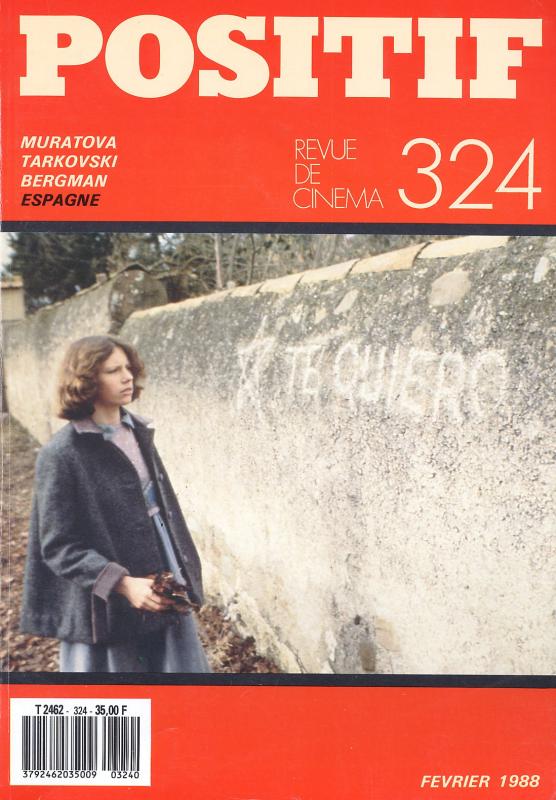
En hommage à celui qui dirigeait déjà Positif avant ma naissance, voici un entretien que j’ai recueilli auprès de Michel Ciment pendant le Festival de Berlin en 2020 (quelque mois avant la pandémie) : une trentaine de minutes joyeuses où nous avons pu parler un peu de sa vie, de la revue Positif, d'Orson Welles, de Kafka, Bernard Chardère, Robert Benayoun, François Truffaut, Godard, des Cahiers du cinéma, de Wanda de Barbara Loden, de Kazan et du Vieil Hollywood, du nouveaux cinéma des années soixante, de Kubrick, de Resnais, d'une cinéphilie internationale, des polémiques, du cinéma des années 2010, de ses relations avec Frémaux-Actes Sud, de la période Frodon-Burdeau des Cahiers, des vieux rédacteurs en chef des Cahiers qu’il a appréciés, contre une nouvelle cinéphilie avec son fétichisme des films cultes, d'un désir pour voir plus de films internationaux, du génie de Buster Keaton, et un peu du Positif de ces dernières années.
Je m’abonne à Positif en 2010 (à l’âge de 22 ans) quand je quitte Toronto pour Ottawa, et je découvre un bon nombre de grands film, d'idées, et un moyen d’aborder le cinéma grâce à cette revue. J’estimais beaucoup Michel Ciment (que j’ai pu rencontrer deux ou trois fois). Je pense à lui aujourd’hui. – D. D.
DD : Vous commencez à Positif avec un critique sur le film d’Orson Welles, The Trial. Ça s’est passé comment ?
MC : Comme ça se passe encore aujourd’hui. C’est-à-dire qu’à Positif les gens qui ont envie d’écrire, ils envoient un texte même s’ils sont complètement inconnus souvent ce sont des gens inconnus. Si le texte qui est lu dans le comité de rédaction est aimer, on propose de le publier et ensuite de collaborer puis ensuite d’entrer au comité de rédaction. Donc quand j’avais 25 ans. J’avais été choqué par l’accueil critique assez mauvais du film d’Orson Welles même en France par rapport à Kafka et cetera. Et comme je connaissais très bien Kafka et Orson Welles. J’ai envoyé l’article et j’ai cru que je ne pouvais pas être publié parce que dans le numéro qui venait de sortir, il y avait une table ronde de sept-huit rédacteurs de Positif qui discutait pendant 15 pages Le Procès. Donc j’ai dit maintenant c’est fini, je vais arriver après. Pas du tout, ils ont trouvé mon texte intéressant et ils m’ont proposé de le publier et ensuite ils m’ont demandé de collaborer à la revue, d’écrire des articles, c’était en 63. Et en 1966, je suis entré au comité de rédaction. Mais c’est comme ça que ça se passe tout le temps.
DD : C’était qui les rédacteurs en chef à cette époque et est-ce que Bernard Chardère était encore là ?
MC : Non, non, non. Bernard Chardère qui est le fondateur est le seul rédacteur en chef qui a existé à Positif, parce qu’il n’y a jamais eu de rédacteur en chef. Bernard Chardère, c’était 7 numéros à Lyon et ensuite il est parti en Algérie pour la guerre. Il était très jeune. Il avait 22 ans, 23 ans. Les rédacteurs, il y avait deux ou trois rédacteurs à Lyon qui sont venus à Paris. Il y avait d’autres rédacteurs également qui travaillaient à Paris et qui avaient de la sympathie pour Positif parce que c’est une revue de gauche et ça c’était des membres du groupe surréaliste comme Robert Benayoun, Ado Kyrou. Ceux-là, ils se sont joints aux Lyonnais, il y avait par exemple Roger Tailleur, Paul Louis Thirard, Louis Seguin. Tous ensembles, ils ont continué la revue. Il y a eu environs 10 éditeurs différents pendant 70 ans.
DD : Dans un de vos blocs-notes, vous avez parlé de votre visite au bureau des Cahiers du Cinéma, et de votre rencontre avec Truffaut. Vous lui avez dit : « Je n’aime pas les textes de Godard, il parle toujours autour des films ». Pouvez-vous parler de votre rencontre avec Truffaut ?
MC : Ma rencontre avec Truffaut ? Comme j’étais un jeune cinéphile et j’étais sympathisant avec Positif pour la politique, avec la personnalité de ces gens, comme Benayoun et Tailleur, qui étaient du fait pour moi les deux meilleurs critiques qui existaient en France et aussi pour les liens avec le surréalisme parce que j’ai été très marqué par le surréalisme dans ma jeunesse quand j’avais 20 ans, 18 ans plus que par Sartre ou par Camus, j’ai été plus marqué par Breton, le goût des surréalistes pour tous les arts, pour la poésie, la peinture, le cinéma. Donc, je n’étais pas exclusivement cinéma mais aussi parce que le surréalisme était aussi un mouvement politique, donc il y avait toute une culture générale qui m’intéressait mais je lisais aussi les Cahiers du Cinéma même si c’était une revue très à droite. Pas Bazin, il était de gauche mais la nouvelle génération Rohmer, Truffaut, Godard, c’était vraiment une position. Mais ils avaient beaucoup de jugement et ils écrivaient des articles très intéressants. Donc je me sentais aussi. J’aimais bien Hitchcock, Hawks, Rossellini. J’aimais aussi évidemment les cinéastes de Positif comme Buñuel, comme Fellini, comme Antonioni, comme Houston.
Donc un jour, je suis allé aux Cahiers du Cinéma pour acheter des anciens numéros parce que c’était à l’époque, c’était le numéro 50. Je voulais acheter des numéros que je n’avais pas. Et j’ai vu un garçon qui était là, c’était Truffaut qui était assis là et j’ai dit : « j’aime beaucoup ce que vous écrivez, ce que Rohmer et Rivette écrivent mais il y en a un que je ne comprends absolument pas c’est Godard. Il ne parle pas des films, il parle d’autre chose. C’est pas de la critique ». Il m’a dit : « vous avez tort parce que c’est le plus doué de nous tous ». C’est amusant parce que quand je relis maintenant par exemple l’article de Godard sur Amère Victoire de Nicholas Ray, le film auquel je pensais. Dans sa critique, il ne parle pas du tout du film, il parle des Champs-Élysées, des machines, des pinballs. En fait, il parle des jeunes filles qu’il aime rencontrer aux Champs-Élysées. En fait, il parle d’À bout de souffle, qu’il n’avait pas encore tourné. Mais c’est déjà un film auquel il pensait. Donc ce n’était pas, il ne faisait pas de la critique du cinéma, mais il faisait de la critique qui annonçait le cinéma qu’il allait faire lui.
DD : Dans votre vie de critique, quels sont les moments marquants qui vous ont façonné ?
MC : Le moment marquant, ça a été mon entrée à Positif. C’est-à-dire une discussion tous les dimanches pendant trois heures sur le cinéma, sur des tas de sujets. À l’époque, on était à peu près tous de la même génération, les plus âgées, il avait 10 ans de plus que moi. Depuis ça a beaucoup changé parce que moi, je vais avoir 82 ans. Mais il y a des gens qui ont 75 ans, des gens qui ont 60 ans, des gens qui ont 40 ans, des gens qui ont 25 ans. Donc c’est un mélange de générations qui, à mon avis, fait la richesse de Positif parce que les Cahiers du Cinéma par exemple, ils ont changé complètement tous les 15 ans, il change totalement l’équipe et ils ont des politiques complètement différentes. Alors qu’à Positif, il y a une continuité, mais en même temps un changement parce que le changement c’est les jeunes qui arrivent avec des idées différentes, mais qui sont en confrontation avec des gens plus âgés. Les gens plus âgés apportent leur expérience et les jeunes apportent leur nouveau regard donc c’est une revue assez unique parce qu’on a mélangé toutes les générations.
Ensuite ma première expérience intéressante, ça a été de faire des entretiens. Je n’ai pas commencé par des entretiens. Au bout de deux ans, j’ai commencé à faire des entretiens avec des gens comme Glauber Rocha, Ruy Guerra, Dušan Makavejev, Richard Brooks, Abraham Polanski, John Boorman. Tout ça dans les années 60 jusqu’à 70. C’a été une grande expérience. Comme je parlais anglais, j’avais l’avantage de pouvoir faire des entretiens directement en anglais avec tous ces grands cinéastes. Parce que j’ai eu la chance d’appartenir à une génération qui était une génération de charnière, une charnière, il y avait encore les anciens cinéastes, les vieux qui continuaient à faire des films. J’ai rencontré John Ford. J’ai rencontré Raoul Walsh. J’ai rencontré Fritz Lang. J’ai rencontré Capra. J’ai rencontré King Vidor. J’ai rencontré von Sternberg. J’ai rencontré William Wellman. Bon j’ai rencontré tous ces gens-là parce que c’était l’ancienne génération mais j’ai aussi connus la nouvelle génération, ça veut dire tous les jeunes qui arrivait dans le cinéma dans les années 60 et 70. C’est-à-dire Resnais, Truffaut, Chabrol, Skolimowski, Polanski, Glauber Rochar, les Suisses, Tanner, Soutter, Denys Arcand, les Canadiens, Pierre Perrault.
J’ai eu la chance d’être là au moment où il y avait la fin des grands, les grands historiques et l’arrivée des jeunes, les plus jeunes. Évidemment Antonioni ce n’est pas les plus jeunes, mais toute la génération de Makavejev, Skolimowski, Miklós Jancsó en Hongrie, Tarkovski, Konchalovsky et cetera. Tous ces gens-là sont arrivés dans les années 60, c’était une exceptionnelle génération.
Voilà donc ça a été une autre expérience très importante et puis évidemment la rencontre avec Kubrick mais avant de rencontrer Kubrick, j’ai fait un livre avec Kazan qui a été très important pour moi en 1969/70. J’étais à Venise. J’ai interviewé Barbara Loden, c’était je crois le seul interview qu’elle a donné dans sa vie avec un entretien très long sur Wanda et Kazan était à Venise pour accompagner sa femme. Et j’ai dit à Kazan : « Est-ce que vous voudriez faire un livre avec moi, d’entretiens comme Truffaut/Hitchcock. On pourrait faire un grand entretien. Le British Film Institute est d’accord. Finalement, Kazan m’a dit bien d’accord, vous venez, vous venez chez moi à la campagne, à Sandy Hook, j’ai une maison, j’ai une chambre pour les amis. Vous pouvez rester 15 jours et tous les jours, on va faire des rencontres. Et donc, j’ai fait mon premier livre avec Kazan, un livre d’entretiens et ensuite j’ai rencontré Kubrick à peu près à la même époque pour A Clockwork Orange et que j’ai fais un très grand entretien et Kubrick a bien aimé parce que je posais des questions, que comme j’étais professeur à l’université, je m’intéressais à la culture en général pas simplement au cinéma, je posais des questions philosophiques, des questions historiques, des questions politiques etc et donc et aussi j’ai respecté totalement les déclarations parce qu’il avait été trahi par des journalistes amateurs, des journalistes suisses, des journalistes anglais qui ne enregistraient pas et qui ensuite transformeraient ce qu’il avait dit donc il était très soupçonneux et comme moi, j’étais un universitaire, j’étais très rigoureux sur la fidélité et je ne faisais pas du journalisme vraiment mais il m’a adopté et après j’ai pu le rencontrer plusieurs fois, comme sur Barry Lyndon. Je crois que c’est le seul entretien qui l’a donné vraiment le seul à donner sur Barry Lyndon, il a donné un petit entretien avec Richard Schickel pour Time. Le mien c’était le seul le seul qui l’a donné parce que quand ils ont fait les Kubrick archives, comment s’appelle le grand éditeur, Taschen, les Kubrick Archives, quand ils voulaient un entretien par film et ils m’ont demandé mon entretien je leur ai répondu mais je l’ai déjà publié et ils m’ont dit, « oui, mais il n’y en a pas d’autres, on a cherché partout dans le monde, il n’y a aucun entretien sur Barry Lyndon. » Alors, « Je vous donne la moitié de l’entretien. » Et après j’ai rencontré Kubrick sur The Shining et Full Metal Jacket.
DD : Vous avez mentioné un cinéaste que j’adore Alain Resnais. Quand il est mort, il y a un grand dossier dans Positif que j’ai tout lu et qui est si bien. Il était comment ?
MC : C’était un homme merveilleux. Je parlais avec lui très souvent, presque une fois par semaine, on parlait parce qu’il avait beaucoup de respect, parce que je connaissais l’histoire du cinéma et il aimait bien parler, et parce qu’évidemment on a défendu son cinéma qui était un peu abandonné par la critique. Même les grands films et même les films après qu’il a faits, qui sont souvent très originaux, très personnels. Donc on parlait très souvent, c’était un homme extrêmement modeste, peut-être pas totalement modeste, mais il cachait son orgueil, très agréable, très fidèle en amitié, très curieux de tout : l’expérimentation, de la découverte, des jeunes metteurs en scène, il aimait Desplechin par exemple beaucoup, il s’intéressait vraiment au cinéma mondial, il connaissait admirablement le cinéma hollywoodien et les comédies, Bob Hope et les choses comme ça, il avait aimé Fellini et les gens comme ça, Antonioni aussi. Il était très très cultivé, il aimait bien le cinéma français classique Clouzot, René Clair et cetera. Non c’était un homme très extrêmement attachant et totalement comme un enfant avec une curiosité d’enfant, il pouvait s’intéresser à tout et n’avait jamais peur du ridicule, pas peur du ridicule, il pouvait dire ce qu’il voulait, comme son cinéma, c’était un homme ouvert à toutes les expériences.
DD : J’ai bien aimé le Projection Privée que vous avez faites sur lui après sa mort. Pour moi, Alain Resnais c’est vraiment le réalisateur français qui marque l’histoire de Positif avec les éloges de Robert Benayoun et qui a fait douze entretiens.
Quand j’essaye de définir Positif c’est un peu son titre qui vient à l’esprit, que ça va être « positif » et plus appréciateur. Es ce que ce titre, cet esprit peut être Lyonnais, d’être plus positif, ça marque son histoire ? Car j’imagine les Cahiersc’est plus parisien, c’est plus peut-être sévère, violent. Mais Positif, il y a un côté un peu plus léger, aérien.
MC : Il y a d’abord le fait que je vous ai dit déjà que le surréalisme était une chose nourricière, qui a nourri Positif et il y avait des collaborateurs au Brésil par exemple, et Paraguay, qui était membre du groupe surréaliste brésilien qui est venu en exil, qui a travaillé à Positif très longtemps. Il y avait les Italiens Goffredo Foffi et maintenant Lorenzo Codelli. Il y avait Petr Král qui est un tchèque, membre du groupe surréaliste tchèque qui a été un très grand poète, qui est toujours d’ailleurs et qui a beaucoup écrit sur le cinéma de façon magnifique. Donc il y avait un esprit international. Ado Kyrou était le plus ancien et il était grec. Donc il y avait un esprit international avec des rapports avec la Belgique, avec la Suisse, mais aussi avec le Brésil, avec la Tchécoslovaquie, avec l’Angleterre. Brunus qui était en Angleterre aussi, membre du groupe surréaliste en France. Et qui s’intéressait aussi à la politique.
Les Cahiers ont été de droite après ils ont été maoïstes, ils ont été dans toutes les couleurs de la politique les plus extrême. Positif a toujours été une revue un peu anarchiste, libertaire, on se moquait des modes, des enthousiasmes, et on disait ce qu’on pensait, ce qu’on aimait dans les films sans calcul. On n’a jamais pensé que le cinéma devait être quelque chose. On n’a jamais dit que le cinéma devait. Les Cahiers, ils ont toujours donné une direction : le cinéma doit être polyphonique, il doit être atonale, il doit être distancié et nous, on n’a jamais dit, on a essayé de voir les films et si on les aimait on disait bon ça c’est la modernité parce que quand on a vu les premiers films brésiliens, les premiers films yougoslaves, les premiers films hongrois, les premiers films québécois, on a découvert la nouveauté, on n’a pas théorisé, on n’a pas dit le cinéma doit être. Par exemple, les Cahiers disait : « le cinéma c’est Godard et les films chinois révolutionnaire. » En 70, les Cahiers aimaient seulement les films de Godard, de Straub et les films chinois maoïstes. C’est absurde.
DD : J’ai les recueils des deux premiers volumes de Positif et ce que je trouve marquant c’est l’humour dans les textes, il y avait le profil d’un réalisateur qui n’existait pas. Il y avait beaucoup de blagues. J’aime plutôt ce côté plus léger, humoristique, surréaliste.
MC : Il y a moins de ça aujourd’hui. Aujourd’hui, c’est moins drôle.
DD : Vous écrivez beaucoup de polémiques dans les éditoriaux. J’aime ça car cela créée des frictions, de nouvelles idées. Pouvez-vous parler à ce sujet ?
MC : Ça fait des ennemis aussi. Libération ne parle jamais de mes livres, les Cahiers du Cinéma non plus. Je suis un peu écarté. Non j’ai beaucoup d’articles, je ne me plains pas. J’ai des articles dans le Figaro, dans Le Monde, dans les Échos, dans L’Observateur etc., donc je ne me plains pas mais c’est vrai que je suis stigmatisé à cause de la polémique. Les gens n’aiment pas.
DD : Je me souviens de mon premier numéro de Positif, c’était un hors-série avec le photographe Nicolas Guérin.
MC : Oui, un très bon photographe.
DD : L’écriture, c’est vraiment érudit.
Donc ce que j’essaie de faire dans mon projet, c’est de présenter les différentes époques dans la critique parisienne et comme vous le disiez, à Positif, on ne voit pas vraiment les changements de l’intérieurs. Quand je regarde les 40 dernières années de Positif, comment pensez-vous que je peux voir où se passent les changements ?
MC : C’est-à-dire, c’est un peu le changement dans la continuité, on ne peut pas dire que c’est la même revue qu’il y a 30 ans. Mais parce qu’il y a des gens qui sont arrivés, des nouveaux goûts etc. mais en même temps, il y a une forme de continuité, d’ailleurs que vous avez vu dans le numéro du mois de février. On a choisi les 10 meilleurs films des 10 dernières années. C’est intéressant de voir que les lecteurs sont très proches des rédacteurs, ça veut dire que par exemple si vous regardez la liste des Cahiers, c’est très très différent, il y a seulement un film en commun. C’est le film de Lars von Trier. C’était à Cannes. Comment il s’appelle ? C’est le plus beau, Melancholia. C’est le seul qui est en commun, tout le reste est différent. Par exemple, il y a des lecteurs, comme nous, ils ont mis dans les meilleurs metteurs en scène Nuri Bilge Ceylan, le Turc, Andrey Zvyagintsev, le Russe, ce sont des gens qui ne figurent pas dans la liste des Cahiers. Il y a aussi, comment il s’appelle, Terrence Malick et The Tree of life et puis Paul Thomas Anderson. Les lecteurs de Positif et les rédacteurs de Positif aiment tous ces metteurs en scène, qui ne figurent pas dans la liste des Cahiers. Même Kechiche, il est dans Positif, et il n’est pas dans les Cahiers. Ils aiment Leos Carax, Godard etc., donc c’est pas du tout les mêmes choix, pas du tout les mêmes choix. Il y a Uncle Boonmee de Weerasethakul pour les Cahiers, et pour Positif, il y a Todd Haynes, Paul Thomas Anderson, il y a Terrence Malick dans les Américains, il y a Nuri Bilge Ceylan, et je ne sais plus, Zvyagintsev. Je ne sais plus encore quels sont les 10 meilleurs. Et donc ça c'est des choix parce que ce sont des metteurs en scène nouveau ; on aime toujours Woody Allen et Eastwood, mais on n’a pas choisi Allen et Eastwood parce que on considérait que c’était déjà des classiques, on a préféré choisir des metteurs en scène qui ont apporté une nouveauté du point de vue du style etc.
DD : Je lis les deux revues et ce que j’aime de Positif c’est que c’est une fenêtre sur la vie cinéphile parisienne. Cela parle des livres, des films, des expositions, des DVD. Il y a tellement de matières dans une revue. C’est toujours fascinant. J’aime bien les blocs-notes aussi.
Comment est-ce que ça s’est passé avec les différents éditeurs pendant les années ?
MC : Aujourd’hui, c’est l’Institut Lumière et Thierry Frémaux qui dirige le Festival de Cannes et c’est Actes Sud. Il n’y a aucune interférence, jamais Frémaux nous a dit quoi que ce soit. Il n’est pas content parce que je fais des critiques sur Cannes comme je fais des critiques sur Berlin ou sur Venise. Ça ne lui plaît pas mais il ne dit rien. Il me le dit, mais il nous laisse la liberté totale. On ne sait pas ce qui va se passer avec les Cahiers puisqu’ils sont achetés maintenant. Il y a dix personnes qui ont mis de l’argent, dont cinq producteurs, ça c’est un vrai problème. Ils veulent changer la politique des Cahiers qui attaquaient beaucoup les films français. Ça, c’est une position très délicate. Mais moi, je ne juge pas. J’attends, j’attends de voir.
DD : Est-ce qu’il y a des rédacteurs en chef des Cahiers que vous étiez plus proche que d’autres ?
MC : Oui, j’étais assez proche avec les différentes rédactions sauf l’époque Frodon-Burdeau qui étaient vraiment pour moi des ayatollahs insupportables. L’équipe aujourd'hui, d’ailleurs, ils ont eu l’élégance de me demander de mettre des étoiles comme d’ailleurs Benayoun dans les années 60, pareil. Donc les Cahiers ont souvent eu des rapports avec Positifqui étaient très antagonistes mais aussi pas du tout hostiles. C’était des antagonismes critiques, Chabrol aimait beaucoup Kyrou, Truffaut parlait avec Benayoun et cetera, donc ce n’était pas du tout de l’hostilité. Frodon, c’était vraiment de l’hostilité. Mais l’équipe aujourd’hui, oui, je ne comprends pas leur choix, j’ai du mal à voir les orientations, pourquoi ils aiment ceci et pas cela. Mais, je parle avec eux, je n’ai pas d’agressivité particulière.
DD : Moi, j’aime bien le rédacteur en chef Charles Tesson.
MC : Ancien.
DD : Oui, oui ancien. Dans un éditorial, il a célébré l’anniversaire de Positif. J’ai trouvé cela beau.
MC : Non, non j’ai de très bons rapports avec Tesson. Antoine de Baeque, j’ai de très bons rapports avec lui. Je ne sais pas ce qui va… mais j’ai publié chez Gallimard, l’année dernière, ce livre qui s’appelle Une vie de cinéma. Il y a toute une partie qui présente des polémiques, des critiques polémiques. En particulier, j’attaque Tarantino – je n’attaque pas le metteur en scène – j’attaque Tarantino le champion des films cultes, qui défend des horreurs italien, de série Z plutôt que Fellini ou Antonioni. Je me plains de ce metteur en scène danois, comment il s’appelle, Nicolas Winding Refn, qui est un peut comme Tarantino qui collectionne des posters de cinéma, je trouve cela épouvantable mais j’aime beaucoup Tarantino comme metteur en scène, mais je trouve qu’il a tendance à encourager les jeunes vers l’absence de culture, les films culte, les série Z. C’est terrible.
DD : Ce que j’aime de Positif, c’est que je pense il y a, au moins au Canada ou au moins dans mon milieu, qu’on regarde moins de films mondiaux. Dans Positif, je découvre des films de pays que je ne connais pas trop. Cela me donne le désir d’explorer des cinémas internationaux même si des fois le sujet est lourd, qu’il y a quand même un geste cinématographique dans ces films.
MC : Oui, on essaye. Je pense qu’on est plus ouvert, c’est une revue plus ouverte parce qu’elle a moins de dogmes. Elle n’essaye pas de mettre tous les films dans la même bouteille, de faire rentrer, c’est une ouverture. Par exemple, presque dans chaque numéro, il y a un metteur en scène inconnu ou pas très connu. Par exemple, le numéro de mars, il y a il y aura le metteur en scène de Singapour qui avait fait Ilo Ilo, il a eu la Caméra d’or, il y a 4 ou 5 ans et là il a fait son deuxième film. On a fait un entretien avec lui à Singapour. Voilà, on essaie de renouveler aussi.
DD : Ça se passe comment le rubrique dans Positif où vous republiez un vieil article, « Voix off » ?
MC : Ce n’est pas des articles de Positif. On les republie parce qu’ils ne sont pas connus, ils sont publiés en traduction. C'est moi qui fournis des textes parce que j’ai de grandes collections de livres et de revues. Et là on a publié récemment un texte de Micheál MacLiammóir sur Orson Welles. Magnifique, un texte formidable. Ça dormait dans un Sight & Soundde 1955, je ne sais pas, peut-être en 56. Et là, on va faire un dossier, Buster Keaton, il y a un entretien avec Buster Keaton dans Sight & Sound de sept pages extraordinaires où Buster Keaton parle de la mise en scène de ses films avec une incroyable mémoire et où il explique les gags de General, de Navigator et tout ça de façon incroyablement précise. Personne ne connaît cet entretien maintenant parce que c’est complètement oublié.
DD : Es ce qu’il y a un actualité Buster Keaton qui se passe ?
MC : Non, l’actualité, c’est ce qu’on a envie de faire. Je sais qu’il y a eu plusieurs DVD qui sont sortis de Keaton et restaurés. C’est une forme d’actualité mais c’est parce qu’on n’a pas écrit sur Keaton depuis 20, 30, 40 ans. On a fait beaucoup d’articles à l’époque. Pas à l’époque, dans les années 70 et maintenant 50 ans après, on pense que c’est bien de revenir à Buster Keaton.
Je m’amusais par exemple, dans le dossier, je parle de du film de Alain Schneider, Film de Samuel Beckett avec Buster Keaton. J’ai vu un documentaire sur ce film de 2h très intéressant qui est sorti en France en DVD avec le film et on se rend compte que sur ce plateau quand ils ont tourné le film. C’est un film de 15 minutes. Il y avait Samuel Beckett qui ne connaissait rien au cinéma qui n’avait jamais touché une caméra. Il y avait Alain Schneider qui avait fait une adaptation de Godot pour la télévision américaine mais qui ne connaissait pas vraiment le cinéma. Et il y avait un homme qui connaissait tout du cinéma, qui est un génie, qui était Buster Keaton, et on ne lui consultait pas. Et lui, il n’a rien compris au film. Il a dit : « c’est de l’avant-garde. Je ne comprends rien. Je ne sais pas ce que ça veut dire ce film. » Et finalement ce film qui n’est pas très bon, il est beaucoup moins bien que les films commerciaux de Buster Keaton parce que les films de Keaton c’était commercial. Il faisait des films pour le public pas pour les festivals. D’ailleurs en 65 quand il était à Venise, c’est la première fois qu’il est venu dans un festival de cinéma, en 1965. Il n’a jamais été dans un festival. Et tous ces deux hommes Beckett et Schneider auraient pu lui demander des conseils parce que c’était tout de même lui le génie du cinéma. Il était considéré comme un comédien comme ça. Et donc le cinéma commercial est parfois meilleur. Moi je préfère Citizen Kane à Sleep d’Andy Warhol.
DD : Je suis surpris à Paris, Je crois que l’équipe Positif est beaucoup plus dans l’actualité et fait beaucoup plus de présentation de séances. Il semble que vous avez un peu gagné sur ce terrain.
MC : Je ne sais pas. Ce qui est sûr, c’est que le Grand Action c’est les films anciens, le passé, le patrimoine, les avant-premières, au Forum des Images c’est le film futur. Ça représente un peu la dualité de la revue. C’est un peu en équilibre entre ça, entre des études très sérieuses par exemple dans le prochain numéro, il y a un magnifique article sur Joachim Phoenix, formidable. Il y a aussi un très bon texte sur Joseph Losey. Je crois que c’est dans le prochain numéro et après on va publier un très beau texte du meilleur monteur français Yann Dedet sur Makavejev. Parce qu’il a travaillé avec Makavejev pour deux films et c’est un texte splendide sur Makavejev avec des souvenirs de tournage etc. Donc on essaye de ne pas faire toujours l’actualité, il y a une grande partie de l’actualité, il y a aussi des dossiers, des textes littéraires de qualité.
***
As a tribute to the man who directed Positif for longer than I was alive, here is an interview I did with him at the Berlin festival in 2020 (a few months before the pandemic): a joyful thirty minutes or we talk a little of his life, the magazine Positif, Orson Welles, Kafka, Bernard Chardère, Robert Benayoun, François Truffaut, Godard, Cahiers du cinéma, Wanda de Loden, Kazan, old Hollywood, the new cinema of the sixties, Kubrick, Resnais, an international cinephilia, controversies, the cinema of the 2010s, Positif’s relationships with Frémaux-Actes Sud, the Frodon-Burdeau period of Cahiers, the old Cahiers editors-in-chief that he likes, against a new cinephilia of a fetishism of cult films, a desire to see more international films, the genius of Buster Keaton, and a bit of Positif from those years.
I subscribed to Positif in 2010 when I moved to Toronto from Ottawa in 2010 (at the age of 22), and I discovered a lot of great films, ideas, and ways of approaching cinema thanks to this magazine. I highly value Michel Ciment (whom I was able to meet two or three times). I think of him today. – D.D.
DD: You started at Positif with a review of the Orson Welles film, The Trial. How did that go?
MC: As it still happens today. That is to say that at Positif those who want to write, they send a text even if they are completely unknown, often they are unknown people. If the text that is read in the editorial committee is liked, we offer to publish it and then they can collaborate and then join the editorial committee. So when I was 25, I was shocked by the rather poor critical reception of Orson Welles’ film even in France and how it was compared to Kafka and so on. And how I knew Kafka and Orson Welles very well. I sent the article and I thought I couldn’t be published because in the issue that had just come out, there was a round table of seven-eight critics from Positif who discussed Le Procès for 15 pages. So I said now it’s over, I’ll come later. Not at all, they found my text interesting and they offered to publish it and then they asked me to collaborate with the magazine, to write articles, that was in ‘63. And in 1966, I joined the editorial board. But that’s how it happens all the time.
DD: Who were the editors-in-chief at that time and was Bernard Chardère still there?
MC: No, no, no. Bernard Chardère, who is the founder, is the only editor-in-chief who has existed at Positif, because there has never been an editor-in-chief. Bernard Chardère was 7 numbers in Lyon and then he left for Algeria for the war. He was very young. He was 22, 23 years old. The contributors, there were two or three of them in Lyon who came to Paris. There were also other critics who worked in Paris and who had sympathy for Positif because it is a left-wing magazine and they were members of the surrealist group like Robert Benayoun, Ado Kyrou. They joined the Lyonnais, there were for example Roger Tailleur, Paul Louis Thirard, Louis Seguin. All together, they continued the magazine. There have been around 10 different publishers over 70 years.
DD: In one of your “bloc-notes”, you talked about your visit to the Cahiers du Cinéma office, and your first meeting with Truffaut. You said: “I don’t like Godard’s texts, he always talks around films”. Can you talk about this and your meeting with Truffaut?
DD: In your life as a critic, what are the significant moments that have shaped you?
Then my first interesting experience was doing interviews. I didn’t start with interviews. After two years, I started doing interviews with people like Glauber Rocha, Ruy Guerra, Dušan Makavejev, Richard Brooks, Abraham Polanski, John Boorman. All this in the 60s to 70s. It was a great experience. As I spoke English, I had the advantage of being able to do interviews directly in English with all these great filmmakers. Because I was lucky enough to belong to a generation which was a pivotal generation, a hinge, there were still the old filmmakers, the old people who continued to make films. I met John Ford. I met Raoul Walsh. I met Fritz Lang. I met Capra. I met King Vidor. I met von Sternberg. I met William Wellman. Well I met all these people because they were the old generation but I also knew the new generation, that means all the young people who were arriving in cinema in the 60s and 70s. That is to say Resnais, Truffaut, Chabrol, Skolimowski, Polanski, Glauber Rochar, the Swiss, Tanner, Soutter, Denys Arcand, the Canadians, Pierre Perrault.
I was lucky to be there at the time when there was the end of the greats, the historic greats and the arrival of the young, the youngest. Obviously Antonioni is not the youngest, but the whole generation of Makavejev, Skolimowski, Miklós Jancsó in Hungary, Tarkovsky, Konchalovsky and so on. All these people arrived in the 60s, it was an exceptional generation.
So that was another very important experience and then obviously the meeting with Kubrick but before meeting Kubrick, I did a book with Kazan which was very important for me in 1969/70. I was in Venice. I interviewed Barbara Loden, it was I believe the only interview she gave in her life with a very long interview on Wanda and Kazan was in Venice to accompany his wife. And I said to Kazan: “Would you like to do a book with me, of interviews like Truffaut/Hitchcock. We could do a big interview. The British Film Institute agrees. Finally, Kazan told me okay, you come, you come to my house in the country, in Sandy Hook, I have a house, I have a room for friends. You can stay 15 days and every day, we will talk. And so, I did my first book with Kazan, a book of interviews and then I met Kubrick around the same time for A Clockwork Orange and I did a very big interview and Kubrick loved it because I asked questions, that as I was a professor at the university, I was interested in culture in general and not just in cinema, I asked philosophical questions, historical questions, political questions etc., and so and also I totally respected the statements because he had been betrayed by amateur journalists, Swiss journalists, English journalists who would then transform what he had said so he was very suspicious. And he liked me, I was an academic, I was very strict about loyalty and I didn’t really do journalism but he adopted me and afterwards I was able to meet him several times on Barry Lyndon.
I think it was the only interview that he really gave on Barry Lyndon, he gave a little interview with Richard Schickel for Time. Mine was the only one he gave, because when they did the Kubrick archives, what the big publisher Taschen, The Kubrick Archives, when they wanted an interview per film and they asked me for my interview I answered them but I already published it and they told me, “yes, but there are no others, we looked all over the world, there are no other interviews on Barry Lyndon.” So I told them, “I’ll give you half the interview.” And then I saw Kubrick again on The Shining and Full Metal Jacket.
DD: You mentioned a filmmaker that I adore, Alain Resnais. When he died, there is a big file in Positif that I read everything is so good. What was he like?
DD: I really liked the Projection privée that you did on him after his death. For me, Alain Resnais is really the French director who marked the history of Positif, with the praise of Robert Benayoun, the twelve interviews.
When I try to define Positif it’s a bit of its title that comes to mind, that it’s going to be positive and more appreciative. Can this title, this spirit Lyonnais, to be more positive, mark its history? Because I imagine Cahiers is more Parisian, it’s perhaps more severe, violent. But Positif, there is a slightly lighter, more airy side.
MC: First of all, there is the fact that I have already told you that surrealism was a nourishing factor, which nourished Positif and there were collaborators in Brazil for example, and from Paraguay, who there were members of the Brazilian surrealist group which came in exile, who worked at Positif for a very long time. There were the Italians Goffredo Foffi and now Lorenzo Codelli. There was Petr Král who is a Czech, member of the Czech surrealist group who was a very great poet and who still is and who wrote a lot about cinema in a magnificent way. So there was an international spirit. Ado Kyrou was the oldest and he was Greek. So there was an international spirit with relationships with Belgium, with Switzerland, but also with Brazil, with Czechoslovakia, with England. Brunus who was also in England, was a member of the surrealist group in France. And who was also interested in politics.
Cahiers initially was right-wing and after they were Maoist, they were all the colors of the most extreme politics. Positif has always been a slightly anarchist, libertarian magazine where we made fun of fashions, the enthusiasms of fashions, and we said what we thought, what we liked in films without calculation. We never thought that cinema had to be something. We never said that cinema should. Cahiers, they have always given a direction: cinema must be polyphonic, it must be atonal, it must be distanced, and we never said that, we tried to see the films and if we liked them we said good things about them, that they were modern, because when we saw the first Brazilian films, the first Yugoslav films, the first Hungarian films, the first Quebecois films, we discovered the new, we did not theorize, we did not say cinema must be. For example, Cahiers said: “cinema is Godard and revolutionary Chinese films.” In 1970, Cahiers only liked films by Godard, Straub and Chinese Maoist films. It’s absurd.
DD: I have the collections of the first two volumes of Positif and what I find striking is the humor in the texts, there was the profile of a director who did not exist. There were a lot of jokes. I rather like this lighter, humorous, surreal side.
MC: There is less of that today. Today, it’s less funny.
DD: You write a lot of polemics in your editorials. I like it because it creates friction, new ideas. Can you speak about this?
MC: It makes enemies too. Libération never talks about my books, neither does Cahiers du Cinéma. I’m a little sidetracked. No I get a lot of reviews, I’m not complaining. I have articles in Le Figaro, in Le Monde, in Les Échos, in L’Observateur etc. so I am not complaining but it is true that I am stigmatized because of the controversy. People don’t like it.
DD: I remember my first issue of Positif, it was a special issue with the photographer Nicolas Guérin.
MC: Yes, a very good photographer.
DD: The writing is really scholarly.
So what I try to do in my project is to present the different eras in Parisian criticism and as you said, at Positif, we don’t really see the changes from the inside. When I look at the last 40 years of Positif, how do you think I can see where the changes are happening?
MC: That is to say, it is a bit of a change in continuity, we cannot say that it is the same magazine as 30 years ago. But because there are people who have arrived, with new tastes etc. but at the same time, there is a form of continuity, moreover which you would have saw in the February issue. We have chosen the 10 best films of the last 10 years. It’s interesting to see that the readers are very close to the critics, that means that for example if you look at the list of Cahiers, it’s very very different, there is only one film in common. It’s the Lars von Trier’s film. It was in Cannes. What is its name? It’s the most beautiful, Melancholia. This is the only one that is in common, everything else is different. For example, there are readers, like us, they put in the best directors Nuri Bilge Ceylan, the Turk, Andrey Zvyagintsev, the Russian, these are people who do not appear in the Cahiers list. There is also, Terrence Malick and The Tree of Life and then Paul Thomas Anderson. The readers of Positif and the critics of Positif love all these directors, who do not appear in the Cahiers list. Even Kechiche, he is in Positif, and he is not in Cahiers. They like Leos Carax, Godard etc., so it’s not at all the same choices, not at all the same choices. There is Uncle Boonmee and Weerasethakul for Cahiers, and for Positif, there is Todd Haynes, Paul Thomas Anderson, there is Terrence Malick in the Americans, there is Nuri Bilge Ceylan, and I don't know anymore, Zvyagintsev. I don’t know which are the 10 best anymore. And so those are choices because they are new directors; we still love Woody Allen and Eastwood, but we didn’t choose Allen and Eastwood because we considered that they were already classics, we preferred to choose directors who brought something new from a stylistic point of view, etc.
DD: I read both magazines and what I like about Positif is that it is a window into Parisian film culture. It talks about books, films, exhibitions, DVDs. There is so much material in a magazine. It’s always fascinating. I like the “blocs-notes” section too.
How has it been with the different publishers over the years?
MC: Today, it is the Lumière Institute and Thierry Frémaux which directs the Cannes Film Festival and it is Actes Sud. There is no interference, Frémaux never told us anything. He is not happy because I critique Cannes like I review Berlin or Venice. He doesn’t like it but he doesn't say anything. He tells me, but he gives us total freedom. We don’t know what will happen with Cahiers since they are purchased now. There are ten people who put money in, including five producers, that’s a real problem. They want to change the policy of Cahiers which strongly attacked French films. That’s a very delicate position. But I don’t judge. I’m waiting, I’m waiting to see.
DD: Were there some editors-in-chief of Cahiers that you were closer to than others?
MC: Yes, I was quite close with the different editorial staff except the Frodon-Burdeau era who were really unbearable, ayatollahs for me. The team today, moreover, they had the elegance to ask me to put stars like Benayoun did in the 60s. So Cahiers often had relationships with Positif which were very antagonistic but also not at all hostile. They were critical antagonisms, Chabrol really liked Kyrou, Truffaut spoke with Benayoun et cetera, so it was not hostility at all. Frodon, it was definitely hostility. But the team today, yes, I don’t understand their choices, I have difficulty seeing the orientations, why they like this and not that. But, I speak with them, I have no particular aggressiveness.
DD: I quite like the editor-in-chief Charles Tesson.
MC: An older one.
DD: Yes, yes an older. In an editorial, Tesson celebrated the anniversary of Positif. I found it tender.
MC: I have a very good relationship with Tesson. Antoine de Baeque, I have a very good relationship with him. I don’t know what’s going on... but I published this book with Gallimard last year, called Une vie de cinéma. There is a whole section which presents controversies, polemical criticisms. In particular, I attack Tarantino – I do not attack the director – I attack Tarantino the defender of cult films, who defends Italian horrors, Z films rather than Fellini or Antonioni. I complain about this Danish director, what’s his name, Nicolas Winding Refn, who is a bit like Tarantino, who collects movie posters, I find it appalling but I really like Tarantino as a director, but I finds that it tends to encourage young people towards the absence of culture, cult films, Z series. It’s terrible.
DD: What I like about Positif is that I think, at least in Canada or at least in my milieu, we watch fewer world-films. In Positif, I discover films from countries that I don’t really know much about. This gives me the desire to explore international cinema even if sometimes the subject is heavy, there is still a cinematographic gesture in these films.
MC: Yes, we try. I think we are more open, it is a more open magazine because it has fewer dogmas. It doesn’t try to put all the films in the same bottle, to bring them in, it’s an opening. For example, almost in every issue, there is an unknown or not very well-known director. For example, the March issue, there will be the director from Singapore who made Ilo Ilo, which won the Caméra d’or, 4 or 5 years ago and there he made his second film. We did an interview with him in Singapore. That’s it, we’re trying to renew too.
DD: How is thought the column in Positif where you republish older article, “Voix-off”?
MC: These are not articles from Positif. We republish them because they are not known, they are published in translation. I am the one who provides texts because I have large collections of books and magazines. And there we recently published a text by Micheál MacLiammóir on Orson Welles. Magnificent, a wonderful text. It was sleeping in a Sight & Sound from 1955, I don’t know, maybe 56. And there, we’re going to do a dossier, Buster Keaton, there is an interview with Buster Keaton from Sight & Sound of seven extraordinary pages where Buster Keaton talks about the setting of scenes from his films with an incredible memory where he explains the gags of General, Navigator and all that in an incredibly precise way. Nobody knows about this interview now because it’s completely forgotten.
DD: Is there any Buster Keaton event happening now?
MC: No, the event is what we want to do. I know there have been several DVDs that have come out of Keaton and restored. It’s a form of news but that’s because we haven’t written about Keaton for 20, 30, 40 years. We did a lot of articles at the time. Not back then, in the 70s and now 50 years later, we think it’s good to come back to Buster Keaton.
I had fun, for example, in the dossier, I talk about the film by Alain Schneider, Film by Samuel Beckett with Buster Keaton. I saw a documentary on this very interesting, a 2-hour film, which was released in France on DVD with the film, and we realize that on this set when they shot the film… It’s a 15 minute film. There was Samuel Beckett who knew nothing about cinema and had never touched a camera. There was Alain Schneider who had made an adaptation of Godot for American television but who didn’t really know cinema. And there was a man who knew everything about cinema, who was a genius, who was Buster Keaton, and they didn’t consult him. And he didn’t understand anything about the film. He said: “It’s avant-garde. I do not understand. I don’t know what this movie means.” And finally this film which is not very good, it is much less good than Buster Keaton’s commercial films because Keaton’s films were commercial. He made films for the public, not for festivals. Besides, in 65 when Keaton was in Venice, it was the first time he came to a film festival, in 1965. He had never been to a festival. And all these two men Beckett and Schneider could have asked him for advice because he was after all the genius of cinema. He was considered a comedian like that. And so commercial cinema is sometimes better. I prefer Citizen Kane to Sleep by Andy Warhol.
DD: I’m surprised in Paris. I think the Positif team is much more in the public and does a lot more presentations. It seems that you have won a little on this ground.
MC: I don’t know. What is certain is that the Grand Action is old films, the past, heritage, previews, at the Forum des Images, it is the future film. This represents a bit of the duality of the magazine. It’s a bit of a balance between that, between very serious studies, for example in the next issue, there is a magnificent article on Joachim Phoenix, fantastic. There is also a very good text on Joseph Losey. I think it’s in the next issue and then we’re going to publish a very beautiful text from the best French editor Yann Dedet on Makavejev. Because he worked with Makavejev for two films and it’s a splendid text about Makavejev with memories of filming etc. So we try not to always aim for relevancy, there is a large part of the new, but there is also film history, and with a more quality literary dimension.