There’s Buster Keaton, bored, at a graduation ceremony, in a full academic robe and square cap, as his peers brightly look towards the future. How to interpret his recognizable blank expression? While his cohort seems excited at the prospects of being indoctrinated into “civil” society, Keaton’s heart is elsewhere, that blank stare perfectly expressing that dread of imposed restrictions.
The still is from College and it graces the cover of the penultimate issue of Stéphane Delorme’s editorship of Cahiers du Cinéma. Delorme writes in its editorial “The End” that the current team had to leave out of principal due to the recent purchase of the magazine by high profile French producers and businessmen. Their departure is a protest against the concentration of press outlets into the hands of a narrower group of millionaires that have close ties to the political sector. This is an ontological conflict of interest. Delorme writes, “The health of Cahiers is its virulence. That it be as firm as possible in the service of ideas, passions and convictions.” This is one of the reasons its readers liked Cahiers so much. They inspired faith to strengthen one’s convictions.
The issue’s feature dossier is on the pedagogy of cinema studies and film production programs in French universities and colleges. This is representative of the Delorme ethos. He saw Cahiers as a place for youth to discover cinema and to be inspired. Each new issue offered strong ideas that formed a basis to argue for a counterculture. It would be a place to foster curiosity and idealism for an emerging generation of youth.
I always imagined the Cahiers team like rebels on the school yard. That it be a gateway drug towards a counterculture for cinephiles. It was never for the sake of aggressivity but instead to protest ideals that become withered due to neoliberal policies. Bertold Brecht ironized, “What is the robbing of a bank compared to the building of one?”
Jean-Philippe Tessé speaks of being a Cahiers critic in terms of having a monk-like existence. There should be no galas or careerism, impositions or compromises. Nothing. All that matters is an unburdened relationship to the screen and to be sincere and trenchant about what you felt and saw.
Jean-Sébastien Chauvin addresses what’s essential about films through his teaching, “I ask my students to start off with an emotion instead of trying to artificially impose a meaning onto a scene. To follow the through line of the emotion as it progresses through different shots and editing… to be able to understand the organic relationship that unites its sensation to its cinematographic qualities. If the emotion is palpable, it’s that the surface of the image is hiding a secret. The emotion is usually volatile and subjective, but it should be your first guide, a compass.”
The reviewed films could sometimes be esoteric if you don’t live in Paris. For example, in the last two issues they featured Kongo, Si c’était de l’amour, Né à Jérusalem (et toujours vivant), Brooklyn Secret, Monsieur Deligny: vagabond efficace, La Communion, Abou Leila and Hotel by the River. Films that I can guarantee would never be released, even in better times, in Toronto. But in every issue, out of their plethora of texts, there were still many fascinating things to read. In these last two issues there are impressive features on the major French directors Jean-Daniel Pollet and Anne-Marie Miéville; an impressive overview of Australian genre films; interviews with John Waters and Hollywood’s bugman Steven Kutcher; and homages to Kirk Douglas and Max von Sydow. To end it all they even put together an impressive thirty-page dossier on how they defined their period and what makes for good film criticism.
I always admired their team especially in response to a lack that I’ve felt in the Canadian context. We don’t really have a comparable close-knit group here, at least in Toronto, that discusses and writes about what gets made. People have their allotted territory and there’s no encroaching upon it. Everyone is compartmentalised and no one speaks to each other. It’s to a point that there’s no way to see the bigger picture and everyone loses. It’s really sad.
And on top of that critics are so poorly perceived by the industry, especially in Toronto, where the industry is too complacent in pandering to American productions for money and work or promoting mediocrities barren of any regional specificities and that nobody wants to see. There are exceptions, of course, but they’re usually the outliers that prove the rule.
Only by coming together as a group can our voices be heard. You have to believe that people can come together. You have to be hopeful for it to the point of a naïve optimism. Because you can’t create a culture on the basis of lament. I think that is what really is at stakes in terms of the future of Canadian cinema. To imagine, once the cinemas re-open up, that folks from a variety of backgrounds, strangers and friends, could come together and talk to each other, particularly about Canadian films. That’s really hope. Cinema, and Cahiers, offers a useful tool to do this and to think about ways to make it possible. As Stéphane Delorme writes, “Criticism is the art of kindness because cinema is the art of kindness.” It’ll either be a swan song to wanting the best of the world or nothing at all.
The issue of Cahiers that comes to mind is ‘Alain Resnais à jamais’ (N.699). With a
cover by the illustrator Blutch, who designed the poster for his last films,
there’s Resnais in his twilight years sitting in his office. He’s smiling,
dressed in a dark suit and his shirt, seat pillows and floor are a bright red.
His iconic white set of hair stands out and so do his glasses that are sitting on
a desk. There are papers and documents everywhere and a door that opens to
another room full of documents. It brings to mind the deuil of his last couple of films Vous n'avez encore rien vu and Aimer,
boire et chanter: that of a charming director already in his afterlife
looking out to the world with joy and compassion sincerely wishing them the
best.
The
social context in France has only gotten darker since the Resnais issue from
the attacks at Charlie Hebdo to the current rise of right-wing politicians. There’s
also been an uncomfortable rise of deaths of cultural icons these last few
years as the important figures that modernized filmmaking have been dying and
leaving in their wake a community of cultural orphans that need to recreate new
cinematographic values and contemporary directors to identify with.
After
the année noire 2015, in 2016 alone
at Cahiers seven out of the eleven
issues featured prominent Hommage features. In these two years alone, with more
already appearing in the 2017 issues, some major figures that passed away and
received these tributes include Manoel de Oliveira (N.711), Chantal Akerman
(N.716), Jacques Rivette (N.720) and Abbas Kiarostami (N.725) along with Pierre
Cottrelll (N.714), Wes Craven (N.714), Setsuko Hara (N.718), David Bowie
(N.719), Andrzej Żuławski (N.721), Charles Bitsch (N.724), Pierre Étaix (N.728),
Raoul Coutard (N.729) and Michèle Morgan (N.730). These eulogistic pieces pay
tribute to these important figures of film history while the mise en page at Cahiers
highlights the value of their importance, which range from being placed right
at the front to closer to the back and from around one to five to
at most thirty-some pages depending on the importance of the figure.
These
features offer a different perspective to the regular Cahiers output as they are not as invested in the discourse of new
releases. They testify to the importance of these figures to the history of
cinema and to Cahiers. As Xavier
Beauvois said about Serge Daney when he passed away, this form of memorial texts
offer points de suspension, ellipsis towards
the respective figure. Hopefully to maybe return in a Cinéma retrouvé dossier,
which in the last couple of years included ones on Truffaut (N.704), Marguerite
Duras (N.706), Paul Vecchiali (N.708), Orson Welles (N.712), John Cassavetes (N.720)
and Akira Kurosawa (N.726).
Alongside
these Hommage features and memorial essays there’s also been many eulogy essays
and obituaries, which mostly appear in the Le Journal.
These include guest contributions by Bruno Dumont on David Dewaele (N.688),
Thierry Jousse on Yoichi Umemoto (N.688), Nicole Brenez on René Vautier (708),
Valérie Donzelli on Jean Gruault (N.713), Jean-Claude Carrière on Étaix and Vecchiali
on Morgan. These pieces show the respective filmmakers in moments of transition. For
example, Dumont piece that concludes, “Le
cinema est bien ‘Au-delà: David y est pour toujours vivant,” would
come to anticipate a shift away from the more austere films he made with Dewaele towards the burlesque of P’tit Quinquin and Ma Loute. While many other figures would just be placed in their regular
obituary section Disparitions: Věra Chytilová, Michael Henry Wilson, Robin
Williams, Antoine Duhamel, Leonard Nimoy, Richard Corliss, Christopher Lee,
Raymond Chirat, Danièle Delorme, Maureen O’Hara, Melissa Mathison, David
Douche, Vilmos Zsigmond, Haskell Wexler, Alan Rickman, Ettore Scola, Francois
Dupeyron, Ken Adam, Ronit Elkabetz, Tony Conrad, Michael Cimino, Gene Wilder,
Andzej Wajda, Herschell Gordon Lewis, Curtis Hanson and Michel Delahaye.
Le Retour d’Hollywood
You can see this
emphasis on a deuil and mourning, a
remapping of the cinematographic landscape and aligning themselves with new
directors through the films they chose to highlight. These new films from the
last couple of years put up on screens images, actions and sentiments that synthesized feelings of melancholy, bereavement, tenderness, anger and optimism
towards death and the problems of the world. Some of these titles include the Arabian Nights trilogy, Mad Max: Fury Road, Jauja, Horse Money, Love is Strange,
The Smell of Us,Mia Madre, Je suis Femen, Cemetary of Splendor, Journey
to the Shore, Toni Erdmann,
Aquarius, Elle, No Home Movie and
Kaili Blues. Cahiers films, in
short.
But
with the rise of deaths and a larger cultural cynicism there has been an
unlikely turn at Cahiers: a return to
Hollywood. In face of growing social divides and an atmosphere of fear, Cahiers has returned to a cinema of mass
popular culture. The two most striking examples of this is its chief editors
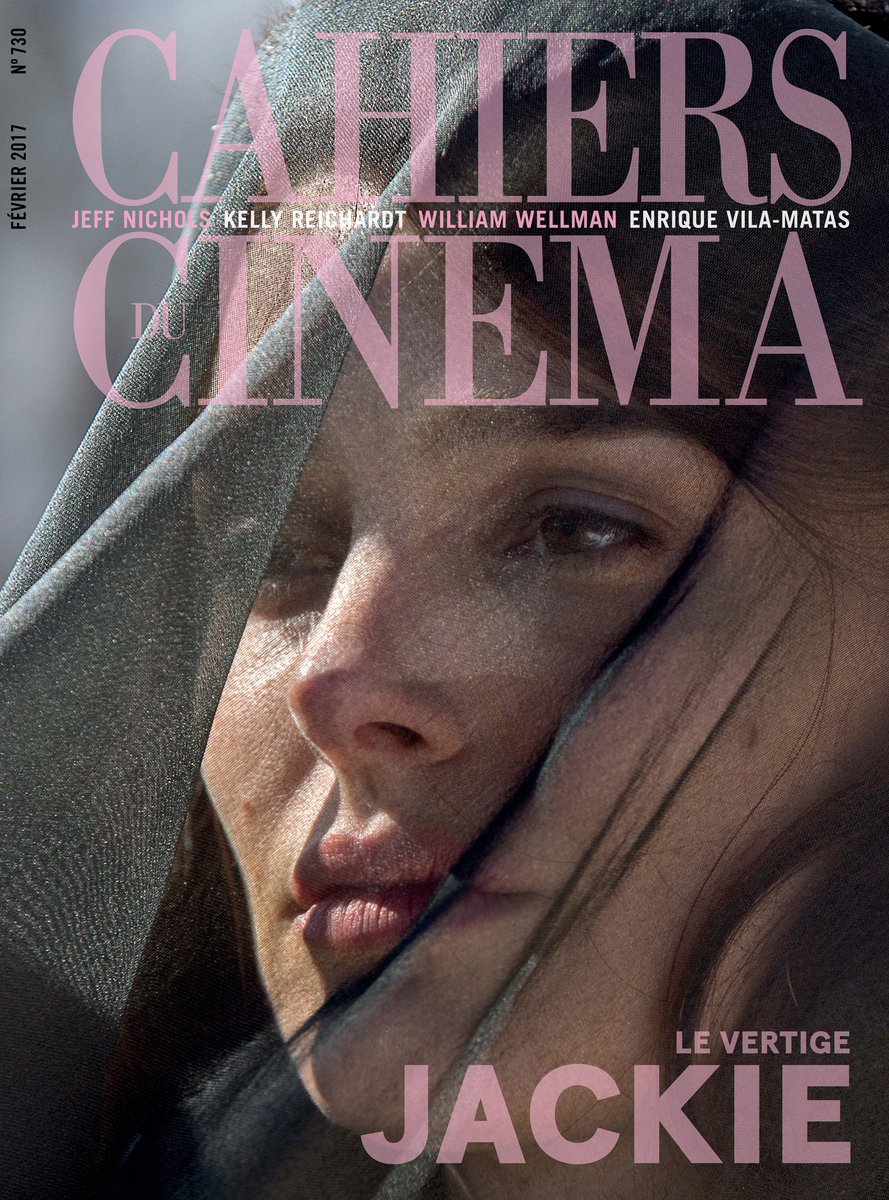
critiques of La La Land and Jackie(and maybe even the one for Arrival), which are all praised. These
two films represent an embrace of a new popular
cinema then what Cahiers is traditionally used to.
American films regularly get positive critiques at Cahiers but they tend to be the films of its regularly championed
auteurs instead of more mainstream Oscars titles. But with these two critiques
two new directors are entering its pages – Damien Chazelle, while Pablo Larraín
is returning after a trashed The Club
– and with them a new way to think about Hollywood. It’s that of a
positive, optimistic Hollywood against a cinema of cynicism.
Stéphane Delorme in his critique of La La Land, Hollywoodland (N.729), has this to say about the film,
“Even though we see its flaws, we
can still be charmed by the film as a whole. Why? Because Hollywood has been
disappointing us recently and this film with its ambition, which isn’t modest
but for the better, is to renew the potential of dreams. If this film has been
getting so much attention and Oscars buzz since Venice, is that it believes in
the Hollywood dream. Damien Chazelle knows that Hollywood at its origins was
called Hollywoodland and it’s this world that he wants to film, and not the love story, which interests him a lot less. It would be a shame to dismiss the
film for its vintage style as this problematic is already behind us. The idea
now is to how renew films: How to make it so that its history isn’t broken? How to
believe in it still? This is Jeff Nichols’ project with Midnight Special and Loving.
These cinéastes feel the need to look back to the past to better construct the
cinema of tomorrow. And they’re right. Because what they give back is a certain
type of emotion that we should never loose. Here the inaugural ballet returns
the ‘La’ to the musical comedy that has been lost on our screens: a sentiment
of enthusiasm. It’s not a restoration, but a reappropriation of a common ground
that has been abandoned, a territory of dreams that Hollywood itself was the one who was able
to bring it into existence.
“In watching the film we are also stunned
by how Hollywood has become Los
Angeles, at what point the crystallization and the glamour of the Hollywood
dream has transferred to the city itself. Damien Chazelle presents a pretty
touristic trip of the city through its great films (A Star is Born, Rebel Without a Cause) and its principal theme song
is entitled City of Lights. It’s Mulholland Dr. that operated this
transfer from a love of Hollywood to a love for L.A. (should we be calling the
film L.A. L.A. Land?), while in
the past the musical comedy (of the studios) never really explored the city to
play with it. La La Land echoes well
with another post-Lynchian angelos film:
The Neon Demon. Nicolas Winding
Refn, older, European, and exterior to Hollywood doesn’t seek to renew a
connection: he projects himself into the cinema of tomorrow by imposing fashion
on cinema. It’s an electroshock – and a failure too. While for Chazelle in a
manner that’s more nostalgic is a winner,
imposes jazz onto the cinema, and his character of a purist who wants to open
his own club certainly pertains to this cinéaste who wants to install himself
there, as a young Tarantino… This exciting film opens the door and shows that
Hollywood is there for its young filmmakers (Chazelle is 30) and can renew
itself again in a decade that’s one of the weakest of its history.”
While
Jean-Philippe Tessé in his critique of Jackie,
Vertige et vanité (N.730), praises
the film for its creation of a Hollywood myth.
“The
composition of the film, and Jackie’s oeuvre, resolves itself in a really
accomplished scene, where she’s wandering through the White House listening to
the song Camelot… The film can then
finish on the memory of a ball one night at the White House where Jackie
waltzed in Jack’s arms. It comes down to this, Jackie, a dance in the gown of a
princess, a waltz that we’d never want to end, the Hollywood dream.”
Un Manque du Réel
Regardless of
your thoughts on these two films, Delorme makes La La Land sound a lot more interesting and Tessé makes Jackie sound just as good as one of
Michel Curtiz’s prestige biopics (a director someone even like Daney returned to in favor in his later years). But these changes come at what cost? Perhaps one of the biggest behind-the-scenes event and news from theCahiers headquarters is L’affaire Nectoux. A newer critic that joined Cahiers in April 2013, Gaspard Nectoux
offered some of the most compelling texts in the magazine over the last few
years (see: more). One of his unique forces was his discussion of the réel, documentaries and hybrids of the two. He could have somewhat been
seen as continuing the work of earlier Cahiers
critics that focused on documentaries such as Serge Le Péron and Frédéric Sabouraud.
Some of Nectoux's merits included: Having written some of the best pieces on Lav Diaz, Alain Bergala and Jean-Luc
Godard and on films like I Used to
Be Darker, A la folie, Summer, Frank and Le Chant d’une ile. Offering unique Cahiers arguments against
consensus film festival favorites that were highly esteemed. Major take-downs of really
obnoxious films were always fun to read. Even though websites like Rue 89 thinks he's the worst or Adrian Martin not caring for his review of Knight of Cups, Nectoux easily created many important polemics that Cahiers is actually famous for and they were always provoking
and convincing. For example, when Nectoux critiques The Look of Silence for how “It’s hard to delve into such a
subject, when all that matters is the spectacle, spectacle, spectacle.” One
agrees due to his passion - sure! it is! - and one also wonders who he is arguing with?
In
a Yap interview Nectoux is
contextualized by Delorme amongst a new generation of 25 to 30 year old
critics at Cahiers that includes Laura
Tuillier, Florence Maillard, Louis Séguin and Hugues Perrot. And it was through
Nectoux, and some of these younger critics, that I saw my own tastes and
arguments reflected in Cahiers, more
so than some of the older critics like Joachim Lepastier and Stéphane du
Mesnildot.
The
rumors behind l’affaire Nectoux is
that he was fired due to a conflict with Delorme – I don’t know anything more
about it than that. Could it have to do with the high passions and tempers of
the atmosphere at Cahiers? Any
prejudice against writing that goes against the grain? Do young critics have a
harder time being initiated into the tight fortress that is Cahiers?
There are other
good young writers that have joined and left Cahiers before really imposing themselves that suggest l’affaire Nectoux is just the tip of the iceberg of potential interior conflict. These critics have
included Mathieu Macheret (who I really liked!), Sophia Collet, Matthieu Bareyre and Vincent
Poli. From the recent December to February issues the only new young critics
that have been able to contribute to the critique sections are Laura Tuillier and Louis Séguin. Of the other
young new Cahiers critics that I've been suggested to look at (which many of them I'm not at all familiar with) - a list that includes Hugues Pierrot, Quentin Papapietro,
Camille Bui, Paola Raiman, Chloé Huvet, Mirjana de Bie, Mathis Badin and Louis
Dréano - they're not regularly contributing to the more important critiques section and are usually tucked away near the back of the magazine in smaller, less important
pieces. As well I don't believe they regularly publish.
Nectoux
brought a focus on the réelthat brought Cahiers back down to earth. It suited the magazine really well as
they were arguments that were at the forefront of a young cinephile culture. L’affaire
Nectoux is one of the first signs that the offices of Cahiers are not as utopic as one imagined. I support the Cahiers combat
against a culture of cynicism and instead to favor enchantment, winning and dreams. But it’s
not the only form of cinema and Nectoux’s writing, choices and taste offered a
vital perspective within a context that I guess wasn’t receptive to it. It
seems like a sense of reality is being loss in this transition. Here’s hoping
Nectoux bounces back and finds places to write and that Delorme at Cahiers becomes more accepting of new
voices and that they can find a place for themselves at the magazine so that Cahiers can
keep on growing and evolving with the times to remain the best. Rereading the same old arguments by an older
generation, who are set in their ways and the filmmakers that they choose to
write about, won’t do for much longer.
“The
Smell of Us belongs to these rare films that reconfigure everything when
we see them: we leave the theater by saying that this is why we go see films…
What’s at stake with this film is an idea of cinema. Where the horizon today is
getting more de-complexed towards these ‘well made’ products, just as insipid as
most commercial products, Larry Clark arrives with his terrible poison, a
chaotic film, a grand accident that undresses his desires, his emotions, his
frights… He’s transmitting us the truth of his emotion… Rarely has a cinéaste
gone so far in undressing his cinema. The son is stuffed by his mother who’s
bored, a post-sixtyeighter that suffocates all of their descendants. The scene
designates less an incite then a blasé delirium of a bourgeois intellectual,
broken, lamentable, held up between a regret of the grandeur of the past and
the inertia of the actual present.” (N.707)
“Today we need
more teams. Of assemblages of intelligences with a common goal. ‘Team’ is the
best word for it. A ‘group’ is too closed within itself, too homogeneous, too
dogmatic. A ‘gang’ is too puerile, almost mafioso. A ‘team’ can go far, and Cahiers knows something about this: reassembling a few die-hard cinephiles and, one thing leads to another, it’s the
nouvelle vague. A team doesn’t stop,
it advances with a common goal. It isn’t a trapped community, closed-off,
utopic. But instead it stimulates the réel for everyone. Utopia isn’t a good
concept, contrarily to what a few nostalgics from the sixties and seventies
would make you believe. The only thing that counts is the réel, that which is of
the here and the now. In the name of an idea. There must be a realism of all the instances to be able efficiently drop an idea into the réel.” (N.708)
“If we like
certain cinéastes, it’s firstly because of this: they don’t tell us ‘stories’,
but instead share with us that which is the most intimate that goes through
them… Rarely has a film since Nanni Moretti’s Mia madre so well described the misfortune of these children that
want to do well but who don’t know how.” (N.716)
“Rivette doesn’t
scatter himself, he doesn’t engage with the b-film, he’s focused and he just
wants to understand. What makes Hawks, Rossellini, Lang, Preminger cinéastes?
He’s searching for a common point, a common ground, which he names mise en scène. It only takes one or two
texts to spell it out, reassembling his thought once and for all. When he
discusses for the first time Bergman, on Summer
Interlude, in 1958, he barely cites the film: it’s especially the occasion
for his text on Bergman, and also the
occasion for something else: to understand what makes a great cinéaste. So no
little details but instead an exulting higher moral view that confines towards an
abstraction. Rivette, by honesty, stops sometimes: to frankly asks himself, ‘Qu'est-ce que le cinéma?’ and he excuses
himself for not being able to answer, but the important thing is to know what
it is the unique question that’s in his head.” (N.720)
One of the major through-lines in Cahiers' special 700th issue are strong and heartfelt responses to films. Some recurring remarks are about the liberty and free spirit of what is being shown, the seriousness of the experience and what the film means, the complexity of contemplative film-going experience, and the affect and importance of a beautiful gesture. This, in short, broadly characterizes where Cahiers is at today.
This review of Restless by Stéphane Delorme
beautifully illustrates the sensitivity of the magazine today. It is as if the generosity of the artist - its director, Gus Van Sant - is re-energizing the magazine, and making sure that it is the best that it can be. Imagine Cahiers is like a flower, a beautiful pink tulip, which is nourished by the creation and viewing of these perseverant and
poetic films that gives the future hope. So the more of them that are made, the better it gets. But also that when cinema strays from this path
and nihilism, disdain and formalism takes over, it withers a little, which it necessitates Cahiers to
fight back.
In his editorial
Le style et le geste, building on Céline
and Roland Barthes, and writing on Nagisa Oshima who then recently passed away, Delorme
properly defines the politique des
auteurs as
talking about
the “morality of the mise en scène.”
This engagement can otherwise be said by one word: its gesture… The idea of the gesture also has the advantage of bringing
up the idea of an event, which
connects the films, scenes, and shots. An auteur
doesn’t only make one gesture. A film is the ensemble of them, and it is these
gestures that we review when we critique a film.
Delorme brings
this level attention to his reviews, and that of the Restless one in specific, which creates a model that raises the level
of writing by his fellow critics. Of note in this review is its focus on youth, people, love, and death – all key
facets of cinema and life. This criteria of evaluation recalls how it was put into practice in Delorme’s review of
David Lynch’s last film to date Inland
Empire, Une femme mariée (n.620),
where after discussing its key features - how it's haunting, and creates fear and affects - he
concludes, “The temptation of adultery or not, dryness or not, there is for
sure the story of an amour fou in Inland Empire, but it takes place on
the other side of the screen, between the director and his actress, Laura
Dern.”
This Restless review from
the May 2011 Cannes issue (N.667) isn’t even the official Cahier Critique (that
would be by Dominique Païni’s in N.670, and it’s also worth checking out Marcos
Uzal’s Trafic N.81 review). I’ve
translated it below. It illustrate the heartfelt and lyrical
aspects of Delorme's writing, which is seamlessly incorporated into traditional film criticism (e.g. the discussion of a director and his films). It’s one of Delorme’s best and most personal recent contributions, alongside his
piece on L’enfant secret. Vant Sant, whose
Elephant made Cahiers'Top Ten of the
decade (whose directors have all slowly been getting événements), has been over time,
surprisingly, the source of some of Cahiers most generous and touching critiques (see in particular what some of their past writers have said, whether it is Serge Daney or Stéphane
Bouquet and Jean-Marc Lalanne). Some filmmakers have a way to bring out the best in people. Gus Van Sant is one of them. - D. D.
***
Gus Van Sant, calme and without rest
Why do we like a
filmmaker? We can easily ask ourselves this question in front of the Gus Van
Sant’s beautiful new film. We do not find the shock that, from Gerry to Last Days, in three films made this director from Portland the most
important one of his generation. But we find something else that no other
direct has to offer today: an assurance, confidence, and perseverance in
oneself to make works guided by personal wishes and challenges that he wants to
take on.
It was a few
years ago that he was at the top of his game with Elephant, Gus Van Sant didn’t try to outdo himself by getting
locked into the posture of an auteur
or of a superauteur which happened
to other past Cannes prize winners and that paralyzed them formally by this quick
ascension (Wenders, Moretti, Almodovar – as we anticipate for their new films).
Gus Van Sant seems not to be a victim of this pride and complex, public
recognition doesn’t seem to affect him: he has nothing to prove, he lands and
shows up again surprisingly, in the hippy streets of San Francisco (Milk), in a line waiting at a busy
Starbucks (an unrealized project with Tom Hanks), or in a pathetic melodrama à laLove Story (1979), because most
people would be able to compare Restless
to the Arthur Hiller film.
We like a
filmmaker for his gesture of picking what films to direct,
just as much for their style. When Coppola takes up projects in the Eighties, without even worrying
about how they are just jobs, he then produces some of his best films
while multiplying his filming style; he makes a Disney (Jack), and then stops and starts over again to make films at his
house. Or like with Lynch when he goes from Lost Highway to The Straight
Story. There are a lot of filmmakers that once they reach 50 years old (Gus
Van Sant is already 58) don’t bother about gestures, and start to advance while
looking behind them, contemplating the vestiges of what they’ve already done.
On the other hand, for some, the gesture seems to be guided by a personal
challenge, which is hard to necessarily convey, that prevents the oeuvre to
just lie down in its own bed. The renewing of the game isn’t that of the
director of the classical studio era who was tied to projects as he held his
singular identity (the standard model of the auteur, Hawks); it’s a choice, a
necessary capacity to accelerate and decelerate, to navigate, follow ones
course, through warm and cold currants, without ever stopping swimming through the
river.
Why Restless? But also why Good Will Hunting? Or Gerry? Or the aberrant remake of Psycho? There is, first off, the desire
and the challenge to realize an intimate film on a heterosexual amorous couple,
something the director has never done before, and to tell this 'love story' in a Hollywood fashion. We can just imagine the criticism this will get from
the fans of Last Days who will
denounce it for its lack of ambition. But Gus Van Sant rediscovers the form of the
walk-film, which follows the principals of the pre-mortem of his 'young death' trilogy
(Gerry, Elephant, Last Days): the
story is that of a man who, haunted by the death of his parents, falls in love
with a young women that has only a few more months to live. The director from
this then tells the story of their friendship during those few months.
It would be a
shame, though, to reduce this subject to the theme of the countdown from the
films in the previous death trilogy. We would miss the originality of
the usage of the inevitable from that trilogy. We would also miss the originality of
Restless. What he’s trying to do is
more difficult than trying to accomplish a fourth opus with a Steadicam held by
Harris Savides on unhappy adolescents. This is because Gus Van Sant is
horrified of routines. The challenge is to bring out the melodrama from this
heavy subject, from an adolescent with cancer towards the sentimental comedy.
The challenge is to blend the tones. There must be a maximum balance that needs
to be achieved that can hold this fragile equilibrium, which takes into account
the fragility of the the physicality of the actors as well the extreme finesse
of the choices of the director. This airy equilibrium nourishes itself on the
trivial, bad taste and a perverse fascination that is brought out with this
closeness to death. Gus Van Sant then finds two aesthetic challenges in Restless: the pleasure of pure
constraint which he rarely ever stays to (here a love story); and the mixing of genres (melodrama and sentimental
comedy), a mixture that he had previously created a perfect model for, though
perhaps in a mode less fluid, with his dream-like My Own Private Idaho (1992).
But we can’t
stop there. Gus Van Sant (more and more?) is making a moralist oeuvre. He wants
to be useful: Milk was a film to make because there was a cause to
defend and we were surprised to find a variety of edifying sentiments (the gay
adolescent who is handicapped that calls at night time to find comfort). Restless proposes an edifying apprenticeship: the
apprenticeship of life after death, in a follow up that isn’t as poisoned as
his previous trilogy. It’s almost the antidote. Like with Larry Clark, this
fascination for adolescents doubles because it comes from an ethical stance of
good will and protection (as if the directors were saying: “beware”). The film wants to be happy, it
offers the hero a reconciliation after the sudden death of his parents. He fell
into a coma during the accident that was the cause of their death, he suffers
from a double culpability, which is that of surviving and that of not assisting
their burial. All of the film lies on this traumatism, and on this healing. He
hadn’t had the time? Now he has all of the time (three months) to say goodbye
to this young girl that he meets just in time to see her off and to accompany
her. It is she that dies but it is he who will rest in peace.
To do this, the
filmmaker choses to go into an unexpected terrain, even though if it has
already been there deep down in certain of his films, that of wonder. This
sense of wonder culminates with a great scene in the forest during Halloween,
where the boy is disguised as a Japanese aviator and her as a geisha, and they
reenact a scene from a Japanese ghost film. The decision to cast Mia Wasikowska
is judicious, because it seems like she is still wearing the fairy-like costume
from Tim Burton’s Alice in Wonderland:
a young actress of a rare intelligence, she brings a conviction that interrupts
the potential pathos of the subject. A haircut like that of Jean Seberg, a head
like a sparrow, boy’s clothes, she has a androgynous figure, which was already
apparent under Alice’s amour with the false impression of a Johnny Depp.
The male hero (Henry Hopper) resembles a king without a crown, who lives with
his aunt in a large house that seems like it’s right out of Last Days. There is a third character,
who is really bizarre, which accentuates this Japanese imagination: Hiroshi,
the ghost of a kamikaze, who accompanies the hero since the death of his
parents. This companion enchants the reality of the young man, but he also weighs
the idea of death upon the story. In the extraordinary opening of Elephant, a son interrogates his father
about his activity at the Chuuk Lagoon during the Pacific War, before answering
him, this adolescent: “I went there” – but how could he? This enigmatic remark
resonates with the omnipresence of war, and the uncalled for intrusion of
archive images of the atomic explosion at Nagasaki.
The enchantment
of Restless relies also on the mise
en scene which is unique to this filmmaker: the autumnal colors that pass
through the trees to the generous night-robe that Mia Wasikowska wears, the
framing that are like friendly gazes posed upon the characters just like a friend’s
hand on one’s shoulder; out-of-focus images that find themselves as the scene
unfolds, like when the couple find themselves in front of the parent's
tombstone, beside a naïve sculpture of two sheep that are side by side. There
are also conventions, notably the music, but they are compensated by genius
ideas: like the first medical attack of the young girl, who in the middle of a
sentence, without even screaming, falls down backwards in a gesture of an
infinite violence; or when, before dying, in a scene that counteracts all of
the hospital scenes in every Hollywood film, she just simply asks him, “Ok?”, in the vein of “can I go now, will you be fine?”
But the
strangest thing, in this luminous film, is the presence of Henry Hopper. With
each expression, his face threatens to take on the traits of his father,
Dennis. All it takes is for him to squint his eyes a little, and we are back in
1955, the era of Rebel Without a Cause. When
the end credits of the film finish and there appears its dedication to Dennis
Hopper, a deeper emotion engulfs the whole film, as if this story is the
backdrop for this character. The resemblance between the father and son
contributes to its power.
“Now I’ve called for a more
emotional cinema. So what I’m looking for is emotional texts. In the past, I
avoided that, largely out of reserve. Then I wrote a short piece on Garrel’s L’Enfant secret in the first person and
I realized that was a potential way forward.” - Stéphane Delorme
Delorme’s contribution
to the Cinéma retrouvé feature Onze
stations pour une histoire poétique du cinéma français on Garrel’s L’Enfant secret is an important text for
his editorialship at Cahiers du Cinéma.
On page 94 of the October 2012 issue (N.682), which on its cover features Hong
Sang-soo, in three paragraphs he is able to emphasize strong emotions and
poetry, which will be the key themes in a remapping of the history of French
cinema, and through repetition the key directors that will rise to the top are
Grémillon, Garrel and Carax. As well it is perhaps his most personal
contribution at the magazine, especially in regards to his conviction that he
could have directed the film. It is an important piece for Delorme, who now
mostly just writes editorials and is selective about writing critiques and événement
essays, as it culminates a focus on strong feelings associated with cinema,
which will gain more momentum and become the guiding drive at the magazine. For
example, in the editorial Avec ou sans
Maillot (N.695), “We needed to write a manifesto for an unruly cinema for
2014… a call to unleashes our demons and to throw ourselves in the water…
without a bathing suit!” In the editorial Exaltation
(N.696), “There remains only one antidote, to recite towards and against
everyone, like a mantra: “The wind rises! … We have to try to live!”” And now
more recently, for their 700th issue they received 138 contributions
of famous film people to share their own significant film experiences. Let’s keep
this going! – D.D.
***
L’Enfant Secret
I
am at the Forum des images in Paris, I’m twenty years old. One movie gives me
everything, like a blinding light. For a long time, this film is remembered by
its first images: a boy and a girl are in their nightshirts, they’re laughing
and kissing, it’s glorious, their experience is unforgettable, their happy. In
all of this, in these sumptuous white images, I don’t get much… There is a
great tenderness, the paradise of childish love, the secret of childhood. I
don’t yet know the great beginning of Au
Hasard Balthazar (1966): two children in a barn with the black donkey,
their on a swing, there is a little girl, who is pale and sick, and that is
looking at them while crying – these are as much fragments of the donkey’s
memory, as they are the rare years of happiness. The start of L'Enfant secret has this same silent
magic, the children are the only ones to occupy this house just like in
Garrel’s first film, which he made when he was 16, Les enfants désaccordés (1964). But it’s Bresson with Godard. Two
kinds of mysticism married together: the sacred and modernity. The voices are
lost, the image evaporates and comes back, the images are re-filmed in a
visionary way, piano music breaks through the silence in regular intervals. The
fragment and the rhythm does not destroy the representation but instead makes
it incandescent.
I
did not know that Garrel himself was re-learning how to make films, after his
reclusive years, to return to the streets, and to film Paris, the benches of
Paris or the lovers that stop at them to then separate. L'Enfant secret is the moment of convalescence, the return to
fiction, but that remembers the liberty of the great portrait-films that he
made in the Seventies with Nico. It is maybe not Garrel’s best film. Les Hautes Solitudes is more pure, J'entends plus la guitare is more
profound, Le Berceau de cristal is
crazier. But it is this rare equilibrium between an intimidate journal, that
would reign in the French cinema, and the flood of the power of dreams, that,
would unforgivably retreat. It could have been the film with potentially the
biggest influence.
There
is the question of a hidden child, Swann, of cinema, of a rupture and, like
always, of truth. The cinema of Garrel has nothing mute about it. From his
years of being amazed, he comes back talkative. The dialogue is reduced to
simple maxims: “The loyalty towards
others is the only movement of the soul.” Or poetic lightning bolts that
Anne Wiazemsky renders familiar: “Your
face is like lace.” We dream of leaving the city to go to the country to
work the land, like in a song by Gérard Manset. One day being poor. In seeing
them, we finally realize that there are two kinds of great films: those that
impress and that even from a distance shine like a thousand fires like an
exploding star (Vertigo). And those
that are so close that we could hold them in the palms of our hands. L'Enfant secret, I could make this
film, I could have made this film, it watches me. This isn’t a pretension, only
a certitude. And if there remains only one image, it’s the first, and the last,
which are the same one: a hand going through hair, a hand on one’s neck – to
love or to heal. In the preface to Une
caméra à la place du coeur, Leos Carax wrote about Garrel: “The air is
cold. Through his hair, a man looks at a woman. Together they shudder… THE
CINEMA TREMBLES.”
Stéphane Delorme
became the chief editor of Cahiers du Cinéma at
the age of 35 when Phaidon purchased the magazine from Le Monde after they failed to manage it properly so that it would be financially successful. Delorme’s
first issue as chief editor was in September 2009. He took over from Jean-Michel
Frodon and Emmanuel Burdeau who were previously responsible of it for most of that decade (2003-2009).
These two editors had almost opposite taste in films - Frodon had a standard appreciation of European art films while Burdeau liked the craziest American films - and these contradictions watered down the singularity of the magazine. The editorial position and mise en page of this Frodon-Burdeau period are remembered for its journalistic profiles, an interest in new media, a privilege of French cinema, and an awkward use of advertisements. Also in retrospect some of Frodon's editorials are not that inspiring.
Since Delorme’s induction as the chief editor he
has brought to the magazine, and refined over time, a unique, fierce and
sensitive editorial position, which is shared amongst its diverse and eclectic
contributors.In a recent interview for Bomb Magazine, Delorme speaks about the
solidarity he has with his generation and his fidelity towards youthfulness,
which is a long-standing tradition at Cahiers (Breathless: "Pardon, vous n'avez rien contre la jeunesse?"). Recently a major undercurrent at Cahiers has been an emphasis on feelings and emotions against a dry and objective academicism. Delorme describes one of the goals of the magazine to be, “not only a film periodical, but also the periodical of its era. I want us to be in accord with our era and also to try to change the era.” The magazine is really critical too,
“Part of the reason we seem harsh is because I’ve chosen to break with Cahiers's tradition and not have the writer who likes a film best write about it. We have a lot of writers: I can get up to fifteen opinions about any given film. I’ll always be able to find someone to like a certain film a little more than the others do. So if we wanted, we could always find a way to not be too mean, even when a film is bad, so everyone is flattered, producers and directors don’t get their feelings hurt, and we can partner with lots of films and distributors.”
Delorme was involved with film publishing even before joining Cahiers as in 1995 he started his own
film magazine Balthazar (in homage to
Bresson), which had a great reputation (cf. Laurent Dubreuil’s La revue Balthazar), and whose life of
six issues lasted until 2003. He has also been a programmer at the Quinzaine
des réalisateurs (2003 and 2009) at Cannes, which itself has become a major
site of intervention for the magazine, both positive and negative. Delorme’s
first review at Cahiers was for Brian de Palma’s Snake Eyes (cf. A maintes reprises, November 1998, N.
529) and since then has written a selective and impressive body of Cahiers Critiques and articles that includes to just
name some of the major directors, Eastwood, Coen brothers, Resnais, Aronofsky, Verhoeven, Bronstein,
Dumont, Dolan, Oshima, van Sant, and von Trier. The adjoined chief-editor Jean-Philippe Tessé
has also penned many important critiques, and so has its small group of writers
and guests, which many of them have been there for a similar amount of time. The new writers are given the space to define themselves quite early on. As Nicolas Azalbert writes on the curation of the writers, "Delorme has well defined the role of each writer in relation to their interest. This allows us to the freedom to write our best texts for the magazine. There is a simplicity and rigor to this method." The
critiques stand out by the strength of their argument, the passion of the prose, the
selectivity of what films get written, and their place within événements and
dossiers.
The following
are all of the Cahiers covers of the
Delorme years up to its newest special 700th issue. It’s first one
(N.648) is of Eccentricities of a Blond-Haired Girl, whose director Manoel de Oliveira is an important reference point at the magazine
for being an older-generation European art-film director whose films have a lightness
of touch and use fantasy. These early covers featured film or publicity stills,
which emphasized portraits of the film’s stars or directors. The Apatow issue
(N.649) was to actually feature a take-down of the director of American
comedies (a surprising and bold move). Resnais (N.650), a major director at the
magazine, whose Coeurs Delorme
praised (N.617), created a stronger bridge between Cahiers and Positif, where
Resnais and the other Left Bank directors were always seen as a better
alternative to the New Wave. The Tetro
cover (N.651) with Vincent Gallo (cf. Delorme and Coppola). The best of the
2000s issue with Lynch's Mulholland Drive on
the cover was a grand gesture for Delorme where he was able to summarize the
previous decade, and which allowed him a new start for the upcoming decade. Onwards the covers
represented features the magazine would be dedicated to: acknowledging their fidelity to the former New Wave directors they gave Rohmer the cover after he passed away (N.653), Herzog’s Bad Lieutenant
(N.654), Burton’s Alice in Wonderland (N.655),
Cannes (N.656), Apichatpong’s Uncle
Boonmee (N.657),American television series with their cover on Mad Men (N.658), utopias in French cinema with a still from Happy Few
(N.659), Claude Chabrol who just died (N.660), and then on the young French cinema (N.661). Julia Hasting arrives at the magazine at the
December 2010 issue and she would be responsible for their
covers. For this issue there is a dark salmon background and on it are drawn the titles of the year’s best
films. This is a return to the origins of the etymology of
magazine’s title Cahiers which means notebook. There is a new casualness to Cahiers and it is becoming more personal in opposition to the corporate status of most 'official' publicity film magazines - as if it was something to be shared amongst friends. These covers would emphasize
abstract designs and graphics that represents the spirit of that issue whether
it is the films, themes, or event that it is covering. The French graphic
artist Floc’h, who is known for working with Resnais, would design their January 2011 cover (N.663), which covered some of the year’s most anticipated films and which would become a regular feature for their January
issues. Some of the
covers in this period are better than others (the Tree of Life one is especially strange). The New Hollywood directors of the past (Cimino, Eastwood,
Spielberg) are emphasized, whose narrative classicism connects
this period of the magazine to the classic cinephilia of the magazine's past and to the origins of Cahiers relationship with them, and this is also in opposition to an emerging cinema of purely iconoclastic formal
experimentation that has slowly been gaining more attention at film festivals.
Some impressive features that they ran include ones on New York do-it-yourself filmmakers (N.670), digital cinema (N.672), French film schools (N.676),
programing (N.678), eroticism (N.680), women filmmakers (N.681), and bad auteur films (N.684). With
their Hong Sang-Soo issue (N.682) they got a new
graphic design company Change is good to do their covers and since then their covers have become
more interesting. (Previously even Bernard Chardère from Positif was
complaining about their covers). There is now more visual details on the cover
that emphasizes the magazines interest in the beautiful and poetic. The covers
now do a better job at featuring the events of the issue and its underlining
themes. Some of these include the most anticipated films of 2013 with a special focus on James Gray (N.685), a few American films (N.686), the young French filmmakers (N.688), Abrams's Star Trek: Into Darkness(N.690), on comedy and Kechiche (N.692-693), and the best films of 2013 issue (N.695). Sometimes there are strange disjunctions where the editorial does not reflect the cover, for example in the Coppola issue (N.677) the editorial emphasized instead its dossier on torrenting. The editorial position in this period is also more open and allows its main writers a stronger influence on the magazine. For example after Cannes instead of being firm on whether Cahiers should support La vie d'Adèle they left this question unanswered until the film would get release (and which Tessé would champion by organizing its dossier, unlike the previous year's Palme d'Or Amour). Or their comedy issue whose main contributor was Vincent Malausa. The covers are becoming more open, abstract and
flexible. In the January 2014 issue with Miyazaki’s The Wind Rises on the cover (N.696) they started to include a new section
at the back of the magazine called The
End where in it they focus on one aspect of film history, which is tied to
their editorial line, and which they beautifully illustrate. This is just another
aspect of what Delorme is bringing to the magazine that illustrates this more
open, flexible, poetic and beautiful new editorial position. For their last Resnais
cover (N.699) they got his close collaborator Blutch to contribute. There are
still some major Cahiers directors
that are still waiting to get covers like Cronenberg, Garrel, Dolan and Ferrara. Cahiers is now at
its 700th issue - congratulations! - and on its cover there is a classic Cahiers title on a pink background, a list of some of its guest
director contributors, and in big numbers a 700 in rainbow colors. The future is a bright
place. - D.D.
"Why a praise of comedy today? In our «dix tares du cinéma d’auteur» published
in our last December issue (which continues to serve us as a compass) there was
prominently featured the fault of "papal seriousness" of all these auteur
films that by force of being so serious become unwatchable or succumb to be
involuntarily comic. The cinema that we defend reserve instead a distance, an
irony, an elegance, whether it is David Cronenberg, Wes Anderson, Hong Sang-
soo, Leos Carax, Harmony Korine or JJ Abrams. This is the mark of great
filmmakers to mix genres with ease and to create ruptures of tone. The two surprise
successes of this summer surprises, L’Inconnu
du lac by Alain Guiraudie and Frances
Ha by Noah Baumbach, are shining examples. Regarding the renewing of French
cinema in these last few months, the films rely much of their approach on
comedy (La Bataille de Solférino by
Justine Triet, La Fille du 14 Juillet
by Antonin Peretjatko). After our praise of eroticism last year, and our praise
of lyricism there were a few months ago, this issue participates in this same
tradition and reaffirms our focus on a cinema of strong emotions, against that
of being mild or shy or well-behaved, which has been developing just about
everywhere. To praise comedy presupposes some kind of idea about comedy. A conception
that is not at all weak. [ ...] This is the adjective of the wildest comedies: Magnificent because it is poetic. It has
to do with temporal shortcuts, differences between one’s age and body, falls
that are fast and slow, the invention of gestures that are unforgettable, and
becoming a child or animal again and to make others laugh and marvel. Magnificent because it is passionate. These
films shine by their candor and their praise of friendship or l’amour fou between characters that
"are pure in their heart and feeble doing everything else," like they
say in the latest Farrelly brothers film." - Stéphane Delorme (Editorial Comédie, N.692)
***
"The logic of this issue follows a montage between
two French filmmakers, an assembly that concentrated all our forces: Abdellatif
Kechiche, crowned with the Palme d'Or for La
Vie d’Adèle, and John Grémillon, the eternal maudit of French cinema. We won’t hide the fact that Kechiche’s
film divided us, perhaps primarily because the film itself is divided. The two
chapters are more like two episodes then like two moments of a demonstration, similar
to the films of Stanley Kubrick, a master of films broken into two (and which Adèle
cites in the film as her favorite filmmaker). [ ... ] There is no specific actuality
about Grémillon going on right now, but there has been a slow accumulation of
events in the last three years that has him returning always more deeper into
our spirits. There was the publishing of his remarkable writing about the
cinema, and the release of his films from Gaumont of Daïnah la métisse, Pattes
blanches et L’Amour d’une femme,
and coming out in November there will be Lumière
d’été. If we don’t do a Grémillon event now, if we don’t press this as a
major and urgent actuality, he will again not find his place in Cahiers and a new generation might
overlook him. We remember the last failure, it was ten years ago, when the
rooms of his retrospective at the Cinémathèque remained half empty.
Systematically missing Grémillon is to refuse to enter into what the French
cinema can truly offer which is the most beautiful, intense and tender: the
best." - Stéphane Delorme (Editorial Kechiche/Grémillon, N.693)