Showing posts with label Canada. Show all posts

Tuesday, March 30, 2010

Upscale Mariage Qualms

Chloe (Atom Egoyan, 2009)
*** (A Must-See)


In fifty-year-old bespectacled director Atom Egoyan’s new film Chloe there isa chilling story of marital dysfunction and intrigue between a charming music professor David (Liam Neeson) and his gynecologist wife Catherine (Julianne Moore). The film is about life and death, language and perceptions, orgasms and music, personal obsessions and Canada. Catherine suspects David of extramarital affairs after finding a picture of him with a younger student the night he missed his surprise birthday. Catherine self-destructive paranoid fantasy leads her to hire a young prostitute Chloe (Amanda Seyfried) to pursue her husband. From there it is ambiguous if Chloe is fulfilling her duties or just leading Catherine on, the sexual adventures eventually involve the couples son Michael (Max Thierriot).

Chloe is successful at presenting its contemporary period as it showcases Torontonians interconnectivity with new media, urbane privilege, alienation, infantilization of adults, the growing indie-rock movement, transcontinental airplane travel and heath care. The film Chole is attuned to women high fashion. The women are dressed beautifully and revealingly from see-through white t-shirts to dresses to high heels, these items represent gender expectations that are placed on women. The level of success and physical appearance exuded by Catherine makes her plight all the more desperate when Catherine suspects her husband of infidelities. Jonathan Rosenbaum writes about Chloe “I think what’s sneaky and deliberately misleading about the story is that is starts off pretending to be a movie about a husband’s midlife crisis and then winds up as a movie about his wife’s midlife crisis.” The thematic gravity and psychological depth, linear narrative and star power are a mélange of Atom Egoyan’s art-house sensibilities and the Reitman’s populism. Chloe is partly funded by Ivan Reitman’s production company Montecito and Ivan’s son Jason Reitman is executive producer and there was collaboration with Studio Canal and Sony distributions.


Atom Egoyan describes Chloe as “the anti-Adoration” as Adoration (2008) - a film about the stigmatization of ethnic minorities - presented a more desperate Toronto landscape while Chloe – which was supposed to be set in San Francisco - is a travelogue of Toronto’s luxuries. While in Egoyan’s earlier films Toronto was seen as a non-place. The cultural tourism in Chloe is overt as the city is an inherit part of the story from Yorkville and Queen Street, the CN Tower skyline presence, the AGO, the ROM, Allen Garden, Cafe Diplomatico (594 College Street), Rivoli’s (332 Queen Street), and the Royal Conservatory.

Assimilation has been a longstanding theme in the oeuvre of the Armenian-Canadian director. Atom Egoyan was born in Cairo, Egypt and at a young age was relocated with his family to Victoria, British Columbia. Egoyan habitually includes the casting of his wife Arsinee Khanjian in his films. Through the 80s, 90s, 00s the director has been dealing with ethnicity and assimilation, and private obsessions and public issues. Since Next of Kin (1984) - with an Armenian protagonist and a cameo by Atom Egoyan, Family Viewing (1987), The Adjuster (1991), Calendar (1993), Ararat (2002), to Adoration Egoyan has been dealing with what it means to be a foreigner in Canada. This is epitomized in the angry sequence in Family Viewing where a waving Canadian flag is cross-edited alongside an Armenian elderly mother committing suicide through swallowing pills while her daughter prostitutes herself to raise money to take care of her medical expenses. In Calendar there are clear distinctions between the Armenian positions of nationalism, Diasporan, and assimilationist. These ethnic positions have been lost from Chloe as it shows Egoyan assimilated and making a film about hegemonic Anglo-Saxons. Similarly to Egoyan’s non-Canadian productions Felicia’s Journey (1999), his most Antonioniesque film, and Where the Truth Lies (2005). Though, in a Q & A session at the Canadian Film Institute, Mr. Egoyan dismissed the “auteur” theory in which for him would include looking at the themes in work that he has no creative input like his directed late 80’s TV fare of Friday the 13th, Alfred Hitchcock Presents and The Twilight Zone.

A defining trait in Atom Egoyan oeuvre is the perfuming of scenes with a “cerebral musk”. Even though this is his first film where he did not co-write the screenplay, which is credited to Erin Cressida Wilson as a remake of Anne Fontaine’s French erotic thriller Nathalie... (2003). This brainy tendency comes from Egoyan’s interest in theatre that was apparent since his stint at the University of Toronto. His interest in theater is reiterated in his direction in the Samuel Beckett series of Krapp’s Last Tape (2000) with John Hurt, as well his short film Howard in Particular (1979) seems rooted between the Theater of the Absurd and Maya Deren. The emphasis of his cerebral musk is on psychoanalyticism and language. In the introduction of the Chloe, the prostitute in a voice-over says “I have always been good with words”, this scene and many others are characterized by a meta-discourse of character motivation, which sometimes can seem a little clunky as people are talking about things that people typically do not address in conversation. So even if Chloe appears more as an enigma then a fully rounded character, she confronts Catherine with an alternative position and forces her rationalize the absurd situation.

Reviews of Chloe have already been written in several Canadian publications. In the Katherine Monk’s Ottawa Citizen review she is eagerly positive as she writes “the movie hits a sustained eerie note” and raves of Amanda Seyfried’s performance. In Liam Lacey’s Globe and Mail review he is condescending towards the film, not biased by sharing the filmmakers hometown, he writes “Chloe is director Atom Egoyan’s foray into the realm of what might be called artful trash” and finishes his review with “Chloe has an awfully corny ending, including some lurid high-jinks and shocks that teeter on genre satire”. In the Montreal Gazette John Griffin writes naively “You’re forgiven for failing to realize Chloe is the first Atom Egoyan picture that isn’t an Atom Egoyan picture”. While Brian Johnson’s review in Macleans emphasizes the surprise emerging career of Amanda Seyfried “Hollywood’s new It Girl.” There has also been several critical analyses on Atom Egoyan by writers including Jonathan Romney, Emma Wilson and Tom McSorley.


The casting is spectacular, the acting is titillating, the architecture is sinisterly photographed, and the themes are relevant. One of my problems with this art-house production is its voyeurism. It condones David for cheating and flirting all the while the providing the viewer with enjoying lesbian fantasies. These sexual sequences seduce the audience similarly to the stripteases in Exotica (1994). Chloe is a mixture of pornography, as Amanda Seyfried is frequently naked, and stylization as the film exist in a realm of heightened realism. With Chloe, Atom Egoyan has created a substantial film about extramarital-confusion and it proves to be a really interesting addition to the Egoyan universe.-David Davidson

(Bytowne Cinema, 324 Rideau Street, 26/03 - 8/04)

Tuesday, February 2, 2010

Great Films of the 00's


Passing Time
by David Davidson


The films on my top twelve of the 00’s list are serious, original and daring works of art. They are not necessarily non-fiction but they are all somehow are drenched in reality, whether that means being based on actual historical events or newspaper headlines, being city symposiums, history revisionism, or just grass root stories of people and their daily realities. These films layer fiction with non-fiction to come up with a piece of work that is evocative of the first decade of the third millennium. These films take place in the present-day or in the historical film genre and through them contemporary film-artist emphasize the importance of geography and history. The list is a good accumulation of moods and experiences of the first decade of the 21st century.


The decade of the 00’s in North America for Canadians meant living under the Liberal Prime Minister Paul Martin (2003-2006) and the Conservative Primer Minister Stephen Harper (2006-?) government and south of the border in the United States of America there was the George W. Bush (2001-2009) administration. The films made in both those countries are social documents and they reflect zeitgeist issues prominent of our times by addressing how people are relating to the world. The foreign films on the list are interesting for a greater understanding of world developments from an insider point of view. They are about social realities and hardships, globalization, living with the consequences of an unfavorable history, the effects of government policy etc. Essentially these films are a humanizing experience that present a different world then ours, creating sympathy for characters that we might not otherwise thing of. Some films achieve what Howard Zinn would advise to people that is to “learn a different history that will make them skeptical of what they hear from authority”. These works are the antithesis of the “authority” which consists of the dominant media portrayal of North-American culture and the abroad. The films emphasis on the life of the working class and the details surrounding them are a testament to the great possibilities of what can be accomplished with a video camera.


The Canadian director David Cronenberg’s A History Of Violence (2005) has marked the top ten film list of the decade for both Film Comment (#7 on their list) and Cahiers du Cinema (#5 on their list) and the film critic Jonathan Rosenbaum included in his personal top ten list the Canadian experimental filmmaker Michael Snow’s *Corpus Callosum (2002), a film which I regrettably have not yet seen. These are two isolated exceptions in what is a non-Canadian dominant international film community recounting of the decade. A History of Violence is a thrilling action film and also a complex critique of the action genre and American society (i.e. violence and war is a passed down trait from one generation to the next. Probably the closest thematic adaptation of the Marxist historian Eric Hobsbawm’s On Empire: America, War and Global Supremacy). It is also a radical departure from the typical Canadian social-realist films. My problem with A History of Violence is that it is complicated to assess how the film is actually Canadian other then the criteria that the birthplace of David Cronenberg is Toronto. The inclusion of this film creates an overarching blanket that reduces and removes other national filmmakers, who are engaging in a discourse of local issues, from the international film community. Other important Canadian filmmakers include the prairie fabulist Guy Maddin, the Armenian assimilationist Atom Egoyan, and the Inuktitut speaking Zacharias Kunuk. I have not yet seen any films by John Greyson or Philip Hoffman, two other Canadians filmmakers that have been recommended to me. The Canadian films on my list My Winnipeg (2007), Atanarjuat (2001), Ararat (2002) and Adoration (2008) are works whose settings remain within our ten provinces and three territories. They are bold and innovative narratives that showcase our national artistry. I have not included Frank Cole’s magnum opus Life Without Death (2000) about his solitary excursion through the Sahara desert as it does not deal with societal issues which is the criteria for my list.


The films on the list take place around the world and back. This includes: Poland during WWII following a Jewish pianist who is in hiding from the death camps (The Pianist); Los Angeles, California during the 1920’s with an investigation of police and psychological institution corruption (Changeling); New York and in a few other American states and cities during WWII with a intricate meditation on the war and its current and later effects on American society (Flags of our Fathers); Paris, France in 1936 with a tale of a crisscrossing Russian agent in one of Eric Rhomer’s last and more political films (Triple Agent); Winnipeg, Manitoba with a meditation on the lack of substance that comes with the demolishing of cultural heritage which includes tearing down the cities old Hockey Arena and Eaton Center (My Winnipeg); A meditation on the Armenian genocide that took place in the beginning of the 20th century (Ararat), a tour de force guide through Russian history in the Hermitage in St. Petersburg (A Russian Ark); a compelling narrative of people searching for former lovers as well as an examination of the effects of the Three Gorges Dam in China (Still Life); a look at London’s working class and the area around their housing complex (All or Nothing); a modern day reworking of Dostoyevsky’s Crime and Punishment in Belgium (L’Enfant); a presentation of the effects of the glass ceiling on a Senegalese taxicab driver in Winston-Salem, North Carolina (Goodbye Solo); a devastating critique of American arrogance in New Jersey (Storytelling); a tale about the effects of living in an inextricable digital age set in Toronto, ON (Adoration); and finally set in the Canadian North a recounting of an Inuit legend (Atanarjuat).


Truthfully the majority of these films were only watched later after their initial release on video, some did not even have a theatrical distribution here. I have not yet seen the 2000 output of all the film festival circuit favorites including Apichatpong Weerasethakul, Jean-Luc Godard, Roy Andersson, Corneliu Porumboiu; filmmakers who have gathered much praise and critical attention. This just shows there is much richness in contemporary filmmaking and I continue to look forward to watch new movies.


The Top Twelve Films of the 00’s
1. Still Life (Jia Zhang-Ke, 2006)
2. Russian Ark (Aleksandr Sokurov, 2002)
3. My Winnipeg (Guy Maddin, 2007)
4. L’Enfant (Dardenne Brothers, 2005)
5. Changeling (Clint Eastwood, 2008) & Flags of Our Fathers (Clint Eastwood, 2006)
6. Triple Agent (Eric Rhomer, 2004)
7. The Pianist (Roman Polanski, 2002)
8. Adoration (Atom Egoyan, 2008) & Ararat (Atom Egoyan, 2002)
9. Storytelling (Todd Solondz, 2001)
10. Goodbye Solo (Ramin Bahrani, 2008)
11. All or Nothing (Mike Leigh, 2002)
12. Atanarjuat: The Fast Runner (Zacharias Kunuk, 2001)


Friday, January 22, 2010

Recommended Reading: The Canadian Journal of Film Studies


Ottawan’s and the Enlightenment
By David Davidson


The Canadian Journal of Film Studies, Editors-in-Chief: Charles Acland and Catherine Russell, Film Studies Association of Canada Press, $15.00.

The Canadian Journal of Film Studies is an ongoing series compiled of scholarly articles on films, reviews of film-related books and miscellaneous writing relating to film studies. Thought I do believe the journal should have a proposed mandate, whether in the journal or on its website, the efforts are a great contribution to a nation-bound endorsement for academic writing about film and film studies. It highlights the importance of peer review work and being accountable to neighboring university film-studies graduate and professors. The Film Studies Association of Canada, who publishes the Canadian Journal of Film Studies, is having its 12th annual graduate colloquium with presentations on topics in Canadian film and media and comparative analyses of film and other media on February 11 – 13 2010 at Carleton University.

I am currently finishing my undergrad with a minor in film studies at the University of Ottawa. The professors were all relatively competent and the classes were usually graded on two papers ranging from 5 to 15 pages and attendance. I felt slight friction in a few classes with classmates and professor as it is hard to reference films and directors that no one else has ever of. I was taught by the following professors: Gary Evans and Boulou Ebanda de B'béri- both from the Department of Communications, Douglas Clayton and Franco Ricci- both from the Department of Modern Languages and Literature, and Leslie Sheldon from the Department of English.


Gary Evans wrote a few Canadian film-related books and in his Canadian documentary class the mandatory readings included his textbooks In the National Interest: A Chronicle of the National Film Board of Canada from 1949 to 1989 (1991) and John Grierson: Trailblazer of Documentary Film (2005). The Russian Cinema professor Douglas Clayton communicated well his knowledge and enthusiasm for Russian and Soviet culture and his preferred directors included Andrei Tarkovsky, Georgi Daneliya, and Alexander Sokurov. A great classroom experience was after the screening of Sokurov's The Russian Ark (2002) professor Clayton turned the lights back on and was in tears as he was so taken aback by the films beauty. The Italian Cinema professor Franco Ricci screened many Vittorio de Sica and Bernardo Bertolucci films. I really appreciated Mr. Ricci as he would later hire me as a marker for his Italian Culture and Cinema class. The professor for Literature and Film Leslie Sheldon made aware a preference for the movies of the Coen brothers and Steven Spielberg and he also seemed adept in film history.

In Boulou Ebanda de B'béri Canadian Cinema and African and Australian Cinema class there was a general disregard towards film history. No films were watched in their entirety and the screened movie-clips were marginal and scarce. His selection of films were questionable as they included really commercial fare from the last decade with little interest in diverging in works from the past or from more experimental directors. However he did introduce me to Zacharias Kunuk which I am very grateful for. Film narrative and the mediums malleable sight and sound elements were not discussed but instead there was an obnoxious perseverance for a meta-discourse on certain communication concepts (e.g., representation, ideologies) and at times concepts were unclear.

These are a few things that are awry about the non-regulated film studies program at the University of Ottawa which lacks a unifying structure. These shortfalls could be avoided if there was a stronger faculty emphasis to impose the professors to be engaged in the greater Canadian Film Studies academic community and abide by a structured format to maximize educating about film.

*****


Charles Tepperman’s “Stolen From the Realm of the Night:” Modernity, Visual Culture and the Reception of Cinema in Ottawa in The Canadian Journal of Film Studies Volume 18 No. 2 Fall 2009 issue is a pleasurable read that has much to offer on the years in which cinema was being introduced to Canadians as well as a social-cultural-developmental-political history of the nation’s capital city interlaced with nostalgic remnants. Tepperman argues that Ottawa between 1894 and 1896, even then a major Canadian city, specific conditions including its particular configurations of commercial entertainment, electrification, and urban expansion prepared its citizens for the reception of motion pictures.


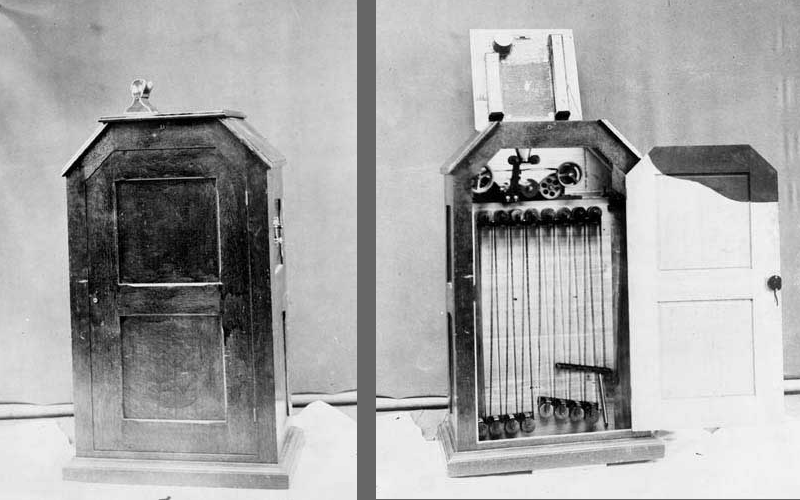
The first contact with photoplays was Edison’s Kinetoscope, the solitary viewing motion picture peepshow, premiered in Ottawa November 3rd 1894 and returned November 2nd 1895. Charles Tepperman argues that this was part of the process of local modernization of urban entertainment. The exhibitors were George and Andrew Holland. The Holland brothers had a close business relationship with Thomas Edison and it was them who opened the first Kinetoscope parlor in New York City April 14 1984. The subject matter of the films, usually Edison company shorts, was secondary to the impressive technical nature of the machine itself.

Throughout Ottawa the proto-cinematic qualities of illumination was beginning to take place. At the Ottawa Winter Carnival electrification enabled the lighting of the Chaudiere Falls and electrical burst of spectacular effects and elaborate mass choreography at the "Storming of the Ice Castle" on Nepean point anticipated future illuminations.


The six week exhibition of the Vitascope in Ottawa July 1896 was the first Canadian exhibition organized again by the Holland brothers. During this period Wilfred Laurier was elected prime minister. The New West End Park outside of the city, with the Vitascope, was a new center of attraction. The Ottawa Electric Railway Company and the Ottawa Land Associations owned the land in Hintonburg and Mechanicsville, where the land was cheaper and the taxes lower, capitalized on the expansion and used the streetcars to advertise their property.


Interestingly this blog is a continuation of the film going tradition described in the essay. While some of the old methods of exchanging information are still around such as the Ottawa Citizen, some are not like the Ottawa Journal and the Ottawa Free Press. The locations are now a little different; there is no longer the Grand Opera House, Wonderland Musée Theatre, and the New Perley Block (55 spark street), but there is the Bytowne Cinema, Mayfair Theatre and the Library and Achieves Canada. Instead of peeping at Thomas Edison we go watch movies by Atom Egoyan, Guy Maddin etc. In the essay there are highlights of Ottawa geography that sparks some nostalgic warmth as it acknowledges the importance of certain places as part of the experience of living in this city. Some of these include the Ottawa River landscape, the Experimental Farm, the Post Office, Sparks Street and Bank Street, Ottawa Canal town, and Lansdowne Park. While now some of these landmarks have been razed and new ones have been built and there has been a shift in media from physical to digital, It is through an understanding of Ottawa's history that enlightens one towards a more cultural ingrained film-going tradition and makes engaging with local repertories a lot more rewarding.