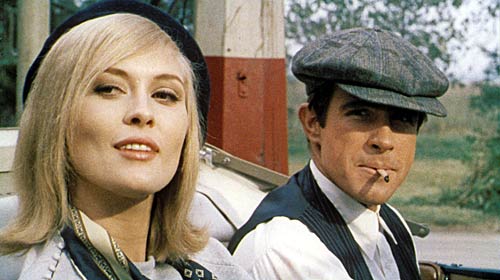
 You like the movies? And you want to hear and talk about them? You should check out the eight-part series by veteran critic Kevin Courrier (Critics At Large), Reflections in the Hall of Mirrors: American Movies and the Politics of Idealism. As part of the Media Mondays at the Miles Nadal JCC every Monday, except for February 20th and March 12th, from 7PM to 9PM, Courrier will be connecting the changing zeitgeist from the sixties onwards with the Hollywood films that best encapsulates them. From John F. Kennedy assassination in 1963 all the way to Barack Obama's inauguration in 2009. No American presidential era will be left unexamined. Like the great new Stephen King book 11/22/63, Courrier starts the course off with one of the turning points in American history - the death of John F. Kennedy. The shooting that happened in Dallas and its portrayal and discussion on network broadcasting will have a large impact on the population and culture and there will be a rippling effect throughout the following eras. News footage and video clips from the eras are examined and, for someone that was born in '88, these clips and background are revelatory. Even though the course is on American idealism there is still something quintessentially Canadian about them. Courrier's tone and demeanor is that of the infectious Canadian friendliness along with a modest authority and a well-researched intelligence. While Courrier's background in journalism and music brings a comprehensiveness as it allows him to bring up many other aspects of the culture. While there is also something personal about the series as this is his selection and he has lived through these times in both Oshawa and Toronto, Ontario. From the two classes that I have attended the lessons have been on par with other zeitgeist film critics like Siegfried Kracauer, Robin Wood and Jim Hoberman. Particular images from films are studied to see how they resonate with a wider culture of the time and the filmmakers that have receive the most focus, so far, are John Frankenheimer and Arthur Penn. All of these classes are for the preparation for a book Courier is writing, which I am sure would be fantastic, but there is just so much more that you get through the classes. If you are in the area you should definitively check them out.
Tuesday, January 24, 2012
American Movies and the Politics of Idealism (Media Mondays at the JCC)
I want to thank Adam Nayman for the shout-out in his piece on these classes in The Grid. - D.D.
You like the movies? And you want to hear and talk about them? You should check out the eight-part series by veteran critic Kevin Courrier (Critics At Large), Reflections in the Hall of Mirrors: American Movies and the Politics of Idealism. As part of the Media Mondays at the Miles Nadal JCC every Monday, except for February 20th and March 12th, from 7PM to 9PM, Courrier will be connecting the changing zeitgeist from the sixties onwards with the Hollywood films that best encapsulates them. From John F. Kennedy assassination in 1963 all the way to Barack Obama's inauguration in 2009. No American presidential era will be left unexamined. Like the great new Stephen King book 11/22/63, Courrier starts the course off with one of the turning points in American history - the death of John F. Kennedy. The shooting that happened in Dallas and its portrayal and discussion on network broadcasting will have a large impact on the population and culture and there will be a rippling effect throughout the following eras. News footage and video clips from the eras are examined and, for someone that was born in '88, these clips and background are revelatory. Even though the course is on American idealism there is still something quintessentially Canadian about them. Courrier's tone and demeanor is that of the infectious Canadian friendliness along with a modest authority and a well-researched intelligence. While Courrier's background in journalism and music brings a comprehensiveness as it allows him to bring up many other aspects of the culture. While there is also something personal about the series as this is his selection and he has lived through these times in both Oshawa and Toronto, Ontario. From the two classes that I have attended the lessons have been on par with other zeitgeist film critics like Siegfried Kracauer, Robin Wood and Jim Hoberman. Particular images from films are studied to see how they resonate with a wider culture of the time and the filmmakers that have receive the most focus, so far, are John Frankenheimer and Arthur Penn. All of these classes are for the preparation for a book Courier is writing, which I am sure would be fantastic, but there is just so much more that you get through the classes. If you are in the area you should definitively check them out.
You like the movies? And you want to hear and talk about them? You should check out the eight-part series by veteran critic Kevin Courrier (Critics At Large), Reflections in the Hall of Mirrors: American Movies and the Politics of Idealism. As part of the Media Mondays at the Miles Nadal JCC every Monday, except for February 20th and March 12th, from 7PM to 9PM, Courrier will be connecting the changing zeitgeist from the sixties onwards with the Hollywood films that best encapsulates them. From John F. Kennedy assassination in 1963 all the way to Barack Obama's inauguration in 2009. No American presidential era will be left unexamined. Like the great new Stephen King book 11/22/63, Courrier starts the course off with one of the turning points in American history - the death of John F. Kennedy. The shooting that happened in Dallas and its portrayal and discussion on network broadcasting will have a large impact on the population and culture and there will be a rippling effect throughout the following eras. News footage and video clips from the eras are examined and, for someone that was born in '88, these clips and background are revelatory. Even though the course is on American idealism there is still something quintessentially Canadian about them. Courrier's tone and demeanor is that of the infectious Canadian friendliness along with a modest authority and a well-researched intelligence. While Courrier's background in journalism and music brings a comprehensiveness as it allows him to bring up many other aspects of the culture. While there is also something personal about the series as this is his selection and he has lived through these times in both Oshawa and Toronto, Ontario. From the two classes that I have attended the lessons have been on par with other zeitgeist film critics like Siegfried Kracauer, Robin Wood and Jim Hoberman. Particular images from films are studied to see how they resonate with a wider culture of the time and the filmmakers that have receive the most focus, so far, are John Frankenheimer and Arthur Penn. All of these classes are for the preparation for a book Courier is writing, which I am sure would be fantastic, but there is just so much more that you get through the classes. If you are in the area you should definitively check them out.

Wednesday, January 18, 2012
Vivre le cinéma! Long live Positif! (Cannes Critics Week at the Lightbox)
 "You like the movies: you also know that film is an art. It took fifty years for the professors to admit it; in another half-century students will be writing theses that attempt to reconstruct lost masterpieces. But whose fault was it that they disappeared? It is up to us to do something against the merchants of the mediocre." - Bernard Chardère
"It's in the darkness of the theater, again and always, where we will like to be." - Fabien Baumann
In honor of the fiftieth anniversary of the Semaine de la Critique, Manager of Film Programmes Brad Deane, who was responsible for the great series Masks and Faces: The Films of John Cassavetes, organized 50 Years of Discoveries - Cannes Critics Week which will take place from January 18th to the 22nd at the Lightbox. Each critic will introduce one film of their choice that has premiered at the Cannes festival sidebar. Some noteworthy guests include Jonathan Rosenbaum (Goodbye Cinema, Hello Cinephilia) who will be introducing Anna Karina's Vivre ensemble (1973) Saturday, January 21st at 7PM, and Fabien Gaffez (Positif) who will be introducing Jean Eustache's Le Père Noël a les yeux bleus (1966) and La Rosière de Pessac (1968) on Friday, January 20th at 6:30PM. As well there is going to be a Higher Learning panel, Film Criticism Today on Friday, January 20th from 11:00 am to 1:00 pm.
For their sixtieth anniversary, there have been a few changes at Positif. First off, Positif recently changed publishers from éditions Scope in Paris to Actes Sud and the Institut Lumière in Lyon. Along with the move they have also slightly altered the magazines formatting and layout; as well the magazine is finally in color! On the subject of the Cahiers-Positif film reviewing one-upmanship at the blog Nightswimming, Edouard S. writes, "The eighties saw Cahiers catching up with Positif and, finally, if Positif is continuing to lead the way, the tendency is that of equilibrium."
What can you find going through the new issues from six-hundred-and-seven to six-hundred-and-nine? The filmmakers that they interview include Almodovar, Sorrentino, von Trier, Refn, Miller, Dumont, Wiseman, Soderbergh, Schoeller, and Ceylan. There are interesting comments on films like how Valérie Donzelli's La guerre est déclarée is "one of the years best French films," or on the filming techniques in Crazy Horse, "On the other hand the camera never places the spectator in a judging or voyeuristic position, it is more one of an admiring accomplice." The Bloc Notes are fascinating as Pierre Eisenreich contrasts scuba-diving with the film-going experience, "the strange feelings, to immerse oneself, and the aesthetic beauty." Michel Ciment writes an erudite and moving memorial for Raúl Ruiz. Positif champions the great actresses Tilda Swinton, Kristen Wiig, and Jessica Chastain. And the books reviews are thorough and vivid. Since these issues three new ones have come out and the films featured on their covers are Shame, Take Shelder, and The Descendants.
What I like about Positif is that you hear about many films first through reading the magazine; where reading the articles creates a palpable desire to then go see the films. It's choices aren't snob and there is an energy and individuality to their writing as they use criticism not as a bases to write synopses but instead as a literary genre - something a lot of English writing disappointingly does not do. Positif is just more in depth, knowledgeable and generous compared to a lot of the film writing going on. While La Maison de la Presse is still three months late (!!!) in getting the new issues (can someone fix this?) and Positif's lack of exposure, to say it quickly, severally isolates their line of inquiry in the world of English language film criticism. Positif continues to explore the contours of the future of cinema, even if sometimes it is at the risk of being out of sync with trends, and at the same time it continues to explore it's history (cf. Positif films) and thematic aspects of the seventh art. It is a benefit to contemporary cinema to have Positif around. People should come to the Lightbox to hear Fabien Gaffez talk.
Tuesday, January 17, 2012
Positif Films, since 1952. (two lists)
For anyone interested in the French film magazine Positif, here are two of their lists that are worth highlighting for a better understanding of their approach to film history and their taste. - D.D.
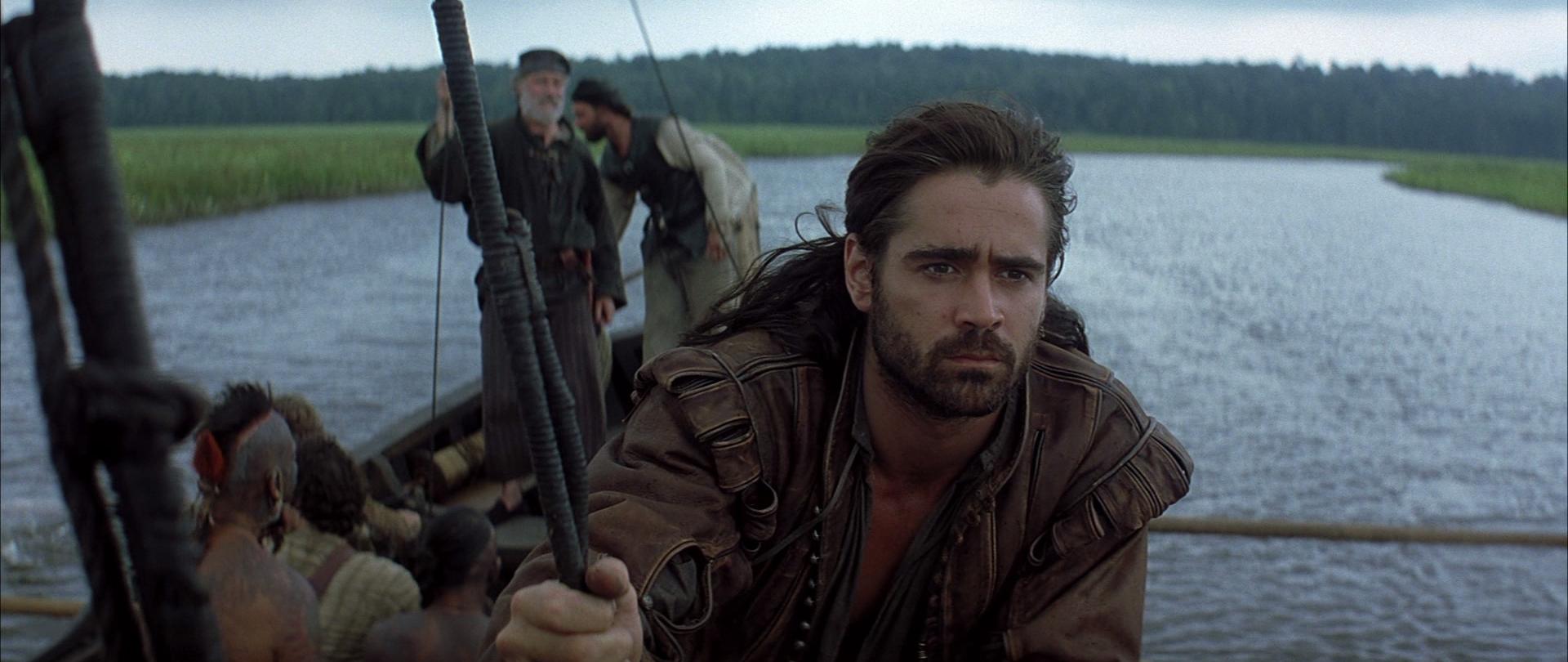 The most striking films of the decade 2000-2009 (Positif, February 2010, N.588)
1. The New World (Terrence Malick, 2005)
2. Million Dollar Baby (Clint Eastwood, 2005)
3. There Will Be Blood (Paul Thomas Anderson, 2008)
4. Mulholland Drive (David Lynch, 2001)
5. We Own the Night (James Gray, 2007)
5. Still Life (Jia Zhangke, 2007)
7. De battre mon coeur s'est arrêté (Jacques Audiard, 2005)
7. In the Mood for Love (Wong Kar-wai, 2000)
7. Sarabande (Ingmar Bergman, 2003)
7. Spirited Away (Hayao Miyazaki, 2001)
11. Elephant (Gus Van Sant, 2003)
11. Distant (Nuri Bilge Ceylan, 2004)
13. A History of Violence (David Cronenberg, 2005)
13. Coeurs (Alain Resnais, 2006)
13. La Graine et le Mulet (Abdellatif Kechiche, 2007)
13. No Country for Old Men (Joel and Ethan Coen, 2007)
13. Talk to Her (Pedro Almodovar, 2002)
13. The White Ribbon (Michael Haneke, 2009)
13. Yi Yi (Edward Yang, 2000)
20. 2046 (Wong Kar-wai, 2004)
20. Kill Bill (Quentin Tarantino, 2003)
20. The Best of Youth (Marco Tullio Giordana, 2003)
20. Un prophète (Jacques Audiard, 2009)
24. Climates (Nuri Bilge Ceylan, 2007)
24. Mystic River (Clint Eastwood, 2003)
24. Oasis (Lee Chang-dong, 2003)
24. The Yards (James Gray, 2000)
*****  For the thirtieth anniversary of Positif in May, 1982 (N.254-255) the magazine polled its critics on "what were the films that have had the biggest impact on you," since in the inception of the magazine in Lyon, 1952.
1. 2001, A Space Odyssey (Stanley Kubrick, 1968)
2. Touch of Evil (Orson Welles, 1957)
3. Vertigo (Alfred Hitchcock, 1958)
4. 8 1/2 (Federico Fellini, 1962)
4. Salvatore Giuliano (Francesco Rosi, 1961)
6. Apocalypse Now (Francis Ford Coppola, 1979)
6. Pierrot le fou (Jean-Luc Godard, 1965)
8. Singin' in the Rain (Stanley Donen and Gene Kelly, 1952)
8. The Barefoot Contessa (Joseph L. Mankiewicz, 1954)
8. Ugetsu Monogatari (Kenji Mizoguchi, 1953)
8. Rio Bravo (Howard Hawks, 1959)
13. The Searcher (John Ford, 1956)
13. The Band Wagon (Vincente Minnelli, 1953)
13. The Traveling Players (Theo Angelopoulos, 1975)
16. Amacord (Federico Fellini, 1973)
16. L'Annee derniere a Marienbad (Alain Resnais, 1961)
16. Lola Montes (Max Ophuls, 1955)
19. Kings of the Road (Wim Wenders, 1976)
19. Wild River (Elia Kazan, 1960)
19. The Night of the Hunter (Charles Laughton, 1955)
19. Senso (Luchino Visconti, 1953)
19. The Spider's Stratagem (Bernardo Bertolucci, 1969)
19. A Star is Born (George Cukor, 1953)
25. Andrei Roublev (Andrei Tarkovski, 1966)
25. Casque d'or (Jacques Becker, 1952)
25. Ashes and Diamonds (Andrzej Wajda, 1958)
25. Written on the wind (Douglas Sirk, 1957)
25. Man of Marble (Andrzej Wajda, 1978)
25. Ma nuit chez Maud (Eric Rohmer, 1969)
25. Nashville (Robert Altman, 1975)
25. Persona (Ingmar Bergman,1966)
25. Le Plaisir (Max Ophuls, 1952)
25. The Servant (Joseph Losey, 1963)
35. A bout de souffle (Jean-Luc Godard, 1960)
35. America, America (Elia Kazan, 1963)
35. Barry Lindon (Stanley Kubrick, 1976)
35. The Ceremony (Nagisa Oshima, 1971)
35. Le Charme discret de la bourgeoisie (Luis Bunuel, 1972)
35. Moonfleet (Fritz Lang, 1955)
35. Deliverance (John Boorman, 1973)
35. Last Tango in Paris (Bernardo Bertolucci, 1972)
35. La Dolce Vita (Federico Fellini, 1960)
35. Fellini's Roma (Federico Fellini, 1971)
35. Splendor in the Grass (Elia Kazan, 1961)
35. The Leopard (Luchino Visconti, 1963)
35. Days of Heaven (Terrence Malick, 1978)
35. North by Northwest (Alfred Hitchcock, 1959)
35. Pickpocket (Robert Bresson, 1959)
35. The Music Room (Satyajit Ray, 1959)
35. The Deer Hunter (Michael Cimino, 1978)
52. The American Friend (Wim Wenders, 1975)
52. The Exterminating Angel (Luis Bunuel, 1962)
52. L'Avventura (Michelangelo Antonioni, 1960)
52. Belle de jour (Luis Bunuel, 1966)
52. Le Carrose d'or (Jean Renoir, 1952)
52. Some like it hot (Billy Wilder, 1959)
52. Elmer Gantry (Richard Brooks, 1960)
52. Fat City (John Huston, 1972)
52. Le Amiche (Michelangelo Antonioni, 1955)
52. Incompreso (Luigi Comencini, 1966)
52. Sansho the Bailiff (Kenji Mizoguchi, 1954)
52. Johnny Guitar (Nicholas Ray, 1954)
52. The French Lieutenant's Woman (Karel Reisz, 1981)
52. La Maman et la putain (Jean Eustache, 1972)
52. The Go Between (Joseph Losey, 1971)
52. The Miracle Worker (Arthur Penn, 1962)
52. The Mirror (Andrei Tarkovski, 1974)
52. The Godfather: Part II (Francis Ford Coppola, 1975)
52. Playtime (Jacques Tati, 1967)
52. Puzzle of a Downfall Child (Jerry Schatzberg, 1970)
52. The Trial (Orson Welles, 1962)
52. Providence (Alain Resnais, 1976)
52. Smiles of a Summer Night (Ingmar Bergman, 1955)
52. Les Vacances de M. Hulot (Jacques Tati, 1953)
52. Tokyo Story (Yasujiro Ozu, 1953)
The most striking films of the decade 2000-2009 (Positif, February 2010, N.588)1. The New World (Terrence Malick, 2005)
2. Million Dollar Baby (Clint Eastwood, 2005)
3. There Will Be Blood (Paul Thomas Anderson, 2008)
4. Mulholland Drive (David Lynch, 2001)
5. We Own the Night (James Gray, 2007)
5. Still Life (Jia Zhangke, 2007)
7. De battre mon coeur s'est arrêté (Jacques Audiard, 2005)
7. In the Mood for Love (Wong Kar-wai, 2000)
7. Sarabande (Ingmar Bergman, 2003)
7. Spirited Away (Hayao Miyazaki, 2001)
11. Elephant (Gus Van Sant, 2003)
11. Distant (Nuri Bilge Ceylan, 2004)
13. A History of Violence (David Cronenberg, 2005)
13. Coeurs (Alain Resnais, 2006)
13. La Graine et le Mulet (Abdellatif Kechiche, 2007)
13. No Country for Old Men (Joel and Ethan Coen, 2007)
13. Talk to Her (Pedro Almodovar, 2002)
13. The White Ribbon (Michael Haneke, 2009)
13. Yi Yi (Edward Yang, 2000)
20. 2046 (Wong Kar-wai, 2004)
20. Kill Bill (Quentin Tarantino, 2003)
20. The Best of Youth (Marco Tullio Giordana, 2003)
20. Un prophète (Jacques Audiard, 2009)
24. Climates (Nuri Bilge Ceylan, 2007)
24. Mystic River (Clint Eastwood, 2003)
24. Oasis (Lee Chang-dong, 2003)
24. The Yards (James Gray, 2000)
For the thirtieth anniversary of Positif in May, 1982 (N.254-255) the magazine polled its critics on "what were the films that have had the biggest impact on you," since in the inception of the magazine in Lyon, 1952.1. 2001, A Space Odyssey (Stanley Kubrick, 1968)
2. Touch of Evil (Orson Welles, 1957)
3. Vertigo (Alfred Hitchcock, 1958)
4. 8 1/2 (Federico Fellini, 1962)
4. Salvatore Giuliano (Francesco Rosi, 1961)
6. Apocalypse Now (Francis Ford Coppola, 1979)
6. Pierrot le fou (Jean-Luc Godard, 1965)
8. Singin' in the Rain (Stanley Donen and Gene Kelly, 1952)
8. The Barefoot Contessa (Joseph L. Mankiewicz, 1954)
8. Ugetsu Monogatari (Kenji Mizoguchi, 1953)
8. Rio Bravo (Howard Hawks, 1959)
13. The Searcher (John Ford, 1956)
13. The Band Wagon (Vincente Minnelli, 1953)
13. The Traveling Players (Theo Angelopoulos, 1975)
16. Amacord (Federico Fellini, 1973)
16. L'Annee derniere a Marienbad (Alain Resnais, 1961)
16. Lola Montes (Max Ophuls, 1955)
19. Kings of the Road (Wim Wenders, 1976)
19. Wild River (Elia Kazan, 1960)
19. The Night of the Hunter (Charles Laughton, 1955)
19. Senso (Luchino Visconti, 1953)
19. The Spider's Stratagem (Bernardo Bertolucci, 1969)
19. A Star is Born (George Cukor, 1953)
25. Andrei Roublev (Andrei Tarkovski, 1966)
25. Casque d'or (Jacques Becker, 1952)
25. Ashes and Diamonds (Andrzej Wajda, 1958)
25. Written on the wind (Douglas Sirk, 1957)
25. Man of Marble (Andrzej Wajda, 1978)
25. Ma nuit chez Maud (Eric Rohmer, 1969)
25. Nashville (Robert Altman, 1975)
25. Persona (Ingmar Bergman,1966)
25. Le Plaisir (Max Ophuls, 1952)
25. The Servant (Joseph Losey, 1963)
35. A bout de souffle (Jean-Luc Godard, 1960)
35. America, America (Elia Kazan, 1963)
35. Barry Lindon (Stanley Kubrick, 1976)
35. The Ceremony (Nagisa Oshima, 1971)
35. Le Charme discret de la bourgeoisie (Luis Bunuel, 1972)
35. Moonfleet (Fritz Lang, 1955)
35. Deliverance (John Boorman, 1973)
35. Last Tango in Paris (Bernardo Bertolucci, 1972)
35. La Dolce Vita (Federico Fellini, 1960)
35. Fellini's Roma (Federico Fellini, 1971)
35. Splendor in the Grass (Elia Kazan, 1961)
35. The Leopard (Luchino Visconti, 1963)
35. Days of Heaven (Terrence Malick, 1978)
35. North by Northwest (Alfred Hitchcock, 1959)
35. Pickpocket (Robert Bresson, 1959)
35. The Music Room (Satyajit Ray, 1959)
35. The Deer Hunter (Michael Cimino, 1978)
52. The American Friend (Wim Wenders, 1975)
52. The Exterminating Angel (Luis Bunuel, 1962)
52. L'Avventura (Michelangelo Antonioni, 1960)
52. Belle de jour (Luis Bunuel, 1966)
52. Le Carrose d'or (Jean Renoir, 1952)
52. Some like it hot (Billy Wilder, 1959)
52. Elmer Gantry (Richard Brooks, 1960)
52. Fat City (John Huston, 1972)
52. Le Amiche (Michelangelo Antonioni, 1955)
52. Incompreso (Luigi Comencini, 1966)
52. Sansho the Bailiff (Kenji Mizoguchi, 1954)
52. Johnny Guitar (Nicholas Ray, 1954)
52. The French Lieutenant's Woman (Karel Reisz, 1981)
52. La Maman et la putain (Jean Eustache, 1972)
52. The Go Between (Joseph Losey, 1971)
52. The Miracle Worker (Arthur Penn, 1962)
52. The Mirror (Andrei Tarkovski, 1974)
52. The Godfather: Part II (Francis Ford Coppola, 1975)
52. Playtime (Jacques Tati, 1967)
52. Puzzle of a Downfall Child (Jerry Schatzberg, 1970)
52. The Trial (Orson Welles, 1962)
52. Providence (Alain Resnais, 1976)
52. Smiles of a Summer Night (Ingmar Bergman, 1955)
52. Les Vacances de M. Hulot (Jacques Tati, 1953)
52. Tokyo Story (Yasujiro Ozu, 1953)
Sunday, January 15, 2012
A Modern Day Kandinsky (On Jean-Marc Vallée's Café de flore)
 Café de flore (Jean-Marc Vallée, 2011)
**** (Masterpiece)
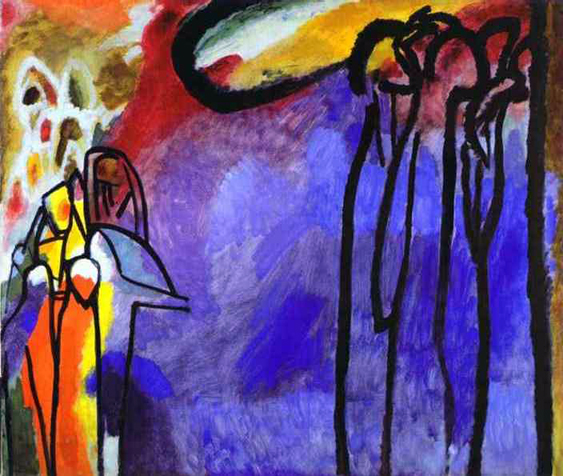
Like the other great Québécois director Denis Côté (cf. 3 + 4 + 1), Vallée’s approach to form is similar to that of Modernist painters and, more precisely, to Wassily Kandinsky’s Impressionist-style paintings from his Munich period. The unlikely comparison offers striking similarities. What these two artists achieve is the creation of abstract visual expressions built from stylized forms that are imbued with symbolic meaning. When Vallée cuts the sound and all you see are figures presented in decisive moments showing unrestrained feeling alongside Doctor Rockit’s catchy track Café De Flore - the effect is that of ecstasy.
There is something free and lyrical to the rhythm and melody of Café that creates an unreal mood and a self-contained world. When Antoine (Kevin Parent) jumps into his swimming pool and some water lands on his daughter’s foot it seems to connote an unexplained spiritual connectedness between the two. Kandinsky was also interested in theosophy, the occult and religion as elaborated in his important essay Concerning the Spiritual in Art. Vallée’s concern with the spiritual bleeds throughout the entire film through representational and abstract forms, the casting and editing, colour and lighting, music and sound. Vallée seeks the essence beneath appearances, where the actions are drowned in style, in hope of sharing unbridled feelings, substance and life. - David Davidson
Wednesday, January 4, 2012
A New Start (Monte Hellman’s Road to Nowhere)
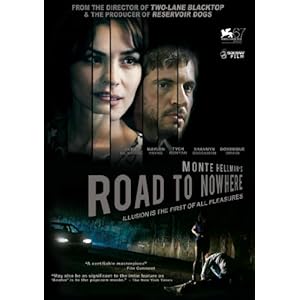 Title: Road to Nowhere (2011)
Director: Monte Hellman
Studio: Monterey Video
Price: 26.95$
“They called them minor classics of anguish and despair.” – Leo (Stanley’s Girlfriend)
One of the biggest disappointments over the past year in the Toronto film scene is that Monte Hellman’s Road to Nowhere never received a first-run theatrical release or even a one-off screening. This sucks. He deserves better. It was the one film that I and a few others were most looking forward to seeing on the big screen. It has been fifty-three years since Hellman first started making films with Beast From Haunted Cave in 1959. Since then, he has made only ten films, which range from great to masterpieces including Ride in the Whirlwind (1965), The Shooting (1966), Two-Lane Blacktop (1971), Cockfighter (1974), and Iguana (1988). Many of his projects failed to get off of the ground, while others got compromised. This places him in the tradition of people like Orson Welles, who also faced similar difficulties. Hellman has been on hiatus from feature film-making since Silent Night, Deadly Night III: Better Watch Out! that came out in 1989, meaning that audiences have been waiting twenty-one years for this new feature. And what came out in theaters instead? A lot of crap. For example, from this year, there is The Trip, Sherlock Holmes, Harry Potter, Transformers 3, New Year’s Eve et cetera. Why an ambitious and fascinating movie like Road to Nowhere did not get distributed is beyond me. I heard Entertainment One was going to distribute the film, but that never materialized. Whatever. You can buy the DVD at the Bay Street Video. It will do.
Road to Nowhere is a puzzle film that is full of temporal leaps. It is hard to easily summarize, as you are not always sure whether you are watching events happen for the first time, or if the film crew is preparing a shot, or if the scene is only being acted, or if something is happening alongside all of this. But here goes, Road to Nowhere begins with a young woman Laurel Graham (played with finesse by Shannyn Sosasmon) leaving her partner after they murder a cop. The man then takes a plane and crashes it into a lake. This “true story” is the subject of the film the director Mitchell Haven (Tygh Runyan) and his script writer Stephen Gates (Rob Kolar) are going to adapt for their film Road to Nowhere. But, apparently, the rumor is, through the inquiry of a blogger Nathalie Post (Dominique Swain) and an insurance investigator Bruno Brotherton (Waylon Payne), the deaths are assumed to be a set up for insurance fraud.
Road to Nowhere has some great scenes, the acting is good, and the clothes people wear is really seventies. The Balsam Mountain Inn in North Carolina where the film is predominantly set has a quintessentially American feel, just like the desolate highways in Two-Lane. As well the Tom Russell song Road to Nowhere is just as moving, and central to the story, as the Kris Kristopherson song Me and Bobby McGee was to Two-Lane, “Freedom’s just another word for nothing left to lose.”
Road to Nowhere is also Hellman's ode to the films he loves, just like Scorsese’s Hugo is an ode to the early French silent cinema of Georges Méliès. In Road to Nowhere, in his hotel room Mitchell lies in his bed with Laurel very comfortably and watches movies, including The Lady Eve, Spirit of the Beehive (“A fucking masterpiece!”), and Bergman’s Seventh Seal (“It never so looked so good”). For attentive viewers, sitting on the TV stand is a copy of the Criterion Collection edition of Two-Lane Blacktop. And there is also a Contempt-like director cameo by Hellman as the cameraman while the crew is filming the flying plane. (corection: the cameraman is Josep Civit, not Hellman.)
There is also a focus on the behind the scenes activities that happens during the making of a movie. Like the nights out where people are passionately talking at a bar, the creative difficulties for the directors in orchestrating the crew, or enjoying the other pleasures of being out on the set. When Mitchell discusses his particular approach, it seems like it is coming right from Hellman as elaborated in the most recent interview book on him, Emmanuel Burdeau’s Monte Hellman: Sympathy for the Devil (Capricci). While some of the backstage stories shown of Mitchell filmmaking seems like they derive from Hellman’s own life as described in Brad Stevens’ essential Monte Hellman: His Life and Films (McFarland). This is personal filmmaking. Even to the extent that the residential scene in Los Angeles are even set in Hellman’s actual house – similar to what Cassavetes did in Love Streams. And Hellman’s dog Moxie is in it too!
Road to Nowhere is continuing Hellman’s 2000s work that started with Stanley’s Girlfriend, which was part of the omnibus Trapped Ashes from 2006. Stanley’s Girlfriend is a short fictionalized account of a young Stanley Kubrick and his friendship with Leo, a filmmaker of an exploitation horror flick The Strangler. There is Stanley (Tygh Runyan), a young Leo (Tahmoh Peniket), and an older Leo (John Saxon), with the femme fatale love interest Nina (Amelia Cooke).The references to Kubrick includes the mention of his “brilliant” racetrack movie, Stanley goes to New York to work on a WWI film (Paths of Glory), and there is footage of his work space full of photographs and props of the unrealized Napoleon project.
Though they don't have the typical Hellmanian scenes of people expressing themselves through gestures or people walking against a desolate landscape, what is unique to Stanley’s Girlfriend and Road to Nowhere is the casting of Tygh Runyan as a surrogate for Hellman. Because of his likeability, wit and intelligence Runyan is brilliant in these two films. Through Runyan’s youth, and that he is playing a director who is still early in his career, Hellman is able to directly speak out to the audience about his thoughts on his career, unrealized and dream projects (“I want to make a film that lasts twenty-four hours”), and broach contemporary cinema. It is almost like he is creating a parallel career to his own. When Mitchell is watching Leonardo DiCaprio on television, the shot expresses that Hollywood and Hellman are in two separate worlds.
But where was the turn for all of this? I think the key film in discussing Hellman’s late career is Better Watch Out!, as this direct-to-video horror film seems to anticipate his latest two projects. Especially as both Stanley’s Girlfriend and Road to Nowhere end on a note that owes to the grisly slashers of Sean Cunningham and Tobe Hooper. It is this return to the horror genre that seems important in discussing the late work of the directors that emerged out of the 1970s American New Wave. Which brings to mind the famous Bill Krohn quote, “If our [American] cinephilia is a religion, it’s of sublime terror and of alien worlds.” Similar to Francis Coppola’s Twixt, Wes Craven’s Scream 4, Joe Dante’s The Hole, and George Romero’s Survival of the Dead – it seems like horror is the last escape. When Mitchell snickers, “Well, I don’t believe in God”, the point is that even amidst the surrounding violence, you can still crack a joke and be serious. With all the injustices and corruption going on in the world, some self-lacerating humor can do us all some good. - David Davidson

Tuesday, December 27, 2011
Happy New Years! (TFR Top Ten of 2011)
Instead of the typical Top Ten, each entry is organized through thematic categories: (1) the presentation of the unconscious mind through cinema by the world's best Québécois directors, (2) Hitchcockian French thrillers starring the great Guillaume Canet, (3) late works by masters of American cinema, (4) these short films are precursors of what is to come out of Canadian cinema, (5) hybrid films that take the luster of mainstream movies, inflicting them with a singular and vibrant sensability, (6) horror, action and the supernatural reigns supreme, (7) some might call these middle-brow but they are undeniably well crafted and complex, (8) funny, smart, personal and full of feeling, (9) formally invigorating world cinema, (10) social activism, political documentary and anarchist films has been pushed to the margins of experimental cinema - these have been the most challenging.
Following the Top Ten there are a few other lists: best new film books, favorite local film critics, upcoming series etc...
I hope you've enjoyed reading Toronto Film Review and that you keep checking it out in 2012 - there is a lot more film coverage and book reviews to come. A special thanks goes out to everyone who contributed and helped. And make sure to check out the twitter account, TOFilmReview. - D.D.
 "You know what, my films resemble more and more what children make in their rooms, when they make little expositions with rocks and seashells: I see more and more clearly my films, and more so the next one, like expositions of little things that I want to share." - Lars von Trier
Top Ten of 2011
Andrew Parker:
for his writing at Criticize This! and Dork Shelf as well as his programming series Defending the Indefensible at the Toronto Underground Cinema. If you were to have told me a year ago that the state of Toronto's weekly film criticism is in good shape and that the best writing could be found on website's with silly names like Criticize This! and Dork Shelf, I would have probably laughed at you. But lo and behold, I was wrong. Andrew is the kind of guy that still writes his reviews longhand with an old pen and notepad. And Andrew's weekly reviews, which run around the one-thousand word mark, of the majority of new releases provides the most thorough readings of what is playing on Toronto's screens. With a special attention to the films that can gain from this critical support like Extremely Loud and Incredibly Close and Beauty Day. As well he seems to be ahead of most trends as he can tell you why movies like Like Crazy and Margaret are terrific and his opinions stand out as he can also say why most commercial drivel is bad.
Along with Andrew's series Defending the Indefensible, there is also John Semley's (A.V. Club Toronto) new series Remake/Remodel, both of which I recommend and that I look forward to starting up again in the new year. As well there is a new class that seems interesting as part of the Media Mondays at the JCC, Reflections in the Hall of Mirrors: American Movies and the Politics of Idealism presented by Kevin Courrier which will be running from January 16th to March 26th each Mondays starting at 7:00PM - except for February 20th and March 12th. As well, like always, there is Early Monthly Segments and Pleasure Dome for your experimental film fix, and the monthly film-blogger pub nights for some camaraderie. And while I am shouting people out, might as well bring up the Cinema Scope Twitter account CinemaScopeMag, which is a lot of fun too.
Most anticipated films of 2012:

Following the Top Ten there are a few other lists: best new film books, favorite local film critics, upcoming series etc...
I hope you've enjoyed reading Toronto Film Review and that you keep checking it out in 2012 - there is a lot more film coverage and book reviews to come. A special thanks goes out to everyone who contributed and helped. And make sure to check out the twitter account, TOFilmReview. - D.D.
"You know what, my films resemble more and more what children make in their rooms, when they make little expositions with rocks and seashells: I see more and more clearly my films, and more so the next one, like expositions of little things that I want to share." - Lars von Trier Top Ten of 2011
 1.       Café de Flore (Jean-Marc Vallée)
          Curling (Denis Côté)
 2.       Espion(s) (Nicolas Saada)
          Une vie meilleure (Cédric Kahn)
 3.       Road to Nowhere (Monte Hellman)
          Twixt (Francis Ford Coppola)
          The Tree of Life (Terrence Malick)
 4.       The Fuse: Or How I Burned Simon Bolivar (Igor Drljača)
          Coorow-Latham Road (Blake Williams)
          Up In Cottage Country (Simon Ennis)
          La Ronde (Sophie Goyette)
          Three Mothers (Rafal Sokolowski)
 5.       Melancholia (Lars von Trier)
          Drive (Nicolas Winding Refn)
          You Are Here (Daniel Cockburn)
          Hors Satan (Bruno Dumont)
          Un été brûlant (Philippe Garrel)
 6.       Super 8 (J.J. Abrams)
          Scream 4 (Wes Craven)
          Le Gamin au vélo (Jean-Pierre and Luc Dardenne)
          The Twilight Saga: Breaking Dawn: Part 1 (Bill Condon)
          Attack the Block (Joe Cornish)
          Kill List (Ben Wheatley)
          Martha Marcy May Marlene (Sean Durkin)
 7.       Restless (Gus Van Sant)
          The Skin I Live In (Pedro Almodóvar)
          Pina (Wim Wenders)
          Contagion (Steven Soderbergh)
          Shame (Steve McQueen)
          The Adventures of Tintin (Steven Spielberg)
 8.       Hall Pass (Bobby and Peter Farrelly)
          How Do You Know (James L. Brooks)
          Midnight in Paris (Woody Allen)
          Bridesmaids (Paul Feig)
          We Bought a Zoo (Cameron Crowe)
          The Descendants (Alexander Payne)
 9.       Ne change rien (Pedro Costa)
          To Die Like a Man (João Pedro Rodrigues)
          The Strange Case of Angelica (Manoel de Oliveira)
          Mysteries of Lisbon (Raoul Ruiz)
          The Future (Miranda July)
          Le quattro volte (Michelangelo Frammartino)
          The Autobiography of Nicolae Ceausescu (Andrei Ujica)
 10.      Seeking the Monkey King (Ken Jacobs)
          The Forgotten Space (Allan Sekula and Noël Burch)
          Vapor Trail (Clark) (John Gianvito)
          This is not a Film (Mojtaba Mirtahmasb and Jafar Panahi)
          Slow Action (Ben Rivers)
          We Can't Go Home Again (Nicholas Ray)
          Too Many Things (Donigan Cumming)
Best new and discovered film books and writing: - Another Fine Mess: A History of American Film Comedy by Saul Austerlitz (Chicago Review Press, 2010).
- The Film Comedy Reader edited by Gregg Rickman (Limelight Editions, 2004).
- Comment Woody Allen peut change votre vie by Éric Vartzbed (Éditions du Seuil, 2011).
- Apichatpong Weerasethakul edited by James Quandt (Austrian Film Museum, 2009).
- Splitting the Choir – The Moving Images of Donigan Cumming edited by Scott Birdwise (Canadian Film Institute, 2011).
- Pencil, Ashes, Matches & Dust by Donigan Cumming (Editions J’ai VU, 2009).
- Trammel up the Consequences by Robin Wood (Lightstruck Film & Media Book, 2011).
- Monte Hellman - Sympathy for the devil by Emmanuel Burdeau (Capricci, 2011).
- Monte Hellman: His Life and Films by Brad Stevens (McFarland & Company, 2003).
- Masters of Cinema: Francis Ford Coppola by Stéphane Delorme (Phaidon, 2010); as well as his writing and direction of Cahiers du cinéma.
- When Movies Mattered: Reviews from a Transformative Decade by Dave Kehr (University Of Chicago Press, 2011); as well as Kehr's weekly DVD review column in The New York Times.
- The American Cinema: Directors and Directions 1929-1968 by Andrew Sarris (Da Capo Press, 1968).
- Films And Feelings by Raymond Durgnat (MIT Press, 1971).
- BFI Modern Classics - WR: Mysteries of the Organism by Raymond Durgnat (BFI, 2008).
- Joseph L. Mankiewicz et son double by Vincent Amiel (Presses Universitaires de France, 2010).
- World Film Locations: Tokyo edited by Chris MaGee (Intellect Ltd, 2011).
- Optic Antics: The Cinema of Ken Jacobs edited by Michele Pierson, David E. James and Paul Arthur (Oxford University Press, 2011)
- Anthology Film Archives.
- Adam Nayman:
- Abel Ferrara's 4:44 Last Day on Earth and Christopher Nolan's The Dark Knight Rises. As well Kazik Radwanski and Antoine Bourges from Medium Density Fibreboard Films (MDFF) should hopefully have their current projects finished in the new year - I look forward to catching these two on the festival circuit.
Thursday, December 15, 2011
La Ronde and some recent Québécois films
Congratulations to Igor Drljača and Sophie Goyette for their respective short-films The Fuse: Or How I Burned Simon Bolivar and La Ronde for making it onto Canada’s Top Ten short film selection for 2011. They will be screening at the TIFF Bell Lightbox as part of Programme B on Sunday, January 8 at 8:30PM, which I highly recommend going to.
I am also still writing a third review of a few other Canadian short-films: Simon Ennis' Up in Cottage Country, Rafal Sokolowski's Three Mothers and Blake Williams' Coorow-Latham Road. - D. D.
 "More than a nouvelle vague, their cinema is perhaps foremost, and more importantly, a new cry. It is our job to know how to listen." - Helen Faradji
In her article Les cinéastes cinéphiles from the dossier on the Renouveau du cinéma Québécois in 24 images (N.152), Helen Faradji discuses Gilles Deleuze's concept of maniérisme to describe a group of feature-filmmakers that are revitalizing the Québécois cinematographic landscape. The filmmakers highlighted are Denis Côté, Maxime Giroux, Rafaël Ouellet, Myriam Verreault, Henry Bernadet, Xavier Dolan, and Stéphane Lafleur. Though I would also include Guy Édoin, Philippe Falardeau and, especially, Jean-Marc Vallée.
Faradji uses the term maniérisme to speak about a third state of the image, “when the root of the image is always still an image.” The term maniérisme, which is derived from the Italian expression bella maniera, is appropriate to label these filmmakers. Like Baroque painters, they reject the rule that art should be an imitation of nature. Deleuze further expands on this style in his book The Fold: Leibniz and the Baroque proposing that mannerism is about altering, twisting and folding visions of reality. This is something that these filmmakers also do as they meticulously set their scenes and place their camera - twisting and distorting reality for it to conform to their vision. The distinct character of this group of contemporary Québécois filmmakers can be traced to three attributes: mannerism as an operative function to capture reality while at the same time changing it, a keen awareness of contemporary cinema - what is good, and what they like - and unique funding opportunities (SODEC, NFB etc).
Though the films of these diverse filmmakers are different, Faradji highlights reoccurring commonalities:
Émond’s short film Sophie Lavoie is exceptionally well-done in its minute social observations through indirect means as in a single-long take it explores the thoughts and feelings of a young woman (Catherine De Léan) as she is getting an STD test. It is about "modern love" as Émond describes it. While Émond also moved to full-length features as her Nuit #1 premiered in Canada First at TIFF 2011 and is being released in Montreal on December 16th. Nuit #1 is about a young woman who picks up a guy at a rave and then how she deals with the nights after effects. While there is also Goyette whose La Ronde I will be reviewing below. But to confirm these two and their generations passion for filmmaking here is a quote from an interview between Goyette and Sonia Sarfati from La Presse Suisse, “I adore writing, and directing is another form of writing. So I can’t really see myself giving my scripts to anybody else, just like I can’t see myself directing something somebody else wrote.” Émond and Goyette truly captures this new Québécois mannerism. They have a story to tell and a desire to share it through cinema.
***** Sophie Goyette’s fourth short-film, and longest to date at twenty-three minutes, La Ronde is a rural Québec drama set in Laval about these identical twins Ariane and Alex Valencourt whose father Michael, who was suffering from schizophrenia, recently attempted suicide. They now have to decide if they want to ‘pull the plug’ on their father who is being kept alive by life-support systems. The twenty-three-year-old Ariane (played brilliantly by Éliane Préfontaine) has a plane ticket and she is ready to leave, while Alex does not really wants to go, even though he only works at a late night diner. Similarly to Sean Durkin's Martha Macy May Marlene and Steve McQueen’s Shame, the film explores the breakup of a family and how it affects both siblings differently through how they deal with the solemnity of the grieving process.
La Ronde begins with an amazing circular shot of Ariane in her family home while she plays the piano. This sequence is similar to the opening of Catherine Martin's Trois temps après la mort d'Anna where a gifted violinist Anna performs a complex Beethoven concerto while her adoring mother Françoise looks on. You can tell that Ariane’ home has not been inhabited for a while, or at least has not taken care of, since it is messy and full of empty beer cans. The kitchen sink is full of dishes and for dinner Ariane makes a microwaveable dinners. There is a loneliness to the scene of her prodding the layer of plastic over the tray. Then Ariane walks through her father’s room where she listens to his voice on the answering machine and spells his deodorant. Ariane's grief is presented with an understated sensitivity. And then she is off into the night on her electric scooter.
Ariane used to be the local high school football coach and she catches on the school’s playing field a few of the boys drunk. The beer cans are littered around and the boys are stumbling and then one of them barfs. Ariane brings the sick boy back to his parent’s house. And in the conversation with the kid’s father, who thought that his son was staying at a friend’s place, the viewer learns about Ariane’s father and the reason for his hospitalization – a suicide attempt. This father and Michael were co-workers in a nearby industrial park, which is a major contributor to Laval’s economy.
Ariane then drives off to the top of a cliff, which looks down upon an industrial park. Where she stands a bit too close to the edge in is a close-up of her feet kicking little rocks off. She then decides to back away and drive off. Except that her scooter dies - it no longer works. All of this loss and stress has been building up in her and this is the breaking point. She has lost her parents and does not know what to do or where to go. In a vulnerable cry for help and protest Ariane yells out "câlisse".
And then, what does Ariane do? She kicks her helmet off the cliff à la Football kickoff and keeps moving onward into the night and forward in her journey.
Walking on the side of an off-beat road, Ariane gets picked up in a car by a mysterious man (is he a criminal on the run?). After driving for a while they run into a dead deer lying on the middle of the road. The man wants to drive on top of the deer but Ariane decides to get out of the car to pull it out of the way. This appreciation of life, of all different species, reflects the films Christianity, the dominant Québécois religion. This was hinted at earlier while they were driving and passed a a brightly lit cross.
While preventing this deer from being run over Ariane sees and hears something from off in the forest, which she decides to follow. In one of the most spellbinding sequences in the film Ariane follows this apparition. In a point-of-view shot through a dark grassy field with a path illuminated by a flashlight the soundtrack also shifts to the conversation between the brother Alex and a doctor discussing cutting off Michael's life support. When Ariane finally gets to what she has seen, it turns out to be a cow. The films mysticism and contrasts gives the impression that it is the father re-incarnated in the out-of-place farm animal. The texture of the scene feels very sci-fi supernatural or more concisely like Apichatpong’s oneiric Tropical Malady. As well this focus on animals seems like general trend in Québécois cinema as an owl played a large role in Halima Ouardiri’s Mokhtar as well Denis Côté’s new film Bestiaire (which is premiering at Sundance) is a documentary consisting solely of animals filmed in a Montreal zoo.
There is a beautiful exposition shot of a brick wall with statues of white doves flying to the light, and then Ariane makes her way to the family’s tombstone. She spends the night there and in the morning she scratches out with chalk Alex and her name. She then calls her brother and says, "Je suis ici avec tois," “I am here with you”. To end La Ronde, Ariane is able reconcile her demons and find solace - her views making a full circle.
David Davidson

***** Sophie Goyette’s other short films include En parallèle (2008), À l’État sauvage (2009) and Manèges (2009). As well she is currently completing a new short, Le futur proche, and writing her first full-length feature film. La Ronde had it’s world premiere at the Big World for Short Films program at the Locarno Film Festival 2011 and also played in TIFF Short Cuts Canada and in the Focus Section of Montreal Festival du Nouveau Cinema.
I am also still writing a third review of a few other Canadian short-films: Simon Ennis' Up in Cottage Country, Rafal Sokolowski's Three Mothers and Blake Williams' Coorow-Latham Road. - D. D.
"More than a nouvelle vague, their cinema is perhaps foremost, and more importantly, a new cry. It is our job to know how to listen." - Helen FaradjiIn her article Les cinéastes cinéphiles from the dossier on the Renouveau du cinéma Québécois in 24 images (N.152), Helen Faradji discuses Gilles Deleuze's concept of maniérisme to describe a group of feature-filmmakers that are revitalizing the Québécois cinematographic landscape. The filmmakers highlighted are Denis Côté, Maxime Giroux, Rafaël Ouellet, Myriam Verreault, Henry Bernadet, Xavier Dolan, and Stéphane Lafleur. Though I would also include Guy Édoin, Philippe Falardeau and, especially, Jean-Marc Vallée.
Faradji uses the term maniérisme to speak about a third state of the image, “when the root of the image is always still an image.” The term maniérisme, which is derived from the Italian expression bella maniera, is appropriate to label these filmmakers. Like Baroque painters, they reject the rule that art should be an imitation of nature. Deleuze further expands on this style in his book The Fold: Leibniz and the Baroque proposing that mannerism is about altering, twisting and folding visions of reality. This is something that these filmmakers also do as they meticulously set their scenes and place their camera - twisting and distorting reality for it to conform to their vision. The distinct character of this group of contemporary Québécois filmmakers can be traced to three attributes: mannerism as an operative function to capture reality while at the same time changing it, a keen awareness of contemporary cinema - what is good, and what they like - and unique funding opportunities (SODEC, NFB etc).
Though the films of these diverse filmmakers are different, Faradji highlights reoccurring commonalities:
“No sunny roads or alleyways with bystanders, but instead new locations (countrysides, suburbs, dumps, etc.) usually in dead mid-season. No idle chatter, stories that lead the viewer by the hand or didactic montages, but instead there is silences, contemplation, and narrative “holes” that force the viewer to focus his attention on the qui-vive […] While it first appeared a priori difficult to account for different approaches and tone of these filmmakers, their reunion under the banner of maniérisme, as well as their different use of formal elements, seems like the cement of their shared identity.”I propose to put forward two up-and-coming Montreal short-film directors to Faradji’s cinéastes cinéphiles banner and they are Anne Émond and Sophie Goyette.
Émond’s short film Sophie Lavoie is exceptionally well-done in its minute social observations through indirect means as in a single-long take it explores the thoughts and feelings of a young woman (Catherine De Léan) as she is getting an STD test. It is about "modern love" as Émond describes it. While Émond also moved to full-length features as her Nuit #1 premiered in Canada First at TIFF 2011 and is being released in Montreal on December 16th. Nuit #1 is about a young woman who picks up a guy at a rave and then how she deals with the nights after effects. While there is also Goyette whose La Ronde I will be reviewing below. But to confirm these two and their generations passion for filmmaking here is a quote from an interview between Goyette and Sonia Sarfati from La Presse Suisse, “I adore writing, and directing is another form of writing. So I can’t really see myself giving my scripts to anybody else, just like I can’t see myself directing something somebody else wrote.” Émond and Goyette truly captures this new Québécois mannerism. They have a story to tell and a desire to share it through cinema.
La Ronde begins with an amazing circular shot of Ariane in her family home while she plays the piano. This sequence is similar to the opening of Catherine Martin's Trois temps après la mort d'Anna where a gifted violinist Anna performs a complex Beethoven concerto while her adoring mother Françoise looks on. You can tell that Ariane’ home has not been inhabited for a while, or at least has not taken care of, since it is messy and full of empty beer cans. The kitchen sink is full of dishes and for dinner Ariane makes a microwaveable dinners. There is a loneliness to the scene of her prodding the layer of plastic over the tray. Then Ariane walks through her father’s room where she listens to his voice on the answering machine and spells his deodorant. Ariane's grief is presented with an understated sensitivity. And then she is off into the night on her electric scooter.
Ariane used to be the local high school football coach and she catches on the school’s playing field a few of the boys drunk. The beer cans are littered around and the boys are stumbling and then one of them barfs. Ariane brings the sick boy back to his parent’s house. And in the conversation with the kid’s father, who thought that his son was staying at a friend’s place, the viewer learns about Ariane’s father and the reason for his hospitalization – a suicide attempt. This father and Michael were co-workers in a nearby industrial park, which is a major contributor to Laval’s economy.
Ariane then drives off to the top of a cliff, which looks down upon an industrial park. Where she stands a bit too close to the edge in is a close-up of her feet kicking little rocks off. She then decides to back away and drive off. Except that her scooter dies - it no longer works. All of this loss and stress has been building up in her and this is the breaking point. She has lost her parents and does not know what to do or where to go. In a vulnerable cry for help and protest Ariane yells out "câlisse".
And then, what does Ariane do? She kicks her helmet off the cliff à la Football kickoff and keeps moving onward into the night and forward in her journey.
Walking on the side of an off-beat road, Ariane gets picked up in a car by a mysterious man (is he a criminal on the run?). After driving for a while they run into a dead deer lying on the middle of the road. The man wants to drive on top of the deer but Ariane decides to get out of the car to pull it out of the way. This appreciation of life, of all different species, reflects the films Christianity, the dominant Québécois religion. This was hinted at earlier while they were driving and passed a a brightly lit cross.
While preventing this deer from being run over Ariane sees and hears something from off in the forest, which she decides to follow. In one of the most spellbinding sequences in the film Ariane follows this apparition. In a point-of-view shot through a dark grassy field with a path illuminated by a flashlight the soundtrack also shifts to the conversation between the brother Alex and a doctor discussing cutting off Michael's life support. When Ariane finally gets to what she has seen, it turns out to be a cow. The films mysticism and contrasts gives the impression that it is the father re-incarnated in the out-of-place farm animal. The texture of the scene feels very sci-fi supernatural or more concisely like Apichatpong’s oneiric Tropical Malady. As well this focus on animals seems like general trend in Québécois cinema as an owl played a large role in Halima Ouardiri’s Mokhtar as well Denis Côté’s new film Bestiaire (which is premiering at Sundance) is a documentary consisting solely of animals filmed in a Montreal zoo.
There is a beautiful exposition shot of a brick wall with statues of white doves flying to the light, and then Ariane makes her way to the family’s tombstone. She spends the night there and in the morning she scratches out with chalk Alex and her name. She then calls her brother and says, "Je suis ici avec tois," “I am here with you”. To end La Ronde, Ariane is able reconcile her demons and find solace - her views making a full circle.
David Davidson
Subscribe to:
Posts (Atom)