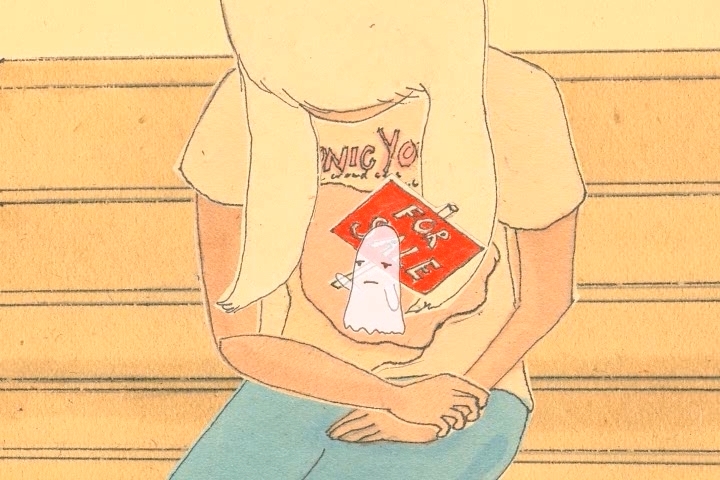
Just a heads up regarding two exciting screenings this week: MDFF presents Sophie Goyette's charming and melancholic first features Mes nuits feront écho tonight at 8PM at The Royal and on Friday, April 7th Connor Gaston's The Devout begins its one-week run at the Carlton. They are well worth checking out!
Showing posts with label Sophie Goyette. Show all posts
Wednesday, April 5, 2017
Monday, January 23, 2017
Saturday, January 25, 2014
For the dreamers!
The Montreal
director Sophie Goyette recently contributed an article À ceux qui rêvent to the Cinéastes invités section on the newly revamped 24
Images website. In trying to answer the question of what is the role of creativity
and self-expression in contemporary filmmaking Goyette proposes a typically personal and
thoughtful response which acknowledges the nervousness and audacity associated
with any creative act but also the necessity and lyricism that drives them.
Since her last
short-film Goyette has been developing three different projects. After the rural landscapes of La Ronde and the aerial perspective of Le future proche, Goyette’s next
project will feature another natural element: water. The subject of oceanography has such rich
cinematic potential and would be conducive to exploring one of the recurring characteristic of her films: that of a person who leaves society to grapple with an emotional crisis. Goyette nicely meditates on this project,
“I would like James Cameron to tell me in detail about his recent expedition in the Deepsea Challenger submarine, which allowed him to be the first to explore the deepest territory underwater … In exchange I can tell him about my childhood amazement of discovering and rewatching La Grenouille et la Baleine and its immersive capturing of marine life sounds, which is the first siren towards this hidden and mysterious world.”
Another one of Goyette's project is an independent documentary where she plans to take a group of people who have mental illnesses to visit the
Spanish mountains. Some themes that it would explore include travel and self-exploration.
One of the joys and advantages of Canadian cinema is its history and diversity where it's possible to discover such rich ambitions and visions. Goyette’s cinema and her future projects is just one particular example. But Québec in general offers many other examples especially since their films have some trouble crossing over to English Canada. Some
of these films are by directors that include Gilles Carles, Claude Jutra, Michel Brault, Pierre Pierrault, Jean-Pierre
Lefebvre, Robert Morrin, and Rafaël Øuellet. As well there is Jean-Claude Lauzon's whose
classic Léolo will be
playing at the TIFF Bell Lightbox on Sunday, January 26 at 7:00PM and which will be
introduced by David Pike, the author of the great new book At the Heart of the
World: Canadian Cinema since the 1980s. For the striving of a local
film culture there needs to be the support of filmmakers that take risks and challenge themselves, and there should also be film writers there to follow behind them.
Wednesday, June 5, 2013
Interviews with Five Emerging Women Filmmakers
To expand upon a recent blog-post on Emerging Women Filmmakers; Nadia Litz, Sofia Bohdanowicz, Leslie Supnet, Sophie Goyette and Ashley McKenzie were kind enough to follow up with these interviews. – D.D.
*****
DD: What I was particularly struck by in Hotel Congress is its sophisticated script. I liked how it’s described as a "a romantic film for the unromantic." How did you go about writing the screenplay and how accurately was it reflected in the finished film?
NL: Thank you very much. I think there are certain tropes within micro and low-budget filmmaking that belie sophistication. But, it need not be so, because writing and, by proxy, ideas are the least expensive part of making a movie. Going into the $1000 Challenge, I think the Hotel Congress core team Michel Kandinsky, Philip Riccio and myself all wanted to specifically retaliate against some familiar Canadian low-budget ground. We didn't want to shoot it in a familiar location, we didn't want it to be too goofy, or stoner or overtly sexy or horror-based. We wanted to create atmosphere. Cinema promises to take you away from your day-to-day life. That's also the promise of an affair. We wanted to create that. It's also innately Canadian, in a way that Canadian films never seem to want to represent, to yearn to escape Canada! We wanted to represent that. We shot it in the scorching hot dessert, in a historic hotel in Tucson, famous for its nefarious associations to bank-robber John Dillinger. We wore the Parisian clothing line A.P.C., set it to the music of Interpol's Paul Banks and we made the characters talk a lot. We wanted you to feel like a voyeur on the character's decision to have an affair or not. We wanted you to feel like you were eavesdropping on the best conversation in the hotel. That's a fun thing that cinema can do. Just put you in a room. With people and their obstacles. I always think those love stories are fun to watch. The romance comes in unexpected ways. The critic Andrew Sarris famously wrote about Rhomer's My Night at Maud's, "there's nothing more cinematic than the spectacle of a man and a woman staying up all night talking." I kind of built the structure of the script with that in mind. As well as the early films of Woody Allen, Whit Stillman, Linklater - which are just interesting conversations at their core. I wrote the script in 12 days, and during that time I would send stuff to Philip and Michel and say, "does this feel right?" The finished film is the exact script. Nothing is improvised. We didn't have time to veer from the script, as we shot the feature in 4 days. We were doing one-takes and devised the direction of the film from that perspective too. I think it works. There would obviously be a few things we'd like to do over, but constraints of time and budget were helpful in a breeding creativity, actually.
DD: I like the character you play in Hotel Congress, Sofia. Since you not only directed the film but also wrote and starred in it, this gives the film a very personal quality, especially in regards to Sofia’s views on relationships and life. Do you think other movies or television shows do justice to representing how women feel and think about these issues?
NL: What I have that is in keeping with the film is a malleable point of view on big life questions when it comes to love and sex and relationships, especially. I'm stubborn, but I also give myself the right to change my position over time. So, the back and forth between Sofia and Francis might be an elaborate version of a conversation I might have with myself on a moral quandary. I also believe in happy endings, but ones that are even more meaningful than what cinema can ever conceive of.
I don't know that media has conquered representation (of women or men!) quite yet, nope. But, that is what we have indie films for: to test boundaries. We just hope that HBO or AMC takes note and makes us proper one day.
DD: Having worked with some impressive directors (Harkema, Cockburn, Refn), did these experiences teach you anything about the filmmaking process or make you want to direct your own films?
NL: I liked working with all of those fellows. Refn didn't know I was an actress. He saw me in a hotel lounge in Winnipeg with my Mom and fired someone to cast me as a waitress with a few lines opposite John Turturro. I loved how he had a gut feeling and followed it, even for a small part of his film. Cockburn is not afraid to be cerebral. Harkema understands how to cast for chemistry. I've been fortunate to work and meet interesting people my whole career. I think I would have been a director eventually, anyway, without those dudes though. They would be the first to say that, too.
DD: What is your next film The People Garden going to be about?
NL: The People Garden is being produced by Daniel Bekerman at Scythia Films. Telefilm Canada has supported it during the script writing process. It has just been accepted to a TIFF Intensive for its final pass, before going into production, so that will be fun. I'm very excited to make it. It starts with a young woman named Sweetpea, telling us her "sweet and terrible" boyfriend will be dead in 3 days. She then boards a plane to Japan. The tale unfolds from there. It's a mysterious film about how to find your way to the human-spirit triumph parts of life, within the darker sides of love and life.
***
SB: A few years ago I was bored to the point of googling names of high school acquaintances of mine to see what they were up to. I eventually moved on to researching what kind of dirty laundry old relatives in my family might have online, and then suddenly remembered that my great grandmother was a poet and wondered if I could find any of her work online. I did a little bit of research and I found her poem Dundas Street somewhere on a Canadian Encyclopedia site.
It wasn’t until 2011 that I decided to borrow a copy of my great grandmothers poetry (which I still haven’t returned) from my uncle John and decided that I wanted to make a film out of Dundas Street. I still remember biking up the Toronto west rail path to his house in High Park to pick up a book of her poetry and was very excited to discover more of her work, I wasn’t really sure what I was going to find. After reading her poetry I knew that I wanted to make a film based on Dundas Street but wasn’t really certain how to do it.
A couple of months later a dear friend of mine Joanna Durkalec, wrote me a note that said that she was interested in working more in film and theatre in Toronto and said that if I needed a hand with anything that I should get in touch with her. Seeing as I regrettably don’t speak Polish (and she does) I contacted her when I wanted to make Dundas Street and we ended up co-directing it together.
DD: I like how instead of being narratives these short films are more like visual poems. How did you decide on the style of filming them?
SB: I made my first poetry film accidently when I had written a poem about ‘the end of a relationship’ and decided to turn it into a film titled falling with force., which is a four minute film that I shot with about 15 female friends of mine in Toronto in 2009. It’s an experimental piece, and I suppose you could consider it a poetry film but I didn’t really realize that’s what it was when I was making it.
It was a wonderful experience to have screened Dundas Street at the Zebra Poetry Film Festival in Berlin because it was the first time I was able to connect with other poetry filmmakers. Many of the artists there didn’t realize that poetry filmmaking was a genre and we all couldn’t believe how many people were making films based on poems.
But in terms of deciding on a visual style, I never decide or plan on how I’m going to approach the projects, I just make them. This sounds ridiculous, but the way that I conceive my work is that I am always thinking in transit. In my day to day interactions, I’m not really very present and that’s because I’m always working out a new idea in my mind or imagining how a certain situation that I’m currently living in might look on film. I think about what kinds of films I want to shoot while I’m biking home, cooking, in conversation or while I’m at my day job (maybe not a good thing to admit). I’m always very busy and try to multi-task and manipulate different ideas in my mind and as a result I’m always kind of half here and half over somewhere else.
If the idea survives a two-week incubation period, I know that it’s right and then I go for it. I don’t like to plan too much and make sure that I work under a very loose and comfortable structure. I like to work on my own, with my partner or with close friends of mine. It’s important for the production of whatever I’m shooting be as low stress as possible and for it to be a collaboration between myself and whomever I am filming with.
DD: Were there any directors that inspired you?
SB: While Joanna and I were working on our script for Dundas Street we watched the entire Decalogue series by Kieslowski. It was at this point I decided that I wanted to make a series of films based on Zofia’s work. Watching a series that was so beautifully interlinked and masterfully put together ignited a desire for me to make a collection of films that represented her poetry.
Fridrik Thor Fridriksson an Icelandic director is a filmmaker that has deeply inspired my work. His films Children of Nature (Börn náttúrunnar) and Mamma Gógó touch upon themes of aging, deterioration, compassion and death like no other filmmaker can. I am also very in love with Rúnar Rúnarsson who produced Volcano (Eldfjall), a predecessor to Haneke’s Amour (which came first the chicken or the egg), long story short, I loved Volcano much much more.
I respect the work of the Varda, so very much. Her ability to melt documentary and fiction together so seamlessly is quite captivating. She made her first film La Pointe Courte without much study or even watching many films before shooting, she just made it because it was a story she wanted to tell. In order to finance it she convinced her parents to re-mortgage their house just to get her through production. She wasn’t able to pay her crew or actors until ten years after completing the feature, this is a woman with nerves of steel.
DD: You were saying that Modlitwa still hasn't premiered anywhere. What are your thoughts on the financing and distribution side of filmmaking?
SB: I don’t have many thoughts, really, because my work has never been financed or distributed. If that ever happened I would be over the moon but this isn’t why I’m producing films. I do it because it feels good and because I love it. If my films are screened, financed or distributed I feel like this would be a real treat, but otherwise I feel very lucky to be able make what I make and do what I do.
I’m a little bit of a rookie when it comes to financing. I pay for it all myself and make sure that it’s done a cost effective as possible. I’ve recently gotten better at writing grants and those can help quite a bit. I am very grateful for all of the financing opportunities we have here in Canada, it’s pretty incredible.
DD: What new projects do you have in the works?
SB: My new film Last Poem that I shot in Iceland is about myself struggling to shoot a music video with a very distempered ‘Herzog like’ German boy named Tobi will be screening at Video Fag as a part of Birdtown and Swanvilles’ Friends and Outsiders series from June 21st to the 24th. It’s an evening of film, performance and theatre programmed by my pals Nika and Aurora. All are welcome! Please pop by! Say hello!
I have a trilogy of films that I shot in my Grandmothers house (Modlitwa is included in this trilogy) and I am currently editing up a storm trying to finish up this little three-part series which will be screened somewhere at some point! My Grandmother (not to be confused with my Great Grandmother) passed away in the fall and since then I have had a strong urge to make more work. It’s exhausting, I usually don’t have so many ideas but I’m suddenly making more films with so much energy. I’m just going to roll with it.
This summer and into the fall I’m also working on a documentary titled, Never Eat Alone that is being supported by the Ontario Arts Council. I am filming it in my building with the residents at 180 Sudbury. It’s a slow meditative documentary that focuses on the way that people eat. And that’s about all I can tell you right now. I am hoping to have it completed by next spring but then again, you never know.
And my film Dundas Street is going to be screened in London at the East End Film Festival on Thursday, July 4th.
***
DD: When did you start making animations? How would you describe the subjects of your drawings? And has your interest and style evolved over time?
LS: I began tinkering with animation in 2007, after taking a circuit-bending workshop at Video Pool Media Arts Centre in Winnipeg. It was my first experience with artist-run culture, and I was hooked. I looked into what else they had to offer, and they had an animation workshop coming up a few months after.
I draw (pun intended) from personal experience - memorable moments of heightened emotion with respect to loss and tragedy. I try to temper all the sadness with some dark humour. Animation and cinema definitely has taken away a lot of my attention from drawing one-offs nowadays. It's hard for me to not think of telling a story without movement or sound. I feel my work is evolving though, paralleling the changes in my life. Getting older, prioritizing different issues and concerns.
DD: It was great to see your work on the big screen at Videofag and then at the Images Festival. Do you make your short-films more primarily for home viewing on Vimeo or is one of the goals to have them screened in a cinema as part of a festival?
LS: Thanks David! I prefer my work to be seen in a cinema, but I'm definitely not opposed to my work being viewed on the internet, on various devices. I want to connect with as much people as possible. I've taken part in online festivals too. It's all good!
DD: What are you currently working on?
LS: I've been doing a lot of collaborative work, so after the last project is complete I'm devoting my time to my own practice for a very very long time. In between these collaborations I've been shooting a lot of Super 8, and it's been great. I haven't animated since last fall, and might not for some time. I'm enjoying shooting people doing everyday things. I toyed with the idea of quitting art altogether after seeing I Remember A Film About Joe Brainard by Matt Wolf at Images this year. I thought of how freeing it must be to no longer identify oneself as an artist. But I haven't yet found a suitable replacement for creative process. So now I'm experimenting with different ways to capture what I feel is meaningful, and figuring out how I can express empathy in a way I'm unaccustomed to.
***
DD: You've told me that Le future proche is your most personal and explorative film to date. Do you care to elaborate?
SG: Le futur proche is not an autobiographical story but it's really how I was feeling at the time. I had just finished my fourth film, La Ronde, which was my first financed film with a big crew, and didn't know personally where I was heading. I shot Le future proche when I was twenty-nine and you can see the number twenty-nine written in the first shot on the airplane highway to symbolize it, to mark it. When you question yourself about your future, you look at everything around you with a different perspective, analyzing details, being more in the "present moment". And a character feels that way too when they have just learnt terrible news, as the death of a parent, like the pilot Robin will experience. Time is being suspended; you question yourself, the past, the present and the future.
Also, I wanted to explore at my own rhythm the making of that story, with a smaller crew and more time than La Ronde. I had an urgency to just do it and didn't want to apply for grants, so I auto-financed it myself to already be able to shoot in the summer. I wanted to try things to aim for precise images and emotions that were in my head. It was the first time I tried voice-overs, the first time I asked for documentary style images from my director of photography even if it was one-hundred percent fiction... I wanted to experience the medium without any pressure, which resulted in my most explorative and personal film to date.
DD: There is a larger discourse going on right now regarding feminism and cinema. The magazine Cahiers du cinéma recently had an issue Enquête sur les réalisatrices where they asked women directors, including Anne Émond, about their thoughts on filmmaking. Two of their questions, which I will ask you, are is there a feminine directing style? And what are your thoughts on the role women have in filmmaking in Quebec?
SG: For me filmmaking is not a gender issue, you can't categorize it. Because a film is not about a subject, but about the personal point of view, the inner world of the filmmaker on that subject. We should never sense that a film could have been made by someone else other than the filmmaker. And because there are as many sensibilities and imaginations as there are different people, the possibilities are endless.
I didn't question myself about doing a story about a forty-four year old pilot in Le futur proche even if I'm not a man, because the film is beyond that.
There are great filmmakers with unique voices, and we couldn't categorize Andrea Arnold, Krzysztof Kieślowski, Miranda July or Carlos Reygadas just by their gender or nationalities. Of course it's in them and makes them what they are, but it's beyond that.
In Quebec, I'm in a generation where there's an equal amount of women and men filmmakers in shorts. I haven't yet stepped into the feature world. I don't know if I could see myself having a specific role on that subject, but if my path, which includes microbiology studies that I've left totally behind to go after my art, can inspire any female or male to also do so, than all for the good. And I know that I can, here today, think that way because great women filmmakers from Quebec and around the world have before stepped into it and stood their ground, as it was for the right to vote and other gender-equal issues.
I had the privilege to be for the first time in nomiation at Gala Jutra (Quebec) this year, and four out of five directors in our "short fiction category" were women filmmakers. As for the feature category, there was one woman out of five. I think there's a change coming, in the near future...
DD: Your short-films have gained quite the critical reputation: La Ronde premiered at the Locarno Film Festival and Le futur proche was named one of the top twelve Quebecois films by 24 Images as well won the jury prize at the Breakthrough Film Festival. Do you have any projects in the works? And what are your thoughts on the differences between short- and feature-length films?
SG: I'm currently writing a screenplay for my first two features and a documentary. It's the idea that dictates the length of the film, because shorts and features are the same, they're both art. Some stories are better being told in five minutes. Others in two hours. For me, I didn't plan to write features, even less two at the same time, it just happened after five shorts, when I saw that those stories needed to unfold on eighty to ninety pages. It's another respiration. Short are like sprints, features like marathons.
DD: I really liked the interviews with you at Nous Sommes Les Filles and Mange Ta Ville. Is there anything else that you would like to say?
SG: Go see movies at the theater! It’s a collective communal experience that can't be replaced by home viewing. And most filmmakers, at least myself, imagine our films, our images, our sounds, for the big screen, where the eye can explore everything in details, when we can have the sense that something bigger than us it taking place but will ultimately connect us back to ourselves.
***
DD: What were you trying to say through your first two short-films Rhonda's Party and When You Sleep? Were there any filmmakers that you took inspiration from?
AM: I didn’t write Rhonda’s Party, but I remember after first reading the script I was left with a strong urge to tell the story so I could avoid offering up a typical happy ending. I saw in the story an almost absurdist worldview and I wanted to preserve that. I was interested in the question of how we make plans and remain open to life when it can be so unpredictable.
I remember drawing inspiration from Jane Campion’s An Angel at my Table. I saw Rhonda as someone who felt paralyzed by life and withdrew from it as a result, similar to the struggles of Janet Frame in that film. Or maybe it resonated because we shot Rhonda’s Party in the abandoned wing of an old psychiatric hospital. I also remember being inspired by Andrew Wyeth’s paintings and the cinematography of Harris Savides.
When You Sleep came out of a time in my life when I was struggling with the codependency of a long-term relationship. I knew a lot of young people in similar situations whose problems were confounded by unplanned pregnancies and poverty. I wanted to explore whether it’s possible to tap into some amount of personal agency when you feel the desperation of being trapped in a cycle seemingly destined to repeat itself.
The Dardenne Brothers were filmmakers I looked to while making When You Sleep. Films like L’enfant and Rosetta had characters and an energy that felt akin to the world inhabited in my story, though I wanted to capture something a bit more abrasive. I was inspired by the photography of Nan Goldin very much at the time and was also reading Just Kids about Patti Smith and Robert Mapplethorpe.
I also remember watching Andrea Arnold’s short film Wasp a couple weeks before shooting When You Sleep and freaking out about similarities between the two. I ended up tweaking my script and shot list at the last minute. I’m not surprised, though, because Arnold is the filmmaker whose work feels most familiar to me when I watch it. I always end up thinking, “that’s what it’s like back home in my town, or I knew that person growing up.” That said, the director I turn to most for inspiration is probably Robert Bresson. I don’t know if that comes out in my work at all, but I’m always reading Notes on the Cinematographer.
DD: What will your new project Stray be about?
AM: Stray is a short film that I’m finishing post on right now. It was the first script I ever sat down to write, along with my producer Nelson MacDonald, and is most directly inspired by my experience growing up in New Waterford. The story stemmed from a refrain I heard often when I was young, “Ashley, don’t cry over this,” and also an obsession I had with stray cats.
The film follows a sensitive nine-year old girl, Savannah, who is searching for some intimacy in the harsh environment of her home and post-industrial town. It incorporates some of the fixtures of my life here, like the coal train that passes behind my house every day and the tracks I walked endlessly as a kid that lead nowhere. More than my previous two shorts, Stray is pretty stripped down. I approached it as a study of how this girl exists within a harsh landscape.
DD: How is it like being a filmmaker in New Waterford, Nova Scotia? What kind of community is out there?
AM: It’s exciting and sometimes lonely. I think I’m the only full-time filmmaker permanently living on the Cape Breton Island right now. My producer is currently living in Halifax even, though he is from here. I have a friend who runs a commercial video production company, and my best friend/editor is a filmmaker who divides her time between here and Montreal.
But there is no commercial film industry or community here. No place to rent gear, no actors union, etc. But’s that’s what I love about it. It’s more relaxed and authentic. The people and landscapes here inspire me so much; it feels like there are so many stories to tell. The island is like this giant palette in front of you that has been untapped. I feel a lot of ownership over this place – it all just seems like a part of my backyard.
There are, of course, many challenges about trying to make a living as an artist. We have the highest unemployment in the country here at almost 19%, so everyone is struggling really. And there is a camaraderie amongst the young adults who have decided to stay and put down roots here. Whenever I need to connect with other filmmakers, I just reach out to friends in Halifax, Montreal, or Toronto for support and inspiration. So I feel pretty lucky to have a network of peers in that way, while still being able to live and work in a place that feels like home for my art practice.
DD: Is there anything else that you would like say?
AM: Thanks for taking an interest in my work :)
Friday, May 10, 2013
Emerging Women Filmmakers: McKenzie, Goyette, Bohdanowicz, Litz, Supnet
Two of the following films When You Sleep and Le Futur Proche will be playing at 8:00PM on May 10th at the Innis Town Hall as part of the Breakthrough Film Festival, which is devoted exclusively to short films by emerging female artists. - D.D.
*****
The Nova Scotian filmmaker Ashley McKenzie has made two
short-films and is currently in
post-production on a new project Stray. Her films are made with her artistic collaborator Nelson Macdonald through their production company Grassfire Films.
McKenzie's short-film's Rhonda's Party and When You Sleep at first appear to be very different but a closer look reveals some similarities. Even though their settings are a world apart - a nursing home and a low-income apartment building - what is explored are women in moments of crisis. Both of these films center on a death - Margaret's and a rats - and how they effect the people around it.
In Rhonda's Party the principal leads are Rhonda, a reclusive nursing-home resident who is grieving over the death of her friend, and Amy, the inexperienced young nurse who needs to comfort Rhonda while still doing her job. In When You Sleep the principal leads are the young adults Jesse, whose messy apartment has a rat infestation, and her boyfriend Lee, who is being a jerk.
To better understand McKenzie's films a good point of comparison would be with the films of Mike Leigh. The two share an observational filming style that poetically presents bleak social realities. The hospital scenes in Rhonda's Party are reminiscent of the ones in All or Nothing. The gritty living conditions in When You Sleep are reminiscent of Leigh's kitchen sink realism. While the lead characters in McKenzie's films seem cut from the same cloth as Poppy in Happy-Go-Lucky or Mary in Another Year.
*****
In the Québécois film magazine 24 Images, Sophie Goyette’s newest short-film Le Futur Proche was included as one of the top ten Québécois films of 2012. Philippe Gajan writes about it,
“Like in her previous short films (La Ronde, Manège), Goyette captures an intermediate state in the lives of her protagonists, an instant suspended between a before and an after, which are never really evoked. If this cinema appears at a first glance to be realistic or psychological, it is especially impressionistic.”The other films included in the 24 Images list are Rebelle, Tout ce que tu possède, Trente tableaux, Laurence Anyways, Pieces and Love All to Hell, La mise à l’aveugle, Le grand ailleurs et le petit ici, Camion and Sur le rivage du Monde. Helen Faradji would also include Sophie Dupuis' Faillir.
I would actually compare Le Futur Proche more to Denis Côté's Bestiaire, another great Québécois film from 2012, for how they blend documentary with fiction. In Côté's Bestiaire a narrative is created around a rural zoo through its filming style which blends a Wiseman institution overview with a Benning use of long-takes. In Goyette's fiction film Le Futur Proche the story of a pilot at an aerodrome is treated like a seventies NFB documentary of a professional at work.
The pilot of Le Futur Proche flies a small plane for industrial and personal
customers. The pilot Robin describes the world as chaotic from the ground level but beautiful from his plane. What elevates Le Futur Proche to a higher level, in terms of quality, is its aerial subject and scope. The film is full of impressive aerial photography of the rural and urban, which is effective on an aesthetic and a character level.
Like in La Ronde, the protagonist of Le Futur Proche shows subtle signs of depression over the death of a parent. Robin's sorrowful underpinnings are illustrated through small visual cues. There is one screw on the
plane that is loose and which needs tightening. There is a shot of a gyrating
ceiling fan which is held for an extended duration. Robin is distant from his peers and he eats his lunches all by himself. His maintenance duties are performed with a silent authority that recalls some of Tony Scott's blue-collar heroes.
Robin perceives memories of his parents everywhere. Le Futur Proche ends with Robin taking an older couple over Montreal to celebrate their 40th anniversary. There is special moment experienced as Robin flies his plane over some fireworks with this nice and familiar couple. This scene seems to represent the character's optimism for the future that are paradoxically saddened by memories of the past. Or as Robin puts it, “Je suis en route pour quelque que chose d’autres, mes je ne sais pas encore quoi.”
Like in La Ronde, the protagonist of Le Futur Proche shows subtle signs of depression over the death of a parent. Robin's sorrowful underpinnings are illustrated through small visual cues. There is one screw on the
plane that is loose and which needs tightening. There is a shot of a gyrating
ceiling fan which is held for an extended duration. Robin is distant from his peers and he eats his lunches all by himself. His maintenance duties are performed with a silent authority that recalls some of Tony Scott's blue-collar heroes.Robin perceives memories of his parents everywhere. Le Futur Proche ends with Robin taking an older couple over Montreal to celebrate their 40th anniversary. There is special moment experienced as Robin flies his plane over some fireworks with this nice and familiar couple. This scene seems to represent the character's optimism for the future that are paradoxically saddened by memories of the past. Or as Robin puts it, “Je suis en route pour quelque que chose d’autres, mes je ne sais pas encore quoi.”
*****
Sofia Bohdanowicz’s three credited short-films are Falling
with Force, Dundas Street, and the newest Modlitwa. Her most famous short-film is Dundas
Street which is inspired by Bohdanowicz's grandmother Zofia Bohdanowiczowa’s
(1895-1965) poems. It is less a narrative than they a visual poem. There is also a religious quality to it that recalls the recent films of Terrence Malick.
Dundas Street, which is co-directed by Joanna Durkalec, is narrated by an elderly Polish woman who is unable to adapt to her new urban landscape. It follows her efforts to find meaning in a inhospitable and unfriendly city. She speaks fondly of the fruit merchant Cornelius. In one stunning shot as he is cashing out, the lighting brightens, and he sings a sorrowful song.
Modlitwa stars Maria Bohdanowicz (1930-2012), who the film is also dedicated too. Modlitwa builds upon the former through Bohdanowiczowa's poetry. Its Catholic wisdom is humbling: “Be Kind to those who suffer, oh good Lord. To those who
labor through life toward death.” Maria's routine of taking care of her urban residence is contrasted with that of a dream of a nature and peace. Its imagery is as equally as touching and beautiful as that of Dundas Street.
*****
The actress-turned-director Nadia Litz has an impressive resume. She has worked with Reginald Harkema
(Monkey Warfare), Daniel Cockburn (You Are Here) and Nicolas Winding Refn (Fear X). Her first feature Hotel Congress, which she co-directed with Michel Kandinsky, was made as part of Ingrid Verninger's 1K Wave. Its setting offers one of its first surprises as it takes place at
the real Hotel Congress in Tucson, Arizona. An American setting is
surprising for any Canadian film but especially one with such a small
budget.
Hotel Congress is described as "a romantic film for the
unromantic," and as a study of women and men relations it belongs up
there with the films Ingmar Bergman, Woody Allen, and Eric Rohmer. The film beings with an intertitle that describes the story in short-form:
“A man and a woman meet at a hotel in Tucson. One of them believed in true love and found none. One of them didn’t believe true love was possible and found it. Both of them were stuck in the desert.”
The woman Sofia (Nadia Litz) and the man Francis (Philip Ricio) both have romantic partners but decide to test their love by escaping with one another to have an affair. What makes the plot interesting is how it isn't cynical and the two of them don't cheat. Instead they have many great conversations which has an emotional cathartic effect on them. The conversations include just about everything but most prominently romance, philosophy, and culture. The witty conversations and the great performances give life to a sophisticated script. In some ways Hotel Congress plays out like the reverse-shot and the missing dialogue track from Malick's To The Wonder.
*****
Leslie Supnet makes these great short animated videos and super 8 films. The animated graphics are cute and simple. They're of these women characters that are working through their personal demons and there is a fantastic quality to them that is reminiscent of Hayao Miyazaki. They are made in collaboration with Clint Enns who does the sound design and edits them.
Supnet has made over a dozen short videos, in varying lengths, but the ones that are the most visually stunning are: You Are Here, which was made as part of a Helen Hill tribute, and is full of cute imagery of death; Gains +
Losses, which is full of situational vignettes of day-to-day
anxieties; and Fair Trade of a girl sitting on a bench and where she scratches open her stomach and then all of her bad thoughts come out.
Supnet's newest projects are the collaborations with Glen Johnson, The Idea and A Time is a Terrible Thing to Waste.
Thursday, December 15, 2011
La Ronde and some recent Québécois films
Congratulations to Igor Drljača and Sophie Goyette for their respective short-films The Fuse: Or How I Burned Simon Bolivar and La Ronde for making it onto Canada’s Top Ten short film selection for 2011. They will be screening at the TIFF Bell Lightbox as part of Programme B on Sunday, January 8 at 8:30PM, which I highly recommend going to.
I am also still writing a third review of a few other Canadian short-films: Simon Ennis' Up in Cottage Country, Rafal Sokolowski's Three Mothers and Blake Williams' Coorow-Latham Road. - D. D.
"More than a nouvelle vague, their cinema is perhaps foremost, and more importantly, a new cry. It is our job to know how to listen." - Helen Faradji
In her article Les cinéastes cinéphiles from the dossier on the Renouveau du cinéma Québécois in 24 images (N.152), Helen Faradji discuses Gilles Deleuze's concept of maniérisme to describe a group of feature-filmmakers that are revitalizing the Québécois cinematographic landscape. The filmmakers highlighted are Denis Côté, Maxime Giroux, Rafaël Ouellet, Myriam Verreault, Henry Bernadet, Xavier Dolan, and Stéphane Lafleur. Though I would also include Guy Édoin, Philippe Falardeau and, especially, Jean-Marc Vallée.
Faradji uses the term maniérisme to speak about a third state of the image, “when the root of the image is always still an image.” The term maniérisme, which is derived from the Italian expression bella maniera, is appropriate to label these filmmakers. Like Baroque painters, they reject the rule that art should be an imitation of nature. Deleuze further expands on this style in his book The Fold: Leibniz and the Baroque proposing that mannerism is about altering, twisting and folding visions of reality. This is something that these filmmakers also do as they meticulously set their scenes and place their camera - twisting and distorting reality for it to conform to their vision. The distinct character of this group of contemporary Québécois filmmakers can be traced to three attributes: mannerism as an operative function to capture reality while at the same time changing it, a keen awareness of contemporary cinema - what is good, and what they like - and unique funding opportunities (SODEC, NFB etc).
Though the films of these diverse filmmakers are different, Faradji highlights reoccurring commonalities:
Émond’s short film Sophie Lavoie is exceptionally well-done in its minute social observations through indirect means as in a single-long take it explores the thoughts and feelings of a young woman (Catherine De Léan) as she is getting an STD test. It is about "modern love" as Émond describes it. While Émond also moved to full-length features as her Nuit #1 premiered in Canada First at TIFF 2011 and is being released in Montreal on December 16th. Nuit #1 is about a young woman who picks up a guy at a rave and then how she deals with the nights after effects. While there is also Goyette whose La Ronde I will be reviewing below. But to confirm these two and their generations passion for filmmaking here is a quote from an interview between Goyette and Sonia Sarfati from La Presse Suisse, “I adore writing, and directing is another form of writing. So I can’t really see myself giving my scripts to anybody else, just like I can’t see myself directing something somebody else wrote.” Émond and Goyette truly captures this new Québécois mannerism. They have a story to tell and a desire to share it through cinema.
***** Sophie Goyette’s fourth short-film, and longest to date at twenty-three minutes, La Ronde is a rural Québec drama set in Laval about these identical twins Ariane and Alex Valencourt whose father Michael, who was suffering from schizophrenia, recently attempted suicide. They now have to decide if they want to ‘pull the plug’ on their father who is being kept alive by life-support systems. The twenty-three-year-old Ariane (played brilliantly by Éliane Préfontaine) has a plane ticket and she is ready to leave, while Alex does not really wants to go, even though he only works at a late night diner. Similarly to Sean Durkin's Martha Macy May Marlene and Steve McQueen’s Shame, the film explores the breakup of a family and how it affects both siblings differently through how they deal with the solemnity of the grieving process.
La Ronde begins with an amazing circular shot of Ariane in her family home while she plays the piano. This sequence is similar to the opening of Catherine Martin's Trois temps après la mort d'Anna where a gifted violinist Anna performs a complex Beethoven concerto while her adoring mother Françoise looks on. You can tell that Ariane’ home has not been inhabited for a while, or at least has not taken care of, since it is messy and full of empty beer cans. The kitchen sink is full of dishes and for dinner Ariane makes a microwaveable dinners. There is a loneliness to the scene of her prodding the layer of plastic over the tray. Then Ariane walks through her father’s room where she listens to his voice on the answering machine and spells his deodorant. Ariane's grief is presented with an understated sensitivity. And then she is off into the night on her electric scooter.
Ariane used to be the local high school football coach and she catches on the school’s playing field a few of the boys drunk. The beer cans are littered around and the boys are stumbling and then one of them barfs. Ariane brings the sick boy back to his parent’s house. And in the conversation with the kid’s father, who thought that his son was staying at a friend’s place, the viewer learns about Ariane’s father and the reason for his hospitalization – a suicide attempt. This father and Michael were co-workers in a nearby industrial park, which is a major contributor to Laval’s economy.
Ariane then drives off to the top of a cliff, which looks down upon an industrial park. Where she stands a bit too close to the edge in is a close-up of her feet kicking little rocks off. She then decides to back away and drive off. Except that her scooter dies - it no longer works. All of this loss and stress has been building up in her and this is the breaking point. She has lost her parents and does not know what to do or where to go. In a vulnerable cry for help and protest Ariane yells out "câlisse".
And then, what does Ariane do? She kicks her helmet off the cliff à la Football kickoff and keeps moving onward into the night and forward in her journey.
Walking on the side of an off-beat road, Ariane gets picked up in a car by a mysterious man (is he a criminal on the run?). After driving for a while they run into a dead deer lying on the middle of the road. The man wants to drive on top of the deer but Ariane decides to get out of the car to pull it out of the way. This appreciation of life, of all different species, reflects the films Christianity, the dominant Québécois religion. This was hinted at earlier while they were driving and passed a a brightly lit cross.
While preventing this deer from being run over Ariane sees and hears something from off in the forest, which she decides to follow. In one of the most spellbinding sequences in the film Ariane follows this apparition. In a point-of-view shot through a dark grassy field with a path illuminated by a flashlight the soundtrack also shifts to the conversation between the brother Alex and a doctor discussing cutting off Michael's life support. When Ariane finally gets to what she has seen, it turns out to be a cow. The films mysticism and contrasts gives the impression that it is the father re-incarnated in the out-of-place farm animal. The texture of the scene feels very sci-fi supernatural or more concisely like Apichatpong’s oneiric Tropical Malady. As well this focus on animals seems like general trend in Québécois cinema as an owl played a large role in Halima Ouardiri’s Mokhtar as well Denis Côté’s new film Bestiaire (which is premiering at Sundance) is a documentary consisting solely of animals filmed in a Montreal zoo.
There is a beautiful exposition shot of a brick wall with statues of white doves flying to the light, and then Ariane makes her way to the family’s tombstone. She spends the night there and in the morning she scratches out with chalk Alex and her name. She then calls her brother and says, "Je suis ici avec tois," “I am here with you”. To end La Ronde, Ariane is able reconcile her demons and find solace - her views making a full circle.
David Davidson

***** Sophie Goyette’s other short films include En parallèle (2008), À l’État sauvage (2009) and Manèges (2009). As well she is currently completing a new short, Le futur proche, and writing her first full-length feature film. La Ronde had it’s world premiere at the Big World for Short Films program at the Locarno Film Festival 2011 and also played in TIFF Short Cuts Canada and in the Focus Section of Montreal Festival du Nouveau Cinema.
I am also still writing a third review of a few other Canadian short-films: Simon Ennis' Up in Cottage Country, Rafal Sokolowski's Three Mothers and Blake Williams' Coorow-Latham Road. - D. D.
"More than a nouvelle vague, their cinema is perhaps foremost, and more importantly, a new cry. It is our job to know how to listen." - Helen FaradjiIn her article Les cinéastes cinéphiles from the dossier on the Renouveau du cinéma Québécois in 24 images (N.152), Helen Faradji discuses Gilles Deleuze's concept of maniérisme to describe a group of feature-filmmakers that are revitalizing the Québécois cinematographic landscape. The filmmakers highlighted are Denis Côté, Maxime Giroux, Rafaël Ouellet, Myriam Verreault, Henry Bernadet, Xavier Dolan, and Stéphane Lafleur. Though I would also include Guy Édoin, Philippe Falardeau and, especially, Jean-Marc Vallée.
Faradji uses the term maniérisme to speak about a third state of the image, “when the root of the image is always still an image.” The term maniérisme, which is derived from the Italian expression bella maniera, is appropriate to label these filmmakers. Like Baroque painters, they reject the rule that art should be an imitation of nature. Deleuze further expands on this style in his book The Fold: Leibniz and the Baroque proposing that mannerism is about altering, twisting and folding visions of reality. This is something that these filmmakers also do as they meticulously set their scenes and place their camera - twisting and distorting reality for it to conform to their vision. The distinct character of this group of contemporary Québécois filmmakers can be traced to three attributes: mannerism as an operative function to capture reality while at the same time changing it, a keen awareness of contemporary cinema - what is good, and what they like - and unique funding opportunities (SODEC, NFB etc).
Though the films of these diverse filmmakers are different, Faradji highlights reoccurring commonalities:
“No sunny roads or alleyways with bystanders, but instead new locations (countrysides, suburbs, dumps, etc.) usually in dead mid-season. No idle chatter, stories that lead the viewer by the hand or didactic montages, but instead there is silences, contemplation, and narrative “holes” that force the viewer to focus his attention on the qui-vive […] While it first appeared a priori difficult to account for different approaches and tone of these filmmakers, their reunion under the banner of maniérisme, as well as their different use of formal elements, seems like the cement of their shared identity.”I propose to put forward two up-and-coming Montreal short-film directors to Faradji’s cinéastes cinéphiles banner and they are Anne Émond and Sophie Goyette.
Émond’s short film Sophie Lavoie is exceptionally well-done in its minute social observations through indirect means as in a single-long take it explores the thoughts and feelings of a young woman (Catherine De Léan) as she is getting an STD test. It is about "modern love" as Émond describes it. While Émond also moved to full-length features as her Nuit #1 premiered in Canada First at TIFF 2011 and is being released in Montreal on December 16th. Nuit #1 is about a young woman who picks up a guy at a rave and then how she deals with the nights after effects. While there is also Goyette whose La Ronde I will be reviewing below. But to confirm these two and their generations passion for filmmaking here is a quote from an interview between Goyette and Sonia Sarfati from La Presse Suisse, “I adore writing, and directing is another form of writing. So I can’t really see myself giving my scripts to anybody else, just like I can’t see myself directing something somebody else wrote.” Émond and Goyette truly captures this new Québécois mannerism. They have a story to tell and a desire to share it through cinema.
La Ronde begins with an amazing circular shot of Ariane in her family home while she plays the piano. This sequence is similar to the opening of Catherine Martin's Trois temps après la mort d'Anna where a gifted violinist Anna performs a complex Beethoven concerto while her adoring mother Françoise looks on. You can tell that Ariane’ home has not been inhabited for a while, or at least has not taken care of, since it is messy and full of empty beer cans. The kitchen sink is full of dishes and for dinner Ariane makes a microwaveable dinners. There is a loneliness to the scene of her prodding the layer of plastic over the tray. Then Ariane walks through her father’s room where she listens to his voice on the answering machine and spells his deodorant. Ariane's grief is presented with an understated sensitivity. And then she is off into the night on her electric scooter.
Ariane used to be the local high school football coach and she catches on the school’s playing field a few of the boys drunk. The beer cans are littered around and the boys are stumbling and then one of them barfs. Ariane brings the sick boy back to his parent’s house. And in the conversation with the kid’s father, who thought that his son was staying at a friend’s place, the viewer learns about Ariane’s father and the reason for his hospitalization – a suicide attempt. This father and Michael were co-workers in a nearby industrial park, which is a major contributor to Laval’s economy.
Ariane then drives off to the top of a cliff, which looks down upon an industrial park. Where she stands a bit too close to the edge in is a close-up of her feet kicking little rocks off. She then decides to back away and drive off. Except that her scooter dies - it no longer works. All of this loss and stress has been building up in her and this is the breaking point. She has lost her parents and does not know what to do or where to go. In a vulnerable cry for help and protest Ariane yells out "câlisse".
And then, what does Ariane do? She kicks her helmet off the cliff à la Football kickoff and keeps moving onward into the night and forward in her journey.
Walking on the side of an off-beat road, Ariane gets picked up in a car by a mysterious man (is he a criminal on the run?). After driving for a while they run into a dead deer lying on the middle of the road. The man wants to drive on top of the deer but Ariane decides to get out of the car to pull it out of the way. This appreciation of life, of all different species, reflects the films Christianity, the dominant Québécois religion. This was hinted at earlier while they were driving and passed a a brightly lit cross.
While preventing this deer from being run over Ariane sees and hears something from off in the forest, which she decides to follow. In one of the most spellbinding sequences in the film Ariane follows this apparition. In a point-of-view shot through a dark grassy field with a path illuminated by a flashlight the soundtrack also shifts to the conversation between the brother Alex and a doctor discussing cutting off Michael's life support. When Ariane finally gets to what she has seen, it turns out to be a cow. The films mysticism and contrasts gives the impression that it is the father re-incarnated in the out-of-place farm animal. The texture of the scene feels very sci-fi supernatural or more concisely like Apichatpong’s oneiric Tropical Malady. As well this focus on animals seems like general trend in Québécois cinema as an owl played a large role in Halima Ouardiri’s Mokhtar as well Denis Côté’s new film Bestiaire (which is premiering at Sundance) is a documentary consisting solely of animals filmed in a Montreal zoo.
There is a beautiful exposition shot of a brick wall with statues of white doves flying to the light, and then Ariane makes her way to the family’s tombstone. She spends the night there and in the morning she scratches out with chalk Alex and her name. She then calls her brother and says, "Je suis ici avec tois," “I am here with you”. To end La Ronde, Ariane is able reconcile her demons and find solace - her views making a full circle.
David Davidson

Subscribe to:
Posts (Atom)


.jpg)


+Sophie+Goyette_re%CC%81alisatrice.jpg)