Showing posts with label Café de flore. Show all posts

Monday, October 6, 2014

Café de Flore

I need to thank Marc Saint-Cyr for letting me post this fascinating essay on Café de Flore. - D.D.
Jean-Marc Vallée’s Café de Flore is one of those rare, special works of art: a film that perfectly marries the cosmic with the intimate, filtering a concept that transcends the boundaries of time, nationality, and probability through an assortment of stories entrenched in intensely relatable human experiences. As demonstrated by both this film and his earlier masterpiece C.R.A.Z.Y., Vallée understands the anatomy of memory, illuminating with insight and detectable pleasure the roots of those golden moments that linger and resonate within us long after they occur. In such moments, which rarely feel special as they are happening, and which Vallée so skillfully isolates and freezes in cinematic amber, anything could turn out to be the Rosetta Stone that serves as the key to a larger, grander narrative beyond your field of vision in which you only play one part: a specific incident or sequence of events, a song or album, a cryptic word or name, a picture on the wall that contains more than initially meets the eye. Passed down from person to person, weathering the seasons, these artifacts serve as tokens of personal history and testaments to the longevity of memories – whether we are fully aware of it or not. Music serves as an especially potent material for the weaving of these memory maps, as Vallée can attest: in C.R.A.Z.Y. and Café de Flore, he repeatedly uses songs and album covers as sturdy, reliable landmarks dotted across the charts of his characters’ lives that add continuity and meaning to the mysterious, incredible journey of human destiny.
            Just as it did in C.R.A.Z.Y., Pink Floyd’s The Dark Side of the Moon is a reoccurring fixture in Café de Flore’s sonic landscape – specifically Clare Torry’s fantastic, echoing yowl heard in the classic album’s opening track “Speak to Me/Breathe,” created by the band that is by now as much a staple of Vallée’s cinema as the Rolling Stones are of Martin Scorsese’s. Antoine (Kevin Parent), a DJ based in present-day Montreal, loves that particular song, integrating it into his sets and indulging in it by himself through his headphones in order to reach that “special place” that music lovers like him know so well. Antoine’s story involves his relationship with Carole (Hélène Florent), his ex-wife and the mother of their two daughters, and Rose (Evelyne Brochu), the new woman in his life. Antoine and Carole’s romance was born in the post-punk era of Joy Division and the Cure but grew not only in years of affection and tenderness between the two lovers, but also in the shadow of a specter that only loomed longer and darker as time went on: alcohol, as the many bottles of Beefeater Gin that appear in the old photos of them together, always within Antoine’s easy reach, testify. In the present, he is haunted by the crimson-uniformed figure from the bottle label in eerie, blink-and-you-miss-it subliminal flashes – a demon that is always lurking in the peripheries of his life.
            The central dilemma Antoine faces stems from the arrival of Rose in his life and the strain it places on both the family he and Carole made together and his faith in the idea of there being just one person out there with whom you are meant to spend the rest of your life. With this premise, Café de Flore straightforwardly adopts a rare philosophical complexity while fiendishly throwing a wrench into the most cherished dream of die-hard romantics everywhere. Having been cheated out of her life with Antoine by Rose and, in a greater sense, fate, Carole soon becomes one of the film’s most sympathetic characters. In her, Vallée and Florent illustrate the cruelty and pain that can come from love, desire, and destiny’s mysterious ways, which Antoine and Carole’s angry oldest daughter keeps bringing back to the surface with her own distress from seeing her father fall for another woman besides her mother. In pure Valléeian fashion, she claims a measure of revenge against her father by deliberately playing the songs associated with their time together, as if her and her sister’s very existence wasn’t a vital enough reminder of his past life with Carole. Music has that power: to summon the pain and glory of the past with an intensity and directness that nothing else can quite manage.
            On the same subject of music and past lives, there is the story of Jacqueline (Vanessa Paradis), a young woman living in Paris in 1969, and Laurent (Marin Gerrier), her young Down syndrome-afflicted son. For film-savvy folk, their world should be quite familiar, since it is the same place and almost the same time period – it’s close enough for government work – that Truffaut, Godard, Varda, Rohmer, and the rest chronicled so well in their day with their tales of records, cafés, cigarettes, boulangeries, young love, and the movies. But Vallée doesn’t take the bait and sacrifice any measure of his story in favor of yet another homage-laden jaunt into Newwaveland (which he previously evoked with his memorable inclusion of Charles Aznavour amongst C.R.A.Z.Y.’s musical delights). And thank goodness for that – as nice as it is to be back in the milieu of Breathless, Cléo from 5 to 7, and The Bakery Girl of Monceau, this is strictly Jacqueline and Laurent’s story, and by keeping his focus on them and their experiences, Vallée expresses a sincerity and authenticity that, beyond their cinematic allure, were what the finest New Wave films were all about. After all, to paraphrase a famous quote from Jules Dassin’s The Naked City, there are more than eight million stories in the City of Light; the story of Michel the car thief and his American girlfriend Patricia was one, the story of Antoine Doinel was another, and the story of Jacqueline and Laurent is simply another. It primarily concerns the incredible strength and beauty of parenthood, which is manifested in the pure, unwavering devotion Jacqueline pledges to her son as she tries her very best to ensure that he receives a “normal” education – one without segregation or special treatment. Despite the daunting nature of her goal, she successfully manages to provide Laurent with a life of safety, happiness, and routine. Together, they create their own secret language made up of private, affectionate rituals only they know – a language of absolute fondness. But soon a new challenge arises with the appearance of Véro (Alice Dubois), a little girl Laurent’s age who also has Down syndrome. A new bond of love, fresh and intense, is formed between the two, sending Jacqueline into a maelstrom of anguish, jealousy, and pain at the thought of losing her soul mate to another. Sound familiar? “Speak to Me/Breathe” may be the Pink Floyd song that is heard again and again in the film, but “Echoes” from 1971’s Meddle perhaps would have been a better thematic fit – though on top of the less subtle devices that Vallée uses to link his two narrative threads together, including ominous reoccurring dreams and a psychic whom Carole visits to try to decipher their meaning, him sampling the prog epic might have fatally tipped the film’s scales from helpful clarity to blunt hand-holding.
            But even with the abovementioned elements in play, Café de Flore is by any reliable measure a brave work crafted with great subtlety and sophistication. Some of its mysteries take longer to develop than others, some of them remaining shrouded in the kind of ambiguity that rewards multiple viewings, prolonged contemplation, and in-depth discussion. From the repeated image of the plane carrying Antoine perfectly aligned with the bright white ball of the sun against a pristine blue sky right before it disappears in a sudden blip of orange to the numerous split-second appearances of the sinister Beefeater man to the special significance of a song called “Café de Flore” to both Laurent and Antoine in their respective time periods, the film is littered with countless clues, signs, and omens that form a shattered mosaic depicting its characters’ destinies and bonds with one another. As a viewer, you are given the task and pleasure of putting the pieces together to try and bring into sharper focus the twisting, turning, intersecting trajectories of these people’s lives. In this way, Café de Flore exemplifies one of the most satisfying traditions of art house cinema – the kind that engages and entertains its viewers in the same way a smart, well-designed game would its ready players.
            In its refreshingly nuanced portrayal of lovers, parents, and children, Café de Flore achieves a rare universal sweep that makes you more deeply aware and appreciative of the various roles you play throughout your life as well as the place you occupy in the labyrinthine narrative of history – which perhaps bears more commonalities and connections across generations than anyone realizes. As I write this, I’m thinking of the scar on the ring finger of my left hand that came from an injury I got many years ago while listening to – you guessed it – The Dark Side of the Moon while riding my bike a little too fast and a little too recklessly. Will there be someone else, born many years from now, who will one day bear a scar that looks exactly like mine in exactly the same place? Was there someone born decades before I was in some other part of the world who bore such a scar? Which albums did/will they count among their favorites? More importantly, did/will either of these hypothetical people ever have relationships that resemble any of the ones I currently have with the people I love? After seeing Café de Flore, not only am I more likely to wholeheartedly place my faith in the likelihood of such things, but also, more importantly, I am more determined to cherish the bonds that connect me to those few special people in my life. In whatever time period or incarnation, such bonds should be treasured while they are intact and unharmed by the forces of fate, time, and death; thankfully, we have films like Café de Flore to remind us of that every now and then.

Marc Saint-Cyr

Friday, November 8, 2013

The Café de flore interview

I need to thank my friend Andrew Parker for sending me this old Jean-Marc Vallée interview. - D.D.  

Andrew Parker: Let’s go back very briefly to the film you made before this one, The Young Victoria, which was entirely a period piece. This film is half a period piece and half about a man who does a lot of travelling. Was it more of a challenge to tackle both types of films in the same movie, or was it more difficult to make one larger period piece?

Jean Marc Valee: I wouldn’t say this was harder to do. Victoria was harder to do than Café because of its complexity, and the world, and the homework that I had to do in order to be familiar with this world of a royal family. It’s so anal. We had to be so meticulous about the way they stand, they way they talk, the way they eat, their rooms, everything. It’s much more of a challenge and more difficult than Café where part of the film is taking place in Paris in the 1960s.

The only hard thing to do there was… It’s not a filmmaking friendly city, Paris, when you want to make a period film because it changed so much. It should be friendly and it should be easy, but they have a hard time, the Parisians, whenever they want to make a period film because they put posts everywhere on the streets in order to not be able to park on the sidewalks. They put fences in front of the schools because they had terrorist attacks at one point.

But it would be perfect to do a period piece in Paris because you look around and you look up at the buildings and the churches and it’s period everywhere. But the cars and this and that and how it changed makes it so when you ask to get rid of these fences and posts the city asks for… it costs an arm and a leg. It’s kind of ridiculous, so it’s tough to find the right streets to shoot in.

AP: One of the things that’s very important in the film is the theme of parenting and what it takes to be a parent. It’s hard for an actor to act like someone is their child when they aren’t, especially for Vanessa Pardis who has to play the mother of a child with Down Syndrome, so was there any special direction you gave to the actors as to how you wanted the relationships to feel or was there anything the actors themselves did to prepare for the roles?

JMV: Of course. Vanessa had to read a lot and do a lot of research to become acquainted with the Down Syndrome aspect of the film. She did her homework and she became very close to the kid’s family and his parents, and she asked a lot of questions and spent a lot of time with all of them before hand so she could get familiar with how to act and react.

AP: You mentioned before that the casting for the part of Laurnet, the young boy with Down Syndrome, was the hardest aspect of the production. What was that process like?

JMV: Yeah, that was something. In the casting we had to find the perfect kids and it took, I don’t know, about four or five months. We searched in France and Belgium and Quebec because they had to speak French. When I started to do the auditions with these kids, I started to realize “Oh God, what did I write there?”

A lot of them had such a hard time talking and such a hard time trying to understand and get what they had to do in an auditioning room. It could be something simple, like I was asking them to pretend to laugh or smile like I was doing. I was asking them to imitate me, and it was hard for them to do. Then I was asking them to smile and they were trying to do it. Then I would say I was going to pretend to be sad, and I asked them to do the same, but instead of pretending to do the same, they were coming to me and hugging me. So at that moment in the auditioning room I felt a little over my head and wondering “What am I trying to do here? Am I going to find these two?”

At one point I thought we were going to meet regular kids and put some make-up on them it was so hard. Then I met Elise, the little girl, and she could talk and comprehend. And she told me she had a lover at school, that she was in love with a down syndrome kid at school. I said “Really? I need to meet this kid!” (laughs) Then she came back with him (Marin Gerrier). They weren’t even really actors. They were kissing on the mouth between takes and I had to keep telling them to stop that! But they were so into expressing love and down syndrome is pure love. It was so beautiful. They had a real understanding of the pretending necessary to take on the roles of being Vanessa Paradis’ son and the other parents daughter, but as soon as I said action, they weren’t playing the truth, they were the truth. They were it.

AP: Your movie follows in a recent line of movies that tackle really abstract concepts, and there are few things more abstract than love. There are no clear cut answers, but it resonates with audiences. Did you have any reservations about tackling something like this and how the film would be received?

JMV: No, I didn’t think it was going to be hard because it’s very universal, the concept of soul mates. Of course, we’re dealing with past life with a twisted plot, but bottom line is that it’s life and love and a true love that we want and we dream of. The one that when we lose it, we want to find it back. That’s really why Helene’s character is trying so hard to figure out just what the fuck’s going on and why she has no control over anything she feels. Then she goes past the direct explanations and tries to go to the paranormal side and maybe find it back or try to move on and believe that it’s over and hope that it could happen again. That’s what the film’s about. It’s about letting go and leaving love, the beautiful and true love, and it could happen more than once.

AP: The music of the film is so integral to the lives of the characters in the film and it serves as their lifeblood. How much music when you originally sat down to write the film did you go through and how long was the list of choices you were working from before you were ready to film?

JMV: Oh man… the list is long. I had it in my iPod and as I was working and working I put more songs in my Café de flore writing playlist. There’s about close to 300 songs and works on there.

AP: How did you settle on Café de flore as the piece the film revolves around?

JMV: I didn’t choose. The song chose me. That’s the weird paranormal thing in my life. (laughs)

AP: When was the moment when you knew this was the song that was going to formulate the story for the film?

JMV: It happened between 2004 and 2007. So for three years I was listening to this track just like the characters of the DJ and the down syndrome kid, they both have this obsession with the track and so did I. I discovered the electronic version first and then the other versions after, and for three years I listened to them repeatedly and I kept telling myself that I was going to make a film one day with this theme. It’s too beautiful.

When I was thinking of a love story, I realized I began humming it and I had some emotional moments. It reminded me of Ennio Morriconne’s music. Particularly when you ask a group of children to perform it. It’s just like… wow. Just thinking of it now and the children just humming it is just epic. It’s so cinematographic and so film like, I just thought it was great for the story. That’s when I thought of it as having two stories.

The Montreal story came up first, and the first thing I saw when I got to Paris was this mother dancing in the morning with her kid, who had down syndrome, outside before going to work and I knew that the Montreal character would be thinking of herself as this mother. So when I was listening to this track and thinking of that premise and concept it was clear to me that this could be very emotional and very beautiful. That’s why I’m saying the track found me. It’s why the film exists. I’m talking to you right now because of this musical theme that created the theme of the film.

AP: In addition to the song that the film is directly framed around, you also have a lot of big name songs used within the film – everything from Sigur Ros to The Cure to Pink Floyd – and none of that had to be cheap or easy to get the rights and permissions to use. How hard was it to get what you wanted and was there anything that you couldn’t get permission to use that you really wanted to?

JMV: Yes. Fuck. (long pause) There was something that could have been used in this film that I wanted to be used in this film because it didn’t work out, and I’m still mad at them! (laughs)

It always takes time to negotiate rights, but it’s easier now that C.R.A.Z.Y. is out there and the labels and record and publishing companies knew about that going in and they knew about Café de flore and I guess the next one will be easy because they know I’m at the service of music and he serves the musicians well because he likes music and his films are music oriented and blah blah blah. I think I have the reputation now that can get the rights.

But I wanted a Led Zeppelin song in the film and it didn’t work out. That’s why Vanessa Paradis is living in a city with all these staircases everywhere. In the subway, on the streets, in her apartment building. She’s always taking and walking up stairs. That’s her burden she has to go down in the most beautiful neighbourhood in Paris going up and down all these stairs in St. Germaine where she has her son’s school. Every day, every night she has to go back to her poorer neighbourhood and it’s her own way of buying her own Stairway to Heaven. I wanted that track.

Sunday, January 15, 2012

A Modern Day Kandinsky (On Jean-Marc Vallée's Café de flore)

Café de flore (Jean-Marc Vallée, 2011)
**** (Masterpiece)
*****
Jean-Marc Vallée’s Café de flore, which recently played at the Lightbox with Vallée in attendance as part of Canada's Top Ten, is a blessing. When there are so many movies that come out already looking like standardized products, a work as original like Café de flore dispels of convention and in its rebirth leaves only essences and feelings behind. Café also proves the long-standing suspicion that Vallée is actually an auteur as he not only directs the film but he also wrote the screenplay and edited it – look carefully and you can spot him in a signature cameo. After the screening, Vallée mentioned that after completing The Young Victoria (2009), a film that he didn’t have total control over, he wanted to make something edgy. And edgy – hell, I would describe it as dangerous! - is what you get in Café as Vallée’s powerful imagination is on view.

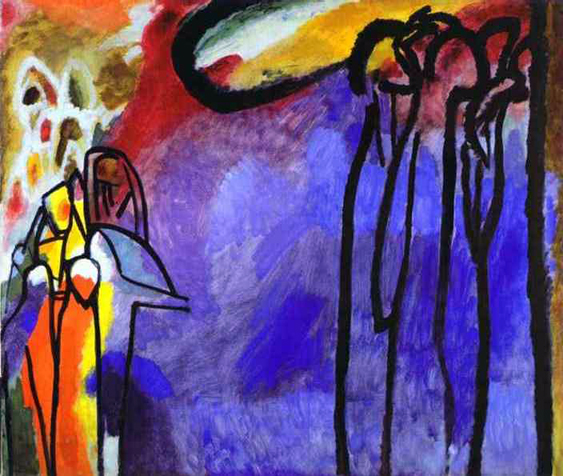
Like the other great Québécois director Denis Côté (cf. 3 + 4 + 1), Vallée’s approach to form is similar to that of Modernist painters and, more precisely, to Wassily Kandinsky’s Impressionist-style paintings from his Munich period. The unlikely comparison offers striking similarities. What these two artists achieve is the creation of abstract visual expressions built from stylized forms that are imbued with symbolic meaning. When Vallée cuts the sound and all you see are figures presented in decisive moments showing unrestrained feeling alongside Doctor Rockit’s catchy track Café De Flore - the effect is that of ecstasy.

There is something free and lyrical to the rhythm and melody of Café that creates an unreal mood and a self-contained world. When Antoine (Kevin Parent) jumps into his swimming pool and some water lands on his daughter’s foot it seems to connote an unexplained spiritual connectedness between the two. Kandinsky was also interested in theosophy, the occult and religion as elaborated in his important essay Concerning the Spiritual in Art. Vallée’s concern with the spiritual bleeds throughout the entire film through representational and abstract forms, the casting and editing, colour and lighting, music and sound. Vallée seeks the essence beneath appearances, where the actions are drowned in style, in hope of sharing unbridled feelings, substance and life. - David Davidson

Tuesday, December 27, 2011

Happy New Years! (TFR Top Ten of 2011)

Instead of the typical Top Ten, each entry is organized through thematic categories: (1) the presentation of the unconscious mind through cinema by the world's best Québécois directors, (2) Hitchcockian French thrillers starring the great Guillaume Canet, (3) late works by masters of American cinema, (4) these short films are precursors of what is to come out of Canadian cinema, (5) hybrid films that take the luster of mainstream movies, inflicting them with a singular and vibrant sensability, (6) horror, action and the supernatural reigns supreme, (7) some might call these middle-brow but they are undeniably well crafted and complex, (8) funny, smart, personal and full of feeling, (9) formally invigorating world cinema, (10) social activism, political documentary and anarchist films has been pushed to the margins of experimental cinema - these have been the most challenging.
Following the Top Ten there are a few other lists: best new film books, favorite local film critics, upcoming series etc...
I hope you've enjoyed reading Toronto Film Review and that you keep checking it out in 2012 - there is a lot more film coverage and book reviews to come. A special thanks goes out to everyone who contributed and helped. And make sure to check out the twitter account, TOFilmReview. - D.D.


"You know what, my films resemble more and more what children make in their rooms, when they make little expositions with rocks and seashells: I see more and more clearly my films, and more so the next one, like expositions of little things that I want to share." - Lars von Trier

Top Ten of 2011
 1.       Café de Flore (Jean-Marc Vallée)
          Curling (Denis Côté)
 2.       Espion(s) (Nicolas Saada)
          Une vie meilleure (Cédric Kahn)
 3.       Road to Nowhere (Monte Hellman)
          Twixt (Francis Ford Coppola)
          The Tree of Life (Terrence Malick)
 4.       The Fuse: Or How I Burned Simon Bolivar (Igor Drljača) 
          Coorow-Latham Road (Blake Williams)
          Up In Cottage Country (Simon Ennis)
          La Ronde (Sophie Goyette)
          Three Mothers (Rafal Sokolowski)
 5.       Melancholia (Lars von Trier)
          Drive (Nicolas Winding Refn)
          You Are Here (Daniel Cockburn)
          Hors Satan (Bruno Dumont) 
          Un été brûlant (Philippe Garrel)
 6.       Super 8 (J.J. Abrams)
          Scream 4 (Wes Craven)
          Le Gamin au vélo (Jean-Pierre and Luc Dardenne)
          The Twilight Saga: Breaking Dawn: Part 1 (Bill Condon)
          Attack the Block (Joe Cornish)
          Kill List (Ben Wheatley)
          Martha Marcy May Marlene (Sean Durkin)
 7.       Restless (Gus Van Sant)
          The Skin I Live In (Pedro Almodóvar)
          Pina (Wim Wenders)
          Contagion (Steven Soderbergh)
          Shame (Steve McQueen)
          The Adventures of Tintin (Steven Spielberg)
 8.       Hall Pass (Bobby and Peter Farrelly)
          How Do You Know (James L. Brooks)
          Midnight in Paris (Woody Allen)
          Bridesmaids (Paul Feig)
          We Bought a Zoo (Cameron Crowe)
          The Descendants (Alexander Payne)
 9.       Ne change rien (Pedro Costa)
          To Die Like a Man (João Pedro Rodrigues)
          The Strange Case of Angelica (Manoel de Oliveira)
          Mysteries of Lisbon (Raoul Ruiz)
          The Future (Miranda July)
          Le quattro volte (Michelangelo Frammartino)
          The Autobiography of Nicolae Ceausescu (Andrei Ujica)
 10.      Seeking the Monkey King (Ken Jacobs)
          The Forgotten Space (Allan Sekula and Noël Burch)
          Vapor Trail (Clark) (John Gianvito)
          This is not a Film (Mojtaba Mirtahmasb and Jafar Panahi)
          Slow Action (Ben Rivers)
          We Can't Go Home Again (Nicholas Ray)
          Too Many Things (Donigan Cumming)
Best new and discovered film books and writing:
  • Another Fine Mess: A History of American Film Comedy by Saul Austerlitz (Chicago Review Press, 2010).
  • The Film Comedy Reader edited by Gregg Rickman (Limelight Editions, 2004).
  • Comment Woody Allen peut change votre vie by Éric Vartzbed (Éditions du Seuil, 2011).
  • Apichatpong Weerasethakul edited by James Quandt (Austrian Film Museum, 2009).
  • Splitting the Choir – The Moving Images of Donigan Cumming edited by Scott Birdwise (Canadian Film Institute, 2011).
  • Pencil, Ashes, Matches & Dust by Donigan Cumming (Editions J’ai VU, 2009).
  • Trammel up the Consequences by Robin Wood (Lightstruck Film & Media Book, 2011).
  • Monte Hellman - Sympathy for the devil by Emmanuel Burdeau (Capricci, 2011).
  • Monte Hellman: His Life and Films by Brad Stevens (McFarland & Company, 2003).
  • Masters of Cinema: Francis Ford Coppola by Stéphane Delorme (Phaidon, 2010); as well as his writing and direction of Cahiers du cinéma.
  • When Movies Mattered: Reviews from a Transformative Decade by Dave Kehr (University Of Chicago Press, 2011); as well as Kehr's weekly DVD review column in The New York Times.
  • The American Cinema: Directors and Directions 1929-1968 by Andrew Sarris (Da Capo Press, 1968).
  • Films And Feelings by Raymond Durgnat (MIT Press, 1971).
  • BFI Modern Classics - WR: Mysteries of the Organism by Raymond Durgnat (BFI, 2008).
  • Joseph L. Mankiewicz et son double by Vincent Amiel (Presses Universitaires de France, 2010).
  • World Film Locations: Tokyo edited by Chris MaGee (Intellect Ltd, 2011).
  • Optic Antics: The Cinema of Ken Jacobs edited by Michele Pierson, David E. James and Paul Arthur (Oxford University Press, 2011)
Best North American Repertory:
  • Anthology Film Archives.
Favorite local film critics:
  • Adam Nayman:
who writes for the Toronto alternative paper The Grid as well the more worthwhile Cineaste and Cinema Scope. His polemical pieces alongside his vocal position on certain kinds of filmmaking definitively elevates film criticism and the film critic to a higher plane. But more so then his writing, Adam's extracurricular activities like his classes at the Miles Nadal JCC have been one of the highlights of 2011. Who can forget the janitor cleaning the alleyway while the stragglers finished watching Goodbye, Dragon Inn or the ridiculously popular class on Woody Allen. More so then reading film criticism, the classes seemed like the next logical progression of it - the living incarnation. The classes are great as Adam's tone blends the informal and the academic and he illustrates the comments with film clips from a ripped DVD - everything seems to be light years ahead of the curriculum at the University of Ottawa. And going to The Pump and Shoeless Joe's after for pints with a group of people and friends is always a lot of fun. Adam's classes included New Wave Foreign Cinema Lectures In Nayman’s Terms and the two part series Love Em or Hate Em: Controversial Directors and MORE Controversial Directors. And Adam has a new class scheduled for the spring of 2012 at the JCC on Stanley Kubrick, with each class dedicated to a specific film. I know that I am speaking for more then myself when I say, we can't wait!


  • Andrew Parker:
  • for his writing at Criticize This! and Dork Shelf as well as his programming series Defending the Indefensible at the Toronto Underground Cinema. If you were to have told me a year ago that the state of Toronto's weekly film criticism is in good shape and that the best writing could be found on website's with silly names like Criticize This! and Dork Shelf, I would have probably laughed at you. But lo and behold, I was wrong. Andrew is the kind of guy that still writes his reviews longhand with an old pen and notepad. And Andrew's weekly reviews, which run around the one-thousand word mark, of the majority of new releases provides the most thorough readings of what is playing on Toronto's screens. With a special attention to the films that can gain from this critical support like Extremely Loud and Incredibly Close and Beauty Day. As well he seems to be ahead of most trends as he can tell you why movies like Like Crazy and Margaret are terrific and his opinions stand out as he can also say why most commercial drivel is bad.


  • Along with Andrew's series Defending the Indefensible, there is also John Semley's (A.V. Club Toronto) new series Remake/Remodel, both of which I recommend and that I look forward to starting up again in the new year. As well there is a new class that seems interesting as part of the Media Mondays at the JCC, Reflections in the Hall of Mirrors: American Movies and the Politics of Idealism presented by Kevin Courrier which will be running from January 16th to March 26th each Mondays starting at 7:00PM - except for February 20th and March 12th. As well, like always, there is Early Monthly Segments and Pleasure Dome for your experimental film fix, and the monthly film-blogger pub nights for some camaraderie. And while I am shouting people out, might as well bring up the Cinema Scope Twitter account CinemaScopeMag, which is a lot of fun too.
  • Most anticipated films of 2012:
    • Abel Ferrara's 4:44 Last Day on Earth and Christopher Nolan's The Dark Knight Rises. As well Kazik Radwanski and Antoine Bourges from Medium Density Fibreboard Films (MDFF) should hopefully have their current projects finished in the new year - I look forward to catching these two on the festival circuit.

    Thursday, July 14, 2011

    Canadian Cinema (Summer 2011)

    It's time to get patriotic over here at Toronto Film Review as I attempt to provide an overview of Canadian cinema – an idea sparked by reading Tom McSorley’s contribution in the International Film Guide 2011 – by grouping together the various elements that constitute it. The four different categories that will be explored are: the first-tier directors, which are the ones that have the most international recognition; the second-tier directors, which are accomplished filmmakers who have yet to cross the border; the directors of short-films; and Québécois cinema.

    In Toronto, in anticipation for TIFF 2011 one cannot help but think of the projects that our directors are working on for possible nominees for the Opening Gala and Canada First! so from this ‘first-tier’ category those who have completed films or have ones in production include David Cronenberg, Deepa Mehta, Guy Maddin, Bruce McDonald and Don Shebib. Peter Mettler is editing a new film. Atom Egoyan is now preparing an opera. For the ‘second-tier’ directors, my point of reference is Adam Nayman’s piece in Montage where he discusses with some filmmakers their possible dream projects. The directors on this list include Carl Bessai, Kari Skoglang, Lynne Stopkewich, Ingrid Verninger, David Weaver, David Christensen and Jerry Cioccritti. I would also include here Sarah Polley, Ron Mann, Michael Dowse, Simon Ennis, Jason Eisener, John Greyson, Patricia Rozema, Philip Hoffman, Vincenzo Natali, Sook-Yin Lee, Charles Officer, and Lee Demarbre. Other note-worthy talents that have been highlighted in Cinema Scope include Bruce LaBruce, Daniel Cockburn and Isabelle Lavigne. Pertaining to short films (and some of the directors have gone on to features) there is the First Generation school, with directors from both Ryerson and York, which includes Kazik Radwanski, Nicolás Pereda (who currently has a retrospective at the Anthology Film Archives), Chris Chong Chan Fui, Igor Drljaca, Shervin Kermani, and the Vancouver-based Antoine Bourges (who is completing his much-anticipated first full-length feature). These projects in waiting and the short-film directors getting ready for their first full-length feature just goes to show the bustling energy under the radar that should be ready to surface soon.

    I don’t think people can talk about Québécois cinema without first acknowledging the important role Cinéma Beaubien plays in projecting their films as well that of the Cinémathèque québécoise; and there is also the Québécois film magazine 24 Images that continuously writes about and supports these filmmakers. In the new issue of 24 Images the feature is Renouveau du Cinema Québécois where they discuss the multifaceted subject of where their cinema is today and, though my attempt is not to convey its complexities here, I want to highlight Jean-Pierre Sirois-Trahan contribution (he did the feature on Québécois cinema in Cahiers) who writes about the different types of filmmakers. There is the “Québec’s New Wave” of the 1990s: Denis Villeneuve, André Turpin, Arto Paragamian and François Girard. The new auteurs of the 2000s: Denis Côté (who in the issue comments about his Director of Photography and Editor), Maxime Giroux (whose Jo pour Jonathan everyone’s talking about), Rafaël Ouellet, Stéphane Lafleur, Myriam Verreault and Henry Bernadet. While there are outsiders like Sophie Deraspe and Xavier Dolan who make “a cinema more artist.” While others still include Yves-Christian Fournier, Simon Galiero, Simon Lavoie, Simon Sauvé, Anaïs Barbeau-Lavalette and Jacob Tierney. There are also the COOP Video de Montréal filmmakers like Bernard Émond, Catherine Martin and Robert Morin. There were some Québec short films that were brought to Toronto this summer that were part of the program Québéc Gold. It is worth restating that Donigan Cumming’s Too Many Things and Theodore Ushev’s Lipsett Diaries are both masterpieces. And after all of that if there is one Québécois director that I have missed and that I think is making some of the most fantastic films (C.R.A.Z.Y., The Young Victoria) in the entire country it is Jean-Marc Vallée whose new film Café de flore I am especially looking forward to see. - David Davidson