Thursday, April 29, 2010

Café Ex: Winnipeg Nostalgia

Memory Work: The Films of Cecilia Araneda (Cecilia Araneda, 1998 - 2010)
**** (Masterpiece) *Director in Attendance


(Club SAW, Café Ex, 67 Nicholas Street, April 29th 7:30PM)

Friday, April 23, 2010

Silent Drama

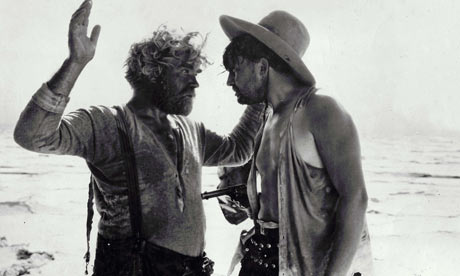
Greed (Erich von Stroheim, 1924)
**** (Masterpiece) * Rick Schmidlin will be presenting the film.


Stroheim’s prominence doesn’t lie only in the power of his images, nor does it come from the merciless rhythm propelling the story and the anguish it stirs in us. It stems from a passion for the grandiose; a grandiose beyond bad taste. It is a climate that might seems harsh at first, but once one gets used to it, it becomes the Garden of Eden.” - Jean Renoir

(Cinémathèque Québécoise, 335 boul. De Maisonneuve Est, Montreal, QC, 23/04, 6:30PM)

Thursday, April 15, 2010

DiverCiné: Romania under Ceauşescu

Contes de l'Age d'Or (Cristian Mungiu, Ioana Uricaru, Hanno Höfer, Rãzvan Mãrculescu, & Constantin Popescu, 2009)


(Canadian Film Institute, Library and Archives Canada, 395 Wellington Street, 17/04, 7PM)

Tuesday, April 6, 2010

Interview with Lee Demarbre

This is an interview I have been working on for a while with Lee Gordon Demarbre. Part of a series of interviews and list from local film experts to increase awareness of Ottawa cinéphiles and to bring them together online. Thanks again Lee for contributing to Ottawa Film Review and for making Ottawa a lot more exciting with your eclectic programming at the Mayfair Theatre.-D.D.


OFR: So Lee, what is your next project?

Lee Demarbre: I'm developing a film project now based on an idea from Sasha Gr-y, to star Sasha Gr-y. Ian Driscoll is hoping to have the script finished by mid-February.

OFR: What is it about this disturbed behavior that interest you so much? And is there anything you learnt from exploring this subject matter so closely, apparently you continue pursuing this interest in Summer’s Blood (2009)?

Lee Demarbre: I don't think I'm really exploring all this on purpose. I'm not setting out to say something about the disturbed mind. It just turns out this is a subject matter of many of my films. I think that's because I'm taking a lot from genre; and genre deals a lot with violence, as a result disturbed minds become my antagonists.

OFR: Why did you pick to film The Dead Sleep Easy (2007) in Mexico?

Lee Demarbre: I was already in Mexico shooting a documentary on Mexican wrestling entitled Vampiro: Angel, Devil, Hero (2008). It was a dream to make a movie about Mexican wrestling in Mexico -- so I jumped at the chance. Mexico is so bad-ass. The landscape of the country is like a modern day wild-west; no set dressing necessary. I'd do it again in a heart beat - it's dangerous at times but worth it.


OFR: What are the charms of filming in Ottawa? I imagine your crew must pretty tightly knit? Do you guys feel like you have reached a celebrity status?

Lee Demarbre: Ottawa's charm is the fact that the film industry doesn't really exist in this city. So when you approach someone about shooting in their restaurant, shop or cinema; most times they let you do it for next to nothing because they're so excited you're shooting a film. That wouldn't happen if people were shooting here all the time. And no I don't feel the sense of celebrity. It's always nice to have someone tell you how much they like your film, but there really isn't a sense of being famous. Just the sense that the movies are out there and some people have seen them; which is rewarding.


OFR: I am wondering what are your views on Canadian cinema? Is it lacking anything? What is that you like about it?

Lee Demarbre: Canadian cinema is looked down upon by many people because our films hardly resemble what people are use to watching; Hollywood movies. And I think the current state is on a down low. In the 90's there was a better sense of new Canadian films and filmmakers. The new films from Atom Egoyan, David Cronenberg, Bruce McDonald were exciting ten or more years ago. But these guys are still really the only "names" in the business, and now they're lesser filmmakers. We need a new wave of young Canadian filmmakers to come along and put a sense of excitement back into Canadian films.

OFR: Are there any prints you wish were still around or were more easily attainable? Have you created any fond relationships with other people distributors through running the cinema?

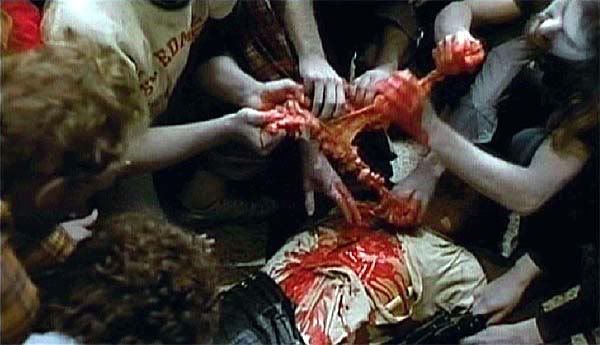
Lee Demarbre: I can't figure out why there aren't prints of the original Dawn of the Dead (1978) or Day of the Dead (1985) still kicking around. I wish I could show them again and again. The best part of my job is tracking down older prints (16mm or 35mm) and showing them. I'm still not sure if people really dig seeing original prints of movies; but for me it's like going to a concert to see your favorite old band. It's like a music fan saying "there's Kiss, live on stage" and me coming to the Mayfair and saying "there's an original print of that old movie that I've never seen before." For me it's that visceral.


OFR: How do you guys at the Mayfair feel about the Lansdowne Live decision and will it affect the cinema? Is there anything regular moviegoer should know or do?

Lee Demarbre: People should realize what an original film print is. That like still photography what we're showing is a positive of the negative that was in the camera on set when the movie was being shot. Seeing a movie in the theatre on 35 mm is like going to a museum and seeing a real life painting, opposed to seeing a copy of the painting printed in a magazine. And with the major studios witching over to digital projectors and showing movies downloaded onto a server; the idea of seeing a print is more real then ever. Forget about watching your DVD's, Blurays or whatever at home -- seeing an original print of your favorite movie is really like seeing it for the first time. If you don't get this -- then please stay at home.

OFR: What would you say were your favorite ten movies that came out in 2009?

Lee Demarbre: Here's my list

- Red Cliff: Part II (John Woo)
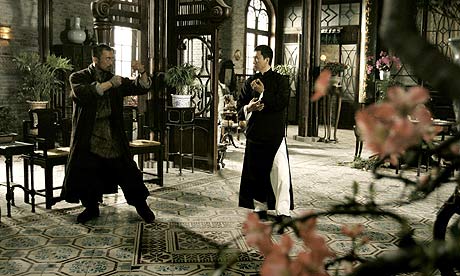
- Ip Man (Wilson Yip)
- Inglourious Basterds (Quentin Tarantino)
- Bronson (Nicolas Winding Refn)
- The Fantastic Mr. Fox (Wes Anderson)
- Invictus (Clint Eastwood)
- Che (Steven Soderbergh)
- Star Trek (J.J. Abrams)
- Whatever Works (Woody Allen)
- The Girlfriend Experience (Steven Soderbergh)


Tuesday, March 30, 2010

Upscale Mariage Qualms

Chloe (Atom Egoyan, 2009)
*** (A Must-See)


In fifty-year-old bespectacled director Atom Egoyan’s new film Chloe there isa chilling story of marital dysfunction and intrigue between a charming music professor David (Liam Neeson) and his gynecologist wife Catherine (Julianne Moore). The film is about life and death, language and perceptions, orgasms and music, personal obsessions and Canada. Catherine suspects David of extramarital affairs after finding a picture of him with a younger student the night he missed his surprise birthday. Catherine self-destructive paranoid fantasy leads her to hire a young prostitute Chloe (Amanda Seyfried) to pursue her husband. From there it is ambiguous if Chloe is fulfilling her duties or just leading Catherine on, the sexual adventures eventually involve the couples son Michael (Max Thierriot).

Chloe is successful at presenting its contemporary period as it showcases Torontonians interconnectivity with new media, urbane privilege, alienation, infantilization of adults, the growing indie-rock movement, transcontinental airplane travel and heath care. The film Chole is attuned to women high fashion. The women are dressed beautifully and revealingly from see-through white t-shirts to dresses to high heels, these items represent gender expectations that are placed on women. The level of success and physical appearance exuded by Catherine makes her plight all the more desperate when Catherine suspects her husband of infidelities. Jonathan Rosenbaum writes about Chloe “I think what’s sneaky and deliberately misleading about the story is that is starts off pretending to be a movie about a husband’s midlife crisis and then winds up as a movie about his wife’s midlife crisis.” The thematic gravity and psychological depth, linear narrative and star power are a mélange of Atom Egoyan’s art-house sensibilities and the Reitman’s populism. Chloe is partly funded by Ivan Reitman’s production company Montecito and Ivan’s son Jason Reitman is executive producer and there was collaboration with Studio Canal and Sony distributions.


Atom Egoyan describes Chloe as “the anti-Adoration” as Adoration (2008) - a film about the stigmatization of ethnic minorities - presented a more desperate Toronto landscape while Chloe – which was supposed to be set in San Francisco - is a travelogue of Toronto’s luxuries. While in Egoyan’s earlier films Toronto was seen as a non-place. The cultural tourism in Chloe is overt as the city is an inherit part of the story from Yorkville and Queen Street, the CN Tower skyline presence, the AGO, the ROM, Allen Garden, Cafe Diplomatico (594 College Street), Rivoli’s (332 Queen Street), and the Royal Conservatory.

Assimilation has been a longstanding theme in the oeuvre of the Armenian-Canadian director. Atom Egoyan was born in Cairo, Egypt and at a young age was relocated with his family to Victoria, British Columbia. Egoyan habitually includes the casting of his wife Arsinee Khanjian in his films. Through the 80s, 90s, 00s the director has been dealing with ethnicity and assimilation, and private obsessions and public issues. Since Next of Kin (1984) - with an Armenian protagonist and a cameo by Atom Egoyan, Family Viewing (1987), The Adjuster (1991), Calendar (1993), Ararat (2002), to Adoration Egoyan has been dealing with what it means to be a foreigner in Canada. This is epitomized in the angry sequence in Family Viewing where a waving Canadian flag is cross-edited alongside an Armenian elderly mother committing suicide through swallowing pills while her daughter prostitutes herself to raise money to take care of her medical expenses. In Calendar there are clear distinctions between the Armenian positions of nationalism, Diasporan, and assimilationist. These ethnic positions have been lost from Chloe as it shows Egoyan assimilated and making a film about hegemonic Anglo-Saxons. Similarly to Egoyan’s non-Canadian productions Felicia’s Journey (1999), his most Antonioniesque film, and Where the Truth Lies (2005). Though, in a Q & A session at the Canadian Film Institute, Mr. Egoyan dismissed the “auteur” theory in which for him would include looking at the themes in work that he has no creative input like his directed late 80’s TV fare of Friday the 13th, Alfred Hitchcock Presents and The Twilight Zone.

A defining trait in Atom Egoyan oeuvre is the perfuming of scenes with a “cerebral musk”. Even though this is his first film where he did not co-write the screenplay, which is credited to Erin Cressida Wilson as a remake of Anne Fontaine’s French erotic thriller Nathalie... (2003). This brainy tendency comes from Egoyan’s interest in theatre that was apparent since his stint at the University of Toronto. His interest in theater is reiterated in his direction in the Samuel Beckett series of Krapp’s Last Tape (2000) with John Hurt, as well his short film Howard in Particular (1979) seems rooted between the Theater of the Absurd and Maya Deren. The emphasis of his cerebral musk is on psychoanalyticism and language. In the introduction of the Chloe, the prostitute in a voice-over says “I have always been good with words”, this scene and many others are characterized by a meta-discourse of character motivation, which sometimes can seem a little clunky as people are talking about things that people typically do not address in conversation. So even if Chloe appears more as an enigma then a fully rounded character, she confronts Catherine with an alternative position and forces her rationalize the absurd situation.

Reviews of Chloe have already been written in several Canadian publications. In the Katherine Monk’s Ottawa Citizen review she is eagerly positive as she writes “the movie hits a sustained eerie note” and raves of Amanda Seyfried’s performance. In Liam Lacey’s Globe and Mail review he is condescending towards the film, not biased by sharing the filmmakers hometown, he writes “Chloe is director Atom Egoyan’s foray into the realm of what might be called artful trash” and finishes his review with “Chloe has an awfully corny ending, including some lurid high-jinks and shocks that teeter on genre satire”. In the Montreal Gazette John Griffin writes naively “You’re forgiven for failing to realize Chloe is the first Atom Egoyan picture that isn’t an Atom Egoyan picture”. While Brian Johnson’s review in Macleans emphasizes the surprise emerging career of Amanda Seyfried “Hollywood’s new It Girl.” There has also been several critical analyses on Atom Egoyan by writers including Jonathan Romney, Emma Wilson and Tom McSorley.


The casting is spectacular, the acting is titillating, the architecture is sinisterly photographed, and the themes are relevant. One of my problems with this art-house production is its voyeurism. It condones David for cheating and flirting all the while the providing the viewer with enjoying lesbian fantasies. These sexual sequences seduce the audience similarly to the stripteases in Exotica (1994). Chloe is a mixture of pornography, as Amanda Seyfried is frequently naked, and stylization as the film exist in a realm of heightened realism. With Chloe, Atom Egoyan has created a substantial film about extramarital-confusion and it proves to be a really interesting addition to the Egoyan universe.-David Davidson

(Bytowne Cinema, 324 Rideau Street, 26/03 - 8/04)

Sunday, March 28, 2010

Studious April Distractions

April Film Listings

Canadian Film Institute
Le Jour Avant Le Lendemain (Marie-Hélène Cousineau & Madeline Ivalu, 2009) 11/04.
Contes de l'Age d'Or (Cristian Mungiu et al, 2009) 17/04.
Revanche (Götz Spielman, 2008) 24/04.

Bytowne Cinema
Les Vacances de M. Hulot (Jacques Tati, 1953) 9/04 - 13/04.

The Mayfair Theatre
The Robe (Henry Koster, 1953) 3/04.
Army of Darkness (Sam Raimi, 1992) 10/04.
Naked Lunch (David Cronenberg, 1991) 25/04.

Cinémathèque Québécoise (Montreal, QC)
Greed (Erich von Stroheim, 1924) 23/04.
Greed: Reconstruction (Erich von Stroheim, 1924) 25/04.
Blind Husbands (Erich von Stroheim, 1919) 30/04.

Wednesday, March 24, 2010

An Unfortunate Kinship

J'ai Tué Ma Mère (Xavier Dolan, 2009)
*** (A Must-See)


J'ai Tué Ma Mère is the first feature of actor-writer-director-coproducer Xavier Dolan-Tadros who completed the project at the age of nineteen years old. This is a thinly veiled autobiographic film where French-speaking Xavier Dolan plays Hubert, an on-screen alter ego, who is a queer Montréal high school adolescent who gets sent off to a boarding school without his consensus.

The conflict in the film arises between Hubert and his Quebecois mother Chantal (Anne Dorval, who looks surprisingly like Shirley MacLaine) and what makes the story so moving is Hubert’s incapability to understand that no matter how badly his mother treats him that it is done out of unconditional love. No matter how tacky is her dress or how safari is her taste or how bland is her cooking. Chantal is irritated by Hubert’s dependency and rejection and easily looses her temper. Her husband left both of them at young age. What increases Hubert’s sense of dismay towards his mother is his jealousy towards his boyfriend Antonin mom who leads an exciting life with young lovers, take-out, and who commissions Hubert to paint her office. What is so contradictory of Hubert’s, and Dolan’s, matricidal urges is that he uses these intense emotions as a source of creativity. In the film, one of his painting’s is entitled “The Son”, interlaced throughout the film are his b/w personal monologues of his yearning to communicate about his love/hate relationship with his mother, and he also writes a story named J'ai Tué Ma Mère.

The closest relationship Hubert seems to have is with his schoolteacher Julie. For a classroom assignment he lies to her stating that his mother is dead and later she picks him up after his mother chases him at school, and later he chooses to stay with her when he runs away. Julie and Hubert similarly have had poor relationships with their parents and they had close relationships with their grandparents. As well they both express a pervading wanderlust. Julie’s comforting of Hubert epitomizes the tenderness of their platonic friendship.


J'ai Tué Ma Mère is similar to Francois Truffaut’s directorial debut Les Quatre Cents Coups (1959) - a film that Xavier included in his personal top ten film list - which is the story of a child Antoine (Jean-Pierre Léaud) and his matriarchal issues who decides to run away from the detainee center he is put into and the film ends with a freeze-frame of him on a beach. Xavier transcends any similarities as the films concluding return to his childhood beach house seems fresh and unpredictable. It is also part of the Quebecois tradition of returning to nature and to rural traditions - like Gilles Carles’s La Vraie Nature de Bernadette (1972). J'ai Tué Ma Mère mixes between the lowbrow and highbrow with references to Jean Cocteau, Marquis de Sade, Jackson Pollack, and Leonardo DiCaprio.

Some criticisms of J’ai Tué Ma Mère include the narrowness of its scope, as it is limited to individuals’ feelings that are void of politics and social realities. There are only slight suggestions of poverty, as outside a Blockbuster are two homeless men rifling amongst the trash – for creative representations of the Montreal socially assisted poor see the work of Donigan Cumming - and homophobia as Hubert once gets beaten. Dolan grew up as a child actor, had been in TV series, commercials, acted in Pascal Laugier’s Martyrs (2008) and has just completed Les Amours Imaginaire (2010). The world of the actor-director tends to verge on sublime narcissism as the surroundings are seen negatively and it is the protagonist who is the victim. Dolan's smarmy wink’s to the audience eventually gets annoying as he implies his own cleverness in the ways in which he looks at his mother with self-evident disgust and insults her for the most superficial reasons, like the way she eats a bagel and then has cream cheese stuck on the corner of her mouth.

Mark Peranson’s editor’s note in CinemaScope issue 39 writes “Québec’s wunderkind Dolan whose incredibly overrated Quinzaine debut strikes me as a case of mass hysteria” and later in the same magazine Jason Anderson contradictorily writes “should there be more who are as bold and brazen as Dolan”, Atom Egoyan personally expressed admiration for the film, and in the magazine 24 Images Issue 146 Marie-Claude Loiselle writes that Dolan film stands out from his contemporaries because he creates a language of his own that fits his personality, that at times J'ai Tué Ma Mère is border lining disequilibrium, and that hopefully with maturation Dolan films will increase in mastery hopefully without loosing his singularity and to not try to please everyone. Loiselle includes Dolan amongst other contemporary French-Canadian film chroniclers, or the “Nouvelle Vague Québécoise”, that includes Simon Galiero, Denis Côté, Rafaël Ouellet, Robin Aubert, Micheline Lanctôt, Sophie Deraspe, Bernard Émond, Marie-Hélène Cousineau and Madeline Ivalu.


J'ai Tué Ma Mère is similar to Ryan Arnold’s Skidlove as the two 2009 actor-director first-features both reflect the period and present particular youthful experiences of early adulthood and the conflicts between identity and role confusion, intimacy and isolation. Both features are partly co-produced which enables them to be full-length features of home movies material. As such they represent an expansive personal creative expression that is rarely seen is the privatively financed Canadian film industry. The films are painfully personal recognitions of deep feelings of anger, fear, and melancholy. In Skidlove, Ryan's character reaches out to others whether it is to his girlfriend Jaymee or to his friends, people are framed together. In J'ai Tué Ma Mère there are isolating close-ups always distancing Hubert from others. In both films the protagonist present a form of alternative lifestyles that includes smoking pot and painting. In Skidlove, Ryan is a heterosexual and deals with contemporary relationships once in the working world and his solace come from friends and girlfriend. In J'ai Tué Ma Mère, Hubert is 16 and wants to move out. Hubert has an intense Oedipus complex shown threw a fall orange-maple-leaf dream sequence where Hubert chases his mother who is dressed in a wedding gown. Through a Langian dream analysis, which emphasizes that dreams bring out underdeveloped aspect of the psyche, it reveals that Hubert complex desire to be closer to his mother.

The two films together present a diptych of English and French-speaking Canadian cinema of the 2010s as did the 1964 films by Don Owen's Toronto based Nobody Waved Goodbye, and Montrealer Gilles Groulx’s Le Chat Dans Le Sac did for their period. Stylistically Xavier Dolan is closer to someone like the expressive Arnaud Desplechin while Ryan Arnold seems more like the evovative Takashi Miike, though they present a sensibility that is rooted in a local cultural heritage. Ryan Arnold’s Skidlove has not attained the same successes as J'ai Tué Ma Mère that won three prizes at the Director’s Fortnight at the 2009 Cannes but it is a must-see and Skidlove will be having its Toronto premiere in May 2010 at The Royal Cinema.-David Davidson

(Bytowne Cinema, 324 Rideau Street, 19/03 - 25/03)