Showing posts with label What We Talk About. Show all posts

Monday, October 22, 2012

The Fakery of Brian de Palma: Truth Hinging Upon the Absurd

This is an edited version of my speech from this month’s edition of  the Toronto lecture series What We Talk About. Each month, three speakers are selected to talk about one theme, this month's being "fakes." The last event in this year's series is about Nemeses and will take place on Monday, November 5th.  – D.D.

What exactly does the word "fake" mean? The Merriam Webster defines fake as “a worthless imitation passed off as genuine,” and proposing synonyms like imposter and charlatan. These are the kind of adjectives that are often used to describe the American filmmaker Brian de Palma. Which makes him a great subject to discuss at length in this edition of What We Talk About When We Talk About "Fakes".

Before I go on and talk about De Palma and his relation to "fakes", let me give you some basic biographical information about him, which is relevant to better understand his films: he was born in Newark in 1940, and when he was young he excelled in his studies, especially in his science classes. His childhood was apparently traumatic: his father was a surgeon, and would take him to watch bloody operations. And his father was also philanderer, and after a young Brian caught him cheating (by spying on him and taking a picture), his parents would divorce. His mother, who used to be an opera singer, suffered from depression. His two older brothers, who were extremely bright, would get all of her attention, and she would ignore him making him feeling sad and lonely. De Palma would later on make a film Home Movies (1980), which would express a lot of his angry feelings towards his family.

De Palma’s most famous films are: Carrie (1976), Blow Out (1981), Scarface (1983), The Untouchables (1987), Carlito’s Way (1993), Mission: Impossible (1996), and Snake Eyes (1998). Though for cinephiles his cult reputation rests more so on Hi, Mom! (1970), Phantom of the Paradise (1974), Dressed to Kill (1980), Body Double (1984), Raising Cain (1992), Femme Fatale (2002), Redacted (2007), and the more recent Passion (2012).

Of all the New Hollywood directors to emerge in the seventies – like Scorsese, Spielberg, Lucas, Atlman, Friedkin, Coppola &c. – de Palma’s reputation might just be most disreputable. In his films people are drilled, slashed and chain-sawed, women undress, touch themselves, are in porn and so on. But nonetheless there is something really interesting which is going on in them, and which might be intrinsically linked to why their so disreputable.

But before I go on, how and why is de Palma a fake? The classic argument, via Andrew Sarris versus Pauline Kael, is that De Palma is simply derivative of Hitchcock - a second-rate suspense director who encapsulates the Regan era zeitgeist of style-over-substance. (Kael, otherwise, would argue, "He goes past Hitchcock's perversity into something gleefully kinky.") .

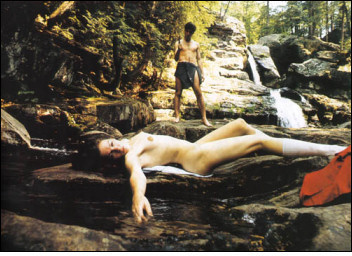
I would also argue that De Palma makes explicit what Hitchcock could only show implicitly due to the censorship of the Hays Code. If one looks at some of the pre-production stills from Hitchcock un-realized Kaleidoscope, which is about a necrophiliac serial killer in New York, it includes some of his most sexual and violent imagery: naked women, nudes in a park, bloody murders and so on. It is this Hitchcock and in this sickness, which De Palma would take to in extreme position in his films starting with Dressed to Kill.
So, yes, there are definitively elements of Hitchcock in his films, just as there are elements of Godard, Bunuel, Antonioni, Welles and Eisenstein - and he would probably be the first to admit it. But is De Palma's films just a matter of copy-and-pasting elements from the classics? Is he really no more than an avant-la-lettre Quentin Tarantino, picking-and-choosing what’s "cool" about the movies from the past and then trying to incorporate them in his own films? Is De Palma on a rampage that consists of constantly remaking Rear Window, Psycho and Vertigo over and over and over again?

Not only do his images seem rehashed, there is a lot in the stories themselves that are false. For example there are the three friends that exaggerate to try to avoid the Vietnam war draft in Greetings, the peeping-tom/activist who puts on a professional smile and pretends to be a bourgeois in Hi, Mom!, the fake movie-within-a-movie in Body Double, the “supposed” deaths in Wise Guys, the room which turns out to be a set and all of the masks in Mission: Impossible, the heist which turns out to be a ruse to betray Carlito in Carlito’s Way, the dream story of Femme Fatale, the fake friendship in Passion, and in Casualties of War when the Vietnamese woman who was raped and murdered, reappears - a la Vertigo - to give the soldier Erikkson some sort of closure: she does it wearing a fake prosthetic nose!

De Palma has also gone to do remakes of other films - official and not - and he has also gone to do remakes of some of his own films! His official remakes include Scarface being a loose remake of the old Howard Hawks film, The Untouchables as a re-boot of the old television show by the same name, Phantom of the Paradise is a psychedelic musical adaptation of Goethe's Faust, there is Dionysus in '69 which is a recording of a The Performance Group stage play, and Passion is a very close remake of Alain Corneau's Crime d'Amour. While the remakes of his own films and of certain key scenes includes the motif of voyeurism, which is that of a man looking from his room into the apartments across from him; which begins in Hi, Mom! and will re-appear in Body Double. There is the story of a lost lover who is haunting a man, which you can see in Obsession, Blow Out, Casualties of War, and Mission to Mars. And the only real difference between Casualties of War and Redacted is one is set in Vietnam while the other one takes place in Iraq.

It's relevant here to bring up a great new book on the director: Chris Dumas’ Un-American Psycho: Brian De Palma and the Political Invisible (Intellect, 2012), which does more to argue for De Palma's place as a major filmmaker than anything that has come before it. One of his key points is in regards to De Palma’s attempt early on in his career to go from New York to Hollywood to make a “Hollywood” film, Get to Know Your Rabbit. Dumas thesis regarding it, is such, “his expulsion from Get to Know Your Rabbit is the traumatic moment at the core of the De Palma’s narrative, and everything that he does, every film he makes after this point […] will in some way refer back to this moment as a defining failure, a prima scene that must be endlessly replayed and that forms the horizon of what it is possible to represent.” From Get To Know Your Rabbit onward, Dumas argues, that De Palma pushes the limits in terms of peoples (i.e. the audience, critics) expectations of him. You want a Hitchcock film? Well here’s Dressed to Kill! You want gore? Well here’s Scarface! You want pornography? Well here’s Body Double!

What are we meant to take seriously in all of this? Dumas posits, is that, “we should take seriously the process by which we decide what to take seriously.”

It is relevant to bring up the political realities of the time to better understand De Palma’s movies. The assassination of John F. Kennedy in Dallas in November of 1963 is important – as political assassinations have appeared in a few of his films (Blow Out, Snake Eyes). Not only is the event itself important, but also how it is dealt with in the media, and what is the etiquette of filming after such an event. The Vietnam War is also very important (De Palma himself never went). You can get a stronger sense of this in De Palma’s early, Robert Kramer-like films.

The leftist historian Howard Zinn in his great book The Peoples History of The United States, writes about the eighties in terms of how, "Regan's victory, followed eight years later by the election of George Bush ('89), meant that another part of the Establishment, lacking even the faint liberalism of the Carter presidency, would be in charge. The policies would be more crass - cutting benefits to poor people, lowering taxes for the wealthy, increasing military budgets, filling the federal court system with conservative judges." While Dumas contextualizes the times and De Palma within the “the aspirations of the New Left and the continually evolving struggle for women’s rights.”

These historical factors provide the spirit of the times that flowed through and around De Palma’s films. And De Palma addresses them in a variety of ways: by being critical, ironic, cynical, satirical and so on. De Palma’s current marginality – his films are not huge commercial successes, and he isn’t a household name like Spielberg or Cameron – might be due to taking an unpopular stance towards a lot of these subjects (one just thinks of the anti-military message in Snake Eyes).

Perhaps this is why in the early twenty-first century his films seem as relevant as ever, which might just prove that he was ahead of his times. His all-seeing eye – like the camera in Snake Eyes, which photographed the true murder -, which watches all, is one of a critical position and skepticism. There is also a Brechtian quality to his images in that they heighten the viewer’s awareness that they are watching a movie, which also makes one more skeptical of what their seeing. For example, it is no coincidence that the second half of Body Double takes place in the porn industry: it’s actually a prescient signifier showing the viewer that images have become pornographized, and if one wants to move forward, one must acknowledge them as such.

But before I conclude I want to bring up the author David Foster Walace, and his important essay E Unibus Pluram: Television and U.S. Fiction (1993), where in it he analyses television’s role in developing the mind-frame of post-50’s American writers. Foster Wallace brings up issues of medium-specificity, “what should literature be today?”, as well as tonal questions, “the nexus where television and fiction converse and consort is self-conscious irony.”

Though, the two points that I want to discuss in regards to De Palma is the idea of image-fiction, and what is the role of social protest in the arts. Foster Wallace describes the concept of image-fiction as, “The fiction of image is not just a use or mention of televisual culture but a response to it, an effort to impose sort of accountability on a state of affairs.” And in response to television’s commercialization, Foster Wallace posits possible solution for creating works of social protest and that they are: 1) the one obvious option is for the fiction writer to become reactionary, fundamentalist; 2) adopt a somewhat more enlightened political conservatism that exempts the viewer and networks alike from any complicity in the bitter stasis of televisual culture; 3) finding a way to incorporate television’s pleasurable qualities into a work that tries to do something more meaningful.

These points illustrate the difficulty and complexity of the creative process after the televisual, and that one must position one-self within these positions. The current realities have multiplied a ten-fold, now in the second decade of the twenty-first century; when our culture seems addicted to new media and social-networking tools like Facebook, Twitter, iPhones and so on. One can no longer create and still be naïve about such matters. Though there are problems with this telemorphosis, which is going on, there are redeeming qualities to it. But I shouldn’t verge too off-topic.

Now when most of De Palma’s films are easily rentable, and that there is a democratization of film criticism– we no longer need the seal of approval from the gate-keepers of good taste - De Palma’s film have slowly found their champions and are being defended. The works themselves have outlasted the ideological battles of their initial release and stand on their own for their originality, audacity, and relevancy.

And if they offer a cynical viewpoint, it might have to something to do with the dark, and awkward times that we are living in. Dumas conclusion, which seems especially relevant, is that “in the end, there is nothing but the knowledge that one could have done better, but did not – and that, regardless of one’s success or failure in producing justice, the spectator will also fail.”  The reoccurring theme of De Palma’s films is that of a character who sees and is powerless to act in front of a bad situation. Watching is very unsettling. Which is something that is also very Hitchcockian.

Monday, October 15, 2012

But do you like him enough? (Brian De Palma, early on at Cahiers du Cinéma)

"Unlike Positif, Cahiers du Cinéma was a review by, about, and for the young. It is strange today to see the review attacked for being recondite, intellectual, and boring" writes Jean Douchet (French New Wave). While Serge Daney would probably add “There’s a great deaf dialogue between the U.S. and France concerning what’s good in American films. Cahiers has always defended the products which Hollywood wasn’t too proud of.” These two comments seem like a good place to start a discussion of Cahiers' relationship with the controversial filmmaker Brian de Palma.

When Cahiers returned to the format of a film-magazine, instead of being a political-activism journal, it needed to redefine its line of inquiry and find new directors that spoke through the gestes du cinéma. At first they were somewhat ambivalent towards de Palma. For example, in their first review of one of his films Bernard Boland writes about The Fury (April ’79, N.299): “Brian De Palma, one of the most energetic contemporary filmmakers, gifted at showing us the world of youth, with The Fury has become pessimistic about the future of our society.” This dismissive conclusion - Boland writes that the film has a "bad ending," too - would be a low point for de Palma at Cahiers before he would become one of their most defended filmmakers.

The following round-table, Douchet décortique De Palma (N.326), was the catalyst to take de Palma seriously at the magazine, which would last to the present day. This round-table, Douchet décortique, appeared in the newly inaugurated Le Journal des Cahiers du Cinema [the first one is from Jan. ’80 (N.312), and which goal was to “write journalism that corresponded to what’s actually going on.”], and it's place in the history of the magazine is important as the article would be brought up, and is most likely the reason for, how in their subsequent Made in USA issue (April ’82, N.334-335) Brian de Palma would be interviewed at length by Serge Daney and Jonathan Rosenbaum. 

As Daney would say, "il faux rester fidèle au visage de ce qui nous a un jour transi." In that case,  Douchet décortique is the Badiouian event that the magazine would remain loyal too.
*****
Douchet décortique De Palma (Cahiers, July-August 1981, N.326)

22, April 1981. During the thirtieth anniversary of Cahiers and in front of a huge cake which is decorated like a scene from Rear Window, Jean Douchet, an old writer from the Cahiers Jaune days and current, attentive reader shares with us something that has been bothering him: do we like Brian de Palma enough? Have we seen Dressed to Kill? In light of this we have put together this round-table to talk more about him.

S.Daney: During the Cahiers party, you told us: Cahiers, it’s great and all, but you risk missing out on somewhere that I personally like a lot, and that’s Brian de Palma. Especially his latest film, Dressed to Kill. This sparked our interest, so Pascal and I went to go see this movie and evidently there is a lot to say. But before we go on, we would like that you go ahead and tell us what you like and think is important about it.
Jean Douchet: Brian de Palma isn’t someone that I know well. I was told that Phantom of the Paradise wasn’t that good, but by chance I went to go see The Fury for a review for the radio. I was stupefied by The Fury, so I went to go see some of his other movies. And I found them to be all fascinating, if only for how they literally rework Hitchcock, just like how Hitchcock would rework Lang's set-ups. This talent interested me to a great extent. So I then went to go see Dressed to Kill. Afterwards, I was equally intrigued by seeing so many bad reviews of the film just about everywhere: it isn’t possible that a film as evidently great as this one is so unanimously attacked. This is why I brought it up to you at the (memorable) Cahiers party.
P.Bonitzer: When you were telling us this, we could not help but think: well in that case, here goes! Because this is a worry for us, that of being cold about certain films, and on the contrary, that of overvaluing others that don’t deserve it. We totally agree with you about his capabilities, the virtuosity and reworking of an auteur like Hitchcock: it’s something that makes Brian de Palma especially singular and salient.
Jean Douchet: The citation-quality of his work is clear. In Dressed to Kill, the museum scene is right out of the museum and cemetery scene in Vertigo, and the whole film is based off of Psycho etc. Just like how Hitchcock presupposes a “Hitchcockian” audience, de Palma presupposes an audience that perfectly understands Hitchcock. Even deeper than this, what interests me about De Palma is how he works on the image. To only say it once – and which makes him a modern filmmaker – de Palma knows that the image is no longer pure. In the same way that he shows us this young girl who looks like a virgin just to brutally change our perception of her by showing her as a prostitute. Nobody is no longer that pure, especially the image. He will then show how corrupted images have gotten:  by showing us whole-heartedly what is “clean”, the normal American, this absolute desire for cleanliness will lead to the worst explosions of messiness and chaos. To use Hitchcock as a visual reference, for me, is a very a fascinating operation. And when we watch the movie, we see how far that he takes it, that de Palma works on the image in a very technologically sophisticated way by using the binocular lenses for shots – which decomposes the image by breaking it into two. It is ground breaking work and de Palma, in this sense, is one of the most formally inventive, and the one who asks, though very differently, the questions asked by Godard: what exactly is an image? If they are totally false and untrue, how far can we even take them into that territory?
P.Bonitzer: Wasn’t it for the same reasons that people refused the films of Hitchcock who worked in a very similar way: that is, of new forms but with very classic stories?
Jean Douchet: Exactly. De Palma works on the image purely like that of an object of publicity. Today, creating images without acknowledging that publicity exist, would be totally false. His films have a publicity photograph look - they are very clean. But at the same time, they contain this idea that, while acknowledging this, images still do have an explosive quality and which is inevitable – the explosion. The more that they get codified, stereotyped, made to look like publicity; more trouble will brew under the surface until it explodes. Explosions happen, especially in The Fury.
S.Daney: What’s also impressive, in regards to the Hitchcock/de Palma affiliation is Angie Dickinson, whose practically unrecognizable, and who changes from one scene to the next. We start to finally wonder if she isn’t the real transsexual of the film because, as with Caine, what we see is pretty much a travesty. While in the scene that opens the film, in the shower, where we go in a one-shot from the actresses face to her naked body – in a style which wouldn’t even be thinkable without Hitchcock – is troubling because it’s a famous actresses, a mask, a fake body, someone full of sexual desire etc. This troubling quality isn’t there with Hitchcock, as in Psycho, to the contrary, the shower scene is filmed in very close-shots, and without any nudity. In that case, isn’t there this other dimension:  de Palma is analyzing Hitchcock and rendering explicit what Hitchcock could only do implicitly? And while he’s at it, making the attacks on us a whole a lot more grizzly.
Jean Douchet: Yes. But even there the film returns back to discomfort and angst. There is a side to de Palma where he endlessly analyses Hitchcock. And this is exactly what also makes him Buñuelian. We realize, as time goes by, that there is actually a lot in common between Buñuel and Hitchcock, two filmmakers that were contemporaries while psychoanalysis was being developed and who both admired one another. And the re-apparition at the end of the film, heightening the fiction, making it about the impossibility of endings, is more aligned with Buñuel.
S.Daney: The nightmare never stops, and the same thing can be said about analysis.
Jean Douchet: There’s still more to say, like that of the social being. The social criticism is also more explicit in de Palma than in Hitchcock.
P.Bonitzer: That’s true. By the way, de Palma isn’t the only one to be haunted by the spirit of Hitchcock. There are others who share many affinities with him, on a superficial level and more like parodies (Mel Brooks, for example) but de Palma has kept what has been really important in the work of the British Hitchcock: and that is of the presence – in its triviality and massiveness – of people as social beings. But for de Palma, his films are set in New York. This is a real affiliation to Hitchcock, in opposition to, for example, Polanski, who is basically an academic filmmaker, and who doesn’t have any real connection to Hitchcock, and who for him there isn’t this formal preoccupation like there is for de Palma – there isn’t this uneasiness that is manifested formally, which fluctuates between the image and its gaze. This is what makes the young student in the film so interesting: Hitchcock in the electronic era, will create these youth that are gifted at creating the optical apparatus which will create new effects and who will be able to create these new forms of “voyeurism.”
Jean Douchet: This character in the film is of even more interest as they are the ones who are explaining how de Palma asks himself these questions of optical construction, by way of even showing within the film these image-making apparatuses.
S.Daney: In regards to this, we especially liked the sequence in the asylum, this dive that introduces what at first belonged to Hitchcock, the anamophosis process. One way to put in place a gaze like this, in this case, by showing us a stupid crowd and a maniac - who are themselves voyeurs who are watching a porno. This is profoundly enfeebling for the public, and this is also profoundly Hithcockian.
Discussion between Jean Douchet, Pascal Bonitzer and Serge Daney.
 *****
For anyone interested, I will be giving a talk The Fakery of Brian de Palma: Truth Hinging Upon the Absurd on Sunday October 21st, 7:30PM at the Drake Underground, as part of the reading series, What We Talk About. – D.D.

Wednesday, August 1, 2012

Pop Quiz: Le fils

Pop Quiz 1
           A man marries a woman, they aren’t too well off, but that’s not important to the story, and they have a baby, a boy, who they love, a lot. One night, the boy, the couples son, he gets killed, he was in their families car and it gets broken into and he gets killed, it’s a tragedy, terrible, wouldn’t even wish this onto ones enemies, but life has to go on, right? The happily married couple, after the murder of their son, splits up, gets divorced, are no longer together, i.e. are no longer legally married, though he still misses her, or not exactly “her,” but his wife, and his son at that, and the life he had, which he longer has. And the man, who sees his ex-wife regularly, has found out that she is now with a new guy and pregnant again, with a new child that wont be his. Let’s say that the man X is a carpenter, you know the blue denim overall type, and at his job, one day he sees this sixteen-year-old kid, let’s call him Y, come in looking for a job, and he recognizes the boy from the trial for his sons murder. This boy Y at first gets a job in the wielding department of the factory, but then, for some complex reason the man X wants for some reason be closer to this “messed up” kid, well after what he’s done, he has to be messed up – right? So this blonde-haired boy who has just got out of a five-year prison term, and you can tell he’s probably living in a half-way house with a social-worker or a shitty one-room apartment with his mattress on the floor and stuff, and he’s so happy and feels lucky to have this job, and but like starts to appreciate X’s guidance and helpfulness, as this kid never knew his own father and apparently his mom’s boyfriend doesn’t allow him to see her, i.e. the boys mom. And X does help him out, not exactly because he wants to, but he’s caught in a few instances where he just kind-of has to help, like he’s asked where a certain street is and, really, if you know, how can you not direct him to the right street, or else you would be a total dick. And Y is impressed with X’s ability to precisely measure objects and distances, to the fucking centimeter, and they play around with this, the distance between Y and a car, the length of a piece of wood etc. Let’s return back to X and describe him more faithfully: X is a big man, he does sit-ups on his floor regularly, looks to be around 5’10 and weighs around 210 pounds, balding with short brown hair, thick lenses in his steel-rimmed glasses, with a constant pissed off look on his face, as if he’s keeping at bay an overwhelming anger (with the loss of the son, this is understandable), and when ever X is around Y this seems to be amplified. While Y is aloof, silent, also more introspective, but unlike X the reasons for Y w/r/t the introspection it seems like its more like that of a hurt puppy or that of a child who accidentally touched a cooking element, he’s gone through too much and is now weary, and its painful to hear Y describes playing foosball when he was locked up as a way “to forget my problems,” because its a perfectly child-like thing to do, but in a very un-childlike mise en scène. So X and Y work more and more together, and on one day they go on a suspiciously long drive to a lumber yard (so far they’ve only been working in the carpentering workshop), and on this drive X asks Y about the murder, and Y asks X if he would consider taking him in and being his guardian. Silence. They keep driving. They are now in the lumberyard, where everything seems to reach a climax w/r/t to their interpersonal relationship. As at the lumberyard, this expansive industrial space, with its steel walls and ceiling, full of stacks of lumber, stacked on one another, full of hiding spaces and shadows: X tells Y that he’s the father of the boy that he killed. An unbalanced moment, for Y as he has to both (a) think about all of the experiences he had with X and mentally revisit these experience – some of them have been pretty scary, e.g. X knocking him off a ladder, X throwing down large planks of wood at him – to see how this might change his perception of them and (b) run, get away from this deranged figure, um, because who would actually spend all of this time to get close to the person who killed your son, right, and what does he, X, want to do to him, anyways? After an extensive chase, which seems like its right out of French Connection II or something, the two of them are now outside on the dirt, X catches up with Y, is on top of him, choking him, X has his hands around his throat, Y isn’t breathing right, X’s grip is getting tighter, there is the look of a murderer in his eyes, shit, is he going to do it? Kill Y, the person who killed his son, who he’s been working with for these last few days, and who he now kind-of likes, what good would it actually do? There is no way X’s son is coming back, and what about, when X was chasing Y, and tells him that he doesn’t want to hurt him, and now he’s doing just that.
And then X stops, and throws his hands, his fists, on the ground.
They both sit up, beside each other, for a while, and breathe heavily, and then the man, X, walks away. He’s now back at his car, dirty, after all the rolling around in dirt, and he’s putting the last few pieces of lumber in his vehicle, and then the boy, Y, is there and after a brief moment of hesitation, the boy starts to help.

Q: (A) Is the man, X, a good father?
*****

For the answer to this question, and more concerning Jean-Pierre and Luc Dardenne's film Le fils come to hear Adam Nayman discuss it at the next talk in the series What We Talk About at the Drake Underground later on this month.