Showing posts with label Serge Daney. Show all posts

Friday, July 7, 2017

The Politics of Mourning at Cahiers du Cinema: Obituaries, AIDS and Politics

This essay will examine how Cahiers du Cinéma responded to the AIDS crisis throughout the eighties and nineties. This will be done through archival research of the journal from 1984 to 1996 in search for references to AIDS and with a particular focus on eulogy dossiers and obituaries. The aim would be to discover how the journal, under its two different chief editors Serge Toubiana and Thierry Jousse, mourned and mourned people with AIDS. The important issue of Cahiers for this project is the one from July-August 1992 that featured an extensive dossier on its previous chief editor Serge Daney. Some of the research questions that will be asked include: How would Cahiers mourn? Who would it mourn? And to what end? From the findings of this research I hope to illustrate what was Cahiers engagement with the AIDS crisis.

Serge Daney
If it could be said that the AIDS crisis had a major impact on Cahiers it is through the toll of the death of Serge Daney. He had been an important critic and theorist at the magazine since the sixties, was the chief editor between 1973 to 1981, before he would go on to Libération and host a radio-show Micro-films on France Culture. Even when he left Cahiers he would use his public platform to discuss and promote the Cahiers project. When Serge Daney died of AIDS on June 12th, 1992 it marked the end of an era in French film culture. But his legacy would live on through his new journal Trafic, the relationships and influences that he formed, and the large body of work that he wrote (which since then has regularly been published in new editions) that provides an example of how to seriously study cinema. For one example of his renown is his inclusion by Jean-Luc Godard in the small pantheon of important theorist and contributors at the end of Deux fois cinquante ans de cinéma français (1995). [The full list includes Denis Diderot, Eugène Fromentin, Elie Faure, Georges Sadoul, Jean Epstein, Jean Georges Auriol, André Malraux, Jean Cocteau, Robert Bresson, André Bazin, Maurice Schérer, François Truffaut, Jacques Rivette, Marguerite Duras, and Serge Daney.]
       At Cahiers du Cinéma, where he was the chief editor from 1973 to 1981, Daney was able to transition the magazine away from its theoretical Marxist period, which was sparked by the May 1968 student protest in Paris, to return the magazine to having cinema as its focus. When Daney would leave for Libération to become a working journalist and film critic, he would leave the chief editor position to Serge Toubiana, who would bring to the magazine his own interests but which many fundamentals were already put into place my Daney. As well many of the film critics that Daney recruited would still write at the magazine for throughout the eighties. Daney himself would also return to Cahiers to write articles, participate in interviews and contribute when needed. Toubiana even published a book-long interview with Daney after his death Perseverance as a debt to his mentor.
       In the sixty-five year history of Cahiers there has only been twice that a film critic was given an entire issue after their death: to Andé Bazin (January 1959, N.91) and to Serge Daney (July-August 1992, N.458). Just as the magazine can be said to be rooted in Bazin’s ideas, and especially that of an ontological realism, the looming presence and intellectual standard of Daney continues after his death.
       Here are some of the eulogies to Daney from the special issue dedicated to him. It starts with an editorial by Toubiana,

Serge Daney left us the night of June 12th. He had just turned 48 years old. He was sick with AIDS, and he wanted this to be said, so we don’t get used to it… The idea to reunite his friends in an issue that would be dedicated to him came about naturally, in the wake of all the emotions. Cahiers was for him like a mother house. He arrived here really young, because it was clear, he would leave his mark as if it was a requirement. Here are traces of his thought in the form of a compass. This issue is a sign of our loyal friendship and our admiration.

       One of the film critics that he mentored at Libération, Olivier Séguret would write about him in Pour l’amour de Sergio,

It’s nice: I’m being encouraged, I’m being asked to write about you, Sergio, about Serge, but I don’t know what to say, I don’t know how to no longer always have for myself you. I would know one day I will because that’s how life works, that we get used to things, that life is maybe a night full of dear dead friends.

       Olivier Assayas, who Daney brought into Cahiers early on in his career as film critic and who he would encourage as a filmmaker, would write about him in Juste une chose,

When I sent to Serge my book-length interview with Bergman, I already knew that he was sick. So I had to accompany it with a letter, to let him know the most simply as possible that whenever I’m directing that I think a lot about him, more so than any other person.

       The German filmmaker Wim Wenders, who they had shared a long friendship with, in his contribution Un Guide wrote, “I have nothing to say about the death of Serge, except that it makes me furious.” [Wenders would guest edit the special 400th issue of Cahiers in October 1987 where he would get a variety of filmmakers to contribute one page about one of their unrealized projects.] The venerable Portuguese filmmaker Manoel de Oliveira in his contribution Secret, “Serge Daney was one of those people who gave his entire spirit and heart to cinema.” The Egyptian film director Youssef Chahine in Serge le vaillant discussed Daney’s failing health, “He had been getting skinnier every time that I saw him… I would ask myself if it was an illusion or if each time I saw him he was getting even skinnier?” Finally the French filmmaker, and former student of Daney, Xavier Beauvois in Points de suspension wrote,

It’s true that it’s hard to talk about Serge without talking about cinema but the truth is I couldn’t care less about cinema because Serge just died of AIDS, just like Béna, Fernando and now I have to put an ellipsis on my relationship to them. Goddamnit these ellipses on people’s lives especially as it becomes normal for others to die of AIDS. While the politicians are more attentive to the stupidities of Philippe de Villiers instead of being attentive to the corpses that are accumulating, because we are all under the weight of all of this awfulness.

       Even philosophers contributed to this special issue. Jacques Rancière in Le lieu ‘commun’ wrote, “Serge wanted us to collaborate in a ‘common’ place. It was as if there was a community between us that would naturally lead to this collaboration, which had yet to take place.” [Rancière would go on to be part of the council of Trafic.] While Jean Louis Schefer in Les enfants wrote,

We had worked together out of necessity, I think: just like children who come together to invent themselves a game to play: to create new worlds where through the body and invisible actions they start to communicate with one another, slowly they become brothers and remain children together for their entire life.

       These contributions are examples of the kind of responses Daney’s death had in the film community at the time. What comes out is his passion for cinema and how it impressed and encouraged others. Fellow film critics imagined him as someone to relate to, test their ideas against, lean against. And they would be saddened at the lost that he would no longer be there for them. Filmmakers would see in him an ideal and thoughtful viewer, able to understand film as an art, an appreciator and supporter of the jubilant experimentation of French and world cinema. And philosophers saw in him a peer, or equal, who was able to raise the occupation of a film critic into something more than just its marketing and promotional dimension, and who was at the height/nobility to carry the torch of a magazine like Cahiers. All of the contributions had a strong affective dimension.

Obituaries at Cahiers
The opening editorial of the special Serge Daney issue (which is dedicated to Daney’s mother) begins, “Serge Daney left us the night of June 12th. He just turned 48 years old. He was sick with AIDS, and he wanted for this to be said, so that we don’t get used to it.” This is the catalyst for me to want to look at how AIDS was received at Cahiers, which as it turns out includes some strong moments but also many omissions and avoidances.
       Just some general context: In Nicolas Mauriac’s Le mal entendu: le sida et les médias (Plon, 1990) he brings up how the discussion of AIDS, known in France as SIDA (syndrome d’immuno-déficience acquise) was not really discussed in popular French press until 1987 when it was confirmed that heterosexuals could get infected. Even though it was initially brought up in the media as early as 1985 but it was marginalized due to the obscure nature of the disease. This started to change with a better understanding of it, acquired from more studies and research, through the slow process of institutionalization.
       We could look at the deaths of some memorable figures of the eighties and nineties to see how Cahiers mourned. Some examples include Michel Foucault, Francois Truffaut, Jacques Demy and Serge Daney among others.
       When Michel Foucault died in June of 1984 he would not receive an obituary at Cahiers. This is surprising as Serge Toubiana, the chief-editor for the time, along with Pascal Bonitzer had a lengthy interview with him in 1974, and whose book Moi, Pierre Rivière, ayant égorgé ma mère, ma sœur et mon frère... they helped to adapt into a film for René Allio in 1976. But when Foucault would die there would be no mention that he would have died of AIDS and no obituary for him in general at Cahiers. But even the New York Times, would not reveal that his was an AIDS related death. For example, Peter Kerr would write about the cause of death, “Mr. Foucault was hospitalized earlier this month for a neurological disorder, but the cause of his death was not immediately disclosed.” The cause of his death was only later revealed. Instead of writing a Foucault obituary, in the Summer June/July 1984 Cahiers issue, they focused on a Special issue dedicated to the Cannes film festival, which they would have been published before the news. And in their following issue, they had another special issue ‘Made in Hong-Kong’ that focused entirely on Chinese cinema. And after that in their October issue in the journal there is an emphasis on their coverage of the Venice film festival. My interpretation of this oversight is that they didn’t have the chance to write about Foucault for the two issues that coincided with his death due to special features that the magazine was publishing and then afterwards it was already too late, that it was no longer news. But it is still surprising that there was no obituary for Foucault as his views and theory were heavily relied upon in the seventies and he was still an important French philosopher. A more critical perspective would be that their omission was a disavowal of their earlier period, but I don’t think that this takes into considerations the realities of magazine publishing.
       The year 1984 offers a few different examples of how Cahiers mourned and how they placed different emphasis on the deaths of different people. The major death for 1984 was that of François Truffaut who was one of the major figures of the Cahiers jaune years, the nouvelle vague and a patron of the magazine. In the same issue that announced Truffaut’s death that had a full page that opens the Le Journal, and a note on the table of contents – before they would produce an Hors-Séries dedicated to him – another previous Cahiers critic, Pierre Kast, who died of a cardiac arrest, would only receive one small paragraph at the back of Le Journal. About Truffaut they wrote, “The death of François Truffaut hit Cahiers du Cinéma hard. As if our family had lost an older brother,” and in the Le Journal, signed Les Cahiers they wrote “With the disappearance of François Truffaut, we have just lost, here at Cahiers where our history is undeniably tied to his, a friend and a fraternal presence, always warm and well-meaning, which nothing and nobody will be able to replace… We will continue for a long time to owe him a lot.” This grand homage is in contrast to Kast who would only receive one small paragraph at the back of Le Journal. This difference shows how the closer to the magazine, more valued, and important, then the more place will be received in terms of mourning. Truffaut who had a more central role at the magazine in his period, having written some of its earlier important polemics and texts, before becoming and important French filmmaker and ambassador to cinephilia, and whose films are still an important reference point for the magazine still to this day, would receive a lengthy eulogy, while Kast, though still included, a smaller one.
       It is also interesting to note, in regards to Truffaut’s declining health. Antoine de Baecque and Toubiana in their biography Truffaut, in a discussion of the operation to remove a brain tumor on his frontal cortex, brings up the shyness and reluctance of the French press to directly address new viruses. De Baecque and Toubiana wrote, “In the eighties, in France, cancer was still poorly understood, the word itself was still taboo, and obituaries usually made use of a conventional phrase, ‘died after a long illness.’”
       In the following December 1984 issue there would be another large obituary, for Pacale Ogier who died at the age of 24 of a cardiac arrest caused by supposed drug use. Ogier would receive a full-page obituary by Toubiana, un elfe a disparu that includes a lovely photograph of her. Toubiana wrote, “She was part of a genealogy of women, that were all tied to acting. It was a talent that was transmitted through love. Pascale will be missed by cinema, also to those who were close to her, which we felt we were.”
       When Rock Hudson died on October 2nd 1985 it made the news for publicizing the death of AIDS, that a Hollywood icon of masculinity could get the virus, breaking the rule of silence of medias to discuss the taboo subject. Douglas Crimp in Melancholia and Moralism described it in relation to taboo and shame, just as much as it helped spread information and create more public awareness. The New York Times, in Joseph Berger’s obituary, Rock Hudson, Screen Idol, Dies at 59 acknowledges the death from AIDS that would become historic in publicizing the virus and create more public awareness. But at Cahiers in the November 1985 issue they had a eulogy dossier on someone who they thought was the greater artist, Orson Welles, who they had recently featured in special Hors Séries issue in 1982. In this eulogy dossier they had 19 pages dedicated to Welles that were full of illustrations and multiple articles. Toubiana wrote,

The death of Orson Welles, that took place on October 10th, definitively closes one chapter in the history of cinema. This death really saddens us, obviously, but there’s something abstract about it, as if the human event, the sadness had been blurred by the legendary image of his character.

       In contrast to Welles’ death, Olivier Assayas in his article Lettre d’Amerique: Octobre a New York, while covering the New York Film Festival, complains that the American media did a poor job at covering Welles’ passing. He is especially critical of Vincent Canby in The New York Times who would not take Welles seriously as an artist. So Assayas brings up the news of the death of Rock Hudson in a glib way to critique how the American media did not pay enough attention to Welles. Assayas writes, “And let’s not talk about Rock Hudson whose death had become a veritable national event. For example, to announce it The New York Post discarded its typical first page and filled it in larger letters: ROCK HUDSON DEAD.” It’s the only mention of Hudson’s death at the journal (no specific obituary) and it doesn’t look good. It shows them as having a different perspective from the majority of mainstream press, that of cinephilia and Cahiers’ rich history at their center. For example, in the same Le Journal Toubiana has a nice obituary on Jean Riboud, un ami du cinema, who was responsible for helping Cahiers re-start its activity and pay off its debts in the late seventies. Toubiana cites a letter that Riboud sent him reflecting on a letter that Truffaut sent him, “’Isn’t it true, Truffaut wrote, Jean, that there are some questions that one must really not ask their doctors?’ I finally understand him today…” Toubiana then writes, “We salute the memory of this man of exception, and we present to his family, those who are close to him and his collaborators, our respectful thoughts.”
       Here are some other examples of eulogy dossiers: There was a special John Cassavetes issue with 28 pages dedicated to him through multiple articles and nice illustrations. Toubiana in its editorial wrote,

Why in front of this sad news, for this filmmaker more so than others, do we feel such a sentiment of injustice? Most likely because John Cassavetes leaves behind him such an unfinished oeuvre… Maybe also because this unfinished quality is the mark of a real fissure that is intrinsic to Cassavetes’ cinema as if it was part of the form that he wanted to give to his films.

There is not much of difference between the eulogy dossier on Welles then that of Jacques Demy’s who passed away on October 27th 1990. The dossier of 25 pages would include a touching eulogy from his spouse Agnès Varda. None of which indicates that he would have died of AIDS, except for one reference to being sick and how it weakened him. Toubiana in the opening of the dossier Jacque Demy ou le Monde en manège wrote,

With the disappearance of Jacques Demy, there is the sentiment that takes over that is original to his cinema, so tied to an enchantment and the cruelty of fairy tales – that for thirty some years this man from Bretagne made softly and with a conviction, invented and turned into cinema – that this man could disappear. We won’t forget him, since we all have in our memories something from Jacques Demy – a rhyme, an image, a color, a pain – but also something of the French cinematographic landscape.

       It is worth noting the these eulogies, of Welles, Cassavetes along with other figures that I didn’t mention, like Sergio Leone and Jacques Doniol-Valcroze are some of Toubiana’s best articles of the time. They contextualize the figures in film history, are affective, as they discuss the respective figure’s importance to the magazine, and the changing times.

AIDS Obituaries
In the nineties, Cahiers got better at addressing the issue. Jacques Morice in the January 1994 issue has an article in documentary section of Le Journal, Dire le sida, on the documentary Sida, paroles de l’un a l’autre, that played on French television and got a release. It shows that the writers at Cahiers were adapting to the language to discuss the issue and placed AIDS-related films into the magazine. This has slowly been the case at the magazine since the early nineties as they were starting to better support an AIDS-conscious queer cinema. Morice wrote,

The first thing that one notices – and that we keep in our spirit – in this documentary Sida, paoles de l’un a l’autre are the smiles. Brief, unexpected, anxious to relativize death as much as life. The smiles are sometimes ironic, accompany a voice that is never sure of itself or others, but that imposes itself anyways, usually with calm serenity… These people whom are seropositive. They appear at first not really there but also solidly present, with a mixture of pride and discretion. We quickly guess that this documentary offers them a possibility: that to have fun together, to reflect on their life and to resist it too.

       There would be a critique of Michel Béna’s Le ciel de Paris, La confusion des sentiments, by Camille Taboulay. Béna, the previous assistant director to André Téchiné, died of AIDS after having completed the film. Taboulay wrote about the film,

The originality of Béna’s film is to hold on to the drama obstinately with a sadness and tenderness, without any hysterics, filming lost, active and gracious movements as if the back and forth of the bodies could reveal the characters’ secrets.

There was an obituary on the French filmmaker Gérard Frot-Coutaz by Thierry Jousse in the ‘Nouvelles du Monde’ section of Le Journal. In Hier, Gérard Frot Goutaz, Jousse wrote, “If I had to keep one image of a film by Frot-Coutaz, it would the one from the end of Beau temps mais orageux en fin de journée, where we see Micheline Presle, bathed in the dusk light, as if she was a Virginia Woolf character, just about to attain her vision.”

There was a small eulogy dossier on Nestor Almedros when he died of AIDS. This one by Eric Rohmer and Fabrice Revault d’Allonnes. Rohmer wrote about him in regards to his work on his own films,

What characterized the modern aesthetic of the Nouvelle Vague, it was first off the mimesis, what Nestor called logic: that light wouldn’t come from any other point except for a window, that there wouldn’t be a show if the light was coming from a different direction… With Almendros, we had an ontological, Bazinien system: to respect nature, and express its beauty… Nestor kept searching: to find the privileged instant where the natural light was just as favorable as the photography of the best artificial lighting.

       An obituary on the independent producer Alain Dahan who had worked on some important recent French films (such as those by Leos Carax). And then later a eulogy dossier on Cyril Collar who had recently died of AIDS. Frédéric Strauss in his article Cyril Collard, un art neuf, wrote,

Cyril Collard was a director of débordement, of excess and surely of reverberations, of this movement that bangs up against others, that of actors and their bodies and also the gaze of the spectator, it upsets it, unsettles it, it makes people react… That Collard was a person with AIDS only made these stakes in a belief in dialogue towards others and everyone more essential. And the more that he pushed it, that of creating reactions, and the more he examined the transmission of a virus, it was Collard’s way to keep talking about communication.”

Conclusion
These examples show the reception of mourning and mourning people with AIDS at Cahiers and how it changed over time. What can we learn from this? Since they did not have a regular obituary section, they had to be casually mentioned elsewhere, such as smaller obituary texts in the Le Journal. More important filmmakers would receive a eulogy dossier or for the case of Daney an entire issue. These texts were times for the Cahiers critics, usually the chief editor, to properly evoke the importance and value of the figure and share an emotional or personal memory of their work. They would bring up the diseased role in film history and discuss their importance. Daney’s death and their mourning had a big role in changing their views on discussing AIDS, which coincided with Jousse becoming the chief editor of the magazine. As AIDS became better understood in France and the media started to discuss it more accurately did Cahiers too become better to address it. Though Cahiers mostly only wrote obituaries of French film professionals and ‘friends of Cahiers’. Cahiers was a little awkward and shy at first to discuss AIDS, though this is part of larger problem with immediate news relating to deaths in print in general (e.g. it involves what the deceased or their families want to reveal, etiquette in journalism etc.). Cahiers got better at talking about AIDS with time and it was through these obituaries that they engaged with the crisis. To be included in these Cahiers obituaries the respective person had to be have had an impact on film history or be important to French cinema or how Cahiers perceived it. These eulogy dossiers and obituaries were their way to respect and celebrate the lives of those that contributed a lot too cinema. It put their life into the news and at the time the collective consciousness of the period, which now they can be found in the archive.

Thursday, January 26, 2017

Trafic n°100 – L’écran, l’écrit

There’s a beautiful idea at the heart of the 100th issue of Trafic, which is to get thirty-six different writers to write their equivalent of Serge Daney’s Tracking Shot in Kapo – to reflect on an important essay or film book that has personally marked them. The issue is at its best when the essays are the closest to the original spirit of Daney’s journal: cinephile, erudite, personal, heartfelt and as Deleuze would characterize Daney’s thought, both optimistic and pessimistic. If Daney was able to reflect on his life and pinpoint Jacques Rivette’s On Abjection as offering a moral compass for his life, then these responses are too at their best when they conjure a life, morality and a way to live with the cinema.

The issue proceeds chronologically from the foundational studies of the early twentieth century through the Occupation to the post-war period to the events of May ’68 all of the way the present day. This is an ethos that developed in the context particular to the history of French film culture.

So Jacques Aumont joyfully imagines a conversation between Jean Epstein (whose Bonjour Cinéma graces the cover) and the Cinema screen, Jean-Louis Comolli goes in depth on the influence of Freud’s L’Avenir d’une illusion on his life and its appropriation to film analysis, and Pierre Gabaston writes about André Malraux and his importance. Two of Trafic’s committee member Patrice Rollet and Raymond Bellour both write on Surrealism through their essays on André Breton and Ado Kyrou. While the other two editors Sylvie Pierre Ulmann writes about introducing Glauber Rocha to France and Marcos Uzal on Barthélemy Amengual’s fine book on Jean Eustache.

The essays work best when there is a sense of surprise to the choices and when the most obvious work by their authors are not the ones that are discussed. Though you can find Luc Moullet writing on François Truffaut’s Certain Tendency essay (perhaps already too commented upon, but the more Moullet the better) and Jean Narboni on André Bazin’s Montage, Interdit (one of his most famous essays), you can also find Dominique Païni on Rivette’s Lettre sur Rossellini and how it helped him both as a critic and programmer, Fabrice Revault meditating on his own film-going pleasures that parallel Roland Barthes’ in En sortant du cinéma, Jean-Michel Alberola on the relation between music and film spring-boarded from Louis Skorecki’s Contre la Nouvelle Cinéphilie, and Dork Zabunyan on how Daney’s essay on Federico Fellini’s Ginger et Fred articulated how he perceived Rome when he was living there. The essays on Claude Ollier and Jean Collet are also superb and the filmmakers Eugène Green and Philippe Grandrieux respectfully have essays on Robert Bresson and Samuel Beckett.

The pleasure from reading these articles comes from how they offer new perspectives on previously read texts and how they create a desire to revisit them. They provide historical context about the earlier pieces and how they were received and how their meaning has evolved over time. The articles provide thoughts and understanding that go beyond their particular analysis. For example, Jean Louis Schefer in his letter describes the influence the bible had on the cinema (you can probably imagine a dozen classical Hollywood films based on its scripture), which for me was particularly resonant after seeing Martin Scorsese’s Silence whose testing of faith while the world is collapsing is another new example. A recently discovered Daney essay Godard, morale, grammaire analyzes the use of language in Godard films, which made me think of the complexity of language mixed with the disruption of social norms in the films of Matt Johnson. And if I had to play this game myself I would probably pick one of the following books: Peter Bogdanovich’s Fritz Lang in America, Raymond Durgnat's Films and Feelings, Annick Bouleau's Passage du cinéma, 4992, Don Owen's Captain Donald’s Quest for Crazy Wisdom or Zoé Bruneau's En Attendant Godard.

One wonders what Daney would think of the journal, cinema or even of the depressing state of the world today? Zabunyan would highlight how Daney described the mannerism of the eighties as cinema’s second death, which implies that it would live through it and reemerge. The importance and continuation of cinema would be that there are still films that communicate a thought and which necessitate a rebounding, an engagement (to use of Daney's tennis metaphors) that would necessitate a response through film criticism. When I think of some films that illustrate some of Daney’s last ideas they would include the scenes in Joaquim Pinto’s What Now? Remind Me (which he has a cameo in, through archive footage) of the gay couple watching an old Hollywood film on their couch together or the utopian environmentalism of Sebastião Salgado in Wim Wenders’s The Salt of the Earth (Wenders being an early close friend to Daney).

If there is anything a little disappointing with Trafic is that there is something non-unified about it and some of its different essays can appear to be contradictory. Other times it can be bland, obscure, too theoretical or set in its past views. In this particular issue some of the debated points throughout the essays include the merits of Bazinien realism, the fragmentation into groups, the respectability of cinema, and a hope for its future. Not that contradictions are bad or that the journal doesn’t have its own editorial position (which it does) but it's its constant return to its same old positions and polemics (with its stiff text-only format, which wasn’t always the case) that can sometimes be stifling. I would have also liked to have seen more on Stanley Kubrick or Alain Resnais in this issue (two of Daney’s favorite filmmakers) or a mention of one of my favorite film critics, Iannis Katsahnias. But as Trafic's full lengthy list of published authors at the back suggests, it does regularly expands its scope towards others and its project and history is quite impressive.

But to end on a graceful note, it is perhaps Stéphane Delorme’s editorial Ensemble from the latest issue of Cahiers and his review of this issue of Trafic that made me better appreciate it. Delorme writes, 
The word ‘ensemble’ doesn’t have a good reputation these days. What’s fashionable instead is fragmentation and specialization that leads quickly to narcissism and shortsightedness. We learn quickly to find our place and to claim our territory. We learn to judge too quickly the pieces without seeing the ensemble. We must instead rise to the occasion and see that an ensemble exists.
These days there is too much a focus on dividing people and thinking about the individual. Delorme at Cahiers and the Trafic team are trying to bring people together, allow for thought to develop from a group, and to unite through the cinema. A message that is even more vital now with every sad thing (and there are many) that is happening in the world. It’s good to think with others. This issue of Trafic illustrates some new ways of thinking about reading a text and opening up to the world to better understand how to live with films.

Thursday, January 28, 2016

Sunday, January 24, 2016

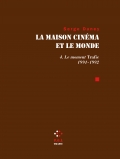
Serge Daney’s La Maison Cinéma et le Monde – 4. Le moment Trafic

The recent publication of Serge Daney’s last two years of writing, La Maison Cinéma et le Monde – 4. Le moment Trafic 1991-1992 (Éditions P.O.L.), reveals many of his major ideas and how they culminated at the end of his life. The book primarily deals with the launch of his new journal Trafic, through his original three articles for it Journal de l’an passé, Journal de l’an nouveau, and Journal de l’an present; interviews about it and his philosophy, and some of his last few essays and public conferences.

The book is important for bringing together many of these texts that have long been unavailable or difficult to find. The many interviews – fundamental  in his role as a passeur – offer a more casual, anecdotal and richer portrait of Daney, which shows a different side of him then that of Perseverance. Through a close attention to these texts, many of his views become clearer, sometimes even in opposition to his earlier writing, and a more precise picture of Daney finally emerges.

Many of the points in the book are just statements, but which have a lot of meaning for Daney, and he does not necessarily unpack them, so they must be taken at face value. The following is a selection of translations of some of these key points and quotations which represent some of the major ideas of one of the greatest film critics of the twentieth century. - D.D.

***
A list of some of Daney’s favorite filmmakers would include the classical carré d'as American directors of the Cinéma Mac Mahon (on Jacques Lourcelles, “the commitment to his tone and being assured in his Mac-Mahoniens taste are intact, and we feel the author being proud of never changing his mind on what’s essential”), the French and nouvelle vague directors of Alain Resnais, Jacques Tati, Robert Bresson, Jean-Luc Godard, Jacques Rivette, Jean-Claude Brisseau (‘Céline is a film of our time’), Philippe Garrel and Leos Carax (more on them below); the more challenging avant-garde films of Guy Debord, Danièle Huillet and Jean-Marie Straub, Akira Kurosawa (the book includes a review of his autobiography), Sergei Parajanov (The Color of Pomegranates, particularly), Pier Paolo Pasolini, Hans-Jürgen Syberberg, Johan van der Keuken, Raúl Ruiz, Manoel de Oliveira; and Stanley Kubrick (‘the only visionary of contemporary cinema’).

It is interesting to hear Daney discuss many emerging directors, who would never really receive full critiques, and revisit older ones, both which are quite perceptive in how they would evolve throughout the nineties.

Daney, “Actually, the most important director is certainly Manoel de Oliveira… Eighty-five-years-old. He’ll never be for the majority. But he continues making films in a way that is absolutely stupefying, which is both anarchic and completely insolent.”

Daney really likes Francis Ford Coppola’s The Godfather Part III and David Lynch’s Twin Peaks (“au charme absolu”). Daney wrote “There are some really good things in Spielberg.” Luc Besson’s Le Grand Bleu is “the most important film of the eighties,” a lot better than Jean-Jacques Annaud’s L’Ours.

According to Daney, La belle noiseuse, “I don’t think it really interested Rivette,” while Le Pont du Nord is his chef-d’oeuvre.

On François Truffaut’s Le Dernier Métro “one of his worsts,” but L'amour en fuite is “magnificent.” For Daney, Truffaut’s Paris, “is by a director of the 19th century, who esteems it, it takes place in Walter Benjamin’s passages.” And, “But either way, I find, in myself and with those around me, that the figure of Truffaut has been growing in esteem since his death. All of his ‘minor’ films are great, and only some ‘serious subject’ films are sometimes shallow. The Truffaut voice, neutral, a little high pitched, is unforgettable. I think that we’ll miss it.”

Daney really likes Van Gogh by Pialat.

On Nanni Moretti, “I for one, I need Moretti. We’re the same age, he’s one of those rare directors who speaks about the world as it is. There are maybe only five or six directors like this today, not enough.”

“Jean-Pierre Oudart once said (or wrote) that what was surprising about Mon oncle d'Amérique, was that the film would be the same if America didn’t even exist. This was a real intuition.”

On Wenders’ newest film at the time, “There’s a lot in it which doesn’t work. The whole last section, for example, isn’t convincing.”

Talks about the introduction of race and European style in some eighties American directors, for Daney, “Spike Lee is interesting because it’s someone who, against all expectations, has never renounced his political conviction. Jarmusch’s is a European cinema… Soderbergh, we don’t know yet. Sex, Lies, and Videotape was malin. But I don’t know how far he can take his project.”

“I saw Drugstore Cowboy, an unknown little film by Gus van Sant with Matt Dillon and the old Burroughs, and I found it formidable. In my usual fashion, I told myself that I needed to follow this director. Two years later, I realize that all of Paris, or at least all of the serious cinephiles in it, were praising My Own Private Idaho. One must no longer ‘fight for’ Gus van Sant.”

 “Abbas Kiarostami, a magnificent Iranian director, makes us think a lot, but at the same time, it’s really strange since it’s the same as Rossellini. We ask ourselves through what alchemy does an Iranian all by himself discovers, or rediscovers or continues, this hypothesis of Rossellini and certain other Italian directors.”

Bertrand Tavernier, for Daney, is “an efficient type, cultivated, who really knows a lot, and who really likes cinema. Because of this, today, he complains a lot against those who don’t like his films.”

Some films that he hated: Peter Weir’s Dead Poets Society and Lars von Trier’s Europa.

“One night, it’s been a few year already, there were two of us, S.T. and I, and we were spending time with a director. Everyone loved Woody Allen’s Crimes and Misdemeanors. Everyone except for our host, who got really upset when S.T. awkwardly described its characters as ‘formidable’.”

“It’s at this moment that the hypothesis of a resistant-cinema which obliges us to take into consideration the resistance of the characters moving towards their death. It’s without a doubt why, after our incursion, that S.T. decided to return to the subject in Cahiers (N.450) on that annoying question. And when he asks why Olivier Assayas centers all of his film (Paris s'éveille) on a character that, finally, ‘has no chance of escaping their faith’, it’s a question that I could not help but be too familiar with. Didn’t I feel obligated to side myself more with Louise at the end of Assayas’ film? No, because I wasn’t close to the character nor was she sympathetic. No, because throughout the film, through time passing and cinema making it dialectic, I still did not become attached to her. No, because the vitality of Louise did not carry the project… I felt the need to detach myself from the auteur…”

On Philippe Garrel and Leos Carax:

“For my generation at Cahiers, we’ve never really become directors. [On film sets, for example, I get bored too quickly. It exasperated me.] The most important director of my generation, was Garrel, a compagnon de route for Cahiers. Though perhaps less so now. Carax, on the other hand, wastes too much energy trying to decide his projects, though he doesn’t have a problem with desire. But I really like Leos, he’s a really gifted boy, but what he’s interested in isn’t always interesting.”

“I left Les Amants du Pont-Neuf just as I did Mauvais Sang: perplexed and affected. Is it because I re-see Leos, an auditor in the cinema class I was teaching, already anachronistic, fiercely listening and intensely quiet, which makes me ask myself, with each new film, what are his ‘references’?”

“I was giving these courses with Danièle Dubroux, and this young boy intrigued us. He seemed a lot more intelligent than the others, he also looked like he was only twelve. He wasn’t even enrolled in the course, and would just sit at the back of the class, and wouldn’t say anything. But he had this gaze, always extraordinary for someone out in public, who was benefiting from our course, this intrigued us. We took the risk and we proposed to him to write for us. One day, I asked him to write about young French filmmakers. He was so young himself. He first said yes, but withdrew by saying this magnificent phrase, ‘There’s only I that could fulfill it, but I’m not going to.’… Leos, it’s like Rivette. When we run into each other on the streets, we get a coffee together. There, we get into pure emotion. But, for the most part, the cinema that I defended, which I represented, including Leos, though not entirely, but a lot, is constituted by people that now don’t even give a damn to even call me. It’s a life choice. A little sad. But I know that if I was friends with Tavernier, he would take care of me.”

On meeting Chris Marker,

“I remember also, this time in Hong Kong, of my only encounter with the hard to find Chris Marker. It was on such a hot day and we imagined (perhaps to jauntily, I think) the pure and simple disappearance of cinema, its content diluting, its lack of vitriol. As if it was the dream of the 20th century wasn’t going to survive the disenchantment of the awakening of the turn of the 21st century. Here we were.”

On the role of festivals,

“The good ones, those that are a medium-sized ones. Not too large, like the Cannes machines, or too insignificant, like some smaller ones. But more so the friendly ones like Rotterdam or Locarno. There there can sometimes have real cinematographic events.”

Surprisingly, a few positive comments on Michel Ciment and Positif,

“The era of  regular film magazine publishing is over – I think of the courageous little magazine Positif with the elegant Michel Ciment – where you could accompany an unknown Wim Wenders up to the point where the bourgeois from Cannes could no longer ignore him. This was in the seventies.”

“The situation today in France is confusing. I wouldn’t know how to fix it. They should get several of us to brainstorm potential solutions. Even people like Michel Ciment know there’s something wrong.”

On the original Cahiers project and his relation to it,

“Oh, the Cahiers jaunes years, those were the bible. It was the absolute truth, without  a doubt. You would follow it with your life to death. I started reading it in 1959, the N.97 issue, which had Hiroshima Mon Amour on the cover. Then we started going to the Cinémathèque with peers from the lycée. There we met Douchet, the only one that kind-of spoke to us. We quickly realized that a long saga has just reached its conclusion in front of our eyes. That of the nouvelle vague – they won. I loved Cahiers for reasons that might not have been too pure deep down. First, for its writing. After for its independent spirit. A magazine capable of taking down in two lines The Bridge on the River Kwai, this film that was immensely popular and that all of France loved. I told myself: ‘Such bold writers do need really strong arguments.’ But I wasn’t wrong. Because these guys who wrote only two lines on River Kwai would also devote ten pages to Fritz Lang’s The Indian Tomb. I was taken over by a fury: Cahiers was always right. In fact, I had the impression of discovering a world that wasn’t official.”

“Such a pleasure to like Lang when my cleaning person also watched his films. Even when I was reading Plato, I was also seeing Lang. Such a pleasure for a kid like me.”

“I think that the two last great films where there was something real in terms of an aesthetic and spiritual work, which was provocative, scandalous, and also really innocent. Films that tried to say: ‘With cinema, we are retaking up this dirty story, but if we didn’t, we would always stay within it and we would reproduce it.’ Between 1975 and 1980, there was one film that we ‘missed’ at Cahiers, and that was Salò by Pasolini, and then he died shortly after, and inversely, there’s a film that we spoke highly of, Syberberg’s Hitler, in 1978, that none of you have probably seen, due to the fact that it was never shown again. I think that this was one of the last times that a director that we were not really close with ideologically, Syberberg, thought the cinema in terms of an art-form. This meant a material practice, that of manipulations, language, could displace the field, stop things from becoming fixed, stir up a dialectic, include some humor, to change the perspective: this little Hitler is not like the adult, a spiritual ideological practice.”

And on the early impact of his generation,

“We believed that we could still fight for the cinema, while in fact it was almost entirely constituted, with its great directors. But regardless, I think I was part of the last generation to define the canon, to specify who was a great director and who wasn’t. For the American cinema, the nouvelle vague already did everything earlier. But Jacques Tourneur, for example, was us. If one day Boris Barnet is recognized, one of the greatest Russian directors, it would be without a doubt because of us.”

“One must return to the origins. The image of man has changed, but through Barthes, with his formulas, he was able to diagnose it. Notably through: ‘structuralism, intelligent commentary around the object’. This marked an entire generation, especially those at Cahiers, who started reflecting, reading and writing. In this structuralist ambiance, the cinephiles were like second-class citizens, the most arrogant. They benefited from a sector, that of cinema, which wasn’t too developed intellectually, but through it we were able to do whatever we wanted. After the Barthes of Mythologies, they were able to rediscover things that seemed entirely natural but that, in fact, reflected an ideology. Therefore we prioritized liking an American cinema, with a conviction in taste that I still won’t ever discredit, which we call these days ‘B films’. Well, it wasn’t, in the most strict sense B films, but lets just say these really minor or failed films, which had a personality due to the fact that they were less supervised projects. Where Cukor was trying to get away with anything under Selznick, Nicholas Ray received everything he wanted from the president of Republic Pictures to make Johnny Guitar, a magnificent film, which was made in absolutely incredible conditions. We then had the tendency to be the first petits malins – I don’t know if there were some before us, to such an extent – perhaps even miscalculating the directors themselves, as they turned out to be not as intellectual as we thought. It was fun to bring these objects into a more classic culture, thought, philosophy, critical program, while in fact they were all starting to slowly become for the majority: products… After this pioneering moment, we eventually became more adventurous, arrogant. We started watching pornos, peplums – I still think today, that Cottafavi, the director of Les Légions de Cléopâtre, is a vastly superior director, in principal, to Peter Greenaway.”

On the death of cinema,

“I never heard this discourse on the death of cinema in the intellectual milieu. I talked about it with Wim Wenders at a certain period. It was always frowned upon. I was always forbidden to tell him too much, I was put back in my place. It’s been ten years that I’ve been feeling this way. So it has to become the dominant discourse.”

“By the end I was getting tired of being reproached by others for what they described as my ‘pessimism’. To provoke, I would tell people that the cinema was dead – maybe since Rossellini! But it didn’t provoke anyone, it just made everyone sad.”

“But Carax, he’s not going to be able to do as he likes! He’s going to go to America and get destroyed! No, no! I don’t know why there’s something inadmissible in the fact that the cinema is going to die. Look at the numbers if you don’t want to believe me. And if you don’t want to believe me, who will you believe? I thought that I was partially credible! I’ve heard enough people telling me: ‘Your article is magnificent, but I’m not going to see the film, it’s not my thing.’ As if my review was an end in itself. Or others: ‘You’re acting in bad faith. Cinema is not going to die. Even though I don’t go anymore, I stay home and watch VHS tapes with my children…”

“No, but really, I couldn’t care less about seeing films in movie theaters. I saw some films all by myself in theaters, and to be honest, it was embarrassing. Especially for comedies, such anxiety!”

Daney offers some fascinating answers to what is cinema?: “I always thought that cinema wasn’t actually wonder in front of a moving image, but the reverberation of sound, the sentiment of time, waiting for something, something fatal.”

The need to write, “For me – it’s really personnel –, I never understood how for some they could watch all of these films without talking about them… I think there should always be a need to discuss, write, with interruptions sometimes where the film can speak back. It’s like a tennis match: the roles go back and forth. And for me, as a cinephile, I call this the oral tradition, it’s an ensemble of social practices.”

A fascinating book, La Maison Cinéma et le Monde – 4. Le moment Trafic 1991-1992, is an essential read for more on Daney’s thought later in his life. If only now his radio show Microfilms can be made more widely accessible and also his many printed interviews (a blind spot of these compilations)! There’s still a lot to learn from Daney and these texts still offer a great compass to navigate cinema today. It might sometimes be a bleak perspective, but it's the truth, for those who even care.

Serge Daney’s Last Texts

What thou lovest well remains, the rest is dross
What thou lov’st well shall not be reft from thee
What thou lov’st well is thy true heritage
Whose world, or mine or theirs or is it of none?
First came the seen, then thus the palpable
    Elysium, though it were in the halls of hell,
What thou lovest well is thy true heritage
            - Ezra Pound, Canto LXXXI

Daney’s life was coming to an end. He contracted AIDS and in this period it was a fatal disease since the international medical community did not know yet how to respond it. Toubiana described Daney’s state of mind in this period as, “It was a stage in his life when he was settling scores, with extreme clarity, without lenience towards himself or others. That is the way it was, and the only demonstration of friendship was to be there.” An example of this settling of scores was a letter he sent to Cahiers. The film The Sheltering Sky at first glance would appear to be made as if it was for Daney. It is by Bernardo Bertolucci and it is about this world travelling couple that decided to go on an epic hike through the North African desert; there the man would catch a fatal STD. But Daney’s letter to Cahiers was an angry rant against Bertolucci and how with The Sheltering Sky that he was now corrupted by these prestigious international productions. 
 Daney’s last major essays continued this settling of scores. They appeared in his new journal Trafic which he created in 1990 with Raymond Bellour, Jean-Claude Biette, Sylvie Pierre and Patrice Rollet. It was a journal of intense theoretical reflection on cinema, culture and politics. Its text-only pictureless design recalled the Cahiers of the Seventies years. The Ezra Pound quotation that opened the first issue contributed to the final and melancholic tone of his last essays there. For example, in the issue with his last contribution when he was alive, it was dedicated to his mother Huguette Daney. They were diary entries of his last two years alive. They comprised of an intense theoretical reflection, settling of scores, and revelations of personal secrets. These traits combined gave these final essays a Rivettian conspiracy quality.
These essays were also similar to Bazin’s late writing as they were both near-death theoretical reflections. In the essays Daney analyzed Bazin’s concept of a transcendent realism in an increasing televisual society. Daney asked what it meant to be human in a media-pervasive world of corrupt politics. The last of these essays also ended rather abstractly with an analysis of humanity as illustrated by an animal documentary, a Bazinian predilection par excellence, that he watched on television. They were also full of references to thinkers and directors such as Roland Barthes, Jean-Luc Godard and Jean-Marie Straub.
“Cinema was dying,” Daney proposed… At this late period the directors that Daney admired now disappointed him. These directors included Wim Wenders, Bernardo Bertolucci, Olivier Assayas and even Jacques Rivette. (Daney shortly before even made a documentary with Claire Denis on Rivette for the Cinéma, de notre temps series, Jacques Rivette - Le veilleur.) Daney returned to Cahiers in this period as he was no longer getting along with the staff at Libération. He helped organize an impressive issue on the political activity in the U.S.S.R. and the fall of communism in Romania. Antoine de Baecque would spend a lot of time to interview him as a major resource for his Cahiers history books. But still the fast-approaching 40th anniversary of Cahiers would leave him ambivalent. Daney wrote in his Journal de l’an passé, “The 25th of May. Cahiers is now forty. Its televisual commemorative celebration is something sad.”
The publication of the Cahiers history books and its 40th anniversary motivated Daney to write one of his most famous essays – The Tracking Shot in Kapo – which was published posthumously in the Fall 1992 issue of Trafic. This essay discussed his relationship with Cahiers by psychoanalyzing his own life and how it intersected with Cahiers when he was a teenager. (Daney wrote, “Rivette was 33 and I was 17…”) Through Cahiers Daney discovered Rivette’s critique of Gillo Pontecorvo’s film Kapo, On Abjection. Daney had never actually ‘seen’ the film but he described that he had ‘seen’ it through Rivette’s critique. [Paul Louis Thirard criticized Daney for not bothering to see the film for himself since he argued that Kapo might not have even included an abject tracking shot... (Positif, N.543)] In the essay Daney wrote,

Rivette never recounted the film’s narrative in his article. Instead he was content to describe one shot in a single sentence. This sentence, now engraved in my memory, read “Just look at the shot in Kapo where Riva commits suicide by throwing herself on electric barbed wire; the man who decides at this moment to track forward and reframe the dead body in a low-angle shot – carefully positioning the raised hand in the corner of the final frame – deserves only the most profound contempt.” Henceforward a simple camera movement must be the one movement not to make. The movement one must — obviously — be abject to make. As soon as I read those lines I knew the author was absolutely right… Over the years “the tracking shot in Kapo” would become my portable dogma, the axiom that was not up for discussion, the breaking point of any debate. I would definitely have nothing to do or share with anyone who did not immediately feel the abjection of “the tracking shot in Kapo.

Daney’s memory of Rivette’s critique was very precise. What stood out for Daney in this Cahiers critique of Kapo is Rivette’s moral perspective on the film and his strength of conviction. (It may also be worth mentioning that Truffaut was not once mentioned in Daney’s article on Kapo. Toubiana would make up for this in a few issues later of Trafic when he would publish his essay Truffaut, domaine public.) At the heart of Daney’s conception of Cahiers was a strong belief in the courage to denounce something that was wrong. The same idea was seen in Libération when in 1987 Daney switched sections from the cinema pages to Rebonds where he could then address the problems that were going on in French society. Between the years 1987 to 1990, in this ‘post-cinema’ period, Daney wrote mostly about cultural products that he strongly disliked

Saturday, January 23, 2016

Jacques Rancière and Cinephilia: A Convergence with Cahiers du Cinéma

Introduction
Jacques Rancière definitively shares the Cahiers du Cinéma ethos, especially its sixties and seventies period and how these ideas have evolved with the times. This is perhaps one reason for the close connection between him and Cahiers. This paper will examine what aligns Rancière with Cahiers through a historical contextualization of the origins of his cinephilia and how his interviews inspired and confirmed some ideas of the Cahiers project. There will be a close analysis of his interviews with an emphasis on his answers and what they imply for an evolving film culture and for Rancière’s larger body of writing. As well there will be a focus on the influence of the interviews, which take place every five to ten years, on the different critics and periods of Cahiers.
Cahiers has had a long and enriching relationship with acclaimed philosophers. For example, throughout their sixty-year history, they have interviewed Roland Barthes, Michel Foucault, Gilles Deleuze, Rancière, Alain Badiou and Slavoj Žižek. Interviewing these figures serves a double purpose at the magazine: both as an involvement with the emerging philosophical concepts of their times and a certain legitimization of cinema within a different intellectual domain. But Rancière is more important than these others at Cahiers as he has been interviewed there more times than anyone else, with a total of six interviews since 1976. In the nineties, he also contributed articles to the magazine, and later with Charles Tesson he interviewed Jean-Luc Godard for Éloge de l'amour (2001).
Rancière’s most cited references in regards to film criticism and cinema theory are to the writings of André Bazin and Serge Daney. On the other hand, Daney and Serge Toubiana, the two chief editors during the seventies and eighties, would credit Rancière’s La leçon d'Althusser for helping them conceptualize the magazine's movement away from the doxa of its Marxist period. This would lead them to their first interview with Rancière in 1976 and then to the following five interviews which span forty years.  Rancière, in these interviews offered a legitimation of their views, interesting conflicting opinions,and new directions for theorization. He has been a compagnon de route for Cahiers. As the current chief editor Stéphane Delorme best addresses it, “If Rancière’s writing is so important to us… it is for his two essential ideas: equality as principal and emancipation as the goal.”

Roland Barthes and Rancière’s Early Cinephilia
It is worth contrasting Jacques Rancière with Roland Barthes for a better idea of how Rancière shares the Cahiers ethos. In Barthes’ early film writing, like in Mythologies, he is opposed to the era’s popular trends in the cinephile discourse. Michel Ciment would even go on to state, “He isn’t at all synchronous with his times. He’s closer to the early Positif. He’s of a position that is more of the left for his period.” But it is clear that Barthes would be familiar with some of the Cahiers theories. For example, André Bazin’s famous essay Ontology of the Photographic Image, building on the connections between the Surrealist and photography, wrote, “A photograph is a really existing hallucination.” Barthes, having read Bazin though without ever citing him, would elaborate on this thesis in the ‘noema of photography’ section of Camera Lucida. Barthes wrote, “The Photograph then becomes a bizarre medium, a new form of hallucination.”  But the differences between the two are striking. Where Bazin emphasized the combination of reality, imagination, and mechanical reproduction; Barthes agreed on the falseness of perception but highlighted the truthfulness of its temporal quality. But Barthes rejects cinema for its concentrated visual activity, as in the same essay he wrote on Federico Fellini’s Casanova, “I was sad, the film exasperated me.” Even though Barthes would be interviewed by Cahiers in the sixties in regards to their growing interest in semiotics, he would remain to have a more ambivalent relationship to cinema in general, and Cahiers and the nouvelle vague directors in particular.
On the other hand, Rancière is to be more synchronous with the Cahiers cinephile discourse. Aside from his political and philosophical writing, Rancière’s early and later writings on cinema offers an in-depth look at some of its important films and a theoretical understanding of it as an art form. Rancière, who was born in 1940, describes his years between 1960 and 1968 in Paris, during the golden age of cinephilia, as his introduction to cinema. Rancière wrote, “I absorbed all of the great westerns, musical comedies and film noir, as well as some Europeans, like Roberto Rossellini – Europe ‘51 was a real shock – and the directors from the nouvelle vague and Kenji Mizoguchi.” Rancière elaborates,

Cinema for me was just like everything else. There are interests of mine that I was focused on at very different moments in my life. I discovered cinema when I was in khâgne, since I had a neighbor who was really passionate about cinema, who explained to me that the true cinema wasn’t Antonioni, Bergman or any of these other culturally legitimate films. What one had to go and see was Raoul Walsh’s Esther and the King or Jacques Tourneur’s La Bataille de Marathon, and this was true cinema… Therefore I discovered cinema away from all initiation of the arts.   For me the history of cinema was Vincente Minnelli, Raoul Walsh, and Anthony Mann, and not the kind of thing which was made for a cultivated bourgeoisie.

It is therefore not the first Cahiers jaune generation that marked Rancière, with André Bazin, Jacques Doniol-Valcroze and the young turks fighting for the legitimation of Alfred Hitchcock; but its subsequent iteration. Rancière discusses having conversations with Jean Douchet and Louis Skorecki in this period at the cinéma Mac-Mahon. Rancière wrote, “In this period, we shared a mac-mahonien love of cinema, which means a love for classic American films, while also having a Marxist vision of the world… And then the nouvelle vague got inscribed into this. I immediately really liked Godard, Truffaut, Demy, Rozier…”
Marc Cerisuelo describes the philosophy of the mac-mahoniens as similar to that of Plato on beauty being “Cinema is that which is the most beautiful.” The Mac-Mahon Cinema, which got its name from the street it is on off of the Champs-Élysées, was an important venue for Rancière’s to develop his sensibilities. In this period the cinema was programmed by Pierre Rissient and its representative carré d'as directors were Fritz Lang, Otto Preminger, Raoul Walsh and Joseph Losey; as well as some other directors like Jacques Tourneur and Kenji Mizoguchi. Michel Mourlet would further conceptualize the invisible style privileged by the mac-mahoniens in his essay Sur un arts ignoré. But what Rancière liked about these films is that, “What was important in a film by Cukor, Minnelli, Walsh, Mann, it was the establishment of a certain relationship to the world and the way to bring together a materialism of the mise en scène with a materialism of the world.”

First Interview. 1976.
This is the background to Rancière’s first interview at Cahiers. It is the July-August 1976 special issue Image de Marque. On its cover there is a photograph of a Buddhist monk in Saigon who set himself on fire to protest the Vietnam War. The issue is on the branding of images. It was part of the magazine attempt to get out of their earlier Maoist period. They had already interviewed Foucault two years earlier. In this introduction Daney and Toubiana wrote, “We have always suspected at Cahiers that the cinema of publicity wasn’t at the undignified margins of the cinema, but its truth.” They are investigating the branding of ideological images that can then be mobilized as tools by ideological institutions. Daney and Toubiana wrote on why to interview Rancière, “La leçon d'Althusser helped us to figure out how the dialectic of class struggle and ideological debates wasn’t doing anything. This book permitted us to better understand the stakes of ideologies, the system of their imbrication and opposition.”
The subjects of this Rancière interview include leftist films, popular memory in France and the importance of history. Rancière brings his critique of Althusserianism (Communism and leftist philosophy in France) to the discussion of political films and their social value. As in the La leçon d'Althusser where Rancière critiques the restrictive doxa of ideology, so are political films criticized for being too one-sided. One problem Rancière sees in French media and cinema is its lack of an egalitarian image resulting from conflicts in its social history. For Rancière, a big clash continues between the bourgeois and the proletariat. The rich conservatives that own and control the media also decide on what kind of images will be disseminated. For Rancière these images project a generalized idea of society which is different than its individual truths. These images are also problematic as they naturalize certain stereotyped behavior.
            The problem for Rancière then arises with the commemoration of historical leftist figures whether on television or in cinema. By the creation of these outdated memorials and historical leftist fictions the popular media is, instead of celebrating the individuals, actually insisting that they are a thing of the past. Another problem arises in a film like Bertrand Tavernier’s Le Juge et l'assassin (1976). Here the film is too flattering of the leftists and implies to its sympathetic viewer that they are on the morally right side. So for Rancière, then, the problem becomes how to produce a new culture, and what images will be decisive for doing this?
Rancière posits two different types of political cinema: the first type is militant for a particular political power and the second is attempting to be political in its proper effect, dynamic accumulation and representations. Some positive examples of films that are discussed include Robert Kramer’s Milestones (1975) and Jean-Luc Godard’s Numéro deux (1975). This interview is note-worthy for Rancière earliest conceptualization of Godard as he praises Numéro deux for its denouncing of the lies of leftism and its inquiry into the technical qualities of the medium. Rancière disagrees with Godard though for claiming that it is shameful to still tell stories, as he thinks that there are still new ones to tell as they can still find ways to unite people. Rancière argues for a new dialectic, un ici et ailleurs.
In this interview Daney and Toubiana ignore Rancière’s earlier relationship to cinema as they want to focus on the subject of militant and leftist films. Rancière would recall this interview, “I think that I expanded the reflection, instead of solely addressing these Brechtian political films that they presented me, to take up the theme of leftist fiction films of the period in general. It was an important interview for me where I crystalized a certain number of ideas that I hold dear.” In retrospect, Rancière brings up an important aspect of these interviews: Not only are they important to Cahiers but also for himself. They have allowed him to have a better idea of his own ideas, and suggest interesting ideas that he would later develop. Rancière continues, “I think it is one of my first interventions that put together all of these problematic aspects of history and memory and how they become constitutionalized through these leftist films. Then there arises a doxa of the left and the rise of a new leftist ideology, which would lead and affirm François Mitterrand and an appropriation of the popular memory of the workers.”

Second Interview. 1985.
The second May 1985 interview La Visite au Peuple is in a special issue on the Scénario and it is by two Daney-era critics, Charles Tesson and Serge Le Péron. It took place after Rancière had published La Nuit des prolétaires (1981), which was well received at Cahiers, and when he would have been writing Le Maître ignorant (1987). The impetus of the interview is sociological again. The questions include how do popular French films represent the people, and, what has happened to leftist cinema and the social film since Mitterrand of the Socialist Party became the French president in 1981? Some of the films that they had asked him to watch included police films and comedies like Claude Zidi’s Les Ripoux (1984), Roger Hanin’s Train d’enfer (1984), and Patrice Laconte’s Les Spécialistes (1985).
         Rancière takes up the representation of immigrants in these films, which typically presents them as socially defined victims of racism. Rancière sees this treatment as being different from how it was in the past and blames the production companies and their notion of demographics,

The problem is that a film like Jacques Becker’s Casque d’Or would today have an Arab cast. All of a sudden, there wouldn’t be the necessary identification of the base line public for the distress of these guilty victims. The issue of race would prevent this and so would the standard practices of justice. The results: immigrants are solely presented as picturesque characters or as victims. It’s not possible, or even permitted, for them to be the subject of a dramatic film.

         Rancière sees these police films being in the mold of Francesco Rosi’s Italian mafia films. There is a new problematic representation of order and the police. These police films show their violence as an expression of their order. The process of them becoming tools within their larger ideological institutions dehumanizes them as individuals. The police no longer fights crime and instead are compromised and defeatist. In these films, which are typically set in these medium-sized French cities, the only relations people have are with the police. Rancière pursues this line of thought, of the lack of morality of the police, towards romantic relationship. Rancière, “It appears to me that effectively when there’s no enunciable morality or law then the potential for desire and love will surely go away… So then in a film like Les Spécialistes the feminine presence is purely decorative or else becomes a mark of publicity.”
         It is interesting that, for Rancière, Éric Rohmer does not offer a positive image. This opinion goes against the standard Cahiers line as Rohmer is a house director. Rancière reproaches Rohmer for his moralist point of view. On Les Nuits de la pleine lune (1984) Rancière wrote,

The film has to take certain behaviors, enacted by certain publicity signs, like normative behavior, to exclude any skeptical judgment that would divide the gaze on the products. And on the political level, it’s a very secure cinema, not in the terms of racial security, but in the sense of the representation of the social. The film is safe where it should take mores risks in regards to the law, the other and desire.

         Even Robert Bresson does not necessarily become a positive example, though he is closer to it. For Rancière, “L’Argent does the same thing Bresson has always done: an inscription into the sign of the time… The film corresponds to the socialist regime by the way it is symmetrical to the exhaustion of the gauchiste morale and culture. It was made at a time where a generation, ours, had put its ‘social’ back into the hands of leftist politicians and returned to the question of evil.” Rancière sees these concepts, that of good versus evil, as already anachronistic.

Bresson, doesn’t feel bad to create these images of an old discourse, that of catechism, which others believe to be discovering today, as if it was the summit of a political reflection (no transcendence, no law, no mistakes; no means to escape the necessary absolute of the society, therefor of terror)… He believes in good and in evil, and in the failure of tentative generosity and trying to do what’s right. This leads us to the fantastic last part of the film, which is a total blow for anyone with a standard amount of belief.

Between, this interview, and the next, Serge Daney would die of AIDS. Jacques Rancière, in an essay Celui qui vient après. Les antinomies de la pensée critique in Trafic twenty years later, would reflect on Daney and in doing so the role of the film critic. Rancière highlights the importance of criticism for Daney whether it is on a Classical Hollywood film or some televisual broadcast. Rancière wrote on the role of film criticism, “To interrogate the films on what they show us and what they hide. Not only in regards to the state of cinema, but also that of the world. So the critic then takes up the activity to lift up the veil of images to show and explain the functioning of the world.” Rancière highlights that modern films, like those by Godard or Jean-Marie Straub, have themselves become criticism. These directors don’t break stories, but separates them, puts them at a distance from their own images and sounds. Rancière, in his own way, would seem to be continuing Daney’s project in his own writing on cinema, politics and philosophy.

Third Interview. 1995.
The third November 1995 interview by Antoine de Baecque Les mots de l’histoire du cinema is on history, the history of film and cinephilia. These questions on the role of history in relation to cinema were especially relevant at the time with the centenary of cinema going on and the concluding century approaching. After a hundred years, how to write the history of film? As a new eighties critic, de Baecque had imposed himself as a major figure at the magazine and in this interview he would propose new subjects to discuss with Rancière. De Baecque, with his background in history and interest in cinephilia, now gets to bring these interests to the forefront through making them the subject of the interview.  Rancière’s rising interest in aesthetics and how to conceptualize image also emerges here.
For Rancière, there are two ways to study cinema, whether it is in the mode of the encyclopedia or that of the director monograph. What’s striking about this discussion are his references to Georges Sadoul and Louis Delluc, which are new for him, and which aligns him with the de Baecque of cinephilia studies. While there are also references to Stéphane Mallarmé and Gustave Flaubert that emerge, which will regularly come up in his future writing on aesthetics. Some films and directors that brought up include Manoel de Oliveira’s Aniki-Bóbó (1942) and Yasujirō Ozu and Satyajit Ray. Rancière views the cinephilia of the nouvelle vague as an enterprise that put into crisis a certain cultural legitimacy, which is in contrast with how the centenary of cinema is making it legitimate through being part of the official national cultural heritage. This heritagization, for Rancière, is not desirable. Rancière wrote, “It’s the multiplication of different perspectives that I find stimulating: to start off with something that is heterogeneous, instead of trying to creating something artificial that is homogenous.” Rancière is also against the museumification of cinema as it is supposed to be the democratic popular art form of the century; therefore it is supposed to be literally the anti-museum.
             For Rancière, the first evolution for cinema was its transition from being silent to incorporating sound, “The problem of writing about cinema has to do with its singular status as an art, which was supposed to be non-Aristotelian, but which ended up taking that narrative form, along with other expressive measures.” But for Rancière what is more interesting,

Is to start out with some questions that deal with, for example, the history of visible forms, narrative strategies and the politics of aesthetic, which, individually and together, can reorient the contemplation of cinema from a point of view, which might not be internal to cinema. At a certain moment, in a certain contexts, in certain places, a certain cinematographic form, a certain theorization or appropriation of cinema is inscribed in this problematic which encapsulates larger modes of representation, and it is through this, more than through an evolution of forms, that it can become the object of history.

This for Rancière accompanies the problem of the chronological linear discourse,

The work of History starts when we start to ask ourselves, for example, what separates the cinematographic style of the nouvelle vague – the life style of a new generation, social unease, direct-cinema, news reporting – with its immediate chronological referents like that of the thirties which had totally opposite preoccupations – the cult of artifice, a lightness of tone etc. – that of Ernst Lubitsch. This was one of the cinephilic activities of the nouvelle vague. As Godard used to say, “Lumière, my contemporary.”

         Some of Rancière’s comments in this interview anticipate his reflection in La Fable cinématographique and interestingly some of the ideas that Godard will bring to his own Histoire(s) du cinéma (1998). Rancière wrote,

To write about the cinema like a historical object is hard even when we don’t take into account its technical bases and its potential utopia of aesthetic and political forms. The cinema is to the 20th century, the material that is the richest in visual information, most filled with other stories… It is then not necessarily necessary to define its choice of objects for this ‘history of cinema’ from the objects that came from itself, but instead objects that come from other histories, like the history of the gaze, narration, sensible strategies of the community and then to return to cinema through these interpretative keys… What is at stake is to find these ‘hard objects’, which resist in their way the erudition of knowledge, while also inscribing themselves into the narration, visible forms with a political-aesthetic dimension where the cinema conserves its place and maximizes its forces.

         This interview led to de Baecque proposing to Rancière to contribute a regular, bi-monthly film chronicle. They started in February 1998 and lasted for fifteen contributions – they represent some of his finest writing on cinema.

Rancière and Godard
After having written previously on Godard, Rancière, with Charles Tesson who would review the film, returns to Cahiers in May 2001 to interview him for Éloge de l'amour. This is the period for Rancière after Le Partage du sensible (2000) and before publishing La Fable cinématographique and Le Destin des images (2003), and in this period he would have sporadic film articles in Cahiers. In the interview Godard is more personable than in some of his other interviews most likely because it is for Cahiers and with Rancière. Éloge de l'amour took Godard five years to make and he discusses its production, being unsure on how to start the film, and how it was made with the help of Anne-Marie Miéville. Godard said, “What I was really interested in, in its first stage of production, was this story of a decomposing chronology: a return to the past.” Godard discusses preferring not to be sure about his intentions, so creating is instinctive, and that it leaves room for interpretation. Rancière finds Éloge important for continuing Godard’s project after Histoire(s).
         In the interview Godard brings up tennis matches that he has been watching on television and how he likes Jean-Marie Straub’s Sicilia! (1999), his work on making Moments choisis des histoire(s) du cinéma (2004) and the success of the Histoire(s) soundtrack as there was no DVD copyrights. Godard even brings up an article on Daney in regards to Walter Benjamin, surveillance and the gaze. Godard speaks more about Daney, “The other day I was reading one of Daney’s book… I found that by the end he is discussing more the commentary of the object than the object itself, bringing it into relation with the other arts. This happened gradually with him… It’s interesting that he never decided to be a director, the same can be said for Bazin.” Even though the Youssef Ishaghpour book is quite positive on Histoire(s), Godard still wished that it received either more enthusiasm or criticism, since it took him ten years to make.
         Godard concludes on a guiding phrase by Denis de Rougemont from Penser avec les mains (1935), which was already cited in Histoire(s), “It’s in hoping that we are saved. But this hoping is real since time destroys the act. But the act is judged by time.” Godard then elaborates on how this relates to Éloge de l'amour, “If I had to express myself as a film critic, if I were writing criticism on this film, I would say that this film tried to film the acts that the time was destroying, but that the time in his own way will be judged by these acts.”

Fourth Interview. 2002.
The fourth April 2002 interview with Jacques Rancière, Le cinéma, art contrarié cinéma was by Stéphane Bouquet and Jean-Marc Lalanne. It is for the release of Film Fables. The two critics are new writers for this period. There is a generational shift in this interview that was not present in the previous ones. Bouquet and Lalanne are now inquiring into a period which was before theirs. They are attempting to reconnect with an earlier cinephile generation and the Cahiers tradition of interviewing Rancière The interview is on Rancière’s background, the philosophy supporting his cinephilia and again on the centenary of cinema.
       On the chronological form of Film Fables, from Jean Epstein to Godard, Rancière describes it as being unintentional. Rancière is against the idea of ruptures within history and he sees trends and influences as the ‘multiplication of the possible’. Rancière spoke on the matter, “I wanted to put into cause a conception of history in terms of progress or of decadence: the paradigm of its origins, of evolution or of rifts, and firstly its sharing between an ancient representative regime and a modern anti-representative one that became for cinema, like elsewhere, a dominant form.” For example, in describing his research and thought process, Rancière wrote, “When I was writing on Rossellini in 1990, I had a tendency to confirm a certain Bazinien idea that holds onto a theological model of grace as in opposition to law: the phenomenological miracle of presence for Bazin, the emphatic celebration of the event was again in fashion in the eighties and nineties.” 
       Bouquet and Lalanne asks Rancière about not mentioning a maniériste cinema, which they support, like films by directors Sam Peckinpah, Sergio Leone and Brian De Palma while Godard’s use of citations are deemed note-worthy. The specific question is, “References, re-writing, and pastiche do not seem to interest you?” For these younger critics, in this changing time period, Rancière is still in the past – they are arguing for a new type of cinema, which they have managed to fit into Rancière’s conceptualization. But Rancière rejects this type of cinema,

First off, I’ve seen very little of this American cinema which reflects on its history of forms. And the films that you cite do not really interest me… As well, I didn’t want singularize cinema. I didn’t want to focus on a cinema that only looked towards itself to see how it transformed… In general, I don’t have much interest for art whose only goal is to show itself off and to cite itself. It’s too easy to show that you are clever by taking a distance with the system of codes that are no longer trendy… For the perversion of the codes of the action genre, for the distance in regards to action-reaction, the films of Takeshi Kitano interest me more than the ‘tired heroes’ of a Quentin Tarantino or Abel Ferrara.

       Rancière, though interested in Gilles Deleuze’s cinema books, finds some aspects of them problematic. For Rancière, “The idea of a ‘crisis’ of the movement-image resumes this problematic tentative. Deleuze’s analysis of Hitchcock, where this crisis is illustrated by this photographer with his broken leg in a cast or a detective with vertigo, seems like a joke.” On the subject of television, Rancière wrote, “I am not really interested in it. Not even to watch it, or criticize it, or even to judge it as the signpost of the fatal destination of our civilization.” On new digital technologies, Rancière wrote, “Knowing that the actors in Titanic were in front of a green screen and that it’s all special effect doesn’t change the nature of the film. We have a transformation of the texture of the images but not one of its nature of affects.” And it is really interesting to hear that Rancière cites a recent screening of Béla Tarr’s Sátántangó (1994) that really impressed him as he would later go on to write a book on the Hungarian director. Rancière wrote, “I recently saw the seven-and-a-half hours of Sátántangó. It really affected me, but to pretend that it gave me pleasure, this isn’t the right way to state it.”

Fifth Interview. 2005.
The fifth February 2005 interview Le déstin du cinema comme art is by Emmanuel Burdeau and Jean-Michel Frodon, two chief-editors around this period. It is in relation to the publication of Malaise dans l'esthétique (2004). It is the shortest of the Rancière interviews to date, being only four pages, which also include large illustrations. In it Rancière brings up the impurity of cinema, in relation to Bazin, and states its mass appeal, “If cinema is significant in this respect, it is because it has become the art-form of the masses. In such terms, it is that which is consumed like art.” In the book Rancière is in dialogue with Alain Badiou and discusses the films Mystic River (2004) and Dogville (2003). Rancière cites Élie Faure to engage with how cinema, and art in general, defines its own politics.
       On the role of the museum, Rancière wrote, “When Chantal Akerman installs on screens in galleries different scenes from De l'autre côté, she’s putting into relationship the autonomy of the space into a filmic continuum… The essential is that, cinema or video, in a museum manifests more a transformation of painting than it does of cinema.” Cahiers asks about the role of the Cinémathèque française, which Serge Toubiana would have then became its artistic director, Rancière answers, “What I think is important for cinema as an art, it is less a matter of the Cinémathèque and more that there are still commercial cinemas which still play auteur films. This is what makes cinema into a visible art, not so much the Cinémathèque, but more so that Wong Kar-Wai and David Lynch films are still playing in theaters destined towards a larger public.” Rancière expresses that the modern approach to filmmaking owes to Godard’s cinematographic experimentation. For example, films like Hou Hsiao-Hsien’s Café Lumière (2003) or Hong Sang-Soo’s La femme est l'avenir de l'homme (2004). Rancière wrote, “Today, there is a standard narrative grammar that has been constituted: the spectator of Mulholland Dr. or In The Mood for Love accepts them without any doubt. This wasn’t the case for Selznick or Zanuck who would have certainly not have allowed it.” To conclude, Rancière wrote, “For me the cinema is a lively art which I still wait to be surprised by.”

Sixth Interview. 2015.
This leads to the magazine in its present form. In his sixth, and most recent March 2015 interview, ‘Le reste, c’est a vous de l’inventer’ with the current chief editor Stéphane Delorme and regular contributor Dork Zabunyan, many of the magazine’s recent polemics and major films are brought up to be discussed. It is part of a larger dossier, La parole aux lycéens, which in itself is a Rancièreien gesture. It is an extensive interview which brings together many of the important ideas for both parties. At a lengthy eleven pages, it is the summit of Rancière’s relationship to the magazine.
The interview begins with a discussion of the recent Charlie Hebdo attacks on Paris. Rancière wrote, “Everyone jumped on the band wagon that it was an attack on freedom of expression which Charlie Hebdo incarnates. But this wasn’t the case.” Rancière sees their illustrations as problematic due to their racism towards the Muslim community, which is already a minority ethnic group in Europe. True freedom of speech, for Rancière, would be to criticize the government in power, but this has already been shown to be ineffective. Rancière doesn’t either see the manifestations for it as unifying or as creating a new public space.
One of the major interventions for this interview is in regards to academia and a ‘contempt for the aesthetics’ which Delorme sees as extremely negative. Rancière wrote, “Since ‘aesthetics’ signify the blurring of boundaries the professors then sees in this a questioning of their roles and competence.” Note-worthy is how Rancière sees Stanley Cavell as problematic,

What is being discriminated against is the idea itself of pleasure and emotions in relation to images in movement. It’s interesting here to see the key role here that the references to Stanley Cavell permit. Cavell appears a little like the hero that was able to re-appropriate the melodrama and the ordinary man. And it’s shocking to see how little he is actually interested in laughs and cries. What really interests him is to take these films like illustrations of his philosophical concepts. The ordinary man is finally the student who we are forcing to go to the cinema to learn more about existential problems and not to have fun. This is what makes the pedagogues happy.

Some of Rancière’s thoughts on newer films include: he dislikes Bruno Dumont’s La Vie de Jésus (1997) for its representation of the social groups in the French countryside, Abel Ferrara’s Pasolini (2014) for not being transgressive enough, and Larry Clark’s The Smell of Us (2014) which he compares its use of teenage actors to prostitution. Instead he prefers Rabah Ameur-Zaïmeche, Pedro Costa (which he wrote more about in Les écarts du cinéma), Gus van Sant, Vincente Minnelli (Some Came Running) and Frank Borzage (7th Heaven). Rancière’s most recent approach to engage with the history of cinema here becomes more clear and refined,

There are an infinity of emotions that are created by the cinema: gestures, gazes, movements and possibilities of the body, and relationships to others. This is the aesthetic treasure that needs to be defended. It is fundamental in relation to the forming of fictions, expressions and for unexpected effects. This is why the cinema needs to be conceived as a global and historical adventure. We would lose the bigger picture if we focus too much on just the films that come out each year. One must not just concentrate on what’s new but to take cinema as a whole and in relation to all that it is possible, which might mean to recreate anew a real militant cinephilia. One needs to rethink cinema in a way compatible to the possibilities of life.

Rancière describes the purpose of art, “It is not the role of art to serve a politic, but instead for the political to know how to import the gestures of art.” And Rancière concludes the interview with reworking a famous citation by Mizoguchi, “Le reste, c’est a vous d’inventer.” Delorme and Cahiers seems to be taking to heart many of the important points that Rancière is making. For example, a usual issue of theirs seems to encapsulate Rancière’s emancipatory method to engage with the history of cinema and contemporary politics. And Rancière’s theories are still offering them tools to best address contemporary cinema. For example, Delorme in a few issues later would use Rancière’s concepts of ‘police’ and ‘politics’ as a guiding compass for the magazine,

There aren’t thirty-six solutions. Either the films propose, even unconsciously, the reaffirmation of domination and belong to the ‘police’. Or the films propose an emancipatory voice, and therefore becomes ‘politics’. For this to happen it is necessary to stop thinking in the ways defined by power: territory, savageness, place and class. And in parallel to stop utilizing a box of tools that constantly recycles old codes and stereotypes of genre films. There is no politics there. Everything is related. As long the French cinema encloses itself and turns towards the past and recreates these same old scene, giving each person his designated role, nothing good can happen, aesthetically nor politically.

The present Delorme-Cahiers owes a tremendous debt to Rancière. His writing offers a useful tool to better understand the world and cinema. In the portrait of Rancière by Xavier Lambours, which accompanies the 2015 interview, the man himself is wearing a bright purple turtleneck, in his art filled apartment. Rancière is looking somewhat frightened as his gaze is directed towards the illumination from an unseen window. Rancière is now over seventy-five and his old age is coming across the photograph through his white hair and facial wrinkles. There have been photographs of Rancière throughout most of the Cahiers interviews. What comes across through all of them is how his different stages of life and intellectual thought had been reflected in and impacted the magazine. Currently, in his twilight years, this could potentially be Rancière’s last interview. As Laurent Jeanpierre and Dork Zabunyan explain, “The interview for Rancière has an important place in his ‘méthode de l'égalité’ which he has been ceaselessly defending since the seventies.” This emphasis on implementing equality is Rancière’s biggest influence at Cahiers. With Rancière growing older, the title of his most recent interview takes on more meaning, “Le reste, c’est a vous de l’inventer.” The rest, it is for you to invent. The emancipation that Rancière has been discussing his whole life will be for the next generation to keep up.