The recent publication
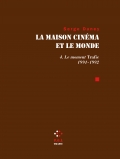
of Serge Daney’s last two years of writing, La Maison Cinéma et le Monde – 4. Le moment Trafic 1991-1992 (Éditions
P.O.L.), reveals many of his major ideas and how they culminated at the end of
his life. The book primarily deals with the launch of his new journal Trafic, through his original three articles for it Journal de l’an passé, Journal
de l’an nouveau, and Journal de l’an
present; interviews about it and his philosophy, and some of his
last few essays and public conferences.
 The book is
important for bringing together many of these texts that have long been
unavailable or difficult to find. The many interviews – fundamental in
his role as a passeur – offer a more
casual, anecdotal and richer portrait of Daney, which shows a different side of him then that of Perseverance. Through a close attention to
these texts, many of his views become clearer, sometimes even in opposition to his earlier writing, and a more precise picture of Daney finally emerges.
The book is
important for bringing together many of these texts that have long been
unavailable or difficult to find. The many interviews – fundamental in
his role as a passeur – offer a more
casual, anecdotal and richer portrait of Daney, which shows a different side of him then that of Perseverance. Through a close attention to
these texts, many of his views become clearer, sometimes even in opposition to his earlier writing, and a more precise picture of Daney finally emerges.
Many of the
points in the book are just statements, but which have a lot of meaning for Daney, and he does
not necessarily unpack them, so they must be taken at face value. The following is a selection of translations of some of these key points and quotations which represent some of the major ideas of one of the greatest film critics of the twentieth century. - D.D.
***
A list of some
of Daney’s favorite filmmakers would include the classical carré d'as American
directors of the Cinéma Mac Mahon (on Jacques Lourcelles, “the
commitment to his tone and being assured in his Mac-Mahoniens taste are intact, and
we feel the author being proud of never changing his mind on what’s
essential”), the French and nouvelle
vague directors of Alain Resnais, Jacques Tati, Robert Bresson, Jean-Luc
Godard, Jacques Rivette, Jean-Claude Brisseau (‘Céline is a film of our time’),
Philippe Garrel and Leos Carax (more on them below); the more challenging
avant-garde films of Guy Debord, Danièle Huillet and Jean-Marie Straub, Akira
Kurosawa (the book includes a review of his autobiography), Sergei Parajanov (The Color of Pomegranates,
particularly), Pier Paolo Pasolini, Hans-Jürgen Syberberg, Johan van der Keuken,
Raúl Ruiz, Manoel de Oliveira; and Stanley Kubrick (‘the only visionary of
contemporary cinema’).
It is
interesting to hear Daney discuss many emerging directors, who would never really receive
full critiques, and revisit older ones, both which are quite perceptive in how they would evolve throughout the nineties.
Daney,
“Actually, the most important director is certainly Manoel de Oliveira…
Eighty-five-years-old. He’ll never be for the majority. But he continues making
films in a way that is absolutely stupefying, which is both anarchic and
completely insolent.”
Daney really
likes Francis Ford Coppola’s The
Godfather Part III and David Lynch’s Twin
Peaks (“au charme absolu”). Daney wrote “There are some really good things in Spielberg.” Luc Besson’s Le Grand Bleu is “the most important
film of the eighties,” a lot better than Jean-Jacques Annaud’s L’Ours.
According to
Daney, La belle noiseuse, “I don’t
think it really interested Rivette,” while Le
Pont du Nord is his chef-d’oeuvre.
On François
Truffaut’s Le Dernier Métro “one of
his worsts,” but L'amour en fuite is
“magnificent.” For Daney, Truffaut’s Paris, “is by a director of the 19th
century, who esteems it, it takes place in Walter Benjamin’s passages.” And, “But either way, I find,
in myself and with those around me, that the figure of Truffaut has been
growing in esteem since his death. All of his ‘minor’ films are great, and only
some ‘serious subject’ films are sometimes shallow. The Truffaut voice, neutral, a little high pitched,
is unforgettable. I think that we’ll miss it.”
Daney really
likes Van Gogh by Pialat.
On Nanni
Moretti, “I for one, I need Moretti. We’re the same age, he’s one of those rare
directors who speaks about the world as it is. There are maybe only five or six
directors like this today, not enough.”
“Jean-Pierre
Oudart once said (or wrote) that what was surprising about Mon oncle d'Amérique, was that the film would be the same if
America didn’t even exist. This was
a real intuition.”
On Wenders’
newest film at the time, “There’s a lot in it which doesn’t work. The whole
last section, for example, isn’t convincing.”
Talks about the
introduction of race and European style in some eighties American directors,
for Daney, “Spike Lee is interesting because it’s someone who, against all
expectations, has never renounced his political conviction. Jarmusch’s is a
European cinema… Soderbergh, we don’t know yet. Sex, Lies, and Videotape was malin.
But I don’t know how far he can take his project.”
“I saw Drugstore Cowboy, an unknown little
film by Gus van Sant with Matt Dillon and the old Burroughs, and I found it
formidable. In my usual fashion, I told myself that I needed to follow this
director. Two years later, I realize that all of Paris, or at least all of the
serious cinephiles in it, were praising My
Own Private Idaho. One must no longer ‘fight for’ Gus van Sant.”
“Abbas Kiarostami, a magnificent Iranian
director, makes us think a lot, but at the same time, it’s really strange since
it’s the same as Rossellini. We ask ourselves through what alchemy does an
Iranian all by himself discovers, or rediscovers or continues, this hypothesis
of Rossellini and certain other Italian directors.”
Bertrand
Tavernier, for Daney, is “an efficient type, cultivated, who really knows a
lot, and who really likes cinema. Because of this, today, he complains a lot
against those who don’t like his films.”
Some films that
he hated: Peter Weir’s Dead Poets
Society and Lars von Trier’s Europa.
“One night, it’s
been a few year already, there were two of us, S.T. and I, and we were spending
time with a director. Everyone loved Woody Allen’s Crimes and Misdemeanors. Everyone except for our host, who got
really upset when S.T. awkwardly described its characters as ‘formidable’.”
“It’s at this
moment that the hypothesis of a resistant-cinema which obliges us to take into
consideration the resistance of the characters moving towards their death. It’s without
a doubt why, after our incursion, that S.T. decided to return to the subject in
Cahiers (N.450) on that annoying
question. And when he asks why Olivier Assayas centers all of his film (Paris s'éveille) on a character that,
finally, ‘has no chance of escaping their faith’, it’s a question that I could
not help but be too familiar with. Didn’t I feel obligated to side myself more
with Louise at the end of Assayas’ film? No, because I wasn’t close to the character
nor was she sympathetic. No, because throughout the film, through time
passing and cinema making it dialectic, I still did not become attached to her.
No, because the vitality of Louise did not carry the project… I felt the need
to detach myself from the auteur…”
On Philippe
Garrel and Leos Carax:
“For my
generation at Cahiers, we’ve never
really become directors. [On film sets, for example, I get bored too quickly.
It exasperated me.] The most important director of my generation, was Garrel, a
compagnon de route for Cahiers. Though perhaps less so now.
Carax, on the other hand, wastes too much energy trying to decide his projects,
though he doesn’t have a problem with desire. But I really like Leos, he’s a
really gifted boy, but what he’s interested in isn’t always interesting.”
“I left Les Amants du Pont-Neuf just as I did Mauvais Sang: perplexed and affected.
Is it because I re-see Leos, an auditor in the cinema class I was teaching,
already anachronistic, fiercely listening and intensely quiet, which
makes me ask myself, with each new film, what are his ‘references’?”
“I was giving
these courses with Danièle Dubroux, and this young boy intrigued us. He seemed
a lot more intelligent than the others, he also looked like he was only twelve.
He wasn’t even enrolled in the course, and would just sit at the back of the
class, and wouldn’t say anything. But he had this gaze, always extraordinary for someone out in public, who was benefiting from our course, this intrigued us. We took the risk and we
proposed to him to write for us. One day, I asked him to write about young
French filmmakers. He was so young himself. He first said yes, but withdrew by
saying this magnificent phrase, ‘There’s only I that could fulfill it, but I’m
not going to.’… Leos, it’s like Rivette. When we run into each other on the
streets, we get a coffee together. There, we get into pure emotion. But, for
the most part, the cinema that I defended, which I represented, including Leos,
though not entirely, but a lot, is constituted by people that now don’t even
give a damn to even call me. It’s a life choice. A little sad. But I know that
if I was friends with Tavernier, he would take care of me.”
On meeting
Chris Marker,
“I remember
also, this time in Hong Kong, of my only encounter with the hard to find Chris
Marker. It was on such a hot day and we imagined (perhaps to jauntily, I think)
the pure and simple disappearance of cinema, its content diluting, its lack of
vitriol. As if it was the dream of the 20th century wasn’t
going to survive the disenchantment of the awakening of the turn of the 21st
century. Here we were.”
On the role
of festivals,
“The good ones,
those that are a medium-sized ones. Not too large, like the Cannes machines, or
too insignificant, like some smaller ones. But more so the friendly ones like
Rotterdam or Locarno. There there can sometimes have real cinematographic
events.”
Surprisingly,
a few positive comments on Michel Ciment and Positif,
“The era of regular film magazine publishing is over – I
think of the courageous little magazine Positif
with the elegant Michel Ciment – where you could accompany an unknown Wim
Wenders up to the point where the bourgeois from Cannes could no longer ignore
him. This was in the seventies.”
“The situation
today in France is confusing. I wouldn’t know how to fix it. They should get
several of us to brainstorm potential
solutions. Even people like Michel Ciment know there’s something wrong.”
On the
original Cahiers project and his
relation to it,
“Oh, the Cahiers jaunes years, those were the
bible. It was the absolute truth, without
a doubt. You would follow it with your life to death. I started reading
it in 1959, the N.97 issue, which had Hiroshima
Mon Amour on the cover. Then we started going to the Cinémathèque with
peers from the lycée. There we met Douchet, the only one that kind-of spoke to
us. We quickly realized that a long saga has just reached its conclusion in
front of our eyes. That of the nouvelle
vague – they won. I loved Cahiers for
reasons that might not have been too pure deep down. First, for its writing. After
for its independent spirit. A magazine capable of taking down in two lines The Bridge on the River Kwai, this film
that was immensely popular and that all of France loved. I told myself: ‘Such
bold writers do need really strong arguments.’ But I wasn’t wrong. Because
these guys who wrote only two lines on River
Kwai would also devote ten pages to Fritz Lang’s The Indian Tomb. I was taken over by a fury: Cahiers was always right. In fact, I had the impression of
discovering a world that wasn’t official.”
“Such a pleasure
to like Lang when my cleaning person also watched his films. Even when I was
reading Plato, I was also seeing Lang. Such a pleasure for a kid like me.”
“I think that
the two last great films where there was something real in terms of an
aesthetic and spiritual work, which was provocative, scandalous, and also
really innocent. Films that tried to say: ‘With cinema, we are retaking up this
dirty story, but if we didn’t, we would always stay within it and we would reproduce
it.’ Between 1975 and 1980, there was one film that we ‘missed’ at Cahiers, and that was Salò by Pasolini, and then he died
shortly after, and inversely, there’s a film that we spoke highly of,
Syberberg’s Hitler, in 1978, that
none of you have probably seen, due to the fact that it was never shown again.
I think that this was one of the last times that a director that we were not
really close with ideologically, Syberberg, thought the cinema in terms of an
art-form. This meant a material practice, that of manipulations, language,
could displace the field, stop things from becoming fixed, stir up a dialectic, include some humor, to change the
perspective: this little Hitler is not like the adult, a spiritual ideological
practice.”
And on the
early impact of his generation,
“We believed
that we could still fight for the cinema, while in fact it was almost entirely
constituted, with its great directors. But regardless, I think I was part of
the last generation to define the canon, to specify who was a great director
and who wasn’t. For the American cinema, the nouvelle vague already did everything earlier. But Jacques
Tourneur, for example, was us. If one day Boris Barnet is recognized, one of
the greatest Russian directors, it would be without a doubt because of us.”
“One must return
to the origins. The image of man has changed, but through Barthes, with his
formulas, he was able to diagnose it. Notably through: ‘structuralism,
intelligent commentary around the object’. This marked an entire generation,
especially those at Cahiers, who
started reflecting, reading and writing. In this structuralist ambiance, the
cinephiles were like second-class citizens, the most arrogant. They benefited
from a sector, that of cinema, which wasn’t too developed intellectually, but
through it we were able to do whatever we wanted. After the Barthes of Mythologies, they were able to
rediscover things that seemed entirely natural but that, in fact, reflected an
ideology. Therefore we prioritized liking an American cinema, with a conviction
in taste that I still won’t ever discredit, which we call these days ‘B films’.
Well, it wasn’t, in the most strict sense B films, but lets just say these
really minor or failed films, which had a personality due to the fact that they
were less supervised projects. Where
Cukor was trying to get away with anything under Selznick, Nicholas Ray
received everything he wanted from the president of Republic Pictures to make Johnny Guitar, a magnificent film, which
was made in absolutely incredible conditions. We then had the tendency to be
the first petits malins – I don’t
know if there were some before us, to such an extent – perhaps even
miscalculating the directors themselves, as they turned out to be not as
intellectual as we thought. It was fun to bring these objects into a more classic
culture, thought, philosophy, critical program, while in fact they were all
starting to slowly become for the majority: products… After this pioneering
moment, we eventually became more adventurous, arrogant. We started watching
pornos, peplums – I still think
today, that Cottafavi, the director of Les
Légions de Cléopâtre, is a vastly superior director, in principal, to Peter Greenaway.”
On the death
of cinema,
“I never heard
this discourse on the death of cinema in the intellectual milieu. I talked
about it with Wim Wenders at a certain period. It was always frowned upon. I
was always forbidden to tell him too much, I was put back in my place. It’s
been ten years that I’ve been feeling this way. So it has to become the
dominant discourse.”
“By the end I
was getting tired of being reproached by others for what they described as my
‘pessimism’. To provoke, I would tell people that the cinema was dead – maybe
since Rossellini! But it didn’t provoke anyone, it just made everyone sad.”
“But Carax, he’s
not going to be able to do as he likes! He’s going to go to America and get
destroyed! No, no! I don’t know why there’s something inadmissible in the fact
that the cinema is going to die. Look at the numbers if you don’t want to
believe me. And if you don’t want to believe me, who will you believe? I
thought that I was partially credible! I’ve heard enough people telling me:
‘Your article is magnificent, but I’m not going to see the film, it’s not my
thing.’ As if my review was an end in itself. Or others: ‘You’re acting in bad
faith. Cinema is not going to die. Even though I don’t go anymore, I stay home
and watch VHS tapes with my children…”
“No, but really,
I couldn’t care less about seeing films in movie theaters. I saw some films all
by myself in theaters, and to be honest, it was embarrassing. Especially for
comedies, such anxiety!”
Daney offers
some fascinating answers to what is cinema?: “I always thought that cinema
wasn’t actually wonder in front of a moving
image, but the reverberation of sound, the sentiment of time, waiting for
something, something fatal.”
The need to
write, “For me – it’s really personnel –, I never understood how for some they
could watch all of these films without talking about them… I think there should
always be a need to discuss, write, with interruptions sometimes where the film can
speak back. It’s like a tennis match: the roles go back and forth. And for me, as a
cinephile, I call this the oral tradition, it’s an ensemble of social
practices.”
A fascinating
book, La Maison Cinéma et le Monde – 4.
Le moment Trafic 1991-1992, is an essential read for more on Daney’s
thought later in his life. If only now his radio show Microfilms can be made more widely accessible and also his many printed
interviews (a blind spot of these compilations)! There’s still a lot to learn
from Daney and these texts still offer a great compass to navigate cinema today. It
might sometimes be a bleak perspective, but it's the truth, for those who even care.


