Showing posts with label Passion. Show all posts
Showing posts with label Passion. Show all posts
Monday, September 2, 2013

Monday, October 29, 2012
Brian De Palma at Cahiers du Cinéma in the 2000’s
Since Brian de Palma’s Passion premiered last month there has been a lot of talk about the filmmaker:
Jim Hoberman praises him in his review of Passion (“De Palma’s movie is a playful, shamelessly
manipulative movie about shameless manipulation — not least of cinematic forms.”),
John Semley profiled the director in the National Post, and Daniel
Kasman has a lengthy interview with De Palma at Mubi. I would also add that there was a lengthy
reassessment of Redacted over at Elusive Lucidity.

There is also the new book Un-American Psycho: Brian De Palma and the Political Invisible – one of
the year’s best film books, along with Hoberman’s Film After Film – where Chris Dumas provides a historical summary
of how De Palma’s films have been received in the American mainstream press. By
summarizing key, and representative reviews and other relevant sources - most of
them accusatory of sexism and exploitative violence – Dumas through a great
feat of argumentation, finds faults in their claims, offering alternative
readings, and through this lengthy self-dialogue - where he also pits De
Palma in opposition to Hitchcock and Godard - the book elevates
De Palma to the status of a major filmmaker whose films deserve to be
reevaluated.
De Palma is usually brought up in relation to Cahiers du
Cinéma, where the main
reference point being how Carlito’s Way
was voted to be the number one film of the 90’s. But little is actually written
about what their critics have actually written in their reviews of De Palma’s
films and what they have to say about the auteur himself.
I recently translated a round-table Douchet décortique De Palma from 1981, which I posited as the
defining embrace of the filmmaker at the magazine. I’m also planning on
publishing their review of Mission: Impossible. But for now, the
following is an attempt to summarize their reviews of De Palma’s films from the
2000 years: Mission to Mars (2000), Femme
Fatale (2002), The Black Dahlia (2006), Redacted (2007), and the most recent Passion (2012).
For the sake of clarity and to not spend too much time
translating easily available synopsis, I will only highlight and translate what
I think to be the key points from the French reviews and essays.
*****
Mission to Mars, de Brian De Palma (Cahiers, May 2000, N.546), w/ an interview by Cédric Anger
with De Palma, Stéphane Delorme reviews the film, Mission to Venus; and Emmanuel Burdeau discusses the body in De
Palma’s films, L’intouchable.
Delorme’s review Mission to Venus brings up a lot of significant points and the
following are translations of them, with further comments to contextualize them
within the review and to better understand the film.
“Because with De Palma everything is revealed in the first scene,” for Delorme this virtuoso long-take that opens up Mission to Mars is important for how it introduces the viewer to most of the astronauts that will go off to mars. But what is also important is how the scene itself excludes two members of the crew. In this group where no one is left behind there is actually two people that are missing: Jim McConnell, who shows up late, and his dead wife, who worked with the group to undertake this project. Which leads Delorme to the claim that for De Palma, “a scene is only as important as what it leaves out.” De Palma's images, and images in general, not only mentent (Godard: “pas une image juste, mais juste une image”) but they also manque: “If his cinema is bouleversant and not only virtuosic and critical, its because they show an empty place in the scene and that this place (that of death) rests empty.”
“Because with De Palma everything is revealed in the first scene,” for Delorme this virtuoso long-take that opens up Mission to Mars is important for how it introduces the viewer to most of the astronauts that will go off to mars. But what is also important is how the scene itself excludes two members of the crew. In this group where no one is left behind there is actually two people that are missing: Jim McConnell, who shows up late, and his dead wife, who worked with the group to undertake this project. Which leads Delorme to the claim that for De Palma, “a scene is only as important as what it leaves out.” De Palma's images, and images in general, not only mentent (Godard: “pas une image juste, mais juste une image”) but they also manque: “If his cinema is bouleversant and not only virtuosic and critical, its because they show an empty place in the scene and that this place (that of death) rests empty.”
By addressing how images lie and what they hide, De Palma is
addressing the question of visibility.
“In Mission to Mars, what is lacking for De Palma, is a body. And that body is a
feminine one. The movie that comes closes to this one finally is Obsession (and its model Vertigo), the woman isn’t there and it is this longing that
decides the path of its male protagonist.” Its also like a remake of 2001:
A Space Odyssey but with the naïve
ideology of Cameron’s Abyss.
“There is only one major event in life: that is of seeing
the person one loves die.” And for the Depalmian hero, “he caries this death on
his back, that of the woman that he loved; because he’s responsible for the
death (The Fury), because he saw her
die (Mission to Mars), or the
two together (the hospital scene in Raising Cain).”
In Mission to Mars,
when Terri turns away from her husband Blake, who was just petrified in space,
“In this instant where Terri is obliged to advert her eyes, and leave her
husband: turning her back on him to rejoin the world of the living.
In front of this wrenching moment where Orpheus is rejoining us: how could
anyone reduce De Palma to a virtuoso formalist?”
***
Mission: Impossible,
“no doubt the most important American film of the nineties, the malediction of
touching takes on these delirious and genial dimensions.” Burdeau expands, from
L’intouchable,“Mission: Impossible (and afterwards with Mission to Mars) shows the dimension of profound tenderness of De
Palma’s gaze (beyond any kind of voyeurism), with sight and sound (De Palma
never forgot the lessons of Blow Out). These are bodies that are prolonged and excited stubbornly towards
their exterior.” For Burdeau, “Since the beginning De Palma wanted a body that was beyond
blood, flesh and vomit. The untouchable:
which isn’t touched or touches. The nightmare of skin, synonymous with the
death of the astronaut once he removes his helmet, isn’t born from Mission
to Mars.” Burdeau continues, “What Mission to Mars realizes, and which was already there in Mission:
Impossible (less so in Snake
Eyes), it’s this rapport between people,
between two bodies, that of two faces looking at one another, but which can no
longer distinguish the form. At the heart of the matter is the relation images
have to other images. The body as a mannerist object that is cracked and
mistreated and scattered to the four corners of the films frame… but which gets
reconstructed. It’s like that the image itself gets reconstituted.” And, “The pleasure that is derived from his cinema has always
been tied to the cycle of memorials and ruins, alternating from high and low
altitudes, connected to a fanfare beginning (the bravura opening sequences), an
average “heart of the film”, which plainly halts, and a finale that is designed
piece by piece, stone by stone, like a building or a cathedral.”
Burdeau concludes: “The humanization and incorporation of the image, with it’s new proximity to man, is
without a doubt the most decisive thing that’s going on today in American
cinema […] science-fiction, progressively, is becoming the major genre of American
cinema, to the detriment of action films, which is too attached to spaces and
its laws, the cities and its walls. […] The most important filmmakers (De
Palma, Ferrara) are trying to go beyond this simple distinction between a cinéma
du corps, which is something that is warm,
concrete, open to surges of uncontrollable desires; with a cinéma des
images, which is something that is cold, abstract, produced
by intelligence and destined to prioritize itself, and is a tomb: there is an
erasure by way of an enchantment.”
*****
Femme Fatale (Cahiers,
May 2002, N.568), w/ an interview by Olivier Joyard and Jean-Marc Lalanne,
Les vances de monsieur De Palma; there is Portrait:
Rebecca Romijn-Ramos by Olivier Joyard
(“In contemporary cinema, she’s the best at undressing: to slowly show her skin
before taking it all off.”), and a review of Femme Fatale by
Jean-Marc Lalanne, Histoire d’un oeil.
“More so than
anything else, De Palma’s Femme Fatale
is an optic drama, slowly laying out a series of episodes that have to do with
gazes,” writes Lalanne. And on the opening long-take at Cannes, “in the time in
which these magnificent scenes take place, we discover a humanity which has
been blinded.” For Lalanne, what’s interesting about Femme Fatale, “It is in this faith of photography, where the
missing scene – that of the redemption – is something a simple as sunlight, a
ray of light that ricochets and transpierces the harmful character, and where
the photographic trace leads to the finishing of him off.” Which leads Lalanne to conclude,
“The image is a mirror and film is a purely reflexive material. The person who
reflects: drowns.”
*****
The Black Dahlia (Cahiers,
Nov. 2006, N.617), w/ Hervé Aubron reviews The Black Dahlia, A plat.
“We would have preferred to have gone overboard, claim that
Brian the master filmmaker is back. Except that this isn’t the case, at least
for now – and it seems like it’s been a while,” writes Aubron, “though it
should be said that Dahlia is perfectly
equipped to delight the dialectician cinephiles that always prefer their films
to be malade to “good”.” On Liz’s corpse: “De Palma seems
apparently indifferent […] and when we find it, it’s in the background - hard
to distinguish behind all of the cries and gestures. De Palma is already
elsewhere.”
Aubron’s conclusion is great and poetic and I don’t
think that I could do it justice, so here it is in French: “Engagé dans les terres arides du work in progress, le vieux rhinocéros met à
bas son trésor et s’expose bravement à la traversée du dérsert: adieu orchidées
capiteuses, riches bouquets du maniérisme, je m’ennuie à vous bouturer, je pars
à la recherche de nouvelles oasis, avec juste un dahlia séché à mâchonner.”
*****
Redacted. De
Palma en Irak: la colère des images (Cahiers, Feb.
'08, N.631) w/ Événement Redacted:
a review of Redacted, Les images sont là, and an interview with De Palma, both by Emmanuel
Burdeau; Jean-Philippe Tessé's brings up the YouTube videos that seem to be the
inspirations for the movie; and there are three other essays: Farce
attaque by Stéphane Delorme, L’image
de la fin by Hervé Aubron, and Cinema de conflit by Eugenio Renzi.
 “This is exactly what Brian de Palma has done: he has just
realized in digital, and with little known actors, a fabulous anti-war film
where all of the images have a second-hand quality to them,” writes Burdeau.
And on the use of digital video in Redacted, “It now needs to be said, unless it will never: Redacted marks the end of a rhetoric and the beginning of a
new one […] We will no longer be searching for images under other images,
instead we will be captures them in motion as they are presenting themselves to
us […] Cinema is now secondary in how images are put together: what it does is
it organizes how they are distributed, except that none of them belong to
it.”
“This is exactly what Brian de Palma has done: he has just
realized in digital, and with little known actors, a fabulous anti-war film
where all of the images have a second-hand quality to them,” writes Burdeau.
And on the use of digital video in Redacted, “It now needs to be said, unless it will never: Redacted marks the end of a rhetoric and the beginning of a
new one […] We will no longer be searching for images under other images,
instead we will be captures them in motion as they are presenting themselves to
us […] Cinema is now secondary in how images are put together: what it does is
it organizes how they are distributed, except that none of them belong to
it.”
For Burdeau, what De Palma does with images is really
important: “With this film, De Palma penetrates the domain of pure images:
barely created, and already seen; barely gone, already worn out.”
Burdeau concludes: “De Palma achieves what is a great
voyage. He has finally found what so many of his films have been searching for:
these “zero-degrees images” that are
beyond any suspicion, which are made by nobody in particular and everybody,
seen by nobody and the whole world. He should feel joyous and a little
terrified with what he has created. Immediate, perfect, and without any
destination: the cinema that he has created with Redacted
resolves all of his past’s ambiguities. This work of pyrotechnics is
awe-inspiring and stuns.”
***
“Redacted is surely the
film our era,” writes Delorme in Farce
attaque, “Redacted hits hard.
It’s a charge. And its principal weapon? Farce.” Delorme continues, “We are
finished with the kind of criticism that come from “good intentions” (the
fictions from the left about Irak), we are finished with popular ironic
spectacles (Starship Troopers): farce
destroys everything in its path.” And for De Palma, “Irak is the bad remake of
the Vietnam war, more so than the Gulf war.”
In front of De Palma’s cinema, and which makes it terribly
important, the spectator has only one choice: that of courage. Because,
according to Delorme, “the moral question for De Palma is never the simple:
“Would you have done this?” but: “What would you have done when this is what’s really
going on?” What would you have done if you had to bear witness?” and there’s
finally only two ways to classify the filmmakers who think about this ethical
question: those that take it up through courage and that see evil as a flaw (De
Palma, Lynch, Ferrara) and those that see in the wrong a temptation, an
ambiguity, which is closer to something fatal. De Palma is clean, he doesn’t fog his vision, and his film is as clear
as water from a spring. Only with a real blindness could one believe that all
of these images are equal and that non show truths; they escape the cynicism
which is so in abundance in this spectacle that we are living in.”
*****
Passion (Cahiers,
Oct. ’12, N.682) w/ Venise à deux vitesses,
Stéphanne Delorme and Jean-Philippe Tessé bring up Passion in
their La Mostra coverage.
“One of the most intense
pleasures of the festival,” writes Delorme and Tessé about Passion,
“which sometimes reaches the self-referential; it deals with a multiplicity of
ideas, forms, and identities." And, "It’s drenched in memories of Femme
Fatale, Body Double and Dressed
to Kill, which gives immense pleasure for
those that admire De Palma.”

Monday, October 22, 2012
The Fakery of Brian de Palma: Truth Hinging Upon the Absurd
This is an edited version of my speech from this month’s
edition of the Toronto lecture series What We Talk About. Each month, three speakers are selected to talk about one theme, this month's being "fakes." The last event in this year's series is about Nemeses and will take place on Monday, November 5th. –
D.D.
What exactly does the word "fake" mean? The
Merriam Webster defines fake as “a worthless imitation passed off as genuine,”
and proposing synonyms like imposter and charlatan. These are the kind of
adjectives that are often used to describe the American filmmaker Brian de
Palma. Which makes him a great subject to discuss at length in this edition of What
We Talk About When We Talk About "Fakes".
Before I go on and talk about De Palma and his relation to
"fakes", let me give you some basic biographical information about
him, which is relevant to better understand his films: he was born in Newark in
1940, and when he was young he excelled in his studies, especially in his
science classes. His childhood was apparently traumatic: his father was a
surgeon, and would take him to watch bloody operations. And his father was also
philanderer, and after a young Brian caught him cheating (by spying on him and
taking a picture), his parents would divorce. His mother, who used to be an
opera singer, suffered from depression. His two older brothers, who were
extremely bright, would get all of her attention, and she would ignore him
making him feeling sad and lonely. De Palma would later on make a film Home
Movies (1980), which would express a lot
of his angry feelings towards his family.
De Palma’s most famous films are: Carrie (1976), Blow Out (1981), Scarface (1983), The Untouchables (1987), Carlito’s Way (1993), Mission: Impossible (1996), and Snake Eyes (1998). Though for cinephiles his cult reputation
rests more so on Hi, Mom! (1970),
Phantom of the Paradise (1974), Dressed
to Kill (1980), Body Double (1984), Raising Cain (1992), Femme Fatale (2002), Redacted (2007), and the more recent Passion (2012).
Of all the New Hollywood directors to emerge in the
seventies – like Scorsese, Spielberg, Lucas, Atlman, Friedkin, Coppola &c.
– de Palma’s reputation might just be most disreputable. In his films people
are drilled, slashed and chain-sawed, women undress, touch themselves, are in
porn and so on. But nonetheless there is something really interesting which is
going on in them, and which might be intrinsically linked to why their so
disreputable.
But before I go on, how and why is de Palma a fake? The
classic argument, via Andrew Sarris versus Pauline Kael, is that De Palma is
simply derivative of Hitchcock - a second-rate suspense director who
encapsulates the Regan era zeitgeist of style-over-substance. (Kael, otherwise,
would argue, "He goes past Hitchcock's perversity into something gleefully
kinky.") .
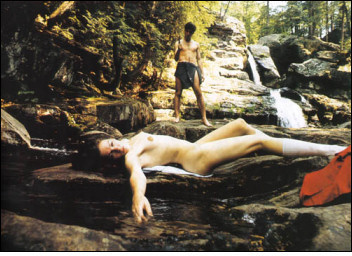
I would also argue that De Palma makes explicit what
Hitchcock could only show implicitly due to the censorship of the Hays Code. If
one looks at some of the pre-production stills from Hitchcock un-realized Kaleidoscope, which is about a necrophiliac serial killer in New
York, it includes some of his most sexual and violent imagery: naked women,
nudes in a park, bloody murders and so on. It is this Hitchcock and in this
sickness, which De Palma would take to in extreme position in his films
starting with Dressed to Kill.
So, yes, there are definitively elements of Hitchcock in his
films, just as there are elements of Godard, Bunuel, Antonioni, Welles and
Eisenstein - and he would probably be the first to admit it. But is De Palma's
films just a matter of copy-and-pasting elements from the classics? Is he
really no more than an avant-la-lettre
Quentin Tarantino, picking-and-choosing what’s "cool" about the
movies from the past and then trying to incorporate them in his own films? Is
De Palma on a rampage that consists of constantly remaking Rear Window,
Psycho and Vertigo over and over and over again?
Not only do his images seem rehashed, there is a lot in the
stories themselves that are false. For example there are the three friends that
exaggerate to try to avoid the Vietnam war draft in Greetings, the peeping-tom/activist who puts on a
professional smile and pretends to be a bourgeois in Hi, Mom!, the fake movie-within-a-movie in Body
Double, the “supposed” deaths in Wise
Guys, the room which turns out to be a set
and all of the masks in Mission: Impossible, the heist which turns out to be a ruse to betray
Carlito in Carlito’s Way, the
dream story of Femme Fatale, the
fake friendship in Passion, and
in Casualties of War when the
Vietnamese woman who was raped and murdered, reappears - a la Vertigo - to give the soldier Erikkson some sort of
closure: she does it wearing a fake prosthetic nose!
De Palma has also gone to do remakes of other films -
official and not - and he has also gone to do remakes of some of his own films!
His official remakes include Scarface
being a loose remake of the old Howard Hawks film, The Untouchables as a re-boot of the old television show by the same name, Phantom
of the Paradise is a psychedelic musical
adaptation of Goethe's Faust,
there is Dionysus in '69 which
is a recording of a The Performance Group stage play, and Passion is a very close remake of Alain Corneau's Crime
d'Amour. While the remakes of his own
films and of certain key scenes includes the motif of voyeurism, which is that
of a man looking from his room into the apartments across from him; which
begins in Hi, Mom! and will
re-appear in Body Double. There
is the story of a lost lover who is haunting a man, which you can see in Obsession,
Blow Out, Casualties of War, and Mission to Mars. And the only real difference between Casualties
of War and Redacted is one is set in Vietnam while the other one takes
place in Iraq.
It's relevant here to bring up a great new book on the
director: Chris Dumas’ Un-American Psycho: Brian De Palma and the Political
Invisible (Intellect, 2012), which does
more to argue for De Palma's place as a major filmmaker than anything that has
come before it. One of his key points is in regards to De Palma’s attempt early
on in his career to go from New York to Hollywood to make a “Hollywood” film, Get
to Know Your Rabbit. Dumas thesis
regarding it, is such, “his expulsion from Get to Know Your Rabbit is the traumatic moment at the core of the De
Palma’s narrative, and everything that he does, every film he makes after this
point […] will in some way refer back to this moment as a defining failure, a
prima scene that must be endlessly replayed and that forms the horizon of what
it is possible to represent.” From Get To Know Your Rabbit onward, Dumas argues, that De Palma pushes the
limits in terms of peoples (i.e. the audience, critics) expectations of him.
You want a Hitchcock film? Well here’s Dressed to Kill! You want gore? Well here’s Scarface! You want pornography? Well here’s Body
Double!
What are we meant to take seriously in all of this? Dumas
posits, is that, “we should take seriously the process by which we decide what to take seriously.”
It is relevant to bring up the political realities of the
time to better understand De Palma’s movies. The assassination of John F.
Kennedy in Dallas in November of 1963 is important – as political
assassinations have appeared in a few of his films (Blow Out, Snake Eyes). Not only is the event itself important, but also
how it is dealt with in the media, and what is the etiquette of filming after
such an event. The Vietnam War is also very important (De Palma himself never
went). You can get a stronger sense of this in De Palma’s early,
Robert Kramer-like films.
The leftist historian Howard Zinn in his great book The
Peoples History of The United States,
writes about the eighties in terms of how, "Regan's victory, followed
eight years later by the election of George Bush ('89), meant that another part
of the Establishment, lacking even the faint liberalism of the Carter
presidency, would be in charge. The policies would be more crass - cutting
benefits to poor people, lowering taxes for the wealthy, increasing military
budgets, filling the federal court system with conservative judges." While
Dumas contextualizes the times and De Palma within the “the aspirations of the
New Left and the continually evolving struggle for women’s rights.”
These historical factors provide the spirit of the times
that flowed through and around De Palma’s films. And De Palma addresses them in
a variety of ways: by being critical, ironic, cynical, satirical and so on. De
Palma’s current marginality – his films are not huge commercial successes, and
he isn’t a household name like Spielberg or Cameron – might be due to taking an
unpopular stance towards a lot of these subjects (one just thinks of the
anti-military message in Snake Eyes).
Perhaps this is why in the early twenty-first century his
films seem as relevant as ever, which might just prove that he was ahead of his
times. His all-seeing eye – like the camera in Snake Eyes, which photographed the true murder
-, which watches all, is one of a critical position and skepticism. There is
also a Brechtian quality to his images in that they heighten the viewer’s
awareness that they are watching a movie, which also makes one more skeptical
of what their seeing. For example, it is no coincidence that the second half of
Body Double takes place in the porn
industry: it’s actually a prescient signifier showing the viewer that images
have become pornographized, and if one wants to move forward, one
must acknowledge them as such.
But before I conclude I want to bring up the author David
Foster Walace, and his important essay E Unibus Pluram: Television and U.S.
Fiction (1993), where in it he analyses
television’s role in developing the mind-frame of post-50’s American writers.
Foster Wallace brings up issues of medium-specificity, “what should literature
be today?”, as well as tonal questions, “the nexus where television and fiction
converse and consort is self-conscious irony.”
Though, the two points that I want to discuss in regards to
De Palma is the idea of image-fiction,
and what is the role of social protest in the arts. Foster Wallace describes
the concept of image-fiction as,
“The fiction of image is not just a use or mention of televisual culture but a response
to it, an effort to impose sort of
accountability on a state of affairs.” And in response to television’s
commercialization, Foster Wallace posits possible solution for creating works
of social protest and that they are: 1) the one obvious option is for the
fiction writer to become reactionary, fundamentalist; 2) adopt a somewhat more
enlightened political conservatism that exempts the viewer and networks alike
from any complicity in the bitter stasis of televisual culture; 3) finding a
way to incorporate television’s pleasurable qualities into a work that tries to
do something more meaningful.
These points illustrate the difficulty and complexity of
the creative process after the televisual, and that one must position one-self
within these positions. The current realities have multiplied a ten-fold, now
in the second decade of the twenty-first century; when our culture seems
addicted to new media and social-networking tools like Facebook, Twitter,
iPhones and so on. One can no longer create and still be naïve about such
matters. Though there are problems with this telemorphosis, which is going on,
there are redeeming qualities to it. But I shouldn’t verge too off-topic.
Now when most of De Palma’s films are easily rentable, and
that there is a democratization of film criticism– we no longer need the seal
of approval from the gate-keepers of good taste - De Palma’s film have slowly
found their champions and are being defended. The works themselves have
outlasted the ideological battles of their initial release and stand on their
own for their originality, audacity, and relevancy.
And if they offer a cynical viewpoint, it might have to
something to do with the dark, and awkward times that we are living in. Dumas
conclusion, which seems especially relevant, is that “in the end, there is
nothing but the knowledge that one could have done better, but did not – and
that, regardless of one’s success or failure in producing justice, the
spectator will also fail.” The
reoccurring theme of De Palma’s films is that of a character who sees and is
powerless to act in front of a bad situation. Watching is very unsettling.
Which is something that is also very Hitchcockian.

Subscribe to:
Posts (Atom)