One of the most cited examples is their (in)famous review of Batman. The review needs to be historicized. It comes from this period at Cahiers eight years after Toubiana became the chief editor and it’s written by Katsahnias one of their most passionate critics of Hollywood films. The Critique is in a Événement dossier, which also includes an essay by Bill Krohn. It’s Tim Burton’s third film and it shows a masterful use of form and ability to create a critical spectacle of American society. It would be Burton’s launch into popularity, which would lead to an illustrious and creative career, especially throughout the upcoming Nineties. He would be one example, of many new figures, that would shake things up at Cahiers, and reflect the evolving direction cinema was going, and how the magazine would respond to it, and what priorities these new critics had to bring to the magazine. And it was meant to be provocative, and controversial, and they did loose subscriptions for putting it on their cover (this would be addressed in their subsequent issue). It would be criticized in Positif too for valorizing too much a film that doesn’t necessarily deserve more media attention.
On Katsahnias,
when he died of AIDS in 1999, Stéphane Bouquet pays homage to him in the Cahiers of June 1999 (N.536),
To write at Cahiers (we don’t know this when we start, we might hesitate if that was the case) is to experience the process of an accelerated maturation… The generations renew themselves so quickly (and we’re not going to fight against this) that it takes so few years to feel like you are one of the seniors… Iannis Katsahnias really liked American cinema. The more it was commercial, popular, and trivial; the more he took it seriously and tried to bring to it the most philosophical concepts. The central idea to his approach to Hollywood cinema could be resumed as follows: all mainstream American films proposed (without trying to be, or conscious of) an aesthetic cypher of the social, political and economic life in the Unite States, there and for the whole world… Katsahnias’ theories were a lot more then just hype. He was able to locate something buried within American cinema.
The years 1988 and 1989 are decisive for American cinema at Cahiers in this period. In 1988 there
would be four covers dedicated to American films and in 1989 there would be seven.
It would be a way for Cahiers to
close their decade and to highlight the films and directors that they deemed
important. If the older Cahiers
critics could see themselves in Kaufman, Eastwood, Scorsese, Coppola, and
Cronenberg then the new, younger critics could see themselves in the new directors
like Spike Lee, Tim Burton and Rob Reiner.
The Burton cover represents a small revolution inside of the
magazine.
For example, take Kaufman as an example of one of these older
American directors from this Eighties period. In Charles Tesson’s review of the The Right Stuff, Seuls les Heros on des Ailes, he opens his Critique,
When Kubrick was directing 2001, NASA and its Apollo program, were a few months away from walking on the moon. A pure coincidence? What is there in common between a fiction that was concocted in a studio and the real voyage into outer-space, between a blurry video image where we see a figure barely moving and the Cinema Scope colors in 70mm? Regarding The Right Stuff, we could say that it operates, 15 years later, like the synthesis of these images.
Tesson elaborates, “The
Right Stuff is a reconstituted documentary but it’s especially a science
fiction film in its purest state (a
fiction about science) that, regardless of its script is able to implement a
shadow of the real.” Tesson sees a filiation between the western, aviation
and science fiction film and sees The
Right Stuff as a renewing of the tradition of the explorer film, which he connects to Bazin. Tesson writes, “André Bazin, who was always attracted to an
exploration cinema, recognized that this type of documentary posed a double
problem: a question of technique and
that of morality. “To trick to better be able to fool the
spectator to see the reality of the events,” he used to say. And to see The Right Stuff, we could say, that it
perfectly fits this mold.”
While de Baecque writes the Critique for Kaufman’s The Unberable Lightness of Being (Cahiers, N.405), Prague Mon Amour. The film is a grand European production that was
made with important European collaborators like the cinematographer Sven
Nykvist and the screenwriter Jean-Claude Carrière, which contributes to its
Czech and humble sensibility. De Baecque sees in the film three major moments: an
erotic friendship, a temptation to exist, and then its failure and then the
normalization of attitudes. De Beacque highlights,
The work on emotions implements also the collective. The essential aesthetic task of the film: the lightness of being is equally the lightness of a population, the erotic games of the population engulfs the collective consciousness… A lightness and weight, the individual and the collective, these two oppositional camps are both aesthetic and narrative, and they give Kaufman and the film all of its ambition: to bring together a coincidence into an instant, bring together their story with History.
Another example is Tesson again with his imposition of a new American filmmaker, Oliver Stone, who he saw as offering a breath of fresh air with his
film Platoon, which offered an ideal
cinematographic treatment of the Vietnam War (which Stone took part in) and
reminded him of the films of Samuel Fuller (a Daney reference).
In Tesson’s Critique, La
Planete Guerre, he writes, “Why do we feel really strongly in front of Platoon of seeing something that has
never been filmed before like this?” By being the story of its survivors, writes Tesson,
This is why Platoon isn’t only one more film on the Vietnam War but, in my opinion, the first film from the Vietnam War… For Oliver Stone, the war film is… the story of an adventure of a subject who perceives (sight, touch, hear), these are trajectories of sensations that are like shots from off-screen and that burrow within the frame… Properly speaking, Oliver Stone, isn’t an aesthetic (he’s not interested in the pyrotechnic madness of the war as seen by Coppola or, coming up, without a doubt, in Kubrick’s Full Metal Jacket) but a realist director who knows how to give to life this documentary material. That’s already a lot.
One of the more visible critics who imposed and wrote some
of the more impressive reviews in this period is Iannis Katsahnias. But there
were also others like Nicolas Saada, who joined in the summer of 1987, where he
only wrote a few Notes reviews, before starting in January 1988 to write Critiques. The first one was on Elaine May’s Ishtar and
subsequently he reviewed Rob Reiner’s The Princess Bride, John Landis’ Coming to America, and Tim Burton’s Beetlejuice.

There was also Thierry Jousse who would write the Critique for Reiner’s When Harry Met Sally, Boy meets girl (N.425),
Rob Reiner isn’t looking to surprise his audience but to work on suspense (in the Hitchcockien sense), that is to say more on the how then on the why. The art of Rob Reiner consist to sidestep all of the way to the end… When Harry Met Sally tells its story ideally, that is to say with a charm and rhythm (there’s no one bad shot), the eternal story of American cinema, which we could resume in one phrase: boy meets girl.
While Jean-Sébastien Chauvin, a contemporary writer at Cahiers, has this to say about the Burton
issue,
I started to read Cahiers at the end of the Eighties. I remember that the first issue that I bought was the one with Bertrand Blier’s Trop belle pour toi on the cover and a few months later the one with Tim Burton’s Batman on the cover. I had already a certain idea of what Cahiers was and this might have been that of a caricature. I thought that it only defended these films that were really intellectual and when I saw this issue I felt all of the sudden in my zone. They had an eclectic taste where they could support these European auteurs and these B films. I only found out later that this was a part of the Cahiers history. I admit, when I first started reading their critiques I didn’t understand everything that they wrote. Today, evidently, when I re-read these texts, it seems the opposite, very straight-forward, but I think it takes some time to understand their mode of thought, the manner in which these ideas, which I wasn’t used to, are formulated.
***
The following is Iannis
Katsahnias Cover Critique of Tim Burton's Batman from the September 1989 issue of Cahiers du Cinéma (N.423).

For the last few months we’ve been assisting a
publicity campaign that has been particularly abstract and wonderfully
elliptical: just an image, that of a bat, which is subtly inscribed within an
ellipse. What is surprising is the thinness of its message. Does this bat
really need this presentation? Who doesn’t know today the symbol of Batman?
Frightening, terrorist, and traumatic. It’s a message that’s been dropped on
the walls throughout cities like the mark of vampire teeth on the neck of
its victims.
The sign of Batman is a brand that’s owned by DC Comics Inc., which is the new industry of myths, and which is owned by Warner. It’s a hermetic sign, which is already fifty years old, and that today the film is trying to penetrate. From its first shot, the camera plunges through a tunnel into a lunar landscape before offering us a perspective of exposition. The visual work therefore becomes a ritual of representation that transforms the landscape and molds it into a giant Batman sign. Behind the sign, and behind the image, is an object that is reproduced and commercialized to infinity, but which hides a character that was created by Bob Kane in 1939. He’s the planetary opposite to Superman in the DC Comics super-hero world, Batman is a character that is impure, a creature between a dog and a wolf, a child that, before losing his parents, by the age of ten, has become the father of this Bat-man.
The primitive scene takes place in Gotham City. Doctor Wayne and his wife brought their little boy Bruce to see The Mark of Zorro (the silent version by Fred Niblo with Douglas Fairbanks in the first part of the series, and then the one by Rouben Mamoulian with Tyrone Powers later on). While leaving the cinema, they got a little lost, and, in an obscure street, a thug emerges from out of nowhere and threatens them with a gun. They visibly are trying to rob them. A few instances later, Bruce Wayne’s parents are shot down by these bad guys. Batman is this mourning child who has become a masked justice fighter, doubled and impenetrable, daily and nocturnally.
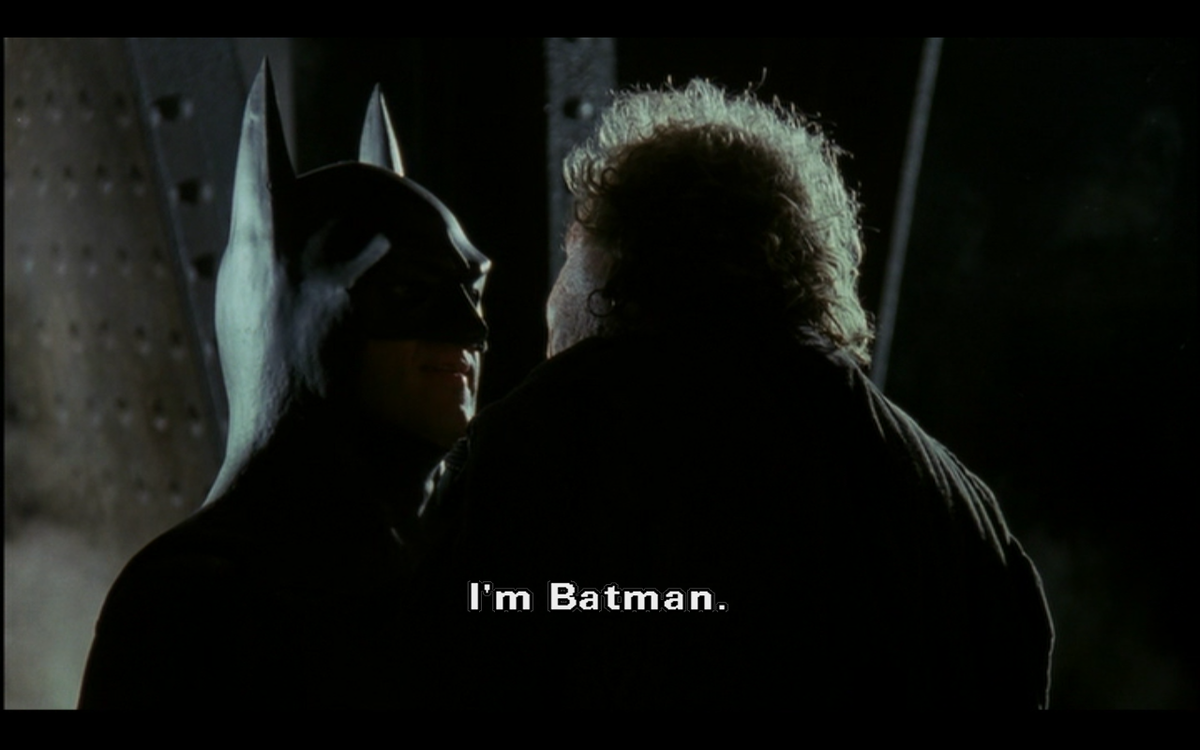
The first scene of Tim Burton’s film is a variation on the theme of the primitive scene. A couple and their son are leaving a movie theater, they bicker, and two thieves come out of nowhere and start menacing them. They beat the father and steal his wallet and then run away and hide on a rooftop to avoid being found. And then, a large bat show up. “I’m not going to kill you,” he says to one of them “I want you to tell all your friends about me.” “Who are you?” asks the thief before being dropped into some debris.
 Batman isn’t a three-dimensional
representation of the comic book. Tim Burton doesn’t only rely on the culture
of the comic books. He puts into question all of the foundations of its memory.
Because Batman isn’t singular. He’s the sum total of all of the drawn images of
him by the different illustrators and of the written stories by its different
scriptwriters throughout the years. Freud acknowledged the inexactitude of memories.
In a dream, for example, the face of a friend blends many ones. A building
could have the window of another one. Memory is a mess. And Batman has the
image of this palimpsest. For Tim Burton, there isn’t only one real one,
either. There only exists the duration of the projection, a time where these
disperse moments can coexist. The clock in the Gotham cathedral, for example,
is inspired by Antoni Gaudí’s architecture, and which is coiffed with the
gothic house from Psycho and the
staircase from Vertigo.
Batman isn’t a three-dimensional
representation of the comic book. Tim Burton doesn’t only rely on the culture
of the comic books. He puts into question all of the foundations of its memory.
Because Batman isn’t singular. He’s the sum total of all of the drawn images of
him by the different illustrators and of the written stories by its different
scriptwriters throughout the years. Freud acknowledged the inexactitude of memories.
In a dream, for example, the face of a friend blends many ones. A building
could have the window of another one. Memory is a mess. And Batman has the
image of this palimpsest. For Tim Burton, there isn’t only one real one,
either. There only exists the duration of the projection, a time where these
disperse moments can coexist. The clock in the Gotham cathedral, for example,
is inspired by Antoni Gaudí’s architecture, and which is coiffed with the
gothic house from Psycho and the
staircase from Vertigo.
But even though the film is composed with objects made from preexisting entities, I wouldn’t permit myself to describe them with the word ‘culure’ (cinephilic or other), since this word here would loose its sense. The ensemble is something that’s unique, a creation of a dream, where the citations, the references, and the winks become sublime. It is exactly the image of the Batman character (Michael Keaton), because through recreating his mental universe after the death of his parents, that now, Bruce Wayne, had been able to mix his last memory of the cinema – the mask of Zorro – with the image of the bat that broke into his house through the window, during one of his nights of morning. Condemned to remember the death of his parents forever, each time he reflects on it he treats it differently, just like it would be rendered by a different animator.
Let’s also salute the casting of Michael Keaton to play the main role. He’s the absolute anti-thesis to the super-hero, and he’s extremely under-played for such an eccentric character. The actor gives the character all of the gravity of his mourning, which is the origins to the creation of Bob Kane. Batman as played by Michael Keaton becomes a blessed man.
The representation of the confusion of memory is just the start of a work that is a lot more complex. The film doesn’t recall the cultural memory that a lot of today’s European directors work with; he’s inventing literally all of his pieces. One must watch the scene at the Flugelheim Museum (which, by the way, owes its name to the Guggenheim Museum in New York), where the Joker (Jack Nicholson), a villain that has become a clown after being drowned in acid, sets up a date with Vicki Vale (Kim Basinger).
Let me open up a parenthesis here to present this disastrous ‘man who laughs’, to which Batman owes partly its immense success (‘The more successful the villain…’, said Hitchcock). We never knew much about the origins of the Joker until Brian Bolland and Allan Moore gave us the key in a memorial story, which was entitled The Killing Joke. The Joker was a married man who abandoned his work to become a comedian. Unfortunately, his jokes never made anyone laugh. So to provide for his wife and future son, he decides to accept to help some criminals to rob a chemical factory. But Batman’s intervention causes him to fall into a pot of chemicals, which on contact transforms the color of his skin to white and his hair green. The accidental death of his wife happens the same day, which ends up making him go insane and become a crazy criminal. The script by Sam Hamm only holds on to one part of this story (here is another example of the eclectic work on memory).
In Tim Burton’s film the Joker isn’t someone who’s innocent and was just corrupted by chance and the cruelty of life. In the film he’s bad right from the start, and his fall into the acid, just pushes this further to an extreme. What Tim Burton holds unto, by the way, from The Killing Joke, is the interpretation of Jack Nicholson, which makes clear, the side ‘failed comedian’ of the character. There’s never been an actor that has been so genial at being ‘bad’.
But lets return to the Flugelheim Museum. The Joker intervenes in the comfortable ambiance of the museum like a switch to a commercial right in the middle of the film, which is accentuated by the smoke and dance music, to then cover the ‘works of art’ in bright paint. But this so-called vandalism just prolongs the work that was already there in the décor. It just puts the finishing touches on the project of the oeuvre. (‘The advertisement that interrupts the films on TV definitively outrages the attitudes of those with good intentions, but they highlight judiciously that most televisual productions don’t even attempt an ‘aesthetic’ level, and that they share the same depths as this publicity,’ wrote Baudrillard in America). By bringing together Rembrandt, the impressionist and Francis Bacon; the museum has already broken down certain aesthetics and cultural values in this décor that’s baroque, cynical, naïve and funny.
The modernity of the lighting, youthfulness and savagery of Tim Burton’s film is the image of America itself: it resumes itself in the way it forms the culture of the past in a surprising ensemble. Batman is the glorification of American individualism to the point of schizophrenia. It’s a film that illustrates Freudian id and superego in a grotesque, clownesque and carnavalesque register. The character of Batman becomes the exterminating angel and the terror against the American way of life.
“When I talk about the American ‘way of life’, it’s to underline its utopia, the mythic banality, its dreams and its grandeur,” writes Baudrillard, again, in America. “This immanent philosophy, not only in regards to the development of its technique, but also to its surpassing, in its excessive games regarding its technique, not only in regards to its modernity but its overabundance of modern forms (whether it is the verticality of New York or the horizontality of Los Angeles), not only in its banality but towards its apocalyptic forms of its banality, not only in regards to the reality of the quotidian life, but towards the hyper-reality of this life, that which, takes up, all of the characteristics of a fiction. It is this fictional character that is passionate. So fiction is no longer imaginary. It becomes real as it’s being imagined.” And Batman realizes this imagination of the mourning child, which we all are.
Iannis Katsahnias
* “A bat from the tropics of America, in general it’s an insectivore, but which can sometimes bite sleeping mammals to draw their blood.” (The Dictionary)
The sign of Batman is a brand that’s owned by DC Comics Inc., which is the new industry of myths, and which is owned by Warner. It’s a hermetic sign, which is already fifty years old, and that today the film is trying to penetrate. From its first shot, the camera plunges through a tunnel into a lunar landscape before offering us a perspective of exposition. The visual work therefore becomes a ritual of representation that transforms the landscape and molds it into a giant Batman sign. Behind the sign, and behind the image, is an object that is reproduced and commercialized to infinity, but which hides a character that was created by Bob Kane in 1939. He’s the planetary opposite to Superman in the DC Comics super-hero world, Batman is a character that is impure, a creature between a dog and a wolf, a child that, before losing his parents, by the age of ten, has become the father of this Bat-man.
The primitive scene takes place in Gotham City. Doctor Wayne and his wife brought their little boy Bruce to see The Mark of Zorro (the silent version by Fred Niblo with Douglas Fairbanks in the first part of the series, and then the one by Rouben Mamoulian with Tyrone Powers later on). While leaving the cinema, they got a little lost, and, in an obscure street, a thug emerges from out of nowhere and threatens them with a gun. They visibly are trying to rob them. A few instances later, Bruce Wayne’s parents are shot down by these bad guys. Batman is this mourning child who has become a masked justice fighter, doubled and impenetrable, daily and nocturnally.
The first scene of Tim Burton’s film is a variation on the theme of the primitive scene. A couple and their son are leaving a movie theater, they bicker, and two thieves come out of nowhere and start menacing them. They beat the father and steal his wallet and then run away and hide on a rooftop to avoid being found. And then, a large bat show up. “I’m not going to kill you,” he says to one of them “I want you to tell all your friends about me.” “Who are you?” asks the thief before being dropped into some debris.
Batman isn’t a three-dimensional
representation of the comic book. Tim Burton doesn’t only rely on the culture
of the comic books. He puts into question all of the foundations of its memory.
Because Batman isn’t singular. He’s the sum total of all of the drawn images of
him by the different illustrators and of the written stories by its different
scriptwriters throughout the years. Freud acknowledged the inexactitude of memories.
In a dream, for example, the face of a friend blends many ones. A building
could have the window of another one. Memory is a mess. And Batman has the
image of this palimpsest. For Tim Burton, there isn’t only one real one,
either. There only exists the duration of the projection, a time where these
disperse moments can coexist. The clock in the Gotham cathedral, for example,
is inspired by Antoni Gaudí’s architecture, and which is coiffed with the
gothic house from Psycho and the
staircase from Vertigo. But even though the film is composed with objects made from preexisting entities, I wouldn’t permit myself to describe them with the word ‘culure’ (cinephilic or other), since this word here would loose its sense. The ensemble is something that’s unique, a creation of a dream, where the citations, the references, and the winks become sublime. It is exactly the image of the Batman character (Michael Keaton), because through recreating his mental universe after the death of his parents, that now, Bruce Wayne, had been able to mix his last memory of the cinema – the mask of Zorro – with the image of the bat that broke into his house through the window, during one of his nights of morning. Condemned to remember the death of his parents forever, each time he reflects on it he treats it differently, just like it would be rendered by a different animator.
Let’s also salute the casting of Michael Keaton to play the main role. He’s the absolute anti-thesis to the super-hero, and he’s extremely under-played for such an eccentric character. The actor gives the character all of the gravity of his mourning, which is the origins to the creation of Bob Kane. Batman as played by Michael Keaton becomes a blessed man.
The representation of the confusion of memory is just the start of a work that is a lot more complex. The film doesn’t recall the cultural memory that a lot of today’s European directors work with; he’s inventing literally all of his pieces. One must watch the scene at the Flugelheim Museum (which, by the way, owes its name to the Guggenheim Museum in New York), where the Joker (Jack Nicholson), a villain that has become a clown after being drowned in acid, sets up a date with Vicki Vale (Kim Basinger).
Let me open up a parenthesis here to present this disastrous ‘man who laughs’, to which Batman owes partly its immense success (‘The more successful the villain…’, said Hitchcock). We never knew much about the origins of the Joker until Brian Bolland and Allan Moore gave us the key in a memorial story, which was entitled The Killing Joke. The Joker was a married man who abandoned his work to become a comedian. Unfortunately, his jokes never made anyone laugh. So to provide for his wife and future son, he decides to accept to help some criminals to rob a chemical factory. But Batman’s intervention causes him to fall into a pot of chemicals, which on contact transforms the color of his skin to white and his hair green. The accidental death of his wife happens the same day, which ends up making him go insane and become a crazy criminal. The script by Sam Hamm only holds on to one part of this story (here is another example of the eclectic work on memory).
In Tim Burton’s film the Joker isn’t someone who’s innocent and was just corrupted by chance and the cruelty of life. In the film he’s bad right from the start, and his fall into the acid, just pushes this further to an extreme. What Tim Burton holds unto, by the way, from The Killing Joke, is the interpretation of Jack Nicholson, which makes clear, the side ‘failed comedian’ of the character. There’s never been an actor that has been so genial at being ‘bad’.
But lets return to the Flugelheim Museum. The Joker intervenes in the comfortable ambiance of the museum like a switch to a commercial right in the middle of the film, which is accentuated by the smoke and dance music, to then cover the ‘works of art’ in bright paint. But this so-called vandalism just prolongs the work that was already there in the décor. It just puts the finishing touches on the project of the oeuvre. (‘The advertisement that interrupts the films on TV definitively outrages the attitudes of those with good intentions, but they highlight judiciously that most televisual productions don’t even attempt an ‘aesthetic’ level, and that they share the same depths as this publicity,’ wrote Baudrillard in America). By bringing together Rembrandt, the impressionist and Francis Bacon; the museum has already broken down certain aesthetics and cultural values in this décor that’s baroque, cynical, naïve and funny.
The modernity of the lighting, youthfulness and savagery of Tim Burton’s film is the image of America itself: it resumes itself in the way it forms the culture of the past in a surprising ensemble. Batman is the glorification of American individualism to the point of schizophrenia. It’s a film that illustrates Freudian id and superego in a grotesque, clownesque and carnavalesque register. The character of Batman becomes the exterminating angel and the terror against the American way of life.
“When I talk about the American ‘way of life’, it’s to underline its utopia, the mythic banality, its dreams and its grandeur,” writes Baudrillard, again, in America. “This immanent philosophy, not only in regards to the development of its technique, but also to its surpassing, in its excessive games regarding its technique, not only in regards to its modernity but its overabundance of modern forms (whether it is the verticality of New York or the horizontality of Los Angeles), not only in its banality but towards its apocalyptic forms of its banality, not only in regards to the reality of the quotidian life, but towards the hyper-reality of this life, that which, takes up, all of the characteristics of a fiction. It is this fictional character that is passionate. So fiction is no longer imaginary. It becomes real as it’s being imagined.” And Batman realizes this imagination of the mourning child, which we all are.
Iannis Katsahnias
* “A bat from the tropics of America, in general it’s an insectivore, but which can sometimes bite sleeping mammals to draw their blood.” (The Dictionary)


