How can a film magazine be challenging? Who
is their readership and what do they want to hear? How to fulfill a demand
without getting trapped in a schema? What movies should be emphasized and how
to write about them? Should there be a fidelity to what has already been published? What should their relation to film history be? And how should print media correspond with digital websites?
So far, to counter this, here at Toronto Film Review, I’ve provided
translations of their recent assessments of the filmmakers Brian de Palma and
Paul Verhoeven. To add to this list here is a new survey of the complete films
of M. Night Shyamalan.
*****
Unbreakable (Cahiers, Jan ’01, N.553),
w/ Cahier Critique by Emmanuel Burdeau, Mon
père ce héros.
The first review of a Shyamalan film in Cahiers was for Sixth Sense, which was rated negatively and relagated to the Critiques section. The
review by Olivier Joyard talks about the platitudes of Bruce Willis, the film's dullness, its inferiority to the work of his contemporaries (Resnais and Egoyan are brought up), and its lack of intellectual merit. This is not a good start for creating a rapport with Shyamalan.
Emmanuel Burdeau, on the other hand, in his review of Unbreakable praises the director. “It
is of no use anymore to asks what is cinema (to answer this question, simply: the
domain of ghosts) but instead one should ask what can cinema achieve: what is the destiny
that it can reserve to these already-deads, to these still-living people whose troubles are on the screen.” And that, “In Unbreakable we find the same religiosity that we found in Sixth Sense. But here it slowly takes
on one of the greatest subjects: progressive disbelief by someone whom the
belief comes from.” Burdeau revises the opinions of Joyard’s
original review: “Sixth Sense,
already, is a response against those that say cinema is dead. Unbreakable takes up this argument and
refines it. First proposition: cinema isn’t dead, because death is
spreading everywhere. Second proposition: it isn’t dead because this death
(life, actually) doesn’t even recognize itself; ghosts in fact still think they're alive (Sixth Sense) and the heroes
are already dead (Unbreakable).” And because of the film's emphasis on the body, Burdeau compares Unbreakable to New Rose
Hotel, Matrix and Mission to Mars.
With this review Burdeau confirmed that Shyamalan is a
filmmaker to look out for and to defend at Cahiers,
and which he would write about on a couple more occasions at the magazine.
*****
Signs (Cahiers, Oct. ’02,
N.572), w/ Cahier Critique by Charles Tesson, Sainte trinité.
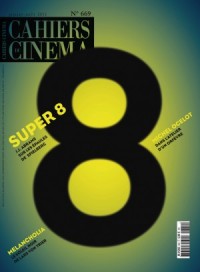
Like Bong Joon-Ho’s The Host and J.J. Abrams’ Super
8, Shyamalan's Signs is a film in the shadow of Spielberg’s E.T.. But where with E.T.
the alien came to befriend (at the time, Spielberg expressed that aliens would
not harm), in these films and in Spielberg’s own War of the Worlds aliens are not only unfriendly but
dangerous and violent. Where in E.T.
the alien can be viewed as a cinematic metaphor for growing up and dealing with
the sadness of divorced parents, the presence of vicious aliens in the recent films reflects a darker post-9/11 mood.
Signs
is about Graham Hess (Mel Gibson), a former priest who lives on a farm with his younger brother and two children. He is widowed, his wife
having died in a tragic car crash. There is something supernatural in the air at his Pennsylvania farm; crop circles appearing late at night in
the surrounding cornfields.
Charles Tesson, the reviewer of Signs, is one of the rare older generation Cahiers
writers who still contributes today (eg. Naissances
du Cinéma Indien, N.686) and who is also now the Artistic Director of the Semaine
de la Critique at Cannes. There is also a great article by Burdeau about Signs in the Shyamalan book, Critical Approaches to the Films of M. Night Shyamalan: Spoiler
Warnings.
 Tesson begins his review, “The latest film of M.
Night Shyamalan, unlike Unbreakable,
is a movie that is on dangerous grounds, which is about to rupture.” Tesson
describes the filmmaker, “a cineaste rather gullible, skilllful, and blessed in
regards to showing our proposed universe. Shyamalan is the opposite of a naïf
in regards to his usage of special effects and especially that of his mise en scéne. He believes in cinema’s
ability to create tricks and their capacity to fabricate frights.” Tesson
continues, “This great alliance between a real talent of mise en scene and a theoretical understanding of American cinema’s
fictional ability contributes to what makes Shyamalan’s cinema so unique.”
Tesson begins his review, “The latest film of M.
Night Shyamalan, unlike Unbreakable,
is a movie that is on dangerous grounds, which is about to rupture.” Tesson
describes the filmmaker, “a cineaste rather gullible, skilllful, and blessed in
regards to showing our proposed universe. Shyamalan is the opposite of a naïf
in regards to his usage of special effects and especially that of his mise en scéne. He believes in cinema’s
ability to create tricks and their capacity to fabricate frights.” Tesson
continues, “This great alliance between a real talent of mise en scene and a theoretical understanding of American cinema’s
fictional ability contributes to what makes Shyamalan’s cinema so unique.”
Tesson speaks about the use of the
television in Signs,
“The television is the primary character in
Signs: at the beginning of the film,
the little girl complains that the TV is not working, without understanding
that all of the channels are playing the same image – September 11th.
In front of these flaming towers, any child could have had the same reaction.
[…] This presence reveals the starting point of Shyamalan’s project: after
9/11, the new cinematic fictions are to be created in the reflections of a
turned-off television screen; this is when cinema will be able to regain all of
its rights."
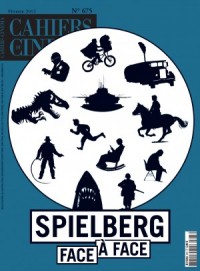
Tesson compares Shyamalan to Spielberg,
“Shyamalan’s universe, like that of Spielberg’s (in this respect, his twin
brother), relies on the denial of sexuality. We have to believe in these
characters that no real libido.” Tesson concludes,
“So what are the signs are sign of? A first
step towards sexuality. A new trinity in the name of the father, the son and
the extraterrestrial where the family can recompose itself and the paternal function
can regenerate. And where are the women in all of this? Between the daughter
who places her glasses of water all over the place and the mother who dies and
looses all of her blood, the liquid hypotheses is quickly consumed.”
*****
The
Village (Cahiers,
Sept. ’04, N.593) w/ Cahiers Critique by Jean-Pierre Rehm, Le village est-il damné?, and a Contrechamp by Emmanuel Burdeau, Stupeur et enchatement.
There was a documentary that came out to
accompany The Village, which
is The Buried Secret of M. Night
Shyamalan. It is strange because one are never quite sure if it is
meant to be taken at face value (the press material makes it especially
confusing), but either way, it highlight many themes that are apparent
throughout Shyamalan’s films, and brings up relevant biographical
points.
The
Village of the film's title is a nineteenth century
community whose inhabitants are horrified by a murderous monster living in the surrounding forest. There is something about the production design
and its isolated community that is haunted by mysterious spirits, which is similar to Lars von Trier’s Antichrist and Carlos Reygadas’ Silent Light and Post Tenebras Lux.
Jean-Pierre Rehm, like Tesson, is another
old Cahieriste who now programs at the
FIDMarseille film festival. In his close reading of the film, which
references the Greek classics, he sees the film as a work of social criticism.
“To be a professor of American history,
what filmmaker’s ambition today is to do that?” Rehm asks at the
start of his review, “The one, as it seems, who
claims it the least.” The Village
with its love story, production design, costumes, casting, and cinematography
is, “evidently and slyly, grand and understated, Shyamalan’s latest fairy tale.”
On the use of horror in the film Rehm
writes,“The Village is economic when
it comes to creating terror: no special effects, little is hidden, nor does the
narrative stall, in it the Grand Guignol remains in the background, and the story reveals itself in scenes of expeditious explanations.” Rehm
continues,
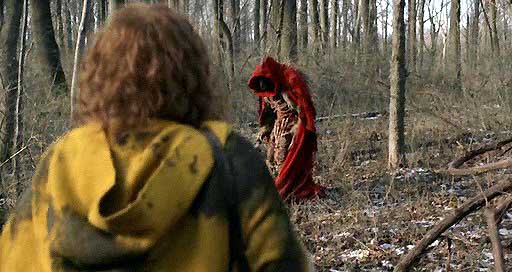 “The
origin of the fear, which is revealed to the audience simultaneously as it is
revealed to the blind heroine, is fear itself. It is the red berries that are
part of this conspiracy theory, that bring about this danger which is a
creation of the Ancients, these Amish actors, as a way to preserve their
project: to isolate themselves in a clearing of innocence and to isolate
themselves from the world and its corrupt cities.”
“The
origin of the fear, which is revealed to the audience simultaneously as it is
revealed to the blind heroine, is fear itself. It is the red berries that are
part of this conspiracy theory, that bring about this danger which is a
creation of the Ancients, these Amish actors, as a way to preserve their
project: to isolate themselves in a clearing of innocence and to isolate
themselves from the world and its corrupt cities.”
The
Village's setting is a fictionalized spatial and temporal one that
becomes a “lesson in dramaturgy.” For Rehm, “Brecht, has finally landed in
the American culture industry, and teaches about the necessary critical
distance.” And he continues,
“Here it is, placed at the heart of suspense,
that he tells us: the tale the most sober and poignant is only an illusion
destined to create a change. To substitute a real violence for a fabricated changes everything. Because to
substitute an uncontrollable violence for another one, real and controllable, that is why the Ancients decided to escape. The real world that is
discovered at the security booth when the chief is reading the newspaper is even more violent.”
For Rehm,
“The fiction is an enclosure, not because
it is real but because it is presented as the actuality. But do we know this?
Since Aristotle this has been said. Does it scare people? Not necessarily. If
it is like the difference between The
Manuscript Found in Saragossa or Brigadoon
or other baroque novels, the fiction is less menaced by the commonplace
violence of the surrounding world, but instead comes from the suffocation of
its utopia, the falsity of its magic, and the disintegration of faith itself.”
Rehm brings up the Italian philosopher Giorgio Agamben to speak about the
politics of the film,
“This is why even though the village is
supposed to be a model of the real, as the chief security speaks about, there
are no planes allowed to fly over the forest, this is nothing but a zone of
non-rights. This territory has become an invisible backstage and with its
surveillance it becomes a sort-of Guantanamo in the rural country. It is no
longer against the exceptional, but a territory constantly in a state of
exception. A state that ceases, like is written by Agamben, “d’être ramené à une situation extérieure et
provisoire de danger réel et tend à se confondre avec la norme même.””
Rehm brings up contemporary events in
relation to his reading of the film,
“The
Village is a bittersweet account of an American seized within its origins
mythology that is completely artificial and that is trying to understand the
reasons why the state incarcerates. Where someone like Michael Moore heavily
plays the Zorro character, Shyamalan prefers the plasticity of a strong fable:
set in 1897 (which can be seen on the tombstone in the opening sequence) to
today, from the stories to its origins, from the western to the pitiful scenario created to
invade Iraq for weapons of mass destruction. These arms, each spectator must
understand are their own and it is the world outside of the village.”
In Rehm’s conclusion he tries to tie
everything together (admittedly, in a complex way, and I’m not sure if I’m
doing his rhetoric justice),
“What kind of boss is then the filmmaker?
Here like before, Shyamalan needs to mystify the options to then pick an
intermediate location. His chief security character, a modest role but an
important one, puts a sense of scale to what Jacob is doing. The Walker
professor teaches history and all of the children listen to him. But there is a
troubling wind that is abounded. The wind continues to agitate the trees of this
Pennsylvania forest where the leaves on their branches can no longer grow. This
troubling atmosphere blows with it a renewed complexity, and where the
particulars are in front of us to see.”
***
Burdeau in Stupeur et enchantement begins, “A major filmmaker: M. Night
Shyamalan, revealed himself to be when he released The Sixth Sense. Since then this evidence is evidently confirmed in
Unbreakable, Signs and now The Village.”
“In
four films, Shyamalan has reignited the beauty, which has for a long time has
been neglected, of decoupage,” writes Burdeau, “But if this was it, grammar and
story-board, Night would only be a master of an art, which isn’t that
important, that of a competent craftsman. But, to our surprise and happiness,
there are two elements that are important to the logic of his “pure cinema.””
These two qualities are, “wild comedy and dry irony but which is understated and where the summit of this
is the jeweler scene in Sixth Sense,”
and, “an extreme slowness. In Shy’s films there is a petrified burlesque, a
terrible weight that belongs to his creatures and somnambulist, more so than
his ghost […] These are films that are dressed in heavy cotton, and it is a
cinema which is slowed down. The suspense is decomposed with each new image.”
What is the function of the comic and the
slowness? “It is to highlight but to wrong, accentuate and to delay revealing
its complex mystery. We have learnt that with Shy, especially when his films
are starting to reveal themselves, and then when they start to shine, that he
organizes each shot like a clue within a larger enigma where only the outcome
will reveal its true purpose.” Burdeau continues, “Let’s call what he does stupor, a word that brings together his
comic tendencies and the slow-burn. Double stupor: a camera that lingers upon a
devastated landscape, the people that are looking out at it: eyes wide open,
standing still, in awe.”
Burdeau’s great conclusion,
“With Shy, this stupor is everywhere, and
it is with it that his cinema carries the promise of being about more than just
mise en scene. It renders the viewer
weak as a way to save them; we can feel it as we watch the screen. And just
like the fake costume-drama of The
Village this common interest, which asphyxiate and seduces, which brings us
closer and farther apart, talks about something extremely precise: this weird
gathering, talks about the intimate trouble that connects us today to images."
*****
Lady
in the Water (Cahiers,
Sept. ’06, N.615) w/ Événement Cahiers Critique by Jean-Philippe Tessé, Rire et ravissement.
Lady
in the Water is perhaps the most clear and unpolluted
Shyamalanesque vision and the most representative of his imagination and burlesque. Inspired by a childhood
fairy tale he invented for his daughter (and which he would also produce into a book)
it is perhaps his funnest and most entertaining film. And amongst the
impressive special features on his DVDs (which includes his early teenager
short films, and lengthy making-of docs) the behind the scenes of Lady in the Water is maybe his best
(with Sixth Sense, The Village and The Happening following).
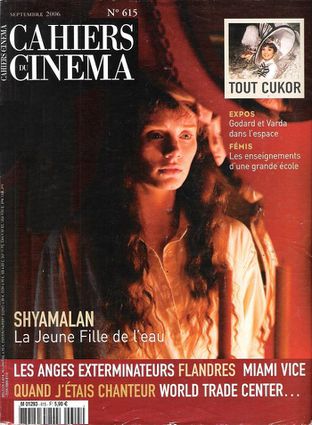
Lady
in the Water is the only Shyamalan film to make it
onto Cahiers’cover page and its
review by Jean-Philippe Tessé, who is now the joint chief-editor, clearly
articulates what the magazine admires in Night's films. Tessé contextualizes
Shyamalan’s place in the magazine in his intro:
“The enthusiasm we have at Cahiers for the cinema of M. Night
Shyamalan since his breakthrough into Hollywood will not diminish with Lady in the Water. The laughing at it
by some people will not change what we think.
Simply because it confirms the certitude of finding in Night’s films a
cinema of constant action. Just because it places this within a grotesque fable
with crazy theories, we can’t help but be ecstatic because we place Shyamalan
as the cineaste le plus farfelu de son
temps. His use of comedy is the key to enter into his films.”
In the review the impressive set (the swimming pool motif which was anticipated in Unbreakable) and décor are acknowledged. But
more importantly Tessé writes,
“The encounter with an entity that is so
radically strange is for the filmmaker the privileged motivation for him to
make these fictions. That which comes does not bring with it order, but comes
in the marvel of itself to create these new connections, they are strange
unknowns. Shyamalan films this encounter like nobody else, the moment of pure
newness, and he does it in the most simple of ways, by letting things just be
there, framing the shot in its after-moments.”
For Shyamalan, “there is something that you
need to be ready for his films, which is that of amazement, if you want to enter his game.” Tessé
continues,
“It is by replaying indefinitively this primitive scene of amazement
that Shyamalan was able to find a style. He hasn’t really reinvented
storytelling (though his storytelling grammar is unique to him alone) but
instead he has redefined the fantastical. To say it differently: there is a
pact between the spectator of a Tourneur film, that believes in supernatural
forces, and the person who doesn’t, or who hasn’t adjusted their belief system
to allow for it [...] Nothing else interests Shyamalan, not the ravaging
twists that end some of his films, nor metaphors that we want to read into some
others, nor the ways that the fantastic is manifested: Nothing else interests
him then this opening, this brutal change of coordinates, a total upheaval of
perspective.”
 Tessé also writes about how “the scene
captures this stunned response, that dictates everything: these scenes of
action, that go in unexpected new directions, time which is standstill, and the
tone of the scene is infinitively comic.” And after bringing up some
farfetched scenes in the film, Tessé acknowledges their ludicrousness, “You
would be right, they are aberrant. Welcome to M. Night Shyamalan, cineaste and
joker.” And this combination, as Burdeau also elaborated on, Tessé sees as “the
alliance stunned-comic can be described in one word: burlesque.” Tessé expands, “Shy is a burlesque, which is a primitive category, who dreams of
being a fabulist full of humor and that is when he is at his best: when he is
being comic.”
Tessé also writes about how “the scene
captures this stunned response, that dictates everything: these scenes of
action, that go in unexpected new directions, time which is standstill, and the
tone of the scene is infinitively comic.” And after bringing up some
farfetched scenes in the film, Tessé acknowledges their ludicrousness, “You
would be right, they are aberrant. Welcome to M. Night Shyamalan, cineaste and
joker.” And this combination, as Burdeau also elaborated on, Tessé sees as “the
alliance stunned-comic can be described in one word: burlesque.” Tessé expands, “Shy is a burlesque, which is a primitive category, who dreams of
being a fabulist full of humor and that is when he is at his best: when he is
being comic.”
To also note about Lady in the Water, the book The
Cookbook by the Night character in the film which he describes as “it is
actually about my thoughts about all of our cultural problems,” and along with
the child psychiatrist character in Sixth
Sense, seems to anticipate the book Shyamalan is about to publish Schooled: The Five Keys to Closing
America's Education Gap about the high-school educational institutions in
Philadelphia.
*****
 There are some other think pieces about
Shyamalan that have appeared in Cahiers
aside from their reviews. The important piece is Années
Hollywood: Shyamalan, Sodergergh, Penn, Mann, Spielberg, Eastwood
(July-August ’06, N.614). In this issue the editor of the time Jean-Michel
Frodon has a good editorial, Bouger les
lignes, Stéphane Delorme has a good overview of contemporary Hollywood, Sur Les Auteurs d’Hollywood, and Hervé
Aubron has an article, Shy en miroir avec
Mann, which compares the films of M. Night Shyamalan with the films of
Michael Mann.
There are some other think pieces about
Shyamalan that have appeared in Cahiers
aside from their reviews. The important piece is Années
Hollywood: Shyamalan, Sodergergh, Penn, Mann, Spielberg, Eastwood
(July-August ’06, N.614). In this issue the editor of the time Jean-Michel
Frodon has a good editorial, Bouger les
lignes, Stéphane Delorme has a good overview of contemporary Hollywood, Sur Les Auteurs d’Hollywood, and Hervé
Aubron has an article, Shy en miroir avec
Mann, which compares the films of M. Night Shyamalan with the films of
Michael Mann.
Another good article appeared in
their Les Meilleurs Films des années 2000
issue (Jan ’10, N.652) in the Cinq
cineaste pour les années 2000 section and it is written by Bill Krohn (I
will hopefully translate that in its entirety at a later date).
I’m not going to discuss the films that Shyamalan
only contributed the story too, or screenplay, since he did not direct them so they do not
reflect accurately his temperament. Stuart
Little has Shyamalan’s water motif and his outsider figure is literalized
as a mouse, and Devil has elements
of the supernatural and family trauma (and a great Joshua Peace performance as Detective
Markowitz) but they are minor works and Cahiers
sees them as such.
*****
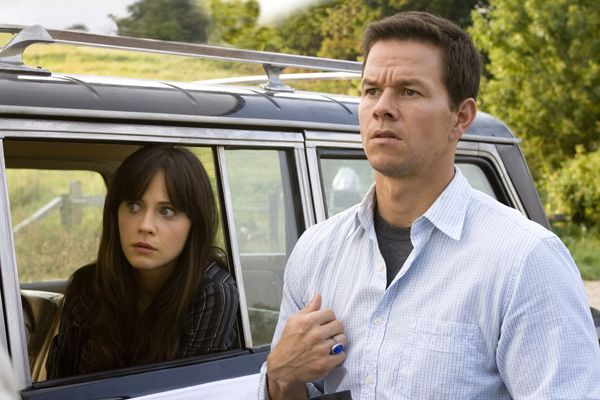
The
Happening (Cahiers,
June ’08, N.635), w/ Cahier Critique by Emmanuel Burdeau, Tombée de la nuit.
Each time a new film by a director the review in Cahiers reevaluates them by
highlighting what made their prior films good, evaluating the new film, and criticizing their flaws. They are
building upon the earlier reviews written about the director in the magazine and the writer's review is distinct for their own unique writing style.
In Burdeau’s review he acknowledges that Cahiers is a minority when it comes to
appreciating Shyamalan. He then brings up the difficulty Cahiers had to watch in advance The
Happening so that they could review the movie. There was an interview with Shyamalan that fell through, the film was
not playing in the US, so Burdeau ended up having to catch a plane to Spain
to watch it.
And the film deceived him… But regardless,
Burdeau still found interesting things to say about it,
“The spectator is warned,
this new film is another exercise in reading: less an explanation of a text
then a favorable plea for the never-ending activating of reading […] The films
of Shyamalan have no other concerns. Nor other messages. The mysteries in them
cannot be resolved, only translated and retranslated to no end from one
language to another, now in the thickness and within the oscillation of so many
voices.”
“The tone is Shyamalian,” says Burdeau,
“which means that it is hard to pronounce with usual language. Wonderful and cryptic.
Exotic and comic. Cryptic and spiritual. Mischievous and furiously
intellectual. This is a weird kind of structuralism: the film does not
construct an intrigue, it’s happy to measure an advance towards dread and also
the pleasure that goes into action when there is an intelligence to the
happenings that are put forth into action.”
Burdeau: “I insist: this isn’t a spectacle,
it’s a lecture; it isn’t about the action, it’s about thought; it isn’t a
screenplay, it is a fable.” And, “like in The
Birds which is the inspiration for all of Shyamalan’s films, the
catastrophe is like the magical resuscitation for the dysfunctional family.”
Burdeau also compares the haunted house scene to Indiana Jones.
But Burdeau sees a fault in the film, “The
decision to not give an explanation to the happening as anything but nature is
the films biggest problem, the biggest rupture with Shyamalan’s other films.”
He goes on, “What is lacking in The
Happening is not an explanation or even more action scenes. What is lacking
is dialogue that would resonate with the smallest of detail and the whole.
Shyamalan is a grand painter of the everyday because he saw the larger picture,
the text of all the other texts.” And that the environmentalist message of the
film is simple.
Burdeau gives Shyamalan the benefit of
the doubt, “This disaster of a disaster film might have something to do with
its production that went through several producers.” Burdeau hopes that
Shyamalan’s next film will be better, and as the little girl on the bus turns
around, her backpack reveals a graphic for Avatar:
The Last Airbender.
*****
The
Last Airbender (Cahiers,
Sept. ’10, N.659) w/ Répliques by Vincent Malausa, Une Page Blanche, and an interview, Air Shyamalan, by Malausa and Jean-Sébastien Chauvin.
This is an important issue in the
development of Cahiers since its new
chief editor took the role late in 2009. There was at first an uncertainty of how to direct the magazine (e.g. small
polemics: an anti-Fellini stance, destroying Funny People etc) but with each passing year the magazine's positions became stronger. The most vocal stance is
perhaps their railling against the petrification of severity in contemporary art-house films,but
they are also known for their championing of American films and world cinema.
What makes Cahiers N.659 so special, with a still of Antony Cordier’s Happy Few on its cover, is
its Événement, Nouvelles utopies du
cinema francais. In the issue Delorme speaks of and is critical
of the trend in French cinema of “mettre
en scene des utopie.” Where he sees in these idealist utopias an escape of
the urban and its realities, which for a long time has been the emphasis of
French cinema. Delorme asks, “What direction are these fictions going in? Why a
closure, which takes place in the form of a denial, to substitute for another
closure, that of the social?” Delorme
prefers Des homes et des dieux
against Homme au bain and Happy Few.
This idea of the utopia of French cinema is
going to be something the magazine will return to. The idea of taking a position and then being commited to it will start to be more important in Cahiers after this issue. This is articulated through the magazines stronger emphasis on their use of meta-textual references. By referencing other articles and other issues
there is a stronger interconnection between each issue and this
bond is making the magazine more dense with connections, more clear and
thorough with its argument, and more convincing and interesting.
In Cahiers N.659 the magazine praises Uncle Boonme by Apichatpong that would make it on their Top Ten Films of 2010. There are also similarities between the Apichatpong film and Shyamalan's The Last Airbender
with their use of nature and spirituality. Apichatpong
has also acknowledge his admiration of Shyamalan. Through how the directors in them present folliage there is a connection between Boonme,
The Happening and John Boorman’s The
Emerald Forest.
 To return to The Last Airbender: Malausa isn’t necessarily convinced that it is
a major work and describes the film as a “visual kitsch cocktail that mixes the
wuxia with the teenage film and Lord of Rings
to create a digital cosmologic folly.” Some highlights of the film include:
“its opening in the radiating clarity of Greenland that can be seen as the blank
canvas that Shyamalan will unleash his imagination,” and Malausa compares the energy of
the child to that of Tintin. The film has some other interesting qualities
like the dichotomy between Aang and the son of the fire god, which can be seen as two sides of
Shyamalan’s character: one wants to create magic and mystery while the other wants
to fulfill his duties (ie. commercial imperatives). Malausa ends the pieces by
highlighting Airbenders tragic quality that connects it to Shyamalan’s other
films, “The Last Airbenders
articulates around this idea of tragedy which is that of children, who are condemned to
carry the weight of the world of their shoulders, and have to start acting like
adults.”
To return to The Last Airbender: Malausa isn’t necessarily convinced that it is
a major work and describes the film as a “visual kitsch cocktail that mixes the
wuxia with the teenage film and Lord of Rings
to create a digital cosmologic folly.” Some highlights of the film include:
“its opening in the radiating clarity of Greenland that can be seen as the blank
canvas that Shyamalan will unleash his imagination,” and Malausa compares the energy of
the child to that of Tintin. The film has some other interesting qualities
like the dichotomy between Aang and the son of the fire god, which can be seen as two sides of
Shyamalan’s character: one wants to create magic and mystery while the other wants
to fulfill his duties (ie. commercial imperatives). Malausa ends the pieces by
highlighting Airbenders tragic quality that connects it to Shyamalan’s other
films, “The Last Airbenders
articulates around this idea of tragedy which is that of children, who are condemned to
carry the weight of the world of their shoulders, and have to start acting like
adults.”
Air
Shyamalan is the first interview with Shyamalan
in Cahiers. The interview is interesting as Shyamalan talks about the minimalism of filming nature, how The Happening was inspired by Village of the Damned (“I saw this film when I was twenty and it has never left me.”), about the special effects in the film, faith in the medium, his multiculturalism, that his favorite filmmakers are Hitchcock, Kubrick and Kurosawa; talks about courage and terror, and his admiration for Agatha Christie and Planet of the Apes.
Even though Night is a championed director
at Cahiers they acknowledge the flaws in some of his films, when they deserve it. What
is the big difference between Cahiers
and how most other critics view Shyamalan’s work is that Cahiers approach his films with a generosity instead of
condescension. Shyamalan's films necessitate the viewer to take a leap a faith to best appreciate their unique and mysterious vision.