Monday, November 29, 2010

On Positif (Getting Ready For Burton)

This is a preliminary note on an eventual defense of Tim Burton. -D.D.


“In the space of eight years, between 1984 to 1992, four directors that were younger then thirty-years-old turned up in the American cinematographic landscape: Joel and Ethan Coen (who are really just one person), Tim Burton, Steven Soderbergh and Quentin Tarantino. These four musketeers form the last generation who – to this day - sparked the torch of North American cinema and were celebrated in these pages [Positif] since the start, similar to how twenty years earlier there was Coppola, Scorsese, Schatzberg and Malick.” – Michel Ciment

I have found it astonishingly surprising how controversial this above quote has been while talking to some ardent Toronto cinephiles. We would agree on a lot of other topics but when I bring it up they would become dismissive of both the directors and my taste. Others were even rude about it like how this one guy turned his back to me mid-conversation. I guess there is a time and place to insinuate that these mainstream directors are viable and that they belong within a relevant cinephilic terrain. Positif’s position is important as it takes these more artistically endeavored films by mainstream directors and lifts them to an auteur level to highlight their merits, which is relevant in a film criticism climate where they are dismissed for being the exact opposite, impersonal and generic. My squabbles are only a minor footnote in a larger unawareness and dismissal of both Cahiers du Cinema and Positif found within English-language film criticism. This refusal can be due to either an inability to be read French or a refusal to acknowledge any artistic merit in some of their outlier choices, which can lead to an eventual dismissal of the magazines as a whole. This reluctance does more harm then good as these two publications have done more for film and film culture then any particular individual or new media outlet, their catalogue is so rich with insightful writing on films and as a window into particular cultural climate, and finally, and the most important point, is the sheer pleasure of discovering a film that you truly enjoy with the awareness that it is a shared reception.

Saturday, November 27, 2010

Toronto December Film Listings

In December the Lightbox has some pretty cool stuff playing like the Exclusive Engagements of Margarethe von Trotta’s Vision, Henry Selick’s The Nightmare Before Christmas in 3-D, Gaspar Noé’s Enter the Void and Jean-Luc Godard’s Film Socialisme. There are going to be double-billed Tim Burton films with movies that inspired them or share similar characteristics and though I do not think they are all perfect match-ups, I am still really looking forward to see some of the accompanying titles as they are by some fun auteurs like Mankiewicz, Harryhausen, Wood, Tashlin and Waters. The Jafar Panahi retrospective is topical as the Irainian director has been recently released from political imprisonment. The Essential Cinema series is coming to a close and, thankfully, next up is Chaplin. Elsewhere, I am curious to see what Florian Henckel von Donnersmarck does in his second film, the big-budget and all-star cast The Tourist. The Bloor Cinema and the Japan Foundation are programing a few Japanese films. The Toronto Film Society has a musical and holiday double-bill on December 6th and 12th. And, the Pleasure Dome’s fall programs last screening is on December 4th.

I am sure I missed a few things but that is it for now. In the following space I will be adding the titles alongside a generic one-out-of-four star rating to the films I actually see.
*****
Big Fish (Tim Burton, 2003)
** (Worth Seeing)

*****
Corpse Bride (Tim Burton & Mike Johnson, 2005)
* (Has redeeming facets)

*****
Sweeney Todd: The Demon Barber of Fleet Street (Tim Burton, 2007)
**** (Masterpiece)

*****
Batman Returns (Tim Burton, 1992)
*** (A Must-See)

*****
Crimson Gold (Jafar Panahi, 2003)
*** (A Must-See)

*****
Offside (Jafar Panahi, 2006)
**** (Masterpiece)

*****
The Mirror (Jafar Panahi, 1997)
**** (Masterpiece)

*****
The Ghost and Mrs. Muir (Joseph L. Mankiewicz, 1947)
*** (A Must-See)

*****
Ed Wood (Tim Burton, 1994)
**** (Masterpiece)

*****
Bride of the Monster (Edward D. Wood Jr., 1955)
** (Worth-Seeing)

*****
2001: A Space Odyssey (Stanley Kubrick, 1968)
**** (Masterpiece) Essential Cinema # 26

*****
Early Monthly Segments In tribute to Will Munro


*****
Pee-wee's Big Adventure (Tim Burton, 1985)
*** (A-Must-See)

*****
Black Swan (Darren Aronofsky, 2010)
** (Worth-Seeing)

*****
Modern Times (Charlie Chaplin, 1936)
**** (Masterpiece)

Wednesday, November 3, 2010

MDFF Reviews (Green Crayons, Woman Waiting)

“In my opinion, there aren’t big or small subjects [for film], because the smaller the subject is, the more we can treat them with grandeur. In truth, there is only truth.” – Claude Chabrol

Kazik Radwanski’s Green Crayons is the captivating story of two elementary school children, an Indian Canadian kid Xavier (Raj Manav) and his Caucasian friend Liam (Kaiden Wiliams), who have to deal with the consequences of spitting on each other in class. At first glance the story appears sweet as the two children are in a classroom; in the background there is one of those inspirational posters that says “Be Generous” and they are browsing through books with cute titles like “Dog” and “Big Cats”. It unexpectedly takes a turn towards an impromptu spiting battle between the two until this catches the attention of the teacher who only sees Liam spitting and sends him to the principal’s office. The rest of the ten-minute short film deals with Liam's shame due to that the principal is going to have to call his parents and Xavier’s guilt of getting his friend in trouble. The green crayon of the title refers to the Crayola writing instrument used by Liam to fill in the third square on his notebook, which means that the principal will have to call his parents. He is asked to fill in the square several times before he does so reluctantly. The grandeur of how this scene is treated reaffirms the above Claude Chabrol quote and has the intensity of the young Jean-Pierre Léaud police interrogation in Les Quatre Cents Coups (1959). The films emotional core comes from Xavier realization that he should look out for his friend. During recess, Xavier plays slapsies with this girl in the playground. He twists her arm, and slaps her in the face. You can tell there is something else eating him up. He spies through the crack of the door at the principal office to see how Liam is doing. Back in class, he rubs Cheez Whiz all over his face as a ploy to go to the washroom. On the way back in the hallway he looks at his notebook and only sees the one green square on it and afterwards he walks up to the main office door. His friend pulls him away. And when he fesses up to his teacher, her verdict is to give them both green squares; “I don’t want to give you a green square, how does that make you feel?” she says. There is no resolution, it ends with each student being more divided and a worst situation then they started. Similar to the mute elementary school children who at such a young age can define atrocities in Michael Haneke’s Code inconnu (2000), the problem facing the kids in Green Crayons is not intrinsic within the children but with the teachers and principals, especially their method of regulating the children’s behavior through a three-strikes-and-your-out approach to anti-social behavior and a one-sided approach to communication. Who knows what is next for these two little boys, outside there is a birch tree with its green leaves blowing in the wind.

Kazik Radwanski is the writer and director of four short films: Green Crayons (2010), Out in That Deep Blue Sea (2009), Princess Margaret Blvd. (2008), and Assault (2007). Film critic Jason Anderson in the Toronto star wrote “[Kazik Radwanski is] one of the most exciting local filmmakers yet to make a feature…”.
*****
Antoine Bourges’ Woman Waiting is the story of a middle age woman, Jane (Carmen Casanova), who is searching for assisted housing in Vancouver, British Columbia in the month of January 2010. During the day she runs into many complications but what is truly generous of the storytelling are the few moments of well-deserved relief and humanity. Jane gets to relax with a coffee, a nice gym receptionist gets her a free one-week membership, and she runs into a friendly woman in a buildings waiting room. Woman Waiting is Beckettian fable that hawks back to Waiting for Godot as the new apartment is always beyond Jane’s grasp and the absurdist touches like toenail clipping episode, desolate grey apartment, and the distinct looking actors further emphasize the films strangeness. There is something about Jane that is similar to Orn (Jenjira Jansuda), the old woman in Apitchatpong’s Blissfully Yours (2002), as the two women are old, express loss and frailty through their physical appearance and dress, and both movies showcases them in fat two-piece bathing suits while swimming. The cinematography by William Fritzberg frames the actors to best showoff their individual characteristics and the swimming pool scenes gleam as a place of solace. It is no surprise I saw Antoine during TIFF 2010 leaving a Kelly Reichardt Maverick Series as Woman Waiting closest antecedent is Reichardt’s Wendy and Lucy (2008) as they are both about marginal women, grim social realities, and a constant feeling of displacement.

Antoine Bourges’ is the writer and director of two short films: Woman Waiting (2010), and Hello Goodbye (2008).

The company Medium Density Fibreboard Films (MDFF) was founded in 2007 by the producer Daniel Montgomery and the director Kazik Radwanski; www.mdff.ca.

Tuesday, November 2, 2010

Toronto November Film Listings (New Mandate)

Since my move to Toronto I had to reconsider the mandate and title of Ottawa Film Review. Now that I am a Toronto resident, I decided to change the title to Ottawa-Toronto Film Review. I would have removed the Ottawa- from the title except that would force me to change the url, which would cause major revamping. Maybe one day… Anyways, what can be expected from Ottawa-Toronto Film Review in the next while? I want to change my traditional monthly film listings from a mere listing to a written paragraph format (see below). Ideas for pieces that I have been ruminating: (1) Write a piece on two films from the Toronto-based production company MDFF; Kazik Radwanski’s Green Crayons and Antoine Bourges’ Woman Waiting; both films premiered at the TIFF 2010 Short Cuts Canada. (2) Finish reading James Quandt’s (the senior programmer of the TIFF Cinematheque) book on the Thai director Apichatpong Weerasethakul (FilmmuseumSynemaPublikationen; 2009) in the hopes of writing a book review. And, (3) see more Zacharias Kunuk’s films that are available to view at the Isuma Productions website. I will just be doing generic posts with all the screenings I see and an arbitrary star ranking, and I hope it is clear, this website prides itself on the longer pieces, the criticism and the reporting, and not on the minor viewing acknowledgements.


At the Toronto Film Society on Monday November 15th at 7:30PM there is a double-bill that consists of Jules Dassin’s Thieves’ Highway (1949) and Martin Ritt’s Edge of the City (1957). The Toronto experimental film collective Pleasure Dome is having a few screenings in November. I will keep seeing all the TIFF Essential Cinema films that I have yet too see and others that I want to re-see; so far I have seen eighty-four out of one-hundred and I hope to do a personal top ten afterwards. There are a few Exclusive Engagements that I want to see; Le Pere de mes enfants, The Light Thief, and I Wish I Knew. On Friday November 5th the Bloor Cinema will have a free screening of Scott Pilgrim vs. the World with the director Edgar Wright in attendance. Later on in the month at the Bloor Cinema there will be screenings of Small Change (Nov. 7th – 9th) and Blow Out (Nov. 25th, 9:30PM). I have also discovered the 18th annual rendezvous with madness film festival (Nov. 5th -13th), which has some interesting titles like Denis Villeneuve’s Next Floor (Nov. 6th; 8:30PM) and William D. MacGilivray’s The Man of a Thousand Songs (Nov. 13th; 8PM). As well there is the 14th annual Toronto Reel Asian International Film Festival; I particularly look forward to see Clement Cheng and Derek Kwok’s 70s kung-fu ode Gallants (7PM; Bloor Cinema); the directors will be in attendance and afterwards there is the opening night gala party at the Century Room (free with a screening stub). Yeah and finally I will go see any cool-looking new releases; right now I want to see Stephen Frear’s Tamara Drew. - David Davidson

*****
Johnny Guitar (Nicholas Ray, 1954) Essential Cinema # 63
*** (A Must-See)

*****
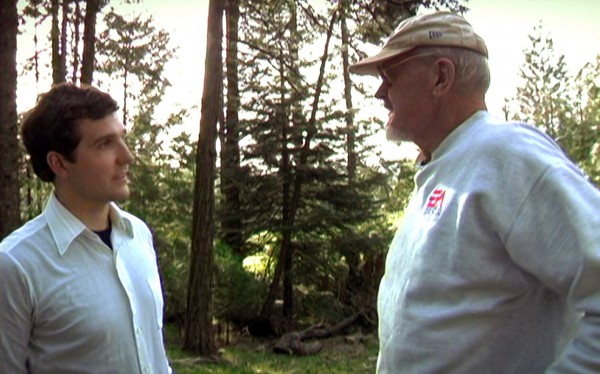
Winnebago Man (Ben Steinbauer, 2009)
* (Has redeeming facets)
*****
Singin' In The Rain(Stanley Donen & Gene Kelly, 1952) Essential Cinema # 62
**** (Masterpiece)

*****
Memories of Underdevelopment (Tomás Gutiérrez Alea, 1968) Essential Cinema # 68
*** (A Must-See)

*****
Le père de mes enfants (Mia Hansen-Løve, 2009)
*** (A Must-See)

*****
Good Neighbours (Jacob Tierney, 2010) *Director in attendance.
** (Worth Seeing)

*****
Tamara Drew (Stephen Frears, 2010)
** (Worth Seeing)

*****
Recent Video by Gary Kibbins *Director in attendance. Pleasure Dome
7 Questions About Bicycles (2009) & The Unlucky Sailor (9 Unread Chapters of Finnegans Wake) (2010)

*****
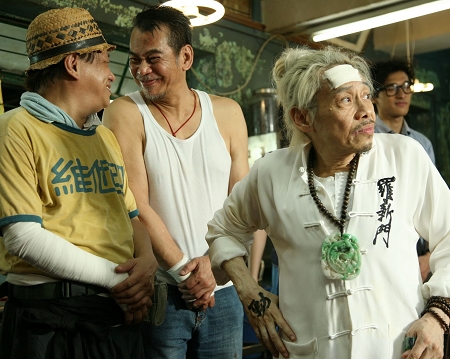
Gallants (Clement Cheng & Chi-kin Kwok, 2010) *Clement Cheng in attendance.
** (Worth Seeing) Reel Asian
*****
A Film For Ollie Gilbert (Scott Cudmore, 2010) *Director in attendance.
** (Worth Seeing) 107 Shaw Gallery

*****
I Wish I Knew (Jia Zhangke, 2010)
*** (A Must-See)

*****
The Land Left Behind (Juan Camilo Sarmiento, 2010) *Director in attendance.
*** (A Must-See) aluCine

*****
Bringing Up Baby (Howard Hawks, 1938)
*** (A Must-See) Essential Cinema # 61

*****
Cléo de 5 à 7 (Agnès Varda,1962)
**** (Masterpiece) Essential Cinema # 96

*****
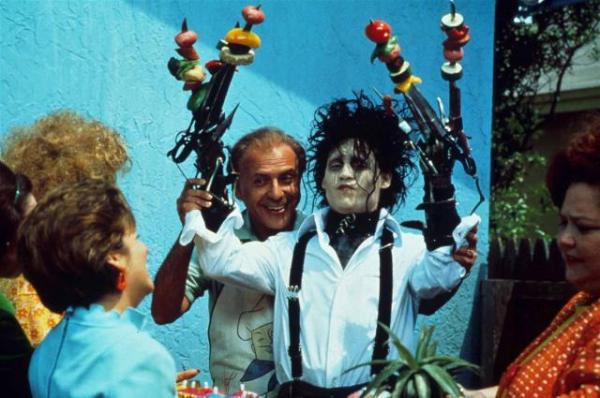
Edward Scissorhands (Tim Burton, 1990) *Director in attendance.
*** (A Must-See)
*****
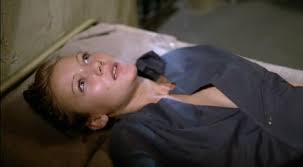
Barbed Wire Dolls (Jess Franco, 1975)
** (Worth Seeing)
*****
Kings of Pastry (Chris Hegedus & D.A. Pennebaker, 2009)
** (Worth Seeing)

*****
The Light Thief(Aktan Arym Kubat, 2010)
*** (A Must-See)

*****
The Third Man (Carol Reed, 1949)
*** (A Must-See) Essential Cinema # 91

*****
Dust in the Wind ( Hou Hsiao-Hsien, 1986)
**** (Masterpiece) Essential Cinema # 69

*****
Blow Out (Brian De Palma, 1981)
*** (A Must-See)

Monday, October 25, 2010

Toronto Film Festivals (enRoute & imagineNATIVE)

It seems like every week there is a new film festival taking place in Toronto. So far have I attended two of these, the Air Canada enRoute Film Festival 2010 and the 11th annual imagineNative: Film + Media Arts Festival. It was the fourth annual enRoute Film Festival: Stories that move and the short films are designated for Air Canada’s in-flight entertainment monitors. The prizewinners get all-inclusive trips to the Whistler Film Festival as well as a monetary prize. The final competition on October 13th consisted of Rob Coxford, Josh Vamos & Marlaina D’Angelo’s Push Past: Rob Dyer’s Skate across Canada, Shervin Kermani & Aita Jason’s Sofia, Allessandro Piedimonte’s A Cut Above, Sandrine Brodeur-Desrosiers Un Trou dans la Memoire, King Mugabi’s Red Snow, and Adam Shamash’s La Khaima: The Tent of Mile-End. The festival was followed by an open bar award celebration at The Drake Hotel. The most impressive short by far is Sofia. In it a reclusive elderly painter recalls the major emotional events that shaped him. From his first girlfriend telling him that they should stay together, to his father explaining why he is leaving, and to a wonderful ballet sequence by his youthful mother. The acting is superb, the mise-en-scene is original, Robert Tagliaferri's cinematography is indelible with lush colors and atmospheric lighting, and its dream-like nature accentuated by long-takes is reminiscent of Tarkovsky.


imagineNative each fall (Oct. 20th – 24th) presents a selection of the most compelling and distinctive indigenous work from around the globe. This year’s festival included two projects by Zacharias Kunuk. The 1995 Caribou Hunt, which is set in Igloolik, fall 1945, and is about the community of First Nations trying to hold onto their traditional shamanistic culture in face of a frightening changing world (i.e. WWII). There was also the world premiere of Mr. Kunuk’s new film Inuit Knowledge and Climate Change, which is an Isuma Productions documentary addressing the issue of climate change with interviews with Inuit’s that are personally experiencing the effects of melting polar ice caps. The Kaleidoscope: Shorts Program III, which I attended, highlights were Bear Witness’ Strange Home Land part 2, which is about a road-trip between Bear and his father through the Six Nations territory with interesting appropriations of Hollywood movies and Saturday morning cartoons; and Alanis Obomsawin’s When All the Leaves are Gone set in 1940, Quebec it is the story of shy little Wato who moves from the rural to the urban. To get away from the cities xenophobia and bullies, she dreams about an idyll nature setting with men-dressed-in-caribou suits to play with and a man playing the violin. These dream sequences are just charming. The program guide is really well designed and it included a memorial on the Māori, which are an indigenous group from New Zealand, filmmaker Merata Mita. The festival also had free discussions and panels. Beyond the Talking Head: New Ways to Doc, which I attended, had Peter Mettler and Zacharias Kunuk on the panel, among others, and they spoke about the importance in New Documentary of themes, honesty and transparency with the subjects, and of having a good team. - David Davidson

Wednesday, September 29, 2010

L.A. Zombie

This is my third out of three TIFF film reviews and I will also be writing a festival report. - David Davidson

L.A. Zombie (Bruce La Bruce, 2010)
** (Worth Seeing)


Bruce LaBruce's L.A. Zombie was enthusiastically presented by Noah Cowan at its TIFF 2010 premiere. The big controversy about the film was that it was turned away from the Melbourne International Film Festival for being too vulgar. Mr. LaBruce describes L.A. Zombie as an alien-zombie-gay-pornographic film and boasted about the zero star ranking in the Toronto Star, “Its just as hard to get no stars as it is to get four”. L.A. Zombie begins with scenic establishment shots of a Los Angeles beach with the water crashing against rocks and sand. The water goes off into the horizon, seagulls are standing on a rock and then an eerie naked zombie (François Sagat; a freakish male porn star) comes out of the ocean, ready to wreck havoc. In an original twist of the Romeroean zombie fable where traditionally the undead infects victims by biting them, François as the zombie has to stick his alien penis into his victims and then ejaculate a black fluid onto their open wounds, whether it is in their stomachs or a hole in their head.

In an interview between Bruce LaBruce and the artistic director of the Locarno Film Festival Olivier Père, Mr. LaBruce says “Zombies can very easily be interpreted as a fear of AIDS. So to create a zombie who heals and brings people back to life through sexual contact and the dissemination of fluids is a strong reversal of the usual paranoid representation of gay sex and AIDS” . In L.A. Zombie François comes out of the ocean looking like a decease, he is bald, has deformed vampire molars, he is muscular and naked, and is painted in bruised blues, bacteria greens and irritated reds. His first victim does not say much. The victim picks up a staggered and shredded clothes François on the side of the lonely highway. There is a fade to black. The car crashes. The man dies. For a brief moment there is so much compassion directed towards this man with the camera lingering around the corpses accompanied by a melancholy tune. This driver picked up the deceased zombie that this led to his early death. There is a moment of silence before the Zombie infects him. Los Angeles homelessness is a supposed subject of the film, similar to LaBruce’s Hustler White (1995), but the gorilla style of inconspicuous filming usually films the Zombie from a distance who has little contact with the surrounding homeless people. I guess, it is more a portrait of the L.A. homeless/schizophrenics in the vein of something like, say, The Soloist (2009), but it is not a subject that is fully explored instead of just presented.

Mr. La Bruce seems to be a Toronto fixation as the Cinema 2 at the TIFF Bell Lightbox (approximately four-hundred seats) was packed to see L.A. Zombie. The tiff Bell Lightbox artistic director, Noa Cowan made it appear that the festival has always been a long advocate for the local director and prides itself on premiering his films. The work of Bruce LaBruce is also written about in the book Toronto On Film (tiff publications; 2009). My criticism of the L.A. Zombie is that it is embarrassingly shot and the set design seemed like it was at an elementary school level. The performances were done in a canned theater style, similarly to Sidney Lumet’s gay murder mystery Deathtrap (1982). While the closest relative to it that I can thing of is those late night nymphic soft-core porn movies that would play on Quebecois broadcasting networks. You know, the ones with those bizarre child-like fairy tales with weird costumes and unabashed sex every five minutes. L.A. Zombie leaves one scratching their head more then anything else. Anyways, I can appreciate all the recommendations (i.e. Eye Weekly, Mubi, Cinema Scope, Locarno, TIFF) and I hope more people get a chance to see L.A. Zombie. It is probably going to be a little seen film, and the more recommendations, hopefully will lead to more people seeing it. What the film truly showcases is the visualization of Bruce LaBruce’s imagination and no prudish morals should interfere with its presentation and distribution. – David Davidson

(BELL Lightbox, 350 King Street West, Toronto, ON)

Tuesday, September 28, 2010

Sad Movie

This is my second out of three TIFF film reviews and I will also be writing a festival report. - David Davidson

Promises Written in the Water (Vincent Gallo, 2010)
**** (Masterpiece)


Vincent Gallo’s third full-length feature Promises written the water is radical, impolite, and punk. Though it is a little unclear, the story is about a guy, Kevin (Vincent Gallo), who is yearning an ex-girlfriend and opts for a job as a funeral director. There he takes up the role of the host of the funeral home, driver of the hearse, helps out at the mortuary and picks up the corpses. This is similar to Vincent Gallo who spreads himself all over filmmaking by being the director, editor, and producer of his films. The funeral director title is also apt to describe the guy as in his films he usually kills off his girlfriends.

He sees this women Malory (Delfine Bafort; a gorgeous thirty-one-year old Belgium model) and they go out to eat where they have a conversation about Kevin’s ex-girlfriend. In this scene, Kevin recites that Colette has left him for a fifty-five year old and that they are going to Thailand together, but she said that he would always be her favorite. What is so fascinating here is that he repeats the line five times, almost like a record skipping, but with slight variation; emphasizing the nuances of his performance, thematically bridging the film, while also expanding and creating a distinct film-language. Vincent Gallo’s music albums (i.e. When) provide interesting extensions to his films. The two are very lyrical like how the guitar strings hint towards the films tranquility and an EP like So Sad hints towards his sadness and repetition.

Kevin walks into his old apartment and picks up a pair of shoes. A mafioso tries to get him to take up a new job. He refuses. There are a lot of close-ups on his sorrowful mug and the Bressonian scenes of him walking emphasize his loneliness. Kevin pours his heart out to Malory, tells her he loves her, asks her to marry him, he plans for them to move into his house and he has money. Though she brings men home, Kevin wants her to find the one person to make her happy. It is hinted that Malory has a terminal illness and the interspaced scenes of her naked in a white bathtub foreshadow her eventual suicide. Kevin’s love for her though, his promises to her written in the water, are part of the baggage he will carry after she goes. The water motif is brought forward at the begging of the film with its opening shot of Lake Los Angeles.

There are obvious influences of Vincent Gallo’s recent collaboration with Francis Ford Coppela on the movie Tetro. The two are digital productions, they both are shot in black-and-white, Vincent Gallo’s bad ass is more rounded compared to The Brown Bunny, and they both include a dance sequence. Though Francis Ford Coppola said his cinematography is more inspired by Elia Kazan and Powell & Pressburger. Vincent Gallo and his director of photography Masanobu Takayanagi are harder to characterize but there are some semblances with works by Ashby, Antonioni, Dreyer, Cronenberg, Cumming, and von Trier. In this film there is now more dialogue, especially compared to The Brown Bunny where words were very sparse.

Vincent Gallo is one of the more exciting contemporary independent directors. He takes roles in larger films to support his independent productions. The latest film he acts in is Jerzy Skolimowski’s Essential Killing. Like Jacques Tati’s Mr. Hulot’s character, the Vincent Gallo by Vincent Gallo character is a reoccurring projection of a melancholy romantic. When Kevin helps out the mortician, carrying a corpse and says, “ I don’t want to do it.” He still goes ahead with it. There is a strange urgency in his films. His uncompromising perseverance to keep making the kind of movies he wants to make places him, alongside Harmony Karine, as one of today’s punk American independents. John Cassavetes would be proud. – David Davidson

(Isabel Bader Theater, 93 Charles Street West, Toronto, ON)