
Showing posts with label Samuel Fuller. Show all posts
Showing posts with label Samuel Fuller. Show all posts
Friday, May 15, 2015

Friday, May 8, 2015
Found File: Martin Scorsese on Sam Fuller
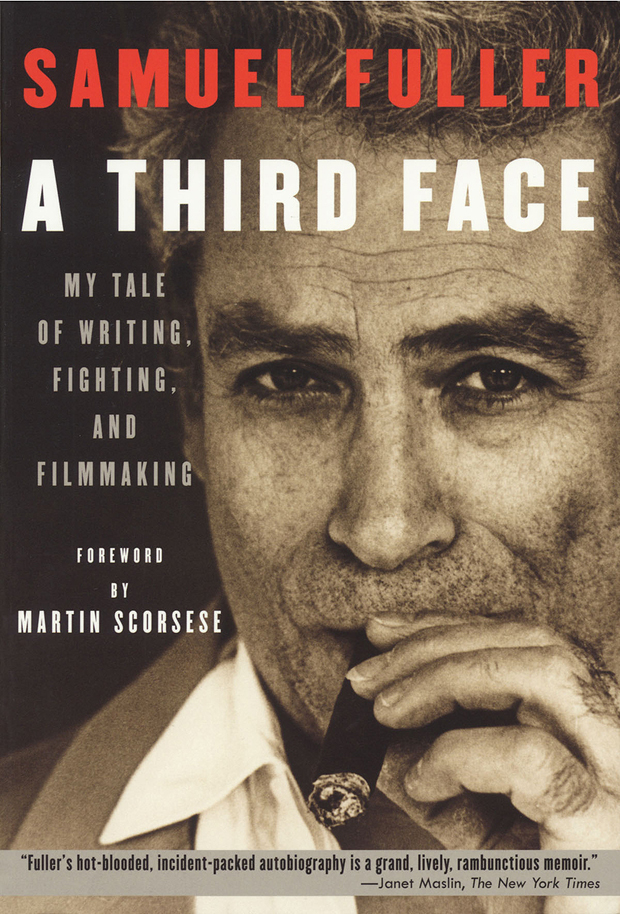 In anticipation for the documentary A Fuller Life, which is playing on
Sunday May 10th at 6PM at Innis Town Hall as part of the Toronto Jewish Film
Festival, here is Martin Scorsese's foreword to A Third Face. The essay builds upon Scorsese’s comments on
Fuller in Scorsese on Scorsese.
In anticipation for the documentary A Fuller Life, which is playing on
Sunday May 10th at 6PM at Innis Town Hall as part of the Toronto Jewish Film
Festival, here is Martin Scorsese's foreword to A Third Face. The essay builds upon Scorsese’s comments on
Fuller in Scorsese on Scorsese.
“I was moved emotionally and
psychologically when I first saw Sam Fuller’s films, then I went back to figure
out how he made them. Park Row –
which is Sam’s favourite, by the way – is a very important movie to me for the
use of tracking shots and the staging of action and violence – how the camera
tracking implies more violence than there really is. Doing that one long take
creates so much in emotional impact, giving you a sense of being swept up in
the fury and the anger, that you begin to understand more why it is happening.
What Sam always says is that emotional
violence is much more terrifying than physical violence.
“For me, there’s no such thing as
‘senseless’ violence. In the fight in the pool room, I held it long because of
the sense of helplessness, the silliness of the whole thing. In the opening of
Fuller’s The Naked Kiss, when
Constance Towers fights with her pimp, he slaps her, and her wig flies off to
show she’s bald. For this sequence, Sam strapped the camera on to their chests,
so you actually go with the hit. In Mean
Streets, in the drunken scene, Harvey had an Arriflex body brace under his
jacket, with a piece of wood made by a grip joined to the camera. As Harvey
walked forward, the grip would move backwards with him, and when Harvey went
down to the ground the grip just went sideways with him holding the contraption
– which was just a jerry-built thing, nothing special. And when Harvey got up
to dance with the strippers, we put him on the dolly.
Make sure to also read an interview with the director of A Fuller Life, Sam's daughter
Samantha Fuller, over at the blog Pinnland Empire.
***
It’s been said that if you don’t like the Rolling Stones, then you just don’t like rock and roll. By the same token, I think that if you don’t like the films of Sam Fuller, then you just don’t like cinema. Or at least you don’t understand it. Sure, Sam’s movies are blunt, pulpy, occasionally crude, lacking any sense of delicacy or subtlety. But those aren’t shortcoming. They’re simply reflections of his temperament, his journalistic training, and his sense of urgency. His pictures offer a perfect reflection of the man who made them. Every point is underlined, italicized, and boldfaced, not out crudity but out of passion. And outrage – Sam found a lot to be outraged about in this world of ours. For the man who made Forty Guns and Underworld U.S.A. and Pickup on South Street and Park Row, there was no time for mincing words. There’s a great deal of sophistication in Sam’s movies, but it’s all at the service of rendering emotion. When you appreciate a Fuller film, what you’re responding to is cinema at its very essence. Motion as emotion. Sam’s pictures move convulsively, violently. Just like life when it’s being lived with real passion.
I’ll never forget the firt time I met Sam. It was in LA in the early ‘70s, right after a screening of Forty Guns that I’d organized. When the picture was over, we started talking, and we couldn’t stop. We talked for hours, but it seemed like a matter of minutes. When it was time to leave, we kept talking as we walked to our cars. When we got there, we were still talking. Sam would start telling a story, which would lead to another story, which would then lead to a whole other story – a quality that’s reflected beautifully in this book by the way. Eventually, we had to be physically separated. We could have talked all night. Sam was one of the rare people who could both ‘talk’ a great movies and make one, too. Many people can do either one or the other, but Sam could do both. I remember once when he and Christa came over to my house for dinner. Sam started talking about an idea that he’d had for a movie about nothing but objects, and drawing the emotion out of the objects – as an example, he gave a detailed, impassioned description of the rope in The Guns of Navarone. It was absolutely mesmerizing. If anyone could have made such a movie, it was Sam.The first Sam Fuller movie I ever saw was his first, too. I was seven years old, and I’d seen a preview for I Shot Jesse James. I wanted to see it just because of the title. When the day finally came, I remember sitting on the bus with my father on our way to the theater and feeling so excited that I couldn’t understand how everyone else around us could just go about their business – didn’t they realize that I Shot Jesse James was playing? It’s a feeling many of us have as children, and we’re usually a little let down – the things we look forward to and fantasize about rarely live up to the image you can build up in your head. But this was one time that the movie more than lived up to its promise. I Shot Jesse James is a film about betrayal; Sam gets right to the heart of it – the way it feels to betray and to be betrayed. I was really struck by the moment when Jesse is taking a bath and Bob Ford, played by John Ireland, aims a gun at his back: Will he shoot, or won’t he? I’ve never forgotten this image, or many others from the movie. I’ve had them in my head since I was seven years old.Sam’s films had a force that blew all the clichés away from whatever issue they were dealing with. There are no cheap thrills in his work. He was always trying to fathom the unfathomable, whether it was a subject as broad as the inhumanity of war or the injustice of racism, or, on a more intimate level, the thirst for power or the infectiousness of paranoia. In Sam’s movies, there was no difference between the personal and the political – both were part of the continuum of human experience. I think he was one of the bravest and most profoundly moral artists the movies have ever had. That’s why his war films – The Steel Helmet, Fixed Bayonets, China Gate, Merrill’s Marauders, and The Big Red One – are the truest, the least sentimental, and the toughest I’ve ever seen. I hope that someday, The Big Red One is restored to its original form.The kid finding his father’s body in the alley and vowing vengeance as he makes a fist in Underworld U.S.A. The unbroken tracking shot that follows Gene Evans out into the street as he beats up his opponent in Park Row. The sad, lonely death of Thelma Ritter’s stoolie in Pickup on South Street. These are moments of pure, raw emotion, unlike anything else in movies. I loved Sam Fuller as a filmmaker, and it’s impossible for me to imagine my own work without his influence and example. I came to love him equally as a friend. This wonderful book, filled to the brim with his passion for life and for cinema, goes a log way toward keeping the memory of Sam Fuller alive and well.Martin Scorsese, New York City, 2002

Wednesday, April 8, 2015
Nick and Sam
Cahiers had always approached American cinema from a detached European
perspective. In this regard two of Daney’s most important critiques from his early
Eighties period are the ones on Wim Wenders’ Lightning Over Water and Samuel Fuller’s The Big Red One. These
were important films and critiques for bridging the classic Cahiers jaune era with the modern cinema
of the Eighties. Daney encouraged this external contemplation of Hollywood and
this is why his favorite American films also implicitly participated in this.
Other examples include the films of John Cassavetes, who made his home movies next door to the Majors in
California, and Barbara Loden and her only film Wanda.
There was always
a side film malade to Daney
(Truffaut’s term to discuss Hitchcock’s Marnie).
For Daney it is these sick films that
are more representative of cinema globally and Daney personally. The
documentary by Wenders met en place Nicholas
Ray’s frail and dying body which for Daney offers a surrogate for the status of
the Classical Studio era. Lightning Over
Water is seen as a film about the politique
des auteurs, where a director’s failure is seen as the more personal work
than the success, which for Daney has now become corrupted as a marketing tool.
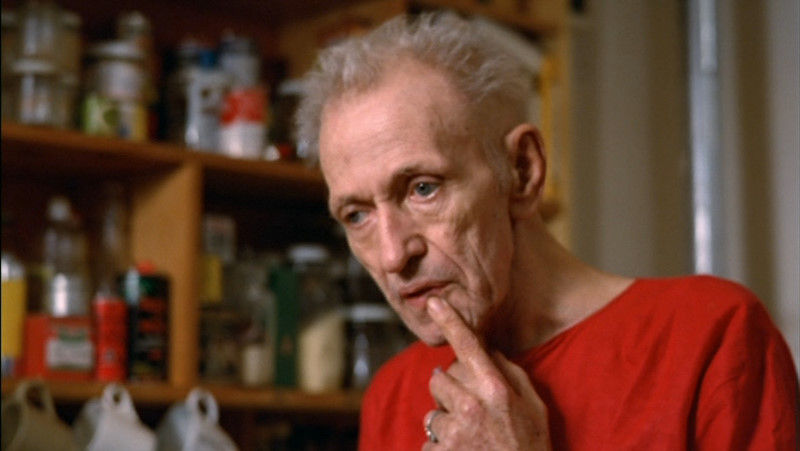
The new European
director in this period that best addressed these concerns for Daney was Wim
Wenders. There was Lightning Over Water
but also before this The American Friend where Wenders would cast Fuller and
Dennis Hopper. There is a Godardian, Le
Mépris quality to these films in their reflexivity and criticality. Daney
in his critique of Lightning Over Water
highlights its perversity which is similar to Ray’s own cinema, “The subjects
of Ray’s films is less revolt than the impossibility of revolt.” Daney’s
description of the relationship between Ray and Wenders in Lightning Over Water can equally be read as a commentary on the
relationship between different generations at Cahiers. “It’s about this
alliance that is forced due to a filiation, where this filiation is experienced
like an alliance. This is the cinema of Nicholas Ray. But also, this
relationship, experienced at the
beginning of the Eighties, becomes a way to recount the history of cinema.”
Serge Le Péron
would pick up on Daney’s analysis in his critique of Wenders’s Hammett. Le Péron writes, “For another time it is a fiction about
filiation that Wenders is confronted with.” To make the film, Wenders had to
learn the old ways of studio filmmaking and the film, which is produced by
Francis Ford Coppola, can be divided, according to Le Péron, with its story that belongs to its producer and
its images that belong to its
director. This emphasis on the director, framing and mise en scène leads Le Péron to concluding on its modernity, “For
his tenth film, with its ancient narrative and retro production, Wenders’
preoccupations are never that far away from those of Godard and Antonioni.”

Samuel Fuller’s The Big Red One, similar to George Cukor’s Rich
and Famous (which was also
featured in this period), is a late testimony film by one of the last old studio
directors. Even though Daney laments that the four-hour version will never get
properly released (which is no longer the case) he still describes Fuller’s The Big Red One as, “It’s the best film
by Samuel Fuller, and nonetheless the most personal and ambitious.” Fuller’s mise
en scène
and morality remained intact and there’s a serenity to the film that comes from
old age. Daney continues,
If Fuller was
adopted at Cahiers like a modern
filmmaker it’s because, more than any other American, he’s a filmmaker who is
obsessed with the idea of the contemporary…
Even when he was telling stories that were set in the past there was always the
sentiment of ‘the first time’. This was new to the cinema. It was as if nobody
had filmed before him… This came from how Fuller was both a wartime journalist and also a mad journalist.
Daney is
building upon Godard’s earlier legacy as a film critic and filmmaker. He’s
creating an explicit filiation with the author of one of the most famous Cahiers critiques which is that of
Godard on Bitter Victory (“Nicholas Ray is cinema…”) and of Godard
the director of Pierrot le Fou where he would cast Fuller in a small
role to discuss his wartime experiences and cinema.
Subscribe to:
Posts (Atom)