Showing posts with label Marcel Jean. Show all posts

Wednesday, April 5, 2017

100 Best Canadian Films - Marcel Jean

Marcel Jean is the second guest contributor to 100 Best Canadian Films, after Mike Hoolboom and my own list. Jean, among many other things, is the general director of the Cinémathèque québécoise, a great supporter of animation, the author of one of my favorite cinema books Dictionnaire des Films Québécois, and the director of the surprising and remarkable documentary État critique, which follows a few cultural critics as they go about their days and discuss their responsibilities. These lists are meant to be personal ruminations on our national film history.  - D.D.
***
Marcel Jean’s 100 Best Canadian Films
Begone Dull Care                                        Norman McLaren, Evelyn Lambart    (1949)
Neighbours                                                   Norman McLaren                               (1952)
Tit-Coq                                                         Gratien Gélinas, René Delacroix         (1953)
Corral                                                           Colin Low                                           (1954)
Blinkity Blank                                             Norman McLaren                               (1955)
City of Gold                                                 Wolf Koenig, Colin Low                     (1957)
Les brûlés                                                     Bernard Devlin                                    (1958)
Les raquetteurs                                            Michel Brault, Gilles Groulx              (1958)
Félix Leclerc troubadour                            Claude Jutra                                        (1958)
Universe                                                        Roman Kroitor, Colin Low                 (1960)

Very Nice, Very Nice                                    Arthur Lipsett                                       (1961)
Bûcherons de la Manouane                         Arthur Lamothe                                  (1962)
Lonely Boy                                                    Wolf Koenig, Roman Kroitor             (1962)
Pour la suite du monde                                Michel Brault, Pierre Perrault             (1963)
À tout prendre                                               Claude Jutra                                        (1963)
Le chat dans le sac                                        Gilles Groulx                                       (1964)
Nobody Waved Good-bye                             Don Owen                                          (1964)
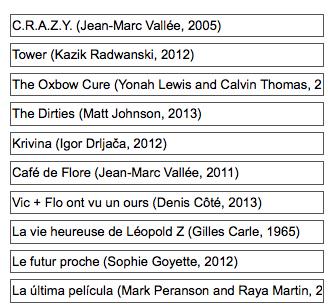
La vie heureuse de Léopold Z                     Gilles Carle                                         (1965)
The Ernie Game                                           Don Owen                                          (1967)
«The Things I Cannot Change»                 Tanya Ballantine                                 (1967)

Warrendale                                                   Allan King                                           (1967)
Wavelength                                                   Michael Snow                                     (1967)
De mère en fille                                            Anne Claire Poirier                             (1968)
Don’t Let the Angels Fall                            George Kaczender                               (1968)
Pas de deux                                                   Norman McLaren                               (1968)
Prologue                                                        Robin Spry                                         (1969)
The Act of the Heart                                    Paul Almond                                       (1970)
Goin’ Down the Road                                  Don Shebib                                         (1970)
Mon oncle Antoine                                       Claude Jutra                                        (1971)
Sad Song of Yellow Skin                              Michael Rubbo                                   (1971)

La région centrale                                        Michael Snow                                     (1971)
Le bonhomme                                               Pierre Maheu                                      (1972)
Variations on a Cellophane Wrapper        David Rimmer                                     (1972)
La vraie nature de Bernadette                   Gilles Carle                                          (1972)
Les dernières fiançailles                              Jean Pierre Lefebvre                            (1973)
À votre santé                                                 Georges Dufaux                                  (1974)
Réjeanne Padovani                                       Denys Arcand                                     (1974)
The Apprenticeship of Duddy Kravitz       Ted Kotcheff                                       (1974)
La faim                                                           Peter Foldès                                        (1974)
Les ordres                                                      Michel Brault                                      (1974)

La tête de Normande St-Onge                    Gilles Carle                                         (1975)
L’eau chaude, l’eau frette                           André Forcier                                      (1976)
The Street                                                     Caroline Leaf                                       (1976)
The Far Shore                                              Joyce Wieland                                     (1976)
L’affaire Bronswik                                       Robert Awad, André Leduc                (1978)
L’âge de la machinne                                   Gilles Carle                                         (1978)
Getting Started                                             Richard Condie                                   (1979)
Les bons débarras                                        Francis Mankiewicz                           (1980)
Premiers jours                                              Clorinda Warny                                  (1980)
La cuisine rouge                                           Paule Baillargeon, Frédérique Collin (1980)

Crac!                                                             Frédéric Back                                      (1981)
Elvis Gratton                                                Pierre Falardeau, Julien Poulin            (1981)
Les Plouffe                                                    Gilles Carle                                         (1981)
Au clair de la lune                                        André Forcier                                      (1982)
La bête lumineuse                                        Pierre Perrault                                     (1982)
Souvenirs de guerre                                     Pierre Hébert                                       (1982)
Videodrome                                                  David Cronenberg                               (1983)
Le dernier glacier                                         Roger Frappier, Jacques Leduc           (1984)
Visage pâle                                                    Claude Gagnon                                    (1985)
The Big Snit                                                  Richard Condie                                   (1985)

Le déclin de l’empire américain                 Denys Arcand                                     (1986)
Family Viewing                                            Atom Egoyan                                      (1987)
I’ve Heard the Mermaids Singing              Patricia Rozema                                  (1987)
A Winter Tan                                                John Walker, Jackie Burroughs…       (1987)
L’homme qui plantait des arbres               Frédéric Back                                      (1987)
Oscar Thiffault                                             Serge Giguère                                      (1987)
Alias Will James                                          Jacques Godbout                                 (1988)
Dead Ringers                                                David Cronenberg                               (1988)
Train of Dreams                                           John N. Smith                                     (1988)
La Sarrasine                                                 Paul Tana                                            (1991)

Léolo                                                              Jean-Claude Lauzon                            (1992)
Secret Nation                                                Michael Jones                                     (1992)
Bob’s Birthday                                             David Fine, Alison Snowden              (1993)
32 Short Films About Glenn Gould           François Girard                                   (1993)
Hard Core Logo                                           Bruce McDonald                                (1996)
Hustler White                                               Bruce LaBruce                                    (1996)
Quiconque meurt, meurt à douleurs         Robert Morin                                      (1997)
Rosaire et la petite nation                           Benoit Pilon                                        (1997)
Le chapeau                                                    Michèle Cournoyer                             (1999)
eXistenZ                                                        David Cronenberg                               (1999)

When the Day Breaks                                  Wendy Tilby, Amanda Forbis            (1999)
Atanarjuat: the Fast Runner                      Zacharias Kunuk                                 (2001)
Le fil cassé                                                     Michel Langlois                                  (2002)
The Corporation                                           Jennifer Abbott, Mark Achbar           (2003)
La face cachée de la lune                             Robert Lepage                                     (2003)
Ryan                                                              Chris Landreth                                    (2004)
C.R.A.Z.Y.                                                    Jean-Marc Vallée                                (2005)
Les états nordiques                                      Denis Côté                                          (2005)
La neuvaine                                                  Bernard Émond                                   (2005)
Congorama                                                   Philippe Falardeau                              (2006)

Up the Yangtze                                             Yung Chang                                         (2007)
My Winnipeg                                                Guy Maddin                                       (2007)
Isabelle au bois dormant                             Claude Cloutier                                   (2007)
Trees of Syntax, Leaves of Axis                  Daïchi Saïto                                         (2009)
Incendies                                                       Denis Villeneuve                                 (2010)
En terrains connus                                       Stéphane Lafleur                                 (2011)
Le démentèlement                                       Sébastien Pilote                                   (2013)
Mommy                                                        Xavier Dolan                                       (2014)
Mynarski Death Plummet                          Matthew Rankin                                  (2014)
Quiet Zone                                                   Karl Lemieux, David Bryant               (2014)

Saturday, February 21, 2015

Marcel Jean’s Dictionnaire des Films Québécois (+ More on Jean-Marc Vallée)

One of the exciting new books on Québécois cinema, along with 40 ans de vues rêvées, is Marcel Jean’s Dictionnaire des Films Québécois (Éditions Somme toute), which offers a passionate and thorough look at that province’s rich cinema. It includes 1300 titles, from feature-, medium-, and short-length films, along with animated and experimental ones, where each entry includes the film’s credits, synopsis and a commentary. It’s organized by the film’s titles, just like a dictionary would be, and it goes from A to Z.

Jean re-watched these films from 2007 to 2014 and the commentaries are all up-to-date from these recent viewings. It’s impressive to see significant entries on films that just came out last year, like Tu dors Nicole, Que ta joie demeure and Mommy.

Jean’s an expert on the subject - having worked in the industry, is a film critic and the author of numerous books on the subject - and the book’s historical depth, diversity and taste benefit from this. Québécois cinema has a richness to it in its representation of its unique culture, and it has been able to create a stable radio and television industry, which allows for the rise of smaller, more artistic films in its periphery. The book goes back to its earliest output in the Forties and then progresses all of the way to the present.

Jean’s comments can be both positive and negative. Jean appreciates originality and innovation, as well as works that are rich historically or anthropologically, while he dislikes simplifications, emotional manipulation, and miscasting. It’s also impressive for his openness and generosity towards typically overlooked forms like the short-film, animation and the experimental genre.

All of the films by the big name auteurs are there, along with many lesser-known figures and oddities. There are great entries on Denys Arcand, Louise Archambault, Michel Brault, Gilles Carle, Denis Côté, Donigan Cumming, Sophie Deraspe, Xavier Dolan, Bernard Émond, Philippe Falardeau, André Forcier, Simon Galiero, Pierre Hébert, Claude Jutra, Stéphane Lafleur, Jean-Claude Lauzon, Robert Lepage, Jean Pierre Lefebvre, Arthur Lipsett, Francis Mankiewicz, Catherine Martin, Norman McLaren, Robert Morin, Rafaël Ouellet, Pierre Perrault, Sébastien Pilote, Léa Pool, Chloé Robichaud, Daïchi Saïto, Theodore Ushev, Jean-Marc Vallée, and Denis Villeneuve.

Some of what are considered the best Canadian films are included, like Mon oncle Antoine, Les Bons débarras, Léolo, Jésus de Montréal, and C.R.A.Z.Y., which are relevant to re-watch and to read about, especially with TIFF’s best of Canadian film poll around the corner (cf. my list, on the right). It includes their popular cinema, as well. Louis Saïa is in there with Les Boys I, II and III, which are dramatic comedies on Québécois masculinity and the attraction of hockey. There are also two entries on Jean’s own films (modestly written about in the third person).

The contemporary generation of directors is present and there is an impressive inclusion of their early short films. One gets the impression that Denis Côté, Stéphane Lafleur, and Xavier Dolan are Jean’s favorite directors of this movement: Côté’s full filmography (except maybe for some shorts) is analyzed and so is Lafleur’s, whose early shorts Karaoke and then Snooze sound especially interesting.

There are some up-and-coming young directors, like Anne Émond (Sophie Lavoie, Nuit #1) and even Sophie Goyette makes it in with an entry on La Ronde. Jean writes, “With its solemn tone, its narrative economy, the unsaid, and its fascination with death, Sophie Goyette’s film is representative of a major trend in Québécois cinema, along with Nicolas Roy.”

There are some interesting choices and exclusions too, which it would be interesting to hear more about their reasoning. The films by its directors that are made outside of Québéc are typically not included. This is sometimes strange, as, for example, a film like Café de Flore, which is set in both Montreal and Paris, isn’t included. While David Cronenberg’s The Brood to Videodrome are included (Jean mentions they got Québécois funding), even though they are set in Toronto and the broader Ontario area. Dušan Makavejev’s Sweet Movie starring Carole Laure is included as one of its most controversial co-productions. It’s interesting to remember that Don Owen started his career in Montreal (The Ernie Game, Ladies and Gentlemen… Mr. Leonard Cohen, Notes for a Film about Donna and Gail). Ted Kotcheff’s important The Apprenticeship of Duddy Kravitz is there. But so is surprisingly Sylvain Chomet for La vieille dame et les pigeons and Les triplettes de Belleville, which I guess must have been Québécois co-productions. One would have also liked to have seen more First Nations entries - Alanis Obomsawin, their most representative figure, only gets one for Incident at Restigouche. 

The book traces how the Québécois cinema evolved throughout its history, what were the films that influenced the subsequent generations, and what were the connections between its artistic collaborators. In the entries there is a strong emphasis of the contributions of the National Film Board in Québécois production, especially as they were based in Montreal. (A lot of these films you can find on the great NFB website). This accounts for a big influence of cinema vérité, which Perrault and Brault helped to define with Pour la suite du monde, on their fiction films and documentaries. The French New Wave was a big influence in the Sixties, and it’s odd not to see more exploitation films, which blossomed in English Canada in the Seventies due to Tax Shelter benefits.

The book doesn’t hierarchize the films, though, which, I think, it could have benefited from. Though Jean has longer entries on the more important films, I think, an evaluative hierarchy or even a list of their best films (which, would have gained by more voices) could have added to its project. But Jean’s evaluations seem to be on point. La vie heureuse de Léopold Z, which I consider the best and one of the most important Canadian film, Jean writes, “Carle’s use of fantasy, his lightness, and sense of humor make this film the summit of Sixties young Québécois cinema.”

But, I think, one must say, because not enough people do, that Gilles Carle is the best Québécois, and Canadian, director of all time; and his heir, for sharing many similar preoccupations, Jean-Marc Vallée, the best working Québécois, and world, director living today.

Either way, those are only some minor qualms, Dictionnaire des Films Québécois is a major new book for Canadian cinema, and it's rich in insight, fun to read, and accessible to the general reader. This dictionary is a must-read for anyone interested in Québécois cinema, along with the regular writing on the subject at 24 Images.
***

Let’s take this review further and look closely at one of the directors that it features. Why not, for example, examine Jean’s entries on Jean-Marc Vallée.

Of note are the two entries on two of his short-films, Les fleurs magiques and Les mots magiques. (Though there is nothing on Stéréotypes). The summaries they include on these films are great since both of these are impossible to find. Jean describes the two works as family dramas, whose theme is that of the father-son relationship, and that they are done in Vallée’s impressive magical-realism style.

The story of Les fleurs magique, which is worth repeating since its unavailable, is,
At the end of the Sixties, a ten-year-old boy wants his father, whose an alcoholic and violent, to recover from his illness. From his room, where he observes his mother’s anguish and his father’s crisis, he prays to Jesus, observes his flower and wears his good-luck hat, to conjure a better fate for his family.
On the film, which came out the same year as Liste noire, Jean notes that it’s ‘remarkably masterful’, especially in its period detail and use of music (Dinah Washington’s What Difference A Day Makes), and it marks Vallée’s first encounter with Marc-André Grondin (who he would star in C.R.A.Z.Y.) and originates many themes and style that the director would later develop.

On Les mots magique Jean describes its story,
Nearing Christmas, a young man visits his father with the intention to give him a letter where he tells him the deepest feelings in his heart. He finds his father unexcited, drinking his beer in front of the television. He imagines telling him his feelings, with the hope of a reconciliation.
Jean writes that these two shorts announce C.R.A.Z.Y and it pursues Vallée’s interest in father and son relationships, his theme of predilection. Jean is especially generous towards it, as he describes it as “the richest short fiction film in all of Québécois cinema history, which explains Vallée’s immaculate progression, where he plays with emotions but without ever falling into pathos.”

There are also entries on Liste Noire, which Jean describes as a classic genre film (which was something rare for its time), and C.R.A.Z.Y., which for some reason Jean describes as his second full-length film (it’s actually his fourth). Jean discusses Vallée’s impressive visual innovation and use of the soundtrack, along with the autobiographical contributions by its screenwriter François Boulay. Jean concludes,  “Finally, we are in front of a rare example, in Québéc, of a truly popular cinema with an ambitious aesthetic dimensions, and which consequently, also rare, found a unanimity with both the public and the critics.”
***

Since Vallée is going to give a Master Class at the Rendez-vous du cinéma québécois on Friday, February 27th at 7:30PM it’s worth bringing some recent news about him.

Éditions Somme toute (again), one of the great publishers of Québécois cinema books, in 2013 published the script of Vallée’s C.R.A.Z.Y. It’s interesting in it to read its editor Raymond Plante’s preface, the script, Vallée’s working methods, as well as to see some of the rare photographs from its production.

On the film Plante expresses his affection for it nicely,
For the most of us, C.R.A.Z.Y. was the film of the summer of 2005, the one that reminds us of memories of a past that wasn’t too far away, it awed us, made us laugh. We saw ourselves in the film. Like how certain songs can mark a season, we hold on to this memory, we believe C.R.A.Z.Y. is unforgettable.
It’s a similar sentiment to what Mathieu Chantelois describes in his Vallée piece in Cineplex Magazine, “When I told my French-Canadian mother I was going to see a screening of Wild, a movie directed by Jean-Marc Vallée and starring Reese Witherspoon, she asked, “Who’s Reese Witherspoon?”” There is something extremely local about Vallée and the personal responses that he gets in Canada are really strong.

The script of C.R.A.Z.Y. is great (I now want to see an annotated version!) especially as one can see how much of the film and story is there on the page. It’s interesting to note, again, that Vallée gets his son Émile Vallée to play his younger self (just like he would get Cheryl Strayed to do with her own daughter in Wild) as well as to look at the scenes with the young priest character, who is played by Vallée himself, especially in light of all of his own following films’ religious themes. It’s also interesting to see what he cut out, like a scene between Zachary Beaulieu and a psychiatrist. Vallée has always been a director of understatement.

In the Approche du réalisateur, which is a must-read for any Vallée fan, he writes, “No matter  what the film, my approach is always the same: to tell a story with the sincere desire to present the best spectacle possible.” He mentions how for him, a good film, can instill a reflection to see the beauty of life and the world. There is so much on Vallée's methods here regarding every element of the filmmaking process. I can't recommend it enough.

Just to conclude: With the promotion of Wild finished it's worth highlighting some of the best pieces and interviews with Vallée that came out. There is now a confirmation that he's going to adapt The Proper Use of Stars on Sir John Franklin's 1845 Northwest passage, Agnès Gruda had a great piece in La Presse on him L'homme qui pleure, in Variety he discusses his collaborators, there is a great interview with in in MovieMaker, Kevin Laforest put up an old piece where they discuss the influence of Yves Lever on both of them, and the L.A. Times posted a great Oscars roundtable (Wild has a few nominations) with Vallée alongside Miller, Linklater, Marsh, and Chandor.

Vallée's at the heart of things.