***
Showing posts with label Eric Rohmer. Show all posts
Showing posts with label Eric Rohmer. Show all posts
Monday, July 28, 2014

Thursday, May 1, 2014
Monday, April 7, 2014
Early Cahiers and Hitchcock: Rohmer on Vertigo
In Antoine de Baecque and Noël Herpe’s new biography on Eric
Rohmer there is a fascinating section about his time at Cahiers. Rohmer was to replace Joseph-Marie Lo Duca (who never
played a significant role) as the chief editor in March of 1957. In describing
this period, De Baecque and Herpe highlight Rohmer’s Bazinian heritage, his
important early texts, the Cahiers
office that he ran like a salon, his friendship with Jean Douchet, and his
eventual split with the magazine by way of his conflict with Rivette and the New Wave aesthetic
direction of the magazine.
Rohmer describes his editorial position in his review of
John Huston’s Moby Dick,
“From its beginning, Cahiers has followed the principle of critiquing “beauties.” The critique of a film is ordinarily assigned to the one among us who finds the most arguments in its favor. There is no question of our abandoning this method which, believe us, is the most equitable.
Some of our readers, however, have written to us saying that a disdainful silence is sometimes too generous and that certain “losers,” especially those favored by the public, merit a more severe punishment than a two-line execution on the monthly list of films, or several black dots from the Conseil des dix. That is why we have readopted the system of notes dedicated to works that seem of minor importance to us and that find only detractors or lukewarm advocates among our editorial staff. As for the rest, they have nothing to teach us, except as a part of French or foreign cinematic production that concerns only the industry, as Malraux would say.”
De Baecque and Herpe would describe the magazine under Rohmer
as,
“The composition of a Cahiers issue under Rohmer had an unchangeable format. To start each issue there would be two or three main articles, the testimony or souvenirs from a filmmaker, or a lengthy interview with an auteur. Then there would be the Petit journal du cinema which includes information about film series, annotated photographs, and professional news. Then there is the Cahiers Critiques that reunite five or six lengthy reviews and the Notes sur d’autres films on the other films, which represents the current realities of film-going. On the last page there is the Conseil des dix which is table that gathers the rankings of ten Cahiers critics, in order of preference, ranked by a black-dot of hatred to four-stars which is a masterpiece. This is the fixed ritual of each issue. With Rohmer there was published a diversity of texts: from the communist George Sadoul writing on Dziga Vertov to the sardonic prose of the young MacMahon cinephiles – this “nursery fascism,” according to the expression of Louis Marcorelles.”
The following is Rohmer’s review of Vertigo (from The Taste for
Beauty). Hitchcock was one of the important pillars at the magazine in the
fifties and onwards. This critical appreciation of one of the most commercial
Hollywood directors would prove to be an important achievement for Cahiers and its influence would be
great. To cite the influence of this early classical cinephilia:
Rohmer and Chabrol’s book Hitchcock: The First Forty-Four films was translated into English,
and it would be an influence on Raymond Durgnat’s Hitchcock scholarship. Chabrol’s
films were also very Hitchcockian in terms of being psychological crime-police
thrillers. Truffaut published his famous interview book Le Cinéma selon Alfred Hitchcock that would be re-titled Hitchcock/Truffaut, which acknowledged
Truffaut’s own growing importance. In its updated introduction Truffaut
discusses the New Wave infiltration of Hollywood as Hitchcock would cast Claude
Jade (Baisers volés) in Topaz. This Cahiers relationship to Hollywood started with cine-clubs that invited
American directors to France and then Cahiers
would send some of its critics to the States for interviews (c.f. Cahiers' interview with Hawks). The
visibility of this connection would culminate when Spielberg would cast Truffaut in Close Encounters of the
Third Kind and Coppola’s Zoetrope would produce a film by Godard. The influence of Hitchcock’s films
and his discussion of technique could also be seen in this period in the films of De Palma and Friedkin or more recently with Abrams and Vallée. One of Robin
Wood’s earliest published reviews was in Cahiers
on Psycho and he
would then go on to publish Hitchcock’s
Films, which he would revise several times. Andrew Sarris would rank Hitchcock in his auteurist pantheon and the influence of Sarris' evaluation can be seen on some of his heirs like Dave Kehr (When Movies Mattered). Bill Krohn would find new ways to discuss
Hitchcock by deconstructing the myths surrounding his statements by revealing the realities behind his production
notes in Hitchcock at Work. Even
Deleuze discusses the Cahiers-Hitchcock
relationship in the section The crisis of
the action-image in The Movement-Image though in more negative terms
(“There is, however, no need to make Hitchcock a Platonic and Catholic
metaphysician, as do Rohmer and Chabrol, or a psychologist of the depths, as
does Douchet.”). Another detractor includes Positif who in their early special on American cinema (N.11), in a
text signed by the editorial staff, included him in their essay Quelque réalisateurs
trop admirés along with Lang, Ray, Hawks and others; and instead championed
America’s less well-known, more social and militant films. – D.D
***

Itself, by itself, solely ONE everlastingly, and single. –
Plato
We would have gladly pardoned Alfred Hitchcock for following
the autere The Wrong Man with a
lighter work, more of a crowd pleaser. Such was perhaps his intention when he
decided to bring the novel by Boileau and Narcejac, D’entre les morts, to the screen. Now, the esoteric nature of Vertigo, so they say, repelled
Americans. French critics, on the contrary, seem to be giving it a warm
welcome. Our colleagues have now given Hitchcock the place we [at Cahiers] have always reserved for him.
As a result, we are now deprived of the pleasurable task of defending him.
There is therefore no reason to measure his genius according
to someone else’s standards. Hitchcock is sufficiently renowned to merit
comparison with no one other than himself. I used as a preface to this critique
a sentence by Plato, which Edgar Poe used at the beginning of “Morella” and
whose argument, in certain respects, resembles that of Vertigo. I did this not because I mean to put our filmmaker on
equal footing with Plato, nor even with Poe, but simply to propose a key that,
in my opinion, is capable of opening more doors than others can. Too bad if it
seems somewhat pretentious. We are not trying to make Hitchcock into a
metaphysician. The commentator alone is responsible for the metaphysics, but he
believes it to be both suitable and useful.
Vertigo seems to
be third panel of a triptych, the first two being Read Window and The Man Who
Knew Too Much. These three films are architectural films, first, because of
the abundance of architectural motifs, in the proper meaning of the word, which
we find in all three. In this case, the first half hour is even a kind of
documentary on the urban setting of San Francisco. The backdrop is furnished by
a number of turn-of-the-century homes, on which the camera lens likes to rest,
just as it rested before in To Catch a
Thief on the Cote d’Azur. Their immediate, pragmatic reason for existence
is to create an impression of disorientation in time. They symbolize the past
toward which the detective turns, at the same time as does the supposed
madwoman.
In the course of the film, we find an older architecture,
that of an eighteenth-century Spanish monastery, which is linked, this time
very directly, by the tower above it, to the major theme of the story, vertigo.
And her we are one step further in the analogy with the two films mentioned. In
each one, the heroes are victims of a paralysis
relative to movement in a certain milieu. The reporter in Rear Window is in a situation of forced
immobility, the milieu being space. In The
Man Who Knew Too Much, the doctor and his wife, in conforming with the
title, knew too much about the future but, at the same time, too little: Their
paralysis is ignorance, and the field is no longer that of space, but of time.
In this film, the detective, once again acted by James Stewart )who in his
corset, reminds us of the photographer in Rear
Window), is also a victim of paralysis, that of vertigo. The milieu in this
instance is constructed by time, but not that of premonition, oriented toward
the future. Rather, it is directed toward the past: reminiscence.
Like the two others, Vertigo
is film of pure “suspense,” that is, it is a constructed film. The motive for
the action is no longer the march of passions or some tragic moral (as in (Under Capricorn, I Confess, or The Wrong Man), but a process that is
abstract, mechanical, artificial, and external, at least in appearance. In
these three films, man is not the driving element. It is not fate, either, in
the meaning that the Greeks gave it, but, rather, the very shapes that the
formal entities space and time acquire. We can, of course, quibble indefinitely
about whether or not Hitchcock’s films contain “suspense.” In the general sense
of the word – the ability to keep the audience breathless – we will always
agree that they do, especially in this film, even though the detective’s key
(which closes the novel) is revealed to us s half hour before the end. We
already knew that Hitchcock’s secret passageways did not open onto the secrets
of police machinations, clever as they may be. We wanted to more and more, as
we learned more of the truth. The important thing is always that the solution
to the enigma not burst the whole of the intrigue, which up until the last
minute was busy expanding, like a soap bubble (a criticism we could have made,
for example, about To Catch a Thief).
Here, the suspense has a double effect: It not only sensitizes us to the
future, but it also makes us reappraise the past. For the past in this case is
not a mass of unknowns, which an author has the divine right to keep in reserve
and which, when exposed, will untangle all the knots. When it reappears, the
past tightens these knots even more. As the smoke of the story clears, a new
figure appears whom we did not know as such but who was always present: the
Madeleine believed to be real, yet whom we never really knew, who was, in any
case, a real phantom, because she existed only in the mind of the detective,
because she was only an idea.
Just like Rear Window
and The Man Who Knew Too Much, Vertigo is a kind of parable of
knowledge. In the first, the photographer turned his back on the true sun
(meaning life) and saw only the shadows on the wall of the cavern (the
courtyard). In the second, the doctor, who had too much faith in the police’s
deduction, also missed his mark, although feminine intuition succeeded. Here,
the detective, fascinated from the start by the past (represented by the
portrait of Carlotta Valdes, with whom the phony Madeleine pretends to
identify) is continually sent from one set of appearances to the next: in love
not with a woman but with the idea of a woman. But at the time, just as in the
two other parts of the trilogy, outside this intellectual meaning (I mean
relative to knowledge) we can distinguish another one, a moral one this time.
Here once again, Stewart is not only wretched and deceived but also guilty,
“falsely guilty” as Hitchcock says, that is falsely innocent. A tribunal
accuses him of being guilty, by his blunder, for the woman’s death. But
although he did not in any way cause Madeleine’s death, this time, because of
his perspicacity and his recaptured dexterity, he will certainly be responsible
for Judy’s death, whom he falsely accused of complicity.
In using the term parable, I do not mean to accuse Vertigo or dry-ness or unreality. I no way is it a tale. At most, one discerns here and there, as in all of Hitchcock’s films, small distortions of verisimilitude – one might say the disdain for certain “justifications” – that in the past often disturbed some people. If Vertigo is bathed in a fairytale atmosphere, the fogginess and blurriness are in the mind of the hero, not of the director, and do not affect the ordinary realism of the tone. On the contrary, we should admire the artistry with which the filmmaker creates this fantastical impression by the most indirect and discreet means, and especially how much, in a subject close to that of Les Diaboliques, he is reluctant to play on our nerves. The impression of strangeness is produced not by hyperbole, but by attenuation: Thus, the first part is almost entirely filmed in wide shots. The distracting satirical episode (the relationship between the detective and the designer) is treated with a no less subtle humor and prevents our feet from ever leaving the ground. These casual asides are not simply meant as a balancing act: They help us better understand the character, by making his madness more familiar, changing it from a state of madness to a certain deviation of the mind, a mind whose nature may be to turn in circles. The passage in which Stewart becomes Pygmalion is admirable, to the point that we almost lose the thread of the story itself. All of Hitchcock’s depth is in his form, that is, in the “rendering.” Like Ingrid Bergman’s gaze in Under Capricorn, this removal of makeup – which is in fact an application – can be seen and not told.
Finally, in this silent, glossy film, which is actually a
love story, more than the burning kiss between the detective and the woman he
tries in vain to bring back from the dead, Stewart’s breathless final speech
introduces a dimension that until then is curiously absent: passion. It is not
a rhetorical sermon in the least, but a digression to discourse, as is Berman’s
monologue in Under Capricorn. So
what if this outburst comes late, as this film is characterized by an
alternating current: Future and past incessantly switch positions. In the light
of this vibrant act of accusation, the entire film takes on a new color: What
was sleeping awakens, and what was living simultaneously dies and the hero,
conquering his vertigo, but for nothing,
once again finds only emptiness at his feet.
Of course, comparisons other than the ones I suggested can
be made with the two films starring James Stewart. Allow me one more
comparison, this time with Strangers on
a Train. We know how much this film owed, not just in severity, but in
lyricism, to the obsessive presence of a double geometrical motif, that of the
straight line and the circle. In this case, the figure – Saul Bass draws it for
us in the credits – is that of the spiral, or more specifically, the helix. The
straight line and the circle are married by the intermediary of a third
dimension: depth. Strictly speaking, we find only two spirals materially
figured in all the film, that of the lock of hair at the nape of Madeleine’s
neck, a copy of the one worn by Carlotta Valdes that, one must not forget,
arouses the detective’s desire, and that of the stairway that leads up the
tower. For the rest, the helix is suggested, by its revolving cylinder, which
is represented by Stewart’s field of vision while following Novak’s car, by the
arch of the trees over the road, by the trunks of sequoias, or by the corridor
mentioned by Madeleine and that Scottie finds in his dream (a dream, I admit,
whose flashy designs clash with the somber grace of the real landscapes), and
many other motifs that can be detected only after several viewings. The shape
of the thousand-year-old sequoia and the traveling shot that pivots (in fact
the subject is pivoting) around the kiss still belong to the same family of
ideas. It is a vast family that counts many relatives by marriage. Geometry is
one thing, art is another. It is not a question of finding a spiral in each of
the film’s shots, like the men’s heads proposed as a guessing game in sketches
of leaves, or even like the crosses in Scarface
(a bet magnificently kept, but a bet nonetheless). These mathematics must
leave a door open to freedom. Poetry and geometry, far from crushing each
other, travel together. We travel in space in the same way we travel in time,
as our thoughts and the characters’ thoughts also travel. They are only probing,
or more exactly, spiraling into the past. Everything forms a circle, but the
loop never closes, the revolution carries us ever deeper into reminiscence.
Shadows follow shadows, illusions follow illusions, not like the walls that
slide away or mirrors that reflect to infinity, but by a kind of movement more
worrisome still because it is without a gap or break and possesses both the
softness of a circle and the knife edge of a straight line. Ideas and forms
follow the same road, and it is because the form is pure, beautiful, rigorous,
astonishingly rich, and free that we can say that Hitchcock’s films, with Vertigo at their head, are about –
aside from the object’s that captive us – ideas,
in the noble, platonic sense of the word.
Monday, July 5, 2010
Love of Movies (Carles, Rohmer)
La Petite Forêt (Gilbert Taggart, 2000), La Guerre des Boutons (Yves Robert, 1962), The Great Dictator (Charles Chaplin, 1940), Leonardův Deník (Jan Švankmajer, 1973), Wanda (Barbara Loden, 1970), Dr. Jekyll and Mr. Hyde (John Robertson, 1920), L’âge de la machinne (Gilles Carle, 1978) Le Viol d’une Jeune Fille Douce (Gilles Carle, 1968) When the Day Breaks (Wendy Tilby & Amanda Forbis, 1999) Les Nuits de la Pleine Lune (Éric Rohmer, 1984), La Città Delle Donne (Federico Fellini, 1980), Konservfilm (Zlatin Radev, 1990), Runaway Train (Andrei Konchalovsky, 1985), Ssaki (Roman Polanski, 1963), The Shout (Jerzy Skolimovski, 1985), Across The Street (Arto Paragamian, 1988), Fast Company (David Cronenberg, 1979)

The second annual Fête du Cinéma hosted by 24 Images: La Revue Québécoise du Cinéma at the Cinémathèque Québécoise took place in the salle Claude-Jutra and at the Café-bar Saturday June 19th to Sunday June 20th. The Fête du Cinéma consisted of a twenty-four hour movie marathon; 35mm and 16mm celluloid passing through a projector for an eager community of cinéphiles. In the lobby there was a booth selling the magazine (2$ for older issues; 6$ for the ones including a DVD) and the Café-bar had specials on sangria and local brews while on the patio they were projecting classic NFB Unit B documentaries. The magazine 24 Images, which started in 1987, has always had a close relationship with the Cinémathèque as it typically reviews the more eclectic films that they screen, the venue’s ticket booth sells the magazines and for special occasions 24 Images dabble in programming. I got there later on in the day at seven o’clock for a commemoration of the works of Gilles Carle.
*****
Gilles Carle’s cinema reflects both his creativity and its fragrances over his perceptions of the Québécois landscape. Whether it is the runaway housewife in La vraie nature de Bernadette (1972); the effortful mannered gentleman in his 1950s Labatt commercials “C’est l’étiquette”; the whimsical police officer who truly wants to become an entomologist in L’âge de la Machinne (1978); to his multifaceted social portrait and bewildering comedy Le viol d’une jeune fille douce (1968). Gilles Carle’s always seem interested in showing the mainstream and sub-sector of his wonderful French-speaking province with wit and an eccentricity.
The misspelled typo in the title of L’âge de la machinne (there is only one “n” in machine) refers to the inability to backspace in the then modern new technological instrument of the typewriter. The title also shows up in Le viol d’une feune fille douce when one of the girls is also learning how to use the machine. L’âge de la machinne is set in 1933 and is about a police officer going from Senneterre to Montréal to recover a cute detainee on Christmas Eve. This NFB short film is noteworthy for the universal theme of pursuing independence in face of the imposition of religion, job security and social norms. There is a meticulous attention to period detail like the community-truck, which is an enclosed flatbed on a truck as a form of public transportation, is significantly delayed due to a roadblock. There is sense of warmth in the filming of all the characters as the viewer can sympathize with all these passengers that would rather be at home with their families then waiting at a train station for a delayed locomotive.
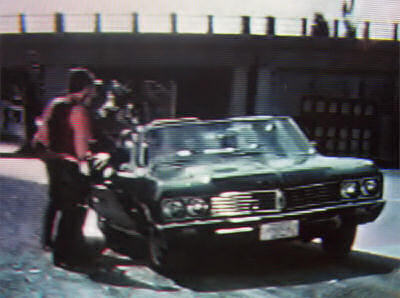
Le viol d’une jeune fille douce is a pop aesthetic portrait of a young women, Julie (Julie Lachappelle), ennui, pregnancy and early motherhood in Montreal in 1960s. It is comparable to Jean-Luc Godard’s early filmmaking period as the two are marked by an iconoclastic enthusiasm. The oddly title of the film refers to an unsympathetic short scene where Julie’s three thuggish brothers rape a young women. It is just one short episode out of many. Emphasizing that even amongst all of this fun and excitement, brutalities still unfold. There is a deadpan humor to everything as people remain emotionless. Gilles Carle dabs each frame with a Crayola-crayon palette of primary colors: a tyrian purple hat here, a baby blue sports car there, the placement of a bulk of consumer goods, and references to contemporary art. The characters dialogue also seems interested in the expressions of a national identity. Like when Julie’s Moroccan Jewish boyfriend asks her about her citizenship in reference to the national holiday Saint-John-Baptiste and the Front de libération du Québec (FLQ). While later on Julie buys stereotyped African groceries emphasizing the food consumption value whereas he see the goods in terms of their country of origin. There seems to be constant conflict between opposing people’s whether it is through language or actions.
Gilles Carle passed away at the age of 81 on November 28th 2009 at a hospital in Granby, Québec. His mark on Québécois cinema and culture seems omnipresent whether it is through the programming of his films or the respect and awe he instills. There are even visual reminder of his presence like the etching on the Fête du Cinéma poster or his portrait that hangs around certain cultural landmarks, for example, the restaurant Le Café Cherrier. His films La vraie nature de Bernadette, La Mort d’un bûcheron (1973) and Fantastica (1980) made their way to the Official Competition at the Cannes Film Festival. Gilles Carle is proving to be an untapped treasure of French-Canada cinema and his films continue to prove to be ever adventurous and intensely pleasurable.

*****
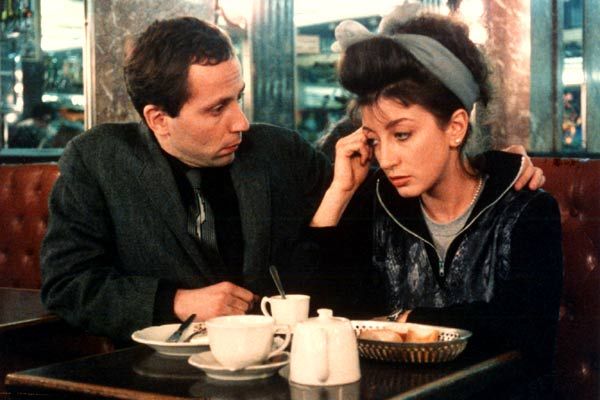
The series highlight and my favorite was the late Éric Rohmer’s Les nuits de la pleine lune. A masterpiece! The fourth in his series Comédies et Proverbes, the subtitle is “Qui a deux femmes perd son âme, qui a deux maisons perd sa raison”. Les nuits de la pleine lune is about a gorgeous, yet somewhat androgynous, women Louise (Pascale Ogier) who gets bored with her husband Rémi (Tchéky Karyo), an architect working on the redevelopment of Marne-la-Vallée in province de Champagne. Louise decides to return to Paris studio that is no longer being rented. Basically, Louise is having a midlife crisis and is unsure of what she wants. Still, she will continue her deep friendship with intellectual and writer Octave (Fabrice Luchini); have a one-night stand with a drummer Bastien (Christian Vadim) who’s leaving town; and sporadically visits her husband.
The night Louise spends with Bastien consists of party hopping and riding on his motorcycle. She returns to his place. They have sex. When she leaves in the middle of the night there is a full moon. Les nuits de la pleine lune is similar to Ma nuit chez Maud (1969) and La genou de Claire (1970) as Éric Rohmer uses movie titles that express the films visual imagery while simultaneously important scenes that culminate the crashing or comedy of an enlightened self-deception. While Les nuits de la pleine lune also refers to the myth of the werewolf and the transformation towards animalistic impulses that arises during full moons.


Éric Rohmer, like the large-format photographs of Jeff Wall, uses fiction as a guise to document the modernization of their own countries respective metropolis; Paris, France and Vancouver, Canada. After a rudimentary glance at Éric Rohmer’s episode Place de l’Étoile in Paris vu par (1965) this fact is further emphasized. The film follows this quirky shirt salesman Jean-Marc (Jean-Michel Rouzière) as he accidentally gets into a fight with a thief. In the background of all of this comic yarn is the 1964 subway reconstruction and theArch of Triumph. Cranes are flying, buildings are being built, roads are closed off and construction workers are on the street. One of Les nuits de la pleine lune more sublime camera movements is at the start with a 360-degree pan of the newly built housing developments and the subway connecting it to the rest of the city. Like Jean-Luc Godard’s 2 ou 3 choses que je sais d’elle (1967), these films are interested in Parisian real estate and architecture and how their consumption infiltrates modern day consciousness. One of Les nuits de la pleine lune shots is framed through a two-plane window. There is an immense crane right in the center of the image. Just as the banlieue is in a constant state of construction, the characters themselves are simultaneously also in a current state of expansion. Where the future for everyone and everything is equally uncertain.
Éric Rohmer birth name is Jean-Marie Maurice Scherer. The first name Éric is an appropriation of Austrian-born director Erich von Stroheim and the last name Rohmer came from the American pulp novelist Sax Rohmer. Mr. Rohmer finished his thesis dissertation on the organization of space in F.W. Murnau’s Faust (1926). He was a film critic and editor during the early years of Cahiers du Cinéma. He worked into his septuagenarian years creating his last film Les amours d'Astrée et de Céladon in 2007 from Honoré d'Urfé 17th century text L'Astrée. One of the heirs of his particular type of talky cinema is Noah Baumbach. As Baumbach’s latest film Greenberg (2010) approach is interested in household and restaurant conversations that are really inquisitive and poignant in regards to his characters motivation and there are strong textual references that give off a strong sense of the Los Angeles and its progressive upper class culture.


The French New Wave actor László Szabó has a small role in the film as a comic-book artist sitting at a café one night. He draws sketches of people and is inspired by the dreams of people. The idea of an artist drawing rough sketches of people is a very modest proposal especially from Éric Rohmer who, if I can be so bold, is one of the most psychologically introspective directors. Éric Rohmer seems interested in the use of language and how it is used and abused in conversations as a way to better understand one another. These inquisitions have quick way to intensify and some times are so memorable that Octave has to write them down. These conversationalist appear all the more foreign and exotic as it seems to be a culturally specific quality that makes France and French culture all the more attractive.
What a terrific experience! My personal reaction to the film (in the Barthesian punctum sense) was very engaged. I downlooked, sighed, was exasperated, laughed, got frustrated and was on the edge of my seat. To see a Éric Rohmer film on the big screen (my first time) was a terrific experience. The wall-sized screen is a right outlet for the classic cinematography of Renato Berta that focuses more on full body shots while consciously discarding classic editing norms. In a gorgeous 1,37:1 35mm original print without any subtitles this was the highlight of the night.
*****
Federico Fellini’s La città delle donne (1980) is a commedia all'italiana about Snàporaz (Marcello Mastroianni) who gets mixed up in a feminist rally and then in a philanderers mansion party that even Silvio Berlusconi would approve of. The one memorable scene that sticks out is a nostalgic musical sequence to Irving Berlin’s Lets Face the Music and Dance with Mastroianni in a top hat and cane prancing with two showgirls. Other then that the film gets itself lost in its own episodic drift and carnivalesque spectacle. By the end keeping up got strenuous.

I would have slept through more of Andrei Konchlovsky’s Runaway Train (1985) if the soundtrack weren’t more obtrusive. It felt like a movie made by a high school drop out that sees the world through crude stereotypes. The Alaskan cinematography was all right. Starring Jon Voight and a couple of other unimpressive actors.
Why I bothered to stay through the dreg were these next two films. Roman Polanski’s Ssaki (1961) is the last of his Łódź Film School black-and-white short films. The English title Mammals is appropriate as it is a tale of two guys who interchangeably pull one another on a sled in a barren snow-covered field while slowly depluming a chicken. A conceptual work whose title I posit refers to the plight of humanity.
Following was Jerzy Skolimoski’s fantastic horror film The Shout (1978). Jerzy Skolimoski who arrived in London from Poland in 1968, like the Italian director Marco Bellochio, seems like the type of director that is really underrepresented on video, which really restricts autodidact studies on these films. Thankfully the Cinémathèque has these programming and where I was lucky enough to see Marco Bellochio’s Abbasso il zio (1961) and Nel nome del padre (1972). Jerzy Skolimosky’s (who in 2008 appeared in David Cronenberg’s Eastern Provinces) The Shout begins with an unsuspecting visitor (Tim Curry) going to mental institute and what unfolds is the maddening of the already insane. All of this takes place in a flashback during a game of cricket in a Caligari fashion. There are some pretty interesting formal experiments including reverberating sound equipment and the use of close up.


*****
Though by six in the morning - like for most movie marathons - consciousness drifts in and out. I still perceived an overall unifying narrative to the programming. Both le viol d’une jeune file douce and Les nuits de la pleine lune have women protagonist and a narrative that progressives monthly, while the displacement from Montreal to France emphasized a shifting international setting. La città delle donne takes the idea of a vacation and pushes it southward to Italy. The progressing train Snàporaz is on with his wife before he starts dreaming will be passed on to Runaway Train and that movies winter landscape will be shared in Ssaki while the interest in landscapes will be continued now through sand desert vistas in The Shout. Les nuits de la pleine lune, La città delle donne and The Shout all have bookend stories that start at the location where they begin.


The programming at the Cinémathèque Québécoise under Pierre Jutras and Yolande Racine continues to prove to be adventurous. The fun and carriable eco-responsible schedule (which started in autumn 2009) and a good communicative website make their calendar easily accessible. The special programs highlight both high- and low-cultures works and highlight films and filmmakers hard to come by on video or ones that truly deserve a big-screen and communal viewings. Like their series on erotic Japanese films, Souleymane Cissi, Stroheim Boulevard, Marco Bellochio, Chairs et Vicere and Ken Rusell among many others.
After The Shout I decided to leave. I was on my way to my friend Alexandre Lemire’s place. I met a few of his friends there too. I was really tired after all that movie watching. Even the previous night I did not get much sleep after partying with friends at an Italo disco concert. St. Denis and Sherbrooke Street are really still at six in the morning. There were very few cars and a few staggerers that look like they belong in a Donigan Cumming or Robert Morin film. After a long night like that all you want to do is get to bed. Tomorrow will be a new day.-David Davidson
(Cinémathèque Québécoise, 335 boul. De Maisonneuve Est, Montreal, QC, 19/06 & 20/06)
The second annual Fête du Cinéma hosted by 24 Images: La Revue Québécoise du Cinéma at the Cinémathèque Québécoise took place in the salle Claude-Jutra and at the Café-bar Saturday June 19th to Sunday June 20th. The Fête du Cinéma consisted of a twenty-four hour movie marathon; 35mm and 16mm celluloid passing through a projector for an eager community of cinéphiles. In the lobby there was a booth selling the magazine (2$ for older issues; 6$ for the ones including a DVD) and the Café-bar had specials on sangria and local brews while on the patio they were projecting classic NFB Unit B documentaries. The magazine 24 Images, which started in 1987, has always had a close relationship with the Cinémathèque as it typically reviews the more eclectic films that they screen, the venue’s ticket booth sells the magazines and for special occasions 24 Images dabble in programming. I got there later on in the day at seven o’clock for a commemoration of the works of Gilles Carle.
Gilles Carle’s cinema reflects both his creativity and its fragrances over his perceptions of the Québécois landscape. Whether it is the runaway housewife in La vraie nature de Bernadette (1972); the effortful mannered gentleman in his 1950s Labatt commercials “C’est l’étiquette”; the whimsical police officer who truly wants to become an entomologist in L’âge de la Machi
The misspelled typo in the title of L’âge de la machi
Le viol d’une jeune fille douce is a pop aesthetic portrait of a young women, Julie (Julie Lachappelle), ennui, pregnancy and early motherhood in Montreal in 1960s. It is comparable to Jean-Luc Godard’s early filmmaking period as the two are marked by an iconoclastic enthusiasm. The oddly title of the film refers to an unsympathetic short scene where Julie’s three thuggish brothers rape a young women. It is just one short episode out of many. Emphasizing that even amongst all of this fun and excitement, brutalities still unfold. There is a deadpan humor to everything as people remain emotionless. Gilles Carle dabs each frame with a Crayola-crayon palette of primary colors: a tyrian purple hat here, a baby blue sports car there, the placement of a bulk of consumer goods, and references to contemporary art. The characters dialogue also seems interested in the expressions of a national identity. Like when Julie’s Moroccan Jewish boyfriend asks her about her citizenship in reference to the national holiday Saint-John-Baptiste and the Front de libération du Québec (FLQ). While later on Julie buys stereotyped African groceries emphasizing the food consumption value whereas he see the goods in terms of their country of origin. There seems to be constant conflict between opposing people’s whether it is through language or actions.
Gilles Carle passed away at the age of 81 on November 28th 2009 at a hospital in Granby, Québec. His mark on Québécois cinema and culture seems omnipresent whether it is through the programming of his films or the respect and awe he instills. There are even visual reminder of his presence like the etching on the Fête du Cinéma poster or his portrait that hangs around certain cultural landmarks, for example, the restaurant Le Café Cherrier. His films La vraie nature de Bernadette, La Mort d’un bûcheron (1973) and Fantastica (1980) made their way to the Official Competition at the Cannes Film Festival. Gilles Carle is proving to be an untapped treasure of French-Canada cinema and his films continue to prove to be ever adventurous and intensely pleasurable.
The series highlight and my favorite was the late Éric Rohmer’s Les nuits de la pleine lune. A masterpiece! The fourth in his series Comédies et Proverbes, the subtitle is “Qui a deux femmes perd son âme, qui a deux maisons perd sa raison”. Les nuits de la pleine lune is about a gorgeous, yet somewhat androgynous, women Louise (Pascale Ogier) who gets bored with her husband Rémi (Tchéky Karyo), an architect working on the redevelopment of Marne-la-Vallée in province de Champagne. Louise decides to return to Paris studio that is no longer being rented. Basically, Louise is having a midlife crisis and is unsure of what she wants. Still, she will continue her deep friendship with intellectual and writer Octave (Fabrice Luchini); have a one-night stand with a drummer Bastien (Christian Vadim) who’s leaving town; and sporadically visits her husband.
The night Louise spends with Bastien consists of party hopping and riding on his motorcycle. She returns to his place. They have sex. When she leaves in the middle of the night there is a full moon. Les nuits de la pleine lune is similar to Ma nuit chez Maud (1969) and La genou de Claire (1970) as Éric Rohmer uses movie titles that express the films visual imagery while simultaneously important scenes that culminate the crashing or comedy of an enlightened self-deception. While Les nuits de la pleine lune also refers to the myth of the werewolf and the transformation towards animalistic impulses that arises during full moons.
Éric Rohmer, like the large-format photographs of Jeff Wall, uses fiction as a guise to document the modernization of their own countries respective metropolis; Paris, France and Vancouver, Canada. After a rudimentary glance at Éric Rohmer’s episode Place de l’Étoile in Paris vu par (1965) this fact is further emphasized. The film follows this quirky shirt salesman Jean-Marc (Jean-Michel Rouzière) as he accidentally gets into a fight with a thief. In the background of all of this comic yarn is the 1964 subway reconstruction and theArch of Triumph. Cranes are flying, buildings are being built, roads are closed off and construction workers are on the street. One of Les nuits de la pleine lune more sublime camera movements is at the start with a 360-degree pan of the newly built housing developments and the subway connecting it to the rest of the city. Like Jean-Luc Godard’s 2 ou 3 choses que je sais d’elle (1967), these films are interested in Parisian real estate and architecture and how their consumption infiltrates modern day consciousness. One of Les nuits de la pleine lune shots is framed through a two-plane window. There is an immense crane right in the center of the image. Just as the banlieue is in a constant state of construction, the characters themselves are simultaneously also in a current state of expansion. Where the future for everyone and everything is equally uncertain.
Éric Rohmer birth name is Jean-Marie Maurice Scherer. The first name Éric is an appropriation of Austrian-born director Erich von Stroheim and the last name Rohmer came from the American pulp novelist Sax Rohmer. Mr. Rohmer finished his thesis dissertation on the organization of space in F.W. Murnau’s Faust (1926). He was a film critic and editor during the early years of Cahiers du Cinéma. He worked into his septuagenarian years creating his last film Les amours d'Astrée et de Céladon in 2007 from Honoré d'Urfé 17th century text L'Astrée. One of the heirs of his particular type of talky cinema is Noah Baumbach. As Baumbach’s latest film Greenberg (2010) approach is interested in household and restaurant conversations that are really inquisitive and poignant in regards to his characters motivation and there are strong textual references that give off a strong sense of the Los Angeles and its progressive upper class culture.
The French New Wave actor László Szabó has a small role in the film as a comic-book artist sitting at a café one night. He draws sketches of people and is inspired by the dreams of people. The idea of an artist drawing rough sketches of people is a very modest proposal especially from Éric Rohmer who, if I can be so bold, is one of the most psychologically introspective directors. Éric Rohmer seems interested in the use of language and how it is used and abused in conversations as a way to better understand one another. These inquisitions have quick way to intensify and some times are so memorable that Octave has to write them down. These conversationalist appear all the more foreign and exotic as it seems to be a culturally specific quality that makes France and French culture all the more attractive.
What a terrific experience! My personal reaction to the film (in the Barthesian punctum sense) was very engaged. I downlooked, sighed, was exasperated, laughed, got frustrated and was on the edge of my seat. To see a Éric Rohmer film on the big screen (my first time) was a terrific experience. The wall-sized screen is a right outlet for the classic cinematography of Renato Berta that focuses more on full body shots while consciously discarding classic editing norms. In a gorgeous 1,37:1 35mm original print without any subtitles this was the highlight of the night.
Federico Fellini’s La città delle donne (1980) is a commedia all'italiana about Snàporaz (Marcello Mastroianni) who gets mixed up in a feminist rally and then in a philanderers mansion party that even Silvio Berlusconi would approve of. The one memorable scene that sticks out is a nostalgic musical sequence to Irving Berlin’s Lets Face the Music and Dance with Mastroianni in a top hat and cane prancing with two showgirls. Other then that the film gets itself lost in its own episodic drift and carnivalesque spectacle. By the end keeping up got strenuous.
I would have slept through more of Andrei Konchlovsky’s Runaway Train (1985) if the soundtrack weren’t more obtrusive. It felt like a movie made by a high school drop out that sees the world through crude stereotypes. The Alaskan cinematography was all right. Starring Jon Voight and a couple of other unimpressive actors.
Why I bothered to stay through the dreg were these next two films. Roman Polanski’s Ssaki (1961) is the last of his Łódź Film School black-and-white short films. The English title Mammals is appropriate as it is a tale of two guys who interchangeably pull one another on a sled in a barren snow-covered field while slowly depluming a chicken. A conceptual work whose title I posit refers to the plight of humanity.
Following was Jerzy Skolimoski’s fantastic horror film The Shout (1978). Jerzy Skolimoski who arrived in London from Poland in 1968, like the Italian director Marco Bellochio, seems like the type of director that is really underrepresented on video, which really restricts autodidact studies on these films. Thankfully the Cinémathèque has these programming and where I was lucky enough to see Marco Bellochio’s Abbasso il zio (1961) and Nel nome del padre (1972). Jerzy Skolimosky’s (who in 2008 appeared in David Cronenberg’s Eastern Provinces) The Shout begins with an unsuspecting visitor (Tim Curry) going to mental institute and what unfolds is the maddening of the already insane. All of this takes place in a flashback during a game of cricket in a Caligari fashion. There are some pretty interesting formal experiments including reverberating sound equipment and the use of close up.
Though by six in the morning - like for most movie marathons - consciousness drifts in and out. I still perceived an overall unifying narrative to the programming. Both le viol d’une jeune file douce and Les nuits de la pleine lune have women protagonist and a narrative that progressives monthly, while the displacement from Montreal to France emphasized a shifting international setting. La città delle donne takes the idea of a vacation and pushes it southward to Italy. The progressing train Snàporaz is on with his wife before he starts dreaming will be passed on to Runaway Train and that movies winter landscape will be shared in Ssaki while the interest in landscapes will be continued now through sand desert vistas in The Shout. Les nuits de la pleine lune, La città delle donne and The Shout all have bookend stories that start at the location where they begin.
The programming at the Cinémathèque Québécoise under Pierre Jutras and Yolande Racine continues to prove to be adventurous. The fun and carriable eco-responsible schedule (which started in autumn 2009) and a good communicative website make their calendar easily accessible. The special programs highlight both high- and low-cultures works and highlight films and filmmakers hard to come by on video or ones that truly deserve a big-screen and communal viewings. Like their series on erotic Japanese films, Souleymane Cissi, Stroheim Boulevard, Marco Bellochio, Chairs et Vicere and Ken Rusell among many others.
After The Shout I decided to leave. I was on my way to my friend Alexandre Lemire’s place. I met a few of his friends there too. I was really tired after all that movie watching. Even the previous night I did not get much sleep after partying with friends at an Italo disco concert. St. Denis and Sherbrooke Street are really still at six in the morning. There were very few cars and a few staggerers that look like they belong in a Donigan Cumming or Robert Morin film. After a long night like that all you want to do is get to bed. Tomorrow will be a new day.-David Davidson
(Cinémathèque Québécoise, 335 boul. De Maisonneuve Est, Montreal, QC, 19/06 & 20/06)
Sunday, August 16, 2009
Diverse 1960s French Filmmaking
Paris vu par... (Claude Chabrol, Jean Douchet, J-L Godard, J-D Pollet, Eric Rohmer & Jean Rouch, 1965)
*** (A Must-See)

(Arsenal, Posdamer Platz, Berlin, Germany)
*** (A Must-See)
(Arsenal, Posdamer Platz, Berlin, Germany)
Subscribe to:
Posts (Atom)