 There are too
few leaps into the imaginary abyss in Canadian film history, which is typically
reserved in naturalistically documenting social classes, issues, and events. If
there’s no such thing as a unified Canadian cinema then it’s made up through
its diversity, with competing interests fighting for more representation. But
what gets lost in these debates is the art of film and the history of film form in
general. There’s nothing at all like Operation
Avalanche in the history of Canadian film, except for perhaps John Paizs’ Crime Wave, because its basic premise
reinvents what could even be a Canadian film: 1967, at the height of the Cold
War, the a/v department for the CIA wants to plant a mole at NASA. With a Zelig-like approach to archival
footage, and building on other films like Opération
Lune and Capricorn One, the film
is even being positioned as a documentary, playing at this year’s Hot Docs,
which is fair in terms of the film’s first half at NASA with real staff
interviews about their archival library. But it’s its side Méliès that really
elevates Operation Avalanche. How to
make a film think and put into practice the lessons of Le Voyage dans la Lune or even
2001: A Space Odyssey (Stanley Kubrick even appears in cameo)? Its use of
image manipulation and the outmoded front-screen projection effects are
particularly well used, and even shown and discussed, for the simple reason of:
why not? Operation Avalanche is full
of the contagious joys of filmmaking. But it’s also a lot more than that!
Johnson, through going back to this decisive historical American period, and in
the conspiracy mode, is critiquing these powerful governmental institutions and
their corruption and use of coercion. While also, in a Godardian tradition (see
the Le Mépris poster), calling into
question the veil of fiction and lies of all photographic images. But Operation Avalanche isn’t a thesis film
which beats the audience over the head with its message. It looks to the moon and stars for inspiration to say something extremely intimate. It’s a personal film for Johnson as since Nirvana: The Band to The Dirties he’s been pursuing the
dissolution of a friendship due to an individualist megalomania. So when Owen gets killed due to
his negligence it is actually heartbreaking. For Matt Johnson, similar to Brian de
Palma, the end result of failure is guaranteed. But the important thing to
do is try! Operation Avalanche is a
bittersweet film full of joyous affects that inevitably falls apart. But a sad
truth is always better than a fake lie. Johnson’s methods are just the best way
to say a message like this in contemporary times. With a few secret projects in
the works, Johnson and his production staff are the eccentrics that are
redefining the mainstream center. How to think of an innovative and insolent
Canadian cinema today? Just look to these guys.
There are too
few leaps into the imaginary abyss in Canadian film history, which is typically
reserved in naturalistically documenting social classes, issues, and events. If
there’s no such thing as a unified Canadian cinema then it’s made up through
its diversity, with competing interests fighting for more representation. But
what gets lost in these debates is the art of film and the history of film form in
general. There’s nothing at all like Operation
Avalanche in the history of Canadian film, except for perhaps John Paizs’ Crime Wave, because its basic premise
reinvents what could even be a Canadian film: 1967, at the height of the Cold
War, the a/v department for the CIA wants to plant a mole at NASA. With a Zelig-like approach to archival
footage, and building on other films like Opération
Lune and Capricorn One, the film
is even being positioned as a documentary, playing at this year’s Hot Docs,
which is fair in terms of the film’s first half at NASA with real staff
interviews about their archival library. But it’s its side Méliès that really
elevates Operation Avalanche. How to
make a film think and put into practice the lessons of Le Voyage dans la Lune or even
2001: A Space Odyssey (Stanley Kubrick even appears in cameo)? Its use of
image manipulation and the outmoded front-screen projection effects are
particularly well used, and even shown and discussed, for the simple reason of:
why not? Operation Avalanche is full
of the contagious joys of filmmaking. But it’s also a lot more than that!
Johnson, through going back to this decisive historical American period, and in
the conspiracy mode, is critiquing these powerful governmental institutions and
their corruption and use of coercion. While also, in a Godardian tradition (see
the Le Mépris poster), calling into
question the veil of fiction and lies of all photographic images. But Operation Avalanche isn’t a thesis film
which beats the audience over the head with its message. It looks to the moon and stars for inspiration to say something extremely intimate. It’s a personal film for Johnson as since Nirvana: The Band to The Dirties he’s been pursuing the
dissolution of a friendship due to an individualist megalomania. So when Owen gets killed due to
his negligence it is actually heartbreaking. For Matt Johnson, similar to Brian de
Palma, the end result of failure is guaranteed. But the important thing to
do is try! Operation Avalanche is a
bittersweet film full of joyous affects that inevitably falls apart. But a sad
truth is always better than a fake lie. Johnson’s methods are just the best way
to say a message like this in contemporary times. With a few secret projects in
the works, Johnson and his production staff are the eccentrics that are
redefining the mainstream center. How to think of an innovative and insolent
Canadian cinema today? Just look to these guys.
Sunday, May 1, 2016
A Must See: Operation Avalanche
There are too
few leaps into the imaginary abyss in Canadian film history, which is typically
reserved in naturalistically documenting social classes, issues, and events. If
there’s no such thing as a unified Canadian cinema then it’s made up through
its diversity, with competing interests fighting for more representation. But
what gets lost in these debates is the art of film and the history of film form in
general. There’s nothing at all like Operation
Avalanche in the history of Canadian film, except for perhaps John Paizs’ Crime Wave, because its basic premise
reinvents what could even be a Canadian film: 1967, at the height of the Cold
War, the a/v department for the CIA wants to plant a mole at NASA. With a Zelig-like approach to archival
footage, and building on other films like Opération
Lune and Capricorn One, the film
is even being positioned as a documentary, playing at this year’s Hot Docs,
which is fair in terms of the film’s first half at NASA with real staff
interviews about their archival library. But it’s its side Méliès that really
elevates Operation Avalanche. How to
make a film think and put into practice the lessons of Le Voyage dans la Lune or even
2001: A Space Odyssey (Stanley Kubrick even appears in cameo)? Its use of
image manipulation and the outmoded front-screen projection effects are
particularly well used, and even shown and discussed, for the simple reason of:
why not? Operation Avalanche is full
of the contagious joys of filmmaking. But it’s also a lot more than that!
Johnson, through going back to this decisive historical American period, and in
the conspiracy mode, is critiquing these powerful governmental institutions and
their corruption and use of coercion. While also, in a Godardian tradition (see
the Le Mépris poster), calling into
question the veil of fiction and lies of all photographic images. But Operation Avalanche isn’t a thesis film
which beats the audience over the head with its message. It looks to the moon and stars for inspiration to say something extremely intimate. It’s a personal film for Johnson as since Nirvana: The Band to The Dirties he’s been pursuing the
dissolution of a friendship due to an individualist megalomania. So when Owen gets killed due to
his negligence it is actually heartbreaking. For Matt Johnson, similar to Brian de
Palma, the end result of failure is guaranteed. But the important thing to
do is try! Operation Avalanche is a
bittersweet film full of joyous affects that inevitably falls apart. But a sad
truth is always better than a fake lie. Johnson’s methods are just the best way
to say a message like this in contemporary times. With a few secret projects in
the works, Johnson and his production staff are the eccentrics that are
redefining the mainstream center. How to think of an innovative and insolent
Canadian cinema today? Just look to these guys.

Friday, April 8, 2016
Opening Today: Jean-Marc Vallée's Demolition

When Phil states, “If you want to fix something, you need to take everything about it apart. To figure out what’s important,” it should be understood as a guiding spirit to analyze Demolition as its meaning is buried in its detail.
And now finally more people get a chance to appreciate Jean-Marc Vallée's newest masterpiece, Demolition. For my most recent review of it, check out the latest issue of Little White Lies. It'll be playing at the Varsity and Cineplex Yonge-Dundas starting today Friday, April 8th.
Opening Today: Andrew Cividino's Sleeping Giant

Andrew Cividino's dynamic coming of age story Sleeping Giant, about three boys experiencing the pleasures of a restless summer along with the anxieties that inevitably arises, finally starts its theatrical release today, Friday, April 8th at the Varsity. Check it out if can!
For more information check out their Facebook page.
Wednesday, April 6, 2016
Interview with Michael Dorland (So Close to the State/s)
David Davidson: Can you tell me how your
book So Close to the State/s: The
Emergence of Canadian Feature Film Policy (UTP, 1998) came to be? What
sparked this research? What methodology problems did you have to solve?


Michael Dorland: I was working as a reporter/editor for Cinema Canada magazine, once upon a time
the voice of a nationalist Canadian and Quebec cinema. In the time I was there,
roughly from 1980-1985, the major federal policy change regarding film was a
shift away from previous attempts to foster feature films (initially using a
small $10m production and later through tax-shelter) with a turn to fostering
TV production (the Telefilm Television Fund). After all, the broadcasting
system was Canadian-owned whereas the cinema distribution system was and
remains mainly US-owned. Also working as a reporter, one tends after a while to
see the same things come around, and around, and this was systemically the
case, whether in attempting to “foster” Canadian film development, or through
the CRTC to “foster” Canadian content in broadcasting and music. What I wanted
to figure out was why all this endless and seemingly unaware repetition. So in
1987, I got the opportunity to start a Phd in Communication at Concordia. The
book is drawn from my dissertation.
The principal
methodological problem I faced was finding an operationalizable concept that
captured the role of the government/state in film production. Marxist methods
had clear limitations in that it was never clear which “bourgeoisie” the
Canadian state ‘worked’ for. Cultural studies in Canada at the time, and
perhaps still, did not have a clear method other than the subcultural. What
worked in the end, and it was something of a fluke, the result of much reading
of Foucault, was the concept of governmentality, which seemed ideally suited
for the Canadian context; that is, of an overriding state interest in the
orientation of both economy and society without being clearly a class interest,
but a muddle of some nationalist ideas mixed in with state interests as an end
in itself. The other problem, with which I began first, was access to
information held in government bureaucracies.
DD: How was its research process? The
references from government documents, archival sources, unpublished material,
personal letters and notes, an extensive referencing of newspaper and Canadian
film journals and periodicals is quite erudite in its depth and range. How did
you know what to look for, and were they easy to access?
MD: Bureaucracy is many-headed, so if you can access one major
bureaucracy, there is a strong likelihood of accessing them all through
duplication. My way in was through the National Film Board. I knew the head
archivist at the time; I had interviewed him for the magazine; and he basically
explained the structure of the Board’s archiving system and I was off and
running. This was still before computerization, and the ensuing nightmare of
computer dumps that fortunately I did not have to deal with. So using the
Board’s archives, from minutes of the Board of the Board and all of the
attached documentation that covered most of the bureaucracy involved in the film
policy process, to production files for given films as well as television,
really opened up the whole field for me. Especially the conviction at the time,
early 1950s, that the Board thought it would be responsible for television in
Canada. This was hugely important, especially when it came to untangling the
symbiotic relationship between film and TV in the Canadian context of the ‘50s
and ‘60s. How to know what to access and whether it was easy is basically hit
and miss. You follow a thread and see where it takes you. If it doesn’t take
you anywhere, you follow another thread. Easy? Never, and I don’t think the
dissertation and book would have been doable without the NFB lifeline into the
state bureaucracy.
DD: How was the book received? Did it
have any effect, that you are aware of, on the domains of its dissertation such
as Canadian filmmaking, government policy, or Canadian film scholarship?
MD: The book itself was quite well received in the small
universe of Canadian film scholarship, and to some extent also in Australian
film scholarship. ‘Well received’ is of course a relative notion. A few people
noticed and said nice things. Outside of these small scholarly worlds, I don’t think
the book had any impact at all.
DD: The book seems to answer the specific
question of is there a ‘Canadian cinema’ by closely examining the formation of
its industry in the 50s and 60s through the role of governmentality and its
mediation between public institutions and private interests. It both brings
together many dilemmas and problems still facing Canadian cinema today as well
as the ground-work that contributed to making Canada a world-class country for
industrial filmmaking (four of last years Best Picture Oscar contenders were
Canadian co-productions, for example). How do you view the arguments from the
book from the vantage point of 2016?
MD: I am not sure the book attempts to answer the specific
question of “is there a Canadian cinema” for the reasons that there isn’t a
Canadian cinema, but rather many Canadian cinemas, some ceaselessly
rediscovered, some endlessly hoped for, and some that couldn’t care less as
long as there is “product,” and if Canadians are involved that’s a plus.
Canadian cinema has been all of these things at various times.
What was the
case in the late 1960s was that there were a handful of filmmakers, usually of
shorts and documentaries, and some of these wanted to make feature films. The
government also wanted there to be more made-in-Canada feature films, without
getting too picky about the phrase made-in-Canada. The government in particular
wanted a feature film industry with
only the vaguest idea of what this might actually mean or entail. With the
creation in 1968 of the first feature film fund of $10m, the head of the fund
called up his pals in Hollywood and said, hey, we’ve got $10m to play with,
wanna play? And of course they did.
That was sixty
years ago and in that time something like a film and television industry has
been created, with all this implies in terms of infrastructure, labs,
equipment, lighting, computerization, etc. Parts of that industry, in Vancouver
and Toronto, sometimes in Alberta, (and in Montreal, though Quebec is always
somewhat different), are capable of producing product that can sell to
Hollywood or elsewhere, and to television all over the world, and in pretty
much any genre imaginable. But that industry is still not “Canadian cinema”, a
creature that remains as elusive as ever. Again, what the Canadian government
of the 1960s wanted was a film industry. Eventually, it got one, after a
fashion.
DD: What contemporary issues do you feel
deserve more attention in the discussion of Canadian cinema today and its
relation to government legislation and the private industry? And can you
envisage any challenges in realizing it? (The conclusion on Policy Knowledge
versus Academic Knowledge seems quite relevant in regards to this).
MD: As you say, there is Academic Knowledge and Policy
Knowledge and they rarely meet each other. There is a large Policy apparatus in
Canada very little studied by academics, which is unfortunate, but the ends are
completely different. To the extent that Academic knowledge is about a broader
understanding of context, and Policy knowledge is (not that it should be) about
selling to bureaucrats something they want to hear and will pay for, there is
still a very long way to go. Since the publication of So Close to the State/s my sense of the direction of academic work
is that it is more regionally focused and more firmly set in the realm of
production studies. As for Policy knowledge, that is a field entirely up for
grabs by interested academics.
MD: You didn’t ask me this, but the title of the book is a play
on the Mexican proverb, “So Close to the
United States, So Far From God.” You can draw your own conclusions.
Friday, March 25, 2016
CineCycle @ 25

For the 25th anniversary of CineCycle there was a ceremony in honor of its owner, Martin Heath. There were snacks, drinks, good company, speeches, a projection of films about and set around CineCycle and a program of some of Heath's favorite films. It was a great event to take part in. Here's to another twenty-five years!
For more information on CineCycle check out John Porter's great website and history of it : http://www.super8porter.ca/CineCycle.htm
Monday, March 21, 2016
Cinema Scope and The World
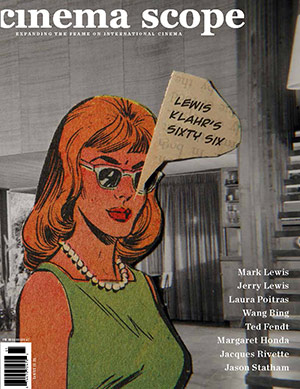 For Cinema Scope
issue number sixty-six a beautiful still from Lewis Klahr’s Sixty Six graces its cover. In its annual, though perhaps begrudgingly,
tradition of organizing a top ten list with its contributors (to be eligible
they must have contributed to each of its quarterly issues) the elected
titles combined tend to offer a representative survey of the major films and
the new cinematographic trends of that previous year. Perhaps to celebrate this new
issue, and with the pass of the half-way mark of the 2010 decade, it’s as good a
time as any to look back and reflect on these lists, going as far back as 2010. These lists for the 2015 to 2010 years appear in the issues number sixty-six, sixty-two, fifty-eight, fifty-four, fifty and forty-six.
This would provide a broader view of the cinematographic preferences of the
magazine, the directors that they feature, their average age, and the countries that
they’re from – essentially what constitute the creators of the most exciting films of this period.
For Cinema Scope
issue number sixty-six a beautiful still from Lewis Klahr’s Sixty Six graces its cover. In its annual, though perhaps begrudgingly,
tradition of organizing a top ten list with its contributors (to be eligible
they must have contributed to each of its quarterly issues) the elected
titles combined tend to offer a representative survey of the major films and
the new cinematographic trends of that previous year. Perhaps to celebrate this new
issue, and with the pass of the half-way mark of the 2010 decade, it’s as good a
time as any to look back and reflect on these lists, going as far back as 2010. These lists for the 2015 to 2010 years appear in the issues number sixty-six, sixty-two, fifty-eight, fifty-four, fifty and forty-six.
This would provide a broader view of the cinematographic preferences of the
magazine, the directors that they feature, their average age, and the countries that
they’re from – essentially what constitute the creators of the most exciting films of this period.
Excluding
their yearly special mentions, all of the films that made their top ten lists
so far (since 2010) include (in alphabetical order): A Touch of
Sin, Adieu au langage, Arabian Nights, Attenberg, autrement, la Molussie,
Cemetery of Splendour, Computer Chess, Django Unchained, Dreileben, Film
Socialisme, From What Is Before, Holy Motors, Horse Money, I Wish I Knew,
Inherent Vice, Inside Llewyn Davis, It’s the Earth Not the Moon, Jauja, Journey
to the West, Kaili Blues, Kill List, L'Apollonide: Souvenirs de la maison
close, L’inconnu du lac, Le gamin au vélo, Leviathan, Lost and Beautiful,
Maidan, Meek’s Cutoff, Moonrise Kingdom, Mysteries of Lisbon, Neighboring
Sounds, No Home Movie, Norte, the End of History, Once Upon a Time in Anatolia,
P’tit Quinquin, Phoenix, Right Now, Wrong Then, Sleeping Sickness, Story of My
Death, Stray Dogs, Tabu, The Assassin, The Autobiography of Nicolae Ceaușescu,
The Forbidden Room, The Ghost Writer, The Kindergarten Teacher, The Last Time I
Saw Macao, The Master, The Strange Case of Angelica, The Strange Little Cat,
The Treasure, The Tree of Life, The Turin Horse, The Wolf of Wall Street, This
is Not a Film, Uncle Boonmee Who Can Recall His Past Lives, Viola, Visit, or
Memories and Confessions, What Now? Remind Me, Winter Vacation.
For the sake of neatness the following summary might include
a few helpful generalizations: where the director might have associations with
more than one country, the specific country of the film or which they are more
identified with will be highlighted (e.g. Godard and Paravel with France,
Loznitsa with Ukraine, da Mata with Portugal, and Zürcher with Germany). Manoel
de Oliveira made Visit, or Memories and
Confessions when he was eighty-three so it would be inputted at that age.
And when the directors work in pairs or with the inclusion of an omnibus film,
each of the individuals would be properly inputted (which might lead to
potential over-representation).
The directors who reoccur on these lists, all with a maximum
of two inclusions, are: Apichatpong Weerasethakul (Cemetery of Splendour, Uncle Boonmee Who Can
Recall His Past Lives), Christian Petzold
(Phoenix, Dreileben), Jean-Luc
Godard (Adieu au langage, Film
Socialisme), Jia Zhangke (A Touch of
Sin, I Wish I Knew), Lav Diaz (From
What Is Before, Norte, the End of History), Manoel de Oliveira (Visit, or Memories and Confessions, The
Strange Case of Angelica), Miguel Gomes (Arabian Nights, Tabu), Paul Thomas Anderson (Inherent Vice, The Master), Tsai Ming-liang (Journey to the West, Stray Dogs). That some directors don’t
(re-)appear more frequently on these lists during this six year period might have more to do with the precariousness of producing these more challenging type of films and
certain curating trends of the film festival circuit.
Of the
sixty-eight directors on the list: fifteen of them are under the age of forty,
twenty-two of them are in their forties, twenty-four of them are between fifty
and seventy, and the remaining six of them are older than seventy.


The most reoccurring countries are the United States (with eleven
titles), Portugal (with nine titles), France (with eight titles), Germany (with
six titles), China (with four titles), and so on.

One of the great film magazines, a convergence point for contemporary
cinematographic trends, and always an interesting and stimulating read. Here’s
to a good 2016 year for Cinema Scope!
Subscribe to:
Posts (Atom)