Tuesday, May 19, 2009

Restaurant Confessions

Adoration (Atom Egoyan, 2008)
*** (A Must-See)


Writer and director Atom Egoyan's Adoration is a Canadian social drama which questions the notion of community, family and personal identity in a deindividualizing metropolitan in a inextricably digital age. Egoyan one of the fore-front Canadian auteur is a cerebral filmmaker whose films sometimes have more to say about the society we live in then it does on getting great performances out of actors. But if compared to last weekend latest escapism Hollywood release, Ron Howard's Angels & Demons, it is a welcome relief to have a film that is willing bring up themes that matter socially then to uncritically entertain. Adoration is a zeitgeist film which critiques upon many contemporary social issues including terrorism, xenophobia, social constructs and alienation. A few of Egoyan's signature touches which are visible in his 11th feature include a national backdrop; Toronto city, Canadian multi-ethnicity, traumatic life experiences and their emotional baggage, digital medias, classical guitar, and the casting of his wife Arsinée Khanjian.

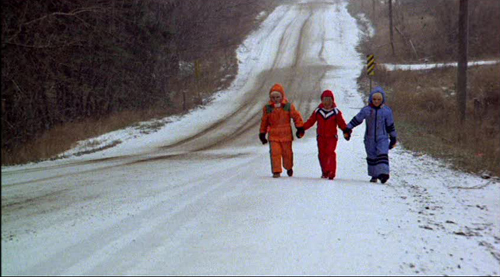
Similar to Egoyan's The Sweet Hereafter the film gyrates over a fatal car crash. In the latter on a brightly lit day in a remote snow-covered Canadian landscape the automobile was a large yellow elementary school bus full of children where the plunge lands the bus into a frozen river and the deaths devastate a small community. In Adoration it takes place at the dead of night leaving a argumentative family dinner, the driver Sami (Noam Jenkins), fuming with rage after indicting the patriarch for his social prejudices, and his wife Rachel (Rachel Blanchard), who is now intoxicated and drowsy, drive off into the night and accidently hit a transport truck head on.

The son of these two passed away lovers is a high school student Simon (Devon Bostick), a spinner of tall tales, who gets involved in appropriating a story of a failed martyr terrorist attack and attributes it to his dead parents for a class dictée. His french/drama teacher Sabine (Arsinée Khanjian) prods him into prolonging the original assignment by revising it and reading it to his classmates. This creative endeavor feeds his need for attention which leads to the online broadcasting of this story on the World Wide Web. Alienated in his dark bedroom he has a multitude of conversation on his MacBook. His videocast then spurs a backlash of indiscriminate responses. Without providing any moral value to each opinion Egoyan is posing a sublime question towards the internet generation. How are unknowledgeable adolescent supposed to differentiate and acknowledge morality, when there are models from all over the spectrum to be chosen from. This anonymous and opaque form of communication is contrasted when Sabine, who has now been laid off for ethically exceeding her performance as a teacher, car gets towed away by Simon's caretaker and Uncle Tom (Scott Speedman) and they both reveal their history and cultural background in a extremely revealing dialogue. In a shoddy Toronto diner their conversation, and confessions, resonate of real emotion and humanity that acknowledges that life is, and will always be, more personal in a physical surrounding then in a virtual window.-David Davidson

(Bytowne Cinema, 324 Rideau Street, 15/05-24/05)

Thursday, May 7, 2009

A Portrait of an Artist

Cult Fiction, A Portrait of an Ottawa Filmmaker: Lee Gordon Demarbre (David Davidson & Rachel LeBlanc, 2009)

Wednesday, May 6, 2009

The Possibilities of Horror

Hunger (Steve McQueen, 2008)
** (Worth Seeing)


Steve McQueen's, a British conceptual/video-projection artist, feature film Hunger concerns are twofold: The horrific 1981 Irish hunger strike and the possibilities of the cinematographic frame. The narrative of film meditates on the minutia of being a captured prisoner and gives attention to those details as it provides little exposition except for short factual intertitles and radio-journalism broadcasts dictating the current political scenario.

The year is 1981, in Northern Ireland Maze Prison a number of Irish Republican and Irish National Liberation Army prisoners go on a hunger strike to regain their status as political prisoners. The film follows an idealizing non-conformist prisoner Davey (Brian Milligan), a courageous prisoner Bobby Sands (Michael Fassbender), and a mundanely evil prison guard Raymond Lohan (Stuart Graham). When Raymond Lohan ultimately visits his catatonic mother he gets assassinated by members of the Irish Republican Army. His silent mother is channeling Margaret Thatcher who refused to arbitrate with Republican prisoners and disallowed their rights.

The film is a purely visual and picturesque experience. To maximize the effect Enda Walsh and Steve McQueen script suppresses the dialogue to the irreducible minimum except for a painstakingly personal, and technical feat, 17 minute long stasis long shot where Bobby Sands is confessing to a priest (Liam Cunningham) his belief in his cause and the morality of the deed. Similar to the American artist-turned-filmmaker Julian Schnabel's The Diving Bell and the Butterfly (2007) the two filmmakers appropriate psychological and physical conditions, nourishment deprivation and locked-in syndrome, and revel in the possibilities to express these individuals subjective point of view through distorting focus, versatile/circular camera movements, and stand-in visuals.

The cinematographer Sean Bobbit flourishes in long shots and close-ups. The prison guard Raymond Lohan allowed a multitude of beautiful scenes. Including the pensive scene where he is composed in a full body shot outside leaning on a white brick wall shrouded by the brightly lit snow. He stands out with his black trousers, light button up shirt and cut knuckles. As well after his anarchistic freshening of prisoners who are participating in the no washing protest there is a close up of his sink routine. The sink contains water used to cool off his wounds and the palette of scene range from sterile colors to blood red after the more severe lashings.

All of these assets make the film well worth its admission.-David Davidson

(Bytowne Cinema, 324 Rideau Street, 01/05-10/05)

Monday, May 4, 2009

Lonely Nights

Two Lovers (James Gray, 2008)
****(Masterpiece)


(World Exchange Plaza, Empire 7 Cinema, 111 Albert Street)

Thursday, April 23, 2009

May Repertory Roundabouts

Bytowne Cinema
Hunger (Steve McQueen, 2008) Friday, May 1st, 6:50PM
The Cook the Thief His Wife & Her Lover (Peter Greenaway, 1989) Monday, May 4th, 9:05PM
Adoration (Atom Egoyan, 2008) Friday, May 15th, 8:50PM
Nightwatching (Peter Greenaway, 2007) Friday, May 22nd, 9:05PM
Les Enfants du Paradis (Marcel Carné, 1946) Wednesday, May 27th, 5:00PM

Mayfair Cinema
Y tu Mamá También (Alfonso Cuarón, 2001) Tuesday, May 5th, 9:15PM
Dingo (Rolf de Heer, 1991) Wednesday, May 6th, 9:30PM
Ms. 45 (Abel Ferrara, 1981) Saturday, May 9th, 11:45PM
The Killing (Stanley Kubrick, 1956) Sunday, May 17th, 1:00PM
The Education of Charlie Banks (Fred Durst, 2007) Friday, May 22nd, 7:00PM
The Tracey Fragments (Bruce McDonald, 2007) Friday, May 27th, 8:45PM

Saturday, April 11, 2009

Morbid Psychological Impetus

The Brood (David Cronenberg, 1979)
** (worth seeing)


The Brood (1979), written and directed by David Cronenberg, deals with a father’s, Frank Carveth (Art Hindle), attempt to get a restraining order on his dementia induced wife Nola (Samantha Eggar) who is currently getting therapy in Dr. Raglan (Oliver Reed) Soma Free Psychoplasmic Institution. On one of their daughters, Candice (Cindy Hinds), weekly visits to see Nola she receives ambiguous beatings and lashings. His goals change from restraining to protecting as possessed brood’s start murdering the individuals that are looking after her. The brood’s vicious attacks and the instituted patients abnormalities elicit tension and queasiness and are meditations on body horror and the vulnerability of flesh. A recurring theme in the films of David Cronenberg.This is a good contemporary horror film with many interesting qualities except for an embarrassing Psycho stabbing rip-off and Howard Shore's mimicking Bernard Hermann musical score.

The Canadian film articulates national identity as the story unfolds in winter and markers include snowy, oak-tree encapsulated, cottage-country landscapes with the characters in respective winter-wear. As well subtle references to Halifax, Vancouver and Toronto. The characters in the film are everyday people and through psychoplasmic intervention and intimate conversations repressed psychological and physical traumas are revealed with an emphasis on their devastating adaptability consequences. (The Mayfair Theatre, 1074 Bank Street, Saturday, May 30th, 11:15PM)-David Davidson

Monday, April 6, 2009

Examplary Optimism

Nights of Cabiria (Federico Fellini, 1957)


Nights of Cabiria (1957) is my favorite Federico Fellini neo-realist film. Compared to his autobiographical reflexive, and reflective, later work (8½, Roma, Amarcord) the focus of Nights of Cabiria is melancholic as it gives attention to the plight of the poverty-stricken lower class. A great example of 1950s art house cinema it is exotic, wistful and full of disenchantment. The story follows a spirited and naive prostitute Cabiria Ceccarelli (Giulietta Masina) and her endearing endeavor's to find some sort of financial, romantic, and social security in a desolate post-war Roman landscape. Cabiria is filmed with such warmth and admiration that the devastating climax is one of the most wrenching scenes in film history.-D.D.