Showing posts with label Krivina. Show all posts

Monday, January 21, 2013

Drive: road movie tendencies in Tower and Krivina

There is a key image in two recent films of that of two people - not necessarily friends but not strangers, either - in a car driving on a highway talking to each other and trying to communicate something, which turns out to be difficult to say. Since both of these films, Kazik Radwanski’s Tower and Igor Drljača’s Krivina, are set in Toronto one could propose to place these scenes in the road movie tradition set forth by the seminal Canadian film Goin' Down the Road. In a spread out country, where there are many opportunities (or the perception of such) offered elsewhere, sometimes the best option is to get in a car and drive. It is this simple impulse, the feeling to get away and start anew, and to share one's stories with whoever they are with, which empowers some of the more powerful scenes in Tower and Krivina.

In Tower there is a scene where Derek (Derek Bogart) is with his coworker and they are in a car, stuck in traffic on their way to a construction site. The man reveals to Derek a lot about himself: how he moved to Toronto from the countryside of Ireland and how he likes woodwork. Derek, on the other hand, spends his nights going out to clubs, getting drunk, and trying to pick up girls (usually unsuccessfully). Derek has been seeing this nice and compassionate woman Nicole but which he breaks up with for no rational or explained reason. When he's in the car with his peer, Derek relates to him this story of Nicole who he "started dating" and how he is committed to her and how he was thinking of maybe settling down. Even though what he's saying is a lie, Derek in this moment is opening up and explaining not what is actually the reality but what would make him happy.
 
Drljača has worked with the lead actor of Krivina, Goran Slavkovic, since the beginning of his film-making career. In Drljača’s films, from his years as a student in the Film Production program at York University, the two of them collaborated together on The Wound (’05), The Battery-Powered Duckling (’06) and On a Lonely Drive (’09). It’s a great coup of casting, in a filmography full of great actors and performances, as Slavkovic is a versatile and layered actor. In his roles Slavkovic has a Sylvester Stallone-like quality. Like Rambo, Slavkovic is able to embody the harsh realities of wartime experiences and the tough outer-shell that it creates while also being able to express a buried sensitivity. Which he embodies in his roles as a brooding sniper in The Wound, the truck-driver in Duckling, a father who just had a fight with his wife in Lonely Drive, and the humble wanderer in Krivina.

In Drljača’s films the main character carries around with him an object that he uses as a safety blanket, which is something that they hold onto to make life easier and less frightening. In The Fuse, a young Igor has the memory of the art-class assignment of a spring-time painting, in Battery-Powered Duckling (one of Drljača’s most ambitious short-films) the teenager continuously listens to the radio that is commenting about the status of people in the various zones, in On a Lonely Drive the child listens to his iPod to drown out his parents fighting, and in Woman in Purple the boy has his basketball. This is less applicable to Mobile Dreams, which is an atypical film for Drljača, as it is about seniors while he usually focuses more on childhood and youth.

Drljača’s other short-films, which were not in the recent retrospective Between Boundaries at The Royal, weren’t included as they are described to be “school assignments” and “work exercises.” Even though these other short-films are not as elaborate and polished as the films on Drljača’s 'official' directing credits, there is still a thematic continuity that travels across Drljača’s other short-films: The Wound (probably the strongest of the group), Juxtaposing the Electoral Spectacle, and the footage of the York University CUPE 3903 student protest. These videos can be fond on Drljača’s YouTube channel, igordrlj.

Krivina has many road movie scenes. In Miro’s search for his old friend Dado there are scenes where Miro is in a car or as a passenger on a bus. Miro is driven by his friend Drago (Jasmin Geljo) on their way to work at a construction site. In these car-rides they share many personal thoughts and vent their frustrations. At an ambiguous moment in the film, Drago is talking about having to put down his dog when he first arrived to a refugee center in Canada and how in an indirect way the officials told him that he couldn’t keep his pet. Drago keeps talking and we are no longer sure if Miro is still there. And in an abrupt change of tone there is loud rock music that takes over the soundtrack.

So what is the safety blanket in Krivina? Is it the photograph that Miro carries around with him of his lost friend, who he is desperately trying to find? Maybe. But I think that it is more the dialogue Drago has with Miro and himself as he is driving in his car. The only way for Drago and others to better understand their situation is by talking about their experiences and to try to make sense of the absurdity. It is this discussion of hopes and regrets and the fact that he can voice his needs and wants, which allows Drago to continue living. The story of Drago needs to be further elaborated, which is Drljača’s idea for his following feature-length film.

Monday, November 26, 2012

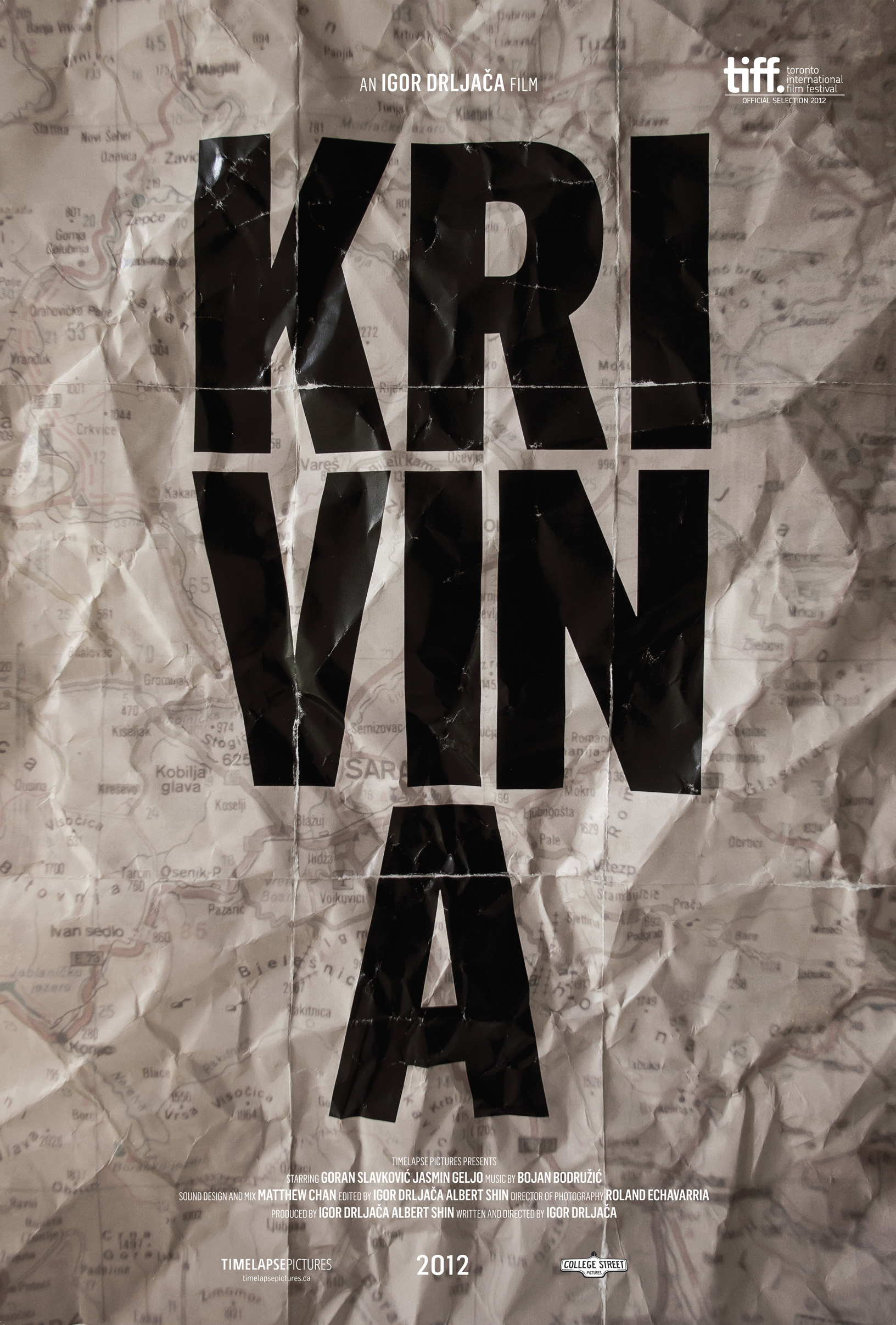
The Tarkovsky Influence on "Krivina"

Some of the original responses to Andrei Tarkovsky’s The Mirror, according to his book Sculpting in Time, include: an equipment engineer from Kalinin, “Half an hour ago I came out of Mirror. Well!! … Comrade director! Have you seen it? I think there’s something unhealthy about it … I wish you every success in your work, but we don’t need films like that.” From an engineer from Sverlovsk, “One can only be astonished that those responsible for the distribution of films here in the USSR should allow such blunders.”

When a film is challenging there is a knee-jerk reaction for some viewers to immediately criticize it for its disregard to certain formulas, instead of evaluating it on its own terms. For Takovsky, who describes his vocation as a “duty and responsibility towards people,” the goal for all art “is to explain to the artist himself and to those around him what man lives for, what is the meaning of his existence. To explain to people the reason for their appearance on this planet; or if not to explain, at least to pose the question.”

One can describe Tarkosvky’s filmic approach as long, slow and meditative. There is a poetry to his approach: that of a musing camera lingering on earthly beauty. Tarkovsky writes about this, “I find poetic links, the logic of poetry in cinema, extraordinarily pleasing. They seem to me perfectly appropriate to the potential of cinema as the most truthful and poetic of art forms.” He would further add,
“Complexities of thought and poetic visions of the world do not have to be thrust into the framework of the patently obvious. The usual logic, that of linear sequentiality, is uncomfortably like the proof of a geometry theorem. As a method it is incomparably less fruitful artistically than the possibilities opened up by associative linking, which allows for an affective as well as a rational appraisal. And how wrong it is that the cinema makes so little use of the latter mode, which has so much to offer. It possesses an inner power which is concentrated within the image and comes across to the audience in the form of feelings, inducing tension in direct response to the author’s narrative logic.” 
This form of poetic, non-associative filming plays a large role in Igor Drljaca’s debut feature-film, Krivina: the story of Miro Kalinic (the hulky Goran Slavkovic), a former Yugoslavian now living in Toronto, who returns to Bosnia to find an old friend Dado, who is rumored to have resurfaced.

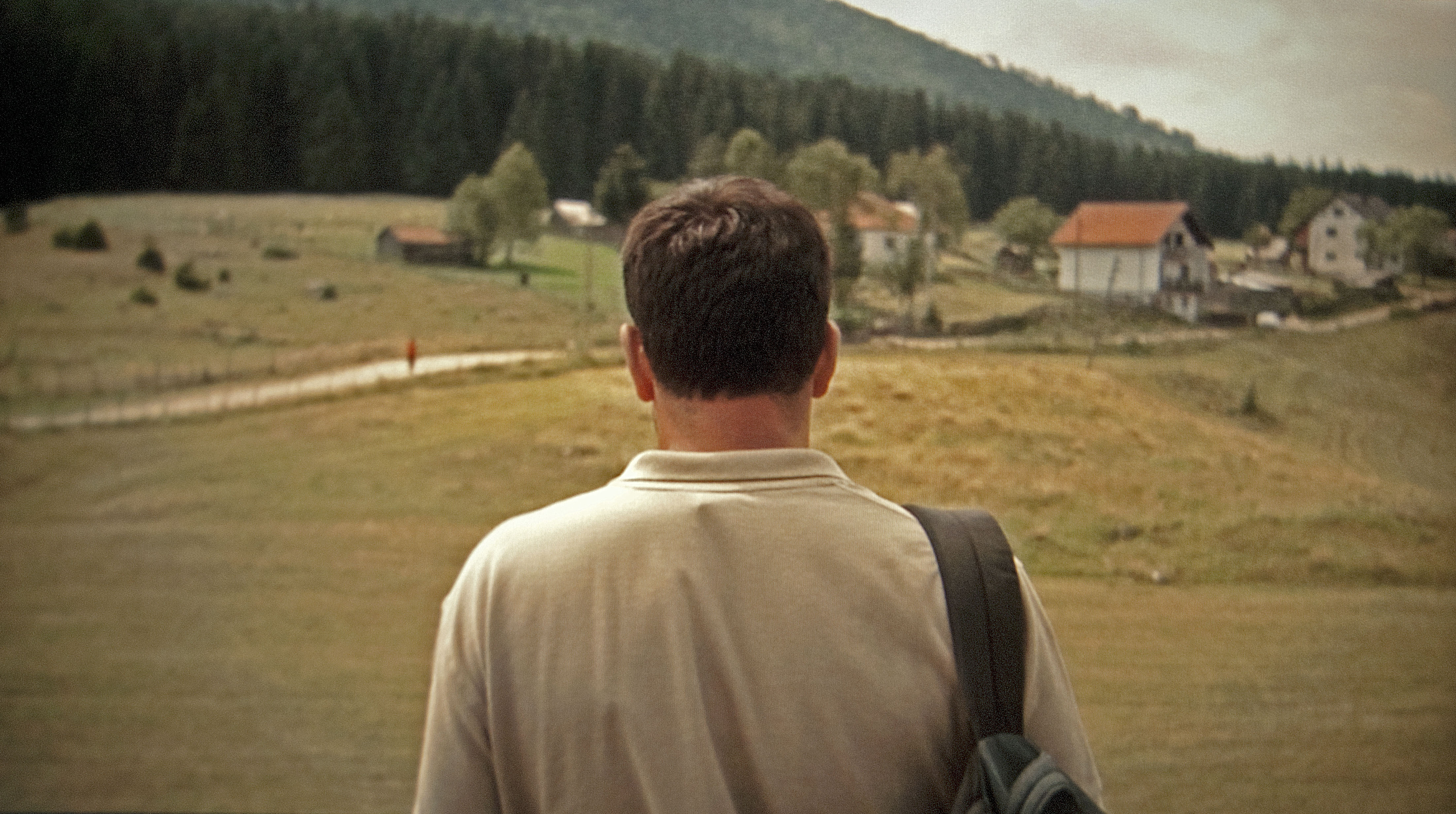
We first discover Miro with his back turned towards us, with a backpack hanging over one-shoulder, as he’s walking the streets trying to find his friend's old apartment. A golden-hued sun rises, illuminating the horizon and flowing onto the streets of Sarajevo as a soothing whistling is overheard. Miro’s search for his lost friend is filmed in a style that includes point-of-view shots towards the sky, still and moving exposition wide-shots of small figures in pastoral landscapes, and hand-held shots following Miro as he’s walking. All the while the sound-track goes from naturalism to folkloric ambient music which gives the film a dream-like quality.

Krivina is more about the journey – similar to Tarkovsky when he’s at his best (Ivan’s Childhood, Stalker) – than about the final destination. As Miro’s travels through the countryside of his old home country there are more new questions that are being asked than there are old questions that are being answered. The first thing that Miro is asked is, “Are you looking for someone?” And as Miro searches for Dado it is slowly becoming ambiguous if they aren't really the same person and if his search is more a personal journey for Miro to find himself. One gets a sense that Miro’s identity has become fragmented after the war, as the two of their described experiences seem very similar to one another - a failed marriage, the lost of his parents – and through the search for Dado certain repressed war-time experiences re-emerge like his participation in the Republika Srpska Special Forces along with war profiteering.

It is this search for oneself after the trauma of war, which makes Krivina’s non-linear narrative a suitable structure. It is the trauma of war which disrupts the narrative. In a stunning shot Miro is in the forest and sunlight is beaming onto him. A butterfly lands on his hand as he sits still and watches it. In this moment of solace, Miro is able to find some form of peace. After the horrors of war it is only by looking at nature that Miro is able to find himself.

Even though Krivina might be Tarkovskyesque, it speaks to a different population describing acutely their experiences and feelings about the lasting effects of the Bosnian war. This makes its message of dislocation and alienation so affective.
(Krivina will be playing at The Royal cinema sometime in the month of December or January.)