Showing posts with label John Ford. Show all posts

Monday, May 11, 2015

Sam Fuller on John Ford

Some quotations from A Third Face where Sam Fuller discusses John Ford. – D.D.
***
“Thanks to Herbert Brenon and his patronage, I met members of the “old school” – veteran directors like John Ford, Raoul Wlash, Howard Waks, Leo McCarey, Todd Browning, Frank Borzage – the guys who created Hollywood out of a bunch of fruit orchards and dusty lots with a burning desire to tell great stories.”

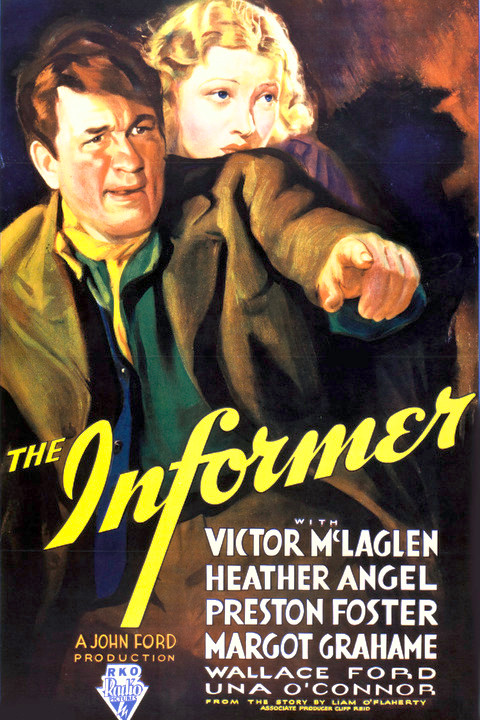
“My favorite film of those formative years was The Informer (1935) by John Ford. It is truly a masterpiece. Of all the wonderful directors I met in Hollywood before World War II, I paid special attention to John Ford. John had a vision up on the screen. John was very supportive of me in the early years when I needed it. He became a friend and a mentor. Ford invited me onto his sets, and, when I started directing, he’d drop in on mine. I cherished the times we were together.
Some critics, looking for a catchy tag line, have called me “the Jewish John Ford.” It was a ridiculous thing to say, though I understand people needing reference points. But let’s face it, next to the monumental Ford, I’d always be a neophyte. To understand the scope of John’s career, you have to remember that he began as an actor way before the talkies, with a small role in Birth of a Nation, in 1915. Over the next sixty-odd years, John Ford would direct about 140 films. John was a giant, having done it all in Hollywood. I learned a helluva lot of stuff from Ford, but one of the most important lessons was modesty. Ford was the most self-effacing of guys. When asked what brought him to Hollywood, he replied, “The train.”
Because he wanted complete artistic control, Ford started producing his own pictures. The desire to shape every aspect of his movies resulted in some of his finest work: She Wore a Yellow Ribbon (1949), Rio Grande (1950), The Quiet Man (1952), and The Man Who Shot Liberty Valence (1962). His mastery of the entire process was always an inspiration for me. I’ve never tried to imitate his work – nor anyone’s, for that matter – but to be mentioned in the same breath as the great Ford will always be a profound compliment. I remained close to him until his death, in 1973. For me, John Ford was everything I loved and respected about Hollywood.

“Each society has its own way of taming young people so they won’t destroy themselves and can mature into useful citizens. By focusing on bad boys, I wanted to thank my mentors for helping me stay on the high road. I was lucky. At critical moments in my life, role models like Arthur Brisbane, Gene Fowler, Terry Allen, George Taylor, Herbert Brenon, and John Ford took me under their wings and kept me from derailing, showing me how to be a mensch.

“My statuesque stripper, Cathy, needed beauty, sex appeal, and intelligence. I picked Constance Towers because se had all three, in spades. John Ford had introduced me to Constance. She’d appeared in Ford’s Horse Solders (1959) and Sergeant Rutledge (1960). A trooper all the way, Constance became a good friend.

“We shot Shock Corridor in about ten days. Once, John Ford stopped in for a surprise visit. It was a tremendous morale booster.
“Sammy, why’re you shooting on this two-bit set?” he asked.
“No Major would touch my yarn, Jack,” I said. “It’s warped. It’s about America.”
“You’re going to stir things up again, like Steel Helmet.”
“Maybe. I’ve just got to do this movie.”
I strolled with Ford down the long, white corridor, both of us puffing cigars. Something jarred his memory.
“Here was the church,” he said, pointing. “There was my set for the prostitute. Woy over there was the IRA interrogation.”
Was it possible that he’d shot one of his greatest movies, The Informer, on the same miserable soundstage? Yes, he explained, back in 1935 RKO was upset about his plans for a pictured based on a Liam O’Flaherty’s proletarian novel about the Irish Republican Party rising against the British. They gave him an embarrassingly small budget, forcing him to rent that very space to shoot the picture. I was stupefied that the great John Ford had been treated disparagingly. He read my face.
“Me too,” he said. “I had to make that movie.”

“A young director named Bertrand Fèvre asked me to play a part in Bleeding Star, his debut short film. Télérama, a widely read TV magazine, hired me to write a children’s book entitled Pecos Bill and the Soho Kid, a Western based on an idea I’d had for a TV show. Like the treatment for the show, the book featured an adult who’d never grown up and a kid with a Cockney accent and mature beyond his years, who took imaginary trips together, catching clouds with lassos. Illustrated by Belgian artist Frank le Gall, my little book was dedicated to John Ford. I was thrilled when my publisher received hundreds of enthusiastic letters from young French readers.

Wednesday, May 15, 2013

John Ford: Multiple Perspectives (Costa, Comolli, Gallagher, Straub)

In discussing John Ford with David Jenkins at Mubi, Pedro Costa praises Ford for his film's documentary and poetic quality, "It makes me dream and it makes me come back. I felt so right when I saw a film by John Ford and I'm in front of those people. It was a dream thing. It was a real thing." It's hard to isolate what exactly makes Ford's film so special and why his influence is so vast. Throughout the history of cinema there has been a plethora of of diverse directors that have praised Ford's cinema: Orson Welles, Ingmar Bergman Stanley Kubrick, Steven Spielberg, Jean-Marie Straub, Maurice Pialat, and the Ross Brothers (River). To just name a few. And, of course, Ford is equally as polarizing, and other directors, like Sam Peckinpah or Quentin Tarantino, have reacted against him.

In an interview with by Daniel Fairfax with Jean-Louis Comolli, "Yes, we were utopians; in a way, I still am...", Comolli brings up Ford in the his recounting of the conflicts between Cahiers du Cinéma and Cinéthique in the late 60's,
"They distinguished themselves by radically rejecting practically the entire cinema. Personally, I have always been concerned with saving the cinema, including the most ideological films. The idea behind "Young Mr. Lincoln" was to save Hollywood. [...] "We proceeded from the idea that, if forms have a meaning, it could be – and this is the case with the great Hollywood directors – that this meaning is not that of the characters, or the story the film tells. It could be that this meaning comes from the mise en scène, and there, all of a sudden, forms take on a meaning at odds with the énoncés of the film’s logic. In the end, Young Mister Lincoln is particularly striking because it is a film which, if you read it rapidly, tells us of the Lincoln myth, of bourgeois, mercantile America. Everything is there, justice, absolutely everything. But as soon as you dismantle it, as soon as you deconstruct it, you perceive that it is infinitely more perverse than that, and that the filmmaker manages, on the basis of his work, or his own genius, to endanger, and even squarely overturn, the énoncés which are in the film. This can lead to a much more subtle reading, which in the end shows the film as fiercely critical of Lincoln’s position. This is what is interesting: Lincoln is there, like a statue, and at the same time he is something much more problematic, none of his weaknesses are concealed."
In an interview by Toni D'Angela with Tag Gallagher for La Furia Umana, Gallagher speaks about Ford in regards to the structure of his films,

"He made “experimental films” (at least according to Straub and me). Sometimes he experimented more in one direction, sometimes in another. [...] Ford is virtually the only filmmaker in Hollywood between the wars who exposes and denounces racism and the nature of the military, […] more Brecht than Brecht, as Jean-Marie Straub says."
Gallagher might be one of Ford's staunchest defender and in his writing he ocasionally brings up Jean-Marie Straub admiration for Ford’s cinema. 

In Gallagher’s incredible John Ford: The Man and His Films (University of California Press) he further elaborates on Straub's describtion of Ford as "Brectian" in Footnote #703 (pg.566-567). 

Here it is: 
***

Any effort persisted in becomes corrupt. The sense of duty that sustains
Ford’s individuals (and also their sense of faith) commonly leads them astray
into aberrations or death. Duty-bound, they invade others’ privacy, and
arrogate knowledge of higher good, right and judgment: judges, ministers,
soldiers, outlaws, priests. Thus racism, war or any form of intolerance
becomes a function of society. In tracing Ford’s pictures (particularly Judge
Priest, How Green Was My Valley, This Is Korea!, The Man Who Shot Liberty
Valance) we have seen how people (and governments) act from feeling, not
from logic. People are made of dreams as much as reality. And we have
seen how Ford, in awakening around 1927 to cinema’s ability to be art
through total stylization, awakened simultaneously to his art’s high task: to
help us free ourselves from determining ideologies. Art, after all, has the
capability of making us understand things through emotion that we would be
absolutely incapable of understanding through the intellect. Within a determining 
milieu, particularly when that milieu is challenged, free will,
human nature, life’s worth, a benign divinity’s existence, all must necessarily
be posed in question. And so Ford pictures ideally construct in minute detail
a social set of apparent homogeneity (thus often military-like) in order to
analyze that society within its historic moment, and in order to demonstrate
how the garments of society, together with history itself, operate on the
individual. It is for these reasons that Jean-Marie Straub has called Ford the
most ”Brechtian” of all filmmakers.703
703. When Straub made this remark to the author in 1975 (after seeing Pilgrimage
and Donovan’s Reef) he was referring not so much to Ford’s acting style —in that
sense no films are truly Brechtian — as to Ford’s manner of stripping naked social
ideologies that are elsewhere unacknowledged. To Joseph McBride, Straub said Ford
is the most Brechtian of filmmakers, “because he shows things that make people
think...by [making] the audience collaborate on the film” (McBride and Wilmington,
John Ford, p. 108). McBride analyzes Fort Apache in this light, pointing out how
Captain York donning Colonel Thursday’s hat at the end is a Brechtian device [like
the cardinal donning the Pope’s robes in Brecht’s Galileo], and that we see clearly
that an insane system needs the dedication of noble men to perpetuate itself.) Less
simply, one might call Ford Brechtian because every element in his cinema is
engaged dialectically with every other element (whether one speaks of elements of
— or between — style, content, myth, ideology, or whatever), with the result that
Ford’s movies are self-reflexive and transparent in their workings.
This notion — essentially the thesis of this book — flies violently in the face of a
recent [1980] critical tendency to regard the “classical” cinema of Hollywood as a
monolithic system that sought to mask its “codes” (e.g., its montage) in order to
create an apparently unmediated representation of the real world; it sought to
entertain passively and left unacknowledged its own governing ideology. (Cf.,
Stagecoach: my argument with Browne (“Spectator-in-the-Text”); also Burch,
Distant Observer; Robert Phillip Volker, The Altering Eye [New York: Oxford, 1983];
Thomas Schatz, Hollywood Genres [New York: Random House, 1981]). “Modernist”
(i.e., some post-1960) cinema, on the other hand, subverts our absorption in
emotion, story, or character, and exposes its “codes” (e. g., by showing the camera,
discordant editing, having an actor speak directly to us), in order to force us to relate
intellectually rather than through emotional identification.
In these circles, Straub is admired as epitomizing “modernist” cinema, while Ford
is often derided (although not by most of the above-named critics) as a sentimental
reactionary. Thus Straub’s comparison of Brecht and Ford caused considerable
head-shaking. It is, of course, generally agreed that many movies cater exclusively
to an audience’s desire for passive spectacle (e.g.. Star Wars, some of Hitchcock);
and all research shows that audiences generally watch movies in order not to think.
Nonetheless, the fallacies of “modernist” critics are multitudinous (even including
their arrogation of the label “modern”). Firstly, their premise of a monolithic
classical system is a pure fantasy that reveals little sensibility for the complexity of
pre-1960 cinema and almost no acquaintance with the actual films themselves.
Secondly, they naively assume that audiences can be forced to think, whereas
“modernist” techniques soon lose their initial shock and audiences happily reimmerse
themselves into the fictional worlds of even the most determinedly
antipathetic movies. Thirdly, because their basis is exclusively materialist, they, like
Grierson and Aristarco before them, distrust emotions and aestheticism and would
destroy the art of cinema in favor of a cinema of political propaganda.
An examination of Brecht’s 1930 table, in which he gave cursory comparison
between the (bad) “dramatic” and the (good, Brechtian) “epic” theaters, will, in the
light of Straub and this book, show Ford very much on the “epic” side — the
“modernist”:
Dramatic Theater                                           Epic Theater
plot                                                                  narrative
implicates spectator into drama                         makes spectator an observer
wears down his capacity for                             action arouses his capacity for action
provides him with sensations                            forces him to make decisions
provides experience                                         provides a picture of the world
involves the spectator                                       confronts the spectator
suggestion                                                         argument
feelings are preserved                                        feelings are propelled into perceptions
man is assumed known                                      man is the object of inquiry
man unalterable                                                 man alterable and altering
suspense about the outcome                              suspense about the progress
each scene exists for another                             each scene for itself
linear development                                            in curves
evolutionary determinism                                   evolutionary leaps
the world, as it is                                               the world, as it becomes
what man ought to do                                       what man is forced to do
man as a fixed point                                          man as a process
his instincts                                                       his motivations
thought determines being                                   social being determines thought
(Brecht did not intend, obviously, that epic theater be absolutely one way and not at
all the other way; it is a question of tendency.)
Tag Gallagher

Tuesday, May 14, 2013

Two Rode Together (John Ford, 1961)


"Puisque nous avons la chance d'avoir affaire à un des rares cinéates qui méritent vraiment le beau nom de classique, les meilleures raisons d'aimer Ford seront encore les simples; et le fait est qu'elles ne sont pas sensiblement différentes de celles qui faisaient Delluc s'embraser pour Rio Jim, il y a quelque quarante-cinq ans. Ce sont donc des raisons vieilles comme le cinéma lui-même. Mais, dans Les Deux Cavaliers, non seulement il n'y a nulle contrainte, mais Ford nous offre son film le plus débridé, le plus désinvolte, en un mot, le plus libre. Le classicisme y appraît comme ce qu'il est vraiment: la souveraine maîtrise d'un art, le libre épanouissement qui autorise l'abandon des contraintes jadis utiles, et dont il est la suprême conquête. N'ayant plus rien à apprendre, le créateur se livre tout à la joie de sa création, et donne, sur le tard, ses oeuvres les plus surprenantes: les dernière pièces de Corneille, le Second Faust. Ainsi Les Deux Cavaliers sont-ils à La Chevauchée fantastique ce que Suréna est à Polyeucte." - Philip d'Hugues (Cahiers du Cinéma, N.127)

Tuesday, October 2, 2012

That Jack Ford yells very loud, he’ll make a great director


How should one start a blog-post about John Ford? Mention some of the great actors and actresses that he’s worked with like John Wayne, Henry Fonda, James Stewart, and Katharine Hepburn, Claudette Colbert, Maureen O'Hara? List many of his great films like The Informer, The Long Voyage Home, The Grapes of Wrath, How Green Was My Valley, When Willie Comes Marching Home, The Long Gray Home? Bring up how he made some of the most iconic Westerns like The Iron Horse, Stagecoach, My Darling Clementine, Fort Apache, The Searchers, Sergeant Rutledge, The Man Who Shot Liberty Valance? Bring up some of the seminal writing about him like Andrew Sarris’s entry in The American Cinema or his interview with Peter Bogdanovich?

Or try to describe why all of these old black-and-white films are as relevant as ever?

Today, in the early twenty-first century, when film production, distribution, and viewing is experiencing a seismic shift, accommodating itself to new technological changes; Ford’s cinema is a reminder of the great films that were being made in the Classical Hollywood studio era. Perhaps studying them might be rewarding to better understand and contextualize some of the films that are being made today? As Jean-Loup Bourget brings up in Hollywood, la norme et la marge, “the classical Hollywood forms are still alive in our time, even though, the truth is that they no longer have the same social function, nor without a doubt, the same significance.”

Eric Rohmer wrote about Westerns in Redécouvrir l’Amérique (Cahiers, N.54),
“There is certainly a touch of pedantry in evoking the Iliad while discussing a Western, but apart from the fact that certain commentators have had no qualms about comparing Chaplin or some Capra hero to the Percival of Arthurian legend, the obsession with antiquity is so flagrant in some masters of the American novel – Melville, James, Faulkner – that a parallel between the first colonizers of the Mediterranean and the pioneers of Arizona is no mere artifice of rhetoric.”
Rohmer is on the right path in bringing up the ancient Greek epic poem - along with highlighting terms like efficacy and elegance in discussing the form, and the genres preoccupation with destiny and morality - as in these Westerns, and especially Ford’s, these men, for their time, were experiencing the parameters of human experience. By choosing the colonizers of North America as his subjects, what we are being shown are the men and women that would go up against the empty abyss of a burgeoning country. They were literarily pushing the boundaries of their preconception of space. But there isn’t a rosy nostalgia to these pictures, as these social portraits hinge upon the collapse of civilized society into that of chaos or violence. One just thinks about the hold-up in Wagon Master, when this group of Mormons face exterior threats and a hold-up from within their group - the only way to fight back is with their guns. This is only one example of what’s particularly interesting about these films, and that is how the characters resolve these moral conflicts in face of humanity in extreme conditions.

The military seems to hold a strong place in Ford’s cinema. In Joseph McBride’s Searching for John Ford, McBride brings up that a young Jack Feeney as a young boy got all excited during his history classes. Ford felt proud when he discovered that a lot of Irish-American immigrants participated in the American Revolution (his father included). Joseph McBride, 
"His identification with the military ethos and his growing sense of himself as a national poet made him turn his postwar filmmaking efforts largely to themes of American history. [...] The result was a postwar body of work that became more nakedly individualistic, more deeply emotional, in many ways more pessimistic, fascinatingly and sometimes maddeningly self-contradictory, often defiantly quirky and self-indulgent to the point of perversity." 
One gets a sense that the military is viewed as a unifier of the population but also as a, perhaps, an inevitable period of misery and grief, before lighter times ahead. Just like how it takes a war and tragedy, in Drums Along the Mohawk, before there could be the creation of the American flag. So that there is something valedictory about how Lana (Claudette Colbert) would then compliment and admire it.
*****

For more information about Ford’s biography a great resource is his grandson’s Dan Ford’s biography Pappy: The Life of John Ford. But for starters, here is a brief account of his youth and his early career.

Ford was born on the first of February, 1895 into a large family and whose parents were Irish-American bootleg saloonkeepers in Portland, Maine. His father John Feeney moved to America from Ireland, following his nephew Michael Connoly, who had already been living there, living through exciting times.

When he was young, a young Jack Ford played on his high school football team, and worked at Portland's Jefferson theater, a prime stop for road companies. He then moved to join his brother's company, the Francis Ford Serial Company, which moved to the new studio Universal City in 1915, "the first truly modern studio," where he would make his first two-reelers The Tornado and The Scrapper (both 1917).

"Francis Ford was John's first great teacher and his first great professional influence,” writes Dan Ford, “but it was John's teaming with silent star Harry Carey that paved the way to his eventual success." Ford would make twenty-three films with Carey. Dan Ford writes about how this collaboration made John Ford, "a first-rate action director." On an assignment for Universal to make another two-reeler, Ford, with Carey, would make Ford’s first full-length feature, Straight Shooting (1917). Irving Thalberg really liked it, and tthe success of Straight Shooting convinced Universal to get Ford and Carey to make more of the same kind-of films billed as "Harrey Carey's and Jack Ford's Just Plain Westerns". Their last film together is Marked Men (1919).

John Ford’s reputation was improving and he left Universal for the William Fox studios, where his wage would increase to six-hundred dollars a week. His first two films there starred Buck Jones: Just Pals and The Big Punch (both 1919). Ford worked with Tom Mix "the hottest western star in Hollywood" on two pictures: Three Jumps Ahead and North of Hudson Bay (1922). Dan Ford describes Cameo Kirby (1923) as his "first truly mature film."

Around this time in 1920, Ford married Mary McBride Smith and had one son with her, Patrick. But this time of joy would not last long, as then the Irish Revolution got Ford interested again in his Irish roots and he went to visit his family in Galway, Ireland.
*****

Tag Gallagher does a good job at breaking up Ford’s career into different periods in his book John Ford: The Man and his Films. Gallagher divides Ford’s oeuvre into the following four categories: 1) The Age of Introspection (1927-1935), 2) The Age of Idealism (1935-1947), 3) The Age of Myth (1948-1961), and 4) The Age of Mortality (1962-1965). About these periods Gallagher writes,
"The first period tends to be relaxed, airy, concerned with being and with contemporary social life. The second period tends to be more manipulative, closed and formal, concerned more with mood and the past. The third period is brighter and more vital, formal but open, concerned with pilgrimage and subsistence. The fourth period, following a "season in hell," is eschatological, existentially and aesthetically."
It is also relevant here to bring up William K. Everson who in American Silent Film, in describing some of the more salient silent films, writes,
"The films of the early twenties concentrated more on beauty of camerawork and lighting - a beauty enhanced by the skilled utilization of tints and tones and by the increased and soon perfected use of gauzes, filters and glass shots. […] Through the twenties, the virtuosity of the purely pictorial aspect of film increased steadily, reaching its apex in 1927 and 1928 [...]  For quite certainly, the overall standards of the American film - both as entertainment and as art - were higher in the twenties then in any other period. It is in the twenties that we find the largest concentration of permanent classics of the American screen."
The films that Everson include in this group of “permanent classics” includes Ford's The Iron Horse and Four Sons, along with Borzage's Seventh Heaven, Griffith's Isn't Life Wonderful? and Orphans of the Storm, von Stroheim's Greed, Murnau's Sunrise, and von Sternberg's Docks of New York
*****

Since Ford's career has spanned for over fifty-years, from the teens to the late sixties, there are many filmmakers that one could classify as his contemporary. He is usually discussed in terms of being a classical Hollywood director, and thus could be associated with many directors of the time. Some examples: Cecil B. DeMille, as they both worked through the transition from silent to talkies, and in both eras made epic-scale spectacles; Alfred Hitchcock, for imbuing their films with a working-class social texture; Frank Capra and Preston Sturges, with Capra for a shared sentimentalist-optimism though Ford wasn't as preachy, and with both for how they re-used a stock company from film to film; Fritz Lang, both directors have made films that share very similar stories, but where Lang was a pessimist, Ford was a humanist; and Howard Hawks, for making Westerns and creating some of John Wayne's most iconic performances.

It is interesting to note what Ford admired about his friend Frank Capra's films,
"His genius has been applied not only to the art of but to the business of making great motion pictures, and his name on the credits has assured rich satisfactions to bankers, exhibitors, stars, feature players, extras, cameramen, crew, and the theatergoing public for more than half a century. This he has accomplished without compromising his own exacting sense of the good, the beautiful, and the appropriate; without ever losing a friend or having a scene censored."
It is interesting to note that the business-side of movies is one thing that Ford admires, because he openly voiced his frustration and anger towards his producers. But if one looks further into why Ford’s films stand out is that he too was able to mix the best of both worlds balancing personal expression with studio resources.

"Capra has not only achieved a place of distinction in that select company of really fine directors - men like Bill Wellman, Fred Zinneman, George Stevans, George Seaton, Billy Wilder, Henry Hathaway, the late Leo McCarey, and (abroad) Jean Renoir, Fellini, De Sica, Sir Carol Reed, and David Lean." Ford continues, from his foreword to Capra's The Name Above the Tile: An Autobiography, "He heads the list as the greatest motion picture director in the world."
*****

Ford’s films have a distinct style: the people in his films are characterized by more than just how they look and by their actions, but also by their behavior, glances and gestures; he usually films in long-shots so that there can be more things going on in the fore-, mid-, and background then just the primary action; there isn't too much editing and the camera movements - like dolly-shots to provide emphasis, or pans - are used sparingly (more like Ozu than Eisenstein). Ford continues in the tradition set forth by the D.W. Griffith of The Birth of a Nation by making films exploring the countries history and social problems. The French film-critic Jean-Loup Bourget refers to Ford as a “cinéaste classique par excellence,” and talks about his films as deriving their form from classical paintings. In Bourget's essay D’un classicisme l’autre: Poussin, Ford, Hawks, from the book Le classicisme hollywoodien, he writes, “It’s clear that the paintings that have been brought up by others aren’t “sources” (e.g. the paintings of the West by Frederic Remington, Winslow Homer) or punctual references, but more like that of similar world-views, that share an air of familiarity, where the reprisal of certain pictorial motifs are openly both visual and thematic.”

Ford is more than just as an auteur, but is a cineaste - a director conscious of making movies, and wanting to heighten their experience. One filmmaker that Ford admired and who had a great influence on him is F.W. Murnau. In the late twenties, Murnau was invited by the Fox Studios to come to Hollywood to shoot a movie Sunrise: A Song of Two Humans (1927). Ford who was at the studio at the time was impressed by its many-fold visual tricks and distorted realism. Gallagher writes about the Murnau influence on Ford that, "Ford found cinema could be completely poeticized; he discovered movies might be art."

The Informer (1935) with its angst-ridden protagonist, stark lighting, titled camera angles and distorted sets; is one of the early Ford films to be influenced by the German Expressionist filmmaker. Murnau's Nosferatu was also was influential on Ford. Especially the shock effect that comes from the revealing of Nosferatu (Max Schreck) from out of the shadows into the light - where he's looking like a mixture between a rat and a vampire. Ford would appropriate this device when he would present luminary figures revealing hidden truths. One can think of the many court-room scenes in Ford's films where in a moment of suspense the onlookers would be shocked by someone revealing important information. As well there is the Nosferatu dazed-like wandering - a tabula rasa which watches and absorbs - that seems to be the primary influence for Huw Morgan (Roddy McDowall), from How Green Was My Valley, whose unchanged stunned look remains on his face as he wanders around the misery of the Welsh mining community.
*****

The subject of American history plays a large role in Ford's cinema. A good description of his films could be that Ford gives life to history through the rituals of individuals within communities: marches getting ready and then taking place, ballroom dances in unison, military preparations and following orders, court-room procedures and so on and so on. Orson Welles said about Ford that at his best, "you feel that the movie has lived and breathed in a real world."

In discussing industrialization Tony Judt and Timothy Snyder, in Thinking the Twentieth Century, highlight that John Steinbeck and his book The Grapes of Wrath, “serves the function of creating an image of working class suffering, making society look different than it did before”. Where Steinbeck creates the social texture of the Great Depression through his prose, Ford presents the faces and the people going through these experiences. So in the film version of The Grapes of Wrath, Tom Joad (Henry Fonda) and his family put a face to the plight of the migrating farmers, which was caused by their property being allocated by the banks. And one could include How Green Was My Valley as one of the great proletariat films. In Ford's films, to use two other examples Mary of Scotland and Cheyenne Autumn, Ford gives precedent to the victims and the defeated. There is something almost modern about the social criticism imbued within his historical portraits.

Where a historian like Richard Hofstadter in The American Political Tradition describes the 19th century politician Abraham Lincoln in terms of being a self-made myth, both self-conscious of his poor and humble origins alongside being political ambitious. Lincoln’s views on slavery, as Hofstadter posits, was more a tool of electoral self-promotion then that of a humanitarian concern. While for Ford, in his rich, though perhaps naive, portrait of Lincoln: Ford emphasizes certain qualities of the Lincoln spirit, that of education, collectivity and the possibility of creating change. It’s almost a revolutionary spirit and you can see it in many of Ford’s films where Lincoln appears as a character or solely represented in a photograph (The Prisoner of Shark Island, the Calvary trilogy).

A good reference for discussing Ford's relation to the spirit of Lincoln is John Ford’s Young Mr. Lincoln, A collective text by the Editors of Cahiers du Cinema from August 1970, which is anthologized in Narative, Apparatus, Ideology. The essay is a Marxist-Freudian reading of the film, that analyzes it in the way that Walter Benjamin has insisted the discussion of arts as, “not as a reflection of the relations of production, but as having a place within these relations.” The Cahiers essay is useful for providing a brief history of the United States of America to contextualize Young Mr. Lincoln. Like how in 1938, under Democrat president Roosevelt, the fairly gloomy context of the Young Mr. Lincoln undertaking was that of “federal centralism, isolationism, economic reorganization (including Hollywood), strengthening of the Democrat-Republican opposition, new threats of internal and international crisis, crisis and restrictions in Hollywood itself." And that, “It is no doubt difficult, but necessary, to attempt to estimate the total and respective importance of these factors to the project and the ideological “message of the film.”"
*****

So what is Ford's influence on contemporary cinema? and how do we remember him today? In a political climate where the truism of the past are snatched from their original meaning to promote false claims and distorted ideals, and in a culture that fetishes the new and novelty to the disregard to the old. John Ford’s cinema stands out for its humanistic concern and as a relic of mainstream mid-century American cinema. His movies today both move and are moving.

From early on, even while he was still alive, his work was already influencing other filmmakers, especially in terms of how he presented communities and his treatment of landscapes. Some directors, from the past to the present, that show a marked influenced by Ford include: Orson Welles, Ingmar Bergman (the early, medieval films), Michelangelo Antonioni, Akira Kurosawa, Stanley Kubrick, Monte Hellman, Maurice Pialat (Van Gogh), Straub & Huillet, Martin Scorsese, Paul Schrader, Walter Hill, Peter Bogdanovich, Paul Thomas Anderson, Quentin Tarantino, José Luis Guerín (Innisfree), Pedro Costa, and Andrew Stanton (John Carter).

When the language of film criticism has yet to catch up with the new realities of the twenty-first century, there needs to be some understanding of the past to better understand how to move forward. Two directors that admirably keep on with the Classical Hollywood tradition which was personified by Ford that I would like to highlight are Steven Spielberg and Clint Eastwood. It is a shame then that some of their great new films like Lincoln and Trouble With The Curve are oddly dismissed as being anachronistic and out-of-date. While a regular, yearly output may lead to a variety in quality, the Hollywood tradition that Spielberg and Eastwood are engaging with; make me confident in the way that the movies are being made, and in the stories that they tell, and in the society that watches them.

David Davidson
Monday, September 24, 2012

John Ford Speaks!


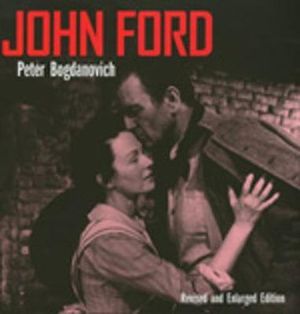
In Peter Bogdanovich's book, John Ford: Revised and Enlarged edition, the center-piece is an interview with Ford, where he discusses his entire career, along with four of Bogdanovich's early journalistic essays. In A Meeting at Monument Valley and My Name's John Ford. I Make Westerns, Bogdanovich describes his experience going to Monument Valley to visit the set of Cheyenne Autumn. In the essay, between reporting on how Ford filmed the movie and how he behaves on the set, are anecdotes about Ford by his collaborators. Two of them that stand out are: a discussion between Ford and Carroll Baker about Ingmar Bergman ("you mean the fella that called me the greatest director in the world."); and how during the McCarthy era at the Director's Guild, Ford defended Joseph L. Mankiewicz against Cecil DeMille who was accusing him  of being a communist.

A Poet and Comedian is how Orson Welles characterizes Ford, and Bogdanovich would add that in Ford's best films "these two sides of his personality are mixed." In the essay, Bogdanovich elaborates about Ford's  career development and themes within his films. "With Ford at his best, you feel that the movie has lived and breathed in a real world," said Welles, quoted by Bogdanovich, and who would add, "he has told the American saga in human terms and made it come alive." And that, "But the key to his work in the thirties lies in a personal struggle (no doubt unconscious) between two very different kinds of film, both of which interested him deeply: the dramas [...] and the lighter pictures of American life."

There is a moving and heart-felt memorial (Taps) and a annotated filmography, which is useful for the brief descriptions of his little-known silent films as well as uncompleted projects.

The following are some of my favorite remarks from the Ford interview, A Job of Work, which was taped at his home in the Fall  of 1966. What's illuminating about the interview is the framework it provides to better understand the realities of a classical Hollywood era studio director and the mediation of personal self-expression within larger commercial projects, as well as the interference and common-place alterations that ended-up shaping his films.

For more information about Ford there is the the great documentary Directed by John Ford, also by Bogdanovich, with a filmed interview with Ford, though he comes off as more gruff and less amicable then he does in the book. As well there is John Ford: Interviews, which is especially interesting for the interviews translated from French, where Ford is more outgoing and receptive. You can also find more of Bogdanovich's writing at his excellent blog Blogdanovich and there is a great interview with him where he speaks for over fifty-minutes about his writing, film-making and other projects at video-magazine The Seventh Art.
*****
Directors and Actors
D. W. Griffith, "influenced all of us. If it weren't for Griffith, we'd probably still be in the infantile phase of motion pictures. He started it all - he invented the close-up and a lot of things nobody had thought of doing before. Griffith was the one who made it an art - if you can call it an art - but at least he made it something worthwhile."

Henry B. Walthall
, "was one of the greatest actors of all time - a personality that just leaped out from the screen. He had nothing to do in that picture [Kentucky Pride] - but he had such a presence - like Barrymore had, but Walthall was a much better actor."

Will Rogers: "Well, no write could write for Will rogers, so I'd say to him, 'This is the script but this is not you - the words will be false coming from you. Just learn the sense of it, and say it in your own words.' Some of the lines he'd speak from the script but most of the time he'd make up his own; he'd stop and let people pick up their cues and then go on; he wouldn't write the lines down, but he'd work it out beforehand and then just get in front of the camera and get the sense of the scene in his own inimitable way."
 
Scripts and Directing
Men Without Women (1930), "I think it was the first picture Dudley Nichols and I did together. From then on, we worked together as much as possible, and I worked very closely with him. He had never written a script before, but he was very good, and he had the same idea I had about paucity of dialogue."

On screenplays: "Well, there's no such thing as a good script really. Scripts are dialogue, and I don't like all that talk. I've always tried to get things across visually. I don't like to do books or plays. I prefer to take a short story and expand it, rather than take a novel and try to condense. But it has become more difficult to get a good story."

Directors: "Certain directors go by fixed rules - they say you must have a close-up of everything. But we've got this big screen: instead of putting a lot of pock-marked faces on it - big horrible head, eye - I just don't like it - if I can play a scene in a two-shot, where you can see both faces very well, I prefer it that way. You see people instead of just faces. Of course, nowadays in pictures, you never even get a chance to look at anyone's face."

Directing: "Phil Dunne wrote the script and we stuck pretty close to it. There May have been a few things added, but that's what a director is for. You can't just have people stand up and say their lines - there has to be a little movement, a little action, little bits of business and things."

Multiple takes: "No-because the actors get tired, they get jaded and lose the spontaneity - so that they-re just mouthing words. But if you get the first or second take, there's a sparkle, an uncertainty about it; they're not sure of their lines, and it gives you a sense of nervousness and suspense."

Music: "Generally, I hate music in pictures - a little bit now and then, at the end or the start - but something like the Ann Rutledge theme belongs. I don't like to see a man alone in the desert, dying of thirst, with the Philadelphia Orchestra behind him."
Medium Specificity and Cinematography
Talkies: "I didn't feel anything about it - it was just a job of work."

His first color film, Drums Along the Mohawk (1939): " There was no change really. It's much easier than black and white for the cameraman; it's a cinch to work in, if you've any eye at all for colour or composition. But black and white is pretty tough - you've got to know your job and be very careful to lay your shadows properly and get the perspective right. In colour - there it is; but it can go awfully wrong and throw a picture off. There are certain pictures, like The Quiet Man, that call for colour - not a blatant kind - but a soft, misty colour. For a good dramatic story, though, I much prefer to work in black and white; you'll probably say I'm old-fashioned, but black and white is real photography."

Filming The Long Gray Line (1955) in CinemaScope: "I hated it. You've never seen a painter use that kind of composition - even in the great murals it still wasn't this huge tennis court. Your eyes pop back and forth, and it's very difficult to get a close-up."

Filming a part of How The West Was Won (1962) in Cinerama
: "It's worse than CinemaScope, because the ends curl on moving shots and the audience moves instead of the picture. You have to hold onto your chair. I didn't care for it."

Cameraman George Schneiderman; "Well, I like to have the shadows black and the sunlight white. And I like to put some shadows into the light. We would talk it over, and I'd say 'Right here, George,' and he'd say 'Fine - I'll move a little to the right.' I'd  say 'Go ahead.' We worked together - Never had an argument with a photographer."

Best cameramen: "Comparisons are odious, of course, but Gregg Toland and Joe August were really great cameramen, and so was Artie Miler. I think they stand out as three of the best I ever worked with."
 
Pictures
The Iron Horse (1924): "But the point is we had this simple little story come out as a so called 'epic', the biggest picture Fox had ever made. Of course, if they had known what was going to happen, they never would've let us make it."

Mother Machree (1927): "I had a lot of fun with that, but you didn't choose these things - they were thrown at you and you did the best you could with them."

Born Reckless (1930): "In those days, when the scripts were dull, the best you could do was to try and get some comedy into it."

Steamboat Round the Bend (1935)
, "should have been a great picture but at the time they had a change of studio and a new manager came in who wanted to show off, so he recut the picture, and took all of the comedy out."

The World Moves On (1934): "I pleaded and quit and everything else, but I was under contract and finally I had to do it, and I did the best I could, but I hated the damn thing. It was really a lousy picture - it didn't have anything to say - and there was no chance for any comedy. But what the hell, that was called 'being under contract.'"

Stagecoach (1939): "I still like that picture. It was really Boule-de-suif, and I imagine the writer, Ernie Haycox, got his idea from there and turned it into a Western story which he called 'Stage of Lordsburg.'"

Young Mr. Lincoln (1939): "They cut some nice things out of it. For example, I had a lovely scene in which Lincoln rode into town on a mule, passed by a theare and stopped to see what was playing, and it was the Booth Family doing Hamlet; we had a typical old-fashioned poster up. Here was this poor shabby country lawyer wishing he had enough money to go see Hamlet when a very handsome young boy with dark hair - you knew he was a member of the Booth Family - fresh, snobbish kid, all beautifully dressed - just walked out to the edge of the plank walk and looked at Lincoln. He looked at this funny, incongruous man in a tall hat riding a mule, and you knew there was some connection there. They cut it out - too bad."

How Green Was My Valley (1941): "I wanted to reprise the mother's song so I got the idea of bringing the cast back. In the theater I always like to see the cast come out - regardless of whether the guy's playing the messenger boy or the butler - I like to see him out and take his bow. That's probably where I got the idea."

My Darling Clementine (1946)
: "I knew Wyatt Earp. In the very early silent days, a couple of times a year, he would come up to visit pals, cowboys he knew in Tombstone; a lot of them were in my company. I think I was an assistant prop boy then and I used to give him a chair and a cup of coffee, and he told me about the fight at the O.K. Corral. So in My Darling Clementine, we did it exactly the way it had been. They didn't just walk up the street and start banging away at each other; it was a clever military manoeuvre."

The Fugitive (1947), "It came out the way I wanted it to - that's why it's one of my favorite pictures - to me, it was perfect. It wasn't popular. The critics got at it and evidently it had no appeal to the public, but I was very proud of my work."

Fort Apache (1948), "Yes - he was the colonel, and what he says - goes; whether they agree with it or not - it still pertains. In Vietnam today, probably a lot of guys don't agree with their leader, but they still go ahead do the job."

When Willie Comes Marching Home (1950)
: "Well, that was my racket for a while, and there wasn't anything funny about it. I wonder what s.o.b. will be the first to make a comedy about Vietnam?"

Wagon Master (1950), "I wrote the original story. Along with The Fugitive and The Sun Shines Bright, I think Wagon Master came closest to being what I wanted to achieve."

The Quiet Man (1952): "We had a lot of preparation on the script, laid out the story pretty carefully, but in such a way that if any chance for comedy came up, we could put it in - like Barry Fitzgerald bringing the crib into their bedroom on the morning after the wedding night, and seeing the broken bed."

The Sun Shines Bright (1953): "The Sun Shines Bright is my favorite picture - I love it. And it's true to life, it happened, Irvin Cobb got everything he wrote from real life, and that's the best of his Judge Priest stories."

The Searchers (1956): "Well, I thought it was pretty obvious - that his brother's wife was in love with Wayne; you couldn't hit it on the nose, but I think it's very plain to anyone with any intelligence. You could tell from the way she picked up his cape and I think you could tell from Ward Bond's expression and from his exit - as though he hadn't noticed anything."

The Wings of Eagles (1957): "I didn't intend it that way, but he did. I woke up one morning and my good hat was gone, my pipe and everything else; they'd taken all the Academy Awards and put them in the office set."

Sergeant Rutledge (1960), "Yes, that's the point. The Negro soldier, the regular, is very proud. They had always been a cavalry outfit, but in this last war, they were mechanized - they took their horses away, and they were broken-hearted. They were very proud of their outfit; they had great esprit de corps. I liked that picture. It was the first time we had ever shown the Negro as a hero."

The Man Who Shot Liberty Valance (1962
): "Well, Wayne actually played the lead; Jimmy Stewart had most of the scenes, but Wayne was the central character, the motivation for the whole thing. I don't know - I liked the both - I think they were both good characters and I rather liked the story, that's all. I'm a hard-nosed director; I get a script - if I like it, I'll do it. Or if I say, ' Oh, this is all right' - I'll do it. If I don't like it, I'll turn it down."

7 Women (1966)
, "I think it was a good story. And it was a good switch for me, to turn around and make a picture all about women. It didn't do well here, but it was a sensation in Europe. I thought it was a hell of a good picture."
Thoughts and Philosophy

The boastful Irish character: "I suppose the character is a composite of several people. My father, for instance. He would tell about the great things he'd done as a young man, such as the time he lifted a heavy boulder up out of the water, or how he swam Galway Bay. Of course, he was a damn liar, but he would entertain us kids."

The concept of the glory in defeat or noble failure that runs throughout Ford's films, "Well, I think that's coincidence - although it's a wonderful thing to think about. But I never realized that - I mean, it isn't something I've done consciously -  it may have been subconscious. But, then, I didn't write the stories."

The difficulty to finance small personal pictures: "Oh, you can't anymore - it's impossible. You've got to go through a series of commands now and you never know who the hell reads the scrips any more. You can't get an O.K. here in Hollywood for a script - it's got to go back to New York, and through a president and a board of directors and bankers and everybody else. What I used to do was try and make a big picture, a smash, and then I could palm off a little one on them. You can't do it any more."

The worth and importance of his films: "Well, that's presumption I can't accept. I never felt that way about it. I've always enjoyed making pictures - it's been my whole life. I like the people I'm around - I don't mean the higher echelons - I mean the actors, the actresses, the grips, the electricians. I like those people. I like to be on the set, and regardless of what the story is, I like to work in pictures - it's fun.
Harry Carey tutored me in the early years, sort of brought me along and the only thing I always had was eye for composition - I don't know where I got it - and that's all I did have. As a kid, I thought I was going to be an artist; I used to sketch and paint a great deal and I think, for a kid, I did pretty good work - at least I received a lot of compliments about it. But I have never thought what I was doing in terms of art, or 'this is great' or 'world-shaking', or anything like that. To me, it was always a job of work - which I enjoyed immensely - and that's it.