Showing posts with label Early Monthly Segments. Show all posts

Monday, March 7, 2016

John Porter at Early Monthly Segments

For tonight's seventh year anniversary of Early Monthly Segments its programmers are organizing a special series of projection of the short-films by the local director-photographer-experimental film enthusiast John Porter, in conjunction with the release of his new book, John Porter’s CineScenes: Documentary Portraits of Alternative Film Scenes, Toronto and Beyond, 1978-2015. The screening is tonight Monday, March 7th at 8PM at the Gladstone Hotel.
But probably the most anticipated film in the program is the 1992 The Secret of the Lost Tunnel (or Woody Allen: A Space Odyssey), which is described on Porter's website as,
"A Camera Dance, using time-lapse/pixilation. John performs for the camera in a rare "narrative" film, edited in-camera. Playing a naked Hardy Boy carrying a lantern in the dark, he discovers a mysterious, long, pink tunnel. Struggling to squeeze all the way through, faster and faster, he passes advertisements on the walls along the way, and at the end he emerges into a scene from Stanley Kubrick's movie 2001: A Space Odyssey (1968). John constructed the tunnel "set" in his apartment, changed shooting speeds to change his apparent crawling speeds, and recorded his grunts onto the sound film afterward. Inspired by a scene in Woody Allen's movie Everything You Always Wanted to Know About Sex, but Were Afraid to Ask (1972). The title, and title page in the film, is borrowed from a Hardy Boys book."
A regular dilemma for Canadian directors: How to make a cinema in the shadow of Kubrick or The Force Awakens? Film a projection of 2001: A Space Odyssey (The Secret of the Lost Tunnel), put Kubrick in your film (Operation Avalanche), document the public event which is the opening night screening of the The Force Awakens (Nirvana: The Band Part. II), or have children playing as if they had the force (Jean-Marc Vallée's Big Little Lies). 
 
An attempt for an auteurist cinema has its limits in Toronto so a good goal is to reach for the sky and produce something great in the model of some of the most popular and imaginative films of the last century. In the shadow of Hollywood, there's a need to do everything to bring attention to your film, first people need to want to see your film, before they can evaluate and appreciate it.

Monday, March 18, 2013

Trinh Minh-hà and Michael Wallin at EMS

For the 4th anniversary of Early Monthly Segments there is going to be a projection of Michael Wallin's Decodings and Trinh Minh-hà's Reassemblage. It will be tonight, Monday March 18th at 8pm at the Art Bar in the Gladstone Hotel.

Monday, February 18, 2013

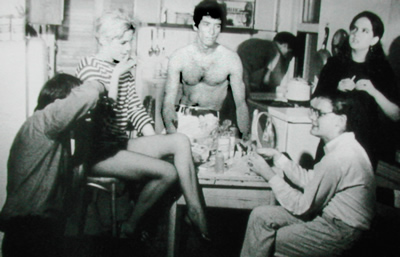
Andy Warhol’s Kitchen and the Escarpment School


To accompany the Oakville Galleries’ exhibition Where I Lived, and What I Lived For, Jon Davies is programming for Early Monthly Segments Andy Warhol’s Kitchen (1965). The screening will be Monday February 18th at 8pm at the EMS regular screening venue, the Ballroom in the Gladstone Hotel.
 *****
Local Listing: The Free Screen begins its Winter 2013 programming with The Road Ended at the Beach and Other Legends: Parsing the "Escarpment School" on Thursday, February 21st at 6:30pm. Regarding the program, its curator Brett Kashmere writes,
"A unique and often overlooked confluence in Canadian film history, the "Escarpment School" denotes a loosely knit band of Ontario-based experimental filmmakers — including Philip Hoffman, Mike Hoolboom, Richard Kerr, Carl Brown, Gary Popovich and Steve Sanguedolce — who studied together at Sheridan College in the 1970s, under the tutelage of Rick Hancox and Jeffrey Paull. Influenced by both the New American Cinema and its conterminous postwar movements (especially Beat literature) as well as the Canadian social documentary tradition (which were often screened side by side in the Sheridan classroom), the Escarpment School cineastes have over the course of thirty years helped to reinvent documentary as a mode for self-expression and formal exploration, extended and deepened the rich landscape tradition in Canadian art, and inspired new generations of filmmakers through their work and their teaching. Although varied in tone and texture, the films in this program share numerous qualities, including an attention to landscape, the filtering of documentary material through individual experience, the looming presence of America, and a formalist, process-based approach to non-fiction."

Wednesday, November 14, 2012

Warren Sonbert Retrospective at Jackman Hall (November 15th – 17th)

Early Monthly Segments, the monthly experimental film series, will be celebrating it’s forty-fifth edition by programming a complete Warren Sonbert retrospective from Thursday, November 15th to Saturday the 17th at the Jackman Hall in the Art Gallery of Ontario.

Sonbert’s films are described as “wonderful records of his vibrant surroundings in New York and San Francisco and his travels abroad. Gorgeously shot and meticulously edited, his films serve as an important touchstone for the possibilities of personal filmmaking.” Jon Gartenberg, who organized this retrospective initially at Light Cone in Paris, calls Sonbert "one of the seminal figures working in American experimental film," and other Sonbert supporters include P. Adams Sitney. The subject matter and style of Sonbert films correspond well with the work of Werner Schroeter, whose films are also currently being shown in a retrospective in the city.

The programs are:
-       On Thursday, November 15th (6:30pm) there is Queer Identity, which includes the Amphetamine (1966), Noblesse Oblige (1981), and Whiplash (1997).
"Of the many creative and cultural universes inhabited by Sonbert, none was perhaps more acutely experienced yet least publicly acknowledged than his homosexual identity and affliction with AIDS. This program examines Sonbert’s relationship to the gay universe, beginning with his provocative and playful first film, Amphetamine, which depicts young men shooting amphetamines and making love in the era of sex, drugs, and rock and roll. The program continues with Noblesse Oblige, a masterfully edited work that features imagery Sonbert photographed of protests in San Francisco following the murders of Mayor George Moscone and Councilman Harvey Milk at the hands of Dan White. (Sonbert modeled the structure of this film on Douglas Sirk’s Tarnished Angels). The program culminates with Whiplash, his elegiac meditation on his own mortality, a film that was completed posthumously according to Sonbert’s instructions."
-       On Thursday, November 15 (8pm) there is From Mise-en-Scene to Montage, which includes The Bad and the Beautiful (1967) and Tuxedo Theatre (1968).
"One of the most profound themes coursing throughout Sonbert’s work is that of love between couples in all its pitfalls and perfect moments. Sonbert expressed this theme not only between his protagonists onscreen, but also in the relationship between his ever-roving hand-held camera and the human subjects within his field of vision. The Bad and the Beautiful is noteworthy for Sonbert’s use of in-camera editing, in which he assembled together individual 100’ camera rolls (that he shot) into a series of mini-narratives. Each camera roll sequence captures an individual couple in unusually intimate, quotidian moments: eating, making love, dancing, and whiling away the time. Beginning in 1968, Sonbert abandoned his earlier filmmaking style, which had brought him such notoriety in the public press while he was still a teenager. He began using his hand-held Bolex camera to enlarge his field of vision beyond New York, recording footage as he traveled around the world. The Tuxedo Theatre offers evidence of Sonbert’s first steps in developing his unique style of montage, which subsequently resulted in his magnum opus, Carriage Trade."
-       On Friday, November 16 (6:30pm) there is Overarching Themes: Art & Industry, Militarism & Feminism (The Female Gaze), which includes Divided Loyalties (1978), Honor and Obey (1988), and A Woman’s Touch (1983).
"Sonbert’s montage works were meticulously constructed in the selection and sequencing of individual shots. Film theorist Noel Carroll gave the term “polyvalent montage” to Sonbert’s working style, in which each shot “can be combined with surrounding shots along potentially many dimensions.” Sonbert himself once wrote, that “the ambition might be seen as an attempt to hold finely balanced series of tensions in which one can read images a variety of ways, sometimes in contradictory stances so that there are many possibilities of interaction. “Each of Sonbert’s films after Carriage Trade was structured with an overarching theme in mind. Divided Loyalties, according to Sonbert, is about “art vs. industry and their various crossovers.” Honor and Obey questions all forms of male-dominated authority, particularly familial, religious, political, and military. Sonbert modeled A Woman’s Touch after Hitchcock’s Marnie, both in the stylistic interplay between “images of [en]closure and escape,” and in the thematic tension between male domination and female independence."
-       On Friday, November 16 (8pm) there is The Travel Diary, which includes Carriage Trade (1972).
"In Carriage Trade, Sonbert interweaves footage taken from his journeys throughout Europe, Africa, Asian and the United States, together with shots he removed from the camera originals of a number of his earlier films. Carriage Trade was an evolving work-in-progress, and this 61-minute version is the definitive form in which Sonbert realized it, preserved intact from the camera original. With Carriage Trade, Sonbert began to challenge the theories espoused by the great Soviet filmmakers of the 1920’s; he particularly disliked the “knee-jerk’ reaction produced by Eisenstein’s montage. In both lectures and writings about his own style of editing, Sonbert described Carriage Trade as “a jig-saw puzzle of postcards to produce varied displaced effects.” This approach, according to Sonbert, ultimately affords the viewer multi-faceted readings of the connections between individual shots. This occurs through the spectator’s assimilation of “the changing relations of the movement of objects, the gestures of figures, familiar worldwide icons, rituals and reactions, rhythm, spacing and density of images.”
-       On Saturday, November 17 (3pm) there is 60′s New York, which includes Where Did Our Love Go? (1966), Hall of Mirrors (1966), and The Tenth Legion (1968).
"Sonbert began making films in 1966, as a student at New York University’s film school. His earliest films, in which he captured the spirit of his generation, were inspired first by the university milieu and then by the denizens of the Warhol art world. Sonbert described the scenes from Where Did Our Love Go?, as follows: “Warhol Factory days…serendipity visits, Janis and Castelli and Bellevue glances…Malanga at work…glances at Le Mépris and North by Northwest…Girl rock groups and a disco opening…a romp through the Modern.” Hall of Mirrors is an outgrowth of one of Sonbert’s film classes at NYU, in which he was given the outtakes from a Hollywood film (starring Fredric March and Florence Eldridge) to re-edit into a narrative sequence. Adding to this found footage, Sonbert filmed Warhol’s superstar René Ricard in more private and reflective moments, and Gerard Malanga in public view at an art gallery. The film has a sophisticated circular structure, beginning and ending with the protagonists’ movements enmeshed within multiple reflecting mirrors. The Tenth Legion stylistically exemplifies Sonbert’s masterful use of a constantly moving hand-held camera as it trails the college-age protagonists in choreographed fashion, and of chiaroscuro lighting effects in interior scenes. Critic Greg Barrios wrote about this film: “People [are] engaged in their living, in their purpose, in their contribution, however trivial or important, to the work of the world.” Sonbert’s attention to capturing on film the minutiae of daily existence can be seen as a precursor to his mature montage films made years later, in which he melded diverse human gestures into a unified global vision."
-       On Saturday, November 17 (6:30pm) there is Silent Rhythms/Sound Symphonies 1, which includes Rude Awakening (1976) and Friendly Witness (1989).
"Rude Awakening, according to Sonbert, is “about Western civilization and its work; activity ethic and the viability of performing functions and activities.” Sonbert’s vivid color palette enhances the ritualistic nature of each action observed. Set against this lush panorama, Sonbert subverts the expectation of classic cinematography with a liberal sprinkling of avant-garde techniques. The incorporation of the materiality of film, the treatment of light, and the use of a hand-held camera, all suggest the influence of Stan Brakhage, Sonbert’s “hero”. Sonbert was also a professional music critic. In Friendly Witness, he returned, after 20 years of making films, to incorporating music tracks back into his movies. In doing so, he selected specific recordings from his firsthand knowledge of a vast repertoire of classical, pop, and world music idioms. Critic Fred Camper has noted that the first section of Friendly Witness is “suggestive of loves gained and love lost” – to the tunes of four rock [and roll] songs. Sonbert accompanied the closing imagery with a music underscore from Gluck’s operatic overture to Iphigénie en Aulide. The filmmaker observed: “Spectacle, public domain, objective (god’s eye) point of view is the aesthetic approach with the constant idea that all this activity is perhaps occurring simultaneously.” Here as Sonbert weaves together an extraordinary palette of synchronous activity worldwide, he places himself firmly in the pantheon of the great montage theorists in film history."
-       On Saturday, November 17 (8pm) there is Silent Rhythms/Sound Symphonies 2, which includes The Cup and the Lip (1986) and Short Fuse (1992).
"Sonbert considered The Cup and the Lip as one of his best films – “complete, succinct and time proof.” Film critic David Sterritt wrote that “the film appears to be a regretful and perhaps sardonic essay on human frailty – and on the effort to stave off chaos by means of political and religious institutions, which carry their own dangers of social control and mental manipulation.” Short Fuse is informed by Sonbert’s awareness of his own mortality, once he was diagnosed with HIV. As film critic Steven Holden astutely noted, in Short Fuse, “an undercurrent of rage seeps through the cracks of its ebullient surface.” The opening of the film explodes with a sea of turbulent emotions, underscored by the gripping sound track from Prokofiev’s First Piano Concerto. Shifting musical passages collide against images of leisure, war, and protest. In 1986, Sonbert wrote a feature-length screenplay adaptation of Strauss’ Capriccio, his favorite opera. A central artistic question raised by Capriccio is whether the music or the libretto takes priority. Short Fuse is replete with a soundtrack that counterpoints the film’s visuals; this prompts the spectator to contemplate, in analogous fashion, whether the images or the sound track predominates. In Sonbert’s creative hands, there are no definitive answers, only more open-ended perspectives."

Sunday, May 27, 2012

Bruce Baillie and others (Experimental Cinema, Summer 2012)

To kick off their Summer program at the Lightbox, The Free Screen will be screening Bruce Baillie’s Quixote, "the Baillie film most in need of rediscovery" according to The Free Screen programmer Chris Kennedy, and All My Life with Arthur Lipsett’s 21-87, and Joshua Romphf’s Ride This Country (May 30th, 7PM), a portrait of a southern Ontario farm, with Romphf in attendance. The Free Screen summer schedule will also include the programs Liquid Metal (June 20th, 7PM), a series that explores the changing textures of new digital effects; Fractured Movement / Constituent Parts (July 18th, 7PM), whose centerpieces are the restored work of Los Angeles avant-gardist Gary Beydler, and with works by Alexandre Larose and Alexi Manis who will be in attendance; and Jonathan Schwartz: The Skies Can't Keep Their Secrets (August 15th, 2012). On the subject of experimental-films, there are also the Pleasure Dome screenings of the recent work of Basma Alsharif at A Space Gallery (June 2nd – July 14th); James Richards recent videos at Cinecycle (June 2nd, 7PM) and a conversation between Richards and Steve Reinke at The Power Plant (June 3rd, 3PM); a book launch and screening of the short movies of Emily Vey Duke and Cooper Battersby at Cinecycle (June 15th, 8PM) and artist talk with Mike Hoolboom (June 16th, 2PM); Robert Frank’s Me & My Brother at the Courtyard (July 21st, 9PM); an Open Screening at the Courtyard (August 11th, 9PM); and screenings of performance art curated by Johannes Zits at Artscape Gibraltar Point (August 19, 7:30PM). The next Early Monthly Segments will feature Ute Aurand, Ulrike Pfeiffer and Marie Menken at the Art Bar in the Gladstone Hotel (June 11, 8PM), as well they will continue their programming into the summer. As part of the TIFF Cinematheque First Peoples Cinema program, Kate MacKay programmed Chick Strand's Anselmo Trilogy a three-part look ath the Mexican native Anselmo Aguascalientes (July 11th, 6:30PM). And to keep up-to-date on all experimental film related screenings in Toronto make sure to keep checking out John Porter’s website super8porter.

***** 
To discuss Baillie it is relevant to bring up the book Radical Light: Alternative Film & Video in the San Francisco Bay Area, 1945-2000 as Baillie is most readily known as one of the grandfather figures of the San Francisco experimental film community.

The book Radical Light which is edited by Steve Anker, Kathy Geritz and Steve Seid is described by film critic Nicole Brenez as being "a scientifically and visually magnificent survey". The title, Radical Light, according to Seid, “emerges from this sense of a cinema that considers its origins in a substrate of emulsion and luminescence.”  And, according to Anker, “They were filmmakers, many of them not-so-recovered painters and poets, ill at ease with cinema as an entertainment but rather fondly fixated on the apparatus, the alchemy of light and chemistry, and their own eccentric admixture that might make this all art.” In the books two introductions by Seid and Anker, what is highlighted is the Bay Area's topography, from Anker’s introduction A Haven for Radical Art and Experimental Film and Video, the Bay Area “remains unsurpassed as a place where artists using film and video for personal expression choose to live.” The history of this art form, as Seid brings up in Form from the Fog: A Book Takes Shape, "begins in the late nineteenth century, in 1878 in nearby Palo Alto. It was then that Eadweard Muybridge began his pioneering experiments with the photographic image and the incremental improvements that would result in the motion picture.” The avant-garde film flourished in San Francisco after World War II with people like Sidney Peterson. In Scott MacDonald’s essay, Art in Cinema: Creating an Audience for Experimental Film, things started, in the fall of 1946, with the San Francisco Museum of Art which had a film series Art in Cinema, organized by Frank Stauffacher, that focused on “avant-garde films in modern art forms - surrealist, non-objective, abstract, fantastic.”” The series was called Art in Cinema which was “established to present a more vigorous and liberated attitude towards the film medium.”  The popularity of experimental cinema was connected not only with advantageous exhibition venues, but also with the educational institutions that taught production and appreciation of experimental film and video, and media arts centers that fostered it.

Baillie was one of the founding members of Canyon Cinema in 1961, “a nomadic group presenting underground programs in different settings, and developed into a small organization that presents a regular series, produced by artists and curators,” which was named after the small town of Canyon which is just outside of Oakland. Canyon Cinema later became the San Francisco Cinematheque.

Baillie, as Kennedy describes him, “has forged a singular path in his visionary explorations of the world, his exquisite treatment of light and fragmented storytelling influencing successive generations of like-minded filmmakers.” Radical Light includes a really nice artist page by Baillie, which includes a picture of him as a boy with his dog, a younger picture of him in an open field carrying a camera on a tripod, and a few colorful figural sketches. Michael Sicinsky's contribution, The Bay Area as Cinematic Space in Twenty-five Stops or Less, includes Baillie’s All My Life, and Sicinsky writes, “Bruce Baillie’s lasting achievement (in this and all his films) is his attention to the living surfaces of the physical world, the way he allows them to disclose themselves.” While in Canyon Cinema: The Early Years – Interviews with Bruce Baillie, Ernest Callenbach, Chick Strand, and Emory Menefee by Kathy Geritz, Baillie talks about the aura around the early screenings, programming criteria, and projection details. Bailie: “Years of fun, work, and thoughtful exchange, covering perhaps everything under the sun!” 

David Davidson
*****


“This visually exquisite masterpiece of minimal-budget, low-tech filmmaking has nothing to do with the Castro Street of San Francisco’s gay district, or with Fidel Castro of Cuba. Named for a Spanish land grantee, Castro Street, in Richmond, California, is a gritty industrial byway lined with refinery structures, railroad switchyards, omnipresent power lines, and the general detritus of modern heavy industry. Bruce Baillie, with his magical eye, has taken these unpromising materials and constructed a flowing lyric poem. Its steady rhythm of pans and dissolves is set by the ponderous motion of trains over a sound track bass line of industrial noises: bangs, regular beats, whirrs, clangs, toots. Baillie makes iris effects in the camera; he softens and blurs the imagery, perhaps with Vaseline on the lens; he distorts images, perhaps with mirrors; he catches a gorgeous palette of colors in the wasteland; he twists human voices into abstract sounds; he runs some images in negative color. This elegant playfulness combines the half-recognizable, the luminously abstracted, and occasional flashes of ordinary vision: train wheels, yellow earth-moving machinery, flowering lupines glowing purple, corrugated iron. Yet everything is carried along with the flow, the dance of exploration and perception: this is what we can see, if our inner eyes are open. Castro Street is a meditation on the reality of our industrial condition, not redeeming it, but transcending it." - Ernest Callenbach on Castro Street (1966)

Thursday, December 1, 2011

Ken Jacobs and Experimental Cinema (Toronto 2011)

So far 2011 has been a good year for experimental film in Toronto. To list some of the highlights: In collaboration between The Free Screen and the Images Festival the Lightbox hosted a book launch, with two screenings, of Radical Light: Alternative Film and Video in the San Francisco Bay Area, 1945–2000 with Kathy Geritz in attendance. Hot Docs programmed Allan Sekula and Noël Burch’s The Forgotten Space. The CFMDC and the Cinémathèque Québecoise released the complete work of Joyce Wieland on DVD, a first, and there was also an accompanying screening at Jackman Hall. Andréa Picard’s Wavelengths program (see: Bart Testa’s coverage) curated Ben Rivers’ Slow Action at Gallery TPW. Early Monthly Segments1 - a monthly experimental film series programmed by Scott Berry, Chris Kennedy and Kate MacKay - had an Owen Land memorial screening. The Pleasure Dome had the projection and book launch of Splitting the Choir; The Moving Images of Donigan Cumming, co-presented by Scott Birdwise. And to sidestep from these Toronto screenings, I went to New York for a week in October. Where I got to see Harun Farocki’s Images of War (at a Distance), which included Serious Games I–IV (2009–10). As well the Anthology Film Archives was having an Adolfas Mekas memorial retrospective where I got to see The Brig (1964).

Now to top off these screenings there were the Ken Jacobs' projections and performance in Mississauga2 and Toronto on November 18th and 19th, which was part of the University of Toronto Arts Council 2011 "Speaker in the Arts" Series. Where Jacobs’ held a Nervous Magic Lantern performance and screened his 00's digital work, including his much anticipate Seeking the Monkey King, which recently played in Zuccotti Park in New York in conjunction with the Occupy Wall Street protests.

How to best describe one of Ken Jacobs' Nervous Magic Lantern performances? It was to take place in the evening time on a Friday. I was surprised to see this university classroom - out in Mississauga! - so full with students. Nearing the 8PM start time the last minute stragglers were being rounded up by Jacobs who was helping them find a seat. The seating was arranged so that the chairs were centered and that the front rows had fewer chairs, so that the quantity progressed outwards with more chairs adding on to the edges. As well each row was higher then the previous one. It was kind-of like a pyramid of people facing forward. With the Nervous Magic Lantern set up at the center, back of the hall where Ken's long-time wife and collaborator Flo Jacobs was sitting.

The Magic Lantern is a pretty primitive device whose origins are the 18th century lamp image-projectors. Wikipedia describes how they operate as such,
"The magic lantern has a concave mirror in front of a light source that gathers light and projects it through a slide with an image scanned onto it. The light rays cross an aperture (which is an opening at the front of the apparatus), and hit a lens. The lens throws an enlarged picture of the original image from the slide onto a screen."
The Nervous Magic Lantern has a rotating propeller that serves as a shutter over the lens, which gives the image a strobe-light effect. For Jacobs, the light source magnifies these various plastic slides that he changes sporadically over the hour-long performance. The light stops being projected between the slides and the room is in pitch-black3. I counted around twelve changes. These plastic slides, which the light passes through and are then projected onto the screen, are all different. They are hand-painted in a style that recalls the Abstract Expressionist - by that I mean colorful, formalist and non-representational - though one can always tease out specific images from them. As well these plastic slides are doubled and can be indented, bubbled, scratched and further manipulated. The pulsating image gives off a sense of three-dimensionality. While Jacobs can, and does, move the slides around to give the image a sense of motion - a form of motion that seems infinite as the objects always seem to be moving while never actually going anywhere. The image is being projected at the front of the classroom on a projection screen as well as the surrounding chalkboard and wall.

Michele Pierson writes about the genesis of the Nervous Magic Lantern performances in his Introduction: Ken Jacobs – A Half-Century of Cinema in the new Oxford University Press book Optic Antics: The Cinema of Ken Jacobs (2011)4, which is edited by Michele Pierson, David E. James and Paul Arthur,
“From the mid-1960s, Jacobs became increasingly involved in the development of a variety of performance projects: shadow plays (THE BIG BLACKOUT OF ’65: Chapter One “Thirties Man” [1965]), multimedia light and sound shows (THE BIG BLACKOUT OF ’65: Chapter four “Evoking the Mystery” [1968]), and diverse types of projection-based performance (including, in the early 1970s, a marathon multiple projector film performance at the Bleecker Street Cinema. […] Sometime in the late 1960s he began using the term paracinema to describe these works. Some, like the shadows plays and, much later, Nervous Magic Lantern performances, create the conditions for a cinematic experience entirely without film, while others exploit the creative potential of projection to make film newly and strangely resonant. Jacobs’ conceptualization of paracinema as a kind of parallel cinema, running alongside the cinema everyone already knew, brilliantly foregrounded the extent to which the technological and material parameters of cinema could still be considered up for grabs […] Precursors for the Nervous Magic Lantern performance are not to be found, as they are for the Nervous System, in the analytical experiments of Eadweard J. Muybridge and Étienne-Jules Marey, but in Thomas Wilfred’s colored light shows.”
Jacobs' Nervous Magic Lantern paracinema have a unique quality to them as you are watching something pass before you that is unlike anything that has shown before or will show again. Jacobs' describes them in the Rountable on Digital Experimental Filmmaking5 in October (N.137) as, “each time I do it, I improvise. I can’t repeat what I did a previous time,” which is removed from the definitive performances one can find on the DVD transfer Celestial Subway Lines/Salvaging Noise (with John Zorn and Ikue Mori) (2005). All the while there is also something about sharing the experience with others, being in the same room with Jacobs, the uniqueness of the score (Jacobs has different scores), physically being under the light that is projected onto the screen, and sharing in the improvisation on how Jacobs' spins the projected plastic sheet - that contributes to a palpable sense of anticipation and then awe.

At the performance there were a few introductions by three different professors, all brief and generous, and then Jacobs introduced the work. He discusses his studies with Hans Hofman who taught him how to better utilize the flatness of painting while being able to give it depth. His speech was evocative of Clement Greenberg’s essay Modernist Painting but transplanted Greenberg’s ideas towards image-projection instead of painting as Jacobs’ emphasis was on image self-criticism, focusing on what makes it medium-specific – it’s flatness – which removes it from the representational and literal while instead rendering it abstract.

One thing about Jacob's work that is interesting is how it mixes formalism with the personal and the social. An example of this is the use of sound in the Nervous Magic Lantern performance. The audio soundtrack is a recording of Jacobs going out and being on the New York City subway. What do you hear? There is the whizzing of the subway, footsteps, people chatting, singing, and music. It continues as such until near the end, where Ken leaves the subway, goes up stairs to his apartment and he chats with his wife Flo. She asks him if he brought up the mail? No, he didn’t. There was only one envelope – the punch line of the performance. The Subway station sounds, just like the neighborhood in Window or the references to New York in Blonde Cobra, give Jacobs’ work a particularly New York City, American quality. As well the conversation with Flo continues the interlacement of his wife and family within his work. The formal-aesthetic qualities come from the visuals created by the Nervous Magic Lantern (as described above). This hybrid of elements leads to interesting results.

1. The Early Montly Segments will be closing up for the year on Monday December 12th with a screening of Jack Chambers’ Hart of London, to coincide with an exhibition of Chambers’ artwork at the Art Gallery of Ontario.
2. The performance took place on the UTM campus, where in the Blackwood Gallery there was a looped projection of Daïchi Saïto's Never a Foot Too Far, Even, which was well worth checking out.
3. The use of non-images has been consistent for Jacobs’, which started in his early work when he would not splice out the flameouts (the black frames at the end of film reels), “I kept them in my films for a number of reasons. I wanted to say, “This is film; this is the character of film. What I’m showing you are unedited rolls from a camera; I left the flash frames in: that was part of the statement. And now you can make it happen digitally, and it doesn’t connote anything. It doesn’t signify. It’s just an effect.” Jacobs’ also writes,
“But the marks of these older technologies mean something. They ring a bell, they do something. I studied decay, OK? My Tom, Tom, The Piper’s Son is really about decay, among a lot of other things. It wasn’t about nostalgia, it was about asking, What is this old stuff? What is it made of? What is its character as a series of light impressions?”
4. So what are the key Jacobs’ references? This new book Optic Antics: The Cinema of Ken Jacobs (2011) - a word play on Jacobs’s Ontic Antics (2005) – is going to be important for all future Jacobs’ scholarship. Especially as Pierson’s introduction increases the knowledge surrounding Jacobs as his research includes a lot of unpublished material. As well there is the 1979 Lindley Hanlon interview with Ken Jacobs. And there is the catalogue Films The Tell Time: A Ken Jacobs Retrospective, which is edited by David Schwartz and has contributions by Tom Gunning.
5. The Roundtable on Digital Experimental Filmmaking included Flo and Ken Jacobs, Luis Recoder, Lynne Sachs, Mark Street, Malcolm Turvey and Federico Windhausen (who does a good job at guiding the conversation). In it Sachs’ brings up an interesting point, “I think one of the interesting directions that the digital world is taking us toward is a fetishism of decay […] The desire for decay is a nostalgia for the aura of the original and its physical transformation.”

*****
Ken Jacobs’ Life and Career
Stan Brakhage’s book Film At Wit’s End1 (1989) is one of the earliest published resources to describe Jacobs biographical information at length. Jacobs was born Jewish in 1933 in Williamsburg in Brooklyn, New York and his childhood was rough. When Jacobs was fifteen his public school got him an access card to the Museum of Modern Art where he could go see films like old classics and the French avant-garde. Jacobs has always had a leftist, anti-military attitude. But even so, he was forced into being drafted after high school where he served his time in the Coast Guard, which was a position that he was told is essentially defensive and “does nothing.” In 1956 his stint was over and Jacobs returned to New York. The living conditions in New York at the time for artists were miserable, Brakhage describes it as, ““Jungle” is not the term to describe it because there is no jungle so dirty as a lower east side apartment in the 1950s.” During this time Jacobs met Jerry Sims, who would be important to his artistic development, along with the journalist-photographer Weegee (The Naked City) and the artist Hans Hofmann, who was one of his teachers. Jacobs with Larry Gottheim would start a film department and teach at Harpur College, New York and St. John’s College in Queens. Since then Jacobs has kept teaching, making cinema, performing, and has had a family.

How best to talk about Jacobs work and career?
(1) There are the early, less polished works starting with Orchard Street (1955). This period includes Jacobs' collaborations with his friend of the time Jack Smith who acted in some of his films like Blonde Cobra (1959-63), which was made out of footage from Bob Fleischner’s Blonde Venus and The Cobra Woman. Brakhage refers to Blonde Cobra as "one of the masterpieces in the American cinema." There is something quintessentially beat about this period through its forming of a junk aesthetic. Pierson describes Jacobs and Smith’s collaboration as their “shared attraction to the marginal produced a collection of films more explicitly antagonistic to prevailing social values than anything the art world could accommodate.”

(2) Things would change once Jacobs' got his “lucky break” (as he puts it) and met his current wife Florence Karpf. The Jacobs had a falling-out with Smith after the arrest of Ken (theatre manager), Flo (ticket seller), and Jonas Mekas (programmer) over the premiere of Flaming Creatures (1963) at the New Bowery Theatre on St. Mark’s Place in March 1964. The work Jacobs created in the wake of this event, where he was in-and-out of court hearings, like Window (1964) and Nisan Ariana Window (1968) and Spaghetti Aza (1976) Jacobs describes as "chamber works"2 and "pockets of sanity." The films are calm places to forget about the American army that was at war with Vietnam, Laos and Cambodia from 1955 to 1975. And there is a stronger impression of his own filming, instead of using found-footage, and that primarily consisted of his New York City surroundings and an engagement with his new family, which included his wife Flo and his newly-born children Nisi and Azazel.

(3) Tom, Tom, The Piper's Son (1969) is the work that Jacobs is most readily known for along with Star Spangled to Death (1956-60/2001-04), which is “the greatest found-footage film” according to Jonas Mekas. In Tom, Tom Jacobs makes the viewer more conscious of film as a manipulative element that consists of celluloid through obvious filmic flips and turns. Brahkage describes it, “Ken’s Tom, Tom is probably an ultimate comedy. It takes a simple comedy that was cranked out in the dawn of the film industry and reaches all the way to the fullest possibilities of comedy that I have ever seen in one film.” While Pierson describes Tom, Tom as a structural film, to use P. Adams Sitney's term, “a new focus on and exploration of the structural features of the medium.” There are now at least two digital versions of it: A Tom, Tom Chaser (2002) and Return To The Scene of The Crime (2008). While Jacobs' Perfect Film (1985) continues his appropriation of old archive footage as he gathers material of news-reporters talking to witnesses and a police sergeant about the Malcolm X assassination in Harlem. Jacobs' comments on it,
“For the straight scoop we need the whole scoop, or no less than the clues entire and without rearrangement. O, for a Museum of Found Footage, or cable channel, library, a shit-museum of telling discards accessible to all talented viewers/auditors."
Which brings us to Jacobs' digital work…

1. The other filmmakers brought up in Film At Wit’s End along with Ken Jacobs include Jerome Hill, Marie Menken, Sidney Peterson, James Broughton, Maya Deren, Christopher MacLaine and Bruce Conner.
2. “He [Jacobs] calls the films he began making with this camera in the year the Flaming Creatures trials took place – Window (1964), We Stole Away (1964), The Winter Footage (1964), Winter Sky (1964), and The Sky Socialist (1964-68) – chamber works. In his words: “Composers, I knew, would sometimes take their most personal thoughts and feelings and experimental ideas and work them out in chamber works rather than concert hall ideas.”” According to Michelle Pierson in Optic Antics.
*****
Digital technologies
Jacobs has been using digital technology since 1999, starting with Flo Rounds A Corner (1999). On the subject, “digital technologies were revolutionary and that they fundamentally changed filmmaking,” with came about through the rise of cheaper digital cameras and editing software like Final Cut Pro. This do it yourself software culminates for Jacobs in his recent six-part 3D Occupy Wall Street series, which is available on YouTube under his username Nervous Ken1.

Malcolm Turvey’s recent article Ken Jacobs: Digital Revelationist from October (N.137) situates Jacobs in the realm of digital experimental cinema. Turvey sees Jacobs work as part of the distinct tradition of revelationism,
“and Jacobs is one of this tradtition’s most important and brilliant contemporary practitioners, extending it into the digital era […] What distinguishes revelationism is its embrace of both the cinema’s capacity to reproduce reality, as beloved by realist such as André Bazin and its ability to transform reality, as celebrated by modernist like Rudolf Arnheim.”
Turvey also looks at the ‘indexical’ quality of digital photography and cinema by arguing against Mary Ann Doane’s essay The Indexical and the Concept of Medium Specificity as digital videos remnants are, “mechanically generated non-contact physical traces.”

1. The nervousness of Jacobs’ account name in relation to the protests that he is filming might be a nervousness of social anxieties. Instead of the optical nervousness of his entitled performances that is derivative from,
““Cézanne’s nervousness” Picasso spoke of wasn’t nervousness at all but his efforts to put down the elusive contours of objects studied very closely as seen with two eyes […] What Cézanne’s apple means to me is that painting is being used less to tell us the facts about the apples than about what it is to see with two adjacent eyes reporting similar but conflicting and forever unfixable (on a flat plane: the canvas, the movie screen, the monitor surface) aspects of three-dimensional reality.”
From the Nicole Brenez contribution in Optic Antics.
*****
Jacobs' 00’s digital work
On Saturday night, November 19th at University College (Room 140) St. George Campus there were the screenings of some of Jacobs' 00’s digital work: Capitalism: Slavery (2006), The Surging Sea of Humanity (2006), Capitalism: Child Labor (2006), Another Occupation (2011), and Seeking the Monkey King (2011). It was a throbbing lights series - not for persons afflicted with epilepsy - that uses Jacobs’ patented eternalism, “a method for creating an appearance of sustained three-dimensional motion-direction of unlimited duration, using a finite number of pictures.”

With Michael Moore-like titles Capitalism: Slavery and Capitalism: Child Labor, Jacobs uses the tools and techniques from his other work to offer a social critique in a series that is ostensibly more political then it has been in the past. There is a focus on infrascenic movement, to use Nicole Brenez’s term, where Jacobs “finds irrational, inconceivable movements that nonetheless form the objective material of human circulation.” It is insightful to bring up Brenez as she describes one thing useful in better understanding Jacobs, which is that he is “the creator of a theory [visual study] that is as important for its technical initiatives as for its textual and filmic manifestations.” Visual study being, “the study of an image using the very means of the image itself.” This study of an image through use of the image itself is what Jacobs accomplishes in these Capitalism films and in The Surging Sea of Humanity, which uses an old 19th century picture by B.W. Kilburn of a crowd of bowl-hat wearing industrialist flâneurs and then superimposes the picture on itself with some Tom, Tom manipulations. While in Another Occupation Jacobs’ takes archive footage of a Huckleberry Fin upstream journey into a military occupation and slave plantation. The video is interlaced with anti-military comments and has some Disorient Express (1996) footage alteration.

To finish it off there is Seeking the Monkey King, which consists of twelve pictures of crumpled gold and black aluminum foil with a digital strobe light effect. There is a slow momentum of the enlarging of the scale of the images. And with J.G.Thirlwell’s music the piece is especially haunting. Where through text Jacobs offers scathing political criticism of American president Barack Obama’s failings mixed with references to his own cinematic evolution from his teenager days seeing the French avant-garde at the MoMA (À nous la liberté) to the heyday of the underground film (Deren, Brakhage). As David Phelps writes about Seeking the Monkey King over at Mubi,
"As younger, American avant-garde masters—Dorsky, Klahr—pursue the veil of illusion, a sublime presence blind to history, Jacobs makes movies that work to break through the patina of beauty, only to reveal the ultimate illusions of movie-making, the third dimension of a figurative space and movement out of single, still images."
The works of Jacobs are spellbinding adventures of perception that continue to provide fresh experiences while still being able to comment about the state of American politics.

David Davidson