The primary research question for this paper is how does the
French sociologist Latour and his theories put pressure on cinema and cinema
studies? This question can be interpreted a few different ways. What
relationship does Latour have with cinema, in terms of the directors that he
has written about and has expressed an affinity towards? Has he been an
influence on any specific directors in terms of his mentorship as a professor?
Has he himself made any films, or acted in any? Does Latour’s cultural writing
in general offer an idea of the aesthetic that he would value in terms of the cinematic?
What about his own artistic and cultural practices? Do they have any cinema-related
value? And finally, does ANT offer a useful concept for analyzing films?
This paper will try to answer those questions by discussing
how Latour has intersected with cinema throughout his career. For example, he
developed personal connections with some filmmakers (Paravel and Green) and his
theories may have had a potential influence on them or vice versa. Latour
himself has made a film, The Tarde
Durkheim Debate (1903/2008), or at least conceptualized it and acted in it. Latour’s writing, curation and
creation (for example, of Paris:
Invisible City) has provided a model for his aesthetic theory as metaphors
for his social theory. Furthermore, ANT offers an interesting perspective to
the analyses of films, most notably the documentary.

Véréna Paravel and Eugène Green
In
recent years, Véréna Paravel, a PhD in Anthropology and one of Latour’s former
students at the École Nationale Supérieure des
Mines, with Lucien
Castaing-Taylor, the director of the Sensory Ethnography Lab (SEL) at Harvard
University, made an experimental documentary on a fishing ship, Leviathan (2012). This was the most
direct connection between Latour and cinema and film studies. Scott MacDonald in American
Ethnographic Film and Personal Documentary wrote, “Leviathan is surprising – its immersion of its audience within the
audio-visual surround... feels not only overwhelming, but quite new in the annals
of modern theatrical cinema.” The film would also receive the cover of Cinema Scope magazine and numerous conferences
and lectures on it at Society for Cinema and Media Studies (SCMS) and Visual
Evidence. It marked something new and exciting for cinema.
This immersive documentary on a fishing ship in New Bedford,
Massachusetts stands out for being the cutting edge of the radical emerging style
of the SEL movement and its content and form display certain tenets of ANT. MacDonald wrote,
“these films exemplify the commitment of the SEL to a sense of culture as
continuous transformation, interpenetration, and imbrication.” Latour’s theory of a sociology
of associations, of circulation and movements, the animating of non-human
actors, like marine life or a fishing ship, found in Leviathan is a compelling illustration.
Paravel even, in an interesting anecdote on the French
radio-show Hors-champs, spoke to
Laure Adler about a unique Skype conversation that she had with Latour. During
it he gave her a tour of his apartment room through his computer, as an
illustration of some of his ideas. One could even detect certain parallels
between this gesture and that of Leviathan’s
with its digital cameras that are always in motion and how the film evokes the
fascination of the sensory world.
Another example of Latour publicly supporting a filmmaker
was in January 2010 at the Centre Pompidou where Latour gave a series of
conferences titled Selon/Salon Bruno Latour. There Latour met with other philosophers
and artists to discuss eloquence and demonstration and how they come together
through articulation and composition. In the description of the series, Latour
highlights the oratory arts and how they allow for movement and a liberating potential.
The arts are a form of articulation and they relate to knowledge and science.
Latour wrote, “Each intellectual discipline learns how to articulate the world
in its unique method, to multiply its knowledge, to differentiate itself from
other disciplines, and, to facilitate its expressions and representations.”
This articulation leads to a need for composition and to understand how to
group its varying elements. The archaeologies of these conferences on the
social sciences, philosophy and the arts share a more subjective empiricism. Among
the conferences the early Einstein-Bergson debate was recreated; Latour, Donna
Haraway and Isabelle Stengers spoke on the potential of cyborgs; and surprisingly
the filmmaker Eugène Green discussed the Baroque and L'âge de l'éloquence.
 Latour in his introduction spoke about how Eugène Green inspires
him. The focus of the conference is on the eloquence of Green’s dialogue most
notably in his theater work, but also in his novels and films. Green’s method,
he claims, has its roots in the Baroque period, between the Renaissance and an
emerging Rational Age, at the intersection of science and religion. Latour
wrote,
Latour in his introduction spoke about how Eugène Green inspires
him. The focus of the conference is on the eloquence of Green’s dialogue most
notably in his theater work, but also in his novels and films. Green’s method,
he claims, has its roots in the Baroque period, between the Renaissance and an
emerging Rational Age, at the intersection of science and religion. Latour
wrote,
Through his Theatre of Sapience, founded in 1977, the
metteur en scène Eugène Green already was searching to revive an art of the
baroque theater through utilizing his declaratory means and proper visuals: pronunciation,
accentuation, rhythm, frontal acting, candle lighting, and gestures: Everything
was codified by very specific rules. Today as a director and writer, Eugène
Green develops in his books and in his films, with the most recent one being La Religieuse portugaise (2009), a new
reflection on eloquence and the incarnation of the parole. How to re-find parole
by a return to the artifice of the elocution, framing and eloquence?
How to bring together rhetoric and demonstration, Latour
asks? These two concepts, which are major preoccupations for Latour, are
elaborated by Green through the importance of dialogue and cinematography in
his work. This interest in language parallels that of Latour’s in his emphasis
on descriptive language for ANT studies. One of the topics that Green brings up
comes from his 2009 book Poétique du
cinématographe. In it he distinguishes between ‘bougants’ (‘move-ies’) and ‘Cinématographe’. This division into two
categories parallels that of Latour’s division between a sociology of the
social and that of a sociology of associations. For Green ‘bougants’ represent
the commercial, non-artistic movies and the ‘cinématographe’ its more artistic
and spiritual potential. Green elaborates in regards to how he films objects,
people, geography and architecture which, he posits, allows for their material
self to truly emerge. This parallels some of Latour’s concepts of how non-human
objects can also have agency.
The Tarde Durkheim Debate
Another
example of how Latour intersects with cinema is his role in the recreation of
the important social theory debate between Garbriel Tarde and Emile Durkheim.
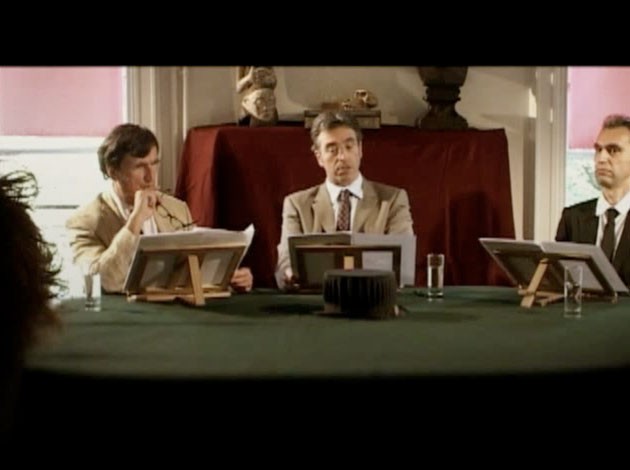
This reenactment of the 1903 debate has Latour in the role of Gabriel Tarde,
Bruno Karsenti as Emile Durkheim and Dominique Reynié as the Dean. It was
filmed in Paris in 2007 in a conference room, filled with an audience, with its
vintage stage by Frédérique Ait-Touatti, research by Eduardo Vargas and recording
by Martin Pavlov.
The film illustrates the importance of their theories for
Latour and a potential interest in the medium. Émile Durkheim, one of the
founders of a scientific sociology, aimed at defining generalizable social
facts like, for example, through statistics the general suicide rates in a
particular Catholic community. Gabriel Tarde, on the other hand, argued for an
emphasis on the microanalysis of actors and networks as, “every thing is a
society and that all things are societies.” Latour prefers Tarde’s theory of
associations and through this recreation aims to recall and call into question
one of the problems with the social sciences.
It is an interesting film as the actors are not necessarily aiming
for physical or oratory verisimilitude, and the debate itself has been
reconstituted (the original whole is no longer available), but what stands out
are the competitive ideologies of the participants, the rationale behind their
ideas, and the confrontation between the hardened ‘scientific’ reason and a
more abstract ‘subjective’ empiricism. The difference is that of a broad
understanding of how society functions through generalizable facts, against
that of an attempt to find the truth-value of a situation by a close analysis
of the actors within a particular site. Through Latour’s identification with
Tarde he is aligning himself with an undervalued tradition in the social
sciences. The underlying gesture is to not pass over this monumental event, but
to better listen to Tarde as his ideas are revelatory and effective ways to
analyze society.
This gesture for a philosopher to recreate an important
theoretical work has a precursor with Michel Foucault who participated in the
recreation of the facsimile document of Moi,
Pierre Rivière, ayant égorgé ma mère, ma sœur et mon frère (1976) by René
Allio. Where Latour’s writing on the Tarde-Durkheim debate can appear to be too
historical (why is this relevant today?), through its current re-creation the
historical event is brought to life and is given new relevance. The debate also
demonstrates Latour’s eloquence, as per his discussion with Green, and turns Latour
into a cinematic screen persona. With his recognizable long face and stern
expression, big black glasses, sharp suit and tie; he is giving his body to
cinema as a visual expression for his ideas. The Tarde Durkheim Debate (1903/2008) is a fitting cinematic
memorial to Latour’s importance.
Latour’s Art Writing and Paris:
Invisible City
Some
of Latour’s art and cultural writing offers interesting ways to bring his ideas
to cinema. In Latour’s essay, Some
Experiments in Art and Politics he discusses Tomas Saraceno’s Galaxies Forming along Filaments, Like
Droplets along the strands of a Spider’s Web (2008) which he sees as a
metaphor for social theory. The work, which was on display at the 2009 Venice
Biennale, creates through organized wires an infrastructure similar to how
Latour conceptualizes ‘networks’. Latour wrote,
What Saraceno’s work of art and engineering reveals is that
multiplying the connections and assembling them closely enough will shift
slowly from a network (which you can see through) to a sphere (difficult to see
through). Beautifully simple and terribly efficient… Namely of explicating the
material and artificial conditions for existence.
For Latour, this artwork offers a great amount of freedom for
understanding connections as a thought experiment. Latour further elaborates on
his artistic sensibility in the exhibition catalog essay From Realpolitik to Dingpolitik, or How to Make Things Public,
where he addresses the need to think of the political beyond necessarily human
and temporal categories to look at people in relation to objects to create a
cohabitation between the two. There are a plethora of artworks, photography and
installations from this Making Things
Public exhibition at the ZKM Center for Art and Media Karlsruhe that
attempt to illustrate this aesthetic.
Another good example
of Latour’s engagement with artistic practices is his digital media online
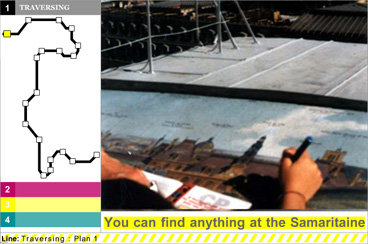
project, Paris: Invisible City, which
is described as a ‘Sociological Web Opera’.
It was first launched in 2004 as part of the Airs de Paris exhibition at
the Centre Pompidou. In Reassembling the
Social Latour wrote, “This somewhat austere book can be read in parallel
with the much lighter… Paris ville
invisible, which tries to cover much of the same ground through a
succession of photographic essays.” There are four stages to this tour: Traversing,
Proportioning, Distribution and Allowing. It begins at a department store on
its rooftop panorama of Paris. Through this limited view Latour theorizes that
there cannot be only one Paris (e.g. a bird’s eye view of the city, does not do
justice to its local specificities or how it’s actually operated) but through
many isolated representations of it, there can be a better understanding of it
as a multiple, invisible (Latour’s word, referencing Italo Calvino) and virtual
city.
Anne Friedberg’s conception of the virtual window is useful in
relation Latour’s Paris: Invisible City.
Friedberg description of the screen is that of both a surface and a frame. The
screen becomes a reflective plane onto which an image is cast and the frame limits
its view. This idea relates Paris:
Invisible City towards the cinematic as, building upon Henri Bergson and Gilles
Deleuze, Friedberg argues that computer screens in general have replaced previous
incarnations of screens, from the architectural window to the cinema screen, and
their specificity is the virtual quality of their representational images. Friedberg
wrote,
The term ‘virtual’ serves to distinguish between any
representation or appearance (whether optically, technologically, or
artisanally produced) that appears “functionally or effectively but not formally’ of the same
materiality as what it represents… Virtual images have a materiality and a
reality but of a different kind, a second-order materiality, liminally
immaterial.
The world that Latour recreated with Paris: Invisible City depends on the computer screen in a novel way,
which reflects Friedberg’s conception of the virtual screen, as it finds new
ways to describe a society and in its own way tell a story.
ANT and Film Analysis
ANT as a model to analyze films has its benefits and
drawbacks. Where it is probably correct to assume that Paravel had been
influenced by Latour’s conception of ANT it is more difficult to broadly use it
as a tool to analyze documentaries. Though one possibility would be to look at
certain documentaries and then make a general taxonomy of how they animate some
of ANT’s major tenets. But this can be limiting as well as in then how to
interpret these scenes and their meaning? There are a few documentaries such as
Silvered Water, Syrian Self-Portrait (2014),
The Iron Ministry (2014) and 88:88 (2015) which are worth exploring
as case studies for ANT’s usefulness for film analysis and to illustrate its
potential.
Wiam Simav Bedirxan and Ossama Mohammed’s Silvered Water, Syrian Self-Portrait is a
documentary on the atrocities of the Syrian civil war. It is a hybrid film made
from the directors’ personal footage and found footage from the Internet of the
atrocities plaguing Syria. The military regime that rules the country does not
allow for filming (if caught filming the person is typically killed) and the
violence of Silvered Water’s imagery is
typically is not reproduced in Western reporting on Syria. In the documentary there
is a scene of the ruins of an old building where a broken outdoor faucet is
dripping. It is a lengthy scene as Bedirxan decides to focus on this one
mundane activity. This broken faucet can take on what ANT describes as the
agency of a non-human actor. ANT wants to distribute agency as broadly as
possible. The social and historical trajectories of the country with its recent
military violence take the specific form of this faucet as an actor in this
scene. Even though the city is being destroyed there is still this
micro-activity occurring. But the problematic aspect of focusing on this scene,
solely to compare it to ANT, would be to take away from the overall project of
the film with its message of urgency about the violence of the Syrian military on
civilians and the destruction of Homs.
 Another example is Isiah Medina’s experimental documentary 88:88. Through its portrait of a working
class neighborhood in Winnipeg, Medina captures these interactions between
nature, people, and community in a striking and unique way. If ANT posits that
everyone and everything is profoundly relational then this experimental form of
filming and editing can be seen as heightening the performative nature of these
interactions and the networks connecting them. ANT presumes that a person’s
identity is not prefigured by the moment of analysis (or filming) so in 88:88 brief shots of figures and lack of
psychology have condensed the actants in enacting their relationships. These
parallels offer some insight but perhaps a more helpful reference in
understanding Medina’s film would be to compare it with works that it is most
likely directly citing, such as Jean-Luc Godard’s Film Socialisme (2010) and Adieu
au langage (2014) or other diary and structural films.
Another example is Isiah Medina’s experimental documentary 88:88. Through its portrait of a working
class neighborhood in Winnipeg, Medina captures these interactions between
nature, people, and community in a striking and unique way. If ANT posits that
everyone and everything is profoundly relational then this experimental form of
filming and editing can be seen as heightening the performative nature of these
interactions and the networks connecting them. ANT presumes that a person’s
identity is not prefigured by the moment of analysis (or filming) so in 88:88 brief shots of figures and lack of
psychology have condensed the actants in enacting their relationships. These
parallels offer some insight but perhaps a more helpful reference in
understanding Medina’s film would be to compare it with works that it is most
likely directly citing, such as Jean-Luc Godard’s Film Socialisme (2010) and Adieu
au langage (2014) or other diary and structural films.
The same would apply to J.P. Sniadecki’s The Iron Ministry. Similar to the SEL Leviathan, The Iron Ministry is a
condensed trip through the major Chinese rail-road system. It offers a
fascinating glimpse to its busy activity, myriad of passengers and interviews. In
one scene the camera is recording a young child criticizing American ideology late
at night on the train. This scene recalls Latour’s focus on description without
interpretation. But then what? The fact that parallels can be drawn between ANT
and certain filming techniques used in specific documentaries does not confirm
that it is necessarily a useful tool for the analysis of film. More research on
the subject is still necessary.
ANT, Documentary and Media
There has also been scholarship on ANT and its relation to
media and documentary which gives a better understanding of how other scholars
have imagined this relationship. Here are two examples of scholarship on ANT’s
relation to media and documentary: Ilana Gershon and Joshua Malitsky’s essay Actor-Network theory and documentary studies which discuss how
science studies and ANT can inform documentary scholarship; and Nick Couldry’s Actor Network Theory and Media: Do They
Connect And On What Terms? which elaborates on ANT’s relation to media in
general. These two essays offer interesting methodologies on the subject.
Gershon and Malitsky’s essay is perhaps the better of the
two to bring ANT to the analysis of documentary and its para-textual objects.
Instead of asking how the film animates certain ANT tenets they attempt to use ANT
to discuss the larger narratives surrounding the films, the films’ possible
truth claims, and the broader social response to them. Gershon and Malitsky are
reacting to the post-modernist critiques of ‘claiming the real’ and its recognition
that truths are socially constructed. Instead they are claiming a similarity
between ANT’s distrust of dichotomies in scientific practice to that of how
documentaries construct truths. For this they propose to study the extra-textual
information around the film as a method to interrogate its own truth claims.
Gershon and Malitsky, cite John Law, who “delineates how ANT
is fundamentally a theory of relationality, the analytical task of figuring how
these relationships condense in various people and objects.” ANT allows for
techniques to reveal how truths are socially constructed and how interactions
are transformed into representations. Gershon and Malitsky propose four
conceptual consequences in bringing ANT to documentary: everyone and everything
contributes to how interactions take place; not all actants are the same; ANT
insists on the performative nature of relations and their forms; and actants
are all network effects. This would lead to,
The ANT perspective makes the
circulation of putative truth a question of how different actants contribute to
shaping a network through specific interactions. What ANT scholars provide are
techniques for sidestepping the ontological question of truth entirely and
focusing instead on truth-value. In other words, what the ANT perspective
offers are techniques for understanding how representations might be
transformed into facts through the labour of specific networks.
For documentary the ANT perspective would involve bringing
all the aspects of the documentary from production, distribution and reception
to see how the documentaries themselves are actants, which each convey their
own information. This would make the study of them more reflexive as analytical
moves provide ways to think about how truths and facts are constructed. For Gershon
and Malitsky, “That is, ANT provides a way of imagining documentary
pre-production, production, post-production, distribution and exhibition
practices as an integrated network for circulating knowledge.”
In his essay Actor
Network theory and Media: Do They Connect and on what Terms? Nick Couldry describes
ANT as an attempt to explain the social order. Couldry elaborates,
through the networks of connections between human agents,
technologies and objects. Entities (whether human or non-human) within these
networks acquire power through the number, extensiveness and stability of the
connections routed through them, and through nothing else.
Couldry uses ANT to generate a
theory of connectivity that brings together the social and nature, which
includes the potential of media. Within these relations, it is the networks
that set the agents in positions relative to other agents. Building on Roger
Silverstone, Couldry argues that,
Networks (and therefore ANT)
tells us something important about the embeddedness of social life in media and
communications technologies, but they do not offer the basis for a completely
new theorization of social order, nor even a new way of analyzing social
action, in spite of claiming to do just that.
ANT is interested in humans and
their entanglement with technology. Couldry argues that “ANT’s insistence on
the necessary hybridity of what we
call ‘social relations’ remains a valuable antidote to the self-effacing,
naturalizing potential of media discourse and of much discourse in media
studies.” Couldry citing Tarde elaborates on the increasing simultaneous conversations
spread over a vast geography as one of the major important developments, which
has grown exponentially since Tarde was discussing newspapers. Couldry instead
of seeing technology, media or even the Internet as a faceless mechanical
entity prefers ANT for being able to localize the specific relations entangled
within it.
But Couldry also sees a limit to ANT and has his own
critiques of it: ANT has a problematic relation to time since it neglects it. Couldry
sees in this neglect of the long-term consequences of networks as overlooking
of social power and the possibilities of resistance. He does not view ANT as
successful when analyzing texts that are meant to be interpretative. As well
Couldry argues that ANT has little to say about the processes that come after the establishment of networks.
Althought Couldry sees a
relationship between ANT and media theory, he argues that it is both
significant and uneasy. It is an antidote to the more functionalist versions of
media theory but its problems of an insufficient attention to questions of
time, power and interpretation are still serious. But it is a good base for more
research around these questions.
Conclusion
Bruno
Latour, even without directly being involved in film studies, has still managed
to put pressure on the cinematic in interesting ways throughout his career. This
influence is seen through his teaching relationship with Véréna Paravel, who
would bring many of ANT’s tenets to the radical approach of the ethnographic documentary
Leviathan, and also through his
participation in the recreation The Tarde
Durkheim Debate, which has him casted as Garbriel Tarde to eloquently
debate some of the social theory ideas that contributed to shape him. His art writing,
curation, and creations like the virtual Paris:
Invisible City have theorized some key concepts in the aesthetics that he
would privilege, which would enact his social theories by bringing together
objects and humans with the goal of creating new relations. And finally
actor-network theory allows for an interesting new approach to study the documentary,
which still needs to be further developed. Latour’s intellectual work has
provided cinema and film studies with many stimulants and his ideas still need
to be further explored for a better understanding of what they have to offer.
