
Sunday, August 3, 2014
Ten Years of Dr. Orlof

New Magazine: Fireflies

It's thanks to Marc Saint-Cyr that I discovered Fireflies, a new film magazine from Berlin, which emphasizes more poetic and creative forms of film writing and graphic design. The issues will be split on two directors and the first issue will focus on two similarly creative spirits, Pier Paolo Pasolini and Apichatpong Weerasethakul. You can order a copy here. We wish them luck from Toronto!
Saturday, August 2, 2014
Must Listen: Altman by Zuckoff (Audio book)

Friday, August 1, 2014
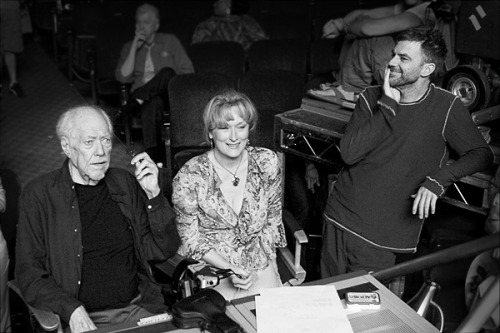
Altman Documentary
Monday, July 28, 2014
Two Departures at Cahiers (Serge Toubiana and Charles Tesson)
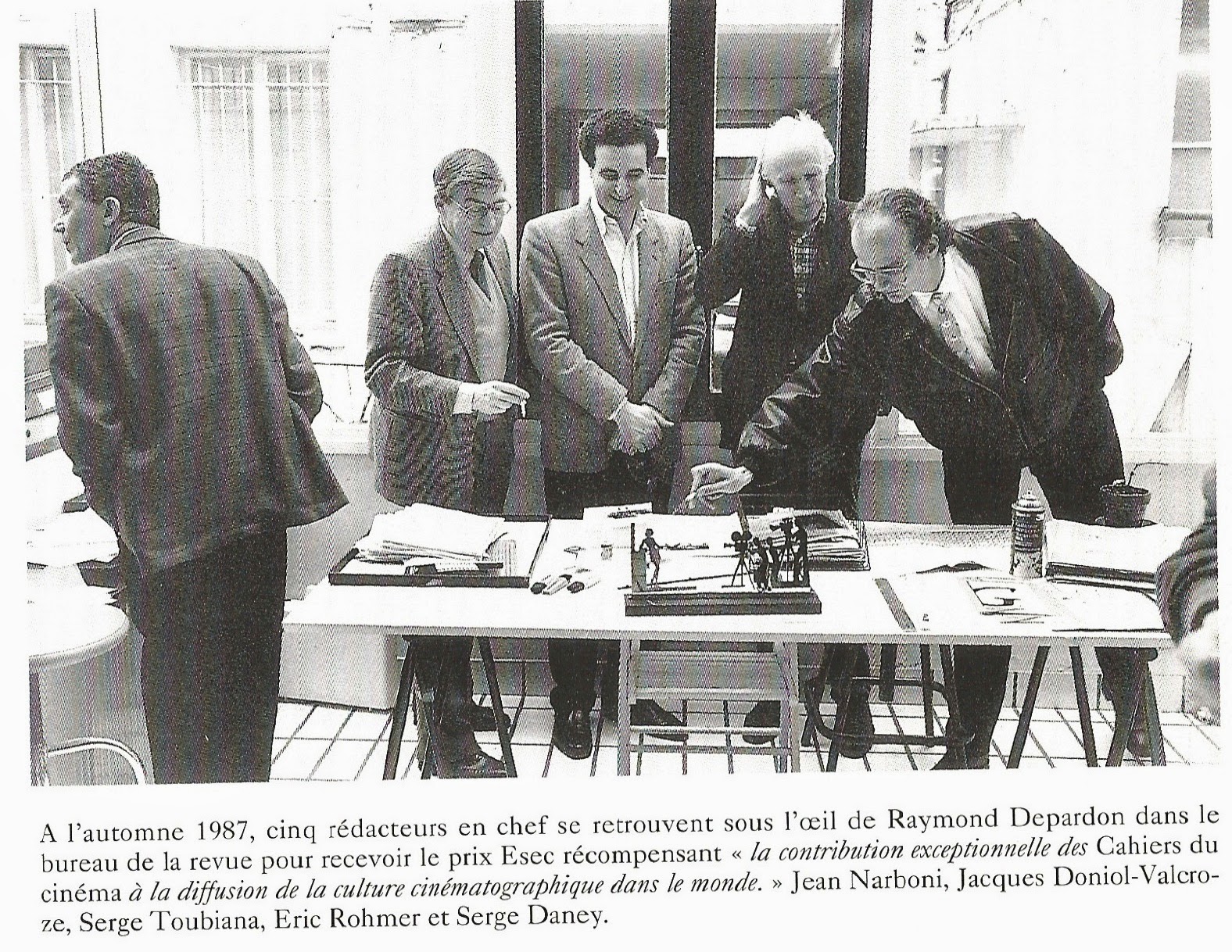
Everything good
comes to an end. And there’s always something next. Serge Toubiana, who
miraculously re-launched Cahiers in
the late Seventies, and then spent over twenty years there as the chief editor,
sometimes with others, spearheaded it to the forefront of relevance,
reconnecting it to is past glory, and successfully made it more international.
His legacy is important there today in the Stéphane Delorme years even though
this influence is invisible. It is one of unabridged cinephilia, generosity,
seriousness and criticality. As the director of the Cinémathèque he brings the
heritage of the magazine and of cinema to a national and international level. As his recent
interview in Cahiers (N.699) attests
he continues a tradition started with Henri Langlois. Toubiana might be less
known for his criticism (though some of his critiques are amazing, the one on Deconstructing Harry comes to mind)
than for the guiding and composing of the issues, evolving with the times, and
recruiting and refreshing a good team of film critics. He imposed himself on
the issues through his pressing editorials, Cannes coverage, and by the
implementation of the Le Journal section. Serge Daney would be his intellectual
and spiritual counter-part. So where Daney kept on the Godardian tradition of
cinema as a tool of social protest where images held a Bazinien ontology that
interrogated the world, Toubiana kept the Truffautian tradition of spectatorship
reverie, biting polemics, and of an optimism mixed with melancholy. The
book Postcards from the Cinema (unfortunately out-of-print), which is a lengthy interview between them, concludes their
beautiful friendship. When the magazine updated it’s format in the early
Nineties and they featured Jacques Doniol-Valcroze it was a subtle reminder of
this mise en page tradition that
Toubiana himself was keeping on. As well with Antoine de Baecque’s two-part
history being published in this period this was when a Cahiers
self-consciousness was emerging.
If one looks at
the subsequent chief editors one can make certain assumptions of their guiding
taste by the representative American directors they most associate with: For
Thierry Jousse (‘91-‘96) it is David Lynch, Antoine de Baecque (’96-’98) it is
Tim Burton, Charles Tesson (’98-’03) it is Martin Scorsese, Jean-Marc Lalanne
(’01-’03) it is James Cameron, Emmanuel Burdeau (’03-’09) it is M. Night
Shyamalan, Jean-Michel Frodon (’03-’09) it is Clint Eastwood, and for Stéphane
Delorme (’09-’14) it is Steven Spielberg.
If Tesson’s
editorialship is so highly regarded it’s for the generosity of his prose,
knowledge of Cahiers history, and
openness to a social and poetic cinema. It stands in opposition to his
successor. Some problems with the Frodon editorialship includes: a self-important
tone, too much reliance on the business
instead of the art of cinema, too much reliance on journalism
instead of criticism, not having too
strong of a personality, being guilty of a weird favoritism, poor economic practices
and unsuccessful managing of the magazine, and branching out the magazine too thin by exploring new outlets,
publishing and distribution. His contribution to the Les petits Cahiers on
“Film Criticism” is especially unnecessary. But it was also a complicated
post-9/11 period with the rise of the internet and its new register of digital
images, the growing DVD market and the autodidact cinephile, and the declining
relevance of cinema as a social-communal past time.
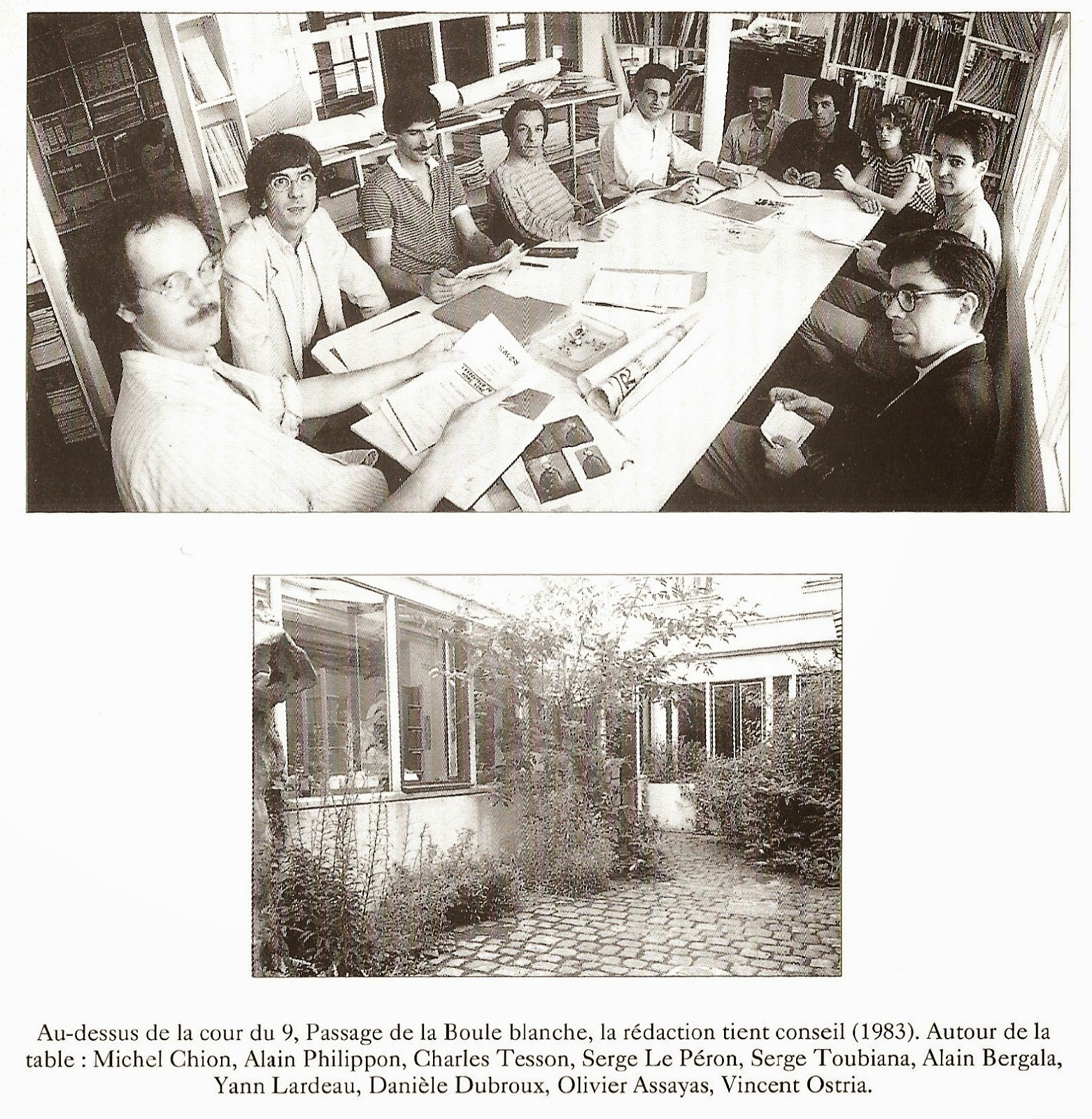
Tesson, on the other hand, is a pure
Cahiersiste. It is a spirit that
animates the magazine from within (see how he refers to the magazine as having a
heart) and it comes from a place that holds the magazine at a very high esteem – an instrument and measure of the cinema and of our times. In his texts he shares the
personal experience of being within – almost like a making of (c.f. Fissures at Cahiers). Tesson now programs at the Critic’s Week at Cannes which
continues his criticism in a different register. He has a close relationship
with the Delorme editorialship as he programs the films Cahiers champions and sometimes contributes to the magazine, notably his piece Peut-on
être rohmero-rivettien? in the Rohmer memorial issue (N.653).
The following is
Toubiana’s farewell letter from when he left the magazine in 2000 and Tesson’s when
he would leave too a few years later. – D.D.
***
Aux lecteurs,
It’s with
sentiment and friendship that I inform you of my departure from Cahiers du Cinema. I’m leaving in
effect, at the end of February 2000, my post of chief editor, as well as
co-runner of Editions de L’Etoire. This decision has been brewing in me for the
last few months. I needed to make this decision, and it was difficult to make.
One never easily leaves a magazine, especially this one, where one has spent twenty-five years of the important
years of one’s life. But it is now the case… I’m relieved that others, those
who are younger and newer, are assuming to be in charge and to guide, orient,
and enliven this magazine that we hold in such high esteem, you and me. Cahiers imperatively needs a new spirit,
a new perspective, because the cinema is changing, evolving, transforming, just
like its environment. A new spirit and a new dynamism, founded on a critical
approach and oppeness, because at Cahiers,
more than elsewhere, is entrenched in this experience for half-a-century. The
history of this magazine, rich and fecund, allows to imagine the present and
the future with serenity and confidence. There is then all the reason to
believe that Cahiers will soon be
ready for this new start, that its rendezvous will be met this year, 2000. Its
writers see themselves as reinforced by the arrival of Franck Nouchi, who will
be in charge of the direction of the magazine, with beside him Charles Tesson.
He is coming back to prepare a new format to the magazine, to respond to your
expectations, and those of the cinema. I wish them good luck, and I address
you, dear reader, my most loyal thoughts.
Serge Toubiana
***
Aux lecteurs des Cahiers
The editorial
that I wrote for the summer issue (N.581) ended with serious thoughts about the
obstacles that was shaking up the magazine last January (a project to
reorganize the editorial team) where we proposed to share our solutions in
September. The editorial of September, which was signed by Jean-Michel Frodon,
who was named the director of the magazine on the first of July, was itself an
answer to the previous editorial. His nomination to a poste that was removed
since the return of the magazine to Le
Monde where Franck Nouchi ended entirely my functions as chief editor all
the while giving them to Jean-Marc Lalanne. Since then, there has been more
changes: departure of Lalanne, which was voluntary or was expected by several
writing comity members, and instead there was the nomination of a new chief
editor, Emmanuel Burdeau, who himself was an old member of the writing
committee…
At the time of
leaving this magazine, I wanted to saw a few things. My first thought goes
towards the reader, numerous, anonymous, and familiar. There is the writer that
one imagines and that we are addressing when we put together each issue. There
is the other one (the same?) who is there (even though he might be invisible)
when we write. We can write a review by addressing the film, cinema in its
entirety, to be read by the director, or even with the desire (crazy, but
actual) to be read by such and such actor or actress. There is no true art of aimer without a certain (critical) sense
of declaration, for its form and its depth. We can also write for those who are
no longer with us (the dead) or just for oneself (a long monologue to help
guide the cinema or to thank, ad infinitum, the vital pleasure that is procured
of renewing one’s relationship with cinema). We can be attached for one’s whole
lifetime to only one aspect of this writing or by changing, according to the
nature of each film or the times or one’s relation to them. Adressing others,
however the form it takes, seems to me to be essential. Without this conscience
towards others (to convince, enlighten, share an emotion, build upon its
foundation, etc.) there is no veritable critical impulse. History, in its long
form, and not being lonely, and to share with words, with films, is one of the
pleasures that makes life livable.
My second thought goes towards those who I've worked with at
the heart of this magazine (who I've met and learnt to appreciate, and to those
that have I've become friends with, which I'll need to thank Cahiers for
bringing us together at an important time in our lives) as well to those that
I've had the pleasure to meet, whether it is in France or at the four corners
of the planet, through the function that I've occupied. A great moment of
happiness for me were the exchanges with those, who were really attached to the
magazine, that wanted to dialogue with those that contribute to it, and not
only through written correspondences. That said, internally, once we start to
have some responsibility in creating this magazine, everything changes. Because
the job of being the chief editor is one that is learnt and it has strictly
nothing with that of the exercise of criticism. Because the pressure is there,
and it's enormous. Because one has to learn within the heart of these multiple tensions,
between the divergent points of views and the sensibilities of the writers
expressions. And especially, being able to accept and overcome them, as soon as
they manifest themselves at the interest of the magazine, so that it can become
a living space, that is also rich in contradictions. So that it is not a space
that is too homogeneous (the terrorizing and terrorist phantasm of a sole
editorial line, where truth is incarnated in only one person, with an
uncomfortable corollary, which leads to a written film criticism that is
cloning and uniform, within an absolute and unique model) nor too heterogeneous
(the heteroclite cohabitation of diverse interests, in a Proteus form, for a
reader that can't make sense of everything, who is usually a minority, and who
would not be able to draw pleasure). In the context and with the conditions
that were particular to my experience, between the participation and majority
financial takeover of the magazine by Le Monde in 1998 and my nomination
to an important role of responsability that lasted until July 2003, I've tried
to bring my best all the while sharing the task and responsibility with others.
Between 1998 and 2003, amongst a changing team, I've with Antoine de Baecque
(up too April 1999), with Serge Toubiana (up to January 2000), with Delphine
Pineau (up too September 2001), with Frank Nouchi (from February 2000 to
December 2001) and then with Jean-Marc Lalanne, starting in October 2001.
My last thought goes to two people,
who if it wasn't for them my adventure at Cahiers, fabulous and unique
more often than not, awful sometimes, would never have happened. Serge
Toubiana, firstly, who, in May 1998, proposed to me to work beside him, as the
director of the magazine and then as its chief editor. And afterwards Serge
Daney. I started out just reading him, I followed at the time his courses on
the cinema at the Censier and I've confided in him my desire to write at the Cahiers,
a crazy dream (but true nonetheless) because I was really intimidated, see very
perplexed, with the idea of concretely sharing the pages with those that I've
enormously appreciated their writing (aside from Daney there was Oudart,
Bonitzer and Narboni). One day, Serge Daney sent me a message (I didn't have a
telephone at the time), marvelously laconic, that only said this: "there
are two or three films that Cahiers risks not discussing in their next issue.
For you to see them." In this list of three films, there was a
Japonese film, An Actor's Revenge by Kon Ichikawa. I saw it at the
cinema on that day, and I wrote the critique in a rush, and Serge Daney
accepted the text immediately, without any hesitation nor any modifications. It
was published in the June 1979 issue (N.302). I was then the happiest that I
can be. For a long time, a really long time, writing at Cahiers, being
part of this magazine, to be installed more or less comfortably in its lifespan
made me happy. What more could one ask for? Shortly before the death of Serge
Daney in 1992, between other things, he confided to me his surprise and regret
that I never got the chance to further excel and take on more responsibility at
the heart of this magazine. He had his own thoughts on this issue. I explained
to him the diverse reasons. Without knowing it, several years later, Serge Toubiana
exercised Daney's wish, which was also my own, but sadly arrives negatively,
because Daney didn't see this, which is a regret. The world is sometimes good
to you even though life in general, under certain circumstances, with no
relation to the other things that are going on, can show itself to be cruel.
To the reader of Cahiers, which I was once one, with
fervour and passion, directly, starting in the mid-Seventies, month after
month, and then the catching up as much as I can with all the ancient issues that
were available. So before I even started writing and reading it, in a different
life but with the same sentiment, then joining and participating in its
elaboration, and becoming attentive in a different way to those that read it
and to the remarks of those that write here. To be finally under the obligation
to quit these responsabilities for good does not leave one indifferent, this
goes without saying. But at Cahiers, where one becomes tied to an
intricate bond with others and the network that one creates - with the past,
present and future - never leaves one indifferent. Except when the unsaid makes
on cringe (irritation, a bad conscience) and the explicit also bothers
(unanimity, and the misplaced).
It was my status
of a young subscriber to this magazine that I owed my first visit to the Cahiers offices, which was already at
Boule-Blanche, because I need to ask for why each month I was getting the
magazine so late when it was already on the newsstands. Going through the
office doors has become for me a regular ritual with slight variations
depending on the occasion: bringing in an article, to learn about press
screenings, to take part in a group meeting or to attend an informal discussion
on a film that’s puzzling the magazine, with the desire to discuss or to run
the risk (sometimes) of bothering them, depending on the availability. Before
knowing how it is like from the other side, to live through the transition into
the team, as a paid writer. I don’t need to get into what it’s like to join Cahiers and what that experience was for
me (that’s another affair, another story, which is really complex, and that
I’ve interiorized. I have the feeling of having lived there during those
months, constructing its table of contents and pages).
To be a reader
of Cahiers, that is what I’m
returning to, like before, but also not like before. It will be a new pleasure,
that I haven’t experienced for a while (that of not knowing what will be in the
next issue), which will be richer because of what I’ve experienced at the heart
of the magazine.
It’ll be a new
chapter for me of reading Cahiers,
attentive, exigent and engaged, like always: reading it is a critical activity
in itself, a prolonguement of the gesture that created this magazine,
transmission.
Charles Tesson, December 2003.
Serge Toubiana on 40 Years of Cahiers
 When I met Serge
Toubiana it was at the gift store that I work at. It’s in a cultural
organization and I just got the job of also ordering the books and DVDs. He was just a customer and he was talking about visiting from France to see the Burton exhibition and that it was going to travel there. He introduced himself “Toubiana, Serge.” Cool! “I read your
blog!” I ask him, like I do to every French cinephile (there aren't many that come through here), do you read Cahiers? What do you think of the new Cahiers
editor and team (without knowing that he used to be there for a long time). Oh you like it? Still young, I thought that people were just meant to criticize Cahiers because that's what the older American critics did (cf. Cahiers Criticisms) and I bring up that one of its past writers was complaining about them on the internet – something regarding how they were wrong about their rave reviews of The Other Guys and Machete.
He laughed it off. But I still feel bad that I criticized them and since then I've tried to make it up by talking and writing about their recent years. Every new issue is really good and it's my favorite monthly film magazine. If at the time I knew more about who I was talking to and more about what Stéphane Delorme
was trying to bring to the magazine I’m sure the conversation would have been
different. Anyways, Mr. Toubiana was nice and I purchased the copy of Truffaut that, by chance I prominently displayed, and he kindly signed it. There aren’t many
direct bonds between Toronto and French cinephilia (with a few exceptions on social
media) so if I blog a lot about French film criticism and on Cahiers today it’s to create and strenghen a bond and to make up for that earlier gaffe.
When I met Serge
Toubiana it was at the gift store that I work at. It’s in a cultural
organization and I just got the job of also ordering the books and DVDs. He was just a customer and he was talking about visiting from France to see the Burton exhibition and that it was going to travel there. He introduced himself “Toubiana, Serge.” Cool! “I read your
blog!” I ask him, like I do to every French cinephile (there aren't many that come through here), do you read Cahiers? What do you think of the new Cahiers
editor and team (without knowing that he used to be there for a long time). Oh you like it? Still young, I thought that people were just meant to criticize Cahiers because that's what the older American critics did (cf. Cahiers Criticisms) and I bring up that one of its past writers was complaining about them on the internet – something regarding how they were wrong about their rave reviews of The Other Guys and Machete.
He laughed it off. But I still feel bad that I criticized them and since then I've tried to make it up by talking and writing about their recent years. Every new issue is really good and it's my favorite monthly film magazine. If at the time I knew more about who I was talking to and more about what Stéphane Delorme
was trying to bring to the magazine I’m sure the conversation would have been
different. Anyways, Mr. Toubiana was nice and I purchased the copy of Truffaut that, by chance I prominently displayed, and he kindly signed it. There aren’t many
direct bonds between Toronto and French cinephilia (with a few exceptions on social
media) so if I blog a lot about French film criticism and on Cahiers today it’s to create and strenghen a bond and to make up for that earlier gaffe.  Right now I'm working on my MRP which will be on Cahiers
in the Eighties and their relationship to American cinema. This period is too
little explored and I think it’s essential to understand the magazine today. As
I plan to argue Toubiana and Daney’s reconnection with Truffaut was the
catalyst for their shift from purely intervention and third world films towards
cinema in its entirety, and they needed to catch up and the media landscape had
rapidly evolved. Daney on Toubiana when he left in 1981, “He has a precise idea
on the magazine: to return it towards the center of cinema. This idea has a
future. My idea is less clear, not really defined, more vagabond. It is
better if he realizes his goal, even though I don’t share with all of his
decisions.”
Right now I'm working on my MRP which will be on Cahiers
in the Eighties and their relationship to American cinema. This period is too
little explored and I think it’s essential to understand the magazine today. As
I plan to argue Toubiana and Daney’s reconnection with Truffaut was the
catalyst for their shift from purely intervention and third world films towards
cinema in its entirety, and they needed to catch up and the media landscape had
rapidly evolved. Daney on Toubiana when he left in 1981, “He has a precise idea
on the magazine: to return it towards the center of cinema. This idea has a
future. My idea is less clear, not really defined, more vagabond. It is
better if he realizes his goal, even though I don’t share with all of his
decisions.”The following is Toubiana’s essay ten years onwards after taking the helm, L'âge de déraison (The age of unreason), it's one of his most reflexive pieces, from their special 40th anniversary issue (May 1991, N.443-44). - D.D.
***
L'âge de déraison
Cahiers is now forty years old! We had to get ready for this
anniversary during the last few months and we wanted to avoid the
“commemorative” aspect of it. Instead we wanted to seize its joyous pretext to
further enliven this magazine towards the present. Cahiers like a site of passage,
and not like an “institution”: that’s it, this is what we were thinking. And
then, people’s sentiment about the magazine are not the same, and I’ll assume
vary from the old writers to the contemporary ones. Amongst the young ones, I
bet that they can’t even imagine being attached to a magazine for forty years!
They are hardly even half of that! For me, being the age of the magazine, and
having grown with it, it’s different.
What astounds
the most, is this strange sentiment that Cahiers,
is never more than a small group of people, during each period, who decide to
be responsible. By choosing how it will brand itself by picking who it will
identify with. This has not always happened without there being tensions and
creating friction amongst people. These groups don’t always get along with
those that have contributed to it in the past, the “Cahiers family” is large. Truly, how many successive generations
are there really to have passed through this “site of bearing witness,” which
is Cahiers?
This magazine is
a site of passage and of writing, or of cinema apprentice for those that take
the leap to the “other side of the mirror.” For this current generation, there
is the sentiment of speaking or writing in a long history that includes those
who have already spoken, and already written. Differently, depending on the
period and by temperaments. This is what makes us feel that there actually
exist a “history” to this magazine, with its past, the glorious and
non-glorious years, and a present that is unfolding, but which is harder to
define. There is a tortuous filiation,
that even though there are changes and an evolution, there is a common unifying
trait to defend and love: the cinema.
These forty
years for Cahiers, we wanted to mark
them with this sign that animates its writers for the last ten years: openness,
curiosity, and questioning. Two issues divide this period, but presented in a
unique form, emerges at the occasion of this anniversary. In one, more than one
hundred filmmakers, actors, artists and producers tell their memories about
cinema. The ensemble draws a strange constellation that is deep down
harmonious: the “I remember…” becomes
a pretext to share a little story, a brief movement, that is intense too, where
each of us and others get to tell our story…
This other issue
– the one that you are holding in your hands – there is also this movement,
deep down, which returns towards the past, and which draws several points of passage between the different periods of
the magazine. And which returns towards the present: the present of cinema and
the present of Cahiers.
What surprises,
is to what point being part of Cahiers
changes that trajectory of people, individual paths and those of collectives.
They don’t always resemble their period, but usually they do. The Nouvelle
Vague, for example, which associate so well with this passage, this major shift, from the black and white of the
after-war years and the end of the Fifties, towards the bright colors and
euphoria, towards the “new cinema” of the early Sixties. But also the other
periods, where the heart of the writers use the magazine as a tool of
investigation, an arm of combat, a space of passage.
With each new group, there are strong relations, and a passion for cinema. A
gamble of “all or nothing.” All the way towards and even during the Seventies,
where Cahiers lived their “maoiste”
period, alone against everyone, after severing themselves from an established
cinema. Of course, with patience, we were able to return to an equilibrium.
To be forty
years old in 1991 necessarily forces us to interrogate the future of cinema. To
ask ourselves if there are still a few good cards to be played, to live new
adventures. Are we optimist? And at what cost? Cinema no doubt has a big field
in front of it, on the condition that it does not trip too much on itself. That
it does not fall for the game or looks too much at itself, which is caused by a
“catch-all” audiovisual terrain. That it knows that through a facilitation
towards new funds and mediums, it’s its identity itself that could be put into
question. For ever. Its horizon would only enlarge on the condition that cinema
remains on its guard and remains vigilant. Cahiers
counts on helping this.
To turn forty in
May (some will no doubt notice a light shift in the history: our first issue
actually came out in April 1951), is to say right during the Cannes festival,
implies the idea of a celebration. With its friends, Cahiers proposes an rendezvous on May 18th, to celebrate
this unreasonable age.
Serge Toubiana
Whoa ! (Serge Toubiana on France Inter)
“Greed has poisoned men’s souls, has
barricaded the world with hate, has goose-stepped us into misery and bloodshed.
We have developed speed, but we have shut ourselves in. Machinery that gives
abundance has left us in want. Our knowledge has made us cynical. Our
cleverness, hard and unkind. We think too much and feel too little. More than
machinery we need humanity. More than cleverness we need kindness and
gentleness. Without these qualities, life will be violent and all will be
lost....” – Charlie Chaplin

There is a great story about François Truffaut, which Toubiana describes as being an important experience for him. In 1975, after taking over Cahiers a year earlier with Serge Daney, they go see Truffaut, who was angry at the magazine, and after they speak Truffaut tells them, “You should never have made Cahiers an ultra-leftist Maoist magazine. It’s unreadable and too theoretical. That’s not what Bazin wanted. You should have created another magazine.” And, “I’ve listened to you, and moving forward I’ll have an open neutrality towards the magazine.” This was Truffaut’s way to test them and to see if they would change. It was the start of the magazine’s return towards its original cinephilia (Truffaut would help them get financing, too). Toubiana describes how the Eighties Cahiers interview with Truffaut was a highlight of his career and it was the start of a truly valued friendship. Since Truffaut’s untimely early death (he was only in his fifties), Toubiana at the time featured an issue of Cahiers on him, wrote a biography (with Antoine de Baecque), and now there’s an upcoming Cinémathèque exhibition. One can see the Truffaut influence at Cahiers in this period through their reconnection with the original nouvelle vague but also on some of their miscellaneous interest, in particular that of a sensitivity and representations of childhood. For example, there is the cover feature they dedicated to E.T., which after seeing it at Cannes, Truffaut reportedly send Spielberg a letter that said, “You belong here more than me.” (Godard, on the other hand, aligned himself more with the American cinema of Woody Allen, who he would cast in his King Lear). Spielberg is also important at Cahiers today and whose reevaluation started in the Two-thousands (in face of reluctance since some of its past chief editors like de Baecque and Emmanuel Burdeau would never be described as Spielbergian.). Toubiana is a big fan of Raymond Devos, Andy Warhol (“he understood that we’re living in an era of reproduction;” and Toubiana also owns a revolver drawing and a Campbell Soup painting), Aragon (he recites a great poem), Charles Trénet (they play the song Boum, and Cocteau was also a fan), Sils-Maria (and the new Assayas film), and (finally) pastis. The episode of Remède à la mélancolie ends with Toubiana in a charming manner asking Bester out for a drink. If the weather’s nice, try to enjoy it!
* Bester’s interview with Antonin Peretjatko is well worth listening, too.** The France Inter interviews with Toubiana are a lot better than those on France Culture especially the one with Michel Ciment, which was poorly put together. The episode of Le Festival en 18 Palmes on Billie August’s The Best Intentions is especially good.
Subscribe to:
Posts (Atom)