Showing posts with label The Mayfair Theatre. Show all posts

Wednesday, June 30, 2010

Canada Day Hoser-O-Rama

Goin’ Down the Road (Don Shebib, 1970)
**** (Masterpiece)


Strange Brew (Rick Moranis & Dave Thomas, 1983)
** (Worth Seeing)


Fubar (Michael Dowse, 2002)
** (Worth Seeing)


(The Mayfair Theatre, 1074 Bank Street, 30/06)

Sunday, June 27, 2010

Another Month (Horror and Action Movies)

July Film Listings

Bytowne Cinema
This Movie is Broken (Bruce McDonald, 2010) 30/07 – 5/08.

Mayfair Theatre
Day of the Dead (George A. Romero, 1985) 02/07.
Cruising (William Friedkin, 1980) 3/07.
The Wild One (Laslo Benedek, 1953) 26/07.
Short Cuts (Robert Altman, 1993) 27/07.
Dillinger (John Milius, 1973) 31/07.

Canadian Film Institute
The Idiot (Akira Kurosawa, 1951) 10/07.
Torossian Short Film Programme I 15/07.
Torossian Short Film Programme II 29/07.

Cinémathèque Québécoise (Montreal, QC)
Fantasia
Ken Russell Retrospective

Doc Films (1212 East 59th Street, Chicago, Illinois, USA)
A Child's Garden and the Serious Sea (Stan Brakhage, 1991) 17/07 7:00PM.

*****

Here is protest footage for the Toronto G20 meeting:


Saturday, June 26, 2010

Silent Cottage Country Yarn

Back to God's Country (David Hartford, 1919)
**** (Masterpiece)


In David M. Hartford’s Back To God’s Country (1919), an adaptation of James Oliver Curwood’s short story “Wapi The Walrus”, Nell Shipman reprises her role of Dolores from the “girl from God’s country” series. God’s country, which I assume is a grandiose reference to the Canadian North, is portrayed as a colonial setting of forest cottages surrounded by rivers, mountains, and wildlife. While in the shadows there lurks dastardly villainy and ruder racism. Nell Shipman utilizes her animal training skill to full capacity as her father’s cottage is bustling with wildlife that includes dogs, wolfs, foxes, bears and turkeys. One of scenes that stick out is that of a pre-cursor Winnie the Pooh cub that constantly sneaks into a jug of food. Wether it is of these furry and cuddly creatures or the frozen landscapes surrounding a traveling ship off the Baffin Islands the mise-en-scène is bustling with a fervent vigour.

Nell Shipman is an important figure in Canadian cinema as an independent pioneering female silent film producer, director, writer and star alongside her husband Ernest Shipman. Nell Shipman looks beautiful in her toque and vintage Hudson Bay Company coat, I bet Lilian Gish or Louise Brooks never appeared in those garments. While the Canadian North of the silent era looks untamed and pure similar to Robert J. Flaherty’s Nannook of the North (1922). In regards to scholarship on the film, I much prefer Kay Armatage book “The Girl From God’s Country Nell Shipman and the Silent Cinema” (2003) erudite overview of the female star with an analysis of her films, compared to Christopher Gitting’s ideology dense – and impenetrable – “Canadian National Cinema” (2002) that unapologetically detracts and puts off the film instead of highlighting the pleasures and cultural importance of this rare gem. The Lost Dominion Screening Collective succeeds again. In a beautiful 35mm print that provides a crisp image and emphasis on the shifting color stock. With an accompanying original musical score by Mike Dubue primarily on the xylophone. The projection was a nostalgic and captivating pleasure.-David Davidson

(The Mayfair Theatre, 1074 Bank Street, 25/06)

Monday, June 7, 2010

Spielberg, Dreyer, von Trier

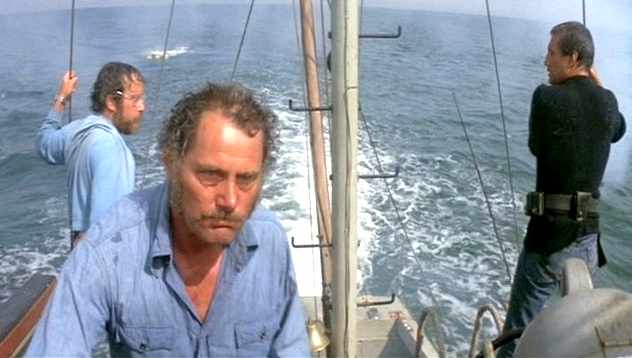
Jaws (Steven Spielberg, 1975)
*** (A Must-See)


1941 (Steven Spielberg, 1979)
*** (A Must-See)


Close Encounters of the Third Kind (Steven Spielberg, 1977)
** (Worth Seeing)


(The Mayfair Theatre, 1074 Bank Street, 08/06 & 14/06)

*****

Day of Wrath (Carl Theodor Dreyer, 1943)
**** (Masterpiece)


(Canadian Film Institute, Library and Archives Canada, 395 Wellington Street, 12/06)

*****

Breaking the Waves (Lars von Trier, 1996)
*** (A Must-See)


(Bytowne Cinema, 324 Rideau Street, 21/06 – 22/06)

Thursday, May 27, 2010

A Busy June (And What I Will Be Doing)

June Film Listings

Bytowne Cinema
Punishment Park (Peter Watkins, 1971) 14/06 – 16/06.
Sweetgrass (Ilisa Barbash & Lucien Castaing-Taylor, 2009) 18/06 – 22/06.
Breaking the Waves (Lars von Trier, 1996) 21/06 – 22/06.

Mayfair Theatre
Steven Spielberg Double Bill 08/06.
Close Encounters of the Third Kind (Steven Spielberg, 1997) 14/06.
Back to God’s Country (David Hartford, 1919) 25/06.
Prime Cut (Michael Ritchie, 1972) 26/06.
Canadian Cult Revue 30/06.

Canadian Film Institute
Day of Wrath (Carl Theodor Dreyer, 1927) 12/06.
Lebanon (Samuel Maoz, 2009) 13/06.
Drunken Angel (Akira Kurosawa, 1948) 19/06.
The Lower Depths (Akira Kurosawa, 1957) 25/06.
Stone Time Touch (Gariné Torossian, 2007) 26/06.

Movie Night at the Imperial
Written on the Wind (Douglas Sirk, 1956) 1/06.
Top Hat (Mark Sandrich, 1935) 29/06.

TIFF Cinematheque (Toronto, ON)
Personal Views: A Tribute to Robin Wood 18/06.

Cinema Beaubien (Montreal, QC)
Les Amours Imaginaire (Xavier Dolan, 2010) 11/06.

Saw Gallery
Lesley Marsland’s Science Fiction Comedy TBA.

*****

It is summer here in Ottawa and the weather is hot. Since completing my Bachelors of Arts with a Major in Psychology and a Minor in Film Studies at the University of Ottawa in April my activities can best be described as idling. A lot of my time is spent at coffee houses, movie theaters, and at bars. I have a few short-term contract jobs here including researching vocabulary and working memory in elementary school students, the production of a couple of educational tool videos, and my part-time gig at the CFI. These jobs help me get by, but If find I am somehow still increasing my credit card debt. Whatever.

Solo reading wise, I have been really enjoying reading Zoë Druick’s erudite Projecting Canada, government policy and documentary film at the national film board (2007), she writes in the book “It is my contention that the NFB represents a rarified site for examining the use of new communications technology (in this case, film) and a new film form (documentary) for education, nation building, and the governmental project of an administered welfare state.” I am also having a pleasure exploring Vidéographe’s box set Robert Morin, The Videomaker’s Journey (1976-1997). Robert Morin and Lorraine Dufour output for their Coop Vidéo de Montréal is rich and compelling.

It looks like there are going to be a lot of worthwhile films going to be screening this month. Cool. Just browsing through my June Film Listings I am partly interested in writing about my friend Lesley Marsland directorial debut, it is supposed to be a twenty-minute sci-fi comedy; Back to God’s Country with the great Nell Shipman and which the film guide describes as “the earliest surviving Canadian feature film from 1919”, there will be live music by Mike Dubue; If I can make it out to it I would be interested in putting my thoughts out there on Xavier Dolan’s remake of François Truffaut’s Jules and Jim (1962), Les Amours Imaginaire (2010); and finally I eagerly anticipate Ottawa’s premiere of Gariné Torossian essay film narrated by Arsinee Khanjian Stone Time Touch (2007), which also includes a book with a contribution by Scott Birdwise. If you are at all interested in reading about the other films I am sure you can find analysis of them in the writings of Robin Wood, Joseph McBride, Cinema Scope, and Jonathan Rosenbaum.

I am also happy to hear Apichatpong Weerasethakul’s newest film Uncle Boonmee who can Recall his Past Lives (2010) won The Palme d’Or. Joe is ever adventurous in his projects and his work recalls the mysticism of Andrei Tarkovsky. I liked how his film Tropical Malady (2004) spoke towards a distinct Thai experience while expanding on more universal themes of fright and loneliness in the search for a partner through its two narratives; one which is straightforward and the other an abstract re-rendition.-David Davidson

Tuesday, April 6, 2010

Interview with Lee Demarbre

This is an interview I have been working on for a while with Lee Gordon Demarbre. Part of a series of interviews and list from local film experts to increase awareness of Ottawa cinéphiles and to bring them together online. Thanks again Lee for contributing to Ottawa Film Review and for making Ottawa a lot more exciting with your eclectic programming at the Mayfair Theatre.-D.D.


OFR: So Lee, what is your next project?

Lee Demarbre: I'm developing a film project now based on an idea from Sasha Gr-y, to star Sasha Gr-y. Ian Driscoll is hoping to have the script finished by mid-February.

OFR: What is it about this disturbed behavior that interest you so much? And is there anything you learnt from exploring this subject matter so closely, apparently you continue pursuing this interest in Summer’s Blood (2009)?

Lee Demarbre: I don't think I'm really exploring all this on purpose. I'm not setting out to say something about the disturbed mind. It just turns out this is a subject matter of many of my films. I think that's because I'm taking a lot from genre; and genre deals a lot with violence, as a result disturbed minds become my antagonists.

OFR: Why did you pick to film The Dead Sleep Easy (2007) in Mexico?

Lee Demarbre: I was already in Mexico shooting a documentary on Mexican wrestling entitled Vampiro: Angel, Devil, Hero (2008). It was a dream to make a movie about Mexican wrestling in Mexico -- so I jumped at the chance. Mexico is so bad-ass. The landscape of the country is like a modern day wild-west; no set dressing necessary. I'd do it again in a heart beat - it's dangerous at times but worth it.


OFR: What are the charms of filming in Ottawa? I imagine your crew must pretty tightly knit? Do you guys feel like you have reached a celebrity status?

Lee Demarbre: Ottawa's charm is the fact that the film industry doesn't really exist in this city. So when you approach someone about shooting in their restaurant, shop or cinema; most times they let you do it for next to nothing because they're so excited you're shooting a film. That wouldn't happen if people were shooting here all the time. And no I don't feel the sense of celebrity. It's always nice to have someone tell you how much they like your film, but there really isn't a sense of being famous. Just the sense that the movies are out there and some people have seen them; which is rewarding.


OFR: I am wondering what are your views on Canadian cinema? Is it lacking anything? What is that you like about it?

Lee Demarbre: Canadian cinema is looked down upon by many people because our films hardly resemble what people are use to watching; Hollywood movies. And I think the current state is on a down low. In the 90's there was a better sense of new Canadian films and filmmakers. The new films from Atom Egoyan, David Cronenberg, Bruce McDonald were exciting ten or more years ago. But these guys are still really the only "names" in the business, and now they're lesser filmmakers. We need a new wave of young Canadian filmmakers to come along and put a sense of excitement back into Canadian films.

OFR: Are there any prints you wish were still around or were more easily attainable? Have you created any fond relationships with other people distributors through running the cinema?

Lee Demarbre: I can't figure out why there aren't prints of the original Dawn of the Dead (1978) or Day of the Dead (1985) still kicking around. I wish I could show them again and again. The best part of my job is tracking down older prints (16mm or 35mm) and showing them. I'm still not sure if people really dig seeing original prints of movies; but for me it's like going to a concert to see your favorite old band. It's like a music fan saying "there's Kiss, live on stage" and me coming to the Mayfair and saying "there's an original print of that old movie that I've never seen before." For me it's that visceral.


OFR: How do you guys at the Mayfair feel about the Lansdowne Live decision and will it affect the cinema? Is there anything regular moviegoer should know or do?

Lee Demarbre: People should realize what an original film print is. That like still photography what we're showing is a positive of the negative that was in the camera on set when the movie was being shot. Seeing a movie in the theatre on 35 mm is like going to a museum and seeing a real life painting, opposed to seeing a copy of the painting printed in a magazine. And with the major studios witching over to digital projectors and showing movies downloaded onto a server; the idea of seeing a print is more real then ever. Forget about watching your DVD's, Blurays or whatever at home -- seeing an original print of your favorite movie is really like seeing it for the first time. If you don't get this -- then please stay at home.

OFR: What would you say were your favorite ten movies that came out in 2009?

Lee Demarbre: Here's my list

- Red Cliff: Part II (John Woo)
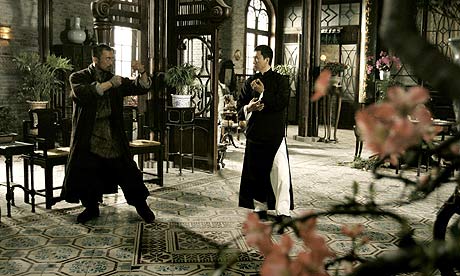
- Ip Man (Wilson Yip)
- Inglourious Basterds (Quentin Tarantino)
- Bronson (Nicolas Winding Refn)
- The Fantastic Mr. Fox (Wes Anderson)
- Invictus (Clint Eastwood)
- Che (Steven Soderbergh)
- Star Trek (J.J. Abrams)
- Whatever Works (Woody Allen)
- The Girlfriend Experience (Steven Soderbergh)


Sunday, March 28, 2010

Studious April Distractions

April Film Listings

Canadian Film Institute
Le Jour Avant Le Lendemain (Marie-Hélène Cousineau & Madeline Ivalu, 2009) 11/04.
Contes de l'Age d'Or (Cristian Mungiu et al, 2009) 17/04.
Revanche (Götz Spielman, 2008) 24/04.

Bytowne Cinema
Les Vacances de M. Hulot (Jacques Tati, 1953) 9/04 - 13/04.

The Mayfair Theatre
The Robe (Henry Koster, 1953) 3/04.
Army of Darkness (Sam Raimi, 1992) 10/04.
Naked Lunch (David Cronenberg, 1991) 25/04.

Cinémathèque Québécoise (Montreal, QC)
Greed (Erich von Stroheim, 1924) 23/04.
Greed: Reconstruction (Erich von Stroheim, 1924) 25/04.
Blind Husbands (Erich von Stroheim, 1919) 30/04.

Wednesday, March 3, 2010

A Quarantine and a Hybrid Western

The Crazies (George A. Romero, 1973)
*** (A Must-See)
(The Mayfair Theatre, 1074 Bank Street, 1/03)


*****

Bring Me the Head of Alfredo Garcia (Sam Peckinpah, 1974)
**** (Masterpiece)
(The Imperial, 329 Bank Street, 2/03)

Monday, February 22, 2010

Old and New Canadian Films in March

March Film Listings

Canadian Film Institute
Dying At Grace (Allan King, 2003) 14/03.

Bytowne Cinema
J’ai Tué Ma Mère (Xavier Dolan, 2009) 19/03 - 25/03.
Inferno of Henri-Georges Clouzot (Serge Bromberg & Ruxandra Medrea, 2009) 17/03 & 18/03.
Chloe (Atom Egoyan, 2009) 26/03 - 8/04.

The Mayfair Theatre
Near Dark (Kathryn Bigelow, 1987) 12/03.
eXistenZ (David Cronenberg, 1999) 23/03.
The Frighteners (Peter Jackson, 1996) 26/03.

Cinémathèque Québécoise (Montreal, QC)
Donigan Cumming: Oeuvres Récentes (Donigan Cumming, 2003 - 2009) 17/03, 6:30PM.

Thursday, February 18, 2010

Some New Auteur Films

The White Ribbon (Michael Haneke, 2009)
* (Has redeeming facets)


Dave Kehr writes about Michael Haneke as being a “finger-wagging sensationalist” and Richard Combs calls him the “pious admonisher”. These labels sum up my feelings towards Haneke and his misanthropy and distaste for humanity, specifically in his latest Palme d’Or winning film The White Ribbon. In it Haneke presents people: a priest; who can not fathom the cruelty in his own community even though he violently disciplines his own children, a father; who condescends and insults his non-marital lover and has pedophilic relations with his daughter, and children; who devastate their community by torturing their neighbors rich and the mentally disabled offspring. Haneke hypocritically looks down on these people, as if saying: look at you people (i.e., the characters, viewers, and humanity), you make me sick! This unearned air of superiority consistently leaves a sense of distaste, the viewing experience felt unnecessarily masochistic.

(Bytowne Cinema, 324 Rideau Street, 19/02 - 28/02)

*****

Shutter Island (Martin Scorsese, 2010)
* (Has redeeming facets)


Martin Scorsese’s Shutter Island, can be seen as being some-what inspired by Jacques Tourneur The Cat People (1942). I see it, as an alternative path Oliver Reed and Irena Dubrovna could have gone. Shutter Island also has the Tourneur-like quality of abstaining from violence while maximizing frights. It is interesting to see Mr. Scorsese finally make a film that addresses the Holocaust since he was originally supposed to direct Schindler’s list (1993) before trading projects with Steven Spielberg for Cape Fear (1991). And whatever happened to Martin Scorsese’s past collaborator Paul Schrader’s film Adam Resurrected (2008)? That seemed like another good film, also set in a post-WWII mental institute, which got lost finding distribution.

One of my criticisms is that one of the inspirations for the Teddy Daniels character was supposedly Dana Andrews from Otto Preminger’s Laura (1944). I do not really see any acting comparisons since Preminger’s long takes accentuated attention to gestures and small details, while Scorsese’s camera work and fast editing do not. All in all, Shutter Island leaves a lot to be desired but at times it is enjoyable.

(World Exchange Plaza, Empire 7 Cinema, 111 Albert Street, Opening 19/02)

*****

Invictus (Clint Eastwood, 2009)
*** (A Must-See)


Clint Eastwood’s 32nd film Invictus (2009) is a stimulating political drama about the true story of the president of the Republic of South Africa Nelson Rolihlahla Mandela (Morgan Freeman) uniting the post-apartheid country for the 1995 Rugby World Cup. The title of the film derives from a Wiliam Ernest Henly poem from 1888, Nelson Mandela used the poem for inspiration during his 27 year jail sentence as a political prisoner.

Clint Eastwood latest output has been historical revisionism. Invictus, Changeling (2008), Letters from Iwo Jima (2006), and Flags of Our Fathers (2006) are all about moments in time grounded in a precise place and where the events and communities surpass any one individual and the focus is that of social movements and political change. Invictus is about the blacks and whites of South Africa coming together - overcoming prejudices – for an international sport event, which becomes a catalyst for peace and unison.

Invictus obfuscates social realities and it does not address issues such as racisms, poverty, and the necessary political challenges Nelson Mandela had to overcome in achieving what he did for the country. Everything appears to be really simple for the president except for when he faints from being overworked and when he talks about being detached from his immediate family. And some scenes seem easy and unsubstantial including when the rugby coach Francois Pienaar (Matt Damon) “generously” gives a world cup final match ticket to his family's black house keeper or when the black and white presidential security officers make amends in the empty stadium. These are just a few minor squabbles in a story about an exceptional man that is well worth being told.

One reoccurring Eastwoodian theme is that of revenge. Clint Eastwood has been in the revenge business since early in his career with the Man with No Name and the Dirty Harrys’ onwards to Josey Wales and the Walt Kowalskis’. There has been a shift from his youthful vigilante justice to a more mature peaceful vocation. Nelson Mandela prevents the sports council decision of revamping the South African Springboks - a symbol of white power for the Afrikaans- rugby team early on in the film, as he believes it would cause more strife between ethnicities. Nelson Mandela as his new hero brings peace and understanding while promoting nationalism.

Drama is created out of the ordinary (i.e. a fast approaching van creates uneasy suspense), computer generated imagery fills a stadium to the rafters, and aerial views of Cape Town are breathless. All of these qualities and many others are proof that the 80-year-old director is a serious and artful chronicler and that his vast talent and energy has yet to be depleted. As Invictus shows, his best has yet to come.-David Davidson

(The Mayfair Theatre, 1074 Bank Street, 19/02 - 21/02, 24/02 & 25/02.)

Sunday, February 7, 2010

Blaxploitation Williamson

Black Caesar (Larry Cohen, 1973)
*** (A Must-See)


(The Mayfair Theatre, 1074 Bank Street, 06/02)

Friday, February 5, 2010

A Cold and Cruel World

Antichrist (Lars Von Trier, 2009)
*** (A Must-See)


Grief, Pain, Despair. The films divided chapter titles perfectly describe the mood of Lars Von Trier’s Antichrist staring Charlotte Gainsbourg (who won a best actress award at the Cannes Film Festival for her performance) and Willem Dafoe (The Spider Man Series, Wild At Heart). The story follows a married couple who go to their woodland cottage “Eden” to bereave the death of their son. The isolated shack, its surrounding forestscape, and the superstitious bad weather do not become a retreat of solace but instead an unsuspecting battleground, his psychotherapist "rational thought” is put against her occult mysticism.

The Danish filmmaker Lars Von Trier is one the most daring and cutting edge world filmmakers. The films handheld shots (hawking back to the Dogme95 movement), image distortions, incorporation of digital technology, uncanny editing, and the overall creativity and originality of the film can be both exasperating and stunning.

Though primarily chilling and atmospheric the interlaced irony provides moments of levity. After arriving to Eden the couple is kept up by the comic clanking of fallings acorns on the roof of the cabin. When the mother overcomes one of her first psychiatric challenges a dead bird infested with ants falls from a tree and then is torn apart by a crow. Everything culminates into a devastating self-sacrifice.

This is not your typical horror film. Though there are some surface similarities between it and Stanley Kubrick’s The Shining (1980) including; the continental secluded setting and the eroding consciousness shown through a journal, it is the spellbinding mixture of misanthropy, sarcasm, and sadomasochism that makes Antichrist so hard to forget.-David Davidson

(Bytowne Cinema, 324 Rideau Street, 05/02 - 09/02) & (The Mayfair Theatre, 1074 Bank Street, 24/02 & 25/02)

Friday, January 29, 2010

Quality and Quantity February and the Double Bill at the Mayfair

February Film Listings

Bytowne Cinema
Groundhog Day (Harold Ramis, 1993) 01/02 & 02/02.
Antichrist (Lars Von Trier, 2009) 05/02 - 09/02.
Vertigo (Alfred Hitchcock, 1958) 07/02 & 08/02.
The White Ribbon (Michael Haneke, 2009) 19/02 - 28/02.

Café Ex
The World Viewed (Chris Kennedy, 2003-2006) 04/02.

Canadian Film Institute
All Fall Down (Philip Hoffman, 2009) 13/02.
Polytechnique (Denis Villeneuve, 2009) 20/02.

The Mayfair Theatre
Black Caesar (Larry Cohen, 1973) 06/02.
The Sexy Film Festival (?, ?) 12/02.
Casablance (Michael Curtiz, 1942) 14/02 & 15/02.
Play It Again, Sam (Herbert Ross, 1972) 14/02 & 15/02.
Invictus (Clint Eastwood, 2009) 19/02 - 21/02, 24/02 & 25/02.
Fantastic Mr. Fox (Wes Anderson, 2009) 20/02 - 23/02.
The Darjeeling Limited (Wes Anderson, 2007) 23/02.
Antichrist (Lars Von Trier, 2009) 24/02 & 25/02.
Some Like It Hot (Billy Wilder, 1959) 27/02 & 28/02.

Sunday, January 17, 2010

Anarchy, Self-promotion and the Comedian

Bronson (Nicolas Winding Refn, 2008)
** (Worth Seeing)


(The Mayfair Theatre, 1074 Bank Street, 15/01 - 17/01, 20/01 & 21/01)

Thursday, January 7, 2010

Apocalyptic Prophesy

Collapse (Chris Smith, 2009)
** (Worth Seeing)


Scare-mongering and facetious, Chris Smith's documentary Collapse is an 80-minute interview with conspiracy theorist Michael Ruppert.

Mr. Ruppert is the founder and editor of the investigative journalism publication From the Wilderness and he has a deep hatred towards the American politicians George W. Bush, Richard Cheney, and the current President Barack Obama. He claims the world oil supply, any day now, is going to be depleted and after the collapse of government, which will happen soon enough, only the survivalist and those who are strong enough to live through the “transition” will persevere. Oh and lest I forget, he imagines that plant seeds will become a new form of currency.

Let’s just say, his argument is less then convincing. Mr. Rupperts anger towards the government and parliamentary corruption overshadow any strength behind his convictions and there is a bargain-basement quality to his argument. All of this is made worst by the tactless cinematography with its manipulative zoom-in close-ups that try to win the viewer through pathos and emphasizing the “authority” of this self-proclaimed seer.

Collapse’s only redeeming facet is as a cultural artifact. Though there are faults to Mr. Ruppert’s logic, the film presents an in depth presentation of the views of a social discontent in the wake of a major economic downturn, one which he apparently foresaw. Late in the documentary it is even told, in one of the many awkward black screens, that Mr. Ruppert is now late for paying his rent and he is facing eviction.

This engagement with the stalled American landscape classifies the documentary, for me, as a recession film. A recession film is one that thematically encapsulates the personal effects of the credit system collapse and the burst of the housing bubble due regulatory failure. Others recession films include: Capitalism: A Love Story, Wendy and Lucy, The Limits of Control, Up in The Air, The Taking of Pelham 1 2 3, The Informant! etc. It is through consciousness and engagement with the issues of our times, in these cases through socially conscious filmmaking, which increases ones world-view and strengthens convictions towards mindful change.-David Davidson

(The Mayfair Theatre, 1074 Bank Street, 8/01 - 10/01)

Sunday, December 27, 2009

See You January

January Listings

Bytowne Cinema
Swimming Pool (François Ozon, 2003) 11/01 & 12/01.
The Killer (John Woo, 1989) 27/01 - 28/01.
Red Cliff (John Woo, 2008) 29/01 - 2/02.

The Mayfair Theatre
Wizard of Oz (Victor Fleming, 1939) 9/01 - 11/01.
Battleship Potempkin (Sergei Eisenstein, 1925) 15/01.
Bronson (Nicolas Winding Refn, 2008) 15/01 - 17/01, 20/01 & 21/01.
The Bad Lieutenant: Port of Call - New Orleans (Werner Herzog, 2009) 28/01 & 29/01.
The Shaolin Temple (Xinyan Zhang, 1982) 29/01.
Piranha Part Two: The Spawning (James Cameron, 1981) 30/01.

Monday, November 30, 2009

Hanukkah December Projections

December Listings

Bytowne Cinema
The Bad Lieutenant: Port of Call New Orleans (Werner Herzog, 2009) 4/12 - 10/12.

The Mayfair Theatre
Bad Lieutenant (Abel Ferrara, 1992) 4/12 & 6/12.
The Inglorious Bastards (Enzo G. Castellari, 1978) 11/12 - 12/12 & 16/12 - 17/12.
Scrooged (Richard Donner, 1988) 19/12 - 20/12.
Man from Deep River (Umberto Lenzi, 1972) 26/12.

Cinéma du Parc
The Magnificent Ambersons (Orson Welles, 1942) 2/12 - 3/12.

Saturday, November 21, 2009

Angry and Provoking

The Last House on the Left (Wes Craven, 1972)
**** (Masterpiece)


(The Mayfair Theatre, 1074 Bank Street, 20/11)

Thursday, November 19, 2009

On Smash Cut

A butchered "300 word" version of this capsule was published in the Volume 70, Issue 14 of the University of Ottawa student paper the Fulcrum. They were even able to cut out any mention of Sasha Grey, one of the prized eye candy of the film. However, I am happy Smash Cut is getting a lot of recognition, especially best 2009 film by a local filmmaker in the Ottawa Expres.-D.D.

Smash Cut (Lee Demarbre, 2009)
*** (A Must-See)


Lee Demarbre’s Smash Cut, from a screenplay by Ian Driscoll, is an entertaining Ottawa gore film which just had its world premiere Saturday July 18th in Montreal at the Fantasia Film Festival. Both dark and jovial, the plot follows a local filmmaker Able Whitman (David Hess), acting as a surrogate for Lee Demarbre, and its concerns are the inconveniences and compromise that filmmakers creating a collaborative art have to deal with.

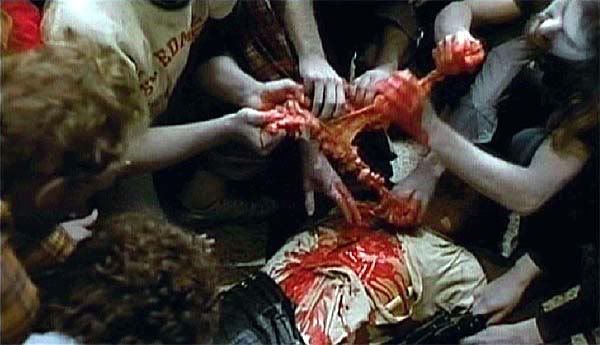
The film starts off with Herschell Gordon Lewis, a low-budget gore filmmaker who spawned the genre in the 1960s, warning the viewers “that filmmaking is a blood sport” and that the content of the film is sure to shock. Herschell Gordon Lewis films Blood Feast (1963), Color Me Blood Red (1965), and The Gore Gore Girls (1972) were some direct influences on the film . His films were filled with gruesome murders, evisceration, and half-clad women victims. Blood Feast starred Connie Mason, from the centerfold of playboy magazine, which is now being paralleled with Sasha Grey who comes from the adult entertainment industry. But his style was invisible, with very little camera movement and a texture that resembled b-exploitation-movies of the era, unprofessional acting, implausible shlock stories, always bright lighting which consisted of a bursting comic-book color palette with flashy hues of blue, red, pink and orange, and moods which were more fun than morbid.

Smash Cut's camera work, by the cinematographers Jean-Denis Ménard and Karl Roeder, is intensely modern, it was shot on a high resolution RED digital camera, with steady cam shots bringing you into the action, close-ups on the dismantlement’s, intricate long shots as well as a mixing up of medias including shots from the perspective of the cameras view-finder, and a short interposition of a monochromatic silent film. The original music, and sound mixing, by Micheal Dubue creates a mood of eeriness and suspence. One scene that stays in mind occurs when the camera follows Able Whitman from his car arriving at the Bytowne Cinema on Rideau Street, past the posters, one of The Dead Sleep Easy (Lee Demarbre, 2007), up the marquee, through a window, and into the projection booth.

Smash cut begins with Abel Whitman presenting his lastest picture, the audience pans the film, denounces its artificiality of a detached eye-ball. For his next picture, Abel, will remove the eyes of a victim with a medical knife, in a sequence that is even more nauseating then the eye slicing in Un Chien Andalou. Then he goes to a bar and drinks his problems away, gets a dance from a stripper named Gigi (Jennilee Murray), and then leaves with her. Driving home, she surprises him by returning her regular fee, but an unsuspecting incoming automobile sidetracks him off of the street where he hits a tree. She dies. The accidental murder of the women, a fleeting career, and frustration towards an audience that is not receptive to his work brings him to a nervous breakdown. What unfolds is a murderous escapade; he has now an insatiable desire to murder and to use the corpses in his film. As precocious as the Nietzscheans in Alfred Hitchcock’s Rope (1948). The body parts make everything, well the gore at least, in his new film of a murdering toy all the more realistic and believable, allowing him to get more grants, a major distribution, which pleased his producer Philip Farmsworth Jr. (Michael Berryman), and awe from his peers.

One unnoted dept Smash Cut might owe would be too Warren Beatty’s Bulworth (1998). Abel Whitman’s nervous breakdown and then ravage lunacy parallels the plight of Sen. Jay Billington Bulworth where after realizing his vanishing presence as a political candidate he decides put a contract out on himself and then starts to blurt out truth’s denouncing the system hypocrisies. With every prod to the current political organization, the more powerful his following becomes. Which is similar to the aggrandizing of Abel as his film is consecutively improving.

The only potential problem the film poses is it lack of a message. What does this film have to say about the world we live in? Able Whitman while in a room preparing to get government funds is asked by an artist what kind of film is he making, her answer was that she will be using the money to decry the passivity that arise from televisions, and then he tells her his film will be a sojourn in the macabre, then knocks her out, slowly tortures her, depletes her blood into a canister and finally lashes it onto the star of his new film April Carson (Sasha Grey). April is Gigi’s sister, the murdered stripper, who is on a editorial pursuit, along with a investigator Isaac Beaumonde (Jesse Buck), to relocate her.

Ian Driscoll script has Shakespearian touches, in particular Hamlet which Abel Whitman comments as being as precursor horror film. The investigator Isaac eventually catches on to what Abel has been doing and puts on a a re-enactment of Abel Whitmans murder of the movie critic Gretchen Gregorski (Guen Douglas) paralleling the same device Hamlet uses on Claudius, though comically done with paper masks and a pretend stabbing with a knife that never makes contact.

Many simple pleasures that arise from the film are the locations and people, starting off with the Car Wash on Catherine Street, the repertoire cinema’s Bytowne and the Mayfair, the National Art Gallery of Canada setting, and alongside the Rideau Canal. This viewer’s only problem arose when Abel Whitman decides to murder one of the film’s producers with a Harpoon, he is asked where he got the Harpoon, and before plummeting him with it, he answers at the Harpoon store. For as this lifetime Ottawa, Ontario, resident knows there are no Harpoon stores here! As well there are a few cameos of a few friends that would have no other opportunity to be immortalities on film including Layla Brown, Lesley Marsland (both from the Bytowne Cinema) and Michael Dubue (In the band the Hilotrons, and Mayfair Theatre) as well as a few Ottawa Famous figures including Guen Douglas (Planet Ink Studios), Jennilee Murray and Phil Caracas (The Harry Knuckles trilogy, and Bytowne Cinema).

The communal midnight screening experience was very lively. Including a waiting line that went around the corner, a practically packed house at the Théâtre Hall at Concordia (1455 de Maisonneuve O.), loud cheers, burst of laughter, comments, and a receptive question and answer period. With popcorn, and soda everyone was in the mood for a good time. The Q & A session afterwards was very enlightening with Lee Demarbre, Ian Driscoll, Sasha Grey and David Hess. Lee Demarbre was his usual enthusiastic self, Sasha Grey, who is 21 years old, (her next film is Steven Soderbergh The Girlfriend Experience) seemed rather reserved when she was not speaking, and finally the Sanford Meisner protégé and acting veteran, David Hess (The Last Hill on the Left) seems to exert both levity and the knowledge of old age. All cohorts played off of each other like a perfect pitch tune.

During the Q & A session, David Hess contextualized the midnight movie phenomenon. He commented on how back then, New York City in the 1960’s, nobody knew who was directing the pictures. When an audience would go to see a midnight movie, their usual routine for the night would involve getting high off marijuana and then watch a lurid seedy picture. The director of the picture remained unanimous, and even though he knew personally Hershell Gordon Levis, he commented on how he still had to be re-introduced to him later through his films.

The conditions were both open and social as Lee Demarbre seemed to be an incarnation of what it means to be a film enthusiast for the people of Ottawa (Full disclosure: I am an avid enjoyer of Lee Demarbre films and with Rachel Leblanc I have made a short documentary on him, you can find it if you youtube; cult fiction lee demarbre). His flamboyant repertoire programming at the Mayfair Theatre (1074 Bank Street) got many local residents to make the pilgrimage to go see the world premiere of Smash Cut in Montreal. When the questions started, some of them were from extras from the movie, others thanking him for the great movies playing at the cinema and wannabe screenwriters asking him for advice. Make sure to go see this one when it gets its local release because this film is well worth checking out.-David Davidson

(The Mayfair Theatre, 1074 Bank Street, 20/11)
Sunday, November 1, 2009

DVD Watching November Confinement

November Listings

The Mayfair Theatre
Smash Cut (Lee Demarbre, 2009) 20/11.
The Last House on the Left (Wes Craven, 1972) 20/11.
The Polar Express (Robert Zemeckis, 2004) 28/11.
Double Agent 73 (Doris Wishman, 1974) 28/11.

Canadian Film Institute
Un prophète (Jacques Audiard, 2009) 28/11.