Dossiers – Martin Scorsese
-
Raging
Bull (1980). La Solitude Sans Fond, by Pascal
Bonitzer. Cahiers du Cinéma N.321. March 1981. Pg. 5-8. *Cover
-
The
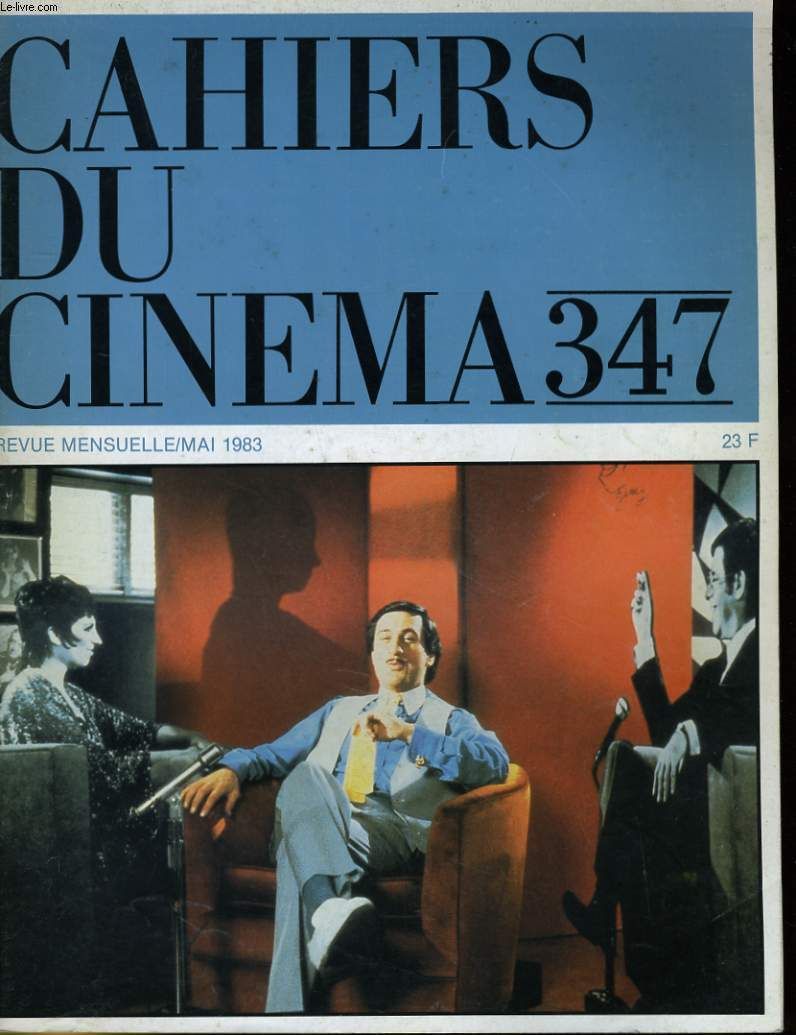
King of Comedy (1982). De l’Autre Coté des Images, by
Olivier Assayas. Cahiers du Cinéma N.347. May 1983. Pg. 5-8. *Cover
-
After
Hours (1985). Mâchoires, by Pascal Bonitzer. Cahiers
du Cinéma N.383-84. May 1986. Pg. 43-44.
-
The
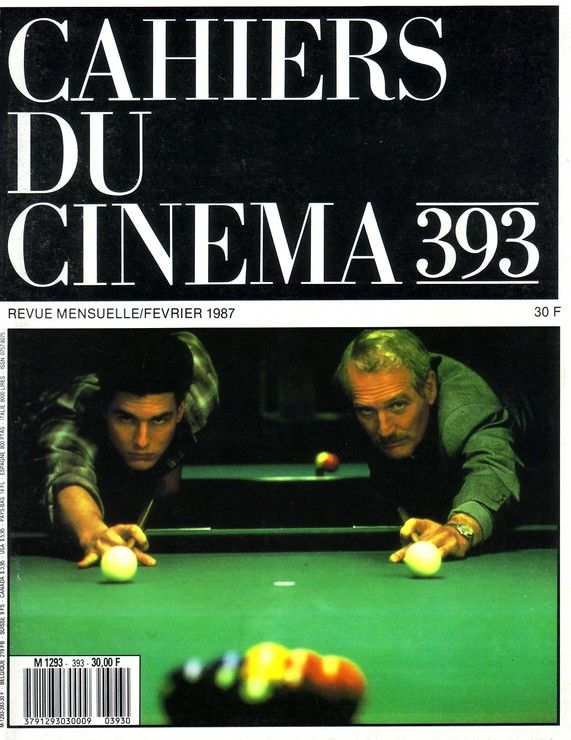
Color of Money (1986). Le Maître du Jeu, by Alain
Philippon. Cahiers du Cinéma N.393. March 1987. Pg. 5-7. *Cover
-
The
Last Temptation of Christ (1988). Portrait de Jesus en Héros Scorsesien,
by Antoine de Baecque. Cahiers du Cinéma N.412. October 1988. Pg. 5-8. *Cover
***
Raging Bull would be the introduction of Martin
Scorsese at Cahiers after their
political-theoretical period. Prior to this first Critique by Pascal Bonitzer
(one of Daney’s critics), Scorsese might have been mentioned only in passing.
Scorsese was part of this new generation of American directors, along with Coppola, De Palma, Spielberg, and Allen that Cahiers was discovering and catching up
with. Raging Bull offered them their first opportunity
to write a Critique on the director and it
would be the start of their relationship with the American director who they
would give the most covers (4) throughout the Eighties. Along with the review
there’s an interview with its producer Irwin Winkler and its editor Thelma
Schoonmaker in the Journal section to correspond with the Critique.
Bonitzer’s
review proceeds in three subtitles:
The Aesthete, The Priest,
and The Thug
“The
life of Jake LaMotta, based on his own autobiography. We could have expected a
sort of retro-fresco, with one side The
Godfather and the other side Fat
City, grandeur and misery, lost illusions, sports and the mafia, a social
truthfulness and an auto-critique of American society etc. The film which is in
black-and-white (except for a few brief exceptions), we could have thought that
it would resemble Bob Fosse’s Lenny,
an evocation of the Fifties and the portrait of an artist as struggling and
neurotic. This isn’t the film at all.
“Martin Scorsese is an artist with a
Dostoevskian sensibility, and not Balzacian. A description of social or
historical facts doesn’t interest him as much as the life of the human spirit.
There is three personalities in this filmmaker: a priest, a suicidal thug, and
an aesthete (which were already all there in his first experimental 16mm film, The Big Shave). The priest is behind
the camera, the thug is in front, and the aesthete is in between. Each of his
(their) films is its own rendition, the deployment of this trinity.*
As it happens
there is a women who witnesses this, who becomes the object or the cartelist
for this tri-partition, but this always leads to (or well, most of the time)
these films where one or two characters are analyzed very closely. This brings us
to Raging Bull.
“Boxing has the same metaphoric and
metaphysical role as the taxi: it expresses identically this solitude, the
tragic identity of this character which the character can’t escape. The boxer
boxes against his shadow, against walls (c.f. the prison sequence). Sugar Ray
Robinson isn’t a black opponent, but his shadow.
“Broadly speaking, Raging Bull is a study in a wide-shot
of the implications of love, sexual desire and jealousy. La Motta is an avatar
of Othello in the era of competition.
“Raging Bull is then maybe also a beautiful love story. Vickie,
or/and Cathy Moriarty, are who inspire Scorsese. She is what’s carnal, the
medium of a passion of cinema, which edges towards a fetishism of the filmic
material. Scorsese is (with Godard) one of the rare directors to possess this
sensual taste for filmic material, which overflows into an abstraction, and
that leads to his experimentation with this black-and white and Super 8 film
stock. This pseudo-amateurish footage troubles the film, and through these
moments of family happiness, breaks the heterogeneous fabric of the film, like
in a painting by Rauschenberg or an atonal composition.
“By the end, and regardless of the
punctuation of its evangelical finale, the Catholic God and this creature resolves
their problems through lighting, in a pure affirmation of cinema, like how in Mean Streets, Harvey Keitel’s puerile
hell concluded in a fascinating explosion of flames.
*
This trinity shouldn’t be confounded with the triangle Scorsese-De Niro-Schrader
(where Schrader played the role of the priest and De Niro the thug). It is
necessary to watch that De Niro and Schrader do elsewhere to understand that
they constitute here moments, in the
dynamic sense, of Scorsese. And why they’re so good makes Scorsese the auteur. (It’s curious how this
notion of an auteur in the cinema is still polemic today). The solitude of the
white male protagonist: this is what connects Raging Bull to Taxi Driver,
they are both variations on a similar character.
***
With The King of Comedy comes another Scorsese
dossier, which includes a Critique by Assayas, an interview with Scorsese by
Barbara Frank and Bill Krohn (who also has another essay). It’s a generally
impressive issue: Serge Daney reviews Jerry Lewis’s Smorgasbord, Serge Toubiana reviews Robert Bresson’s L’Argent, and there’s an homage to André
Bazin (for the publication of the Dudley Andrew biography in French).
Oliver Assayas (again,
also a Daney critic) in his review of The
King of Comedy illustrates a few qualities of what makes a Cahiers Critique unique: their extreme
movie love, a prose that borders onto the purely interpretive and nonsensical,
a refined understanding of the film and its relationship to the director’s body
of work, the work of the director’s collaborators and what they bring to the
project, a large knowledge of film history, and how the film documents certain
social trends in American culture. Assayas’ review also references the Cahiers Made in U.S.A. issue (which
Assayas participated in the making) where they published a conversation between
Scorsese and Schrader.
“There
isn’t a satire nor a parody and its scrupulous realism is what makes it so
powerful. In his recent films, Scorsese has strictly stuck to genres and the
formal rules of Classical Hollywood. On a subject like this one, we would have
expected to see an approach inspired by Capra. But it’s exactly the opposite! The King Of Comedy doesn’t resemble
anything by the fact that it is a film by a cinephile: it’s a contemporary
film. It’s a new kind of film, and
this is rare.
“The
America of The King of Comedy is in
effect an acclimatized nightmare, a
superstore that has the dimensions of a nation, a system with the essence of
socialism or of a uniformity of individuals, like those of ideas, they are no
longer created. The process has been completed.
“The way that Scorsese and De Niro
make the films they choose to make, which are relatively commercially
unsuccessful, have led them to realize something clearly: that the American society had been solidly
armed to reject this supplement of the spirit that they were proposing. Just as
much with Mean Streets, Taxi Driver, New York, New York and Raging
Bull. These are films impregnated with a belief, full with a moral and a
spirit, and with the mission of the artist to defend these spiritual values in
face of uncaring contemporary society. This is why a film like The King of Comedy is just as much an
artistic film as it is a film noir,
destructive and somber in its discouragement.
“The film is unacceptable for being
so profoundly subversive. It touches upon, in effect, really closely what today
it means to create an image. This is America. This is Hollywood. This is the
system and these are the individuals that it creates. This is how they reproduce.
“There isn’t any content, there’s
only this form. Regardless of what’s the nature of what we do, the only thing
that counts is the energy that we put into it. A figure like Jerry Langford
holds on to his scar regarding this, in his silences resides something of his
spirit, he’s a being who’s suffering. While Rupert Pupkin is, himself, already
ready to assume everything: from the other side, the spectacle is not his
mirror, he’s the mirror of the television. He only sends back to Jerry Langford
his own image. Rupert Pupkin is the horror of the man without a spirit; he’s
the pure emanation of the man who succumbed to the media. He was born into a
generation where everything is the same thing as its image, and through this
his substance is the same thing as his essence: he isn’t more than what we see,
but he’s the incarnation of his
appearance.
“Rupert Pupkin dreams of passing
through the image: that’s where he belongs. And, just like in E.T., he wants to go back home. But in
reality there isn’t anything on the other side. And this nothingness, which is
carpeted in red, is literally hell. And for this The King of Comedy, without a doubt Scorsese’s most audacious work,
is a horror film. Founded on a nightmare logic, it reminds the viewer of an
adaptation of Kafka’s The Trial that
Welles directed. This makes us regret the fate of K.: at least he had a future.
***
After Hours would be the only Scorsese film to not
get a cover in this period. It’s part of their Cannes Événement, France-USA.
Bonitzer returns to write his second Scorsese Critique. It’s a lengthy and serious
review of one of the director’s lighter films. It shows Cahiers’ loyalty and dedication towards Scorsese. The issue also
includes an essay by Michel Chion, Forma
Dolorosa, on a Scorsese retrospective at the Festival de Strasbourg (“Martin
Scorsese is one of the best working directors, one of the most important artists.”) and there’s an interview with
Scorsese, Into the Night, by Bill
Krohn.
“After The King of Comedy, Martin Scorsese
found himself alone and rejected. After
Hours brings him back into the circuit: it was a requested project, like we
know, by its principal comedian, Griffin Dunne, the co-producer on the film… After Hours, in its nightmare style, is
a light film, which doesn’t have the troubling qualities of Scorsese’s other
films, the deep anguish that weighted down his other films. The King of Comedy was a film that was profoundly
horrible. After Hours is only that
superficially… Anguish and fright, which are at the heart of the story, are
especially treated with a virtuoso direction. It is this virtuoso
demonstration, this grand style in itself, in this small subject, which is what
After Hours is putting forward.
“There is always an ecce homo in Scorsese’s cinema. So few
directors know how to transmit this deictic power, this value of an index of
one’s destiny, to the camera… After
Hours is a comedy of panic, just how like Topor and Arrabal defined it.
Despite its allusions to Kafka (its characters and the punk bar, for example), it
is actually more like Polanski’s The
Tenant in its use of the fantastic.
“After Hours is in reality, lastly, a satire on misogyny, which is
literally anarchic, where it’s through the character of Paul that it incarnates
its terrorizing expression.
“It’s the art of Scorsese to work on
two different levels, to take and squeeze us, existentially, in what is just a
diversion that is pretty dark. It’s a diversion, to repeat, but in a grand
style: what’s there to complain about?
***
Even The Color of Money gets a cover! This a
film that even one of Scorsese’s biggest American defenders Roger Ebert
publicly disapproved of. In the issue Scorsese is highlighted along with Clint
Eastwood’s Heartbreak Ride (a
director that was also taken more seriously earlier on in France).
In Alain
Philippon’s Critique (again, not necessarily a Toubiana critic) he describes
how in the Eighties Hollywood auteurs were experiencing an identity crisis, which forced them to make sequels and to take on more ‘commercial’ projects (e.g. Spielberg’s
episode of Amazing Stories). This led them to experiment with these new forms. It was Paul Newman that asked Scorsese
to make this sequel to Robert Rossen’s The
Hustler (1961).
“More and more the standards of the
American production system are tending to regress. It’s making more ‘series’,
remakes or even sequels (like how we
would describe a sickness). Their alternative American cinema is being quickly
reduced. It’s up to their few great directors to affirm their personality and
grandeur.
“The situation isn’t being played
exactly as a simple rupture, say on one side the ‘standard cinema’ against that
of the ‘auteur cinema’. To prove this: in The
Color of Money, Scorsese remains totally loyal to his own line and it’s
actually one of his richest films, even though it could have looked like a
triple handicap: a sequel, a major production, and an order.
“This
is the spiritual crisis that we get to see in The Color of Money. It’s another work that follows Martin
Scorsese’s questioning of ambition and self-destruction (Raging Bull), success and the trauma towards depressives (The King Of Comedy), and the desire for
a purification (Taxi Driver). In
short: the way that for a while now Scorsese has been able to examine the value
of the American society through its most recent incarnations. A fall, crisis, a
new start, and a comeback: this is the itinerary of Eddie, which is almost like
a religious conversion.
“Here Scorsese itinerary crosses
that of Eddie Felson’s. (There was equally for Scorsese a crisis and then a rebirth
with After Hours after the
commercial failure of The King of Comedy
and the forced abandonment of The Last
Temptation of Christ). Before the two of them can be rejoined in their ‘I’m back!’ finales, there needs to be a
decisive last game of pool, with its round balls on this green carpet.
***
So for
Scorsese’s last film of the decade, his personal project, The Last Temptation of Christ, it is Antoine de Baecque that would
write the Cover Critique (one of his first few, along with Yeelen and The Unbearable
Lightness of Being). It needs to be said: Even though Scorsese is the
American director to get the most covers throughout the Eighties he doesn’t
necessarily reflect a growth at the magazine. He was imposed in the Daney
period and was generally reviewed by his critics. As the decade was progressing
he would be aside from what Toubiana would bring to the magazine and he would
not necessarily reflect the more contemporary American cinema that the younger
new critics were championing.
The Last Temptation of Christ would get its own dossier. Toubiana
brings up the religious controversy surrounding it in his editorial, De Baecque
reviews it, Frédéric Strauss has an essay on Scorsese, Todd McCarthy discusses
its American release, Bérénice Reynaud analyzes Willem Dafoe, and Bill Krohn
has an essay.
De Baecque starts
his Critique with a François de Sales quote,
“As long as we
have two sides to our spirit, one inferior and the other superior, and that the
inferior side never takes over (…), it arrives sometimes though that the
inferior side sometimes succumbs to the temptation and tries to overcome the
superior side.”
“Martin
Scorsese wanted his passion. It has been almost seven years now that he’s been
carrying this cross, sometimes succumbing to temptation (commercial projects,
like After Hours and The Color of Money), but all the while
doing research, accumulating notes, documents and an archive. Today, the
process that he takes, the media attention that he creates, is really
contradictory. This religious polemic against the film displaces its merits as
an exercise in cinematographic theology, it’s a master-work, the key to his
universe.
“All
of his heroes, are forced into a destiny that is thrown onto them in the first
images of the film (After Hours),
Scorsese believes in pre-destiny: This suffering Christ that he pursues
throughout the film, he finishes by catching up to him.
“The
essence of art, for Scorsese, has always been deadly, the stigma (in Raging Bull how De Niro disfigures
himself), these martyrs who find these miracles in Christ… It is due to this
imperative regarding the index of destiny, which is why Scorsese had to be the director of this crucifixion.
A nail digging into flesh is even the synthesis representation of his own
style. But, behind this style, Scorsese wanted to film Christ like an ordinary
man
De Baecque
highlights how Scorsese incorporates a carnal quality in his Christ as he
builds on the writings of Leo Steinberg,
“Scorsese discovers Jesus, gets rid
of his magnificent halo like how he had in the Zeffirelli film. He’s searching
for the most primitive illustration, an expressionism of the counter-reform,
which refuses the baroque pieta, which is reproached by the contemporary integrationist
movement.
“Rarely has a film ever felt to ‘feel’
so profoundly human flesh, to render it in such simple and precise images. This
double transformation of the flesh, which accompanies the voyage of the Christ
figure, this voyage that Scorsese accomplishes through emotions, which he does
while still letting the material speak for itself.
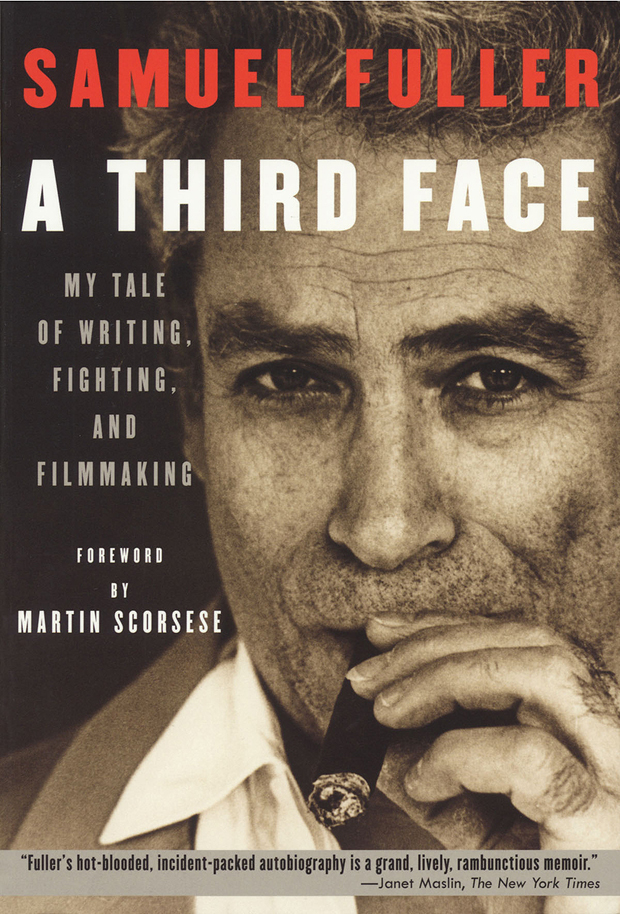 In anticipation for the documentary A Fuller Life, which is playing on
Sunday May 10th at 6PM at Innis Town Hall as part of the Toronto Jewish Film
Festival, here is Martin Scorsese's foreword to A Third Face. The essay builds upon Scorsese’s comments on
Fuller in Scorsese on Scorsese.
In anticipation for the documentary A Fuller Life, which is playing on
Sunday May 10th at 6PM at Innis Town Hall as part of the Toronto Jewish Film
Festival, here is Martin Scorsese's foreword to A Third Face. The essay builds upon Scorsese’s comments on
Fuller in Scorsese on Scorsese.