Showing posts with label Bytowne Cinema. Show all posts

Wednesday, August 4, 2010

The Last Of Summer (Carle, Torossian, Local Films)

August Film Listing

Bytowne Cinema
I Am Love (Luca Guadagnino, 2009) 06/08 – 17/08.
The Hidden Fortress (Akira Kurosawa, 1958) 10/08 & 11/08
Les Herbes Folles (Alain Resnais, 2009) 27/08 – 31/08.

Mayfair Theatre
Long Pigs (Nathan Hynes & Chris Power, 2007) 06/08.
Two Evil Eyes (Dario Argento & George. A. Romero, 1990) 13/08.
Ip Man Double Bill 17/08.
Canadian Cult Review 18/08.
Survival of the Dead (George A. Romero, 2009) 20/08, 21/08, 25/08 & 26/08.
Dixie Dynamite (Lee Frost, 1976) 28/08.
Merry Christmas Mr. Lawrence (Nagisa Oshima, 1983) 31/08.
*****


Réalisateur Nouvelle-France
Whether it is in his period films (Les Corps Célestes, L’âge de la Machinne) or in his contemporary film (La vraie nature de Bernadette, Le mort d’un bûcheron), roadblocks pop up sporadically in the work of Gilles Carle. In the only province in North America to emerge from a French colony - all the way back to the exploration of the Saint Lawrence River by Jacques Cartier in 1534. The uncontrollable nature of Canada’s untamed landscape for a long time has been aggravating its travelers, bringing them together, and making them late for wherever they are going. This visual is an apt metaphor to describe Gilles Carle mark in film history, as Gilles Carle is one of those directors that are undeservingly little known outside of Québec.

Piers Handling’s has written “Carle is a central figure in the history of Québec cinema, having created a diverse, rich, complex body of work over 40 years, which despite its unevenness, contains several enduring classics.” Which is true. Gilles Carle was born July 31st 1928 in Maniwaki, QC. Then he moved to Atibidi where he spent part of his childhood before moving to Montreal. He would set Les corps célestes in Atibidi during the 1940s, around the same time he would have been growing up there. He has won a plethora of Canadian film awards. His resume includes being a director, scriptwriter, and cinematographer for the NFB and then for the production companies Les Productions Carle-Lamy, Onyx Films, and Editions de l’Hexagone. He died of Parkinson’s disease complications on November 28th 2009 in Granby, Québec.

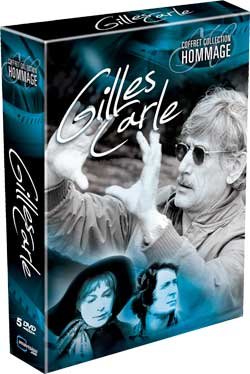
The fact that Gilles Carles is unrecognized might have to do that other then his film festival output in the 1970s and 1980s he has not received an international distribution or major DVD release outside of Quebec. Presently only five of his films and one of his TV-series, Les plouffe, are available on a unilingual French DVD’s that does not have English subtitles. The Coffret Collection; Hommage Gilles Carle only came out in September 9th 2009. And it was not until his death late last year that the NFB put up a few of his short films on their online catalog. Some of his other films are available on Ilico On Demand television. And a few others are available on VHS. With only these few films available, most of them purely for a French-speaking Québécois audience, Gilles Carle is truly on that other side of that roadblock.

The Coffret Collection; Hommage Gilles Carle set has been one of the most rewarding DVD collections I have had the pleasure to discover in a while. On it there is La vie heureuse de Léopold Z (1965), La vraie nature de Bernadette (1972), Les corps célestes (1973), La mort d’un bûcheron (1973) and La tete de Normande St-Onge (1975). The titles themselves anticipate these folkloric tales that are integral to the French-Canada mythology. As well they hint towards his blend of comedic irony and warm complicity in the troubling of the typical Carles protagonist. The southwestern Québec townships of his childhood are not only relevant in his biography but they play a prominent role in the locales of his films. The stories provide the opportunity for these locals with their exotic quétaine (i.e. Québécois kitsch) and joual (i.e. the working-class dialect) to be crystallized on film. Throughout the collection there is the depiction of the change in the province of Québec from the rural and catholic towards a modern, urban and secular society.

The latter films in the series have an Altmanesque quality as Gilles Carle uses genre and farcical characters to paint a colorful and riveting portrait of his idea of the Québécois community. The characters stand out with their odd wardrobe and irregular situations but there is a familiar quality to them. This approach differs from his earlier films iconoclasm, like Le viol d’une jeune fille douce (1968), as he moves more towards realism that allows an emphasis on the characters and the situations instead of the aesthetics. However eccentric the characters are, the inevitable fact that they are together makes them care for one another. This sense of community is the emotional bases grounded in the films of Gilles Carle. There is also a consistent theme of the return to nature and wilderness but as he demonstrates in La vraie nature de Bernadette; it is not feasible, and what the 1930s setting of Les corps célestes suggests, it never was.

His first feature, a short that was expanded to sixty-eight minutes, La vie heureuse de Leopold Z. is a tour-de-force of a snowplower Leopold Z. Trembaly (Guy L'Ecuyer) making his rounds on December 24th doing everything but snowplowing. The film was ostensibly funded by the NFB to be a straightforward documentary on Montreal snowplowing, which Gilles Carles subverted to create his dreamlike and snowy tale. Some of Leopold’s tasks include getting a fur coat for his wife, picking up his cousin and helping his supervisor move. The black-and-white cinematography dazzles and the bumbling protagonist seems to just float his way by on chance. Leopold takes out a loan to get his wife a fur coat. She kisses him on the cheek after he gives it to her. She then holds his hands before slowly moving it towards the coat. As much warmth is directed towards Leopold there is sly cynicism as Gilles Carle puts him through a lot of annoyances by the end of the day. This hand movement emphasizes the tension between the two.

La vraie nature de Bernadette is a real “director” movie as the elliptical story seems to progress in a way to illustrate a Carlien tableaux of the rural Québécois landscape with striking colors and irregular situations.

The next three films can be seen as the Carole Laure trilogy that examines femininity during the sexual revolution of the 1960s. Carole Laure in Les corps célestes is a virgin courtesan, in Le mort d’un bûcheron she is in search of her lost father, and in La tete de Normande St-Onge she is desperately getting her mother out of a psychiatric ward.

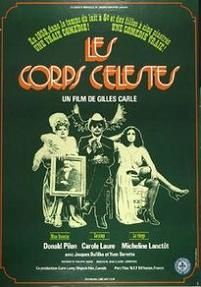
Les corps céletes is set in the pre-WWII days in Atibidi, as a pimp and his five prostitutes try to set up a brothel. One of the girls is frequently scared for the European Jews as she listens to radio broadcast of the demagogues, Adolf Hitler and Benito Mussolini. This is Gilles Carle take on Hannah Arendt’s theory of the banality of evil and Jean-Luc Godard’s one-time idea to make a film about a secretary at Auschwitz.

In Le mort d’un bûcheron, based on the 1913 Louis Hémon novel, Marie Chapdeleine (Carole Laure) moves to Montreal to find her estranged father. The only job she can get is that of a country-western singer at a nudie bar and then as a nude fashion model. Gilles Carles is making up here for the timidity of Les corps céletes, which only had a few seconds of bare breast. After finding out her mother died, by finding all the letters she sent to her returned by her door. She leaves with her boss, her fathers ex-lover and her generous neighbor to find her father dead at the lumberyard he worked at. All the while her exploitative boyfriend is trying to find her. They meet a serial killer in the woods.

In La tete de Normande St-Onge, Carole Laure moves from her job at a pharmacy, where everyone is really friendly with her, to kidnapping her mother from a psychiatric ward. Returning to her mother will prove to be detrimental to her mental health and social life, as she becomes a source of stress and a factor to regress from everyday life. Denys Arcand is great as the brother of Carole Laure’s mother.

What makes Carole Laure so great is both her sensuality and vulnerability. She is both sexy and exciting. It does not hurt that she also acted in Dušan Makavejev’s Sweet Movie (1974), John Houston’s Victory (1981) and André Forcier’s L’eau chaude, l’eau frette (1976). What makes her personality so interesting and Gilles Carle’s liberal worldview so fascinating is how sexuality does not impede on the sense of community. The brothel in Les corps célestes is a family oriented place and in Le mort d’un bûcheron Carole Laure has sex a few feet away from her adult friends. And none of this seems at all sleazy.


There is the element of cinema of attractions to his films as he interlaces them with non-narrative vignettes. For example, a dash of a musical-sequence here and real-time intercourse-sequence there. There is also marginal narratives. These two aspects of his work anticipates the films of Robert Morin and Lorraine Dufour from the Coop Vidéo de Montréal. The family oriented strip club where Marie is country-western singer is similar to the strip club in Robert Morin’s My Life is for the Rest of my life (1980), He has earned his wings (1981), and Yes Sir! Madame... (1984). The quirkiness of the Western club owner (Wilie Lamothe) seems like he could have been the star of Morin’s The mysterious Paul (1983). The street scenes share the same local as Morin’s The thief lives in hell (1984). And the western Les corps célestes falls into the genre of Québécois westerns like Morin’s Preliminary notes for a western (1989).

The works of Gilles Carles and other Québécois filmmakers exist in a film history of their own. Bill Marshall has a book Quebec National Cinema (McGill-Queen’s University Press; 2001) where he focuses on the French speaking “national majority” and the representation of its cultural identity. Québécois cinema is extremely fertile and is proud to boast such big names like Gilles Groulx, Jean Pierre Lefebvre, Michel Brault, Pierre Perrault, and Claude Jutra. What I find so interesting about the work of Gilles Carles is not exactly what he has to say about Québec but what he has to say about contemporary experiences, which resonates decades after their original creation. People should care for one another, sex is normal, relationships are tough, and there are a lot of obstacles we need to overcome. His work should be more widely accessible and should be more generously remembered.

*****

Elective Identities
The Canadian Film Institute hosted two Café eX screenings in July for a retrospective on the film tapestries of Gariné Torosisan. For me, Ms. Torossian’s work consists of self-portraits and homage’s that can be interpreted as self-portraits. I agree with Scott Birdwise when he writes that “Come Around partakes and what can be called a pneumatological imagination and process.” Just as Pneumatology is the study of holy spirits, Torossian’s work flickers between spiritual meditations and the means of self-representation. When she does not put herself in her films that position is passed onto one of her many friends and artists. All the while contemplating on her home country of Armenia and what it means and how she feels towards it from the position of a Diaspora Armenian.

To accompany the retrospective the CFI put out a book on the filmmaker Elective Identities: The Moving Images of Gariné Torossian, edited by Tom McSorley. The book is well worth checking out and can be purchased online through the institute. To order yourself a copy e-mail the CFI here (info@cfi-icf.ca). Torossian Short Film Programme I: Ferocities of Arrival, Early Works 1992-1999 consisted of Visions (1992), Girl From Moush (1993), Drowning in Flames (1994), My Own Obsession (1998), Passion Crucified (1998), Pomegranate Tree (1998), Find Your Holy Self (1998), Red Brick (1999), and Sparklehorse (1999). Torossian Short Film Programme II: New Millennial Memory, 21st Century Works 2000-2008 consisted of Platform (1998), Dust (2000), Hokees (2000), Babies On The Sun (2001), Death To Everyone (2001), Shadowy Encounters (2002), Garden In Khorkhom (2003), Hypnotize/Mesmerize (2005), Elect The Dead (2007), and Come Around (2008). It was a sublime experience. More people should have came out to enjoy them…


*****

Independent Canadian Filmmaking
It seems like this summer has been a major one for independent projects. In April the Canadian Film Institute projected Carlo Bruno’s supernatural road-movie In April (2009). In July, Scott Birdwise presented his experimental film Of Hands (2010) at IFCO’s third annual summer-time evening of experimental films Dogme Films 2010. Of Hands is a wonderfully photographed series of hands performing various tasks. Some scenes that stick out are of hands grabbing money, fingers wearing flamboyant jewelry, a lighter being lit, and the act of using a hammer. These observations are a microcosm for the most basic tasks within a post-colonial capitalist federation. This is Scott Birdwise’s second feature, the first being Smoke and Mirrors (2009) that played at the Dogme Films 2009. Patrice James wonderfully hosted the event at the Rideau street underpass.


This month on August 3rd, Lesley Marsland and Matt Miwa’s will project at Club Saw their short sci-fi comedy Captain Sorelski and the women in search of Spacegold (2010). Luke Ciesielski will be presenting the music video he made for local musician Adam Saikaley at the Ottawa International Film Festival, which will take place on August 21st and 22nd. Starring Lidija Marie and Candace Boivin’s bicycle the Golden Hawk. The Toronto directors Nathan Hynes and Chris Power and actor Anthony McAlister will be at the Mayfair Theatre on August 6th to present their cannibal pseudo-documentary Long Pigs (2007). These independent features will all be well worth checking out. I hope to see all of you out there.

I also picked up Lee Demarbre’s latest effort Summer’s Moon (2009) on DVD. Fellow Ottawa film-critic Joel Crary, who is soon moving to Vancouver, has written an interesting piece on the residing memories from, and use of, locations in Lee’s Jesus Christ Vampire Hunter (2001), which can be found here.

Finally, I am currently working on an instructional video for the French language department at the University of Ottawa. I am sure this series of seven podcasts will be keep me busy for this upcoming month. Expect less entries.-David Davidson

Sunday, July 25, 2010

Mainstream Summer Movies

Cyrus (Jay & Mark Duplass, 2010)
*** (A Must-See)


Inception (Christopher Nolan, 2010)
** (Worth Seeing)


This Movie Is Broken (Bruce McDonald, 2010)
** (Worth Seeing)

(World Exchange Plaza, Empire 7 Cinema, 111 Albert Street) &
(SilverCity Gloucester, 2385 City Park Drive) &
(Bytowne Cinema, 324 Rideau Street)

Sunday, June 27, 2010

Another Month (Horror and Action Movies)

July Film Listings

Bytowne Cinema
This Movie is Broken (Bruce McDonald, 2010) 30/07 – 5/08.

Mayfair Theatre
Day of the Dead (George A. Romero, 1985) 02/07.
Cruising (William Friedkin, 1980) 3/07.
The Wild One (Laslo Benedek, 1953) 26/07.
Short Cuts (Robert Altman, 1993) 27/07.
Dillinger (John Milius, 1973) 31/07.

Canadian Film Institute
The Idiot (Akira Kurosawa, 1951) 10/07.
Torossian Short Film Programme I 15/07.
Torossian Short Film Programme II 29/07.

Cinémathèque Québécoise (Montreal, QC)
Fantasia
Ken Russell Retrospective

Doc Films (1212 East 59th Street, Chicago, Illinois, USA)
A Child's Garden and the Serious Sea (Stan Brakhage, 1991) 17/07 7:00PM.

*****

Here is protest footage for the Toronto G20 meeting:


Wednesday, June 16, 2010

Changing American Landscape

Punishment Park (Peter Watkins, 1971)
*** (A Must-See)


(Bytowne Cinema, 324 Rideau Street, 14/06 – 16/06)

*****

Sweetgrass (Ilisa Barbash & Lucien Castaing-Taylor, 2009)
**** (Masterpiece)


(Bytowne Cinema, 324 Rideau Street, 18/06 – 22/06)

Monday, June 7, 2010

Spielberg, Dreyer, von Trier

Jaws (Steven Spielberg, 1975)
*** (A Must-See)


1941 (Steven Spielberg, 1979)
*** (A Must-See)


Close Encounters of the Third Kind (Steven Spielberg, 1977)
** (Worth Seeing)


(The Mayfair Theatre, 1074 Bank Street, 08/06 & 14/06)

*****

Day of Wrath (Carl Theodor Dreyer, 1943)
**** (Masterpiece)


(Canadian Film Institute, Library and Archives Canada, 395 Wellington Street, 12/06)

*****

Breaking the Waves (Lars von Trier, 1996)
*** (A Must-See)


(Bytowne Cinema, 324 Rideau Street, 21/06 – 22/06)

Thursday, May 27, 2010

A Busy June (And What I Will Be Doing)

June Film Listings

Bytowne Cinema
Punishment Park (Peter Watkins, 1971) 14/06 – 16/06.
Sweetgrass (Ilisa Barbash & Lucien Castaing-Taylor, 2009) 18/06 – 22/06.
Breaking the Waves (Lars von Trier, 1996) 21/06 – 22/06.

Mayfair Theatre
Steven Spielberg Double Bill 08/06.
Close Encounters of the Third Kind (Steven Spielberg, 1997) 14/06.
Back to God’s Country (David Hartford, 1919) 25/06.
Prime Cut (Michael Ritchie, 1972) 26/06.
Canadian Cult Revue 30/06.

Canadian Film Institute
Day of Wrath (Carl Theodor Dreyer, 1927) 12/06.
Lebanon (Samuel Maoz, 2009) 13/06.
Drunken Angel (Akira Kurosawa, 1948) 19/06.
The Lower Depths (Akira Kurosawa, 1957) 25/06.
Stone Time Touch (Gariné Torossian, 2007) 26/06.

Movie Night at the Imperial
Written on the Wind (Douglas Sirk, 1956) 1/06.
Top Hat (Mark Sandrich, 1935) 29/06.

TIFF Cinematheque (Toronto, ON)
Personal Views: A Tribute to Robin Wood 18/06.

Cinema Beaubien (Montreal, QC)
Les Amours Imaginaire (Xavier Dolan, 2010) 11/06.

Saw Gallery
Lesley Marsland’s Science Fiction Comedy TBA.

*****

It is summer here in Ottawa and the weather is hot. Since completing my Bachelors of Arts with a Major in Psychology and a Minor in Film Studies at the University of Ottawa in April my activities can best be described as idling. A lot of my time is spent at coffee houses, movie theaters, and at bars. I have a few short-term contract jobs here including researching vocabulary and working memory in elementary school students, the production of a couple of educational tool videos, and my part-time gig at the CFI. These jobs help me get by, but If find I am somehow still increasing my credit card debt. Whatever.

Solo reading wise, I have been really enjoying reading Zoë Druick’s erudite Projecting Canada, government policy and documentary film at the national film board (2007), she writes in the book “It is my contention that the NFB represents a rarified site for examining the use of new communications technology (in this case, film) and a new film form (documentary) for education, nation building, and the governmental project of an administered welfare state.” I am also having a pleasure exploring Vidéographe’s box set Robert Morin, The Videomaker’s Journey (1976-1997). Robert Morin and Lorraine Dufour output for their Coop Vidéo de Montréal is rich and compelling.

It looks like there are going to be a lot of worthwhile films going to be screening this month. Cool. Just browsing through my June Film Listings I am partly interested in writing about my friend Lesley Marsland directorial debut, it is supposed to be a twenty-minute sci-fi comedy; Back to God’s Country with the great Nell Shipman and which the film guide describes as “the earliest surviving Canadian feature film from 1919”, there will be live music by Mike Dubue; If I can make it out to it I would be interested in putting my thoughts out there on Xavier Dolan’s remake of François Truffaut’s Jules and Jim (1962), Les Amours Imaginaire (2010); and finally I eagerly anticipate Ottawa’s premiere of Gariné Torossian essay film narrated by Arsinee Khanjian Stone Time Touch (2007), which also includes a book with a contribution by Scott Birdwise. If you are at all interested in reading about the other films I am sure you can find analysis of them in the writings of Robin Wood, Joseph McBride, Cinema Scope, and Jonathan Rosenbaum.

I am also happy to hear Apichatpong Weerasethakul’s newest film Uncle Boonmee who can Recall his Past Lives (2010) won The Palme d’Or. Joe is ever adventurous in his projects and his work recalls the mysticism of Andrei Tarkovsky. I liked how his film Tropical Malady (2004) spoke towards a distinct Thai experience while expanding on more universal themes of fright and loneliness in the search for a partner through its two narratives; one which is straightforward and the other an abstract re-rendition.-David Davidson

Tuesday, May 25, 2010

An Unexpected Discovery

The Young Victoria (Jean-Marc Vallée, 2009)
*** (A Must-See)


Jean-Marc Vallée’s The Young Victoria (2009), with a screenplay by Julian Fellowes who has an ear for period dialogue, tells the story of Queen Alexandrina Victoria of the United Kingdom who was born in London in 1809. From her near isolation during the “Kensington System” under the pretense of a potential Regency by her mother the Duchess Mary Louise Victoria and her advisor Sir John Conroy, to her 1938 coronation, and finally to her marriage to Prince Albert. Queen Victoria's reign as the sovereign is the longest, specifically for a female, in the British monarch history. It recently played at the Bytowne Cinema on Victoria Day (May 24th), which is a federal Canadian statutory holiday, in honor of both the Queens birthday and her participation in the enactment of the Constitution Act that formed Canada in 1867.

The Montreal-born Vallée is proving to be a Canadian director of considerable talent, especially in his ability to fuse visual storytelling innovation in what could be drab material. He turns a Victorian period film into a virtuoso experience of suspense, high emotions, intrigue, and romance. Unlike less note-worthy efforts like, say, Jane Campion’s sterile Bright Star (2009). The setpieces, costumes, and period details are fine to boot. And through appropriate - instead of superfluous - tracking shots, close-ups, shifting focal planes, freeze frames, steadycam shots, and the dolly zoom effect. Vallée's cinema expands on the possibilities of studio-filmmaking.


Vallée's directorial debut at the age of thirty is Stéréotypes (1993) and his following five features are Les Fleurs Magiques (1995), Liste Noire (1995), Los Locos (1997), Les Mots Magiques (1998), and Loser Love (1999). As well he has done some television work. Though all of these efforts are less well known compared to Vallée's more famous and partly self-financed film C.R.A.Z.Y. (2005), co-written with François Boulay. The title of the film stands for a lot of things like how it is an acronym of the protagonist family children names (Christian, Raymond, Antoine, Zachary, Yvan), a reference to the Patsy Cline’s song (whose music Mr. Beaulieu has a strong affinity towards, alongside Charles Aznavour), and an ironic descriptor of the unusual Québécois Beaulieu family who represents French-Canada’s changing norms away from the traditional nuclear family and the waning influence of the papal authority.

It is interesting that Martin Scorsese is a producer of The Young Victoria. Scorsese who is most notably known as a director whose content and style has always been adventurous among the years has been gaining prestige as being equally as important as a patron, protector, and preserver of motion pictures. Both of his The Film Foundation, which was organized in 1990, and the World Cinema Foundation, whose special advisor Kent Jones tended the 2010 restorations at Cannes Classic, are important landmarks in film-culture. He is currently working on a documentary on Elia Kazan (whose On The Waterfront (1954) was a monumental film of his adolescence) and has one on the producer Val Lewton. He has created several rockumentaries and documentaries on musicians. And he has acted in other respected directors films [e.g., Akira Kurosawa’s Dreams (1990)] and popular television series [e.g., Curb Your Enthusiasm (2005), Entourage (2008)]. Scorsese's role has shifted toward one of a patron of global film-culture. By spreading his affluence towards films that mark his influence, he is reaffirming the importance of his more creative and daring output. Like his films that anthropologically address his Italian-American New York City heritage, the gangster films, and bold social critiques [e.g., Mean Streets (1973), Taxis Driver (1976), Raging Bull (1980), The King of Comedy (1982)]. Whether it is through sole recommendations, like his praise of Wes Anderson’s Bottle Rockets (1996), to distribution, like releasing Matteo Garrone’s Gommora (2008), and now co-producing Vallée’s The Young Victoria - a project in itself that is similar to Scorsese’s The Age of Innocence (1993). It is for this patronage Mr. Scorsese late period will be remembered for, not for his multiplex fodder spooks or his quirky cameos in his commercials.

C.R.A.Z.Y. is a stylish film and it proves Vallée position as a cinematic maximalist. The compelling soundtrack that adds depth to each scenes (which the director took pay-cuts to afford) is akin to the soundtrack in Martin Scorsese’s Goodfellas (1990). The dream- and wish-fulfillment sequences come out of something from the Coen Brothers. The supernatural, inter-connectivity and fantasy sequences is reminiscent of M. Night Shyamalan. And the queer content and visual flamboyancy hawks back to Gus Van Sant. It is this exciting mélange of technique that feels like it just came out of the blue in Canadian cinema as the film invades ones perceptive and auditory senses. It also paved the way for the type of Québécois cinema that Vallée's Montreal heir Xavier Dolan - the French cinema admirer, specifically François Truffaut - would later create. Dolan's new film Les Amours Imaginaire (2010) recently won him the “Regards Jeunes”, for the second year in a row, at the Cannes Film Festival.

Where C.R.A.Z.Y. can be categorized as being ambiguous. For example, Zachary and a friend leave a Cutlass and the friend walks away while Zachary zips up his pants. Mr. Beaulieu who sees this is dismayed as he, and the viewer, do not know if Zachary just got a blowjob. Though in The Young Victoria this ambiguity is replaced by the rendering of personal experiences. For example, there are melancholy moments of loneliness felt by a child imprisoned in a palace, the triumph of the courageousness of standing up for oneself in front of intimidation, and being shared the joys and frustrations of a newly embraced relationship.


Vallée seems to be a better director of character-types then of true characters. The young Queen and the Prince play the roles with brief moments of unbridled emotion as otherwise they are used as chess-piece portraiture-facsimiles in Vallée’s larger scale co-ordinations, akin to Stanley Kubrick’s Barry Lindon (1975). But even so Emily Blunt and Rupert Friends play the leads exceptionally well with intelligence and determinism. And the film has Vallée’s trademark moments of spiritual connection between mother and kin, Freudian dream sequences, slow motion to heighten tragic incidents, and beautiful and kinetic rendering of hyper-subjective moments.

In C.R.A.Z.Y. Vallée excelled at a depiction of the French-Canadian Québécois culture such as the large families, a collectivistic community, the personalities, and the places. Through its twenty-year span, it provides insight on varying aspect of the life cycle (e.g., birth, childhood, adolescents, adulthood). While The Young Victoria excels in the portrayal of social realities, when it does so, like the monarchy growing concern with the working class through inquiry in the housing and living conditions of the industrial-age workers or in the intense proletariat manifestation. Though sometime Vallée fails and when he does he falls hard. These moments of facile sensationalism like in C.R.A.Z.Y. with the slow-motion knockout and the slingshot across desert or in The Young Victoria when in slow-motion Albert takes a bullet for the young Queen (which in itself is a historical inaccuracy). These moments prove not to have any real insight.

C.R.A.Z.Y is a lot more then just an airport paperback of the topical issue of the week. It excels beyond anything generic even though it uses easy character types as it uses them to paint a complex situation. It provides complex family dynamics that are defined through several ecological levels and complex sibling dynamics that evolve and radicalize over time. It also looks at the self-regulation people do due to neighborhood watch and it looks at cultural norms as facets that play a larger role in the ways people define themselves as the film is set in a working-class Montreal suburb between 1960 and 1980, during the Quiet Revolution.


Vallée seems to be a criminally underrated director. Even though C.R.A.Z.Y. made a shit-load of money (estimated over six-million-dollars) and won several Canadian film awards (ten Genies) there has not been enough critical writing on the director, his technique, or the aims he tries to achieve. Even in Québec 24 Images, the province’s better film-criticism magazine, has yet to review The Young Victoria or include Vallée in their decade review (a similar injustice that befell Robert Morin). If Film is anything, let’s return to the birth of the cinematographic medium and the silent era. The greatest cinematic art is not found in narrative, dialogue, or words - a quality that is more defining of books and essays - just look at The Young Victoria for it as it reveals Film is at its best when it truly defines itself from other medium with a focus on images, sounds and atmosphere.

David Davidson

Tuesday, May 4, 2010

Moviephile May Listings

May Film Listings

Bytowne Cinema
The Young Victoria (Jean-Marc Vallée, 2009) 23/05 & 24/05.
Mother (Bong Joon-ho, 2009) 28/05 – 3/06.
The Red Shoes (Michael Powell & Emeric Pressburger, 1948) 28/05 – 3/06.

Mayfair Theatre
La Dance (Frederick Wiseman, 2009) 7/05 - 9/05 & 12/05.
Canadian Cult Revue 19/05.
Carmen, Baby (Radley Metzger, 1967) 29/05.

Movie Night at the Imperial
Sunrise (F.W. Murnau, 1927) 25/05.

Cinémathèque Québécoise (Montreal, QC)
Le Documentaire Utilitaire d’Après Gierson 13/05.
Précurseurs des Nouvelle Vague 20/05.

Carleton University
Scott Birdwise's Thesis Dissertation on Donigan Cumming 12/05, 10:00AM.

Tuesday, March 30, 2010

Upscale Mariage Qualms

Chloe (Atom Egoyan, 2009)
*** (A Must-See)


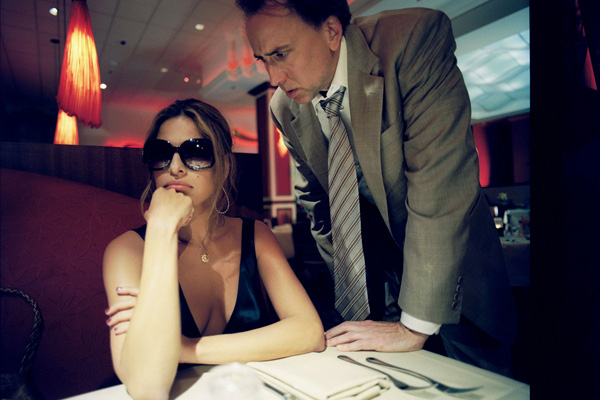
In fifty-year-old bespectacled director Atom Egoyan’s new film Chloe there isa chilling story of marital dysfunction and intrigue between a charming music professor David (Liam Neeson) and his gynecologist wife Catherine (Julianne Moore). The film is about life and death, language and perceptions, orgasms and music, personal obsessions and Canada. Catherine suspects David of extramarital affairs after finding a picture of him with a younger student the night he missed his surprise birthday. Catherine self-destructive paranoid fantasy leads her to hire a young prostitute Chloe (Amanda Seyfried) to pursue her husband. From there it is ambiguous if Chloe is fulfilling her duties or just leading Catherine on, the sexual adventures eventually involve the couples son Michael (Max Thierriot).

Chloe is successful at presenting its contemporary period as it showcases Torontonians interconnectivity with new media, urbane privilege, alienation, infantilization of adults, the growing indie-rock movement, transcontinental airplane travel and heath care. The film Chole is attuned to women high fashion. The women are dressed beautifully and revealingly from see-through white t-shirts to dresses to high heels, these items represent gender expectations that are placed on women. The level of success and physical appearance exuded by Catherine makes her plight all the more desperate when Catherine suspects her husband of infidelities. Jonathan Rosenbaum writes about Chloe “I think what’s sneaky and deliberately misleading about the story is that is starts off pretending to be a movie about a husband’s midlife crisis and then winds up as a movie about his wife’s midlife crisis.” The thematic gravity and psychological depth, linear narrative and star power are a mélange of Atom Egoyan’s art-house sensibilities and the Reitman’s populism. Chloe is partly funded by Ivan Reitman’s production company Montecito and Ivan’s son Jason Reitman is executive producer and there was collaboration with Studio Canal and Sony distributions.


Atom Egoyan describes Chloe as “the anti-Adoration” as Adoration (2008) - a film about the stigmatization of ethnic minorities - presented a more desperate Toronto landscape while Chloe – which was supposed to be set in San Francisco - is a travelogue of Toronto’s luxuries. While in Egoyan’s earlier films Toronto was seen as a non-place. The cultural tourism in Chloe is overt as the city is an inherit part of the story from Yorkville and Queen Street, the CN Tower skyline presence, the AGO, the ROM, Allen Garden, Cafe Diplomatico (594 College Street), Rivoli’s (332 Queen Street), and the Royal Conservatory.

Assimilation has been a longstanding theme in the oeuvre of the Armenian-Canadian director. Atom Egoyan was born in Cairo, Egypt and at a young age was relocated with his family to Victoria, British Columbia. Egoyan habitually includes the casting of his wife Arsinee Khanjian in his films. Through the 80s, 90s, 00s the director has been dealing with ethnicity and assimilation, and private obsessions and public issues. Since Next of Kin (1984) - with an Armenian protagonist and a cameo by Atom Egoyan, Family Viewing (1987), The Adjuster (1991), Calendar (1993), Ararat (2002), to Adoration Egoyan has been dealing with what it means to be a foreigner in Canada. This is epitomized in the angry sequence in Family Viewing where a waving Canadian flag is cross-edited alongside an Armenian elderly mother committing suicide through swallowing pills while her daughter prostitutes herself to raise money to take care of her medical expenses. In Calendar there are clear distinctions between the Armenian positions of nationalism, Diasporan, and assimilationist. These ethnic positions have been lost from Chloe as it shows Egoyan assimilated and making a film about hegemonic Anglo-Saxons. Similarly to Egoyan’s non-Canadian productions Felicia’s Journey (1999), his most Antonioniesque film, and Where the Truth Lies (2005). Though, in a Q & A session at the Canadian Film Institute, Mr. Egoyan dismissed the “auteur” theory in which for him would include looking at the themes in work that he has no creative input like his directed late 80’s TV fare of Friday the 13th, Alfred Hitchcock Presents and The Twilight Zone.

A defining trait in Atom Egoyan oeuvre is the perfuming of scenes with a “cerebral musk”. Even though this is his first film where he did not co-write the screenplay, which is credited to Erin Cressida Wilson as a remake of Anne Fontaine’s French erotic thriller Nathalie... (2003). This brainy tendency comes from Egoyan’s interest in theatre that was apparent since his stint at the University of Toronto. His interest in theater is reiterated in his direction in the Samuel Beckett series of Krapp’s Last Tape (2000) with John Hurt, as well his short film Howard in Particular (1979) seems rooted between the Theater of the Absurd and Maya Deren. The emphasis of his cerebral musk is on psychoanalyticism and language. In the introduction of the Chloe, the prostitute in a voice-over says “I have always been good with words”, this scene and many others are characterized by a meta-discourse of character motivation, which sometimes can seem a little clunky as people are talking about things that people typically do not address in conversation. So even if Chloe appears more as an enigma then a fully rounded character, she confronts Catherine with an alternative position and forces her rationalize the absurd situation.

Reviews of Chloe have already been written in several Canadian publications. In the Katherine Monk’s Ottawa Citizen review she is eagerly positive as she writes “the movie hits a sustained eerie note” and raves of Amanda Seyfried’s performance. In Liam Lacey’s Globe and Mail review he is condescending towards the film, not biased by sharing the filmmakers hometown, he writes “Chloe is director Atom Egoyan’s foray into the realm of what might be called artful trash” and finishes his review with “Chloe has an awfully corny ending, including some lurid high-jinks and shocks that teeter on genre satire”. In the Montreal Gazette John Griffin writes naively “You’re forgiven for failing to realize Chloe is the first Atom Egoyan picture that isn’t an Atom Egoyan picture”. While Brian Johnson’s review in Macleans emphasizes the surprise emerging career of Amanda Seyfried “Hollywood’s new It Girl.” There has also been several critical analyses on Atom Egoyan by writers including Jonathan Romney, Emma Wilson and Tom McSorley.


The casting is spectacular, the acting is titillating, the architecture is sinisterly photographed, and the themes are relevant. One of my problems with this art-house production is its voyeurism. It condones David for cheating and flirting all the while the providing the viewer with enjoying lesbian fantasies. These sexual sequences seduce the audience similarly to the stripteases in Exotica (1994). Chloe is a mixture of pornography, as Amanda Seyfried is frequently naked, and stylization as the film exist in a realm of heightened realism. With Chloe, Atom Egoyan has created a substantial film about extramarital-confusion and it proves to be a really interesting addition to the Egoyan universe.-David Davidson

(Bytowne Cinema, 324 Rideau Street, 26/03 - 8/04)

Sunday, March 28, 2010

Studious April Distractions

April Film Listings

Canadian Film Institute
Le Jour Avant Le Lendemain (Marie-Hélène Cousineau & Madeline Ivalu, 2009) 11/04.
Contes de l'Age d'Or (Cristian Mungiu et al, 2009) 17/04.
Revanche (Götz Spielman, 2008) 24/04.

Bytowne Cinema
Les Vacances de M. Hulot (Jacques Tati, 1953) 9/04 - 13/04.

The Mayfair Theatre
The Robe (Henry Koster, 1953) 3/04.
Army of Darkness (Sam Raimi, 1992) 10/04.
Naked Lunch (David Cronenberg, 1991) 25/04.

Cinémathèque Québécoise (Montreal, QC)
Greed (Erich von Stroheim, 1924) 23/04.
Greed: Reconstruction (Erich von Stroheim, 1924) 25/04.
Blind Husbands (Erich von Stroheim, 1919) 30/04.

Wednesday, March 24, 2010

An Unfortunate Kinship

J'ai Tué Ma Mère (Xavier Dolan, 2009)
*** (A Must-See)


J'ai Tué Ma Mère is the first feature of actor-writer-director-coproducer Xavier Dolan-Tadros who completed the project at the age of nineteen years old. This is a thinly veiled autobiographic film where French-speaking Xavier Dolan plays Hubert, an on-screen alter ego, who is a queer Montréal high school adolescent who gets sent off to a boarding school without his consensus.

The conflict in the film arises between Hubert and his Quebecois mother Chantal (Anne Dorval, who looks surprisingly like Shirley MacLaine) and what makes the story so moving is Hubert’s incapability to understand that no matter how badly his mother treats him that it is done out of unconditional love. No matter how tacky is her dress or how safari is her taste or how bland is her cooking. Chantal is irritated by Hubert’s dependency and rejection and easily looses her temper. Her husband left both of them at young age. What increases Hubert’s sense of dismay towards his mother is his jealousy towards his boyfriend Antonin mom who leads an exciting life with young lovers, take-out, and who commissions Hubert to paint her office. What is so contradictory of Hubert’s, and Dolan’s, matricidal urges is that he uses these intense emotions as a source of creativity. In the film, one of his painting’s is entitled “The Son”, interlaced throughout the film are his b/w personal monologues of his yearning to communicate about his love/hate relationship with his mother, and he also writes a story named J'ai Tué Ma Mère.

The closest relationship Hubert seems to have is with his schoolteacher Julie. For a classroom assignment he lies to her stating that his mother is dead and later she picks him up after his mother chases him at school, and later he chooses to stay with her when he runs away. Julie and Hubert similarly have had poor relationships with their parents and they had close relationships with their grandparents. As well they both express a pervading wanderlust. Julie’s comforting of Hubert epitomizes the tenderness of their platonic friendship.


J'ai Tué Ma Mère is similar to Francois Truffaut’s directorial debut Les Quatre Cents Coups (1959) - a film that Xavier included in his personal top ten film list - which is the story of a child Antoine (Jean-Pierre Léaud) and his matriarchal issues who decides to run away from the detainee center he is put into and the film ends with a freeze-frame of him on a beach. Xavier transcends any similarities as the films concluding return to his childhood beach house seems fresh and unpredictable. It is also part of the Quebecois tradition of returning to nature and to rural traditions - like Gilles Carles’s La Vraie Nature de Bernadette (1972). J'ai Tué Ma Mère mixes between the lowbrow and highbrow with references to Jean Cocteau, Marquis de Sade, Jackson Pollack, and Leonardo DiCaprio.

Some criticisms of J’ai Tué Ma Mère include the narrowness of its scope, as it is limited to individuals’ feelings that are void of politics and social realities. There are only slight suggestions of poverty, as outside a Blockbuster are two homeless men rifling amongst the trash – for creative representations of the Montreal socially assisted poor see the work of Donigan Cumming - and homophobia as Hubert once gets beaten. Dolan grew up as a child actor, had been in TV series, commercials, acted in Pascal Laugier’s Martyrs (2008) and has just completed Les Amours Imaginaire (2010). The world of the actor-director tends to verge on sublime narcissism as the surroundings are seen negatively and it is the protagonist who is the victim. Dolan's smarmy wink’s to the audience eventually gets annoying as he implies his own cleverness in the ways in which he looks at his mother with self-evident disgust and insults her for the most superficial reasons, like the way she eats a bagel and then has cream cheese stuck on the corner of her mouth.

Mark Peranson’s editor’s note in CinemaScope issue 39 writes “Québec’s wunderkind Dolan whose incredibly overrated Quinzaine debut strikes me as a case of mass hysteria” and later in the same magazine Jason Anderson contradictorily writes “should there be more who are as bold and brazen as Dolan”, Atom Egoyan personally expressed admiration for the film, and in the magazine 24 Images Issue 146 Marie-Claude Loiselle writes that Dolan film stands out from his contemporaries because he creates a language of his own that fits his personality, that at times J'ai Tué Ma Mère is border lining disequilibrium, and that hopefully with maturation Dolan films will increase in mastery hopefully without loosing his singularity and to not try to please everyone. Loiselle includes Dolan amongst other contemporary French-Canadian film chroniclers, or the “Nouvelle Vague Québécoise”, that includes Simon Galiero, Denis Côté, Rafaël Ouellet, Robin Aubert, Micheline Lanctôt, Sophie Deraspe, Bernard Émond, Marie-Hélène Cousineau and Madeline Ivalu.


J'ai Tué Ma Mère is similar to Ryan Arnold’s Skidlove as the two 2009 actor-director first-features both reflect the period and present particular youthful experiences of early adulthood and the conflicts between identity and role confusion, intimacy and isolation. Both features are partly co-produced which enables them to be full-length features of home movies material. As such they represent an expansive personal creative expression that is rarely seen is the privatively financed Canadian film industry. The films are painfully personal recognitions of deep feelings of anger, fear, and melancholy. In Skidlove, Ryan's character reaches out to others whether it is to his girlfriend Jaymee or to his friends, people are framed together. In J'ai Tué Ma Mère there are isolating close-ups always distancing Hubert from others. In both films the protagonist present a form of alternative lifestyles that includes smoking pot and painting. In Skidlove, Ryan is a heterosexual and deals with contemporary relationships once in the working world and his solace come from friends and girlfriend. In J'ai Tué Ma Mère, Hubert is 16 and wants to move out. Hubert has an intense Oedipus complex shown threw a fall orange-maple-leaf dream sequence where Hubert chases his mother who is dressed in a wedding gown. Through a Langian dream analysis, which emphasizes that dreams bring out underdeveloped aspect of the psyche, it reveals that Hubert complex desire to be closer to his mother.

The two films together present a diptych of English and French-speaking Canadian cinema of the 2010s as did the 1964 films by Don Owen's Toronto based Nobody Waved Goodbye, and Montrealer Gilles Groulx’s Le Chat Dans Le Sac did for their period. Stylistically Xavier Dolan is closer to someone like the expressive Arnaud Desplechin while Ryan Arnold seems more like the evovative Takashi Miike, though they present a sensibility that is rooted in a local cultural heritage. Ryan Arnold’s Skidlove has not attained the same successes as J'ai Tué Ma Mère that won three prizes at the Director’s Fortnight at the 2009 Cannes but it is a must-see and Skidlove will be having its Toronto premiere in May 2010 at The Royal Cinema.-David Davidson
(Bytowne Cinema, 324 Rideau Street, 19/03 - 25/03)

Monday, February 22, 2010

Old and New Canadian Films in March

March Film Listings

Canadian Film Institute
Dying At Grace (Allan King, 2003) 14/03.

Bytowne Cinema
J’ai Tué Ma Mère (Xavier Dolan, 2009) 19/03 - 25/03.
Inferno of Henri-Georges Clouzot (Serge Bromberg & Ruxandra Medrea, 2009) 17/03 & 18/03.
Chloe (Atom Egoyan, 2009) 26/03 - 8/04.

The Mayfair Theatre
Near Dark (Kathryn Bigelow, 1987) 12/03.
eXistenZ (David Cronenberg, 1999) 23/03.
The Frighteners (Peter Jackson, 1996) 26/03.

Cinémathèque Québécoise (Montreal, QC)
Donigan Cumming: Oeuvres Récentes (Donigan Cumming, 2003 - 2009) 17/03, 6:30PM.

Thursday, February 18, 2010

Some New Auteur Films

The White Ribbon (Michael Haneke, 2009)
* (Has redeeming facets)


Dave Kehr writes about Michael Haneke as being a “finger-wagging sensationalist” and Richard Combs calls him the “pious admonisher”. These labels sum up my feelings towards Haneke and his misanthropy and distaste for humanity, specifically in his latest Palme d’Or winning film The White Ribbon. In it Haneke presents people: a priest; who can not fathom the cruelty in his own community even though he violently disciplines his own children, a father; who condescends and insults his non-marital lover and has pedophilic relations with his daughter, and children; who devastate their community by torturing their neighbors rich and the mentally disabled offspring. Haneke hypocritically looks down on these people, as if saying: look at you people (i.e., the characters, viewers, and humanity), you make me sick! This unearned air of superiority consistently leaves a sense of distaste, the viewing experience felt unnecessarily masochistic.

(Bytowne Cinema, 324 Rideau Street, 19/02 - 28/02)

*****

Shutter Island (Martin Scorsese, 2010)
* (Has redeeming facets)


Martin Scorsese’s Shutter Island, can be seen as being some-what inspired by Jacques Tourneur The Cat People (1942). I see it, as an alternative path Oliver Reed and Irena Dubrovna could have gone. Shutter Island also has the Tourneur-like quality of abstaining from violence while maximizing frights. It is interesting to see Mr. Scorsese finally make a film that addresses the Holocaust since he was originally supposed to direct Schindler’s list (1993) before trading projects with Steven Spielberg for Cape Fear (1991). And whatever happened to Martin Scorsese’s past collaborator Paul Schrader’s film Adam Resurrected (2008)? That seemed like another good film, also set in a post-WWII mental institute, which got lost finding distribution.

One of my criticisms is that one of the inspirations for the Teddy Daniels character was supposedly Dana Andrews from Otto Preminger’s Laura (1944). I do not really see any acting comparisons since Preminger’s long takes accentuated attention to gestures and small details, while Scorsese’s camera work and fast editing do not. All in all, Shutter Island leaves a lot to be desired but at times it is enjoyable.

(World Exchange Plaza, Empire 7 Cinema, 111 Albert Street, Opening 19/02)

*****

Invictus (Clint Eastwood, 2009)
*** (A Must-See)


Clint Eastwood’s 32nd film Invictus (2009) is a stimulating political drama about the true story of the president of the Republic of South Africa Nelson Rolihlahla Mandela (Morgan Freeman) uniting the post-apartheid country for the 1995 Rugby World Cup. The title of the film derives from a Wiliam Ernest Henly poem from 1888, Nelson Mandela used the poem for inspiration during his 27 year jail sentence as a political prisoner.

Clint Eastwood latest output has been historical revisionism. Invictus, Changeling (2008), Letters from Iwo Jima (2006), and Flags of Our Fathers (2006) are all about moments in time grounded in a precise place and where the events and communities surpass any one individual and the focus is that of social movements and political change. Invictus is about the blacks and whites of South Africa coming together - overcoming prejudices – for an international sport event, which becomes a catalyst for peace and unison.

Invictus obfuscates social realities and it does not address issues such as racisms, poverty, and the necessary political challenges Nelson Mandela had to overcome in achieving what he did for the country. Everything appears to be really simple for the president except for when he faints from being overworked and when he talks about being detached from his immediate family. And some scenes seem easy and unsubstantial including when the rugby coach Francois Pienaar (Matt Damon) “generously” gives a world cup final match ticket to his family's black house keeper or when the black and white presidential security officers make amends in the empty stadium. These are just a few minor squabbles in a story about an exceptional man that is well worth being told.

One reoccurring Eastwoodian theme is that of revenge. Clint Eastwood has been in the revenge business since early in his career with the Man with No Name and the Dirty Harrys’ onwards to Josey Wales and the Walt Kowalskis’. There has been a shift from his youthful vigilante justice to a more mature peaceful vocation. Nelson Mandela prevents the sports council decision of revamping the South African Springboks - a symbol of white power for the Afrikaans- rugby team early on in the film, as he believes it would cause more strife between ethnicities. Nelson Mandela as his new hero brings peace and understanding while promoting nationalism.

Drama is created out of the ordinary (i.e. a fast approaching van creates uneasy suspense), computer generated imagery fills a stadium to the rafters, and aerial views of Cape Town are breathless. All of these qualities and many others are proof that the 80-year-old director is a serious and artful chronicler and that his vast talent and energy has yet to be depleted. As Invictus shows, his best has yet to come.-David Davidson

(The Mayfair Theatre, 1074 Bank Street, 19/02 - 21/02, 24/02 & 25/02.)

Friday, February 5, 2010

A Cold and Cruel World

Antichrist (Lars Von Trier, 2009)
*** (A Must-See)


Grief, Pain, Despair. The films divided chapter titles perfectly describe the mood of Lars Von Trier’s Antichrist staring Charlotte Gainsbourg (who won a best actress award at the Cannes Film Festival for her performance) and Willem Dafoe (The Spider Man Series, Wild At Heart). The story follows a married couple who go to their woodland cottage “Eden” to bereave the death of their son. The isolated shack, its surrounding forestscape, and the superstitious bad weather do not become a retreat of solace but instead an unsuspecting battleground, his psychotherapist "rational thought” is put against her occult mysticism.

The Danish filmmaker Lars Von Trier is one the most daring and cutting edge world filmmakers. The films handheld shots (hawking back to the Dogme95 movement), image distortions, incorporation of digital technology, uncanny editing, and the overall creativity and originality of the film can be both exasperating and stunning.

Though primarily chilling and atmospheric the interlaced irony provides moments of levity. After arriving to Eden the couple is kept up by the comic clanking of fallings acorns on the roof of the cabin. When the mother overcomes one of her first psychiatric challenges a dead bird infested with ants falls from a tree and then is torn apart by a crow. Everything culminates into a devastating self-sacrifice.

This is not your typical horror film. Though there are some surface similarities between it and Stanley Kubrick’s The Shining (1980) including; the continental secluded setting and the eroding consciousness shown through a journal, it is the spellbinding mixture of misanthropy, sarcasm, and sadomasochism that makes Antichrist so hard to forget.-David Davidson

(Bytowne Cinema, 324 Rideau Street, 05/02 - 09/02) & (The Mayfair Theatre, 1074 Bank Street, 24/02 & 25/02)

Friday, January 29, 2010

Quality and Quantity February and the Double Bill at the Mayfair

February Film Listings

Bytowne Cinema
Groundhog Day (Harold Ramis, 1993) 01/02 & 02/02.
Antichrist (Lars Von Trier, 2009) 05/02 - 09/02.
Vertigo (Alfred Hitchcock, 1958) 07/02 & 08/02.
The White Ribbon (Michael Haneke, 2009) 19/02 - 28/02.

Café Ex
The World Viewed (Chris Kennedy, 2003-2006) 04/02.

Canadian Film Institute
All Fall Down (Philip Hoffman, 2009) 13/02.
Polytechnique (Denis Villeneuve, 2009) 20/02.

The Mayfair Theatre
Black Caesar (Larry Cohen, 1973) 06/02.
The Sexy Film Festival (?, ?) 12/02.
Casablance (Michael Curtiz, 1942) 14/02 & 15/02.
Play It Again, Sam (Herbert Ross, 1972) 14/02 & 15/02.
Invictus (Clint Eastwood, 2009) 19/02 - 21/02, 24/02 & 25/02.
Fantastic Mr. Fox (Wes Anderson, 2009) 20/02 - 23/02.
The Darjeeling Limited (Wes Anderson, 2007) 23/02.
Antichrist (Lars Von Trier, 2009) 24/02 & 25/02.
Some Like It Hot (Billy Wilder, 1959) 27/02 & 28/02.

Sunday, December 27, 2009

See You January

January Listings

Bytowne Cinema
Swimming Pool (François Ozon, 2003) 11/01 & 12/01.
The Killer (John Woo, 1989) 27/01 - 28/01.
Red Cliff (John Woo, 2008) 29/01 - 2/02.

The Mayfair Theatre
Wizard of Oz (Victor Fleming, 1939) 9/01 - 11/01.
Battleship Potempkin (Sergei Eisenstein, 1925) 15/01.
Bronson (Nicolas Winding Refn, 2008) 15/01 - 17/01, 20/01 & 21/01.
The Bad Lieutenant: Port of Call - New Orleans (Werner Herzog, 2009) 28/01 & 29/01.
The Shaolin Temple (Xinyan Zhang, 1982) 29/01.
Piranha Part Two: The Spawning (James Cameron, 1981) 30/01.

Saturday, December 5, 2009

Inherent Vice

The Bad Lieutenant: Port of Call - New Orleans (Werner Herzog, 2009)
*** (A Must-See)


Werner Herzog is really doing something interesting in The Bad Lieutenant: Port of Call - New Orleans. This iguana-child film is somewhere between dream-like and high off of too much coke. The shift from realism to stylishness, heady camera movements, drug infused episodes (which are elliptic and brief, like the 15 minute euphoria you would get from doing cocaine), and with the blundering protagonist contribute to a dazed-like feeling. As well, Nicolas Cage camp performance provokes laughter and giddiness which is an element of being stoned after smoking marijuana.-David Davidson

(Bytowne Cinema, 324 Rideau Street, 4/12 - 10/12)

Monday, November 30, 2009

Hanukkah December Projections

December Listings

Bytowne Cinema
The Bad Lieutenant: Port of Call New Orleans (Werner Herzog, 2009) 4/12 - 10/12.

The Mayfair Theatre
Bad Lieutenant (Abel Ferrara, 1992) 4/12 & 6/12.
The Inglorious Bastards (Enzo G. Castellari, 1978) 11/12 - 12/12 & 16/12 - 17/12.
Scrooged (Richard Donner, 1988) 19/12 - 20/12.
Man from Deep River (Umberto Lenzi, 1972) 26/12.

Cinéma du Parc
The Magnificent Ambersons (Orson Welles, 1942) 2/12 - 3/12.

Saturday, September 26, 2009

October Horrors and Shrills

October Listings

Bytowne Cinema
The Bicycle Thief (Vittorio De Sica, 1948) 2/10 - 08/10.
Le Silence de Lorna (Dardenne Brothers, 2008) 9/10 - 13/10.
La Dolce Vita (Federico Fellini, 1960) 21/10 - 22/10.

The Mayfair Theatre
Il Divo (Paolo Sorrentino, 2008) 2/10 - 4/10 & 7/10.
The Dead Zone (David Cronenberg, 1983) 5/10.
Deep Red (Dario Argento, 1975) 9/10.
The Killer (John Woo, 1989) 10/10 & 11/10.
Shocker (Wes Craven, 1989) 12/10.
Thirst (Chan-wook Park, 2009) 16/10 - 18/10 & 21/10 - 22/10.
The Cabinet of Dr.Caligari (Robert Wiene, 1920) 16/10.
Faust (F.W. Murnau, 1926) 23/10.
Frankenstein (James Whale, 1931) 31/10.

Canadian Film Institute
A Life (Frank Cole, 1986) 3/10.
Life Without Death (Frank Cole, 2000) 17/10 & 18/10.

Companionship and Recitations

Bright Star (Jane Campion, 2009)
* (Has redeeming facets)


The paradox of Jane Campion’s period-costume film Bright Star is in its inability to mesh sight and sound. When its auditory dialogue is at its peak there is nothing worth looking at and when the visuals reach an insurmountable beauty there is nothing worth hearing.

True emotion is the focus of these sparse and brief scenes of John Keats (Ben Whishaw) reciting his poem “Ode to a Nightingale” to Fanny Brawne (Abbie Cornish) and when they are enjoying each other companionship through subtle gestures, particularly his sentimental down looking, and light physical contact involving the two holding hands. Emphasizing the cathartic benefits and warmth of relationships.

The film does not truly raise above the comfortable-world-cinema middlebrow with its pandering to the baby boomer generation sensibilities. Particularly with its focus on love in face of physical illness as John Keats dies of tuberculosis, a pristine white bourgeois family with primarily no concerns except a remedy for a broken heart, and finally with its familiar and twice-told grasping of a sociological clash of a relationship being formed by two members of opposite economic stratums.

Its treatment of the role of women in society and self-expression and devaluation of John Keats poetry, which is now considered a key figure of Victorian Romantic poetry, is interesting. But all in all the film leaves one disappointed.-David Davidson

(Bytowne Cinema, 324 Rideau Street, 25/09 - 08/10)