Showing posts with label Stanley Kubrick. Show all posts

Tuesday, June 20, 2017

What a Wonderful Feeling: Ciment and Vachaud on Kubrick

Une bonne journée! You can find the Kubrick experts Michel Ciment and Laurent Vachaud on a special episode of  Les Nuits de France Culture, Comprendre l'œuvre du génie Kubrick. Highly recommended! 

As well, I'll like to point out that the Emilio D'Alessandro documentary S is for Stanley is now on Canadian Netflix. 

Two great additions that show how bountiful Stanley Kubrick's oeuvre really is! 

Sunday, October 30, 2016

Sunday, July 24, 2016

Stanley Kubrick and Me: An Interview with Filippo Ulivieri

David Davidson: What were some of the rarest things that you’ve found for ArchivioKubrick prior to meeting Emilio D’Alessandro? How is the film culture in Italy and what is Stanley Kubrick’s place within it?
Filippo Ulivieri: I started my website ArchivioKubrick.it purely for fun during my university years. I had this rather impractical idea of building an archive of all things Kubrickian, which is of course doomed for failure from the start. But it was indeed fun, and actually it was thanks to ArchivioKubrick that I got the chance of writing Emilio's biography, because a friend of his contacted me at that email address. My website must have given him the impression I could be the right person for the job, and that's how it all started.
Of all the material I gathered for ArchivioKubrick, what I treasure most are the letters that Kubrick wrote to Mario Maldesi, the dubbing director who took care of the Italian versions of Kubrick's films. I met Mario in 2002, and at that time nobody had seen Kubrick's production material such as letters, scripts, audio recordings from the dubbing sessions... It was really exciting to take a peek at the creative process.
Kubrick is very highly regarded in Italy. His films have always been very favorably reviewed here, and Kubrick himself often premiered his films in Europe at the Venice Film Festival. After he died, the attention hasn't diminished for a bit. The traveling Stanley Kubrick Exhibition went to Rome in 2007, and it was a huge success. The exhibition of the photos that Kubrick took for Look magazine also toured Italy for two years. Basically, in Italy as everywhere, you just can't stop talking about Kubrick.

DD: What was it like spending time with D’Alessandro and first discovering his amazing stories while you were doing the interviews?
FU:
It was incredibly exciting. It was every film buff's dream. I had the opportunity to ask Emilio everything I wanted about the production of the films, how Kubrick spent his days when he was shooting and when he wasn't shooting, which was something I was particularly interested in, because nobody really knew what Kubrick did when he was not making films. With his stories, Emilio made me feel the incredible amount of work that went into these films: I really had no idea. I mean, everybody knows Kubrick was a perfectionist and a taskmaster, but these are just words. Emilio made me understand the reality of such perfection.
What I found revelatory is to see Kubrick as a producer: how he conducted the meetings with his screenwriters, how he dealt with the actors, why he wanted to own his cameras and lenses while other directors just rent their equipment, how he managed the long shooting schedules, the brilliant ideas he had to save money, and so on. I really learned a lot about Kubrick thanks to Emilio.
In fact, before embarking on the project, I wondered if writing the nth book about Kubrick was worthwhile. After all, Kubrick is one of the most written about film directors. But Emilio's account truly is unique.

DD: What was the original writing process of the book like? How long did it take? Were there any other interesting stories that didn’t make it into the final edition?
FU: I went to Emilio's place during weekends, and I recorded our conversations. I talked with him and his wife Janette for around twenty weekends over approximately two years. I then wrote a first draft, which basically was a polished, chronologically ordered version of our very colloquial transcriptions. Emilio and Janette read this draft and they corrected some details, such as names, dates, etc. Then they left me alone, they trusted me completely and didn't want to interfere with my work.
I wanted the book to have a strong narrative quality: Emilio led an adventurous life – an emigrant who becomes a racing car driver who reinvents himself as a chauffeur who then is picked up by the greatest film director and spends thirty years with him – so much so that you almost can't believe it. I wanted the reader to be as surprised as I was when I listened to Emilio's memories. I wanted the book to be read as much as a novel as possible.
The easy part was the plot, so to speak: I didn't need to invent anything or to play with the timeline of the events, because Emilio's life had a wonderful shape in itself: everything that happened to him, in the exact order it happened, makes for a compelling narrative. It's almost as if his life was scripted by a very good screenwriter. I just had to dig up what was buried under thirty years of life.
I selected what I felt was interesting, and I tried to give the material a captivating quality. This was the difficult part, because I thought it wasn't just a matter of selecting, but also of connecting the episodes to build a momentum. For the book to work as I wished, I had to turn real people into characters too: I had to give each person a distinct voice, and I was wary of the risk of being unfaithful to their own personality, because I do not know these people personally.
I rewrote the book eight times. It was my first book and I couldn't rely on experience. I also didn't have any connection in the publishing business, so it took me three years to find a worthy publisher. All in all, from when I was first contacted to when the book came out in Italy, seven years had passed.

DD: Why originally first publish the book in Italian? How was the translation of the book in English? And how was it finding an English publisher?
PU:
I had to write it in Italian because my knowledge of the English language is limited. I can write grammatically correct English sentences, but this wasn't enough for what I intended to do. I knew that being written in Italian would have been a handicap for a story that is naturally of international interest, but I had no choice.
Despite our Italian publisher is extremely well established and the book was very well received, again it took us three more years to find an American publisher.
Simon Marsh, the English writer who translated Stanley Kubrick and Me, did an excellent job, by the way. He also writes poetry and music, and he has an excellent sense of the rhythm of language. I am immensely happy with his work.


DD: How have you found it to be already generally received? I feel like this book will definitively only become more popular with more word of mouth attention.
PU:
The reviews are very, very positive. The New York Times called it "a weird, revealing delight." Online all I read is "this is the best book on Stanley Kubrick", and I receive lots of emails and messages from people who want to congratulate Emilio for what he did for Kubrick. I've recently been told that the first printing has sold out already. But yes, if you liked the book please be as vocal as you can: word of mouth is essential for the success of such an unheard of story.
I am very pleased by the fact that readers are responding to the book in a strongly emotional way. They seem to enjoy not only the plethora of information about Kubrick the filmmaker, but also the very unusual story of kinship between these two apparently incompatible men who were in fact weirdly similar.

DD: What was the most surprising thing about Kubrick you’ve learned putting this book? How has this changed your perception of him?
FU: The most surprising thing is the story itself: before Emilio decided to talk, nobody had the slightest idea of who he was, or that someone had been so close to Stanley Kubrick for such a long time, apart from his family. When I was first contacted I had no idea what to expect. I knew vaguely Emilio had been Kubrick's driver. I even thought there wasn't much of a story in it. It was really a revelation. After listening to his thirty years of life with Stanley, what surprised me the most is how much Kubrick trusted Emilio. He was the only one allowed to enter his offices and private rooms, to the point that when he left for Italy for two years nobody could access those rooms, not even to clean them.
With Emilio's memoir, I believe you get a truer and more balanced picture of Stanley Kubrick: Emilio worked for him from 1971 to 1999, a time span unmatched by any of Kubrick's collaborators. Moreover, since Emilio didn’t even know who Stanley Kubrick was when he first met him, he experienced his job and Kubrick himself without any preconceptions or expectations, nor the will to prove or disprove anything. His alien nature to the movie business led Kubrick to open up to him, as if Kubrick felt safe around Emilio. The result is both a confirmation of the literature, and a complete revolution of Kubrick’s image.

DD: Do you see any of Kubrick’s own biography reflected in his films? Re-watching the films after reading the book, I notice new little details that make the films more personal...
FU: It's impossible to look at Kubrick's films in the same way after listening to Emilio's recollections. Every scene now has a hidden gem: the most obvious are the tributes that Kubrick put in Eyes Wide Shut to honor Emilio when he went back to work after the two-year hiatus; Emilio is the newspaper vendor in the scene with Tom Cruise, Janette is one of the extras in several scenes, even Marisa, their daughter, is in the picture. And of course the Caffè da Emilio in the Greenwich Village set. But again, when I now watch the training sequences in Full Metal Jacket I notice the English street signs because I know Emilio asked Stanley about this supposed error, and Stanley simply shrugged his shoulders – he was not that pedant. Or I know how freezing it was when they were on location at Beckton Gas Works. Or when Kubrick was finally satisfied over a particularly difficult scene. I see the Volkswagen minibuses out of Barry Lyndon's frames... But I have to say all this hasn't spoiled the pleasure of seeing his films. They are so powerful that even if you know how they were made, they still captivate you.

DD: What has D’Alessandro thought of the book now that it has been published? Do you know what the Kubrick-Harlan family think about it?
FU: We were all very anxious for the book to be published, and then to be translated into English. It really took a lot, and we were dying to see how people would react. Emilio and Janette were also eager to let their life known to their friends and relatives: they had been so faithful to Kubrick's request of secrecy that even their closest friends didn't know what Emilio's job was.
Emilio told Christiane Kubrick he has started to work on a memoir, and she understandably had mixed feelings at first. In the end, they consented to the publication of photographs and letters by Kubrick, something they very rarely – if not ever – did for a book that was not originated by them. I think this shows their appreciation for Emilio and Janette. I don't know if anyone in the Kubrick family has yet read the book or not, though.

DD: Were there more pictures or memorabilia of D’Alessandro that didn’t make it into the final edition?
FU: Emilio has around 200 letters and memos by Kubrick, and many more photographs than the ones that are in the book. I would have liked to have more pictures in it, but then the book would have been a very different object: more expensive, and less immersive as a story. But the photos are so good I managed to squeeze in a few more for the English version!


DD: What is the documentary by Alex Infascelli S is for Stanley? Where would people be able to see it?
FU:
Alex Infascelli was so moved by the book that he wanted to meet Emilio and then he bought its adaptation rights. I was particularly pleased by his idea of doing a documentary film. Emilio has a strong presence, and Alex thought it would have been interesting to show his rough hands to suggest his hard working life, his teary eyes when he speaks about Stanley's death... And in a documentary you can use Kubrick's letters, memos, production documents and movie props to convey a sense of reality and build a lively atmosphere. 
The film premiered in Italian theaters last May and it has been shown around in European festivals. Distribution rights for the international market have been acquired, but I don't know at the moment if the film will have a theatrical distribution or if it will be broadcasted, or streamed. Anyway, it is shot in English so this should speed things up.

DD: Are you still in touch with D’Alessandro? How is he doing these days?
FU: We speak regularly on the phone and we meet pretty often because, even if the book was published in Italy in 2012, we're still invited by bookshops, film clubs and even universities to talk about it. Emilio is doing very well: at first he was surprised to get all this attention, but now that he has seen how heartfelt the reaction has been, he enjoys talking to people about his take on Stanley Kubrick. I think the book has helped him cope with the void left by Kubrick's death. He says Stanley talks to him again now.

Lost Documents: John Hofsess on 2001: A Space Odyssey

One of the great surprises of Jerome Agel’s original The Making of 2001 (before it was removed in its current incarnation, along with its McLuhanesque medium-specific graphic design) is the discovery of John Hofsess original review of the film. There has been a renewed interest in Hofsess the filmmaker due to the publication and launch of Stephen Broomer’s Hamilton Babylon: A History of the McMaster Film Board – an essential read that re-writes Canadian cinema under the sign of Jonas Mekas, Sigmund Freud and T.S Eliot. An important filmmaker early on at the McMaster Film Board, Hofsess’ masterpiece Palace of Pleasure (1967) is a dual projection psychedelic trip full of symbolic imagery. This review from Hofsess ‘film critic’ period (before he would become a prominent Right to Die activist) is important for succinctly and clearly addressing what Hofsess valued so much about the film medium and his (bleak) view of humanity. One could even see parallels between Kubrick’s psychedelic trip and Hofsess’ mind-altering narrative and it is essential to better under its Dr. Strangelove references. But what’s the most important thing about Hofsess’ review is: that it’s Stanley Kubrick who is the catalyst. Kubrick continues to be the model for the artist filmmaker par excellence and this review testifies to that fact in Canada as early as the late sixties while his films were being released (Paul Almond was also a great admirer). Hofsess final challenge to filmmakers to match and exceed Kubrick’s s standard of excellence has now taken on a new prescience as it’s finally been done. One name: Matt Johnson. – D.D.

***
John Hofsess on 2001: A Space Odyssey (originally from Take One).


Due to the oohing and ahhing that passes for criticism of ‘psychedelic’ art, the true dimensions of 2001: A Space Odyssey have rarely been suggested. John Allen’s perceptive comments in The Christian Science Monitor and Clyde Gilmour’s columns in The Toronto Telegram represent the best attempts to explore the film in depth. For the rest we’ve been told to groove or grok as best we can with wide eyes and dilated pupils, and to drop the names of Marcuse or McLuhan if anyone suspects we don’t know much about Kubrick.

2001 no less than Dr. Strangelove is an apocalyptic vision: it is an alternate future but no less pessimistic. Beneath its austerely beautiful surface an alarm is sounded for us to examine a problem of which Dr. Strangelove was a pronounced symptom: the possibility that man is as much at the mercy of his own artifacts as ever he was of the forces of nature. The film depicts three leaps in evolution each time augured by the appearance of mysterious slabs. The apelike creatures discover the use of a weapon/tool based on recent findings of a carnivorous predator who used rudimentary weapons. Modern man, as depicted in the film, has built his entire civilization as an extension of this predatory beginning, and when he in turn encounters the slab, it signifies the obsolescence of man and the emergence of machine-intelligence such as H.A.L. 9000. But HAL too has pathological characteristics, and, for no more reason than that he is capable of killing, attempts to destroy the human crew and in all but one case succeeds. Finally, Kubrick envisions a complete breakthrough (not a further step in this progression of predators but a break in the chain), drawing upon the resources of a different type of human, the details of which are left to the imagination of each viewer to dream his own dream, to find out within himself what is salvageable and what requires change. Kubrick makes it clear, however, that astronaut Bowman alone displays any sign of non-cognitive skills; his sketches (of hibernating humans) are the only evidence of artistic wonder and curiosity, and represent one of the few activities and uses of mind that HAL is not programmed to emulate. To Bowman is given the task of dismantling HAL.

Reviewers who pursue the ‘man’s greatest adventure – man on the threshold of space – a roller-coaster experience’ type of approach to the film must consistenly be missing the irony. Kubrick is much more likely to regard man (as presently constituted and socially organized) as a superannuated form of life, rather than as a promote for NASA would, mindlessly extolling the platitudes of ‘progress’. That the music of Mr. Kubrick’s spheres should be that of a German nationalist is one of his inspired jokes. (The main point of Dr. Strangelove, if we can narrow it down to one, isn’t to illustrate the ‘fail-safe’ crisis – but to point out to what extent Germany won the last world war.) Dr. Strangelove dealt with savagely funny caricatures of various types of sexual pathology. From the mechanical copulation of two airplanes, to Slim Pickens disappearing from view astride a missile shouting ‘Ya! Hoo!,’ sexual hysteria and social catastrophe are inseparable in Dr. Strangelove.

2001 moves progressively away from the ‘animal warmth’ of the apelike creatures huddling together, to the ‘ballet mechanique’ of man’s complex technology, suppressing every form of human relationship. When Dr. Heywood Floyd arrives at the Moon base, he meets a woman scientist who casually remarks that she doesn’t see much of her husband any more due to his research in oceanography. When Dr. Floyd contacts hi home on Earth (his wife is absent), he speaks to a pale color image (his daughter, about six years old, wearing lipstick) and promises to bring her a present as a substitute for not being able to attend her birthday. Astronaut Poole, receiving a taped transmission from Earth, stares at his mother and father congratulating him on his birthday, completely void of any response. The line between humans and machines is blurred in the film not only because HAL is semi-human but because the humans are semi-mechanical, and as long as superiority is measured by the ability to destroy, HAL with his instantaneous memory-banks and improved logistics is the logical successor to man. As Abraham Maslow writes in The Psychology of Science (1966) ‘prediction, control, orderliness, rationality, organization – are all capable of being pathologized when pushed to the extreme.’

Frequently when critics discussed Lolita, both as a novel and film, they literally interpreted it as dealing with pedophilia. But Nabokov is a big-game hunter in everything but Lepidoptera, and Lolita is nothing less than the definitive satire on romantic love – and the age-difference between Lolita and Humbert merely a distancing device to make the self-deception, pathos, desperation and possessiveness seem remote from the reader and his ‘mature’ loves. But when the joke is unsprung, it makes the satire all the more biting. Looked at unsparingly, by a man of Olympian wit and disdain, western forms of love rarely rise above the level of Lolita. For Kubrick, Lolita is no more about pedophilia than 2001 is about space travel – he is drawn to psychological insights and satire, and his continuing exploration in Lolita, Dr. Strangelove, and 2001 is that of psychological space. Repeatedly in 2001 he nudges us with satirical jabs (‘Are those sandwiches ham? Chicken? They look like ham.’ ‘Yes, well they’re getting better at it all the time.’) to make it clear that he does not regard change necessarily as progress. Indeed, he inverts the Nietzschian myth of ape-man-superman to show that each stage is progressively worse than the one preceding it, for each time the circumference of its predatory powers is enlarged and the creature becomes increasingly single-minded in its destructiveness. 

Critics who have rhapsodized about the film (and falsified it) have overlooked the salient fact that it clearly depicts an early death for modern man. The assertion that man can only save himself through a thoroughgoing psychological reorientation or ‘resurrection’ is irony of an Olympian order. Mr. Kubrick offers man two futures, and both of them are funerals. In Dr. Strangelove he dies in nuclear war, unconscious of what drives him or his war machine. In 2001 he gains sufficient self-awareness to unplug his machines and phase himself out of existence, which is like imagining a cancer considerate enough to destroy itself.

Literary critic Harry Levin is reported to have said of James Joyce’s Ulysses that it set such a standard of excellence as to make the writing of novels thereafter much more difficult. Mr. Kubrick has presented a similar challenge to all filmmakers. An inarticulate rave is no substitute for understanding, and 2001 is about as well understood in its first year of release as Ulysses was in its first edition.

John Hofsess

Tuesday, March 1, 2016

Kubrick Influence : Universe


Check out Tina Hassannia's memorial essay on Colin Low and his influence on Stanley Kubrick.

Monday, August 17, 2015

Interview with Justin Bozung (The Shining)

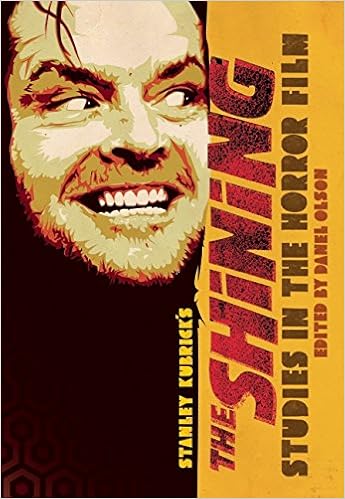
DD: What is your background? How did you get involved with the Studies in the Horror Film: Stanley Kubrick's The Shining [Centipede Press, 2015] book project?  What was your role in the making the book? 

JB: I interview film-makers/actors/actresses for a living. I've written for such print publications in the past as Fangoria and Videoscope, and at present am a featured contributor with the long-running Shock Cinema magazine. I also "blog" full time. I do interviews for several different film/television websites all owned by one mega-company based out of Michigan. I blog out articles and interviews on a plane of film/television topics which are credited to my name and done anonymously as well.

I came to work on The Shining book in late 2012, when Jerad Walters, the owner of Centipede Press approached me about wanting to re-print an interview that I had done with Shelley Duvall from late 2009. Prior to Jerad reaching out to me, I had just finished conducting about twenty or so interviews with various members of the cast and crew of Kubrick's 2001: A Space Odyssey (1968) for a project I was interested in putting together about the film, but that eventually fell by the wayside. I had mentioned my 2001 interviews to Jerad one afternoon over the phone, and out of that, he asked me to contribute as many interviews as I could come up with related to The Shining for his book project.

As for my involvement in the book... Basically, I did all the interviews that are included in the volume, except those with Leon Vitali, The Burns twins, and Diane Johnson. I did a share of the research for the project. I found the previously published interviews for the book with Jack Nicholson, Scatman Crothers, and the director of photography John Alcott as well. I had to track down the rights holder for the Alcott interview. I hit all of my interview subjects up for unpublished materials, memoriums, speeches, photos etc… Out of that I found those never-seen Greg MacGillivray photos from the set, a couple of pictures belonging to Ray Andrew – that amazing Maze panorma. I sourced all kinds of vintage essays and magazine articles on the film across various outlets, I found other interviews with cast members etc... I'd find them, and I'd send them over to Jerad. From there, I imagine all the stuff I sent in went to the editor of the volume. I was also supposed to write an essay on the film itself, but I got overworked with tracking down people, scheduling interviews, my own research into the film for the interviews, the hype of Room 237, etc... So I abandoned my essay on the film. I have about 4000 words that I've done about the film, but I'm saving my piece for now. I might do something with it in the future, but for the time being – frankly, I'm just a little tired of The Shining. 

DD: What is your essay about regarding The Shining? 

JB: Let's talk about the essay at the end of  this. It will give the interview a good wrap-up. 

DD: How many times have you seen The Shining? And what Kubrick resources do you really like? 

JB: I was counting early on in the project, but, for whatever reason I stopped. I can tell you that I watched the film, at least, once a day for six-to-seven months straight. My resources for this project? I think all the books that have been written about Kubrick to date are really solid, well-written books. I think one can take a little from each that they read. But I would advise those who have an interest in Kubrick to stay away from John Baxter's biography however. That book is riddled with errors. In fact, as I was researching the film, I would listen to John Baxter's commentary track on one of the most recent Warner Brothers DVD releases of the film; and on that, Baxter states something that is ridiculous – yet it took me down a weeks-long rabbit hole when I first heard him say it. Baxter says, and forgive my paraphrasing here: "Kubrick chose to use the numbers 2-3-7 in The Shining as an homage to Dr. Strangelove (1964) as they were the same numbers that were supposed to disarm the bomb..." When I heard Baxter say that on the DVD commentary, I freaked out. I think it was right around the time that Room 237 had been released. I was interested in the idea because of how much attention 2-3-7 had gotten in Rodney Ascher's film, Room 237. I decided to explore the idea because I thought, maybe, that if I brought that bit of information out in the book through an interview it be would this amazing factoid that would discredit Ascher's film in some stupid way. See, when I first saw Room 237 I was not a fan of it. I just thought it was ridiculous. I'm like most people, I'm of the school of thought that if you put forth a theory about something you need to have some evidence to back it up. And I didn't see the participants in Room 237 as having any real creditable proof to support their claims. It seemed, at least to me, that Ascher's film just managed to capture these incredible, almost, unbelieveable coincidences. It really made me think of something writer Norman Mailer once said, and I think he was paraphrasing Shakespeare when he said it: "Out of drama comes great coincidences..."

In pursuing some evidence to back up Baxter's claim, I went back and re-watched Dr. Strangelove. Now, I've seen Strangelove at least thirty-times. So, I know that there is no visual reference to 2-3-7 in the film itself nor is there any dialogue mentioning those numbers. Thanks to a archivist friend I managed to get my hands on the shooting script for Strangelove. I opened that, and of course, there is no mention of 2-3-7 in there either. So that led me to read the book that the film was based on, Peter George's Red Alert. There is nothing in there pertaining to that number, of course. I read Peter George's novelization for the film too. Guess what? – There is nothing in there to support Baxter's claim either. Out of frustration, and hoping to just get an answer in my search, I emailed John Baxter directly. His response? "I don't remember." I searched for a couple additional days for connections. I cross-checked 2-3-7 with military communication codes, I checked the numbers up against number theory, even numerology as well. There was nothing whatsoever that connected 2-3-7 with Dr. Strangelove. I really think that Baxter just made it all up for the commentary. 

DD: I'm glad you brought up Room 237. I wanted to ask you about it anyhow. What makes this book so special is how it reacts against things that are in Ascher's film. The analyses of the documentary – from the scene of Jack Nicholson reading the Playboy magazine, the geography of the set, and its other hypotheses – are discussed with its creators, who usually think that it goes too far... 

JB: Yeah, well, as I already mentioned, I didn't like Room 237 on my first-viewing of it. I've since seen it a few times, and I admire it now as a film for its aesthetic approach. I do think Rodney Acher's a brilliant film-maker. I'd be going too far to suggest that Ascher's re-invented the documentary as we know it for the zeitgeist, but he has certainly re-defined it aesthetically. It's just too bad, that in doing that, he's been completely overshadowed by the subject matter of his film though. I, frankly, for one, am so sick and tired of documentary films about movies or makings-of about the making-of. They all seem to blur together for me, and they all take the same aesthetic approch. One thing everyone is guaranteed to see in any of the recent documentaries to come out in the last three-four years about any film or rock band – it's that moment where an image appears on screen with that reverse zoom. There's an image, in color, then it goes to freeze frame.  The image then turns to black and white, and whatever the subject of the image is – a person, let's say, then, that person is cut out of the background and we always get that slow reverse zoom. The figure in the image slowly moves closer to us. You see it in every single documentary that is made today practically. That's what I loved about Room 237. I loved that it changed up the entire approach to documentary in a sense. Ascher's film is really great because of how it strived to not just be about these theories in relation to The Shining, but that it strived to exist on a different aesthetic plane in it's presentation. I know many people bitched and complained about how they felt it was confusing because of the fact that one doesn't see any of the "talking heads" in the film, but I found that profound because of what it does to one psychologically.

If you're really asking me about whether I agree or adhere to any of the ideas in Room 237, I will say that I do not. But that doesn't mean that they don't hold any merit. I mean, those theories or ideas or whatever you wanna call them--those are those peoples' truths and realities. Film is completely subjective, right? Hell, all art is really subjective. It's what makes the film critic, or the notion of film criticism completely null and void of merit itself. Some of the ideas in Room 237 are interesting for sure. There isn't enough time to talk all of the theories in Room 237, so let's just talk about the (alleged) American Indian connection. Am I interested in the idea that The Shining may be some sort of allegory about the atrocities upon the American Indians? No, I'm not. I'm not, because there isn't enough evidence to support the theory, and every thing in Room 237 that is pointed out in reference to the Blakemore theory can be explained away with ease. I feel like in my interviews in the book, one should get a good idea of Kubrick's working method. By understanding this, one should be able to shake off the ballyhoo of the idea of the American Indian imagery in The Shining as having some secret meaning... 

To start, if you read The Shining volume, one knows that Kubrick sent a research team out across the Southwest of the United States to take photographs of many hotels for research for the film. The "Red Bathroom" in the film was copied from a bathroom that one of the research team saw in Arizona. I believe it was at The Biltmore hotel there – if memory serves... We know that the research team visited the Ahwahnee Hotel in Yosemite, California. Have you see photos of the inside of the Ahwahnee ever? I mean, even today, some thirty-odd years after they visited it, it has almost the same decor inside of it. It is just covered in American Indian imagery. The red elevator doors, with the black lattice surrounding them that we see in The Shining film – that idea was taken from the mens' bathroom there at the Ahwahnee. One need only read the interviews with Les Tomkins and Brian Cook in the book, to understand how Kubrick was adament about virtually duplicating what he saw in his research from the States. He liked the visual aesthetic of the hotel, so he duplicated it for The Shining – indian imagery and all. This is certainly consistent with what, I believe, is suggested in Jon Ronson's wonderful documentary Stanley Kubrick's Boxes (2008) from a few years back. In that documentary, one of the researchers on Eyes Wide Shut (maybe Manuel Harlan?) talks about how Kubrick wanted him to take photographs of nightstands in the bedrooms of the apartments he was visiting. Apparently he was fascinated by the layout of the items on the nightstands? I believe he said something like: "You could never create that same arrangement on the nightstand of those items ever..." In one of my interviews in the book (maybe with Brian Cook?) something similiar is discussed regarding the Overlook hotel design/motifs: "Why would I try to design something like the hotel, when the original is much more interesting..." 

In addition, the notion of the Indian imagery also appears early on in Stephen King's book as well. Anyone who has ever said that "the book is so much different from the film..." has never read the book carefully or read it at all. Over the two years that I worked on this book project, I read King's book ten times. When the Torrences arrive at the Overlook for the first time in King's book, King notes how there are Native American masks adorning the walls of the hotel. In Kubrick's thirty-forty page treatment of the novel, there was an early idea where Danny, in one of his visions, sees one of these masks spewing out green flames. Kubrick felt that his film was very faithful to King's book, and I for one, agree with him. I think if one goes back and re-reads King's book carefully, and doesn't treat it like the "page-turner" it is, one might notice the many subtle ideas on the page and how they may have influenced Kubrick. One easy example to point out: The idea of the maze appearing in the film. People often city the inclusion of the maze in the film as being one of the elements added by Kubrick to the story, but in fact, if one goes back to King's book, one will read about every ten-twelve pages about how, and sometimes King does it in half a sentence, but usually at the end of a chapter: "...the hotel was maze-like..." or "...the corridors of the hotel twisted..." or something like that. I'm paraphrasing again, of course. But it's totally there in the book. 

The elevator appears in the book. The weird dog-faced man who felates the well-dressed gentleman appears in the book. As an appartion, the dog-faced man confronts Danny in the book in one of the hotel corridors one afternoon saying – almost verbatim – Nicholson's Three Little Pigs line from the film...   

Yes, Kubrick did shift around certain narrative-points of the story. Yes, he cut out sub-plots. Yes, he changed the ending. But, these are things that any screenwriter would do on his own. These are things that any director would do. But, it's such a point of contention for many, as if in some ways it reduces the merit of the film in some way. It's crazy. I think Kubrick was right in his approach to the film. He "trimmed the fat," as he said in some interview around the time of the film's release. And rightly so, it's a terrible book, in my opinion anyhow. What's the addage? Good books make bad movies? Bad books make good movies?  

While Room 237 is aesthetically wonderful as a documentary, for me, it's a dangerous film as well. One thing that I really took from it, an element that I think is wonderful in it – it reminds one of the importance of a discourse about any work of art, right? But, it's dangerous too, because of its audience being the internet generation. The first time I saw Room 237, I walked out saying, "Great, now all of these hipster kids are gonna go around telling people that they think that The Shining is all about the atrocities inflicted upon the American Indians." Because our culture revels so much in film-as-entertainment, and not film-as-art (no matter how much it claims to be for the latter), we don't want to have to think about what we see. We are spoon-fed information and we often times accept it with open arms. If one spends five minutes on Facebook, and visits any number of the several Stanley Kubrick Groups, one sees those riddled with Shining/Indians references.   Search Facebook for a hashtag "#TheShining" and see hundreds, well, maybe not today, but last year hot on the release of Room 237 – "The Shining is really about the atrocties of the Holocaust or the American Indians..."     

Yes, Kubrick was interested in a element of the American Indians appearing in the story! But as an allegorical device? I don't think so. I think he understood, through his research, the idea that he needed a guise to implement the supernatural into the narrative. There's that, plus there are the elements in King's story too, as I've already mentioned, however spare. And, of course, the hotel SK was duplicating was grounded in Indian imagery as well. One plus one plus one doesn't equal one hundred, it equals three.    

DD: What I like about Studies in the Horror Film: Stanley Kubrick’s The Shining are all its interviews. It’s like the Ciment book, which had some good interviews, but this book goes a lot further, by interviewing a lot of the periphery characters in the film. I was wondering how it was to find all of these interviewees? And do you have any other cool stories from the experience? 

JB: If I told you, then I might be out of a job in the future. Other cool stories? I have so many stories that I cut out of the interviews. I had to cut some stuff at the request of the interview subjects, and Centipede Press also cut a thing here or there on the advice of their lawyer as well. My favorite experience? I have two... The first:  Just this general feeling in the air that I felt during the interviews. As a Kubrick fan you've heard all of these stories about how brutal he was... How meticulous he was... How crazy he was... Yet, his crew – he worked with almost the same crew members film-after-film-after-film. That should tell you right there exactly what his crew thought about him, and what he thought about his crew! His crew loved him. So, in talking with many of the crew members, one could feel in the air that there was still this great sadness swirling around above, even all these years later, that he was still very missed. In fact, one crew member I interviewed, when we got around to talking about SK's passing, began to cry. I could hear tears in his inflection. That got to me.    

Another moment that got to me, perhaps, more than any other, was when I spoke with one of SK's cameraman on The Shining. This particular crew member, when I first called him to inquire about a interview turned me down. He thought that I was only interested in talking about Kubrick, the crazy, eccentic guy that the media has grown quite fond of reporting about over the years. Which, of course, I wasn't interesed in doing. This crew member and I ended up talking for well over two hours one Saturday morning over Skype, and at the end of it, after having talked for those two hours about The Shining and Kubrick, his favorite cameras, his favorite lenses, etc… The crew member said to me, completely out-of-the-blue and unprovoked: "You know, Justin.  I'm sorry you never got to meet Stanley. He would have really liked you..." And when he said that to me, I got choked up. It really made me emotional. And for what reason? I mean, what is it about Kubrick that would cause me to have such a response? 

DD: Was there anyone that you wish that you could have included? I was wondering why the assistant director Michael Stevenson, Stanley’s daughter Vivian Kubrick, and the executive producer Jan Harlan weren’t included? 

JB: Absolutely, in fact, there were many people that I spoke with in-passing that I wanted to talk in-depthly with but, for one reason or another, wouldn't commit to a time to talk. I exchanged many, many emails with little Danny Lloyd, now grown-up, a teacher out East. We went back-and-forth for months and he just wouldn't commit to talk to me, yet, near the end, he graciously granted an interview to some little UK online website. Jack Nicholson, I reached out to, and his Manager got back to me but in the end decided wasn't worth his time. A friend of mine, a well-known screenwriter, actually gave Nicholson's phone number, but in the end, damn – I was just too scared to call him. I just didn't want to call him unsolicted. I also exchanged many, many emails with The Shining Costume Designer Milena Canonero – but she was always tied up with work to talk with me. I got in touch with The Shining Assistant Director Terry Needham, Camera Operator Danny Shelmerdine, Shining composers Wendy Carlos and Rachel Elkind, Richard Daniels, one of the soundman on the shooting of the film. Lou Bogue, a grip on The Shining. All declined participation for one reason or another. I tracked down one of The Shining electricians even. He was so busy with work that he could never commit to a time to talk with me as well. I even pursed an interview with the Star Wars producer Gary Kurtz. Kurtz had been a Borehamwood during the shooting of the film. He was there with George Lucas waiting to start Empire Strikes Back (1980). Their production was delayed start a few weeks, I was told, because of The Shining. I was told by a source that Kurtz and Kubrick had it out a couple times because of The Shining delaying the shooting of Empire Strikes Back at the studio. But I never got to confirm this with him directly. 

Sadly, too, there were some involved in the film that I reached out to as well, that just couldn't talk with me because of illness. One actor from the film was too ill as was one of the crew members. Pivotal people in the making of the film, that may not be with us much longer. I never reached out to Jan Harlan, as Centipede Press informed me early on in the project that Harlan had declined participation but that he wished us luck with the project. Michael Stevenson, I spoke with briefly on the telephone. He also declined to participate as he said he was instructed not to speak with me about the film because of another book in the works about the film. Vivian Kubrick? I reached out to her, and I also reached out to Kubrick's other daughter Katharina Kubrick as well. I heard nothing back from either, nor did I hear back from Christiane Kubrick either when I emailed a request for interview. There were others too, whom I'm forgetting now in this moment as well. I reached out to everyone that is still alive. I even reached out to the African American model who was the subject of the nude painting that we see hanging on the wall of Scatman's apartment in the film. I found her on Facebook. We exchanged a few messages, and in the end she wanted financial compensation to talk to me.   

DD: The interviews offer fascinating, varying and sometimes even contradictory perspectives on Stanley Kubrick and The Shining. These interviews are helpful to understand the film but do you think they demystify the aura around it as well?  

JB: Not really. Maybe. I don't know actually. I was always more interesetd in demystifying the Kubrick mythos than I was in trying to do such relating to film itself. Any questions that hint at Room 237 theories, really came up because that film was out and circulating and it was on everyone's mind that worked on The Shining. The crew members would often bring it up in our conversations. One might say: "Did you see this rubbish?"  I think the interviews do a decent job at breaking some of the tabloid notions associated with Kubrick, and yet, they also add to them as well...   

DD: What are your thoughts on the ending deleted scene of Danny in the hospital? I think that it’s really important and I wish that that footage was still available. Just from the description it seems like it almost anticipates Eyes Wide Shut – the secret society, the brainwashing and controlling of women and children, and the banal menace. 

JB: I like the way the film ends now. The hospital footage is out there. I know of someone (allegedly) who has it here in the States. Maybe someday it will surface or then again, maybe not. SK didn't want it to be seen, so as someone who is faithful to the artists intentions – I'd like to respect his wishes.     

DD: Two areas of interest for me regarding Kubrick are his connection to the moon landing footage and his relationship with Steven Spielberg. I find the William Karel documentary Opération Lune to be really convincing. And I don’t care what Leon Vitali says, Kubrick was a very private person, and it could have been a secret that he worked more closely with NASA. While the Steven and Stanley documentary shows the two as being good friends. What are your thoughts on these subjects?  

JB:  I think Opération Lune (2002) was a joke, wasn't it? Isn't that the documentary with Donald Rumsfield in it? I am one-hundred percent certain that Kubrick had nothing to do with the moon-landing. His connection to NASA came out his friendship with Arthur C. Clarke. I've always thought that Jay Weidner from Room 237 has probably just watched Capricorn One (1977) one too many times... 

DD: I really like the Emilio D’Alessandro interview. How were you able to get in touch with him? Have you read his book Stanley e me? Is it only available in Italian? And the Joan Honour Smith interview, about the retouching of the final photograph, is really great. How did you go about to find her?  

JB: I have a friend, a great guy, who runs this incredible site in Italy dedicated to 2001: A Space Odysssey. I think I got in the door there through him, if memory serves. From there I just called Emilio up and we spoke one evening. I believe, that yes, Stanley e me is currently only available in Italian. I actually suggested to Emilio that he contact Centipede Press about publishing the book in the United States but I don't know if anything came out of that suggestion. Joan Smith – she was a lot of fun to talk with. She was actually pretty easy to find. The challenge, initally, was finding out who had done the photographic work on that picture in the film. But once I found that out, she was very easy to find online.

DD: Are you happy with the final product? Or was there anything else that you wished that you could include? 

JB: I am, yes. Actually, I got into a spot of trouble when the book arrived to me back in June, as I had forgotten to include my wife's name in the acknowledgements. When she opened the book and saw that her name was missing she wasn't very happy. She said: "I watched that movie with you every night for months!" I think that Jerad Walters at Centipede Press did one hell of a fantastic job with the design and the layout of the book itself. When I got the galley from him back in December of '14 to review it so I could suggest edits I was really impressed with the design of it even back then in its raw presentation. I really wished those that those, who declined interviews with me, would have participated however... What could've been will always be a question in my head I think... 

DD: And what about your essay on the film? 

JB: Well, I am almost hesitant to talk about what it's about, but I will, I guess. The thing that has eluded almost everyone regarding The Shining is Kubrick's aesthetic approach to the film. For Kubrick, all of film was a dream. In fact, if you pick up the great book that Alexander Walker did on Kubrick at the start of the '70s, Kubrick tells Walker: "to me, all film is a dream..." So with that mind, one can free themselves up to explore the film through that lens. Considering how fascinated Kubrick was with Freud and Jung – in particular, Freud's The Uncanny – in relation to The Shining, it stands to reason that we can explore the film even deeper through the guises of the Freud and Jung, even their dream modules. In particular: Freud's The Interpretation of Dreams and Jung's Man and His Symbols. Using those books we can look at visuals in the film with the idea that the visual cues serve as symbols for subtextual context in the film itself. An example of this:  So much is made in Room 237 about the non-sensical appearance of Shelley Duvall reading J.D. Salinger's The Catcher in The Rye in The Shining, and how it is really a weird choice for inclusion into the mise-en-scene itself as in the prior sequence in the film with Nicholson at the hotel he tells Stuart Ullman that "..his wife is a confirmed ghost and horror story addict..." Again, forgive my paraphrasing there... Yet, when we consider the core of the narrative in relation to the moment in which this information is relayed to us, we know that Jack Torrence has hurt Danny in the past, right? He's come home, one evening, having had too much to drink and injured Danny – pulling his arm out of his socket. As a dream symbol in the film, Salinger's The Catcher in The Rye serves a very potent visual cue to suggest to us, the audience, Shelley's state-of-mind. We know, from reading The Catcher in The Rye, that one of the major aspects of its narrative is this notion that Holden Caufield must protect the children's innocence. When, you consider this idea in Catcher in The Rye juxtaposed up against the mise-en-scene with Shelley sitting at the table reading the book, her cigarette ash growing and growing (another visual dream symbol) – Kubrick is communicating with us visually the unconsious state-of-mind of Wendy Torrence. She is terrified within the familial unit. The unspoken, natural bond that is constructed within the family unit between man and woman and their child – it's been forever tainted by Jack Torrence's drinking and violence toward his son. She is terrified for her son's safety from the start of the film itself. This, of course, being one of the most important aspect of the story to Kubrick – if we are to read closely, his interview with Michel Ciment from 1980.... 

There are so many "dream symbols" in the film itself. Whether Kubrick researched them or allowed them to come to fruition out of instinct – we'll never now. I'll leave it up to anyone that might read this to explore this idea farther. I have, in my essay, about forty or fifty well-marked dream symbols in the film.   

The most potent dream symbol in the film is the vision of the elevator of blood. People should really look to that as a visual cue up against Freud and Jung interpretation... It's quite staggering when you consider it in the context of the narrative. 

DD: What new projects do you have in the works?

JB: Thanks for asking. Right now, I'm finishing up a year of work on a sort of experimental print anthology about the films of Pulitzer Prize-winning writer Norman Mailer. Mailer produced some very polarizing work – three films in the 1960's, a film in the '80s, and a slew of scripts that he wanted to make but didn't get a change to get off the ground before the end of his life in 2007. Mailer was a big supporter of the avant-garde cinema. In the '60s he helped finance the films of Robert Downey Sr., and Ron Rice. His written works are layered with film metaphors even. Film was very influential upon him, and he wrote some pretty incredible theory stuff in the late '60s – in the spirit of Eisenstein and André Bazin. His films are amazing because they mix theatrcality with Dostoyevsky, film noir, Godard, and Cubism. 

I'm also working on a  biography of film-maker Frank Perry. I've been working with his estate closely for the last couple years on it. They've been a great source of information and guidance. I've done about 100-120 hours of interviews thus far relating to Frank and his incredible films. On The Shining book, I did about 35 hours of interviews in total. I'm hoping to have the Perry book done by late 2016. After that, I'm taking a very long break.

Tuesday, November 11, 2014

The Seafarers: Watch out for the Water

A little forgotten today, Stanley Kubrick’s The Seafarers (1953) is worth returning towards and closely studying for a better understanding of the director’s oeuvre. Made after his other short-docs Flying Padre and Day of the Fight, and even his first, and disowned, film, Fear and Desire, which is about a wartime invasion in an anonymous country; The Seafarers stands above the rest, by, along with being his first experiment with color, exploring many important themes that Kubrick would later develop. Where Padre and Fight build on his Look photography background, and then more explicitly his Weegee affinity and Dassin’s The Naked City (which he worked on as a street photographer) with The Killer’s Kiss and The Killing; The Seafarers stands out as an anomaly.

A bit of context, The Seafarers is a commissioned thirty-minute promotional industrial film for the Seafarers International Union, written by Will Chasan, and is filmed at the offices at the Atlantic and Gulf Coast District of the American Federation of Labor. It is generally seen as a minor work in Kubrick’s career (if it is even known), but, as Vincent LoBrutto writes, it is actually note-worthy. "In tone the project was an extension of the positive-spin material he had done for Look magazine," writes LoBrutto, but "if The Seafarers had been directed by any of the hundred of professionals working on these meat-and-potatoes films, it would probably be of little note to film history. But the short subject as directed contains the DNA to identify it as a Stanley Kubrick film." What exactly does this mean?

In The Seafarers Kubrick creates some very striking images. There are scenes of groups of men in high activity and at rest, a striking close-up of a photograph of a naked young woman in a barbershop, a bravura long-take in the cafeteria etc. The themes that emerge here are the conflict between humanity and technology, and self-interest against collective good. Kubrick even has a way to undermine the purely promotional value of the film through its subjects and editing. There is a reason why in Full Metal Jacket Joker plays a marine photographer! Something happened on this ship that Kubrick is trying to highlight. I suspect, if Laurent Vachaud’s brilliant thesis that Eyes Wide Shut is a critique of the Illuminati is correct - through its compassion towards the couple’s daughter (which he suggest might get abducted at the end) - then The Seafarers anticipates the marine that Alice Harford (Nicole Kidman) fantasizes about. Could all this be a reference to L. Ron Hubbard? What exactly happened on the ship? Not to get all The Crying of Lot 49 about this, but if one scrutinizes beyond the surfaces, there are also many connections between The Seafarers and other films like, say, the war-time USS Ship reference in Steven Spielberg’s Jaws or even the more direct critique of scientology in Paul Thomas Anderson’s The Master.

And water actually plays an important role in Kubrick’s cinema. The Sterling Hayden general of Dr. Strangelove worries that the Russians are going to contaminate the American drinking water supplies and Jack Torrance gets frozen, stuck in ice, at the end The Shining. Take this as one Kubrick’s most devastating warnings: Watch out for the water and seas! Who knows what’s going there!
****

Wednesday, November 5, 2014

Spielberg on Kubrick

"For such a rational man, 2001: A Space Odyssey was a step beyond rational. It was all very ordered - maybe his most ordered film until the very end. He let you see that all of this order was leading to something you could not comprehend but was experiential: it was illustrating emotionally what the next evolutionary step was going to be - and you can't do that rationally. 2001 is the emotional illustration of the terrible limits of intelligence, and it's ironic that this most intellectual of American film-makers is the one who succeeded in allowing the irrational to be grasped by audiences of all ages. The Star Child at the end of 2001 is to me the great moment of optimist and hope for mankind that has ever been offered by a modern film-maker." - Steven Spielberg
***

Stanley Kubrick


Monday, January 6, 2014

Michel Ciment sur Stanley Kubrick


Plus suis le liens pour lire un fascinant entretien avec Michel Ciment a propos Positif. Et n'oublie pas de lui écouter chaque semaine sur Projection privée!

Thursday, June 21, 2012

Where Eros and Thanatos meet: The Films of Stanley Kubrick

Film and Literature: On Monday June 25th, 7PM at the Miles Nadal JCC there is going to be the last class of the series In Nayman's Terms: The Films of Stanley Kubrick on Eyes Wide Shut. Also, it is worth sharing, for any literature guys, that there is a David Foster Wallace reading group that was recently started which gets together every two weeks at Victory Café (581 Markham Street) at 6PM to discuss Infinite Jest in one hundred page increments. The next meeting will be on July 3rd at 6PM, and if you are interested in joining, we will be discussing the book up to page 410.

These two meetings – the film class and book club, respectively – are fun as they get together a group of varied like-minded individuals to discuss a subject everyone involved is interested in. When discussing, a person usually goes about it from their own perspective, but in these settings the emphasis is that of having a conversation, getting a group of people to share their perspective on something and where they bring their own background in discussing it – with the results always being stimulating.

*****

Now on to Stanley Kubrick, where in discussing him I’m going to talk about Michel Ciment’s Kubrick: The Definitive Edition (2003), as well as the reception of Eyes Wide Shut at both Cahiers du Cinema and Positif.

The sections in Kubrick: The Definitive Edition are: Kubrick’s odyssey with its two sections Milestones (on Kubrick’s biography) and Standards (on Kubrick’s creative process, his perfectionism); Directing, Between reason and passion, Kubrick and the fantastic, Full Metal Jacket, Number 13: Eyes Wide Shut, and a memorial. The book also includes interviews with Stanley Kubrick (revised for the English translation of the book), and with his collaborators: James B. Harris, Ken Adam, John Alcott, Julian Senior (all from the older edition of the book); and Michael Herr, Frederic Raphael, Les Tomkins, Marit Allen, Andrew Birkin, Malcolm McDowell, Marisa Berenson, Diane Johnson, Jack Nicholson, Shelley Duvall (from the new edition).

Stanley Kubrick
Kubrick was born in the Bronx in 1928, the son of American Jews of Central European origin. His parents were very encouraging, for example his father got Kubrick at a young age interested in both chess and photography. It is interesting that Ciment brings up how Kubrick’s three favorite childhood activities would leave a lasting mark on his filmmaking, that of chess, photography (he was a photographer for Look magazine) and jazz. James Naremore is insightful about this period, in his book On Kubrick, as Naremore discusses how the popularity of Weegee’s photographs in New York at the time could have influenced Kubrick’s own photography. As well Naremore highlights the James Agee influence, with Agee being a leading New Yorker film critic of the time, and where Naremore speculates that Agee’s writing might have been one of the reasons Kubrick started to take cinema seriously, as well a guide to Kubrick’s emerging taste.

Kubrick would then go on to make two documentary shorts Day of the Fight and Flying Padre (both 1951), and then move on towards an amateur war-film Fear and Desire (1953). He was able to present his personal vision to achieve commercial success - and a form of independence through resourcefulness - in his next two features Killer’s Kiss (1955) and The Killing (1956), both film noirs. At an early stage of his career, Kubrick understood the importance of castings and having bankable actors in his films, so where in The Killing there is the rough Sterling Hayden, moving forward Kubrick used Kirk Douglas to be able to make the anti-war film Paths of Glory (1957), and who he would work with again as a hired-hand on Spartacus (1960). Afterwards, Kubrick was starting to get fed up with all the distractions and all of the delays in Hollywood, so with his next film Lolita (1962), based on the Vladimir Nabokov book, Kubrick filmed in England where he has kept his opperations until his death in 1999.

Kubrick’s films are sometimes accused of being too detached and sardonic, but like other modernist filmmakers like Robert Bresson or Andrei Tarkovsky, there are metaphysical questions being scrutinized under the surface. Ciment describes his approach as, “The contradiction which he has been exploring – that of admitting the importance and legitimacy of the instincts and the subconscious, while at the same time regarding reason as the only solution for both the individual and mankind as a whole – is one that confronts us all.” In a recent issue of The New Yorker – their Science Fiction Issue (June 4 & 11, 2012) – it includes a piece by Anthony Burgess The Clockwork Condition from 1973 on his book, and the film adaptation, which he though of as a Orwellian critique of society and the state; “It would seem that enforced conditioning of a mind, however good the social intention, to be evil.” While Gilles Deleuze on Kubrick from Cinema II: The Time-Image, from his discussion of the cinema of the body, and that of the cinema of the brain,
"If we look at Kubrick's work, we see the degree to which it is the brain which is mise-en-scene […] Kubrick is renewing the theme of the initiatory journey because every journey in the world is an exploration of the brain […] But if the calculation fails, if the computer breaks down, it is because the brain is no more reasonable a system that the world is a rational one.”
Other great essays in Kubrick: The Definitive Edition includes Kubrick and the fantastic which highlights how Kubrick’s films deal with the fantastic, which Ciment defines as “the hesitation experience by a being cognizant only of the laws of nature when confronted with an apparently supernatural phenomenon.” And in these moments, Ciment writes, “the spectator is incapable of supplying a rational explanation for what he has witnessed and ends up by accepting the supernatural.” On Full Metal Jacket, Ciment narrows in on the first weapon of the film, the hair clipper; and on the film, “Full Metal Jacket provided a clinical examination of reality.”

It is also worth bringing up here Geoffrey Cocks’ book The Wolf at the Door: Stanley Kubrick, History,  the Holocaust, where Cocks' is able to find in the scene in Eyes Wide Shut where Bill is pushed by a group of thugs onto a blue Mercedes, significance that, "That the car is a Mercedes is, moreover, a typically tiny clue to Kubrickian passions and concerns directly related, though often indirectly expressed, to the problematic nature of human existence in general and the dangerous history of the modern world in particular." And that, "But at the center of this body of work - like the Minotaur in its maze - lies The Shining, for in that film there slouches a deeply laid subtext that positions the Holocaust as the modern benchmark of evil." This is one interesting way to read The Shining, though as I’ve discussed elsewhere (cf. Stephen King on The Shining), is not the only way to read the film. Which brings me towards an interesting documentary that was recently made, Rodney Ascher’s Room 237, which is a documentary on a variety of people’s interpretation of what exactly The Shining is about? 

Eyes Wide Shut
In the issue of Cahiers (N.538) which features Eyes Wide Shut, Tom Cruise is on the cover (earlier in that year Cahiers also had a Kubrick issue). Nicolas Saada’s review Scenes de l’envie conjugale, pin-points exactly how a Kubrick fan would respond to the film, “Five Seconds. It’s about the time it takes for one to fall under the spell of the new film by Stanley Kubrick.” Saada talks about how the film is based on Rhapsody: A Dream Novel (1926) by the Austrian author Arthur Schnitzler, and then makes a Viennese connection between the Kubrick film and those of the European émigré direcrors Max Ophuls and Ernst Lubitsch. The mysterious death of the young woman in Eyes Wide Shut seems like a reference to Kubrick’s own early noirs, and in the scene in the mortuary, when Bill (Tom Cruise) is contemplating the corpse in front of him, Saada is quite insightful when he describes the scene as, 
“We don’t know if Bill desires to sense the dead or, on the contrary, to transmit life to this inert corpse. And it might be because of this gesture that Tom Cruise, with this hand posed on the forehead of the dead, has something indelible and shaking, that goes against the simple mystery of a man who can finally just let go.”
Kent Jones, a American correspondent for Cahiers at the time, in the same issue has a piece, Frissons, on how American film critics discussed Eyes Wide Shut at the time of its release: Jonathan Rosenbaum and Roger Ebert liked it versus The New Yorker and Dave Kehr, who didn’t. While in a few succeeding issues of Cahiers came Laurence Giavarini, Puissance des fantasmes, which is one of the more thorough readings of Eyes Wide Shut. Giavarini sees Kubrick’s last film as a horror film, it’s not the story of Bill and his ghosts, but that of Bill in the land of ghosts – which makes it a horror film as much as The Shining. Giavarini, “It is clear that this bewitchment is the temptation of Eyes Wide Shut. It is thus a horror film for this reason of slowness that the exact images passes in front of us, that bring the couple red-eyed together in the morning.” 

While in Positif (Sept.99, N.463), Michel Henry has a great essay La penombre des ames that contextualizes Eyes Wide Shut within the turn of the century Vienna, the actual setting of Arthur Schnitzler’s Traumnovella (the original German title of the book), and places the film in the Kammerspielfilm “chamber drama” tradition of Germany of the 1920s. While Jean-Pierre Coursodon’s review Fear and desire: the night of masks in the same issue is a lot more skeptical, “We can regret that his other projects – Napoleon, or A.I. – have been abandoned for this one, but, if someone had to turn Traumnovelle into a film, we doubt anyone could have done a better job.”

While in a couple of issues later, Positif would do a special issue dedicated to Stanley Kubrick, Ciment from it’s editorial, “Positif is without a doubt in the world, the one magazine that has dedicated the most text to the films of Stanley Kubrick.” And that issues centerpiece is The tomb of Stanley Kubrick which asks forty-eight filmmakers, from Woody Allen to the Taviani brothers, what they think Kubrick’s relation to cinema is and what films they are most attached to.

Kubrick, Ciment and Positif
Kubrick: The Definitive Edition by Ciment is not only a great Kubrick book, but as I’ve argued elsewhere (cf. Kubrick by Ciment) is a great example of Positif-ien criticism. Where the form of the publication gives precedence to the films. So through a management of space – Positif is the magazine with the largest page size and it publishes twelve issues a year – and the placement of texts and images, there is the impression of a rapid-fire effect of film appreciation. Some of Positif's different magazine sections are: film reviews, interviews, books and DVD reviews, voix-off, which are unpublished contributions by filmmakers; Bloc-notes, diary like entries by their writers; and features dedicated to subjects and film history. All of these different forms of writing not only expand on Positif’s discourse on cinema, but express that writing about cinema can be a form of self-expression. And similar to The New York Review of Books, Positif’s dozen writers stand out in such a big magazine through their prose, knowledge and generosity.

In Kubrick, Ciment brings up Kubrick’s cinema in relation to the other art forms whether they be painting, literature, philosophy, classical music, opera and theater. Unlike Cahiers which seems more interested in cinema in terms of medium-specificity, Positif aligns cinema with all the other arts (e.g. see their recent dossier on Opera and Cinema). Where Cahiers can dismiss a “bad” film in a short paragraph, Positif’s lengthy reviews enrich film criticism within that of the larger field of art- and literary-criticism. For example here is Ciment on Kubrick, “His approach is more like that of a write or painter. The fame of writers like Stendhal, Flaubert, Kafka, and Joyce is based on a relatively small number of works.”

Ciment’s Kubrick book is similar to other books by Positif writers like Robert Benayoun’s photo-based book Le regard de Buster Keaton or the intellectual prose of Vincent Amiel’s Joseph Mankiewicz et son double. These forays into book publishing, continues the canon that Bernard Chardère wanted to create when he founded Positif in 1952. At this current date Ciment, the current director of the publication, does not publish too much in Positif. Ciment writes several of the magazines monthly editorials - usually directing the magazines editorial stance - as well as he conducts a lot of the interviews with the big name directors, a bloc-notes in January where he lists his ten favorite films of the preceding year, and he contributes some of Positif best memorials (e.g. Raoul Ruiz, Theo Angelopoulos). The feel of Ciment's writing is  more like a friend talking about something - it seems personal - which is different then the “objective” writing style of a  New York Times. And he isn't afraid to take on unpopular positions (e.g. see his recent attacks toward Jean-Luc Godard). Reading Positif on a regular basis gives off the impression of being in one of their famous monthly meetings – the ones where they discuss the films that they’ve seen and choose the upcoming months magazine cover.

Why discuss Positif so much? What do I like so much about the magazine? Does Positif have the secret key to unlock all of the mysteries of cinema? First off, before I get to these questions, I want to say, that I’m not only person to inquire about the history of this revered magazine, and for more information I would have to point you  towards the great French film-blog Nightswimming by Edouard Sivière, who has dedicated three lengthy entries on the history of the magazine (I, II, III).

Even though Positif has changed over the years, there seems to be a constant to it, and I think what is at the heart of Positif returns back to the magazines title, Positif, to be positive, and the writing gains from their writers, people sharing their pleasures about why they like certain movies, and why they have given their lives to cinema. If I read and write about Positif so much, its just because it's an important part of my cinephilia. 

If I can point to only one of their issues, as a summit of Positif-ien thought – as useful as Andrew Sarris’ The American Cinema - it would be their recent Portfolio 80 cinéastes vus par… Positif et Nicolas Guérin (2010). What is it about? Well... Let’s talk about our favorite auteurs. Let’s talk about cinema. Let’s talk about history, politics and culture. Let’s do it well, and let’s make it look good!