
Passing Time
by David Davidson 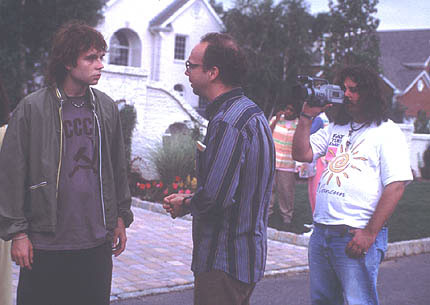
The films on my top twelve of the 00’s list are serious, original and daring works of art. They are not necessarily non-fiction but they are all somehow are drenched in reality, whether that means being based on actual historical events or newspaper headlines, being city symposiums, history revisionism, or just grass root stories of people and their daily realities. These films layer fiction with non-fiction to come up with a piece of work that is evocative of the first decade of the third millennium. These films take place in the present-day or in the historical film genre and through them contemporary film-artist emphasize the importance of geography and history. The list is a good accumulation of moods and experiences of the first decade of the 21st century.


The decade of the 00’s in North America for Canadians meant living under the Liberal Prime Minister Paul Martin (2003-2006) and the Conservative Primer Minister Stephen Harper (2006-?) government and south of the border in the United States of America there was the George W. Bush (2001-2009) administration. The films made in both those countries are social documents and they reflect zeitgeist issues prominent of our times by addressing how people are relating to the world. The foreign films on the list are interesting for a greater understanding of world developments from an insider point of view. They are about social realities and hardships, globalization, living with the consequences of an unfavorable history, the effects of government policy etc. Essentially these films are a humanizing experience that present a different world then ours, creating sympathy for characters that we might not otherwise thing of. Some films achieve what Howard Zinn would advise to people that is to “learn a different history that will make them skeptical of what they hear from authority”. These works are the antithesis of the “authority” which consists of the dominant media portrayal of North-American culture and the abroad. The films emphasis on the life of the working class and the details surrounding them are a testament to the great possibilities of what can be accomplished with a video camera.

The Canadian director David Cronenberg’s
A History Of Violence (2005) has marked the top ten film list of the decade for both Film Comment (#7 on their list) and Cahiers du Cinema (#5 on their list) and the film critic Jonathan Rosenbaum included in his personal top ten list the Canadian experimental filmmaker Michael Snow’s
*Corpus Callosum (2002), a film which I regrettably have not yet seen. These are two isolated exceptions in what is a non-Canadian dominant international film community recounting of the decade.
A History of Violence is a thrilling action film and also a complex critique of the action genre and American society (i.e. violence and war is a passed down trait from one generation to the next. Probably the closest thematic adaptation of the Marxist historian Eric Hobsbawm’s On Empire: America, War and Global Supremacy). It is also a radical departure from the typical Canadian social-realist films. My problem with
A History of Violence is that it is complicated to assess how the film is actually Canadian other then the criteria that the birthplace of David Cronenberg is Toronto. The inclusion of this film creates an overarching blanket that reduces and removes other national filmmakers, who are engaging in a discourse of local issues, from the international film community. Other important Canadian filmmakers include the prairie fabulist Guy Maddin, the Armenian assimilationist Atom Egoyan, and the Inuktitut speaking Zacharias Kunuk. I have not yet seen any films by John Greyson or Philip Hoffman, two other Canadians filmmakers that have been recommended to me. The Canadian films on my list
My Winnipeg (2007),
Atanarjuat (2001),
Ararat (2002) and
Adoration (2008) are works whose settings remain within our ten provinces and three territories. They are bold and innovative narratives that showcase our national artistry. I have not included Frank Cole’s magnum opus
Life Without Death (2000) about his solitary excursion through the Sahara desert as it does not deal with societal issues which is the criteria for my list.


The films on the list take place around the world and back. This includes: Poland during WWII following a Jewish pianist who is in hiding from the death camps (
The Pianist); Los Angeles, California during the 1920’s with an investigation of police and psychological institution corruption (
Changeling); New York and in a few other American states and cities during WWII with a intricate meditation on the war and its current and later effects on American society (
Flags of our Fathers); Paris, France in 1936 with a tale of a crisscrossing Russian agent in one of Eric Rhomer’s last and more political films (
Triple Agent); Winnipeg, Manitoba with a meditation on the lack of substance that comes with the demolishing of cultural heritage which includes tearing down the cities old Hockey Arena and Eaton Center (
My Winnipeg); A meditation on the Armenian genocide that took place in the beginning of the 20th century (
Ararat), a tour de force guide through Russian history in the Hermitage in St. Petersburg (
A Russian Ark); a compelling narrative of people searching for former lovers as well as an examination of the effects of the Three Gorges Dam in China (
Still Life); a look at London’s working class and the area around their housing complex (
All or Nothing); a modern day reworking of Dostoyevsky’s Crime and Punishment in Belgium (
L’Enfant); a presentation of the effects of the glass ceiling on a Senegalese taxicab driver in Winston-Salem, North Carolina (
Goodbye Solo); a devastating critique of American arrogance in New Jersey (
Storytelling); a tale about the effects of living in an inextricable digital age set in Toronto, ON (
Adoration); and finally set in the Canadian North a recounting of an Inuit legend (
Atanarjuat).


Truthfully the majority of these films were only watched later after their initial release on video, some did not even have a theatrical distribution here. I have not yet seen the 2000 output of all the film festival circuit favorites including Apichatpong Weerasethakul, Jean-Luc Godard, Roy Andersson, Corneliu Porumboiu; filmmakers who have gathered much praise and critical attention. This just shows there is much richness in contemporary filmmaking and I continue to look forward to watch new movies.
 The Top Twelve Films of the 00’s
1.
Still Life (Jia Zhang-Ke, 2006)
2.
Russian Ark (Aleksandr Sokurov, 2002)
3.
My Winnipeg (Guy Maddin, 2007)
4.
L’Enfant (Dardenne Brothers, 2005)
5.
Changeling (Clint Eastwood, 2008) &
Flags of Our Fathers (Clint Eastwood, 2006)
6.
Triple Agent (Eric Rhomer, 2004)
7.
The Pianist (Roman Polanski, 2002)
8.
Adoration (Atom Egoyan, 2008) &
Ararat (Atom Egoyan, 2002)
9.
Storytelling (Todd Solondz, 2001)
10.
Goodbye Solo (Ramin Bahrani, 2008)
11.
All or Nothing (Mike Leigh, 2002)
12.
Atanarjuat: The Fast Runner (Zacharias Kunuk, 2001)


