Showing posts with label Woody Allen. Show all posts
Showing posts with label Woody Allen. Show all posts
Friday, May 23, 2014

Monday, May 19, 2014
Jean-Luc Godard, Dziga Vertov Group and Woody Allen
Introduction
What makes Jean-Luc Godard’s films so
unique and what about them changed and what would remain the same as he would
evolve as a filmmaker? Is there anything in particular that can unite films as
diverse as Le mépris (1963), 2 ou 3 choses que je sais d'elle (1966),
Le Vent d'est (1969), Soigne ta droite (1987), Histoire(s) du cinéma (1998), and Film Socialisme (2010)? Since his first
full-length feature À bout de souffle
(1960), a Parisian crime thriller
influenced by the Hollywood film noirs
from the 40s - and which proved its cinephilic credentials by being dedicated
to the B-movie studio Monograph Pictures - to his agitation-propaganda, video
work and the most recent digital and 3D films, Godard has engaged with three
primary principals: cinephilia, formal experimentation and politics. If some of
his films are so different than the others it is because in them Godard solely pursued
one of these principals to the disregard of the others. But if there is
consistency to Godard’s oeuvre it is that he inevitably returns to an
equilibrium.
Having revolutionized the ideas of a modern,
self-conscious cinema first through criticism as a film critic at Cahiers du Cinema and then through
filmmaking along with the nouvelle vague
directors, Godard has then spent the subsequent fifty years of his life making
over one-hundred cinematic works on a variety of formats, which are consistent
in their constant interrogation of the world and the medium’s potential. This
paper will explore Godard’s signature filmmaking traits with a particular focus
on his Dziga Vertov Group (DVG) films and his subsequent film and video work. As
well as how these new political filmmaking practices were conceptualized at Cahiers as they themselves were
radicalizing.
The mass student protests in May 1968 was
the catalyst for Godard to spend 1969 to 1973 with the DVG where with
Jean-Pierre Gorin, Jean-Henri Roger and Paul Burron, among others, they escaped
the authorial point-of-view for that of the collective. They made over ten
films that represent the theoretical summit of what is the ‘political film,’
which was for them a form of social intervention that also radicalized the film
form. After this period in his life, Godard, with his new wife Anne-Marie
Miéville, moved to Grenoble where he started an alternative video production
and distribution company, Sonimage. Like the Hitchcockian wrong man, Godard
needed to fall from grace, having to denounce the entertaining commercial films
of his early career to pursue the logical conclusions of a cinema of protest,
before he can re-invent himself in the 80s having matured, where he now could focus
on the intimate and explore the political through the personal.
There is a binary for Godard, which is
that cinema offers both the potential for an authentic human experience along
with a form of deception. For Godard, acknowledging how that the later –
cinema’s veil of fiction – is corrupt inevitably complicates the former and makes
it more difficult to search for authenticity and honesty in the creative
process. If Godard has appeared cynical or ironic, in either his films or
public media appearances since the 80s, it is because these positions have
become the general starting point for a serious discussion of the human
condition within the growing, omnipresent televisual and new media landscape of
late capitalism.
Dziga Vertov Group
“The problem is not to make political
films, but to make films politically,” writes Godard. This mantra is useful to
understand the DVG films. To make a political film or to make a film
politically there are some defining questions that must be asked: What is the
role of cinema on the cultural front-line? What can a film achieve on a local,
national and global context? How to film the Marxist class struggle? What is
the ideal organizational form of a society? What alternative does communism and
socialism have to offer against a dominant global capitalism? What is the
relationship between theory and practice? These questions don’t have any easy
answers nor are they static but instead are both personal and social, and
evolve with maturation and in response to a changing world.
The DVG films and Cahiers in the 70s due to their militant position offer an
interesting case study to answer these questions. Jean-Luc Comolli and Jean
Narboni were the chief editors at Cahiers
from 1965 to 1974 and they changed the editorial position of the magazine from
a classical cinephilia towards a more modernist one, which emphasized emerging
new world cinemas, political films and theoretical texts. This is the period of
fighting back against the “authoritarian” Fifth Republic of Charles de Gaulle.
There is the protest against the censorship of Jacques Rivette’s La Religieuse (1966) and there is the
Henri Langlois affair, there is the closing down of the Cannes film festival
and the May 1968 student riots. This period of heavy politicization at Cahiers not only reflected larger cultural
ideas of political engagement but was also an attempt to catch up with the
social engagement of one of its foundational figures Godard whose film La Chinoise (1967) was a catalyst for
their change. With this change came a distancing between the magazine and its
publisher Daniel Filipacchi who they would eventually split with due to
disagreements over having to publish more on a popular cinema (which is what he
preferred and also had commercial imperatives) and afterwards they reduced
their publishing to only four issues a year, which they would print at the
French Communist Party publishing house. There is a retreat to marginality,
which is against a mainstream cinema and the official ideology of France. These
changes would be in parallel to Godard’s political utopianism, which he was
trying to achieve with his own filmmaking practices with the DVG.
One particular incarnation of Comolli and
Narboni’s new editorial position would be their essay “Cinema/Ideology/Criticism.”[1]
It was a way for them to lay out a proposition for a more scientific form of
film-criticism beyond a less ‘subjective’ aesthetic, religious and moral
criteria. For Comolli and Narboni, “This implies awareness of its own
historical and social situation, a rigorous analysis of the proposed field of
study, the conditions which make the work necessary and those which make it
possible, and the special function it intends to fulfill.”[2]
By this Comolli and Narboni mean that they would interrogate their subjectivity
just as they would the films and their relationship to its ideology. One of the
important points of the essay is when Comolli and Narboni describe the
relationship between cinema and the economy,
One the one hand it is a particular
product, manufactured within a given system of economic relations, and
involving labor-factored within a given system of economic relations, and
involving labor (which appears to the capitalist as money) to produce – a
condition to which even ‘independent’ film-makers and the ‘new cinema’ are
subject – assembling a certain number of workers for this purpose (even the
director, whether he is Moullet or Oury, is in the last analysis only a film
worker). It becomes transformed into a commodity, possessing exchange value,
which is realized by the sale of tickets and contracts, and governed by the
laws of the market. On the other hand, as a result of being a material product
of the system, it is also an ideological product of the system, which in France
means capitalism.[3]
Comolli and Narboni would adopt a more
aggressive Marxist-Maoist position where cinema was utilized as a tool on the
cultural front against a capitalist industry of profit. As Sylvia Harvey argues
in May ’68 and Film Culture the impact of May ’68 greatly contributed
to the development of Marxist film criticism in France.[4]
The emphasis at Cahiers and at other
intellectual cultural journals like Cinéthique,
Tel Quel and Positif would be
that of a bourgeoning new kind of film writing based around theories of ideology
and a materialist understanding of culture and culture production. Christian
Metz and the study of semiotics along with Jacques Lacan and psychoanalysis
would become important analytical tools for the Cahiers film-criticism in this period.
In this period the ideas of the French
Marxist philosopher Louis Althusser were becoming influential. In his essay “Ideology
and Ideological State Apparatuses” Althusser defines society dually: It has an
infrastructure, which is it’s the economic base (e.g. the ‘unity’ of the
productive forces, the relations of production), and a superstructure, which
includes the state and the law.[5]
There are two potentially different forms of state apparatuses: there are the
Repressive State Apparatuses and the Ideological State Apparatuses. The basic
difference between the two is that the, “Repressive State Apparatus functions
‘by violence’, whereas the Ideological State Apparatuses function ‘by
ideology’.”[6]
The Ideological State Apparatuses present themselves to the immediate observer
in the form of distinct and specialized institutions, which includes religion,
education, family, media etc. And even though the idea of ideology is an
abstract concept it is rendered physical by concrete subjects incarnating them.
As Althusser writes, “there is no ideology except by the subject and for
subjects. Meaning, there is no ideology except for concrete subjects, and this
destination for ideology is only made possible by the subject: meaning, by the
category of the subject and its functioning.”[7]
What is interesting about the cinema and
film criticism of this post-68 period is how by pushing the boundaries of
cinema and politics it exemplifies an uncompromising commitment to political
cinematic forms as well as the limitations on what they can accomplish. Godard
was already becoming more politicized before he joined the DVG. The iconoclastic
cinephilia of Godard’s early films and the nouvelle
vague in general was meant to be a revolutionary rupture within film
history. Godard’s key filmmaking stylistics created a shift in acceptability in
filmmaking practices and led to a transition towards a new modern cinema. Some
of these stylistics include technological effects that arise from practical
filmmaking solutions, a nonchalant worldview as incarnated in people’s attitudes
and gestures, a youthful and fast-pace style, an original and daring approach
to the creation of content and adaptation, and a sense of daring and scandal. Even
though there was a joyous and entertaining quality to Godard’s pre-La Chinoise films there was a still a
political aspect to them. For example Le
Petit Soldat (1963) is about a soldier during the Algerian War, and Les Carabiniers (1963) is about a
dystopian society always at war. Even in his famous interview with Fritz Lang Le Dinosaure Et Le Bébé (1967) Godard
was already describing the negative effects of French censorship and his
combative nature against it.
When the DVG goes to Czechoslovakia to
make Pravda (1969) or Italy in Lotte in Italia (1969) they are
travelling to engage with international social movements while creating films
that attests to this radical spirit. Their Marx infused method aims for the
revolutionary seizure of power and their tactics called for an organized
movement. Some of their championed causes included the workers movements, civil
rights and third world struggles. A goal of the DVG was to highlight protest,
which the media was not covering, along with to democratize the filmmaking
apparatus by allowing the workers and strikers to make their own films. The
group is generally credited to have made nine full films: Un Film comme les autres (1968), British Sounds (1969), Pravda,
Le Vent d'est, Lotte in Italia, Jusqu'à la
victoire (1970), Vladimir et Rosa
(1971), Tout va bien (1972), and Letter to Jane (1972).
The group was in activity up to 1972 and
they disbanded after the pair films Tout
va bien, about a manifestation at work meat factory and how it was reported
in the news, and Letter to Jane, a gauchiste critique of the Tout va bien American star Jane Fonda
and her liberal humanitarian activism for the anti-Vietnam War movement. The films
of the DVG are famous stylistically for their aesthetic techniques that include
a Brechtian form, a Marxist ideology and lack of personal authorship. Quite a
few of the films remained unfinished or were denied the right to be projected. If
by pushing cinema, which at its roots is an industrial narrative art-form that
is most regularly identified with the Hollywood factory, towards politics the DVG
and Cahiers were proposing a radical
break with its tradition and instead the pursuit in uncharted territories of a
new political cinema.
The DVG film about the Palestine
Liberation Organization Jusqu'à la
victoire could not be completed by the group so Godard and Melville would
later make from the material Ici et
ailleurs (1974). Godard and Melville would go on to create other works on
video, which includes Numéro deux
(1975), France/tour/détour/deux/enfants
(1977), Comment ça va? (1978), as
well as some short-films, documentaries and other miscellaneous videos. After
this Godard’s return to more traditional fiction films was first with Sauve qui peut (la vie) (1980), which
was the first of a series of films marked with autobiographical currents. The
other films include Passion (1982), Lettre à Freddy Buache (1982), Prénom Carmen (1984), Détective (1985), and Grandeur et décadence d'un petit commerce de
cinéma (1986). These films were also controversial and Godard was never a
director to receive unanimous praise – for example, see the negative critiques
on his films from the Positif
throughout his entire career – and some of his films like Je vous salue, Marie (1985) would condemned by the Catholic Church
for alleged heresy. In this period Godard also adapted King Lear (1987), which became an extraordinary and freewheeling mediation
on William Shakespeare and language.
Godard, Capitalism and
Woody Allen
In Anne-Marie Miéville’s Nous sommes tous encore ici (1997)
Aurore Clément plays a stand-in for Miéville while Godard acts for himself as
the two of them relive and discus their intimate romantic and personal dramas,
in a tradition similar to what Godard did with Anna Karina in the 60s. The film
is divided into three parts. It begins with two women (Clément and Bernadette
Lafont, two icons of the nouvelle vague)
reciting one of Plato’s Dialogues as they perform domestic chores, and then it
goes to Godard on an empty stage where he recites Hannah Arendt's essay
"The Nature of Totalitarianism," and finally in its longest section Clément
and Godard go about a day in the life of a married couple as they discuss their
social disappointments and personal fears.
Godard is often typified as being an
angry, reclusive, vague, impenetrable, unwelcoming, serious, formalist etc.
There are too many negative character traits associated with him even though
the films themselves remain most of the time unseen, especially his output
since the 70s, and this unfair characterization tends to overlook the diversity
of his oeuvre and his warmth, generosity, honesty and humor. It is true that
since the DVG films some of Godard’s key themes include a negative critique of
capitalism and the human alienation that occurs within it – as illustrated by
the reoccurring character of the prostitute in his cinema, selling herself to
the uncultured business man – and an impenetrable approach to form – for
example, the allusive Navajo subtitles for Film
Socialisme – but since his departure from the DVG there has also been an
internal questioning of humanity, which has made him less cynical. For example
in the extended documentary-television series France/tour/détour/deux/enfants on a mother and her two children,
there are the children that speak for themselves, and reflect a kind humanity,
which both humbles the criticalness of Godard’s inquiry, and shows how Godard’s
critique of a capitalist society has validity, because at times the children reflect
on the sadness of the world. In Sauve qui
peut (la vie) the mother-children relationship is a site of emotional
struggle within a very harsh landscape.
This transition from the political to the
personal is a really interesting shift in Godard’s career as it illustrates the
limits of the former and interrogates the idea of the self-expression and the
creative process of the later. The Godard-Miéville pair and their output is
actually very similar to another director and his work and the relationship
with his wives: Woody Allen and Diane Keaton, and Allen with Mia Farrow. If one
looks at Allen’s career and his films after his shift away from slapstick comedies
to more serious intellectual comedy-dramas: the films between Annie Hall (1977) and Celebrity (1998). Even though Allen's films
after this start to feel more like a routine activity then they do as political
statements, in these early films there are many key social themes and personal
anguishes that are being explored, which make for an interesting comparison
with the films by Godard from this period.
The most obvious connection between
Godard and Allen is the documentary Godard made on him, Meetin’ WA (1986). Opening on a shot of Godard looking out a window
onto Central Park with a superimposed drawn portrait of Allen onto, Godard
begins by describing his friendly relationship with the famous New York City
director. This is the beginning of their eventual meeting. In Meetin’ WA there then a lengthy conversation
between the two that is filmed in Godard’s characteristic filming style as it
is interjected with sub-titles and has an unusual approach to perspective,
sound and editing. The two directors discuss the press, acting, architecture,
inter-titles (“The way you use it is a cinematic device, the way I use it is a
literary device.”), cinematography, the changing nature of cinema, and the
dying repertory culture in New York. There is a shared anxiety between the two
directors and it is more than just personal as they bring these doubts to the
visuals of their films.
Some scenes that stick out in Allen’s career
that seem Godardian include: The scene in Annie
Hall (1977) where Allen’s character goes to Los Angeles and critiques the
sitcom with its laugh-track, in Stardust
Memories (1980) there is the director who is angry towards his appreciative
audience, in The Purple Rose of Cairo
(1985) the young woman who meets a character that walks right out of a
movie-theater’s screen, the dealing with gender and race issues in Radio Days (1987), and the documentary
on the philosopher in Crimes and
Misdemeanors (1989). The list can go on. Another connection between both
directors is their interest in doomed couples that inevitably break up (e.g.
the couple in Tout va Bien). They
both also have an interest in jazz that they include on the soundtrack of their
films. Godard has even casted Allen in his film King Lear.
Though there are influences by other
comedy directors on Godard, most notably Jerry Lewis and Frank Tashlin but also
Jacques Tati, Woody Allen and his anxieties, which are both personal and
social, are an important reference point for Godard’s 80s films. It is through
this return to a classic interest in cinema and the films of Woody Allen, and
away from the directly political, that Godard was able to re-invent himself in
the 80s by shifting the subject of his films more towards himself in a stylized
comic representation, which would become a starting point for him to discuss personal
experiences, though somewhat ironically, and their relation to the social body.
Conclusion
A key aspect of Godard’s cinema is its
role as historical memory, which is both political and cinematic. This can be
seen in Histoire(s) du cinéma in
regards to politics through its
interrogation of the ability of cinema to document and make sense of war and
the abuse of human right. This can be seen in Alain Fleischer’s documentary Morceaux de conversations avec Jean-Luc
Godard (2009) in terms of film
history when Godard takes Jean Narboni into his film collection and
discusses the key directors of the medium as they browse through his VHS
collection. Raymond Bellour highlights this Proustian quality to Godard in the
essay “When the Photograph of Cinema is Written”[8]
where he discusses Jean-Francois Chevrier’s book Proust et la photographie and its relation to Godard and other
art-film directors like Michael Snow, Hans-Jürgen Syberberg, Chris Marker, Marguerite
Duras, Jacques Fieschi, and Thierry Kuntzel. Bellour highlights the modernity
of nostalgia amongst all of them and how this trait builds upon the classical film
narrative model, “being Proustian means scratching that film, not accepting its
mirage.” For Bellour being Proustian also means,
attacking the image’s substance, its
irrepressible tendency towards naturalism, and its mechanical consent to
tendency towards naturalism, and its mechanical consent to the dispositive (there are many ways of
going about this, but the voice – words, phrases – is certainly one of the
privileged access points: touching the image from the outside, it alters and
reconstructs it, modifying its enunciation).[9]
While for Daniel Morgan in Late Godard and the Possibilities of Cinema
describes Godard more in pictorial terms. [10]
There are five key filmmaking stylistics to Godard’s work since 80s, according
to Morgan, and they are: an argumentative quality to the montage, manipulated
images, a medium specificity, an authorial point-of-view, and a natural beauty.[11]
The films have less to do with a photographic realism as elaborated by André
Bazin and more to do with painting and a wider tradition of image making. For
Morgan,
His understanding of cinema, as I’ve been
arguing throughout is fundamentally impure, containing multiple styles, media,
and forms of appeal. And so photography is not entirely eliminated from
Godard’s account of cinema: it takes a place within the wider ecology of
artistic media that cinema contains and is built out of, no longer the privileged
medium, but one of many.[12]
There is a sense of rediscovery that
comes from acknowledging the impurity of cinema, and through this comes the
potential to renew the contemporary relevance of its forms. The cinema has a
complicated relationship to represent the social and political realities of
they day as it evolves with the new technologies of media production and
distribution. Godard brings to this whole situation an emphasis on the medium’s
aesthetic potential, its philosophical role, and ability to protest. With Godard’s
new films like the recent 3D projects 3 x
3D (2013) and Adieu au Langage
(2014) he is paving the way for the future of cinema.
[1] Comolli, Jean-Luc & Jean Narboni.
“Cinema/Ideology/Criticism” from Movies
and Methods Volume II. Bill
Nichols ed(s). California: University of California Press, 1992.
[2] Ibid.
[3]
Ibid.
[4] Harvey, Sylvia. May '68 and Film Culture. London: British Film Institute, 1980.
[5] Althusser, Louis. On The Reproduction Of Capitalism: Ideology And Ideological State
Apparatuses. New York: Verso, 2014.
[6] Ibid.
[7] Ibid.
[8] Bellour, Raymond. Between-the-Images. New York City: Distributed Art Publishers,
2012.
[9] Ibid.
[10] Morgan, Daniel. Late Godard: and the Possibilities of Cinema. Berkeley: University
of California, 2013.
[11] Ibid.
[12] Ibid.
Wednesday, February 6, 2013
The American Comic Film Tradition: Allen, Brooks, Apatow

Here is a proposition: the two most important and
influential American comic filmmakers are Woody Allen and James L. Brooks.
Allen’s impact on the genre comes from his ability to incorporate stand-up
into his films, and Brooks is important for incorporating a theater
sensibility. These are the two distinguishing features between both filmmakers:
stand-up and theater.
These two forms of performance are so intrinsic to these
filmmakers' art, as if they were part of these films' DNA. Allen’s use of stand-up
is a model that relies heavily on wisecracks, a shtick, build-up and punch
lines. For example, in To Rome With Love,
when the young woman Hayley is describing her awkward parents, it’s then funny
when the film cuts to a dolly-shot on a plane and there is Allen (back in front
of the camera) kvetching to his wife. The build up is that of a joke.
Brooks, on the other hand, doesn’t rely on tricks and
formula but instead if there is humor then it comes out through the characters
and/or situations that they are in.
As Brooks quotes, it comes from Oscar Wilde's belief that, “If you want
to tell people the truth, make them laugh, otherwise they'll kill you.” For example,
in Brooks’ most recent film How Do You Know when Lisa (Reese Witherspoon) one night has to decide between going
home with her date or not, the framing of shot is set-up in a humorous way. The
dramatic force of the story comes from what is this former softball-player Lisa
is going through and less so on the laughs. But through using a variety of
forms, and in this case the burlesque, Brooks is able to find the humor in the
everyday.
For some more background information, which expands on this
thesis: Allen started his career, when he was still in high school, by writing
jokes for comedians and for talk shows. When Allen became a filmmaker his films
had this rough quality as their slapstick and wisecracking vignettes seemed
loosely tied together - as in a stand-up comedy act. Ralph Rosenblum, who
edited these early films, speaks at length about his collaboration and efforts
that went into shaping the films into their final form. Saul Austerlitz, in his
great book Another Fine Mess: A History of American Film Comedy, posits that Allen's two major influences were Bob
Hope and Ingmar Bergman, and that Allen who had a "natural whiz with
wisecracks" was "striving for something deeper, something less
instantly gratifying," and that with Annie Hall created, and would popularize, the somber comedy.
Brooks’ background is more in television than it is in
cinema: he has worked as a producer on numerous popular series including The
Mary Tyler Moore show, The Critic and The
Simpsons. Compared to Allen’s filmography (IMDb
has 48 listed director credits) Brooks’ directing career is a lot more smaller
and includes only six films: Terms of Endearment ('83), Broadcast News ('87), I'll Do Anything ('94), As Good as It Gets ('97), Spanglish ('04) and How Do You Know ('10). It seems like Allen’s response to things is
like the joke: you can fake quality but you can’t fake quantity! But, anyways,
back on-topic. When How Do You Know had it’s theatrical run there were only two film magazines that gave it
its due: Film Comment and Cahiers du Cinéma. The features in Cahiers on Brooks were especially good, which included a
glowing review of Comment Savoir (its French title) by Jean-Sébastien Chauvin (N.664)
and an interview with Brooks by Chauvin (N.665). Chauvin’s piece James
L. Brooks, en toute discretion includes a
nice introduction ("The lucidity of Brooks doesn't contradict the tender
gaze he has towards people"), and many insightful answers about his life,
career and new film. "I come from theater," says Brooks, who also
speaks about his thoughts on a variety of subjects like drama, humanism, The
Simpsons, and his research process. When Brooks is asked if he was a
cinephile before he was a filmmaker: “I had a great passion for the theatre, to
the point of just liking it when the curtains goes up, and keeping the torn
entrance ticket, etc. I really like the cinema of course, but it is not my
first love.”
So who are the new generation of mainstream Hollywood
filmmakers that have been influenced, inspired or had the patronage of Allen
and Brooks? In the Allen camp there is: Judd Apatow, for his comedic structure;
Todd Solondz, for heightening the perverse; Whitt Stillman, for exploring the
inner-lives of the upper class; and Wes Anderson, for his idiosyncrasies. In
the Brooks tradition there is: Cameron Crowe, whose first film Say Anything… was produced by Brooks; Alexander Payne, for some
shared preoccupations; and Noah Baumbach, for taking the material into darker
places.
And so who then are the other major comedy directors and where
do they fit into a comedy filmmaker lineage? The Robert Altman tradition of
black comedy is kept up in the films of the Coen brothers (Burn After
Reading), Richard Linklater (Bernie) and the Paul Thomas Anderson of Punch-Drunk
Love and The Master. The screwball comedy influence can be seen in
something like Peter Bogdanovich’s What’s Up, Doc?. The Frank Tashlin-Jerry Lewis anarchic comedy
spirit can be seen in the films of Adam McKay (Talladega Nights), the Farrelly brothers (Hall Pass, Movie
43) and Glenn Ficarra and John Requa (I
Love You Philip Morris). And the Jim
Jarmusch brand of dead-pan comedy (Stranger Than Paradise) is most on view in smaller scale independent films
like Alex Ross Perry’s The Color Wheel.

*****
But these macro observations do not really speak too much
about individual personalities and temperaments, and I want to talk more about
Judd Apatow.
There have been many people who have made connections
between the films of Allen and those of Apatow. Adam Kotsko, in his great
cultural theory book Awkwardness,
writes, “If Woody Allen was the king awkwardness in 1970s American film, then
Judd Apatow arguably fills that role now.” And Austerlitz writes, "Before
taking leave of comedy and entrusting it into the hands of the future, we must
acknowledge the ever-growing influence of Apatow, whose films have come to
define the 2000s like Woody Allen's did the 1970s." And regarding Funny
People, Austerlitz writes , “It would be
more accurate to describe the film as a stand-up drama, whose haunting
emotional core is leavened by a steady stream of jokes and asides.” So let it
be clear that there are many similarities between both the A-named directors
(Allen, Apatow) and the prominent ones are that of awkwardness and stand-up.
Austerlitz describes the theme of friendship within these
bromances as, "The becoming of one flesh is predicated on the abandonment
of those who had once loved and cared for you. In the time of Adam, this meant
one's parents. For Judd Apatow's man-boys, it means saying a painful farewell
to the guys." And on his style Austerlitz describes it as, “Apatow's blend
of no-holds-barred raunch, discreetly rendered emotion, and bromance
brilliantly tweaked the formula established by Old School and its minions."
Apatow’s newest film This is 40 is about a struggling music producer (Paul Rudd)
going about his life (the film also has interesting nods to the films of Steven
Spielberg and Jonathan Franzen's book The Corrections). So far the best review of the film that I’ve read
is from the great film-blogger Jake Wilson, who writes:
“It's a far more believable and complex heterosexual relationship than anything Apatow has shown us in the past, which is one reason This is 40 marks an advance on his previous work. To be sure, for the moment he can't hold a candle to Cassavetes or Edwards or James L. Brooks (another obvious role model) or, for that matter, Albert Brooks or Lena Dunham. But so what? This is 40 is all about doing the best with what you have – and like Pete and Debbie, he largely succeeds in muddling through."
Apatow writes more about his creative approach in the
shooting script of This is 40,”I
started out as someone who just wanted to write comedy. I never thought about
comedy being an intimate, vulnerable act. Lately I have accepted that writing
is a form of self-exploration. I am trying to sort through how I feel about
this life while attempting to make it amusing on some level.” And one could
look at the book of fiction that he edited I Found This Funny as where Apatow could have found other sources of
inspiration.
But the best resource on Judd Apatow is a French book, Judd Apatow: Comédie, Mode d’Emploi – Entretien avec Emmanuel Burdeau (Capricci) where there is a thoughtful introduction
and then for around 100 pages Apatow speaks about his life and career and so
much more.
Some highlights: Apatow speaks about being a first
generation Saturday Night Live viewer
when it started in 1975, “this marked a golden age of comedy, […] and it took
part in a tradition that is situated somewhere between the vaudeville and a
talk-show.” On some of his favorite comedians, “as a Jewish kid from Long
Island I already knew all of the films of Woody Allen,” and he also adored
Steve Martin (there is a good photo-spread of the two in the Vanity Fair
comedy issue). Apatow speaks about being a comedy nerd, his work on The
Cable Guy (“I was devastated by its
negative reception”), as a teenager he interviewed many famous comedians for a
non-existent radio show, his work on the The Ben Stiller Show (“We were very much inspired by Albert Brooks…”),
his work with James L. Brooks, and contributing punch-ups to screenplays to
make them funnier and have more depth. On his new pre-production approach,
Apatow writes, “I’ve learnt to adopt the strategy of a Cameron Crowe or of a
James L. Brooks: to take my time, to dedicate several long years to refine one
perfect screenplay that I would then be able to direct myself.” Apatow speaks
about his work on the television series Freaks & Geeks and Undeclared and his frustration that they both only lasted one season (the new
series Girls that Apatow
produces is not encountering this). Apatow speaks about other filmmakers that
he admires: Hal Ashby, John Cassavetes and Robert Altman. And what makes a good
film? “If it connects people with people.”

Saturday, July 9, 2011
Interview with Adam Nayman (On Love Em or Hate Em: MORE Controversial Directors)

In anticipation of Adan Nayman’s newest series of classes Love Em or Hate Em: MORE Controversial Directors, I decided to take the opportunity to meet up with the guy to ask him a few questions. In this new series there will be lectures on Lars von Trier on Monday July 11th, Michael Haneke on Monday July 18th, Luis Buñuel on Monday July 25th and Woody Allen on August 8th. All of the classes start at 7PM and are at Miles Nadal JCC (750 Spadina Avenue). – D.D.
Toronto Film Review : So Adam why these particular directors?
Adam Nayman : The first course seemed to go well, and I felt that the idea of talking about challenging filmmakers was still appealing to me. So I asked around about some other directors who might fit into this class, and Lars von Trier's name kept coming up, plus he was in the news at the time because of what he said at Cannes. And then from there, I thought that it would be good to pick some filmmakers who were a little less famous than the ones I did last time: Verhoeven, Cronenberg and Polanski are all artists who moved from the margins to the mainstream (less so Catherine Breillat). Buñuel is of course famous but maybe not to a non cinephile audience. Michael Haneke is well known and his films are polarizing but he's someone who people might want to learn more about. As for Woody Allen, he's more mainstream but in some ways he's a guy who begs to be considered as a kind of European art-house auteur even though he's American. I think that the throughline between all four filmmakers is that there are elements of satire and absurdity in their work -- all expressed very differently of course.
TFR : Buñuel is the one director out of the four that I am least familiar with. I remember seeing his Las Hurdes at the Cinémathèque québécoise in Montreal. I was just wondering how many of his 34 titles have you seen? Are they available on DVD? I know Criterion Collection has released a few of them. And have you gone over his autobiography My Last Sigh? I remember Jonathan Rosenbaum was telling us that in the editing process from French to English that the editor was conspicuously editing things out; I wonder what he actually removed?
AN : I can't speak to the differences in the translations. That's something that Jonathan Rosenbaum would know more about then I do. And there's no lack of critical writing on Buñuel, but one of the things I want to work against is the idea that he mellowed as he got older -- that his late pictures are the work of a less strident filmmaker. For me, films like The Phantom of Liberty, Discreet Charm of the Bourgeoisie and That Obscure Object of Desire are still examples of an artist challenging himself and his audience, right to the end. As for whether I've seen all of his films; I can't count offhand, but probably not.
TFR : I think Woody Allen is just great! And I am especially fond of his latest films, did you know that both You will meet a tall dark stranger and Midnight in Paris made the cover of Positif, which is not an easy task. And it is interesting to note that Richard Brody, one of the biggest Woody Allen partisans along with Eric Lax, sees the Barbara Kopple documentary Wild Man Blues (1997) as the beginning of his late period. Allen also excels at fiction; there is a big database over at The New Yorker of his collected work; I particularly recommend Udder Madness. Which brings me to how I like that you bring up his fictional writing in your review of Midnight in Paris. One of my favorites of his short stories is Fabrizio’s: Criticism and Response from Side Effects. Have you read that one? It is about a high-minded restaurant critic who writes these elaborate criticism and responses about restaurant food profiles, and in the process undermines the jargon of analysis:
“I began my meal with an antipasto, which at first appeared aimless, but as I focused more on the anchovies the point of it became clearer. Was Spinelli [the chef at the restaurant in question; Fabrizio’s Villa Nova Restaurant] trying to say that all life was represented here in this antipasto, with the black olives an unbearable reminder of mortality? If so, where was the celery? Was the omission deliberate? At Jacobelli’s the antipasto consists solely of celery. But Jacobelli is an extremist. He wants to call our attention to the absurdity of life. Who can forget his scampi: four garlic-drenched shrimp arranged in a way that says more about our involvement in Vietnam than countless books on the subject?”Anyways, what themes are you going to highlight in your WA class?
AN : Yes, I like that essay, among others in Side Effects. Like Polanski, Allen’s films are not overtly transgressive (although I rewatched Husbands and Wives last night and was shocked by how raw it was). He does not craft extreme images. The controversy stems from his private life and the possibility that his films -- especially the ones in the 1990s -- are autobiographical. Polanski used to deny that sort of thing, and Allen doesn't encourage it, but it seems plain. I feel like Allen makes movies as a form of therapy -- like Lars von Trier -- but he seems to get less out of it; he has the same hangups and phobias as he did forty years ago. If you want to put it positively, you can say he's consistent; if you want to be negative you can say he's redundant.
TFR : Once when you and Andrew Tracy were in the tiff.shop, he picked up Screening Modernism and was saying that since the book had a blurb from David Bordwell that it was reason enough to buy it. I bring this up because there are some critics that I hardly see make these kind of blurbs. For example, there is Dave Kehr, out of all of my DVDS his name is only on two of them: James Cameron’s Ghosts of the Abyss and Lars von Trier’s The Boss of It All. Though his DVD reviews for the New York Times are great as well he highlights books sometimes on his personal website. I bring this up as I have noticed your name only once on a DVD and it is on the Canadian film Six Figures. Are you quoted on any other DVDs? What is it about supporting these quality under-exposed Canadian films that you like?
AN : I have been quoted before on DVD boxes, sure. and I even wrote the liner notes for Sergei Dvortsevoy's film Tulpan (2008). Pull quotes can be funny to be read, and I've had my name on films I'm not sure I'd stand by now -- like the 2001 Canadian drama Treed Murray -- but it's not really an important thing one way or the other. On the other hand, I think it's great when critics get to write liner notes or essays for DVD releases, like my friend Mark Peranson’s text for the Pedro Costa Letters from Fontainhas Criterion box set and Michael Koresky’s pieces on The Actuality Dramas of Allan King Eclipse box-set. It’s not the format that most people usually look for penetrating criticism but they can be a wonderful supplement to the features on the disc. I think that Kent Jones has written better DVD booklet notes than most critics have ever written good film reviews. And I would rather read a pull-quote blurb by Dave Kehr then an entire review by Peter Travers.
TFR : Michael Haneke. That guy is controversial. I was blown away the first time I discovered Cinema Scope. It was an issue dedicated to the Cannes Film Festival and there was only one sentence (!) dedicated to the Palme d’Or winner The White Ribbon. What I got from that was the position that sometimes the movies that are the most interesting are not the ones getting the main prizes at film festivals. What are your thoughts on Haneke?
AN : What I think Mark was getting at there, in his inimitable style, is that Haneke is a little old to be an enfant terrible. Though he always was a little too old. The Seventh Continent and Funny Games were films made by a guy in his forties, even though they feel more adolescent and even a bit snotty. You would picture their maker as a punk like Gaspar Noé rather than an older Austrian intellectual. I think Haneke has had that paradoxical thing happen to him where the more acknowledged his talents have become by the critical establishment, the less certain kinds of anti-establishment critics want to go the bat for him. I would say that I think he's one of the more brilliant contemporary directors in terms of composition, pacing, sustaining tone and staging acts of violence. He’s a born film director. Even The White Ribbon, which I didn't really want to write about either, there's more filmmaking savvy than in 90% of whatever came out that year. But it's also very much of a piece with his old work, thematically, and if someone finds his style didactic, there's nothing in the new movie that's going to change their mind. If a critic like Mark, or anyone else, found the didactic qualities of his old films unforgiving back then there is nothing that’s going to change their mind.
TFR : Do you recommend any particular film books relating to the directors in this series? I really tried to get you the Director’s Cut book on von Trier.
AN : Linda Badley 's book on von Trier in the Contemporary Film Directors series is good. She does not mythologize the guy, partially because he does that already himself. It's incisive analysis without a ton of jargon. The book on Woody Allen in the Masters of Cinema series is atrocious; it feels like the copy-editor was so bored that he stopped catching errors by the end, and I am not a fan of film books that you can read in 8 minutes. One of my favourite pieces on Haneke is a very negative short take by Nick Pinkerton at Reverse Shot, who describes him as the kind of guy who could not watch someone enjoy a steak without mentioning the abattoir. At the other end though there is Robin Wood, who was one of Haneke’s best champions. I do like the Directors Cuts series, even if I didn't use it for this class; the Spielberg book in the series is good, it made me think that in possible future iterations of this class that I could maybe focus on supposedly uncontroversial directors. I'd point to Spielberg as someone who's actually sort of complicated.
TRF : On von Trier, do you take his films seriously or do you see a kind of snarky derision in them to both the characters and the stories? I saw some black humor in Antichrist which I liked even thoughhe was always putting his characters through the most unbearable situations where things could not have gotten worst.
AN : I think in summation that Lars is funny. I think that snarky is only half of it. And I think that it is rare that his films end up on the side of snark. It is a weapon in his arsenal, and he is so good at it that people think his films are only snarky and mean. Re-watching Breaking the Waves or Dogville or Antichrist, I think that it is superficial to dismiss them as essentially mean-spirited. One of the things that I have come to think about Lars is the characters in his films that get punished are the ones he feels closer, whereas Haneke like to pummel people he has contempt for. A film like Antichrist would be unbearable if the film took Willem Dafoe’s point of view, but it has the courage, or the craziness, or both to align itself with Charlotte Gainsbourg even in her worst moments. Von Trier identifies with her character and how incredibly infuriating it is for her to be told how to feel and how to think by someone that is condescendingly trying to help her.
TRF : You got a Masters in Film Studies at the University of Toronto, right? I want to eventually do my Masters there and I was wondering a bit about their program and what are your thoughts of it?
AN : I loved their one-year program, even though I do not consider myself to be an academic as I have and will continue to work as a film-critic. They have a great faculty there: Bart Testa, Rob King, Nicholas Sammond and Corin Columpar are all terrific. Any graduate or under-graduate student would be lucky to study with them, listen to them and be listened to by them. I don’t know if it is true of all graduate film programs, but U of T offered a lot of space for students to contribute and lead the discussion. For anyone who might be reading this from outside of Toronto, getting a film degree in a city where there are so many films to see is a good idea. Toronto is the kind of city where you can get a film education in class or in your spare time, and if you combine both things, you will be in good shape.
TFR : When Stéphane Delorme became the editor of Cahiers late in 2009, he asked himself, what is the point of a film magazine today? The answer was simple: movies make you speak. As someone interested in films, it is always interesting to hear what other people have to say. So there are tons of books to read. What I like about your classes is that they offer the information and perspective you can find in a book but there is a more human and communal quality to them as you are there engaging with people. There is something comforting about being in that JCC room with other like-minded individuals; kind of like the feeling of acceptance in Role Models with that nerdy teenager and Paul Rudd reuniting for the medieval role-playing combat. Anyways, where I was going, can you tell me about your method of putting the classes together?
AN : I love the idea that you compared my class to L.A.I.R.E. from Role Models. I can only hope that in one of my classes I can ask the probing question: "Who the fuck is Marvin Hamlisch?" I really do try to leave space for people to chat and contribute, though I don’t think I was too good at it in the first series of lectures on contemporary New Waves in World cinema, as there was just too much information to impart in two hours. I think people attending a class on polarizing directors are already coming with an opinion and in this cycle I will try and let people assert how they feel, too.
TRF : I’ve read your writing in The Grid (formely Eye Weekly), Cinema Scope, Cineaste and Reverse Shot. And I recently saw a couple of articles pop up at the Museum of Moving Images and Project: New Cinephilia (am I missing anything?); where you wrote about the Toronto classes that you give, can you elaborate on this segment:
“The challenge, as I see it, is to retain my critical voice without alienating the uninitiated. A drop-in course is very different from a university curriculum, and it’s better to err on the side of accessibility than elitism — to encourage cinephilia rather than assume it. It’s a fine line between consolidating one’s critical authority and talking down to an audience, and the adjustment of that tone is an ongoing process. Nobody likes to feel lectured to, even when they’re attending something explicitly billed as a lecture; my goal was to make my points and leave plenty of room for group discussion. At the same time, the idea of a total free-for-all cheapened the idea that I was facilitating some kind of relevant film education.”AN : There should be balance. It's about the sweet spot between having authority and being accommodating. I would rather a self-described cinephile feel a little bored then a less experienced and curious newcomer be alienated.
TFR : I remember in the last series it seemed like a big issue for you was staying within the two-hours time spot. Its weird, the lectures were generally thorough, wouldn’t cut anything from them, but they generally went over the time limit. I know that you just got a teaching position at Ryerson giving a class on documentaries. Are you going to be stricter on the time limit in this series? And how do you think these classes will prepare you to be a professor in the classroom?
AN : Yeah, I felt bad that a couple of classes went over, though it felt good that people did not mind as the classes are rather informal. It’s not nice to feel like anyone’s eyes are on the clock. But if I'm slow people can tell me to hurry up!
TRF : On a final note, what do you hope people take from these classes?
AN : A sense that their twelve dollars are not wasted. Or a desire to learn more about the films and filmmakers discussed. I'm not trying to have the last word on anything; I like starting a discussion.
TRF : Kaz and Dan from MDFF films first told me about your New Waves class, which I am grateful for, and now you moved onward to two Controversial Directors and then there will be Stanley Kubrick series. I’ve met some cool people there like Marc Saint-Cyr, Natalie Killick, Kiva Reardon and James McNally. I know that we all look forward to this new series!

Wednesday, July 8, 2009
Comical Cynicism
Whatever Works (Woody Allen, 2009)
*** (A Must-See)

(World Exchange Plaza, Empire 7 Cinema, 111 Albert Street)
*** (A Must-See)
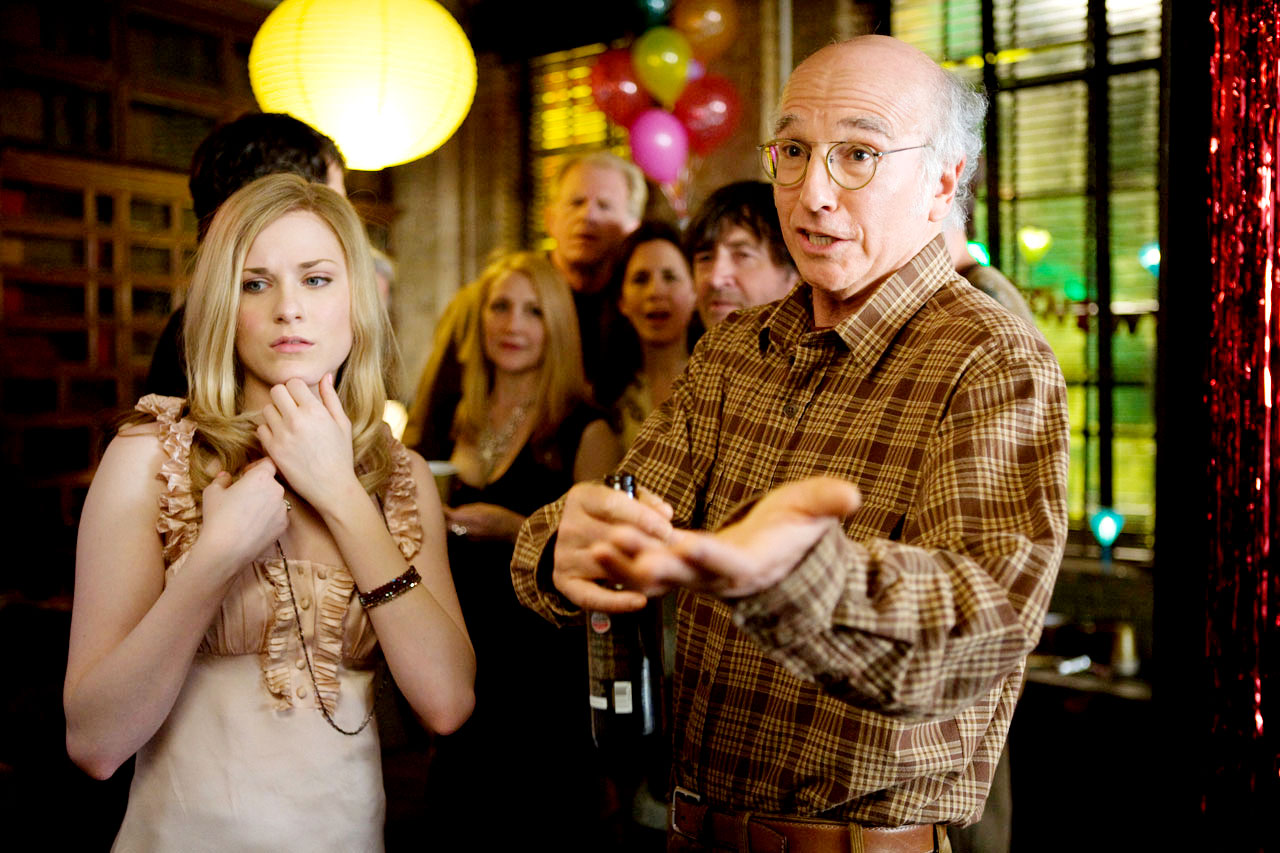
(World Exchange Plaza, Empire 7 Cinema, 111 Albert Street)
Saturday, August 23, 2008
A Great Date In Barcelona Or We'll always have Rhiota.
Vicky Christina Barcelona (Woody Allen, 2008)
*** (A Must See)

Vicky (Rebeca Hall) and Christina (Scarlett Johansson) disembark in Barcelona for a sunny summer stay with family friends Judy (Patricia Clarkson) and Mark (Kevin Dunn) Nash. Vicky is in Barcelona to further her postgraduate work on Catalan and the architect of Antoni Gaudí and Christina is there for love. Christina meets a well known painter in the arts community Juan Antonio (Javier Bardem). He is introduced at his nihilistic best; we find out about his devastating ex-wife who shot him, he is all by himself and he is looking gloomy drinking wine. The two girls go on a weekend trip in Rhiota with Juan Antonio where Christina accidently gets sick. Hesitantly Vicky goes out with Juan and they indulge in beautiful Catalan wine, cuisine, classical guitar to accompany private intellectual and emotional conversations. Maria Elena (Penélope Cruz) returns and gets back together with Juan Antonio just as a blooming relationship with Christina is emerging. The film contrast the relationships of the two leads Vicky with her stable and secure relationship with an Allen prototypical New York intellectual Doug (Chris Messina) and Christina with her spontaneity and excitement in her love affair with Juan Antonio and Maria Elena. Underneath it all there is a study of compromise in relationships, everyone has their own regrets and desires that are fulfilled or neglected. As Vicky is trying to come to terms with her shrewd night with Juan Antonio the film meditates on fleeting joyful encounters and concealing sadness with alleged cheerfulness. Woody Allen has always been trying to combine the froth with the serious and this film offers many of pleasures that are reminiscent of his good old days. The cast is gorgeous, cute, beautiful, sexy, and sells itself but what makes the film so much greater are the hilarious wisecracks; Great, just what we needed a Rorschach blotch.
Vicky Christina Barcelona is Woody Allen's the latest film from his prolific career as a writer-director that started in 1969 with his directional debut Take the Money and Run. His last feature to show in Ottawa was Scoop (2006). "Well, Scoop I found to be a trivial little Kleenex of a film..." Woody Allen proclaimed in a recent interview with The Village Voice. Cassandra’s Dream (2007) did not even make it to repertories in Ottawa. Point is: Vicky is the best Allen you can get. Vicky Christina Barcelona will be playing at the AMC and SilverCity and more comfortably at the Bytowne in October. To get ready for the Bytowne premiere their playing, my favorite Woody Allen film, Manhattan (1979) on September 23rd and 24th. If you still want more his next film Whatever Works is scheduled for release next year and will be starring Seinfeld and Curb Your Enthusiasm creator Larry David and if your going to be in Los Angeles next summer he will be directing his first ever opera Puccini’s Gianni Schicchi.-David Davidson
(Bytowne Cinema, 324 Rideau Street, 10/02-10/05)
*** (A Must See)

Vicky (Rebeca Hall) and Christina (Scarlett Johansson) disembark in Barcelona for a sunny summer stay with family friends Judy (Patricia Clarkson) and Mark (Kevin Dunn) Nash. Vicky is in Barcelona to further her postgraduate work on Catalan and the architect of Antoni Gaudí and Christina is there for love. Christina meets a well known painter in the arts community Juan Antonio (Javier Bardem). He is introduced at his nihilistic best; we find out about his devastating ex-wife who shot him, he is all by himself and he is looking gloomy drinking wine. The two girls go on a weekend trip in Rhiota with Juan Antonio where Christina accidently gets sick. Hesitantly Vicky goes out with Juan and they indulge in beautiful Catalan wine, cuisine, classical guitar to accompany private intellectual and emotional conversations. Maria Elena (Penélope Cruz) returns and gets back together with Juan Antonio just as a blooming relationship with Christina is emerging. The film contrast the relationships of the two leads Vicky with her stable and secure relationship with an Allen prototypical New York intellectual Doug (Chris Messina) and Christina with her spontaneity and excitement in her love affair with Juan Antonio and Maria Elena. Underneath it all there is a study of compromise in relationships, everyone has their own regrets and desires that are fulfilled or neglected. As Vicky is trying to come to terms with her shrewd night with Juan Antonio the film meditates on fleeting joyful encounters and concealing sadness with alleged cheerfulness. Woody Allen has always been trying to combine the froth with the serious and this film offers many of pleasures that are reminiscent of his good old days. The cast is gorgeous, cute, beautiful, sexy, and sells itself but what makes the film so much greater are the hilarious wisecracks; Great, just what we needed a Rorschach blotch.
Vicky Christina Barcelona is Woody Allen's the latest film from his prolific career as a writer-director that started in 1969 with his directional debut Take the Money and Run. His last feature to show in Ottawa was Scoop (2006). "Well, Scoop I found to be a trivial little Kleenex of a film..." Woody Allen proclaimed in a recent interview with The Village Voice. Cassandra’s Dream (2007) did not even make it to repertories in Ottawa. Point is: Vicky is the best Allen you can get. Vicky Christina Barcelona will be playing at the AMC and SilverCity and more comfortably at the Bytowne in October. To get ready for the Bytowne premiere their playing, my favorite Woody Allen film, Manhattan (1979) on September 23rd and 24th. If you still want more his next film Whatever Works is scheduled for release next year and will be starring Seinfeld and Curb Your Enthusiasm creator Larry David and if your going to be in Los Angeles next summer he will be directing his first ever opera Puccini’s Gianni Schicchi.-David Davidson
(Bytowne Cinema, 324 Rideau Street, 10/02-10/05)
Subscribe to:
Posts (Atom)