Showing posts with label Lee Gordon Demarbre. Show all posts

Tuesday, April 6, 2010

Interview with Lee Demarbre

This is an interview I have been working on for a while with Lee Gordon Demarbre. Part of a series of interviews and list from local film experts to increase awareness of Ottawa cinéphiles and to bring them together online. Thanks again Lee for contributing to Ottawa Film Review and for making Ottawa a lot more exciting with your eclectic programming at the Mayfair Theatre.-D.D.


OFR: So Lee, what is your next project?

Lee Demarbre: I'm developing a film project now based on an idea from Sasha Gr-y, to star Sasha Gr-y. Ian Driscoll is hoping to have the script finished by mid-February.

OFR: What is it about this disturbed behavior that interest you so much? And is there anything you learnt from exploring this subject matter so closely, apparently you continue pursuing this interest in Summer’s Blood (2009)?

Lee Demarbre: I don't think I'm really exploring all this on purpose. I'm not setting out to say something about the disturbed mind. It just turns out this is a subject matter of many of my films. I think that's because I'm taking a lot from genre; and genre deals a lot with violence, as a result disturbed minds become my antagonists.

OFR: Why did you pick to film The Dead Sleep Easy (2007) in Mexico?

Lee Demarbre: I was already in Mexico shooting a documentary on Mexican wrestling entitled Vampiro: Angel, Devil, Hero (2008). It was a dream to make a movie about Mexican wrestling in Mexico -- so I jumped at the chance. Mexico is so bad-ass. The landscape of the country is like a modern day wild-west; no set dressing necessary. I'd do it again in a heart beat - it's dangerous at times but worth it.
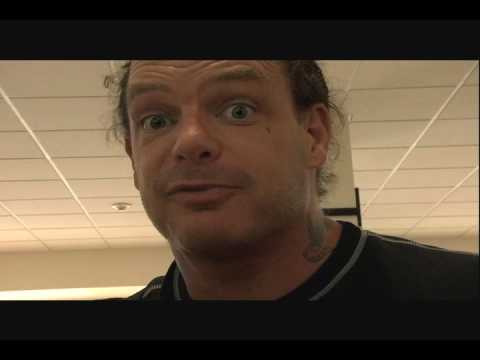

OFR: What are the charms of filming in Ottawa? I imagine your crew must pretty tightly knit? Do you guys feel like you have reached a celebrity status?

Lee Demarbre: Ottawa's charm is the fact that the film industry doesn't really exist in this city. So when you approach someone about shooting in their restaurant, shop or cinema; most times they let you do it for next to nothing because they're so excited you're shooting a film. That wouldn't happen if people were shooting here all the time. And no I don't feel the sense of celebrity. It's always nice to have someone tell you how much they like your film, but there really isn't a sense of being famous. Just the sense that the movies are out there and some people have seen them; which is rewarding.


OFR: I am wondering what are your views on Canadian cinema? Is it lacking anything? What is that you like about it?

Lee Demarbre: Canadian cinema is looked down upon by many people because our films hardly resemble what people are use to watching; Hollywood movies. And I think the current state is on a down low. In the 90's there was a better sense of new Canadian films and filmmakers. The new films from Atom Egoyan, David Cronenberg, Bruce McDonald were exciting ten or more years ago. But these guys are still really the only "names" in the business, and now they're lesser filmmakers. We need a new wave of young Canadian filmmakers to come along and put a sense of excitement back into Canadian films.

OFR: Are there any prints you wish were still around or were more easily attainable? Have you created any fond relationships with other people distributors through running the cinema?

Lee Demarbre: I can't figure out why there aren't prints of the original Dawn of the Dead (1978) or Day of the Dead (1985) still kicking around. I wish I could show them again and again. The best part of my job is tracking down older prints (16mm or 35mm) and showing them. I'm still not sure if people really dig seeing original prints of movies; but for me it's like going to a concert to see your favorite old band. It's like a music fan saying "there's Kiss, live on stage" and me coming to the Mayfair and saying "there's an original print of that old movie that I've never seen before." For me it's that visceral.

OFR: How do you guys at the Mayfair feel about the Lansdowne Live decision and will it affect the cinema? Is there anything regular moviegoer should know or do?

Lee Demarbre: People should realize what an original film print is. That like still photography what we're showing is a positive of the negative that was in the camera on set when the movie was being shot. Seeing a movie in the theatre on 35 mm is like going to a museum and seeing a real life painting, opposed to seeing a copy of the painting printed in a magazine. And with the major studios witching over to digital projectors and showing movies downloaded onto a server; the idea of seeing a print is more real then ever. Forget about watching your DVD's, Blurays or whatever at home -- seeing an original print of your favorite movie is really like seeing it for the first time. If you don't get this -- then please stay at home.

OFR: What would you say were your favorite ten movies that came out in 2009?

Lee Demarbre: Here's my list

- Red Cliff: Part II (John Woo)
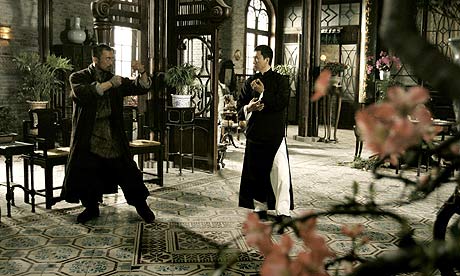
- Ip Man (Wilson Yip)
- Inglourious Basterds (Quentin Tarantino)
- Bronson (Nicolas Winding Refn)
- The Fantastic Mr. Fox (Wes Anderson)
- Invictus (Clint Eastwood)
- Che (Steven Soderbergh)
- Star Trek (J.J. Abrams)
- Whatever Works (Woody Allen)
- The Girlfriend Experience (Steven Soderbergh)


Thursday, November 19, 2009

On Smash Cut

A butchered "300 word" version of this capsule was published in the Volume 70, Issue 14 of the University of Ottawa student paper the Fulcrum. They were even able to cut out any mention of Sasha Grey, one of the prized eye candy of the film. However, I am happy Smash Cut is getting a lot of recognition, especially best 2009 film by a local filmmaker in the Ottawa Expres.-D.D.

Smash Cut (Lee Demarbre, 2009)
*** (A Must-See)


Lee Demarbre’s Smash Cut, from a screenplay by Ian Driscoll, is an entertaining Ottawa gore film which just had its world premiere Saturday July 18th in Montreal at the Fantasia Film Festival. Both dark and jovial, the plot follows a local filmmaker Able Whitman (David Hess), acting as a surrogate for Lee Demarbre, and its concerns are the inconveniences and compromise that filmmakers creating a collaborative art have to deal with.

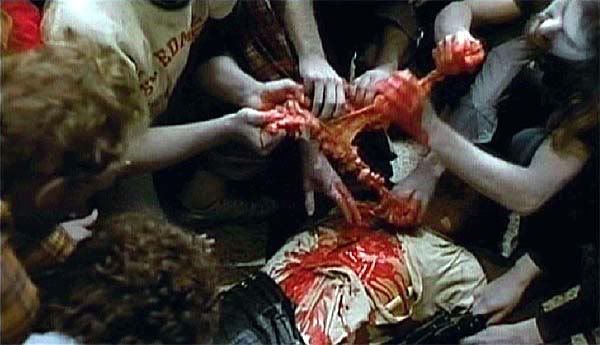
The film starts off with Herschell Gordon Lewis, a low-budget gore filmmaker who spawned the genre in the 1960s, warning the viewers “that filmmaking is a blood sport” and that the content of the film is sure to shock. Herschell Gordon Lewis films Blood Feast (1963), Color Me Blood Red (1965), and The Gore Gore Girls (1972) were some direct influences on the film . His films were filled with gruesome murders, evisceration, and half-clad women victims. Blood Feast starred Connie Mason, from the centerfold of playboy magazine, which is now being paralleled with Sasha Grey who comes from the adult entertainment industry. But his style was invisible, with very little camera movement and a texture that resembled b-exploitation-movies of the era, unprofessional acting, implausible shlock stories, always bright lighting which consisted of a bursting comic-book color palette with flashy hues of blue, red, pink and orange, and moods which were more fun than morbid.

Smash Cut's camera work, by the cinematographers Jean-Denis Ménard and Karl Roeder, is intensely modern, it was shot on a high resolution RED digital camera, with steady cam shots bringing you into the action, close-ups on the dismantlement’s, intricate long shots as well as a mixing up of medias including shots from the perspective of the cameras view-finder, and a short interposition of a monochromatic silent film. The original music, and sound mixing, by Micheal Dubue creates a mood of eeriness and suspence. One scene that stays in mind occurs when the camera follows Able Whitman from his car arriving at the Bytowne Cinema on Rideau Street, past the posters, one of The Dead Sleep Easy (Lee Demarbre, 2007), up the marquee, through a window, and into the projection booth.

Smash cut begins with Abel Whitman presenting his lastest picture, the audience pans the film, denounces its artificiality of a detached eye-ball. For his next picture, Abel, will remove the eyes of a victim with a medical knife, in a sequence that is even more nauseating then the eye slicing in Un Chien Andalou. Then he goes to a bar and drinks his problems away, gets a dance from a stripper named Gigi (Jennilee Murray), and then leaves with her. Driving home, she surprises him by returning her regular fee, but an unsuspecting incoming automobile sidetracks him off of the street where he hits a tree. She dies. The accidental murder of the women, a fleeting career, and frustration towards an audience that is not receptive to his work brings him to a nervous breakdown. What unfolds is a murderous escapade; he has now an insatiable desire to murder and to use the corpses in his film. As precocious as the Nietzscheans in Alfred Hitchcock’s Rope (1948). The body parts make everything, well the gore at least, in his new film of a murdering toy all the more realistic and believable, allowing him to get more grants, a major distribution, which pleased his producer Philip Farmsworth Jr. (Michael Berryman), and awe from his peers.

One unnoted dept Smash Cut might owe would be too Warren Beatty’s Bulworth (1998). Abel Whitman’s nervous breakdown and then ravage lunacy parallels the plight of Sen. Jay Billington Bulworth where after realizing his vanishing presence as a political candidate he decides put a contract out on himself and then starts to blurt out truth’s denouncing the system hypocrisies. With every prod to the current political organization, the more powerful his following becomes. Which is similar to the aggrandizing of Abel as his film is consecutively improving.

The only potential problem the film poses is it lack of a message. What does this film have to say about the world we live in? Able Whitman while in a room preparing to get government funds is asked by an artist what kind of film is he making, her answer was that she will be using the money to decry the passivity that arise from televisions, and then he tells her his film will be a sojourn in the macabre, then knocks her out, slowly tortures her, depletes her blood into a canister and finally lashes it onto the star of his new film April Carson (Sasha Grey). April is Gigi’s sister, the murdered stripper, who is on a editorial pursuit, along with a investigator Isaac Beaumonde (Jesse Buck), to relocate her.

Ian Driscoll script has Shakespearian touches, in particular Hamlet which Abel Whitman comments as being as precursor horror film. The investigator Isaac eventually catches on to what Abel has been doing and puts on a a re-enactment of Abel Whitmans murder of the movie critic Gretchen Gregorski (Guen Douglas) paralleling the same device Hamlet uses on Claudius, though comically done with paper masks and a pretend stabbing with a knife that never makes contact.

Many simple pleasures that arise from the film are the locations and people, starting off with the Car Wash on Catherine Street, the repertoire cinema’s Bytowne and the Mayfair, the National Art Gallery of Canada setting, and alongside the Rideau Canal. This viewer’s only problem arose when Abel Whitman decides to murder one of the film’s producers with a Harpoon, he is asked where he got the Harpoon, and before plummeting him with it, he answers at the Harpoon store. For as this lifetime Ottawa, Ontario, resident knows there are no Harpoon stores here! As well there are a few cameos of a few friends that would have no other opportunity to be immortalities on film including Layla Brown, Lesley Marsland (both from the Bytowne Cinema) and Michael Dubue (In the band the Hilotrons, and Mayfair Theatre) as well as a few Ottawa Famous figures including Guen Douglas (Planet Ink Studios), Jennilee Murray and Phil Caracas (The Harry Knuckles trilogy, and Bytowne Cinema).

The communal midnight screening experience was very lively. Including a waiting line that went around the corner, a practically packed house at the Théâtre Hall at Concordia (1455 de Maisonneuve O.), loud cheers, burst of laughter, comments, and a receptive question and answer period. With popcorn, and soda everyone was in the mood for a good time. The Q & A session afterwards was very enlightening with Lee Demarbre, Ian Driscoll, Sasha Grey and David Hess. Lee Demarbre was his usual enthusiastic self, Sasha Grey, who is 21 years old, (her next film is Steven Soderbergh The Girlfriend Experience) seemed rather reserved when she was not speaking, and finally the Sanford Meisner protégé and acting veteran, David Hess (The Last Hill on the Left) seems to exert both levity and the knowledge of old age. All cohorts played off of each other like a perfect pitch tune.

During the Q & A session, David Hess contextualized the midnight movie phenomenon. He commented on how back then, New York City in the 1960’s, nobody knew who was directing the pictures. When an audience would go to see a midnight movie, their usual routine for the night would involve getting high off marijuana and then watch a lurid seedy picture. The director of the picture remained unanimous, and even though he knew personally Hershell Gordon Levis, he commented on how he still had to be re-introduced to him later through his films.

The conditions were both open and social as Lee Demarbre seemed to be an incarnation of what it means to be a film enthusiast for the people of Ottawa (Full disclosure: I am an avid enjoyer of Lee Demarbre films and with Rachel Leblanc I have made a short documentary on him, you can find it if you youtube; cult fiction lee demarbre). His flamboyant repertoire programming at the Mayfair Theatre (1074 Bank Street) got many local residents to make the pilgrimage to go see the world premiere of Smash Cut in Montreal. When the questions started, some of them were from extras from the movie, others thanking him for the great movies playing at the cinema and wannabe screenwriters asking him for advice. Make sure to go see this one when it gets its local release because this film is well worth checking out.-David Davidson

(The Mayfair Theatre, 1074 Bank Street, 20/11)

Thursday, May 7, 2009

A Portrait of an Artist

Cult Fiction, A Portrait of an Ottawa Filmmaker: Lee Gordon Demarbre (David Davidson & Rachel LeBlanc, 2009)