Friday, June 22, 2018

Friday, June 8, 2018
Listening to Others: On Antoine Bourges’ Fail to Appear

Tuesday, May 15, 2018
TFR Presents : Now It’s Dark
Not to be too glib, but one gets the feeling that if you’re a young Canadian filmmaker wanting to make a mark, there’s almost something of an algorithm to follow. Simply make a film in the mould of the Dardennes Brothers or Michael Haneke, then expect a few festival appearances followed by polite word from local press desperate for a thriving Canadian art cinema.
And this is not to say that many fine films aren’t being produced in this tradition, but is it not a little depressing to find a certain mix of naturalism and cynicism as the standard for Canadian film? That’s why with its latest screening, Toronto Film Review is shining a light on recent films (well, dating back to 2012 in some cases) that have shown a strong inclination towards a wholly different cinema.
While the eights films on display in this program wildly vary in scope and resources, they’re undeniably all exciting. Many of them taking place in less glamorous corners, be they cramped apartments, dank city streets or hellishly cold landscapes, the overriding theme of the works could seem like yet more variations on millennial despair. Yet they’re filtered through utterly unique visions that don’t rely on mundanity as a crutch. That being said, they render a Canada that’s highly recognizable to this writer, meaning quite fucking strange. - Ethan Vestby
And this is not to say that many fine films aren’t being produced in this tradition, but is it not a little depressing to find a certain mix of naturalism and cynicism as the standard for Canadian film? That’s why with its latest screening, Toronto Film Review is shining a light on recent films (well, dating back to 2012 in some cases) that have shown a strong inclination towards a wholly different cinema.
While the eights films on display in this program wildly vary in scope and resources, they’re undeniably all exciting. Many of them taking place in less glamorous corners, be they cramped apartments, dank city streets or hellishly cold landscapes, the overriding theme of the works could seem like yet more variations on millennial despair. Yet they’re filtered through utterly unique visions that don’t rely on mundanity as a crutch. That being said, they render a Canada that’s highly recognizable to this writer, meaning quite fucking strange. - Ethan Vestby
Wednesday, April 4, 2018
Tuesday, March 20, 2018
Springtime in Toronto
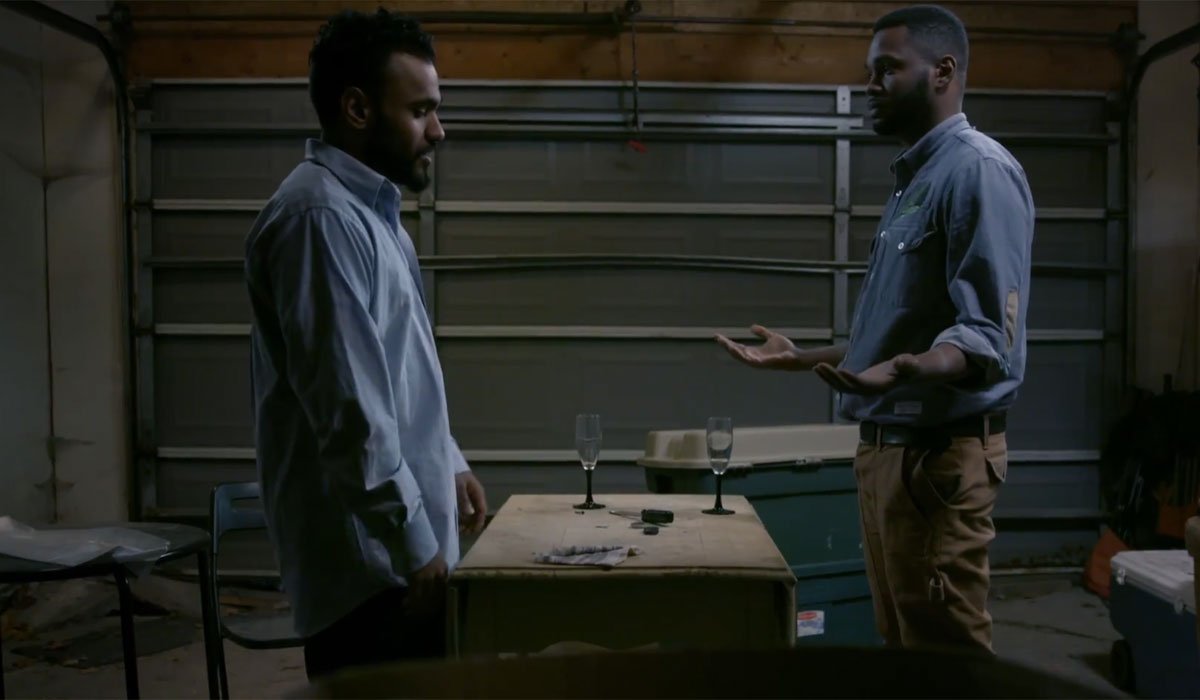
In Natty
Zavitz’ Edging (now available on
iTunes) a young man is in a period of transition in his life. Having just bought
a house, he’s having a housewarming party with friends from throughout his life
but where instead of hosting he’s stubbornly focused on a home maintenance
problem in his garage. Edging is a
tale of springtime in Toronto. Where the rest of the city, and the world too,
is moving forward with confidence, after a harsh winter, in what should be a
period of renewal, its protagonist Jordan (Shomari Downer) gets stuck on one of
the immediate problems at hand: The garage door is broken. Throughout the film,
old friends come and go, recollecting about their youth and current anxieties,
while new acquaintances come through, enjoying themselves and getting into
trouble, but for Jordan, to make sense of the confusion and chaos around him,
he has to remove himself from the social center, contemplate and discuss, so
that he can eventually regain self-confidence and grow.
This narrative of anxiety and growth
is a great metaphor for how I’m experiencing the Toronto film culture in the Spring
of 2018. By all accounts it’s thriving: Every night there’s an exciting
screening, on weekends a new festival and publications are putting forward relevant
polemics. Some positive recent examples: There’s the publication of the new André
Bazin’s Selected Writing, the film
magazines Cahiers, Positif and Cinema Scope are on point, CBC’s new
shows Workin’ Moms and Caught exceeded expectations, and there’s
the upcoming What The Film Festival and Canadian Film Fest. Regardless of the
problems in the world, the consensus seems to be that Toronto film folks are
forming communities, pursuing goals and achieving results. All really great
things.
But sometimes it’s important to step
back a little and figure out what you need
to do before you can go out to join others.
Monday, March 19, 2018
100 Best Canadian Films – Seth Feldman
It was a good SCMS this year. In Toronto
at the Sheraton there were hundreds of guests, panellists and academics,
graduate students and senior professors, and the atmosphere was lively and
congenial. There were some great panels on Canadian cinema, both by Canadians
and Americans, along with stimulating ones on topics that synthetized the last
year of scholarship, and which most likely will influence research to come. There
was also socializing and events, where I got to chat with folks about this 100 Best Canadian Films project, and who were receptive towards it.
The first of these academics to have completed
the request is my old documentary cinema professor Seth Feldman
from my time at York University when I did my Masters there. Feldman is
noteworthy in the Canadian film scholarship landscape for his academic practice
at York University and his research on Canadian cinema and documentary. This
includes a book on Allan King and a plethora of contributions to a myriad of
anthologies on Canadian cinema and documentary, along with being a regular
presence at conferences on these topics. Thanks again Seth!
100 Best
Canadian Films is a series of personal versions of Canadian film history.
Other lists includes those by Stacey
Donen, Michael
Marlatt, Jim
Sheddan, Philippe
Gajan, Kevin
Laforest, Steve
Gravestock, Olena
Decock, Dan
Browne, Réalisatrices
Équitables and Films Fatales Montréal, Helen
Faradji, Fabrice
Montal, Stephen
Broomer, Paul
Corupe, David
L. Pike, Jerry
White, André
Loiselle, Paul
Williams, Greg Klymkiw, Pat Mullen, Jason Anderson, Daniel Kremer, Yves Lever, Piers Handling, Marcel Jean, Mike Hoolboom and myself. – D.D.
***
Seth Feldman’s 100 Best Canadian Films
Pre-NFB
1. Back to God’s Country (David Hartford, Neil Shipman, 1919)
2. Carry On, Sergeant! (Bruce Bairnsfather, 1928)
3. Rhapsody in Two Languages (Gordon Sparling, 1934)
4. The Viking (George Melford, Varick Frissell, 1931)
5. Tit-Coq (René Delacroix, Gratien Gélinas, 1952)
6. Lest We Forget (Frank Badgley, 1935)
NFB (1939-1959)
1. Churchill’s Island (Stuart Legg, 1941)
2. The War for Men’s Minds (Stuart Legg, 1943)
3. Alexis Tremblay Habitant (Jane Marsh, 1943)
4. The Loon’s Necklace (F. R. Crawley, 1948)
5. Neighbours (Norman McLaren, 1952)
6. Corral (Colin Low, 1954)
7. City of Gold (Colin Low, Wolf Koenig, 1957)
8. Skid Row (Allan King, 1956)
9. Begone Dull Care (Norman McLaren, Evelyn Lambart, 1949)
10. The Days Before Christmas (Wolf Koenig, Terence Macartney-Filgate,
Stanley Jackson, 1958)
11. Back Breaking Leaf (Terence Macartney-Filgate, 1959)
12. A Chairy Tale (Norman McLaren, Claude Jutra, 1957)
13. Les Raquetteurs (Michel Brault, Gilles Groulx, 1958)
1960s – 1970s
1. Glenn Gould: On the Record (Wolf Koenig, Roman Kroitor, 1959)
2. Universe (Colin Low, Roman Kroitor, 1960)
3. Lonely Boy (Wolf Koenig, Roman Kroitor, 1962)
4. Warrendale (Allan King, 1967)
5. The Things I Cannot Change (Tanya Ballantyne, 1967)
6. In the Labyrinth (Roman Kroitor, Colin Low, Hugh O'Connor,
1967)
7. La Lutte (Michel Brault, Claude Jutra, Marcel
Carrière, Claude Fournier, 1961)
8. À Saint-Henri le cinq septembre (Hubert Aquin, 1962)
9. Pour la suite du monde (Pierre Perrault, Michel Brault, Marcel
Carrière, 1963)
10. À tout prendre (Claude Jutra, 1963)
11. The Cat in the Bag (Gilles Groulx, 1964)
12. Very Nice, Very Nice (Arthur Lipsett, 1961)
13. Wavelength (Michael Snow, 1967)
14. Reason Over Passion (Joyce Wieland, 1969)
15. The Hart of London (Jack Chambers, 1970)
16. La Région Centrale (Michael Snow, 1971)
17. The Far Shore (Joyce Wieland, 1976)
18. Tiger Child (Donald Brittain, 1970)
19. The Mills of the Gods (Beryl Fox, 1965)
20. Waiting for Fidel (Michael Rubbo, 1974)
21. La vie heureuse de Léopold Z (Gilles Carle, 1965)
22. The Death of a Lumberjack (Gilles Carle, 1973)
23. Les Ordres (Michel Brault, 1974)
24. Nobody Waved Good-bye (Don Owen, 1964)
25. Goin’ Down the Road (Donald Shebib, 1970)
26. Mon Oncle Antoine (Claude Jutra, 1971)
27. Paperback Hero (Peter Pearson, 1973)
28. The Apprenticeship of Duddy Kravitz (Ted Kotcheff, 1974)
29. The Old Country Where Rimbaud Died (Jean Pierre Lefebvre, 1977)
1980s – 1990s
1. The Grey Fox (Phillip Borsos, 1982)
2. Videodrome (David Cronenberg, 1983)
3. The Wars (Robin Phillips, 1983)
4. Margaret Atwood: Once in August (Michael Rubbo, 1984)
5. Moose Jaw (Rick Hancox, 1992)
6. Canada’s Sweetheart (Donald Brittain, 1985)
7. My American Cousin (Sandy Wilson, 1985)
8. Decline of the American Empire (Denys Arcand, 1986)
9. Night Zoo (Jean-Claude Lauzon, 1987)
10. A Winter Tan (Jackie Burroughs, John Walker, John
Frizzell, Louise Clark, Aerlyn Weissman, 1987)
11. Bye Bye Blues (Anne Wheeler, 1989)
12. The Company of Strangers (Cynthia Scott, 1990)
13. Black Robe (Bruce Beresford, 1991)
14. Naked Lunch (David Cronenberg, 1991)
15. Canal (Richard Kerr, 1981)
16. Illuminated Texts (R. Bruce Elder, 1982)
17. Lamentations (R. Bruce Elder, 1985)
18. ?O, Zoo! (Philip Hoffman, 1986)
19. Forbidden Love (Lynne Fernie, Aerlyn Weissman, 1992)
20. Kanehsatake (Alanis Obomsawin, 1993)
21. Thirty Two Short Films About Glenn
Gould (François Girard,
1993)
22. Le Confessional (Robert Lepage, 1995)
23. Rude (Clement Virgo, 1995)
24. A Place Called Chiapas (Nettie Wild, 1998)
25. Last Night (Don McKellar, 1998)
2000s
1. A History of Violence (David Cronenberg, 2005)
2. What These Ashes Wanted (Philip Hoffman, 2001)
3. Ararat (Atom Egoyan, 2002)
4. Le Confessional (Robert Lepage, 1995)
5. Ataranjuat: The Fast Runner (Zacharias Kunuk, 2002)
6. From the Journals of Knut Rasmussen (Zacharias Kunuk, Norman Cohn, 2006)
7. Ginger Snaps (John Fawcett, 2000)
8. The Heart of the World (Guy Maddin, 2000)
9. Waydowntown (Gary Burns, 2000)
10. Manufactured Landscapes (Jennifer Baichwal, 2006)
11. The Barbarian Invasions (Denys Arcand, 2003)
12. Beowulf and Grendel (Sturla Gunnarsson, 2005)
13. C.R.A.Z.Y. (Jean-Marc Vallée, 2005)
14. Fire (Deepa Mehta, 1996)
15. Water (Deepa Mehta, 2005)
16. The Trotsky (Jacob Tierney, 2009)
17. Maelström (Denis Villeneuve, 2000)
18. My Winnipeg (Guy Maddin, 2007)
19. Away From Her (Sarah Polley, 2006)
2010 –
1. Angry Inuk (Alethea Arnaquq-Baril, 2016)
2. Bear 71 (Jeremy Mendes, Leanne Allison, 2012)
3. High Rise (Katerina Cizek, 2009-2015)
4. Tom at the Farm (Xavier Dolan, 2013)
5. Mommy (Xavier Dolan, 2014)
6. Monsieur Lazhar (Philippe Falardeau, 2011)
7. Take This Waltz (Sarah Polley, 2011)
8. Stories We Tell (Sarah Polley, 2012)
Tuesday, March 13, 2018
Toronto Film Review Presents : That DMX Feeling

“Of all the recent American films that were set in Las Vegas, Showgirls was the only one that was real – take my word for it. I who have never set foot in the place!” - Jacques Rivette

Though forgive this writer for making any big claims about Vancouver, as he’ll admit he hasn’t visited since he was a young child. Yet the three films being shown as part of the latest screening in the Toronto Film Review Presents, Neil Bahadur’s From Nine to Nine, Sophy Romvari’s It’s Him and Heather McDonald’s ReZoning Love, paint a vivid picture for anyone who’s never even been.
 Forming somewhat of a collective, the three millennial directors dramatize one of the most filmed yet not depicted (well with the exception of maybe um, Ballistic: Ecks vs. Sever) cities in the last thirty years of cinema, and put it through the lens of youth escaping trauma, or rather the painful everyday experience of living paycheque to paycheque. As taking us through fried food joints, movie theatres, parks, libraries, sketchy audition rooms, malls and euphorically in Bahadur’s film, “da club”, we get a sense of the lives lived by a greater portion of the 647,540 who call Van home than we’d care to think. - Ethan Vestby
Subscribe to:
Posts (Atom)