Thursday, October 9, 2014
Monday, October 6, 2014
Café de Flore
I need to thank Marc Saint-Cyr for letting me post this fascinating essay on Café de Flore. - D.D.
Jean-Marc Vallée’s Café de Flore is one of those rare,
special works of art: a film that perfectly marries the cosmic with the
intimate, filtering a concept that transcends the boundaries of time,
nationality, and probability through an assortment of stories entrenched in
intensely relatable human experiences. As demonstrated by both this film and
his earlier masterpiece C.R.A.Z.Y.,
Vallée understands the anatomy of memory, illuminating with insight and
detectable pleasure the roots of those golden moments that linger and resonate
within us long after they occur. In such moments, which rarely feel special as
they are happening, and which Vallée so skillfully isolates and freezes in
cinematic amber, anything could turn out to be the Rosetta Stone that serves as
the key to a larger, grander narrative beyond your field of vision in which you
only play one part: a specific incident or sequence of events, a song or album,
a cryptic word or name, a picture on the wall that contains more than initially
meets the eye. Passed down from person to person, weathering the seasons, these
artifacts serve as tokens of personal history and testaments to the longevity
of memories – whether we are fully aware of it or not. Music serves as an especially
potent material for the weaving of these memory maps, as Vallée can attest: in C.R.A.Z.Y. and Café de Flore, he repeatedly uses songs and album covers as sturdy,
reliable landmarks dotted across the charts of his characters’ lives that add
continuity and meaning to the mysterious, incredible journey of human destiny.
Just as it did in C.R.A.Z.Y.,
Pink Floyd’s The Dark Side of the Moon
is a reoccurring fixture in Café de Flore’s
sonic landscape – specifically Clare Torry’s fantastic, echoing yowl heard in
the classic album’s opening track “Speak to Me/Breathe,” created by the band
that is by now as much a staple of Vallée’s cinema as the Rolling Stones are of
Martin Scorsese’s. Antoine (Kevin Parent), a DJ based in present-day Montreal,
loves that particular song, integrating it into his sets and indulging in it by
himself through his headphones in order to reach that “special place” that
music lovers like him know so well. Antoine’s story involves his relationship
with Carole (Hélène Florent), his ex-wife and the mother of their two
daughters, and Rose (Evelyne Brochu), the new woman in his life. Antoine and
Carole’s romance was born in the post-punk era of Joy Division and the Cure but
grew not only in years of affection and tenderness between the two lovers, but
also in the shadow of a specter that only loomed longer and darker as time went
on: alcohol, as the many bottles of Beefeater Gin that appear in the old photos
of them together, always within Antoine’s easy reach, testify. In the present,
he is haunted by the crimson-uniformed figure from the bottle label in eerie,
blink-and-you-miss-it subliminal flashes – a demon that is always lurking in
the peripheries of his life.
The central dilemma Antoine faces stems from the arrival
of Rose in his life and the strain it places on both the family he and Carole
made together and his faith in the idea of there being just one person out there with whom you are meant to spend the rest
of your life. With this premise, Café de
Flore straightforwardly adopts a rare philosophical complexity while
fiendishly throwing a wrench into the most cherished dream of die-hard
romantics everywhere. Having been cheated out of her life with Antoine by Rose
and, in a greater sense, fate, Carole soon becomes one of the film’s most
sympathetic characters. In her, Vallée and Florent illustrate the cruelty and
pain that can come from love, desire, and destiny’s mysterious ways, which
Antoine and Carole’s angry oldest daughter keeps bringing back to the surface
with her own distress from seeing her father fall for another woman besides her
mother. In pure Valléeian fashion, she claims a measure of revenge against her
father by deliberately playing the songs associated with their time together,
as if her and her sister’s very existence wasn’t a vital enough reminder of his
past life with Carole. Music has that power: to summon the pain and glory of
the past with an intensity and directness that nothing else can quite manage.
On the same subject of music and past lives, there is the
story of Jacqueline (Vanessa Paradis), a young woman living in Paris in 1969,
and Laurent (Marin Gerrier), her young Down syndrome-afflicted son. For
film-savvy folk, their world should be quite familiar, since it is the same
place and almost the same time period – it’s close enough for government work –
that Truffaut, Godard, Varda, Rohmer, and the rest chronicled so well in their
day with their tales of records, cafés, cigarettes, boulangeries, young love,
and the movies. But Vallée doesn’t take the bait and sacrifice any measure of
his story in favor of yet another homage-laden jaunt into Newwaveland (which he
previously evoked with his memorable inclusion of Charles Aznavour amongst C.R.A.Z.Y.’s musical delights). And
thank goodness for that – as nice as it is to be back in the milieu of Breathless, Cléo from 5 to 7, and The Bakery Girl of Monceau, this is
strictly Jacqueline and Laurent’s story, and by keeping his focus on them and
their experiences, Vallée expresses a sincerity and authenticity that, beyond
their cinematic allure, were what the finest New Wave films were all about.
After all, to paraphrase a famous quote from Jules Dassin’s The Naked City, there are more than
eight million stories in the City of Light; the story of Michel the car thief
and his American girlfriend Patricia was one, the story of Antoine Doinel was
another, and the story of Jacqueline and Laurent is simply another. It
primarily concerns the incredible strength and beauty of parenthood, which is
manifested in the pure, unwavering devotion Jacqueline pledges to her son as
she tries her very best to ensure that he receives a “normal” education – one
without segregation or special treatment. Despite the daunting nature of her
goal, she successfully manages to provide Laurent with a life of safety,
happiness, and routine. Together, they create their own secret language made up
of private, affectionate rituals only they know – a language of absolute
fondness. But soon a new challenge arises with the appearance of Véro (Alice
Dubois), a little girl Laurent’s age who also has Down syndrome. A new bond of
love, fresh and intense, is formed between the two, sending Jacqueline into a
maelstrom of anguish, jealousy, and pain at the thought of losing her soul mate
to another. Sound familiar? “Speak to Me/Breathe” may be the Pink Floyd song
that is heard again and again in the film, but “Echoes” from 1971’s Meddle perhaps would have been a better
thematic fit – though on top of the less subtle devices that Vallée uses to
link his two narrative threads together, including ominous reoccurring dreams
and a psychic whom Carole visits to try to decipher their meaning, him sampling
the prog epic might have fatally tipped the film’s scales from helpful clarity
to blunt hand-holding.
But even with the abovementioned elements in play, Café de Flore is by any reliable measure
a brave work crafted with great subtlety and sophistication. Some of its
mysteries take longer to develop than others, some of them remaining shrouded
in the kind of ambiguity that rewards multiple viewings, prolonged
contemplation, and in-depth discussion. From the repeated image of the plane
carrying Antoine perfectly aligned with the bright white ball of the sun
against a pristine blue sky right before it disappears in a sudden blip of
orange to the numerous split-second appearances of the sinister Beefeater man
to the special significance of a song called “Café de Flore” to both Laurent
and Antoine in their respective time periods, the film is littered with
countless clues, signs, and omens that form a shattered mosaic depicting its
characters’ destinies and bonds with one another. As a viewer, you are given
the task and pleasure of putting the pieces together to try and bring into
sharper focus the twisting, turning, intersecting trajectories of these
people’s lives. In this way, Café de
Flore exemplifies one of the most satisfying traditions of art house cinema
– the kind that engages and entertains its viewers in the same way a smart,
well-designed game would its ready players.
In its refreshingly nuanced portrayal of lovers, parents,
and children, Café de Flore achieves
a rare universal sweep that makes you more deeply aware and appreciative of the
various roles you play throughout your life as well as the place you occupy in
the labyrinthine narrative of history – which perhaps bears more commonalities
and connections across generations than anyone realizes. As I write this, I’m
thinking of the scar on the ring finger of my left hand that came from an
injury I got many years ago while listening to – you guessed it – The Dark Side of the Moon while riding
my bike a little too fast and a little too recklessly. Will there be someone
else, born many years from now, who will one day bear a scar that looks exactly
like mine in exactly the same place? Was there someone born decades before I
was in some other part of the world who bore such a scar? Which albums did/will
they count among their favorites? More importantly, did/will either of these
hypothetical people ever have relationships that resemble any of the ones I
currently have with the people I love? After seeing Café de Flore, not only am I more likely to wholeheartedly place my
faith in the likelihood of such things, but also, more importantly, I am more
determined to cherish the bonds that connect me to those few special people in
my life. In whatever time period or incarnation, such bonds should be treasured
while they are intact and unharmed by the forces of fate, time, and death;
thankfully, we have films like Café de
Flore to remind us of that every now and then.
Marc Saint-Cyr
Film Review: Nightcrawler
A guest contribution by Lori A. Russell. - D.D.
A pair of pliers in the midst of an abandoned junk yard - that is where we first meet Lou Bloom (Jake Gyllenhaal), a socially awkward man desperate to earn a living any way he can, even if he has to commit reckless vandalism to pay the bills. We realize upon his first encounter, that he is learned. He is factual. He is reliable. He is conniving and ever so persistent. After an untimely rejection for employment, he quickly proceeds to his next opportunity: the scene of a car accident. Intrigued by the commotion, he pulls over to investigate the incident and thus begins his ravenous quest for fulfillment. During the next 108 minutes, we watch as Bloom operates a camera to navigate, and adapt, to the confines of late night news television.
The brilliance
of Gyllenhaal’s portrayal lays purely on Bloom’s ability to mask his
sociopathic tendencies through his persistence to please and impress those who
he feels are worthy of such admiration. Gyllenhaal easily captivates the
audience through his verbal fluidity and talent to dance along the lines of
perversion without completely giving it all away. He prances throughout the
film with hollowed eyes that speaks greater volumes than his mouth ever does.
He is constantly challenging the individuals around him with facts he’s learned
from the internet and knowledge he’s gained from those who have rejected and
belittled him. Nevertheless, the more praise he receives for his footage, from Producer
Nina (Rene Russo), the greater his appetite grows for the grotesque. Each
stakeout becomes more horrendous than the last and he will stop at nothing
until he has abolished whatever moral compass the viewer has left.
Visually, the
film is stunning; shot mostly during the night as Bloom scours the city for the
latest suburban catastrophe. The city lights transform into a mesmerizing blur
as he speeds down the streets in an effort to beat the ambulances and cop cars
that race against him but, as riveting as the cinematography may be, the score
is even more enticing. Electric guitars, soft pianos, and rhythmic drums
enhance and emulate Bloom’s character to great effect. The gong that beats
every so often reminds us that we are in Bloom’s world, trapped inside the
frame of his lens, whether we like it or not.
Written and
directed by Dan Gilroy, Nightcrawler
exemplifies Bloom’s reality, as well as our own. Gilroy denotes Bloom’s thirst
for violence by fulfilling the audiences’ resounding thirst for violence each
time that Bloom re-enters the editing suite. We are aware that what he is about
to show Nina is extremely graphic, invasive and probably inappropriate for
daytime television yet Bloom always seems to get his way. As a result, Gilroy
fantastically portrays Bloom’s indiscretion and the consequences for those
around him who ignore it. Nightcrawler
is a magnificent film; one that will resonate in your mind long after you have
left the theater.
Nightcrawler
opens in cinemas on October 31.
Monday, September 29, 2014
Jean-Luc Godard on The Man Who Knew Too Much
It’s on Ed’s
blog Les Cahiers-Positifs that I
discovered Godard also reviewed Hitchcock’s The Man Who Knew Too Much (1956). I thought he only reviewed Strangers on a Train and The Wrong Man by Hitch. I guess, I was
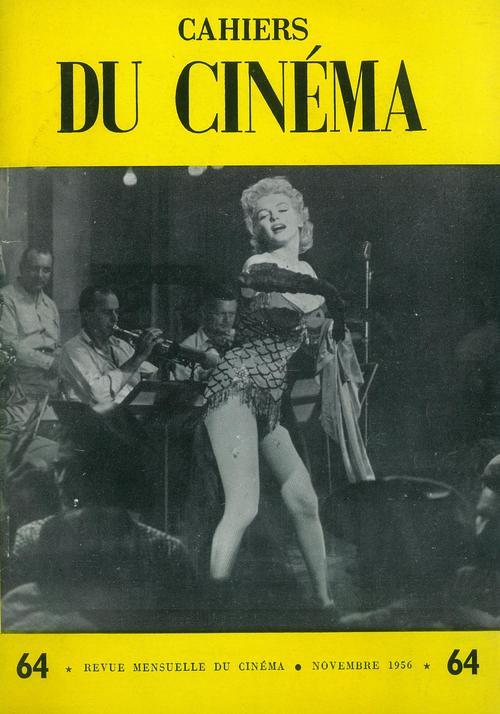
wrong. It happens. Anyways, on the cover of the November 1956 issue of Cahiers (N.64) there is a still of
Joshua Logan’s Bus Stop with Marilyn
Monroe, which is reviewed by Jacques Doniol-Valcroze (a critic whose output
deserves more attention). The early defining features of Cahiers are: André Bazin’s friendship with François Truffaut, the
young critics fight to take over the magazine, and Hitchcock as a defining
figure for the group. The Critiques were, and are, the most important section
at Cahiers – their chronicle of the
films, and the times – and these early Hitchcock reviews are the seeds that the
magazine would grow out of. (More so than those on Nick Ray, whose affinity never really left the magazine). Even Truffaut and Godard, whose friendship broke in
the post-’68 years (c.f. their last correspondence), would remain loyal to
Hitchcock throughout their whole careers: the Hitchcock interview book for Truffaut and Godard, who would return
more to narrative filmmaking after Truffaut’s death (a reconciliation?), in his
Histoire(s) describes Hitchcock as
the “greatest creator of form in the 20th century.” Hitchcock would also play a
significant role when the magazine renewed itself in the Eighties through their critical appreciation of Brian dePalma and how his films interrogate Hitchcock’s impulses and artistry. And Hitchcock is also at the root of their current appreciation of Steven Spielberg and
how he is able to mediate between personal projects within an industrial studio
system. – D.D.
***
The Student’s Path
One market
day an Allied secret agent, disguised, of course, as an Arab, is killed right
in the middle of the crowd in Marrakech. An important diplomat is shortly to be
assassinated. Before he dies, the spy manages to whisper his secret to an
innocent witness to the crime, an American tourist who is then uncertain
whether or not to pass it on in his turn to the (ex) French police in Morocco.
A telephone call helps him make up his mind to say nothing. His little boy has
been kidnapped, says a voice at the other end of the wire, and if he talks, he
and his wife will never see their child again. An incredible but very real
threat, which instantly fills our two Babbitts – James Stewert as a doctor from
Indianapolis and Doris Day as a once-celebrated singer – with alarm. Neverless,
like a modern Robinson family, they launch out into the unknown, following
their adventure without losing heart. Where to? To London. They have reason to
believe that the plot will unravel there. Zig and Puce on Dolly’s trail could
not show more heroism or more commend sense. Chance it and trust to God. Que sera, sera. This is also the opinion
of Scotland Yard, who are waiting as they leave the plane. An important
official wants to take the affair in hand. He fears complications of the kind of
French Cabinet calls ‘cosmic’. Is it worth the risk of aggravating an already
tense international situation for a little boy? James Stewart and Doris Day say
yes. Who can blame them? We, too, have little boys, or maybe little girls. But
no matter – they must act. And, in fact, with a little luck – but they earn it
– our amateur Perry Masons soon pick up the kidnappers’ trail, meanwhile
unwittingly foiling the plot of a foreign Power which has once again tried to
undermine the prestige of old England.
It
is easy to see what is likely to shock the susceptible in this story: the touch
of extravagance and, what obviously attracted Hitchcock, the introduction of
this extravagance in lives as ordinary as yours and mine. This is perhaps the
most improbable of Hitchcock’s films, but also the most realistic. What is
‘suspense’? Waiting, and therefore a void to be filled; and more and more
Hitchcock loves to fill it with asides which have little bearing on the event.
When
he leaves the studio to shoot on location, the director of To Catch a Thief allows his actors more freedom, lets his camera
linger on a landscape, seizes neatly and firmly on every droll character or
bizarre object to come his way. The scenes in the bedroom, the Arab café, the
two police offices (French and English), the taxidermist’s shop, the
Presbyterian chapel, the concert or the embassy ought, if they are logical, to
make all the Buñuels and Zavattinis of this world pale with envy. Today Alfred
Hitchcock looks all round his characters, just as he forces them to look round.
Not that he ever loses interest without tenderness, he had never before
stressed with such fierce irony the ridiculousness of the most natural.
Everyday gestures. The characters in The
Man Who Knew Too Much are not exactly puppets, they are at once more and
less than the marionette described by Valéry.
All
right, you will say, but what about the suspense? A booby-trap? I don’t think
so, here even less than in the other films. Firstly, because the extraordinary
serves as a foil for the ordinary, which, left to its own devices, would
engender nothing but dullness. Secondly, one must admit, because Hitchcock
believes in destiny. He believes with a smile on his lips, but it is the smile
which convinces me. If the story were simply frightening, perhaps we would not
be naïve enough to play along. Hitchcock cunningly presents us with a well-bred
destiny, speaking the language of the drawing-room rather than of German
philosophy. The clash of cymbals has the affection disguise itself, to sneak by
without drawing attention to itself. People say Hitchcock lets the wires show
too often. But because he shows them, they are no longer wires. They are the
pillars of a marvelous architectural design made to without our scrutiny.
Que sera, sera: this time, whether you like it or not, it is
explicit in the text. I know Hitchcock doesn’t believe it entirely, for the
moral of the film is also ‘God helps those who help themselves.’ ‘When
Stavrogin believes,’ wrote Dostoyevsky, ‘he does not believe that he believes,
but when he does not believe, he still does not believe that he believes.’
But we can believe in Doris Day’s tears, and no
other Hitchcock heroine’s tears seem so unlike face-pulling. We who know all,
and know that her alarm is needless, perhaps we sympathize even more readily.
Why does she weep? Why does she wail? What has she to do with this foreign
diplomat? Is she so crazy, so imprudent? She is a woman, or rather she is like
us all. We believe in suspense. We believe in destiny. Our anguish is increased
by what we know, hers by what she does not know. We watch her with a touch of
cruelty, a half-feigned terror, and a pity of which we did not know ourselves
capable.
This film by a
supposedly misogynous director has as its sole mainspring = assuming one
resolutely rejects metaphysics – feminine intuition. It is, like assuming one
resolutely rejects metaphysics – feminie intuition. It is, like his preceding
films, without self-indulgence, but the better displays its moments of grace
and liberty. Sometimes, like the little boy held prisoner in the embassy who
hears his mother’s voice as she sings in the salon, we are touched in
the work of his caustic and brilliant man by a grace which may only come to us
in snatches from afar, but which minds more immediately lyrical are incapable
of dispensing with such delicacy.
Let us love Hitchcock
when, weary of passing simply for a master of taut style, he takes us the
longest way round.
Jean-Luc
Godard
Subscribe to:
Posts (Atom)