Wednesday, September 29, 2010

L.A. Zombie

This is my third out of three TIFF film reviews and I will also be writing a festival report. - David Davidson

L.A. Zombie (Bruce La Bruce, 2010)
** (Worth Seeing)


Bruce LaBruce's L.A. Zombie was enthusiastically presented by Noah Cowan at its TIFF 2010 premiere. The big controversy about the film was that it was turned away from the Melbourne International Film Festival for being too vulgar. Mr. LaBruce describes L.A. Zombie as an alien-zombie-gay-pornographic film and boasted about the zero star ranking in the Toronto Star, “Its just as hard to get no stars as it is to get four”. L.A. Zombie begins with scenic establishment shots of a Los Angeles beach with the water crashing against rocks and sand. The water goes off into the horizon, seagulls are standing on a rock and then an eerie naked zombie (François Sagat; a freakish male porn star) comes out of the ocean, ready to wreck havoc. In an original twist of the Romeroean zombie fable where traditionally the undead infects victims by biting them, François as the zombie has to stick his alien penis into his victims and then ejaculate a black fluid onto their open wounds, whether it is in their stomachs or a hole in their head.

In an interview between Bruce LaBruce and the artistic director of the Locarno Film Festival Olivier Père, Mr. LaBruce says “Zombies can very easily be interpreted as a fear of AIDS. So to create a zombie who heals and brings people back to life through sexual contact and the dissemination of fluids is a strong reversal of the usual paranoid representation of gay sex and AIDS” . In L.A. Zombie François comes out of the ocean looking like a decease, he is bald, has deformed vampire molars, he is muscular and naked, and is painted in bruised blues, bacteria greens and irritated reds. His first victim does not say much. The victim picks up a staggered and shredded clothes François on the side of the lonely highway. There is a fade to black. The car crashes. The man dies. For a brief moment there is so much compassion directed towards this man with the camera lingering around the corpses accompanied by a melancholy tune. This driver picked up the deceased zombie that this led to his early death. There is a moment of silence before the Zombie infects him. Los Angeles homelessness is a supposed subject of the film, similar to LaBruce’s Hustler White (1995), but the gorilla style of inconspicuous filming usually films the Zombie from a distance who has little contact with the surrounding homeless people. I guess, it is more a portrait of the L.A. homeless/schizophrenics in the vein of something like, say, The Soloist (2009), but it is not a subject that is fully explored instead of just presented.

Mr. La Bruce seems to be a Toronto fixation as the Cinema 2 at the TIFF Bell Lightbox (approximately four-hundred seats) was packed to see L.A. Zombie. The tiff Bell Lightbox artistic director, Noa Cowan made it appear that the festival has always been a long advocate for the local director and prides itself on premiering his films. The work of Bruce LaBruce is also written about in the book Toronto On Film (tiff publications; 2009). My criticism of the L.A. Zombie is that it is embarrassingly shot and the set design seemed like it was at an elementary school level. The performances were done in a canned theater style, similarly to Sidney Lumet’s gay murder mystery Deathtrap (1982). While the closest relative to it that I can thing of is those late night nymphic soft-core porn movies that would play on Quebecois broadcasting networks. You know, the ones with those bizarre child-like fairy tales with weird costumes and unabashed sex every five minutes. L.A. Zombie leaves one scratching their head more then anything else. Anyways, I can appreciate all the recommendations (i.e. Eye Weekly, Mubi, Cinema Scope, Locarno, TIFF) and I hope more people get a chance to see L.A. Zombie. It is probably going to be a little seen film, and the more recommendations, hopefully will lead to more people seeing it. What the film truly showcases is the visualization of Bruce LaBruce’s imagination and no prudish morals should interfere with its presentation and distribution. – David Davidson

(BELL Lightbox, 350 King Street West, Toronto, ON)

Tuesday, September 28, 2010

Sad Movie

This is my second out of three TIFF film reviews and I will also be writing a festival report. - David Davidson

Promises Written in the Water (Vincent Gallo, 2010)
**** (Masterpiece)


Vincent Gallo’s third full-length feature Promises written the water is radical, impolite, and punk. Though it is a little unclear, the story is about a guy, Kevin (Vincent Gallo), who is yearning an ex-girlfriend and opts for a job as a funeral director. There he takes up the role of the host of the funeral home, driver of the hearse, helps out at the mortuary and picks up the corpses. This is similar to Vincent Gallo who spreads himself all over filmmaking by being the director, editor, and producer of his films. The funeral director title is also apt to describe the guy as in his films he usually kills off his girlfriends.

He sees this women Malory (Delfine Bafort; a gorgeous thirty-one-year old Belgium model) and they go out to eat where they have a conversation about Kevin’s ex-girlfriend. In this scene, Kevin recites that Colette has left him for a fifty-five year old and that they are going to Thailand together, but she said that he would always be her favorite. What is so fascinating here is that he repeats the line five times, almost like a record skipping, but with slight variation; emphasizing the nuances of his performance, thematically bridging the film, while also expanding and creating a distinct film-language. Vincent Gallo’s music albums (i.e. When) provide interesting extensions to his films. The two are very lyrical like how the guitar strings hint towards the films tranquility and an EP like So Sad hints towards his sadness and repetition.

Kevin walks into his old apartment and picks up a pair of shoes. A mafioso tries to get him to take up a new job. He refuses. There are a lot of close-ups on his sorrowful mug and the Bressonian scenes of him walking emphasize his loneliness. Kevin pours his heart out to Malory, tells her he loves her, asks her to marry him, he plans for them to move into his house and he has money. Though she brings men home, Kevin wants her to find the one person to make her happy. It is hinted that Malory has a terminal illness and the interspaced scenes of her naked in a white bathtub foreshadow her eventual suicide. Kevin’s love for her though, his promises to her written in the water, are part of the baggage he will carry after she goes. The water motif is brought forward at the begging of the film with its opening shot of Lake Los Angeles.

There are obvious influences of Vincent Gallo’s recent collaboration with Francis Ford Coppela on the movie Tetro. The two are digital productions, they both are shot in black-and-white, Vincent Gallo’s bad ass is more rounded compared to The Brown Bunny, and they both include a dance sequence. Though Francis Ford Coppola said his cinematography is more inspired by Elia Kazan and Powell & Pressburger. Vincent Gallo and his director of photography Masanobu Takayanagi are harder to characterize but there are some semblances with works by Ashby, Antonioni, Dreyer, Cronenberg, Cumming, and von Trier. In this film there is now more dialogue, especially compared to The Brown Bunny where words were very sparse.

Vincent Gallo is one of the more exciting contemporary independent directors. He takes roles in larger films to support his independent productions. The latest film he acts in is Jerzy Skolimowski’s Essential Killing. Like Jacques Tati’s Mr. Hulot’s character, the Vincent Gallo by Vincent Gallo character is a reoccurring projection of a melancholy romantic. When Kevin helps out the mortician, carrying a corpse and says, “ I don’t want to do it.” He still goes ahead with it. There is a strange urgency in his films. His uncompromising perseverance to keep making the kind of movies he wants to make places him, alongside Harmony Karine, as one of today’s punk American independents. John Cassavetes would be proud. – David Davidson

(Isabel Bader Theater, 93 Charles Street West, Toronto, ON)

Thursday, September 23, 2010

TIFF Review (Boxing Gym)

This is my first out of three TIFF film reviews and I will also be writing a festival report. - David Davidson

Boxing Gym (Frederick Wiseman, 2010) *Director in attendance
*** (A Must-See)


There are three superstar documentary auteurs whose films reflect both their areas of interest and their recognizable approach to filming them. They are Frederick Wiseman, whose approach is of that of the fly-on-the-wall observer and his subjects are institutions; Errol Morris, whose technique is interviewing and his subjects vary though the focus is usually politically topical; and Werner Herzog, who has the uncanny ability to render the familiar into the surreal. Coincidently all three of these filmmakers have new movies premiering at TIFF 2010, Mr. Wiseman has Boxing Gym, Mr. Herzog is bringing his 3-D Caves of Forgotten Dreams, and Errol Morris’s new doc is called Tabloid.

Frederick Wiseman’s PBS documentary Boxing Gym is about an old-school boxing gym in Austin, Texas that is run by old-timer Richard Lords. It was filmed in 2008 before Mr. Wiseman filmed La dance – le ballet de l’Opera de Paris. Mr. Wiseman is a man who thinks that boxing is a noble sport; elegant and choreographed. He said he chose the Lords Gym after only twenty seconds within it. It is an obvious choice because the people there and the building have so much character. The gym boasts a plethora of boxing paraphernalia, colorful characters, and well-worn equipment. On the wall there are Nike boxing posters with Greek wrestlers (a subtle way to contextualize the history of the sport the goes back to ancient Rome), and a poster of Martin Scorsese’s Raging Bull (1980) [a way to contextualize the representation of the sport; I would also add King Vidor’s The Champ (1931) and Robert Wise’s The Set-Up (1949) and Somebody Up There Likes Me (1956)].

Mr. Wiseman is both the director and editor of the film. Though it is in the editing process that Mr. Wiseman’s vision comes together, as he moulds all his cinéma vérité footage, without any voice-of-god narration, into a portrait of a community. This community of both sexes, people of different life stages, multi-ethnicity and viewpoints form a positive microcosm for the United States of America.

The way the documentary progress is also very interesting. It begins with a sunrise and the younger gym members training. Children training and babies in cribs are one of the first subjects and as Boxing Gym progresses the age of the subjects increase. By the end there has been the entire life cycle including adolescents, emerging adults, adults, and seniors. Boxing is with these people their entire lives and it hints that it is a sport that is passed down through parents. As well to contrast the opening sunset (which in the bottom of the frame includes the small sign that indicates where at the Lords Gym), the film ends with an extended sequence of sunsets.

The documentary is not about the boxing fights themselves, if you wanted that Mr. Wiseman rebuttal is that you can just turn on TV any evening of the week. Boxing Gym is more concentrated on the process of becoming physically fit and disciplined. Here is Roland Barthe's on boxing from his essay The World of Wrestling in the book Mythologies:
This public knows very well the distinction between wrestling and boxing; it knows that boxing is a Jansenist sport, based on a demonstration of excellence. One can bet on the outcome of a boxing-match: with wrestling, it would make no sense. A boxing- match is a story which is constructed before the eyes of the spectator; in wrestling, on the contrary, it is each moment which is intelligible, not the passage of time. The spectator is not interested in the rise and fall of fortunes; he expects the transient image of certain passions. Wrestling therefore demands an immediate reading of the juxtaposed meanings, so that there is no need to connect them. The logical conclusion of the contest does not interest the wrestling-fan, while on the contrary a boxing-match always implies a science of the future.
Boxing Gym is about this "science of the future" and how a person through will, training and dedication can overcome perceived limitations and take up the sport. It is about how one refines ones body and familiarizing oneself with the sport to the point where training and acting becomes second nature; a similar subject explored in La dance – le ballet de l’Opera de Paris.

Boxing Gym is relatively limited to what goes on in the gym except for a few apt establishing shots. These shots not only establish the setting, the time of the day and the progress of the films cycle, but also they contextualize the gym within a larger city, thus rendering these personal experiences more universal. There is a wife who wants to buy her husband a membership to the gym. She wants to give her husband a chance to pursuit his dreams. There is also a weighty gym member who trains really hard. He is pushing himself, giving it his all. This sequence renders the participants in Mr. Wiseman’s films overarching common attributes, which is “a perpetual desire to see their dignity recognized”. It is this celebration of individual efforts that make Mr. Wiseman’s film so rich. – David Davidson

(AMC Yonge & Dundas 24, Toronto, ON)

Monday, August 23, 2010

September Decisions.

September Film Listing
Bytowne Cinema
Life During Wartime (Todd Solondz, 2009) 17/09 – 23/09.
Saboteur (Alfred Hitchcock, 1942) 27/09 & 28/09.

Mayfair Theatre
Canadian Cult Review 22/09.
American Grindhouse (Elijah Drenner, 2010) 24/09 & 25/09.

Museum of Civilization (Gatineau, Quebec)
The Lost Dominion 70mm Film Festival 24/09 & 26/09.
*****
More about what I have been up too: After I finish editing these instructional videos that I have been commissioned for by U of O, the deadline is the first week of September, I have to figure out what I am going to do with myself. I anticipate hearing from the Canadian Film Institute to see if I can get more responsibilities. Anyways, we shall see. In September I just might go on a road-trip to Montreal or Toronto to see some friends if I have not yet figured anything out. The World Film Festival and the Toronto International Film Festivals look really good this year. I want to write more right now but I just cannot think of anything else to say...

I will leave you guys with the new music video of Adam Saikaley's song Bike that was directed by my friend Luke Ciesielski starring Lidija Marie and Anton Sharko.

Saturday, August 14, 2010

Salvaging Corpses

Long Pigs (Chris Power & Nathan Hynes, 2007)
*** (A Must-See)


Chris Power and Nathan Hyne’s feature Long Pigs is about two Toronto filmmakers making a documentary on a cannibal serial killer, Anthony McAlistar (Anthony Alviano). The term Long Pigs is defined as “human flesh as food for cannibals.” Over the course of the film Anthony picks up a prostitute and a few other victims and creates these scrumptious meals from their corpses. Chris Bridges, who has worked on the special effects for Diary of the Dead and 300, provides some abominably realistic decapitations. There is a scene where Anthony, in a stunning long-take, slowly carves into a hooker and in a other scene he goes to a farm to examine hanging meat products. All the while he has a normal life and routinely hangs out with his friends and plays hockey. Edward Keenan who wrote an extensive article on Long Pigs at Eye Weekly has a cameo on the rink. Similarly to Robert Morin’s The Body-Sculptors, about the Montréal Olympic games bodybuilders, the two films have a straightforward structure as well a meta-commentary by experts on the subject - for Morin it is a physiologist and for Power and Hyne’s it is a criminologist - that allow a wider view on their subjects. These scenes explore Anthony’s pathology from a variety of perspective and try to humanize the guy. Essentially, for the filmmakers and actors and everyone involved, this is a worthwhile product of a labor of love and however shocking and frightening the story got, being able to see it in Ottawa at the Mayfair was a charm. Good luck with everything guys!-David Davidson

(The Mayfair Theatre, 1074 Bank Street, 6/08, 11:55PM)

Friday, August 13, 2010

August Roundabouts

Les herbes folles (Alain Resnais, 2009)
**** (Masterpiece)


Survival of the Dead (George A. Romero, 2009)
*** (A Must-See)


The Jeff Koons Show (Alison Chernick, 2004)
*** (A Must-See)


I Am Love (Luca Guadagnino, 2009)
** (Worth Seeing)


Splice (Vincenzo Natali, 2009)
** (Worth Seeing)

(The Mayfair Theatre, 1074 Bank Street) &
(Bytowne Cinema, 324 Rideau Street) &
(Auditorium, National Gallery of Canada, 380 Sussex Drive)

Wednesday, August 4, 2010

The Last Of Summer (Carle, Torossian, Local Films)

August Film Listing

Bytowne Cinema
I Am Love (Luca Guadagnino, 2009) 06/08 – 17/08.
The Hidden Fortress (Akira Kurosawa, 1958) 10/08 & 11/08
Les Herbes Folles (Alain Resnais, 2009) 27/08 – 31/08.

Mayfair Theatre
Long Pigs (Nathan Hynes & Chris Power, 2007) 06/08.
Two Evil Eyes (Dario Argento & George. A. Romero, 1990) 13/08.
Ip Man Double Bill 17/08.
Canadian Cult Review 18/08.
Survival of the Dead (George A. Romero, 2009) 20/08, 21/08, 25/08 & 26/08.
Dixie Dynamite (Lee Frost, 1976) 28/08.
Merry Christmas Mr. Lawrence (Nagisa Oshima, 1983) 31/08.

*****


Réalisateur Nouvelle-France
Whether it is in his period films (Les Corps Célestes, L’âge de la Machinne) or in his contemporary film (La vraie nature de Bernadette, Le mort d’un bûcheron), roadblocks pop up sporadically in the work of Gilles Carle. In the only province in North America to emerge from a French colony - all the way back to the exploration of the Saint Lawrence River by Jacques Cartier in 1534. The uncontrollable nature of Canada’s untamed landscape for a long time has been aggravating its travelers, bringing them together, and making them late for wherever they are going. This visual is an apt metaphor to describe Gilles Carle mark in film history, as Gilles Carle is one of those directors that are undeservingly little known outside of Québec.

Piers Handling’s has written “Carle is a central figure in the history of Québec cinema, having created a diverse, rich, complex body of work over 40 years, which despite its unevenness, contains several enduring classics.” Which is true. Gilles Carle was born July 31st 1928 in Maniwaki, QC. Then he moved to Atibidi where he spent part of his childhood before moving to Montreal. He would set Les corps célestes in Atibidi during the 1940s, around the same time he would have been growing up there. He has won a plethora of Canadian film awards. His resume includes being a director, scriptwriter, and cinematographer for the NFB and then for the production companies Les Productions Carle-Lamy, Onyx Films, and Editions de l’Hexagone. He died of Parkinson’s disease complications on November 28th 2009 in Granby, Québec.


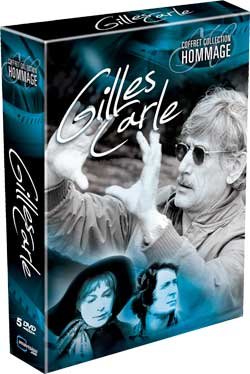
The fact that Gilles Carles is unrecognized might have to do that other then his film festival output in the 1970s and 1980s he has not received an international distribution or major DVD release outside of Quebec. Presently only five of his films and one of his TV-series, Les plouffe, are available on a unilingual French DVD’s that does not have English subtitles. The Coffret Collection; Hommage Gilles Carle only came out in September 9th 2009. And it was not until his death late last year that the NFB put up a few of his short films on their online catalog. Some of his other films are available on Ilico On Demand television. And a few others are available on VHS. With only these few films available, most of them purely for a French-speaking Québécois audience, Gilles Carle is truly on that other side of that roadblock.

The Coffret Collection; Hommage Gilles Carle set has been one of the most rewarding DVD collections I have had the pleasure to discover in a while. On it there is La vie heureuse de Léopold Z (1965), La vraie nature de Bernadette (1972), Les corps célestes (1973), La mort d’un bûcheron (1973) and La tete de Normande St-Onge (1975). The titles themselves anticipate these folkloric tales that are integral to the French-Canada mythology. As well they hint towards his blend of comedic irony and warm complicity in the troubling of the typical Carles protagonist. The southwestern Québec townships of his childhood are not only relevant in his biography but they play a prominent role in the locales of his films. The stories provide the opportunity for these locals with their exotic quétaine (i.e. Québécois kitsch) and joual (i.e. the working-class dialect) to be crystallized on film. Throughout the collection there is the depiction of the change in the province of Québec from the rural and catholic towards a modern, urban and secular society.

The latter films in the series have an Altmanesque quality as Gilles Carle uses genre and farcical characters to paint a colorful and riveting portrait of his idea of the Québécois community. The characters stand out with their odd wardrobe and irregular situations but there is a familiar quality to them. This approach differs from his earlier films iconoclasm, like Le viol d’une jeune fille douce (1968), as he moves more towards realism that allows an emphasis on the characters and the situations instead of the aesthetics. However eccentric the characters are, the inevitable fact that they are together makes them care for one another. This sense of community is the emotional bases grounded in the films of Gilles Carle. There is also a consistent theme of the return to nature and wilderness but as he demonstrates in La vraie nature de Bernadette; it is not feasible, and what the 1930s setting of Les corps célestes suggests, it never was.

His first feature, a short that was expanded to sixty-eight minutes, La vie heureuse de Leopold Z. is a tour-de-force of a snowplower Leopold Z. Trembaly (Guy L'Ecuyer) making his rounds on December 24th doing everything but snowplowing. The film was ostensibly funded by the NFB to be a straightforward documentary on Montreal snowplowing, which Gilles Carles subverted to create his dreamlike and snowy tale. Some of Leopold’s tasks include getting a fur coat for his wife, picking up his cousin and helping his supervisor move. The black-and-white cinematography dazzles and the bumbling protagonist seems to just float his way by on chance. Leopold takes out a loan to get his wife a fur coat. She kisses him on the cheek after he gives it to her. She then holds his hands before slowly moving it towards the coat. As much warmth is directed towards Leopold there is sly cynicism as Gilles Carle puts him through a lot of annoyances by the end of the day. This hand movement emphasizes the tension between the two.

La vraie nature de Bernadette is a real “director” movie as the elliptical story seems to progress in a way to illustrate a Carlien tableaux of the rural Québécois landscape with striking colors and irregular situations.


The next three films can be seen as the Carole Laure trilogy that examines femininity during the sexual revolution of the 1960s. Carole Laure in Les corps célestes is a virgin courtesan, in Le mort d’un bûcheron she is in search of her lost father, and in La tete de Normande St-Onge she is desperately getting her mother out of a psychiatric ward.

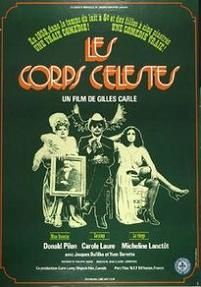
Les corps céletes is set in the pre-WWII days in Atibidi, as a pimp and his five prostitutes try to set up a brothel. One of the girls is frequently scared for the European Jews as she listens to radio broadcast of the demagogues, Adolf Hitler and Benito Mussolini. This is Gilles Carle take on Hannah Arendt’s theory of the banality of evil and Jean-Luc Godard’s one-time idea to make a film about a secretary at Auschwitz.

In Le mort d’un bûcheron, based on the 1913 Louis Hémon novel, Marie Chapdeleine (Carole Laure) moves to Montreal to find her estranged father. The only job she can get is that of a country-western singer at a nudie bar and then as a nude fashion model. Gilles Carles is making up here for the timidity of Les corps céletes, which only had a few seconds of bare breast. After finding out her mother died, by finding all the letters she sent to her returned by her door. She leaves with her boss, her fathers ex-lover and her generous neighbor to find her father dead at the lumberyard he worked at. All the while her exploitative boyfriend is trying to find her. They meet a serial killer in the woods.

In La tete de Normande St-Onge, Carole Laure moves from her job at a pharmacy, where everyone is really friendly with her, to kidnapping her mother from a psychiatric ward. Returning to her mother will prove to be detrimental to her mental health and social life, as she becomes a source of stress and a factor to regress from everyday life. Denys Arcand is great as the brother of Carole Laure’s mother.

What makes Carole Laure so great is both her sensuality and vulnerability. She is both sexy and exciting. It does not hurt that she also acted in Dušan Makavejev’s Sweet Movie (1974), John Houston’s Victory (1981) and André Forcier’s L’eau chaude, l’eau frette (1976). What makes her personality so interesting and Gilles Carle’s liberal worldview so fascinating is how sexuality does not impede on the sense of community. The brothel in Les corps célestes is a family oriented place and in Le mort d’un bûcheron Carole Laure has sex a few feet away from her adult friends. And none of this seems at all sleazy.


There is the element of cinema of attractions to his films as he interlaces them with non-narrative vignettes. For example, a dash of a musical-sequence here and real-time intercourse-sequence there. There is also marginal narratives. These two aspects of his work anticipates the films of Robert Morin and Lorraine Dufour from the Coop Vidéo de Montréal. The family oriented strip club where Marie is country-western singer is similar to the strip club in Robert Morin’s My Life is for the Rest of my life (1980), He has earned his wings (1981), and Yes Sir! Madame... (1984). The quirkiness of the Western club owner (Wilie Lamothe) seems like he could have been the star of Morin’s The mysterious Paul (1983). The street scenes share the same local as Morin’s The thief lives in hell (1984). And the western Les corps célestes falls into the genre of Québécois westerns like Morin’s Preliminary notes for a western (1989).

The works of Gilles Carles and other Québécois filmmakers exist in a film history of their own. Bill Marshall has a book Quebec National Cinema (McGill-Queen’s University Press; 2001) where he focuses on the French speaking “national majority” and the representation of its cultural identity. Québécois cinema is extremely fertile and is proud to boast such big names like Gilles Groulx, Jean Pierre Lefebvre, Michel Brault, Pierre Perrault, and Claude Jutra. What I find so interesting about the work of Gilles Carles is not exactly what he has to say about Québec but what he has to say about contemporary experiences, which resonates decades after their original creation. People should care for one another, sex is normal, relationships are tough, and there are a lot of obstacles we need to overcome. His work should be more widely accessible and should be more generously remembered.

*****

Elective Identities
The Canadian Film Institute hosted two Café eX screenings in July for a retrospective on the film tapestries of Gariné Torosisan. For me, Ms. Torossian’s work consists of self-portraits and homage’s that can be interpreted as self-portraits. I agree with Scott Birdwise when he writes that “Come Around partakes and what can be called a pneumatological imagination and process.” Just as Pneumatology is the study of holy spirits, Torossian’s work flickers between spiritual meditations and the means of self-representation. When she does not put herself in her films that position is passed onto one of her many friends and artists. All the while contemplating on her home country of Armenia and what it means and how she feels towards it from the position of a Diaspora Armenian.

To accompany the retrospective the CFI put out a book on the filmmaker Elective Identities: The Moving Images of Gariné Torossian, edited by Tom McSorley. The book is well worth checking out and can be purchased online through the institute. To order yourself a copy e-mail the CFI here (info@cfi-icf.ca). Torossian Short Film Programme I: Ferocities of Arrival, Early Works 1992-1999 consisted of Visions (1992), Girl From Moush (1993), Drowning in Flames (1994), My Own Obsession (1998), Passion Crucified (1998), Pomegranate Tree (1998), Find Your Holy Self (1998), Red Brick (1999), and Sparklehorse (1999). Torossian Short Film Programme II: New Millennial Memory, 21st Century Works 2000-2008 consisted of Platform (1998), Dust (2000), Hokees (2000), Babies On The Sun (2001), Death To Everyone (2001), Shadowy Encounters (2002), Garden In Khorkhom (2003), Hypnotize/Mesmerize (2005), Elect The Dead (2007), and Come Around (2008). It was a sublime experience. More people should have came out to enjoy them…


*****

Independent Canadian Filmmaking
It seems like this summer has been a major one for independent projects. In April the Canadian Film Institute projected Carlo Bruno’s supernatural road-movie In April (2009). In July, Scott Birdwise presented his experimental film Of Hands (2010) at IFCO’s third annual summer-time evening of experimental films Dogme Films 2010. Of Hands is a wonderfully photographed series of hands performing various tasks. Some scenes that stick out are of hands grabbing money, fingers wearing flamboyant jewelry, a lighter being lit, and the act of using a hammer. These observations are a microcosm for the most basic tasks within a post-colonial capitalist federation. This is Scott Birdwise’s second feature, the first being Smoke and Mirrors (2009) that played at the Dogme Films 2009. Patrice James wonderfully hosted the event at the Rideau street underpass.


This month on August 3rd, Lesley Marsland and Matt Miwa’s will project at Club Saw their short sci-fi comedy Captain Sorelski and the women in search of Spacegold (2010). Luke Ciesielski will be presenting the music video he made for local musician Adam Saikaley at the Ottawa International Film Festival, which will take place on August 21st and 22nd. Starring Lidija Marie and Candace Boivin’s bicycle the Golden Hawk. The Toronto directors Nathan Hynes and Chris Power and actor Anthony McAlister will be at the Mayfair Theatre on August 6th to present their cannibal pseudo-documentary Long Pigs (2007). These independent features will all be well worth checking out. I hope to see all of you out there.

I also picked up Lee Demarbre’s latest effort Summer’s Moon (2009) on DVD. Fellow Ottawa film-critic Joel Crary, who is soon moving to Vancouver, has written an interesting piece on the residing memories from, and use of, locations in Lee’s Jesus Christ Vampire Hunter (2001), which can be found here.

Finally, I am currently working on an instructional video for the French language department at the University of Ottawa. I am sure this series of seven podcasts will be keep me busy for this upcoming month. Expect less entries.-David Davidson