Showing posts with label Calvin Thomas and Yonah Lewis. Show all posts

Monday, August 26, 2013

The Oxbow Cure

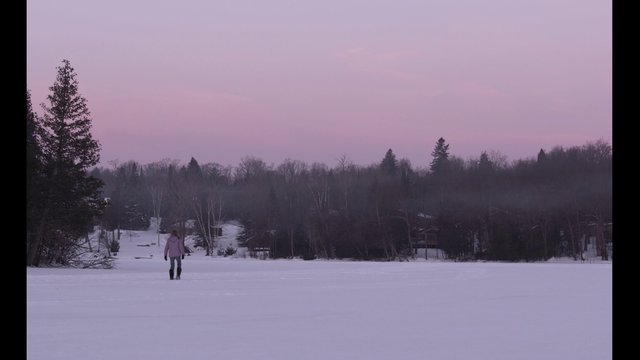
The Oxbow Cure is reminiscent of some Bergman dramas (The Passion of Anna): the characters retreat to a remote location, private fears are openly discussed, and the heavy existential themes are represented visually through the harsh weather.

It’s about a woman Lena, who has a spinal injury, and she leaves the city for a remote cottage, to treat her illness. There she starts a routine that includes exercises, walks, and cooking. She’s in touch with her father, who is hospitalized, and is dying. One night, she hears barking; following the noise she finds a trapped dog that she rescues.

The performance by Claudia Dey is exceptional; appearing both vulnerable and persistent as she treats her illness, and fearless as she walks through the forest. These scenes are filmed with a hand-held camera, and are both frightening and elegiac. The noises are especially harrowing as natural sounds, like, snow crunching and wind blowing, are reminders of Lena’s fragility. And the score by Lev Lewis goes from orchestral piano and strings to a P.J. Proby songs.

The Oxbow Cure is Calvin Thomas and Yonah Lewis’ follow up to Amy George, which is suburb drama about a teenager with a crush on a next-door neighbor. It might appear like a grand departure, but there are still some similarities. In Amy George Jesse has a photography assignment, and The Oxbow Cure begins with Lena taking pictures at the cottage. The walks through the woods in Amy George are heightened a ten-fold in The Oxbow Cure. And similar to how Jesse was seduced by Amy in Amy George, there is a beckoning in The Oxbow Cure that needs to be seen to be believed.

I’m not going to spoil any more of its mysteries. I’ll just say that The Oxbow Cure goes into some unexpected territory, gains in ambience from a theatrical setting, and richness through multiple viewings. What are these bold filmmakers going to do next?

Friday, August 23, 2013

The Oxbow Cure at the Lightbox (Opens August 23rd)


The Oxbow Cure is having its Toronto premiere and starts its theatrical run on Friday August 23rd at the TIFF Bell Lightbox. 
Recommended Reading:

Thursday, March 14, 2013

Festival Premiere: The Oxbow Cure

The 15th edition of the Sarasota Film Festival recently unveiled their line up for this year's edition, which will take place from April 5th to the 14th. It includes many great films, most notably The Oxbow Cure.

The festival has a good reputation amongst cinephiles as they play the latest acclaimed independant and international films. The festival director Tom Hall says of the lineup that it "is really diverse, we're trying to bring the best films to the community." For example, in the Narrative Feature Competition there is Matthew Porterfield's new film I Used to be Darker

The Independent Visions Competition is presented by Factory 25, the New York based specialty DVD company, and the section's jurors are Matt Grady, Alex Ross Perry, Michael Tully, and C. Mason Wells.

The Toronto directors Yonah Lewis and Calvin Thomas's sophomore feature The Oxbow Cure will have its world premiere in the Independent Visions Competition. The film stars Claudia Dey (the mother from Amy George) and the program describes the film as, "a portrait of isolation that is at once riveting as it is beautiful. Using the frozen landscape of the Canadian winter as a cinematic backdrop for Lena’s slow road to forgiveness, C&Y have created a poetic portrait of a women seeking to heal herself." This is one of the most anticipated films of the year.


Monday, August 27, 2012

Upcoming Canadian Films (+ Amy George & The Strawberry Tree)

The new Canadian films that I'm most looking forward to at the Toronto International Film Festival are: from Toronto there is Igor Drljaca’s Krivina and Kazik Radwanski’s Tower (both in the Discovery section), Sean Garrity’s My Awkward Sexual Adventure (Contemporary World Cinema), Simon Ennis’s Lunarcy! (TIFF Docs), Peter Mettler's The End of Time (Masters), Sarah Polley's Stories We Tell (Special Presentation), Blake Williams’s Many a Swan and Jean-Paul Kelly’s A Minimal Difference (both in the adventurous Wavelengths program, where, as an aside, they are also screening Lillian Schwartz's recently restored UFOs). From Montréal there is Rafaël Ouellet' Camion (Contemporary World Cinema), Denis Coté’s Bestiaire (Wavelengths), Anaïs Barbeau-Lavalette's Inch'Allah (Special Presentation), Bernard Émond's Tout Ce Que Tu Possèdes (Masters), and Xavier Dolan’s Laurence Anyways (Special Presentation).
In the Short Cuts Canada program there is Sophie Goyette’s Le futur proche, Ashley McKenzie’s When You Sleep, Theodore Ushev’s Apart, Deco Dawson’s Keep a Modest Head, and Aaron Phelan’s Dear Scavengers.
I’ll hopefully get to review some of these films later, after, when I’ve seen them. 
*****
Now onto discussing two recent Canadian films: Calvin Thomas and Yonah Lewis's Amy George, and Simone Rapisarda Casanova’s The Strawberry Tree.

In the newest issue of Cahiers du cinéma (N.680), Stéphane Delorme highlights what kind of traits Cahiers likes to champion: “intimate, and affectionate films, […] because of their ambition, richness, and generosity are worth infinitely more than prefabricated narcissistic masterpieces.” I can't think of a better way to start a review of Amy George as describing its treatment of a teenager wading through the difficulties of childhood as being intimate, affectionate and generous. It's like L'argent de poche meets Terry within that Baumbach realm of dysfunctional families but with the humor of The Color Wheel.

Amy George takes place in the Riverdale neighborhood where thirteen-year-old Jesse (the excellent Gabriel del Castillo Mullally), a shaggy haired kid usually dressed in a striped shirt and jeans, is given a school assignment, The Fearless Project. The project is to take a picture of something that best represents himself. The teacher's advice is “you can find something interesting anywhere… you just have to look around.” Jesse asks his parents for a new camera - more points if it's analog - so they bring him to a store to buy him one, and there the store clerk shows him a few tricks on how to use it. At first the curious Jesse tries to find inspiration walking through a park, on his solute strolls, he tries to find something of himself in the surrounding nature. He takes a stunning photograph of a pot in silhouette. Jesse even goes to the library to do some research on how to be an artist, and after some reading, he’s worried that he can’t be a 'true artist' as he hasn't yet experienced true suffering or as he reads in a book The Artist, “You can never be a real artist until you have made love to a woman.”

The challenges of the creative process aren't made easier for Jesse, who’s a single child, as his relationship with his parents is at odds. There is an awkward tension between Jesse and his parents, Tim (Don Kerr) and especially with his mother Sabi (Claudia Dey), as when he's not around she speaks about her concerns that he might be 'gay' or if he'll turn out 'alright.' One day when in the house a watch and money go missing, Sabi asks Jesse if he knows what has happened to them, and even though Jesse says that he doesn't and that his guess is that it was probably the maid - who they eventually, and wrongly, fire - his mother still searches his room, where she discovers that he hasn't been taking his medicine and finds his porno magazines. It is later revealed that it was Jesse's aunt, Tara (Natasha Allan), who stole from them, which was partly caused by her alcohol problem. Jesse's relationship with Tara is the core emotional bond in Amy George, and their conversations together, reveal his timidity and his anxiety of growing up. Jesse shares with his aunt his thoughts about his emerging interest in the opposite sex and how instead of paying much attention in class all that seems to be on his mind is girls. When one day the neighborhood girl he has crush on, Amy (Emily Henry, of the film’s title), is spending the afternoon at his family’s house - her parents are dealing with the police, after their own house has been broken into - the two of them flirt and play a game where he 'hypnotizes' her: where, when she is unconscious, he mischievously unzips her pants and touches her underwear. This is the kind of guilt that he can only share with his aunt. “Have you ever raped somebody?” He asks her, which is what he thought that he did. Jesse's lack of belonging and feelings of shame, guilt and teen angst will all come out in the final photograph that he hands in to his teacher - and it won’t be what you would expect.

Amy George's minimal score by Lev Lewis creates a mood of wistful longing (especially the song The Whole World by Michael Holt) and the somber cinematography by the directorial pair reflects Jesse's feelings of solitude. This dark cinematography seems like it is going to anticipate Calvin and Yonah’s forthcoming production: The Oxbow Cure starring Claudia Dey, which is supposed to be a lot more experimental. An important film to look out for.

*****
The local filmmaker Kazik Radwanski put together a list of First Generation filmmakers that, as he describes them, are a new breed of Toronto filmmakers whose uniqueness is that though they are informed by living in Toronto they shoot their films outside Canada. The First Generation directors that Kazik highlights are Igor Drljaca, Chris Chong Chan Fui, and Nicolás Pereda. And now after seeing The Strawberry Tree I would have to include the York University graduate Simone Rapisarda Casanova onto that list. The Strawberry Tree, which had its Toronto premiere at the Images Festival, is a hybrid documentary. Its subject is the village of Juan Antonio on Cuba’s North Coast and it depicts the rural community filled with fragile straw huts - one year before it was devastated by a category-four hurricane.

The Strawberry Tree is filmed in a poetic-ethnographic style that is really similar to that of the important Canadian documentary, Pierre Perrault's Pour la suite du monde. It is also similar to Andrés Livov-Macklin's A Place Called Los Pereyra as they are both naturalistic documentaries made by outsiders about a foreign community. But where Los Pereyra's approach is more anthropological and in the style of Fred Wiseman, The Strawberry Tree is more ontological and bizarre, in the style of Luis Buñuel. At first The Strawberry Tree is filmed in a tranquil, observatory style capturing the villagers of Juan Antonio preparing, singing, playing around etc. What at first is the capturing of natural activities slowly dissolves into the events that would be the center of attention would slowly gets pushed to the periphery, and it is what's going around these moments that become the center of attention. What is being shown is the physicality of the people and the characteristics of the village. Then there is almost a sinister twist: the beating of a fish, an eerie magician, the killing of a goat. Everything culminates at the end with the sight of the lightning and the thunder storm that would ravage the community. This uneasy sense of dread, of knowing what is going to happen to the village, and knowing that the villagers are going to end up alright, make The Strawberry Tree such a fascinating experience.