Showing posts with label Serge Toubiana. Show all posts

Wednesday, April 22, 2015

Toubiana's Eighties Editorship: French Cinema and Cannes


From the time he became the chief editor of Cahiers in 1981 until his departure in 1992 Toubiana wrote and published an estimated 230 articles which includes editorials, critiques, interviews and journal. What stands out from his critiques is how they are able to canonize films and directors into the Cahiers canon just by the fact that he was writing about them. The films that Toubiana wrote major critiques for stand out as ‘Événements’ as the film would usually be featured on the cover and the director would be interviewed. They would also later be cross-referenced as important films for that year. These critiques stand out both due to the strength and interest of Toubiana’s writing but also due to the fact that he was the patron of Cahiers. As a journalist-critic Toubiana usually cites interviews within his critiques and there is a loose quality to them. He cites dialogue from memory and acknowledges that it might not be exactly correct. It’s a writing that’s not always precise. There is also a lot of gastronomical references in his critiques which is a trait that recalls the earlier writing of Claude Chabrol. The critiques provide examples of what were considered are the most important French and international films of the year. There were two important areas of interest for Toubiana’s editorship of Cahiers in the Eighties – these are French cinema and the Cannes Film Festival. 
Of the first area of interest, French cinema, Toubiana wrote “It is French cinema that is our conjecture.” The French film industry was the terrain that Cahiers could most efficiently engage with and could help shape. The Eighties marked the return of French cinema at Cahiers. The important directors to spark this return are the older nouvelle vague directors with Godard and Truffaut at the forefront and then Rivette, Rohmer and Chabrol. Even though Truffaut died early on in the decade he would still retain an immense importance for Toubiana. There was a special Truffaut memorial issue.  His life and films would be honored, in the culture at larger and at Cahiers, with the re-release of Les Deux Anglaises as well as by the publication of Truffaut-related books like Hitchcock/Truffaut and his Correspondences.
This encounter with Truffaut also sparked a return towards an industrial French cinema. Among Toubiana’s best critiques are the ones where he brings a new generation of French directors into Cahiers pantheon. Toubiana published major texts, whether critiques or interviews, on the following French directors: Alain Corneau, Claude Miller, André Téchiné, Robert Guédiguian, Claude Chabrol, François Truffaut, Robert Bresson, Raymond Depardon, Jean-Pierre Mocky, Maurice Pialat, Bertrand Blier, Jean-Jacques Beineix, Claude Berri, Louis Malle, Jean-Luc Godard, Michel Deville, Pascal Thomas, Jacques Demy, Tonie Marshall, Georges Rouquier, Jean-Marie Straub and Danièle Huillet, Marguerite Duras, Leos Carax, Éric Rohmer, Patrice Chéreau, Jean-Claude Brisseau and Paul Vecchiali.
The second important area of interest for Toubiana and Cahiers in this period was the Cannes film festival. It was according to Toubiana “the grand window into world cinema” and through it the magazine could encounter and analyze emerging directors and the trends of contemporary cinema. By its coverage of the Cannes Festival, the biggest media event on film, Cahiers could evaluate the state of world cinema while at the same time improving Cahiers’ own visibility. 
Toubiana started to cover the Cannes film festival in 1981 and he continued to do so throughout his tenure. In 1992 was even invited to the festival as a jury member and this experience disillusioned him with regards to it. Toubiana also covered the Venice film festival but which he saw as second-rate due the lesser quality of the films.  Italy film didn’t benefit as much from government subsidies for culture which France had and which Cannes benefitted from. 
The festival coverage stands out for being critical rather than sensationalist publicity for the festival. The mediocrity of many of the films was mentioned and a there was frustration about the festival’s disregard for smaller but more difficult films. The directors favored by Cahiers were put in opposition to negatively viewed academic directors showing at the festival. The criticism by Cahiers of some of the film festival practices made its relationship with the festivals a little tendentious at times. This strong and dissident coverage towards the festival was rare within the often self-congratulating cultural sphere.
Toubiana’s first Cannes coverage, Un film-surprise dans un festival sans, was critical of the festival. “It was a sad celebration,” wrote Toubiana. “What bothers us the most this year are the films. There is a nearly total absence of cinema, of the strong moments of cinema.” Toubiana complained how the role of criticism was weakening in the face of the film’s publicity and promotional machines. This demanded in response an increased intensity in film criticism. 
Toubiana criticized a ‘dumb’ Mel Brooks film which received a popular reception and instead highlighted Skolimowski’s Haut-les-main which he discusses alongside Godard’s Ici et ailleurs. Toubiana wrote, “It’s their secret. They are manifesto and testament films about cinema. They pose Bazinian questions par excellence: What is this cloth which drapes over all of the images? What motivates the movement of characters? What is a cinematic image?”
Serge Daney had encouraged this dissidence. In a Journal contribution from 1987 Daney brings up how the 40th anniversary of Cannes was over-saturated with media. Daney sees the discourse of this over-mediatized festival as full of clichés that ends up not doing it justice. This is a failure. The dissidence of Cahiers is in opposition to the popular press and the polite notes of many professional journalists reviewing the festival. Daney argued that Cannes needs more criticism and less promotion,

It will not be enough as long as the television media will only present a soft positive perspective on everything that unfolds on the Cannes stages.  What is important is doubt, criticism and a negation. These taboos and criticism are actually what makes a film festival. There needs to be dirt, debates, polemics, proclamations and swoons because without these the festival would only be a simulacrum and nothing but noise. The festival only works through its negative moments – through a process that denies it. This is necessary for it to finally becoming itself. Through this negation there can finally be an event at the festival.

***

Cahiers and Truffaut : A Reconciliation

-->
In the early Eighties at Cahiers French cinema became a renewed area of interest and this was celebrated in their two special 30th anniversary issues (May and June 1981). Through these issues Cahiers were able to strengthen their ties with the French film industry and its producers, directors and actors. Even though articles on Godard had already been a standard feature since Daney’s early editorship now finally the rest of the nouvelle vague directors would become a renewed area of interest for the magazine.
In 1980 Daney and Toubiana met Truffaut in an effort of reconciliation as he had been actively neglected from the magazine. They discussed the new philosophy of the magazine and requested help with financing that Truffaut would help to arrange. After their meeting Truffaut would say that he now had an ‘open neutrality’ towards Cahiers. As a result of this meeting, a lengthy interview with Truffaut would follow and would be published throughout two issues in 1980. It builds upon the two previous interviews with Truffaut. (This makes Truffaut the less interviewed nouvelle vague director. The other interviews include with Jean Collet, Michel Delahaye, Jean-André Fieschi from December 1962 and with Jean-Louis Comolli and Jean Narboni from 1967).
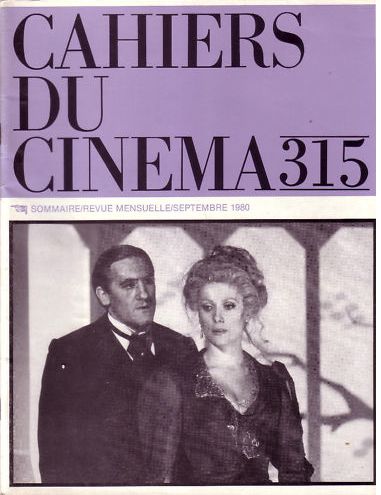
 The Événement film that sparked the encounters with Truffaut was Le Dernier Métro. The film was publicized on the magazine’s cover and a positive review, Une nuit au theatre by Yann Lardeau, was printed along with the interview. Truffaut, who represents French popular cinema, received an equal amount of attention as Godard.
The first part of the Truffaut interview by Daney, Narboni and Toubiana appeared in the September 1980 issue. The Événement was prefaced by Toubiana, Truffaut ou le juste milieu comme experience limite. The last interview the magazine had done with Truffaut was in 1967 (which was entitled, Le juste milieu) for Fahrenheit 451, and since then Truffaut made 13 more films.
Toubiana wrote,

There was thirteen years of silence or non-dialogue (there were some critiques of his films, but no interviews) between us and Truffaut because of our attachment to theory and our political chores. What we were looking for in the Seventies were what you could call limit experiences – far from the ‘juste milieu’ which preoccupied Truffaut.

Toubiana then argued that what Truffaut was doing at the juste milieu was a limit experience of the center of French society and film production. The extreme qualifier is that Truffaut was making the films that he wanted to make and he had the independence to make them through his own production company. It’s a paradoxical and contradictory proposition. Truffaut is not trying to distinguish himself from the other professionals in the French film industry but he’s not part of the Qualité française which he in the past denounced. Toubiana’s perspective offers a different way to look at Truffaut’s more conventional works. Cahiers was in perpetual evolution and it constantly tried to gaze beneath the surface of things.
In the interview Truffaut was very frank and modest. On his work as a director he said, “Finally, what makes me the happiest about cinema is that it gives me the best job possible.” “I don’t see an incompatibility between the terms auteur and professional.” “I work better with director-producers that work hard - Rohmer, Mocky, Berri – than with those that complain like spoiled children that deserve everything.” On Godard, who he thought was ‘compulsively jealous,’ Truffaut undermined his more high-minded statements by showing the simple, uncaring arguments behind them:

When Rivette received one of the largest advances on receipts - 200 million for four films - Godard went after him in Pariscope. ‘The pleasure of Rivette is the same as Verneuil but it’s not mine. Rivette has no longer any humanity.’ And then it was Rohmer’s turn when everyone admired La Marquise d’O, Godard criticized it. When Resnais won six or seven Césars for Providence, Jean-Luc, as you can expect, turned against him saying ‘Resnais hasn’t made any good films since Hiroshima.’

On his distancing himself from Cahiers, Truffaut said “I’ve stepped back from Cahiers since the day where I made my first film. I had the sense of changing camps [from critic to filmmaker].”
The interview with Truffaut signaled a major shift at Cahiers from Daney’s often enigmatic editorial stances to Toubiana’s more populist ones. Godard would not necessarily be dropped but he would no longer be as fetishized. Truffaut and other popular French directors would start to get equal coverage. Cahiers and Toubiana, drawing from Bazin, Truffaut, Hitchcock, and Chaplin, would show how strong personal art works could be created within the popular film industry.

Thursday, February 26, 2015

1992 – Serge Toubiana Leaves Cahiers


The year 1992 represents a culmination and turning point for Cahiers: its intellectual guide since the mid-Seventies, Serge Daney, on June 12th dies of AIDS at the age of 48, and its chief-editor, Serge Toubiana, after a disenchantment from finally experiencing Cannes as a jury member, in October resigns from his position. Toubiana in his modest farewell Passage de témoin (N.460) – one small paragraph, on the same page as the table of contents –, writes, “For more than ten years I’ve directed this magazine, and I believe that I’ve allowed it room for new developments. But I couldn’t have done it without a close team of friends, and their complicity.” Before leaving, in the previous couple of years, Toubiana updated the layout of the magazine and added new features to the magazine[1], Cahiers celebrated its 40th anniversary and they would publish a two-volume history of its first thirty years (1951-81), and a new generation of critics were slowly arising to prominence at the magazine and where Thierry Jousse, who was appointed the adjoined chief-editor in 1990, would finally take the helm. It’s a new decade, and the previously mentioned events closed the Eighties, and the current decade seemed like it is up for grabs.

Toubiana would organize an important special issue dedicated to Daney[2] that consists of 38 testimonies by fellow critics, friends and filmmakers. These testimonies and the publication of two of his essays – one of his first, on Rio Bravo, and the other regarding the launch of Trafic – highlight his singularity and value in the French cultural sphere as well as his importance at Cahiers, which he always saw as his maison-mère. It is only the second time, throughout a sixty-year period, where a sole critic (excluding critics-turned-filmmakers) received a cover of the magazine, with the first one being on one of its original founders André Bazin (N.91).[3] The issue, which is gorgeously illustrated, and attest to Daney’s love of travel and friendship with a myriad of filmmakers, is described by the rédaction in its opening editorial, “This issue is the sign of our loyal friendship, and admiration to Serge Daney.”

The testimonies in this issue provide a good portrait of Daney: they trace an evolving human being who conceptualized the relationship between politics and art within a new media sphere; they address the importance that he stressed on dialogue and work within a group; as well as his love to travel. There is also a lot regarding what characterized his editorship of Cahiers from 1974-1981.

In Toubiana’s entry, Parce que l’amitié!, he recalls first meeting Daney in 1972 at a point where he wanted move away from gauchisme, and the strong political fervor that arose from May ’68, towards something new. On their early encounter, “In reality, we were so different… But deep down, we both shared a friendship, we were also poor together.” On this early Seventies period and Daney’s editorship,

Serge ‘inherited’, despite himself, the magazine. With his back against the wall, he improvised and, after a bit of experimentation, was able to put the magazine back in place on a much better trajectory… Serge accepted my help, more out of friendship than necessarily my competence. We had a tight alliance, sharing for many years the same somber office, which was already at the Bastille. At the heart of this alliance, he brought the essentials: principals, an immense culture, a project for the magazine founded on the desire to accompany the strongest, and craziest, experiences of the cinema.

Toubiana highlights what Daney brought out in others and the impact that he had on himself,

I always admired with Serge his way to highlight the importance of things, and to oblige others, like myself, to rise up to this level. I feel like I’m missing him already, that I won’t have anyone to talk to, except for his memory, when I have my doubts on a film, a book, show or other things, simply put, when I have a personal choice to make… For Daney, who, regarding whatever the film, thought so strongly and naturally about the frame, he might have not known how much he helped me, like he did so many others, to help frame my life, and my relationship with the cinema. It bothered him still recently, when he asked me what I would become, while all the while he was telling me that my time was coming to accomplish something…

Claudine Paquot, the general secretary of the magazine[4], highlights how the deux Serges in 1978 would meet her, and how Daney would think that the magazine was missing quelque chose and that she would bring to it a fabrique d’une revue, which would include an open new layout and more pictures that would enrich the texts. Paquot would highlight Daney’s dictionary entry on Italiques in their 30th anniversary issue as just one example of on how they would put together an issue.

Paquot highlights Daney’s generous personality and the personal impetus of what it meant to carry the Cahiers identiy.

And your voice never lacked generosity to discuss Cahiers, its history, its raison d'être, from its largest projects to its smallest notes... First, at the Cahiers office, in a reconverted floor at the Passage de la Boule Blanche; the pleasure of reading all of the pieces, discovering ideas, the quality of style, the work of a critique; precise syntax, the right word, perfect orthography, and especially the respect for each proper name, verifying in its original language, as a sign of respect (Ouch, the day where I spelt it ‘Minelli’! – N.328, Pg. XV).


[1] Including: Nouvelle du monde, Image(s) du mois, Portrait, Séquence du mois, Actuelles, Chronique, Hors-Salles.
[2] Cahiers, July-August 1992 (N.458).
[3] These special eulogy issues, which highlight singular figures in the Cahiers history, would have an importance in Toubiana’s editorship: As a way to look backwards and to reflect, as well as to use these figures and their lessons as guides while moving forward. There would be Hors Séries homage issues on Alfred Hitchcock (1981) and Francois Truffaut (1984) after their death, as well as featured dossiers on Orson Welles, John Cassavetes and Sergio Leone, throughout the Eighties.
[4] An important figure at the magazine in this period as she would work closely with the new writers and help them through editing, and refining, their reviews, before she would move on to the Cahiers book publishing department. When she died in 2011, Stéphane Delorme, the current chief-editor at Cahiers, would feature an homage to her, with contributions by Toubiana, Alain Bergala, Thierry Jousse, and Hélène Frappat. On Paquot, and Clotilde Arnaud, who was in charge of their administration, Toubiana writes, “Serge Daney and I wanted to re-launch the magazine, to give it a redactional and economic bases. These new recruits, ‘les filles’, were going to help us.” (Cahiers, July-August 2011, N.669).

Serge Toubiana's First Important Editorials

(Cahiers du Cinéma,  n°307 & n°326)

Monday, July 28, 2014

Two Departures at Cahiers (Serge Toubiana and Charles Tesson)

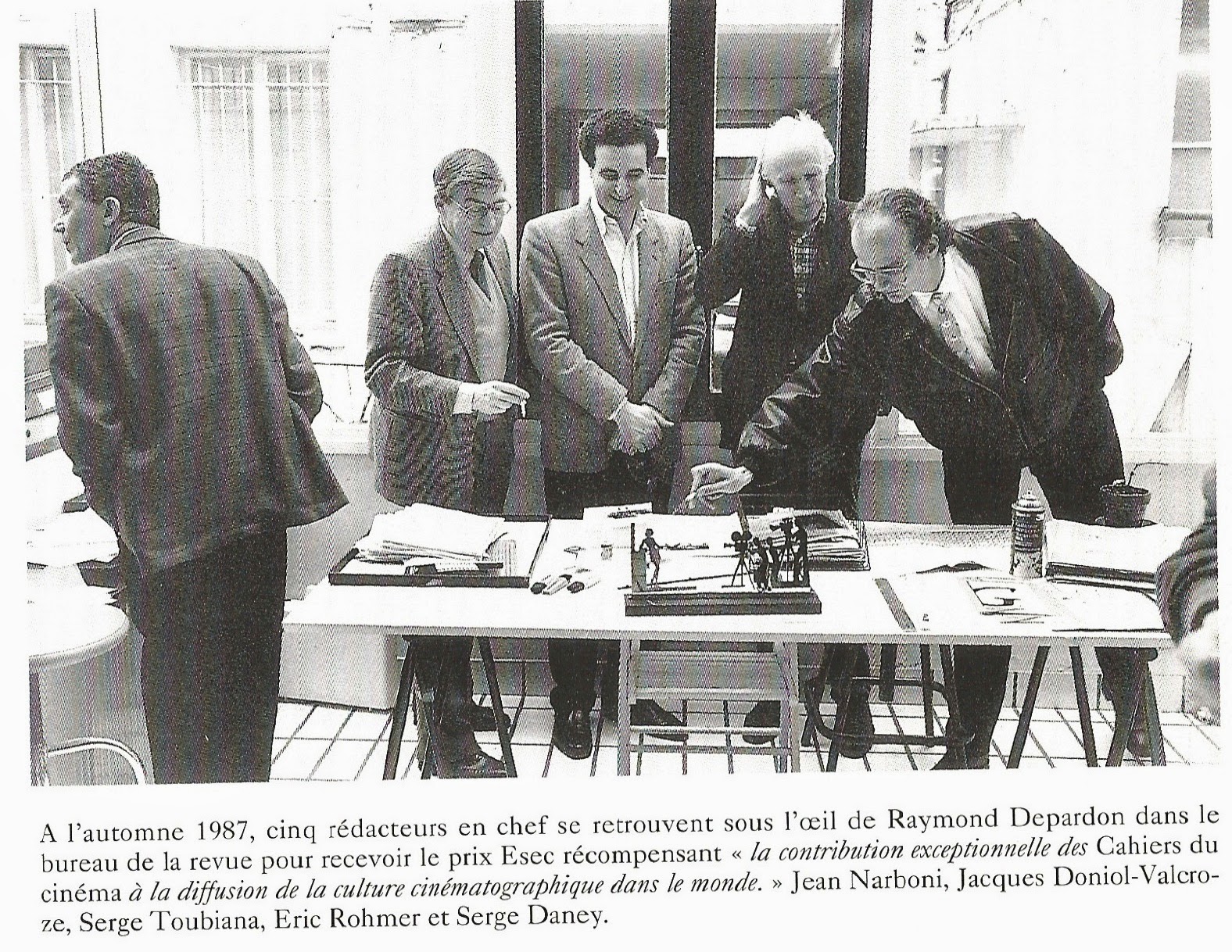
Everything good comes to an end. And there’s always something next. Serge Toubiana, who miraculously re-launched Cahiers in the late Seventies, and then spent over twenty years there as the chief editor, sometimes with others, spearheaded it to the forefront of relevance, reconnecting it to is past glory, and successfully made it more international. His legacy is important there today in the Stéphane Delorme years even though this influence is invisible. It is one of unabridged cinephilia, generosity, seriousness and criticality. As the director of the Cinémathèque he brings the heritage of the magazine and of cinema to a national and international level. As his recent interview in Cahiers (N.699) attests he continues a tradition started with Henri Langlois. Toubiana might be less known for his criticism (though some of his critiques are amazing, the one on Deconstructing Harry comes to mind) than for the guiding and composing of the issues, evolving with the times, and recruiting and refreshing a good team of film critics. He imposed himself on the issues through his pressing editorials, Cannes coverage, and by the implementation of the Le Journal section. Serge Daney would be his intellectual and spiritual counter-part. So where Daney kept on the Godardian tradition of cinema as a tool of social protest where images held a Bazinien ontology that interrogated the world, Toubiana kept the Truffautian tradition of spectatorship reverie, biting polemics, and of an optimism mixed with melancholy. The book Postcards from the Cinema (unfortunately out-of-print), which is a lengthy interview between them, concludes their beautiful friendship. When the magazine updated it’s format in the early Nineties and they featured Jacques Doniol-Valcroze it was a subtle reminder of this mise en page tradition that Toubiana himself was keeping on. As well with Antoine de Baecque’s two-part history being published in this period this was when a Cahiers self-consciousness was emerging.

If one looks at the subsequent chief editors one can make certain assumptions of their guiding taste by the representative American directors they most associate with: For Thierry Jousse (‘91-‘96) it is David Lynch, Antoine de Baecque (’96-’98) it is Tim Burton, Charles Tesson (’98-’03) it is Martin Scorsese, Jean-Marc Lalanne (’01-’03) it is James Cameron, Emmanuel Burdeau (’03-’09) it is M. Night Shyamalan, Jean-Michel Frodon (’03-’09) it is Clint Eastwood, and for Stéphane Delorme (’09-’14) it is Steven Spielberg.

If Tesson’s editorialship is so highly regarded it’s for the generosity of his prose, knowledge of Cahiers history, and openness to a social and poetic cinema. It stands in opposition to his successor. Some problems with the Frodon editorialship includes: a self-important tone, too much reliance on the business instead of the art of cinema, too much reliance on journalism instead of criticism, not having too strong of a personality, being guilty of a weird favoritism, poor economic practices and unsuccessful managing of the magazine, and branching out the magazine too thin by exploring new outlets, publishing and distribution. His contribution to the Les petits Cahiers on “Film Criticism” is especially unnecessary. But it was also a complicated post-9/11 period with the rise of the internet and its new register of digital images, the growing DVD market and the autodidact cinephile, and the declining relevance of cinema as a social-communal past time.
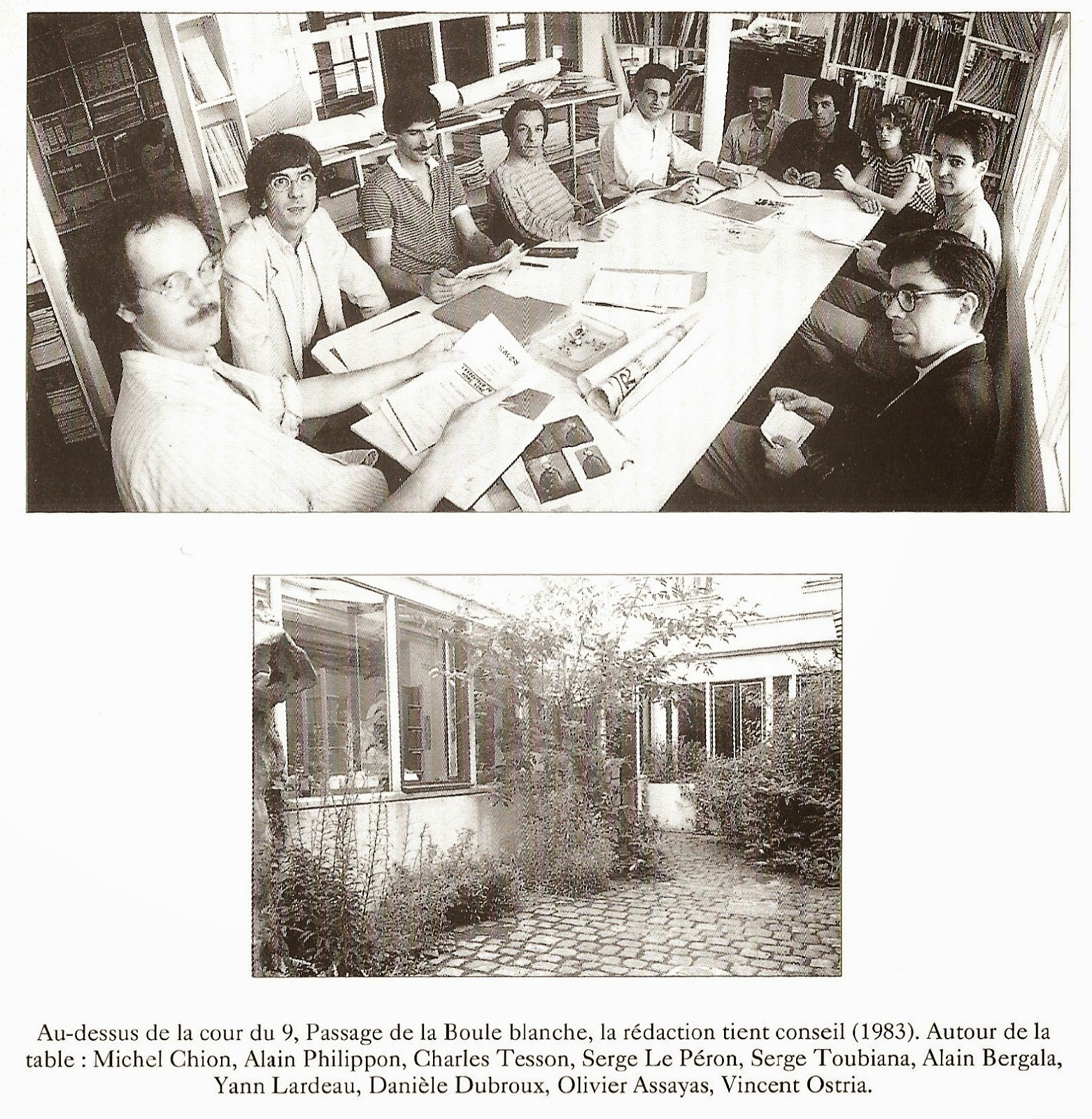
Tesson, on the other hand, is a pure Cahiersiste. It is a spirit that animates the magazine from within (see how he refers to the magazine as having a heart) and it comes from a place that holds the magazine at a very high esteem – an instrument and measure of the cinema and of our times. In his texts he shares the personal experience of being within – almost like a making of (c.f. Fissures at Cahiers). Tesson now programs at the Critic’s Week at Cannes which continues his criticism in a different register. He has a close relationship with the Delorme editorialship as he programs the films Cahiers champions and sometimes contributes to the magazine, notably his piece Peut-on être rohmero-rivettien? in the Rohmer memorial issue (N.653).

The following is Toubiana’s farewell letter from when he left the magazine in 2000 and Tesson’s when he would leave too a few years later. – D.D.
***
Aux lecteurs,

It’s with sentiment and friendship that I inform you of my departure from Cahiers du Cinema. I’m leaving in effect, at the end of February 2000, my post of chief editor, as well as co-runner of Editions de L’Etoire. This decision has been brewing in me for the last few months. I needed to make this decision, and it was difficult to make. One never easily leaves a magazine, especially this one, where one has spent twenty-five years of the important years of one’s life. But it is now the case… I’m relieved that others, those who are younger and newer, are assuming to be in charge and to guide, orient, and enliven this magazine that we hold in such high esteem, you and me. Cahiers imperatively needs a new spirit, a new perspective, because the cinema is changing, evolving, transforming, just like its environment. A new spirit and a new dynamism, founded on a critical approach and oppeness, because at Cahiers, more than elsewhere, is entrenched in this experience for half-a-century. The history of this magazine, rich and fecund, allows to imagine the present and the future with serenity and confidence. There is then all the reason to believe that Cahiers will soon be ready for this new start, that its rendezvous will be met this year, 2000. Its writers see themselves as reinforced by the arrival of Franck Nouchi, who will be in charge of the direction of the magazine, with beside him Charles Tesson. He is coming back to prepare a new format to the magazine, to respond to your expectations, and those of the cinema. I wish them good luck, and I address you, dear reader, my most loyal thoughts.

Serge Toubiana
***
Aux lecteurs des Cahiers

The editorial that I wrote for the summer issue (N.581) ended with serious thoughts about the obstacles that was shaking up the magazine last January (a project to reorganize the editorial team) where we proposed to share our solutions in September. The editorial of September, which was signed by Jean-Michel Frodon, who was named the director of the magazine on the first of July, was itself an answer to the previous editorial. His nomination to a poste that was removed since the return of the magazine to Le Monde where Franck Nouchi ended entirely my functions as chief editor all the while giving them to Jean-Marc Lalanne. Since then, there has been more changes: departure of Lalanne, which was voluntary or was expected by several writing comity members, and instead there was the nomination of a new chief editor, Emmanuel Burdeau, who himself was an old member of the writing committee…

At the time of leaving this magazine, I wanted to saw a few things. My first thought goes towards the reader, numerous, anonymous, and familiar. There is the writer that one imagines and that we are addressing when we put together each issue. There is the other one (the same?) who is there (even though he might be invisible) when we write. We can write a review by addressing the film, cinema in its entirety, to be read by the director, or even with the desire (crazy, but actual) to be read by such and such actor or actress. There is no true art of aimer without a certain (critical) sense of declaration, for its form and its depth. We can also write for those who are no longer with us (the dead) or just for oneself (a long monologue to help guide the cinema or to thank, ad infinitum, the vital pleasure that is procured of renewing one’s relationship with cinema). We can be attached for one’s whole lifetime to only one aspect of this writing or by changing, according to the nature of each film or the times or one’s relation to them. Adressing others, however the form it takes, seems to me to be essential. Without this conscience towards others (to convince, enlighten, share an emotion, build upon its foundation, etc.) there is no veritable critical impulse. History, in its long form, and not being lonely, and to share with words, with films, is one of the pleasures that makes life livable.

My second thought goes towards those who I've worked with at the heart of this magazine (who I've met and learnt to appreciate, and to those that have I've become friends with, which I'll need to thank Cahiers for bringing us together at an important time in our lives) as well to those that I've had the pleasure to meet, whether it is in France or at the four corners of the planet, through the function that I've occupied. A great moment of happiness for me were the exchanges with those, who were really attached to the magazine, that wanted to dialogue with those that contribute to it, and not only through written correspondences. That said, internally, once we start to have some responsibility in creating this magazine, everything changes. Because the job of being the chief editor is one that is learnt and it has strictly nothing with that of the exercise of criticism. Because the pressure is there, and it's enormous. Because one has to learn within the heart of these multiple tensions, between the divergent points of views and the sensibilities of the writers expressions. And especially, being able to accept and overcome them, as soon as they manifest themselves at the interest of the magazine, so that it can become a living space, that is also rich in contradictions. So that it is not a space that is too homogeneous (the terrorizing and terrorist phantasm of a sole editorial line, where truth is incarnated in only one person, with an uncomfortable corollary, which leads to a written film criticism that is cloning and uniform, within an absolute and unique model) nor too heterogeneous (the heteroclite cohabitation of diverse interests, in a Proteus form, for a reader that can't make sense of everything, who is usually a minority, and who would not be able to draw pleasure). In the context and with the conditions that were particular to my experience, between the participation and majority financial takeover of the magazine by Le Monde in 1998 and my nomination to an important role of responsability that lasted until July 2003, I've tried to bring my best all the while sharing the task and responsibility with others. Between 1998 and 2003, amongst a changing team, I've with Antoine de Baecque (up too April 1999), with Serge Toubiana (up to January 2000), with Delphine Pineau (up too September 2001), with Frank Nouchi (from February 2000 to December 2001) and then with Jean-Marc Lalanne, starting in October 2001.

My last thought goes to two people, who if it wasn't for them my adventure at Cahiers, fabulous and unique more often than not, awful sometimes, would never have happened. Serge Toubiana, firstly, who, in May 1998, proposed to me to work beside him, as the director of the magazine and then as its chief editor. And afterwards Serge Daney. I started out just reading him, I followed at the time his courses on the cinema at the Censier and I've confided in him my desire to write at the Cahiers, a crazy dream (but true nonetheless) because I was really intimidated, see very perplexed, with the idea of concretely sharing the pages with those that I've enormously appreciated their writing  (aside from Daney there was Oudart, Bonitzer and Narboni). One day, Serge Daney sent me a message (I didn't have a telephone at the time), marvelously laconic, that only said this: "there are two or three films that Cahiers risks not discussing in their next issue. For you to see them." In this list of three films, there was a Japonese film, An Actor's Revenge by Kon Ichikawa. I saw it at the cinema on that day, and I wrote the critique in a rush, and Serge Daney accepted the text immediately, without any hesitation nor any modifications. It was published in the June 1979 issue (N.302). I was then the happiest that I can be. For a long time, a really long time, writing at Cahiers, being part of this magazine, to be installed more or less comfortably in its lifespan made me happy. What more could one ask for? Shortly before the death of Serge Daney in 1992, between other things, he confided to me his surprise and regret that I never got the chance to further excel and take on more responsibility at the heart of this magazine. He had his own thoughts on this issue. I explained to him the diverse reasons. Without knowing it, several years later, Serge Toubiana exercised Daney's wish, which was also my own, but sadly arrives negatively, because Daney didn't see this, which is a regret. The world is sometimes good to you even though life in general, under certain circumstances, with no relation to the other things that are going on, can show itself to be cruel.
To the reader of Cahiers, which I was once one, with fervour and passion, directly, starting in the mid-Seventies, month after month, and then the catching up as much as I can with all the ancient issues that were available. So before I even started writing and reading it, in a different life but with the same sentiment, then joining and participating in its elaboration, and becoming attentive in a different way to those that read it and to the remarks of those that write here. To be finally under the obligation to quit these responsabilities for good does not leave one indifferent, this goes without saying. But at Cahiers, where one becomes tied to an intricate bond with others and the network that one creates - with the past, present and future - never leaves one indifferent. Except when the unsaid makes on cringe (irritation, a bad conscience) and the explicit also bothers (unanimity, and the misplaced).

It was my status of a young subscriber to this magazine that I owed my first visit to the Cahiers offices, which was already at Boule-Blanche, because I need to ask for why each month I was getting the magazine so late when it was already on the newsstands. Going through the office doors has become for me a regular ritual with slight variations depending on the occasion: bringing in an article, to learn about press screenings, to take part in a group meeting or to attend an informal discussion on a film that’s puzzling the magazine, with the desire to discuss or to run the risk (sometimes) of bothering them, depending on the availability. Before knowing how it is like from the other side, to live through the transition into the team, as a paid writer. I don’t need to get into what it’s like to join Cahiers and what that experience was for me (that’s another affair, another story, which is really complex, and that I’ve interiorized. I have the feeling of having lived there during those months, constructing its table of contents and pages).

To be a reader of Cahiers, that is what I’m returning to, like before, but also not like before. It will be a new pleasure, that I haven’t experienced for a while (that of not knowing what will be in the next issue), which will be richer because of what I’ve experienced at the heart of the magazine.

It’ll be a new chapter for me of reading Cahiers, attentive, exigent and engaged, like always: reading it is a critical activity in itself, a prolonguement of the gesture that created this magazine, transmission.

Charles Tesson, December 2003.

Serge Toubiana on 40 Years of Cahiers

When I met Serge Toubiana it was at the gift store that I work at. It’s in a cultural organization and I just got the job of also ordering the books and DVDs. He was just a customer and he was talking about visiting from France to see the Burton exhibition and that it was going to travel there. He introduced himself “Toubiana, Serge.” Cool! “I read your blog!” I ask him, like I do to every French cinephile (there aren't many that come through here), do you read Cahiers? What do you think of the new Cahiers editor and team (without knowing that he used to be there for a long time). Oh you like it? Still young, I thought that people were just meant to criticize Cahiers because that's what the older American critics did (cf. Cahiers Criticisms) and I bring up that one of its past writers was complaining about them on the internet – something regarding how they were wrong about their rave reviews of The Other Guys and Machete. He laughed it off. But I still feel bad that I criticized them and since then I've tried to make it up by talking and writing about their recent years. Every new issue is really good and it's my favorite monthly film magazine. If at the time I knew more about who I was talking to and more about what Stéphane Delorme was trying to bring to the magazine I’m sure the conversation would have been different. Anyways, Mr. Toubiana was nice and I purchased the copy of Truffaut that, by chance I prominently displayed, and he kindly signed it. There aren’t many direct bonds between Toronto and French cinephilia (with a few exceptions on social media) so if I blog a lot about French film criticism and on Cahiers today it’s to create and strenghen a bond and to make up for that earlier gaffe. 

Right now I'm working on my MRP which will be on Cahiers in the Eighties and their relationship to American cinema. This period is too little explored and I think it’s essential to understand the magazine today. As I plan to argue Toubiana and Daney’s reconnection with Truffaut was the catalyst for their shift from purely intervention and third world films towards cinema in its entirety, and they needed to catch up and the media landscape had rapidly evolved. Daney on Toubiana when he left in 1981, “He has a precise idea on the magazine: to return it towards the center of cinema. This idea has a future. My idea is less clear, not really defined, more vagabond. It is better if he realizes his goal, even though I don’t share with all of his decisions.”

The following is Toubiana’s essay ten years onwards after taking the helm, L'âge de déraison (The age of unreason), it's one of his most reflexive pieces, from their special 40th anniversary issue (May 1991, N.443-44). - D.D.

***
L'âge de déraison

Cahiers is now forty years old! We had to get ready for this anniversary during the last few months and we wanted to avoid the “commemorative” aspect of it. Instead we wanted to seize its joyous pretext to further enliven this magazine towards the present. Cahiers like a site of passage, and not like an “institution”: that’s it, this is what we were thinking. And then, people’s sentiment about the magazine are not the same, and I’ll assume vary from the old writers to the contemporary ones. Amongst the young ones, I bet that they can’t even imagine being attached to a magazine for forty years! They are hardly even half of that! For me, being the age of the magazine, and having grown with it, it’s different.

What astounds the most, is this strange sentiment that Cahiers, is never more than a small group of people, during each period, who decide to be responsible. By choosing how it will brand itself by picking who it will identify with. This has not always happened without there being tensions and creating friction amongst people. These groups don’t always get along with those that have contributed to it in the past, the “Cahiers family” is large. Truly, how many successive generations are there really to have passed through this “site of bearing witness,” which is Cahiers?

This magazine is a site of passage and of writing, or of cinema apprentice for those that take the leap to the “other side of the mirror.” For this current generation, there is the sentiment of speaking or writing in a long history that includes those who have already spoken, and already written. Differently, depending on the period and by temperaments. This is what makes us feel that there actually exist a “history” to this magazine, with its past, the glorious and non-glorious years, and a present that is unfolding, but which is harder to define. There is a tortuous filiation, that even though there are changes and an evolution, there is a common unifying trait to defend and love: the cinema.

These forty years for Cahiers, we wanted to mark them with this sign that animates its writers for the last ten years: openness, curiosity, and questioning. Two issues divide this period, but presented in a unique form, emerges at the occasion of this anniversary. In one, more than one hundred filmmakers, actors, artists and producers tell their memories about cinema. The ensemble draws a strange constellation that is deep down harmonious: the “I remember…” becomes a pretext to share a little story, a brief movement, that is intense too, where each of us and others get to tell our story…

This other issue – the one that you are holding in your hands – there is also this movement, deep down, which returns towards the past, and which draws several points of passage between the different periods of the magazine. And which returns towards the present: the present of cinema and the present of Cahiers.

What surprises, is to what point being part of Cahiers changes that trajectory of people, individual paths and those of collectives. They don’t always resemble their period, but usually they do. The Nouvelle Vague, for example, which associate so well with this passage, this major shift, from the black and white of the after-war years and the end of the Fifties, towards the bright colors and euphoria, towards the “new cinema” of the early Sixties. But also the other periods, where the heart of the writers use the magazine as a tool of investigation, an arm of combat, a space of passage. With each new group, there are strong relations, and a passion for cinema. A gamble of “all or nothing.” All the way towards and even during the Seventies, where Cahiers lived their “maoiste” period, alone against everyone, after severing themselves from an established cinema. Of course, with patience, we were able to return to an equilibrium.

To be forty years old in 1991 necessarily forces us to interrogate the future of cinema. To ask ourselves if there are still a few good cards to be played, to live new adventures. Are we optimist? And at what cost? Cinema no doubt has a big field in front of it, on the condition that it does not trip too much on itself. That it does not fall for the game or looks too much at itself, which is caused by a “catch-all” audiovisual terrain. That it knows that through a facilitation towards new funds and mediums, it’s its identity itself that could be put into question. For ever. Its horizon would only enlarge on the condition that cinema remains on its guard and remains vigilant. Cahiers counts on helping this.

To turn forty in May (some will no doubt notice a light shift in the history: our first issue actually came out in April 1951), is to say right during the Cannes festival, implies the idea of a celebration. With its friends, Cahiers proposes an rendezvous on May 18th, to celebrate this unreasonable age.

Serge Toubiana

Whoa ! (Serge Toubiana on France Inter)

“Greed has poisoned men’s souls, has barricaded the world with hate, has goose-stepped us into misery and bloodshed. We have developed speed, but we have shut ourselves in. Machinery that gives abundance has left us in want. Our knowledge has made us cynical. Our cleverness, hard and unkind. We think too much and feel too little. More than machinery we need humanity. More than cleverness we need kindness and gentleness. Without these qualities, life will be violent and all will be lost....” – Charlie Chaplin

“Is your spirit melancholic?” asks Éva Bester*, and Serge Toubiana**, in a lucid manner, describes how sadness can take over him, though never in a debilitating way, and how he eventually overcomes it and finds pleasure. The conversation brings to mind the tape-recording scene in Manhattan. One can sympathize with Toubiana as he shares not-usually-discussed real human anxieties on life. Some conclusions that he draws is that being melancholic is normal and solitude is important, but regardless one must experience life and engage with the world. One comfort: films. Chaplin’s The Great Dictator, “Which is made all the more relevant today with what is going on in the world.” Chaplin’s speech of peace and acceptance, spoken to the world against the darkness that would befall Europe, has urgency and is inspiring, traits that he feels are lacking today. Toubiana describes Chaplin as “an absolute genius of the 20th century”, and has worked on the MK2 Chaplin DVDs. Listening to him brings to mind Jean Narboni’s great book on the film Pourquoi les coiffeurs? (Capricci), Eric Hobsbawm’s Age of Extremes (which has a still from it on its cover), and the upcoming The Charlie Chaplin Archives (Taschen). Toubiana then transitions the conversation towards Chaplin’s last film A Countess from Hong Kong, which was a commercial and critical failure, but that is actually one of his favorites and that's what he told to one of its stars Sophia Loren when he saw her. It's a passionate cinephilic gesture that recalls Henri Langlois' contribution on Land of the Pharaohs in the Fifties Cahiers Hawks dossier. Toubiana’s blog at the Cinémathèque is a great resource, too. Toubiana continues on Godard’s Pierrot le Fou, one of the key films of his life, and La Strada, a terrifying experience that he elaborates on in Cahiers N.700 (which aligns him with the stradistes). His childhood in Tunisia. How he forgets. Jerry Lewis. La Maman et la Putain, “One of the greatest French films.” 

There is a great story about François Truffaut, which Toubiana describes as being an important experience for him. In 1975, after taking over Cahiers a year earlier with Serge Daney, they go see Truffaut, who was angry at the magazine, and after they speak Truffaut tells them, “You should never have made Cahiers an ultra-leftist Maoist magazine. It’s unreadable and too theoretical. That’s not what Bazin wanted. You should have created another magazine.” And, “I’ve listened to you, and moving forward I’ll have an open neutrality towards the magazine.” This was Truffaut’s way to test them and to see if they would change. It was the start of the magazine’s return towards its original cinephilia (Truffaut would help them get financing, too). Toubiana describes how the Eighties Cahiers interview with Truffaut was a highlight of his career and it was the start of a truly valued friendship. Since Truffaut’s untimely early death (he was only in his fifties), Toubiana at the time featured an issue of Cahiers on him, wrote a biography (with Antoine de Baecque), and now there’s an upcoming Cinémathèque exhibition. One can see the Truffaut influence at Cahiers in this period through their reconnection with the original nouvelle vague but also on some of their miscellaneous interest, in particular that of a sensitivity and representations of childhood. For example, there is the cover feature they dedicated to E.T., which after seeing it at Cannes, Truffaut reportedly send Spielberg a letter that said, “You belong here more than me.” (Godard, on the other hand, aligned himself more with the American cinema of Woody Allen, who he would cast in his King Lear). Spielberg is also important at Cahiers today and whose reevaluation started in the Two-thousands (in face of reluctance since some of its past chief editors like de Baecque and Emmanuel Burdeau would never be described as Spielbergian.). Toubiana is a big fan of Raymond Devos, Andy Warhol (“he understood that we’re living in an era of reproduction;” and Toubiana also owns a revolver drawing and a Campbell Soup painting), Aragon (he recites a great poem), Charles Trénet (they play the song Boum, and Cocteau was also a fan), Sils-Maria (and the new Assayas film), and (finally) pastis. The episode of Remède à la mélancolie ends with Toubiana in a charming manner asking Bester out for a drink. If the weather’s nice, try to enjoy it!
* Bester’s interview with Antonin Peretjatko is well worth listening, too.
** The France Inter interviews with Toubiana are a lot better than those on France Culture especially the one with Michel Ciment, which was poorly put together. The episode of Le Festival en 18 Palmes on Billie August’s The Best Intentions is especially good.

Serge Toubiana & Jean A. Gili

Wednesday, July 6, 2011

Photographing Directors (and Cannes Cinema)

Title: Magnum Cinema - photographs from over 50 years of movie-making
Series: Phaidon
Author: Alain Bergala
Publisher: Phaidon Press Limited* (1995)
Pages: 360
Price: $59.95
*****
I am not quite sure if the 2005 English language re-print of Magnum Cinema is the same one Mr. Toubiana** highlights as one of the many accomplishments of the recently deseased Claudine Paquot (I do not see her name in the credits) but it is a gorgeously put-together book. Toubiana's post from his magnificent blog, which since then he wrote about Pierre Cottrell and the arrest of Mahnaz Mohammi, highlights the important back-stage role Pacquot had at the world's best film magazine Cahiers du Cinéma and there are some moving comments from the old Cahiers writers Nicolas Saada, Jean-Michel Frodon and Bill Krohn as well as one from the filmmaker Chantal Akerman. The personal anecdotes describe a singular and wonderful women who help shaped Cahiers for what it is now.

On the front cover of Magnum Cinema Elli Wallach is in the front seat of a car driving Marilyn Monroe. The black-and-white photograph which is drabbed in shadows with the azure blue title in the top left corner is an unassuming beginning to this beautiful documentation of the seventh art through different behind the scene film shoots. The book comprises of a small selection of Magnum Photos seven-thousand photograph collection which are spread throughout the sections: The Movie Nomads, Preparing for the Shoot, The Shoot, In the Edit Room, Film Festivals, The Stars, Cinema in the Street. The index of films and personalities at the back of the book make it easily navigable.

Alain Bergala opens the book with his essay Magnum meets the Cinema where he writes an abridged history of the photography agency which was spear-headed by Roger Capa, who was originally renowned for his war-time photographs, and Henri Cartier-Bresson and George Rodger who started Magnum in 1947. Their first photograph is of Alfred Hitchcock filming Ingrid Bergman's hand on the set of Notorious. Capa brought a magnetisms to the agency while their executive editor John G. Morris, who would use his connections from his stint at Life Magazine, was able to guarantee magazine purchases of the backstage photo shoots that reeled them in a higher income as well as more prestige. Though sometimes acquiring contracts through personal connections prevented certain openings, as well some studios were not receptive, which is one of the reasons for the exclusion of some directors in the book. The photographers talked about the difficulty and restrictions about their work on set, yet, as Bergala notes, "Yet the greatest strength of Magnum's photographers in dealing with set photography has been both their ability to maintain artistic freedom with subjects that were not necessarily of their own choosing, and their strength of character in not giving in to market demands." The golden age of the agency seemed to have reached a climax with The Misfits which was to become a symbol of the gloriousness of the Studio Era as well of the changing of a time as Clark Gable and Marilyn Monroe died shortly afterwards. The Misfits, which Phaidon has another book dedicated too, with its iconic images of Monroe, Gable and Montgomery Clift captures, as Bergala notes, "the legacy of a dying dynasty and of a woman who was its last tragic embodiment." The crisis and turning point for Magnum on acquiring contracts had to do with the rising competition from television on the studios which lead to lesser interest in both the films and for coverage by prestigious photographers.

The subjects of the photographs in Magnum Cinema include stars, directors, technicians, screenplay writers, authors, film critics and philosophers; and some photographers are a better match for particular subjects. Some noteworthy affiliations include: Antonioni saw Bruce Davidson, who took the pictures of Zabriskie Point, as his alter ego. Eli Reed shoots John Singleton. Erich Solomon's in situ photographs of Eisenstein and Lubitsch. Other note-worthy talents include Guy Le Querrec and Philipp Halsman whose pictures are both innovative and ambitious. Eve Arnold has a good eye. Ernst Hass did well with his subjects. And from all their photographers the one that successfully moved onward to feature film is Raymond Depardon.

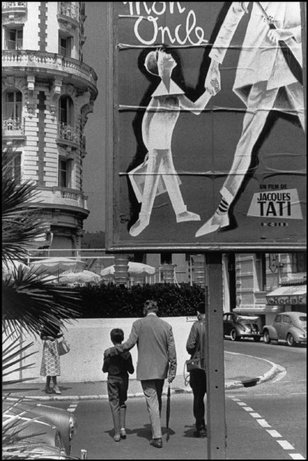
There is a great photograph of the white-haired bearded older man John Huston, who has a major presence in Magnum Cinema as Capa and him were friends, who is filming Under The Volcano. Thierry Jousse writes in Cannes Cinema, "Huston was one of the last superstars of American Cinema." Orson Welles appears almost God-like. The Italians Visconti, Rosselini and De Sica are there. Truffaut and Godard have a big presence and so does Renoir. As well many other directors sporadically pop up: Kusturica, Wajda, Ray, Allen, Fuller, Mankiewicz, Angelopolous, Chaplin, Wilder, Wise, Yimou, Robson, Renais, Wenders, Hartley, Cronenberg, De Palma, Tarantino, Ferrara, Eastwood, Rivette and Garrel. One of the most gorgeous images is of Jacques Tati walking with a boy with a Mon Oncle poster in the background. There is part of the set of Carax's Les Amants du Pont-Neof. There is also a focus on actors and actresses like Isabelle Hupert and Jane Birkin, Elizabeth Taylor and Humpthrey Bogart, Edward G. Robinson and Audrey Hepburn. Some writers that are photographed include Jacques Prevert, Margarite Duras and William Faulkner. As well you can see Henri Langlois and a Cahiers chief editor boardroom.

Magnum Cinema is at its most interesting when there is more descriptions and commentary, which it is lacking, as one wishes it had even more text kind-of like the Cannes Cinema book. And the book appears almost dated, as the latest in art cinema seems incarnated by Kusturica, Hartley and Angelopoulos. When was the last time these guys even made a movie? I would have liked to seen some photographs of Terrence Malick, Apichatpong Weerasethakul and James Gray. Anyways, for more recent trends there are the film magazines: Cahiers, Positif and Cinema Scope. I really liked in Cahiers the pictures of Gregg Araki in a tanktop and big head-set directing two chicks on the set of Kaboom, Wes Craven almost-looking like a devil directing My Soul to Take or Philipe Garrel with some of his friends making Un Été Brûlant. And for photography, last years out-of-series issue of Positif Portfolio: 80 cinéastes vus par… Positif & Nicolas Guérin is one of the best collections of director portraits mixed with serious film-criticism that’s out there.

Though in the other book Cannes Cinema: a visual history of the world’s greatest film festival the film festival is documented through the local Traverso family over four generations of photographers starting with Auguste Traverso, the founder of Traverso Maison, to the Traverso that is still working today Henri. The book is similar to Kieron Corless and Chris Darke’s Cannes: Inside the World's Premier Film Festival (Faber and Faber, 2007) as they both expand on the same stories. Toubiana writes about the raison d'être of Cannes that in the wake of the catastrophic Second World War,
"Thus the festival was about demonstrating, in the most visible and impressive way possible, the desire on nations to gather together around the idea of peace. Cinema became the vehicle for this recovered ideal. And the festival would continue to fly the many flags of the nations that presented their films in competition."
Cannes Cinema is better at chronologically documenting the history of cinema then Magnum Force as it encompasses a wider subject as well the bottom of each page is filled with interesting observations from the perspective of Cahiers with the contributors Serge Toubiana, Joël Magny and Thierry Jousse. You can even see the Cahiers and Cannes ties from the photographs of Godard, the discussion of Hitchcock as a serious artist, and photographs of the writers, directors and programmers all together. The connection between Cahiers and Cannes is still present in the lastest issues (N. 667, 668) as the magazine covers the competition, discusses four French films that played at the Directors’ Fortnight Après le sud, La Fin du silence, My Little Princess and 17 Filles; as well Cahiers has a feature on the Palme d'Or winner Tree of Life with multiple interviews with everyone involved, except for the elusive Mallick. Even the chief editor Stéphane Delorme has been on the selection of Directors’ Fortnight since 2004.

Like the crisis for Magnum there came a time when photography at Cannes changed; in terms of both approach and style, the media accreditations and restrictions in the 1980s, around the time of the expansions of the Palais des festival, shifted the tone from casual to more restrictions. The golden age of the photography encapsulated within these pages makes the book a pleasure to go through. Magnum Cinema and Cannes Cinema are also necessary illustrations of film-history, similarly to Gallimard’s publishing of Godard’s Histoire(s) du cinema, as these documents put a face and a context on film history, as they expand on the backstage presence of the stars as well it illustrates the convergence between the studio era and a prestigious photography agency. – David Davidson

*Other books from Phaidon Press includes Truffaut at Work, Hitchcock at Work and Welles at Work. They have two film-festival books Take 100 - The Future of Film and Gilles Jacob’s Citizen Cannes. As well Cinema Today, Seen Behind the Scene, Musée du Cinema and Movie Book. They are also responsible for the Masters of Cinema series and a Clint Eastwood and Martin Scorsese interview book with Michael Henry Wilson.

**Serge Toubiana was the Cahiers chief editor from 1981 to 2000 and he is now the director general of the Cinémathèque Française. Here is Toubiana’s Top Ten list of films from the 2000s from Cahiers (N. 652):
- Million Dollar Baby (Clint Eastwood, 2004)
- The Departed (Martin Scorsese, 2006)
- Tetro (Francis Ford Coppola, 2009)
- Three Times (Hou Hsiao-Hsien, 2005)
- Coeurs (Alain Resnais, 2006)
- Catch me if you Can (Steven Spielberg, 2002)
- Volver (Pedro Almodovar, 2006)
- Les destinées sentimentales (Olivier Assayas, 2000)
- The Queen (Stephen Frears, 2006)
- A Christmas Tale (Arnaud Desplechin, 2008)
- Saraband (Ingmar Bergman, 2003)