Showing posts with label Interview. Show all posts

Wednesday, April 6, 2016

Interview with Michael Dorland (So Close to the State/s)

David Davidson: Can you tell me how your book So Close to the State/s: The Emergence of Canadian Feature Film Policy (UTP, 1998) came to be? What sparked this research? What methodology problems did you have to solve?

Michael Dorland: I was working as a reporter/editor for Cinema Canada magazine, once upon a time the voice of a nationalist Canadian and Quebec cinema. In the time I was there, roughly from 1980-1985, the major federal policy change regarding film was a shift away from previous attempts to foster feature films (initially using a small $10m production and later through tax-shelter) with a turn to fostering TV production (the Telefilm Television Fund). After all, the broadcasting system was Canadian-owned whereas the cinema distribution system was and remains mainly US-owned. Also working as a reporter, one tends after a while to see the same things come around, and around, and this was systemically the case, whether in attempting to “foster” Canadian film development, or through the CRTC to “foster” Canadian content in broadcasting and music. What I wanted to figure out was why all this endless and seemingly unaware repetition. So in 1987, I got the opportunity to start a Phd in Communication at Concordia. The book is drawn from my dissertation.

The principal methodological problem I faced was finding an operationalizable concept that captured the role of the government/state in film production. Marxist methods had clear limitations in that it was never clear which “bourgeoisie” the Canadian state ‘worked’ for. Cultural studies in Canada at the time, and perhaps still, did not have a clear method other than the subcultural. What worked in the end, and it was something of a fluke, the result of much reading of Foucault, was the concept of governmentality, which seemed ideally suited for the Canadian context; that is, of an overriding state interest in the orientation of both economy and society without being clearly a class interest, but a muddle of some nationalist ideas mixed in with state interests as an end in itself. The other problem, with which I began first, was access to information held in government bureaucracies.

DD: How was its research process? The references from government documents, archival sources, unpublished material, personal letters and notes, an extensive referencing of newspaper and Canadian film journals and periodicals is quite erudite in its depth and range. How did you know what to look for, and were they easy to access?

MD: Bureaucracy is many-headed, so if you can access one major bureaucracy, there is a strong likelihood of accessing them all through duplication. My way in was through the National Film Board. I knew the head archivist at the time; I had interviewed him for the magazine; and he basically explained the structure of the Board’s archiving system and I was off and running. This was still before computerization, and the ensuing nightmare of computer dumps that fortunately I did not have to deal with. So using the Board’s archives, from minutes of the Board of the Board and all of the attached documentation that covered most of the bureaucracy involved in the film policy process, to production files for given films as well as television, really opened up the whole field for me. Especially the conviction at the time, early 1950s, that the Board thought it would be responsible for television in Canada. This was hugely important, especially when it came to untangling the symbiotic relationship between film and TV in the Canadian context of the ‘50s and ‘60s. How to know what to access and whether it was easy is basically hit and miss. You follow a thread and see where it takes you. If it doesn’t take you anywhere, you follow another thread. Easy? Never, and I don’t think the dissertation and book would have been doable without the NFB lifeline into the state bureaucracy.

DD: How was the book received? Did it have any effect, that you are aware of, on the domains of its dissertation such as Canadian filmmaking, government policy, or Canadian film scholarship?

MD: The book itself was quite well received in the small universe of Canadian film scholarship, and to some extent also in Australian film scholarship. ‘Well received’ is of course a relative notion. A few people noticed and said nice things. Outside of these small scholarly worlds, I don’t think the book had any impact at all.

DD: The book seems to answer the specific question of is there a ‘Canadian cinema’ by closely examining the formation of its industry in the 50s and 60s through the role of governmentality and its mediation between public institutions and private interests. It both brings together many dilemmas and problems still facing Canadian cinema today as well as the ground-work that contributed to making Canada a world-class country for industrial filmmaking (four of last years Best Picture Oscar contenders were Canadian co-productions, for example). How do you view the arguments from the book from the vantage point of 2016?

MD: I am not sure the book attempts to answer the specific question of “is there a Canadian cinema” for the reasons that there isn’t a Canadian cinema, but rather many Canadian cinemas, some ceaselessly rediscovered, some endlessly hoped for, and some that couldn’t care less as long as there is “product,” and if Canadians are involved that’s a plus. Canadian cinema has been all of these things at various times.

What was the case in the late 1960s was that there were a handful of filmmakers, usually of shorts and documentaries, and some of these wanted to make feature films. The government also wanted there to be more made-in-Canada feature films, without getting too picky about the phrase made-in-Canada. The government in particular wanted a feature film industry with only the vaguest idea of what this might actually mean or entail. With the creation in 1968 of the first feature film fund of $10m, the head of the fund called up his pals in Hollywood and said, hey, we’ve got $10m to play with, wanna play? And of course they did.

That was sixty years ago and in that time something like a film and television industry has been created, with all this implies in terms of infrastructure, labs, equipment, lighting, computerization, etc. Parts of that industry, in Vancouver and Toronto, sometimes in Alberta, (and in Montreal, though Quebec is always somewhat different), are capable of producing product that can sell to Hollywood or elsewhere, and to television all over the world, and in pretty much any genre imaginable. But that industry is still not “Canadian cinema”, a creature that remains as elusive as ever. Again, what the Canadian government of the 1960s wanted was a film industry. Eventually, it got one, after a fashion.

DD: What contemporary issues do you feel deserve more attention in the discussion of Canadian cinema today and its relation to government legislation and the private industry? And can you envisage any challenges in realizing it? (The conclusion on Policy Knowledge versus Academic Knowledge seems quite relevant in regards to this).

MD: As you say, there is Academic Knowledge and Policy Knowledge and they rarely meet each other. There is a large Policy apparatus in Canada very little studied by academics, which is unfortunate, but the ends are completely different. To the extent that Academic knowledge is about a broader understanding of context, and Policy knowledge is (not that it should be) about selling to bureaucrats something they want to hear and will pay for, there is still a very long way to go. Since the publication of So Close to the State/s my sense of the direction of academic work is that it is more regionally focused and more firmly set in the realm of production studies. As for Policy knowledge, that is a field entirely up for grabs by interested academics.

MD: You didn’t ask me this, but the title of the book is a play on the Mexican proverb, “So Close to the United States, So Far From God.” You can draw your own conclusions.

Monday, August 17, 2015

Interview with Justin Bozung (The Shining)

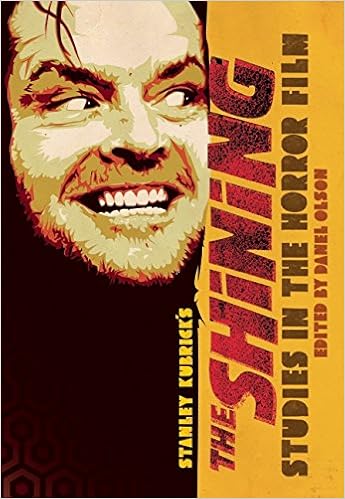
DD: What is your background? How did you get involved with the Studies in the Horror Film: Stanley Kubrick's The Shining [Centipede Press, 2015] book project?  What was your role in the making the book? 

JB: I interview film-makers/actors/actresses for a living. I've written for such print publications in the past as Fangoria and Videoscope, and at present am a featured contributor with the long-running Shock Cinema magazine. I also "blog" full time. I do interviews for several different film/television websites all owned by one mega-company based out of Michigan. I blog out articles and interviews on a plane of film/television topics which are credited to my name and done anonymously as well.

I came to work on The Shining book in late 2012, when Jerad Walters, the owner of Centipede Press approached me about wanting to re-print an interview that I had done with Shelley Duvall from late 2009. Prior to Jerad reaching out to me, I had just finished conducting about twenty or so interviews with various members of the cast and crew of Kubrick's 2001: A Space Odyssey (1968) for a project I was interested in putting together about the film, but that eventually fell by the wayside. I had mentioned my 2001 interviews to Jerad one afternoon over the phone, and out of that, he asked me to contribute as many interviews as I could come up with related to The Shining for his book project.

As for my involvement in the book... Basically, I did all the interviews that are included in the volume, except those with Leon Vitali, The Burns twins, and Diane Johnson. I did a share of the research for the project. I found the previously published interviews for the book with Jack Nicholson, Scatman Crothers, and the director of photography John Alcott as well. I had to track down the rights holder for the Alcott interview. I hit all of my interview subjects up for unpublished materials, memoriums, speeches, photos etc… Out of that I found those never-seen Greg MacGillivray photos from the set, a couple of pictures belonging to Ray Andrew – that amazing Maze panorma. I sourced all kinds of vintage essays and magazine articles on the film across various outlets, I found other interviews with cast members etc... I'd find them, and I'd send them over to Jerad. From there, I imagine all the stuff I sent in went to the editor of the volume. I was also supposed to write an essay on the film itself, but I got overworked with tracking down people, scheduling interviews, my own research into the film for the interviews, the hype of Room 237, etc... So I abandoned my essay on the film. I have about 4000 words that I've done about the film, but I'm saving my piece for now. I might do something with it in the future, but for the time being – frankly, I'm just a little tired of The Shining. 

DD: What is your essay about regarding The Shining? 

JB: Let's talk about the essay at the end of  this. It will give the interview a good wrap-up. 

DD: How many times have you seen The Shining? And what Kubrick resources do you really like? 

JB: I was counting early on in the project, but, for whatever reason I stopped. I can tell you that I watched the film, at least, once a day for six-to-seven months straight. My resources for this project? I think all the books that have been written about Kubrick to date are really solid, well-written books. I think one can take a little from each that they read. But I would advise those who have an interest in Kubrick to stay away from John Baxter's biography however. That book is riddled with errors. In fact, as I was researching the film, I would listen to John Baxter's commentary track on one of the most recent Warner Brothers DVD releases of the film; and on that, Baxter states something that is ridiculous – yet it took me down a weeks-long rabbit hole when I first heard him say it. Baxter says, and forgive my paraphrasing here: "Kubrick chose to use the numbers 2-3-7 in The Shining as an homage to Dr. Strangelove (1964) as they were the same numbers that were supposed to disarm the bomb..." When I heard Baxter say that on the DVD commentary, I freaked out. I think it was right around the time that Room 237 had been released. I was interested in the idea because of how much attention 2-3-7 had gotten in Rodney Ascher's film, Room 237. I decided to explore the idea because I thought, maybe, that if I brought that bit of information out in the book through an interview it be would this amazing factoid that would discredit Ascher's film in some stupid way. See, when I first saw Room 237 I was not a fan of it. I just thought it was ridiculous. I'm like most people, I'm of the school of thought that if you put forth a theory about something you need to have some evidence to back it up. And I didn't see the participants in Room 237 as having any real creditable proof to support their claims. It seemed, at least to me, that Ascher's film just managed to capture these incredible, almost, unbelieveable coincidences. It really made me think of something writer Norman Mailer once said, and I think he was paraphrasing Shakespeare when he said it: "Out of drama comes great coincidences..."

In pursuing some evidence to back up Baxter's claim, I went back and re-watched Dr. Strangelove. Now, I've seen Strangelove at least thirty-times. So, I know that there is no visual reference to 2-3-7 in the film itself nor is there any dialogue mentioning those numbers. Thanks to a archivist friend I managed to get my hands on the shooting script for Strangelove. I opened that, and of course, there is no mention of 2-3-7 in there either. So that led me to read the book that the film was based on, Peter George's Red Alert. There is nothing in there pertaining to that number, of course. I read Peter George's novelization for the film too. Guess what? – There is nothing in there to support Baxter's claim either. Out of frustration, and hoping to just get an answer in my search, I emailed John Baxter directly. His response? "I don't remember." I searched for a couple additional days for connections. I cross-checked 2-3-7 with military communication codes, I checked the numbers up against number theory, even numerology as well. There was nothing whatsoever that connected 2-3-7 with Dr. Strangelove. I really think that Baxter just made it all up for the commentary. 

DD: I'm glad you brought up Room 237. I wanted to ask you about it anyhow. What makes this book so special is how it reacts against things that are in Ascher's film. The analyses of the documentary – from the scene of Jack Nicholson reading the Playboy magazine, the geography of the set, and its other hypotheses – are discussed with its creators, who usually think that it goes too far... 

JB: Yeah, well, as I already mentioned, I didn't like Room 237 on my first-viewing of it. I've since seen it a few times, and I admire it now as a film for its aesthetic approach. I do think Rodney Acher's a brilliant film-maker. I'd be going too far to suggest that Ascher's re-invented the documentary as we know it for the zeitgeist, but he has certainly re-defined it aesthetically. It's just too bad, that in doing that, he's been completely overshadowed by the subject matter of his film though. I, frankly, for one, am so sick and tired of documentary films about movies or makings-of about the making-of. They all seem to blur together for me, and they all take the same aesthetic approch. One thing everyone is guaranteed to see in any of the recent documentaries to come out in the last three-four years about any film or rock band – it's that moment where an image appears on screen with that reverse zoom. There's an image, in color, then it goes to freeze frame.  The image then turns to black and white, and whatever the subject of the image is – a person, let's say, then, that person is cut out of the background and we always get that slow reverse zoom. The figure in the image slowly moves closer to us. You see it in every single documentary that is made today practically. That's what I loved about Room 237. I loved that it changed up the entire approach to documentary in a sense. Ascher's film is really great because of how it strived to not just be about these theories in relation to The Shining, but that it strived to exist on a different aesthetic plane in it's presentation. I know many people bitched and complained about how they felt it was confusing because of the fact that one doesn't see any of the "talking heads" in the film, but I found that profound because of what it does to one psychologically.

If you're really asking me about whether I agree or adhere to any of the ideas in Room 237, I will say that I do not. But that doesn't mean that they don't hold any merit. I mean, those theories or ideas or whatever you wanna call them--those are those peoples' truths and realities. Film is completely subjective, right? Hell, all art is really subjective. It's what makes the film critic, or the notion of film criticism completely null and void of merit itself. Some of the ideas in Room 237 are interesting for sure. There isn't enough time to talk all of the theories in Room 237, so let's just talk about the (alleged) American Indian connection. Am I interested in the idea that The Shining may be some sort of allegory about the atrocities upon the American Indians? No, I'm not. I'm not, because there isn't enough evidence to support the theory, and every thing in Room 237 that is pointed out in reference to the Blakemore theory can be explained away with ease. I feel like in my interviews in the book, one should get a good idea of Kubrick's working method. By understanding this, one should be able to shake off the ballyhoo of the idea of the American Indian imagery in The Shining as having some secret meaning... 

To start, if you read The Shining volume, one knows that Kubrick sent a research team out across the Southwest of the United States to take photographs of many hotels for research for the film. The "Red Bathroom" in the film was copied from a bathroom that one of the research team saw in Arizona. I believe it was at The Biltmore hotel there – if memory serves... We know that the research team visited the Ahwahnee Hotel in Yosemite, California. Have you see photos of the inside of the Ahwahnee ever? I mean, even today, some thirty-odd years after they visited it, it has almost the same decor inside of it. It is just covered in American Indian imagery. The red elevator doors, with the black lattice surrounding them that we see in The Shining film – that idea was taken from the mens' bathroom there at the Ahwahnee. One need only read the interviews with Les Tomkins and Brian Cook in the book, to understand how Kubrick was adament about virtually duplicating what he saw in his research from the States. He liked the visual aesthetic of the hotel, so he duplicated it for The Shining – indian imagery and all. This is certainly consistent with what, I believe, is suggested in Jon Ronson's wonderful documentary Stanley Kubrick's Boxes (2008) from a few years back. In that documentary, one of the researchers on Eyes Wide Shut (maybe Manuel Harlan?) talks about how Kubrick wanted him to take photographs of nightstands in the bedrooms of the apartments he was visiting. Apparently he was fascinated by the layout of the items on the nightstands? I believe he said something like: "You could never create that same arrangement on the nightstand of those items ever..." In one of my interviews in the book (maybe with Brian Cook?) something similiar is discussed regarding the Overlook hotel design/motifs: "Why would I try to design something like the hotel, when the original is much more interesting..." 

In addition, the notion of the Indian imagery also appears early on in Stephen King's book as well. Anyone who has ever said that "the book is so much different from the film..." has never read the book carefully or read it at all. Over the two years that I worked on this book project, I read King's book ten times. When the Torrences arrive at the Overlook for the first time in King's book, King notes how there are Native American masks adorning the walls of the hotel. In Kubrick's thirty-forty page treatment of the novel, there was an early idea where Danny, in one of his visions, sees one of these masks spewing out green flames. Kubrick felt that his film was very faithful to King's book, and I for one, agree with him. I think if one goes back and re-reads King's book carefully, and doesn't treat it like the "page-turner" it is, one might notice the many subtle ideas on the page and how they may have influenced Kubrick. One easy example to point out: The idea of the maze appearing in the film. People often city the inclusion of the maze in the film as being one of the elements added by Kubrick to the story, but in fact, if one goes back to King's book, one will read about every ten-twelve pages about how, and sometimes King does it in half a sentence, but usually at the end of a chapter: "...the hotel was maze-like..." or "...the corridors of the hotel twisted..." or something like that. I'm paraphrasing again, of course. But it's totally there in the book. 

The elevator appears in the book. The weird dog-faced man who felates the well-dressed gentleman appears in the book. As an appartion, the dog-faced man confronts Danny in the book in one of the hotel corridors one afternoon saying – almost verbatim – Nicholson's Three Little Pigs line from the film...   

Yes, Kubrick did shift around certain narrative-points of the story. Yes, he cut out sub-plots. Yes, he changed the ending. But, these are things that any screenwriter would do on his own. These are things that any director would do. But, it's such a point of contention for many, as if in some ways it reduces the merit of the film in some way. It's crazy. I think Kubrick was right in his approach to the film. He "trimmed the fat," as he said in some interview around the time of the film's release. And rightly so, it's a terrible book, in my opinion anyhow. What's the addage? Good books make bad movies? Bad books make good movies?  

While Room 237 is aesthetically wonderful as a documentary, for me, it's a dangerous film as well. One thing that I really took from it, an element that I think is wonderful in it – it reminds one of the importance of a discourse about any work of art, right? But, it's dangerous too, because of its audience being the internet generation. The first time I saw Room 237, I walked out saying, "Great, now all of these hipster kids are gonna go around telling people that they think that The Shining is all about the atrocities inflicted upon the American Indians." Because our culture revels so much in film-as-entertainment, and not film-as-art (no matter how much it claims to be for the latter), we don't want to have to think about what we see. We are spoon-fed information and we often times accept it with open arms. If one spends five minutes on Facebook, and visits any number of the several Stanley Kubrick Groups, one sees those riddled with Shining/Indians references.   Search Facebook for a hashtag "#TheShining" and see hundreds, well, maybe not today, but last year hot on the release of Room 237 – "The Shining is really about the atrocties of the Holocaust or the American Indians..."     

Yes, Kubrick was interested in a element of the American Indians appearing in the story! But as an allegorical device? I don't think so. I think he understood, through his research, the idea that he needed a guise to implement the supernatural into the narrative. There's that, plus there are the elements in King's story too, as I've already mentioned, however spare. And, of course, the hotel SK was duplicating was grounded in Indian imagery as well. One plus one plus one doesn't equal one hundred, it equals three.    

DD: What I like about Studies in the Horror Film: Stanley Kubrick’s The Shining are all its interviews. It’s like the Ciment book, which had some good interviews, but this book goes a lot further, by interviewing a lot of the periphery characters in the film. I was wondering how it was to find all of these interviewees? And do you have any other cool stories from the experience? 

JB: If I told you, then I might be out of a job in the future. Other cool stories? I have so many stories that I cut out of the interviews. I had to cut some stuff at the request of the interview subjects, and Centipede Press also cut a thing here or there on the advice of their lawyer as well. My favorite experience? I have two... The first:  Just this general feeling in the air that I felt during the interviews. As a Kubrick fan you've heard all of these stories about how brutal he was... How meticulous he was... How crazy he was... Yet, his crew – he worked with almost the same crew members film-after-film-after-film. That should tell you right there exactly what his crew thought about him, and what he thought about his crew! His crew loved him. So, in talking with many of the crew members, one could feel in the air that there was still this great sadness swirling around above, even all these years later, that he was still very missed. In fact, one crew member I interviewed, when we got around to talking about SK's passing, began to cry. I could hear tears in his inflection. That got to me.    

Another moment that got to me, perhaps, more than any other, was when I spoke with one of SK's cameraman on The Shining. This particular crew member, when I first called him to inquire about a interview turned me down. He thought that I was only interested in talking about Kubrick, the crazy, eccentic guy that the media has grown quite fond of reporting about over the years. Which, of course, I wasn't interesed in doing. This crew member and I ended up talking for well over two hours one Saturday morning over Skype, and at the end of it, after having talked for those two hours about The Shining and Kubrick, his favorite cameras, his favorite lenses, etc… The crew member said to me, completely out-of-the-blue and unprovoked: "You know, Justin.  I'm sorry you never got to meet Stanley. He would have really liked you..." And when he said that to me, I got choked up. It really made me emotional. And for what reason? I mean, what is it about Kubrick that would cause me to have such a response? 

DD: Was there anyone that you wish that you could have included? I was wondering why the assistant director Michael Stevenson, Stanley’s daughter Vivian Kubrick, and the executive producer Jan Harlan weren’t included? 

JB: Absolutely, in fact, there were many people that I spoke with in-passing that I wanted to talk in-depthly with but, for one reason or another, wouldn't commit to a time to talk. I exchanged many, many emails with little Danny Lloyd, now grown-up, a teacher out East. We went back-and-forth for months and he just wouldn't commit to talk to me, yet, near the end, he graciously granted an interview to some little UK online website. Jack Nicholson, I reached out to, and his Manager got back to me but in the end decided wasn't worth his time. A friend of mine, a well-known screenwriter, actually gave Nicholson's phone number, but in the end, damn – I was just too scared to call him. I just didn't want to call him unsolicted. I also exchanged many, many emails with The Shining Costume Designer Milena Canonero – but she was always tied up with work to talk with me. I got in touch with The Shining Assistant Director Terry Needham, Camera Operator Danny Shelmerdine, Shining composers Wendy Carlos and Rachel Elkind, Richard Daniels, one of the soundman on the shooting of the film. Lou Bogue, a grip on The Shining. All declined participation for one reason or another. I tracked down one of The Shining electricians even. He was so busy with work that he could never commit to a time to talk with me as well. I even pursed an interview with the Star Wars producer Gary Kurtz. Kurtz had been a Borehamwood during the shooting of the film. He was there with George Lucas waiting to start Empire Strikes Back (1980). Their production was delayed start a few weeks, I was told, because of The Shining. I was told by a source that Kurtz and Kubrick had it out a couple times because of The Shining delaying the shooting of Empire Strikes Back at the studio. But I never got to confirm this with him directly. 

Sadly, too, there were some involved in the film that I reached out to as well, that just couldn't talk with me because of illness. One actor from the film was too ill as was one of the crew members. Pivotal people in the making of the film, that may not be with us much longer. I never reached out to Jan Harlan, as Centipede Press informed me early on in the project that Harlan had declined participation but that he wished us luck with the project. Michael Stevenson, I spoke with briefly on the telephone. He also declined to participate as he said he was instructed not to speak with me about the film because of another book in the works about the film. Vivian Kubrick? I reached out to her, and I also reached out to Kubrick's other daughter Katharina Kubrick as well. I heard nothing back from either, nor did I hear back from Christiane Kubrick either when I emailed a request for interview. There were others too, whom I'm forgetting now in this moment as well. I reached out to everyone that is still alive. I even reached out to the African American model who was the subject of the nude painting that we see hanging on the wall of Scatman's apartment in the film. I found her on Facebook. We exchanged a few messages, and in the end she wanted financial compensation to talk to me.   

DD: The interviews offer fascinating, varying and sometimes even contradictory perspectives on Stanley Kubrick and The Shining. These interviews are helpful to understand the film but do you think they demystify the aura around it as well?  

JB: Not really. Maybe. I don't know actually. I was always more interesetd in demystifying the Kubrick mythos than I was in trying to do such relating to film itself. Any questions that hint at Room 237 theories, really came up because that film was out and circulating and it was on everyone's mind that worked on The Shining. The crew members would often bring it up in our conversations. One might say: "Did you see this rubbish?"  I think the interviews do a decent job at breaking some of the tabloid notions associated with Kubrick, and yet, they also add to them as well...   

DD: What are your thoughts on the ending deleted scene of Danny in the hospital? I think that it’s really important and I wish that that footage was still available. Just from the description it seems like it almost anticipates Eyes Wide Shut – the secret society, the brainwashing and controlling of women and children, and the banal menace. 

JB: I like the way the film ends now. The hospital footage is out there. I know of someone (allegedly) who has it here in the States. Maybe someday it will surface or then again, maybe not. SK didn't want it to be seen, so as someone who is faithful to the artists intentions – I'd like to respect his wishes.     

DD: Two areas of interest for me regarding Kubrick are his connection to the moon landing footage and his relationship with Steven Spielberg. I find the William Karel documentary Opération Lune to be really convincing. And I don’t care what Leon Vitali says, Kubrick was a very private person, and it could have been a secret that he worked more closely with NASA. While the Steven and Stanley documentary shows the two as being good friends. What are your thoughts on these subjects?  

JB:  I think Opération Lune (2002) was a joke, wasn't it? Isn't that the documentary with Donald Rumsfield in it? I am one-hundred percent certain that Kubrick had nothing to do with the moon-landing. His connection to NASA came out his friendship with Arthur C. Clarke. I've always thought that Jay Weidner from Room 237 has probably just watched Capricorn One (1977) one too many times... 

DD: I really like the Emilio D’Alessandro interview. How were you able to get in touch with him? Have you read his book Stanley e me? Is it only available in Italian? And the Joan Honour Smith interview, about the retouching of the final photograph, is really great. How did you go about to find her?  

JB: I have a friend, a great guy, who runs this incredible site in Italy dedicated to 2001: A Space Odysssey. I think I got in the door there through him, if memory serves. From there I just called Emilio up and we spoke one evening. I believe, that yes, Stanley e me is currently only available in Italian. I actually suggested to Emilio that he contact Centipede Press about publishing the book in the United States but I don't know if anything came out of that suggestion. Joan Smith – she was a lot of fun to talk with. She was actually pretty easy to find. The challenge, initally, was finding out who had done the photographic work on that picture in the film. But once I found that out, she was very easy to find online.

DD: Are you happy with the final product? Or was there anything else that you wished that you could include? 

JB: I am, yes. Actually, I got into a spot of trouble when the book arrived to me back in June, as I had forgotten to include my wife's name in the acknowledgements. When she opened the book and saw that her name was missing she wasn't very happy. She said: "I watched that movie with you every night for months!" I think that Jerad Walters at Centipede Press did one hell of a fantastic job with the design and the layout of the book itself. When I got the galley from him back in December of '14 to review it so I could suggest edits I was really impressed with the design of it even back then in its raw presentation. I really wished those that those, who declined interviews with me, would have participated however... What could've been will always be a question in my head I think... 

DD: And what about your essay on the film? 

JB: Well, I am almost hesitant to talk about what it's about, but I will, I guess. The thing that has eluded almost everyone regarding The Shining is Kubrick's aesthetic approach to the film. For Kubrick, all of film was a dream. In fact, if you pick up the great book that Alexander Walker did on Kubrick at the start of the '70s, Kubrick tells Walker: "to me, all film is a dream..." So with that mind, one can free themselves up to explore the film through that lens. Considering how fascinated Kubrick was with Freud and Jung – in particular, Freud's The Uncanny – in relation to The Shining, it stands to reason that we can explore the film even deeper through the guises of the Freud and Jung, even their dream modules. In particular: Freud's The Interpretation of Dreams and Jung's Man and His Symbols. Using those books we can look at visuals in the film with the idea that the visual cues serve as symbols for subtextual context in the film itself. An example of this:  So much is made in Room 237 about the non-sensical appearance of Shelley Duvall reading J.D. Salinger's The Catcher in The Rye in The Shining, and how it is really a weird choice for inclusion into the mise-en-scene itself as in the prior sequence in the film with Nicholson at the hotel he tells Stuart Ullman that "..his wife is a confirmed ghost and horror story addict..." Again, forgive my paraphrasing there... Yet, when we consider the core of the narrative in relation to the moment in which this information is relayed to us, we know that Jack Torrence has hurt Danny in the past, right? He's come home, one evening, having had too much to drink and injured Danny – pulling his arm out of his socket. As a dream symbol in the film, Salinger's The Catcher in The Rye serves a very potent visual cue to suggest to us, the audience, Shelley's state-of-mind. We know, from reading The Catcher in The Rye, that one of the major aspects of its narrative is this notion that Holden Caufield must protect the children's innocence. When, you consider this idea in Catcher in The Rye juxtaposed up against the mise-en-scene with Shelley sitting at the table reading the book, her cigarette ash growing and growing (another visual dream symbol) – Kubrick is communicating with us visually the unconsious state-of-mind of Wendy Torrence. She is terrified within the familial unit. The unspoken, natural bond that is constructed within the family unit between man and woman and their child – it's been forever tainted by Jack Torrence's drinking and violence toward his son. She is terrified for her son's safety from the start of the film itself. This, of course, being one of the most important aspect of the story to Kubrick – if we are to read closely, his interview with Michel Ciment from 1980.... 

There are so many "dream symbols" in the film itself. Whether Kubrick researched them or allowed them to come to fruition out of instinct – we'll never now. I'll leave it up to anyone that might read this to explore this idea farther. I have, in my essay, about forty or fifty well-marked dream symbols in the film.   

The most potent dream symbol in the film is the vision of the elevator of blood. People should really look to that as a visual cue up against Freud and Jung interpretation... It's quite staggering when you consider it in the context of the narrative. 

DD: What new projects do you have in the works?

JB: Thanks for asking. Right now, I'm finishing up a year of work on a sort of experimental print anthology about the films of Pulitzer Prize-winning writer Norman Mailer. Mailer produced some very polarizing work – three films in the 1960's, a film in the '80s, and a slew of scripts that he wanted to make but didn't get a change to get off the ground before the end of his life in 2007. Mailer was a big supporter of the avant-garde cinema. In the '60s he helped finance the films of Robert Downey Sr., and Ron Rice. His written works are layered with film metaphors even. Film was very influential upon him, and he wrote some pretty incredible theory stuff in the late '60s – in the spirit of Eisenstein and André Bazin. His films are amazing because they mix theatrcality with Dostoyevsky, film noir, Godard, and Cubism. 

I'm also working on a  biography of film-maker Frank Perry. I've been working with his estate closely for the last couple years on it. They've been a great source of information and guidance. I've done about 100-120 hours of interviews thus far relating to Frank and his incredible films. On The Shining book, I did about 35 hours of interviews in total. I'm hoping to have the Perry book done by late 2016. After that, I'm taking a very long break.

Wednesday, May 29, 2013

Howard Hawks: Cahiers du Cinéma 1956 Interview

In the current world of film criticism where, with some exceptions, there is a a narrow representation of contemporary film tastes on the internet and a lack of space dedicated to film history in print, it's important to return to its history to read, or re-read, its major texts to have a better perspective on where it's today.

The following is one of the first major interviews with Howard Hawks from Cahiers du Cinéma from 1956. Scott Breivold in Howard Hawks: Interviews writes about it,
"The "discovery" of Howard Hawks began in the 1950s (ironically not in America but in France) with the publication of Jacques Rivette's 1953 essay, The Genius of Howard Hawks in the journal Cahiers du Cinéma. [...] In 1956, some of the French critics conducted what is regarded as the first important interview with Howard Hawks. [...] The 1956 Cahiers interview is a good foundation for discovery of Hawks, exploring his choice of subjects, genres, techniques, and early influences."
In the interview Hawks discusses his films The Land of the Pharaohs, Scarface, Viva Villa and Paid For Love as well as he emphasizes the humor in his films. Saul Austerlitz in his book on film comedy, Another Fine Mess, would highlight the Hawksian "farcical good humor" of the performances and especially the ones by Cary Grant. This interview is also frequently cited (cf. Bill Krohn's The Making of Land of Pharaohs). - D.D.
*****

Interview by Jacques Becker, Jacques Rivette, and Francois Truffaut (Cahiers du Cinéma, N.56, Feb. 1956). English translation from Interviews With Film Directors by Andrew Sarris.

“The evidence on the screen is the proof of Hawks’s genius,” we had recently written. It would have been an exaggeration to pretend that this evidence was accessible to everyone; and critical unanimity is happily far from being settled on the genius of one of the great American cineastes: it is clear enough that our own evaluation has not changed.
            It was not a question of interrogating Hawks on his “genius”; no metaphysical speculations; nothing that could distress the champions of clarity or common sense; at least, let us hope that each will find here his own account, and that includes the “Hitchcocko-Hawksians” of pure obedience.
            When we arrived for our interview, we found Hawks conversing with whom? Jacques Becker, one of our old friends. The auteur of Casque d’Or courteously took his leave of the auteur of Sergeant York when we protested his departure: since Jacque Becker was a friend of Howard Hawks, the interview could only gain in interest. Furthermore, Becker’s fluency in the language of Griffith made him more than an interpreter, a valuable collaborator.
            Since our interview transpired a few days before the release of The Land of the Pharaohs, our first questions quite naturally dealt with that film.

Howard Hawks: I made this film for one simple reason: Cinemascope. At the time I was approached to direct a film in this new screen size, I was considering as a project the story of an astonishing feat of construction in China during the war. The American Army wanted an airfield which the engineers estimated would take eight months to construct. The Chinese supplied twenty thousand men and women, who carried stone in little baskets on their heads, and this huge airfield was completed in three weeks. I was about to abandon this project because the political situation made cooperation with Red China impossible; the producers then considered shooting the film in Thailand. It then occurred to me that the building of the pyramids was the same kind of story – it too demonstrated what man is able to create with his bare hands from sand to stone. This kind of story appeals to me tremendously. We thus wrote our script on this one theme: the construction of a pyramid.
Cahiers: What part did William Faulkner play in the development of the scenario?
Hawks: He collaborated with Harry Kurnitz in the writing of both story and screenplay. As always, he contributed enormously. He’s a great writer; we are very old friends and work easily together. We understand each other very well, and any time I need any sort of help, I call on Faulkner. He has done three or four scenarios for me, but he has also helped me on many others. The story of The Land of the Pharaohs because his imagination was challenged by these men, their conversations, the reasons for their belief in a second life, how they happened to achieve these tasks for beliefs we would find it difficult to understand today, such as the slight importance attached to the present life in comparison with the future life, the rest that was to be assured to the Pharaoh in a place where his body would be secure…
Cahiers: For ages, or even…
Hawks: For eternity, for eternity. For all these reasons, Faulkner was the man for the assignment: he has an affinity for these ideas. They are what he is made for.
Cahiers: We would like to know how you transported your imagination back to an age so remote as the ancient Egyptian.
Hawks: We were assisted by several historians in Egypt’s Department of Antiquities, and above all by a Frenchman who has lived and written numerous books on Egyptian history in a little house in the shadow of the great Pyramid – the exact spot on which we shot the picture. He and the other authorities instructed us in the ways and customs of the Egyptians. I’m afraid we paid attention only to hat best suited our picture. It is possible to reconstruct the furniture and dress, and even some of the ritual, of the Pharaohs from the hieroglyphics and drawings on the tombs. We know what the soldiers’ uniforms looked like, what musical instruments were played, and what utensils were used. As for the architecture, Trauner did a great piece of work. He is, without doubt, one of the greatest scene designers in the world. We tried to reproduce Trauner’s visual conceptions exactly.
Cahiers: Did that French Egyptologist see what you shot each day?
Hawks: He saw some of the rushes, I think. He was very interested in some of the schemes we concocted for moving and transporting the blocks of stone. According to him, it was quite possible the Egyptians had thought of the same stratagems. For example, we were in agreement about the use of a ramp to get the stones to the summit, and the subsequent dismantling of the ramp once it was no longer need. The method by which stones are raised from the ground and lowered onto the boat in the film is our invention. So is the way the pyramid is sealed after its construction. The scholars were quite intrigued. We employed a hydraulic process which is quite modern, but instead of water or oil, we used sand. Thus, we had a huge stone rest upon enormous wooden pilings. Each pile was sunk in a hole, and each hole was filled with sand. For each block of rock to fall into place it was necessary merely to open a small hole which allowed the sand to run out. As the sand did so, the huge block settled down slowly into its final position. This is probably the method the Egyptians used. We don’t know for sure.
Cahiers: Then you have tried to make a realistic film?
Hawks: As realistic as possible, but that didn’t stop us from using camels, even though very few camels were in Egypt at the time of our story. Our justification, shaky on purely historical grounds, was that camels did seem integral to our image of Egypt. There were many other things we could only guess about. That’s why we had the workers be free at the start of the pyramid and slaves at the end. We reasoned that the employment of 10,000 men on a pyramid for 30 years would drain the country economically and that after the first few years of exaltation, discontent would smolder into collective rage and the workers would have to be enslaved to make them continue. This thesis is an integral part of our film.
Cahiers: You ordinarily avoid stories with a long time span, and the notion of continuity plays a great role in almost all your films. Were you bothered by the fact that this story extended over thirty years?
Hawks: Bothered, no, but handicapped. It was difficult to devise a story that lasted thirty years while maintaining an acceptable continuity.
Cahiers: What have you concluded from your experience with Cinemascope?
Hawks: We have spent a lifetime learning how to compel the public to concentrate on one single thing. Now we have something that works in exactly the opposite way, and I don’t like it very much. I like Cinemascope for a picture such as The Land of the Pharaohs, where it can show things impossible otherwise, but I don’t like it at all for the average story. Contrary to what some think, it is easier to shoot in Cinemascope – you don’t have to bother about what you should show – everything’s on the screen. I find that a bit clumsy. Above all, in a motion picture, is the story. You cannot shoot a scene as quickly in Cinemascope, because if you develop a situation quickly, the characters jump all over the wide screen – which in a way makes them invisible. Thus you lose speed as a means of exciting or augmenting a scene’s dramatic tension. You have to proceed differently. What you lose on the dramatic plane, however, you gain on the visual plane. The result can be very pleasing to the eye. You have to decide what seems best. Have you seen a film entitled The Tall Men with Gable?
Cahiers: No, not yet.
Hawks: My brother produced it. It’s Red River, but in color and in Cinemascope, and it’s a very pleasant film to watch. It’s not a great film, but a good film. It made me regret not having Cinemascope when I made Red River. John Ford and I made some anamorphic attempts around 1926, but we didn’t care for the results. I always think that the artist who paints a scene in a certain manner must, in changing his manner, change his scene.
Cahiers: And Africa?
Hawks: For this film we must use portable cameras. For certain scenes even hand-held cameras; the Cinemascope gear would be too difficult.
Cahiers: Will this be your next film?
Hawks: I don’t really know. We can start shooting, the scenario is finished, but I must make another film before; we won’t go down into Africa before next September.
Cahiers: Could you tell us a little about this other film?
Hawks: It’s difficult, we are only beginning to work on it. I can’t tell you very much, because we haven’t even decided on the main plot line. I don’t know what form it is going to take. I don’t even know what genre of film it will be. Its point of departure is a true incident that I’ve heard about, but it might never become a film. It depends.
Cahiers: All your films are based on events which tend to show a man in action, his effort and struggle. Even considering the wide variety of your projects, these themes keep recurring in almost all your films. Do you think this is so?
Hawks: That may be true, but I am not really aware of it. I make movies on subjects that interest me: That could be automobile racing, airplanes, a western or a comedy, but the best drama for me is the one which shows a man in danger. There is no action where there is no danger. It follows that if you achieve real action, there must be danger. To live or to die! What drama is greater? Therefore I have probably chosen this direction because I have gradually come to believe that it matters more than anything else. It’s very easy to make a movie knowing that everyone will love it, but that doesn’t count for much. What one should do, what one must do, is try to anticipate what the public is going to like. I don’t think that these people are producers; they make a picture because somebody makes a picture that is successful, so they make one like it, you know?
Cahiers: Yes, too many films exist only as imitations of others.
Hawks: That’s true. We made Scarface because the violence of this particular era was interesting. Scarface is still being copied – and hence still lives. There were fifteen murders in Scarface, and people said I was crazy to have so many. But I knew that was the story: violence made the story. Also, in practice, all the gangster movies that have followed Scarface only reiterated the same material. Similarly, when I made Red River, I thought an adult western could be made for mature audiences, and now everyone is making “intelligent” westerns. And a film like Twentieth Century… have you seen Twentieth Century?
Cahiers: Helas non!
Hawks: It was the first time the dramatic leads, instead of secondary comics, played for laughs. I mean we got the fun out of John Barrymore and Carole Lombard. It was two or three years ahead of its time.
Cahiers: We think that a film like Monkey Business has renewed American comedy, and is undoubtedly more ambitious than it seems…
Hawks: Oh, probably, yes. Because of its general theme: the laughs are born out of the inhibitions that restrict each of us and are here abruptly removed by rejuvenation. It was a good story. Perhaps we pushed the point a bit too far for the public. From this point of view, it is less amusing than Male War Bride or Bringing Up Baby. Monkey Business went too far, became too fanciful and not funny enough: this is my opinion.
Cahiers: And Gentlemen Prefer Blondes?
Hawks: Oh, that was just … fun! In other movies, you have two men who go out looking for pretty girls to have fun with. We pulled a switch by taking two girls who went out looking for men to amuse them: a perfectly modern story. It delighted me. It was funny. The two girls, Jane Russell and Marilyn Monroe, were so good together that any time I had trouble figuring out any business, I simple had them walk back and fort, and the audiences adored it. I had a staircase built so that they could go up and down, and since they are well built… This type of movie lets you sleep at night without a care in the world; five or six weeks were all we needed to shoot the musical numbers, the dances and the rest.
Cahiers: What period of work do you prefer? Script, shooting, editing?
Hawks: I hate the editing.
Cahiers: But you do the editing of your films?
Hawks: Oh, yes! Simultaneously with the shooting, if possible. When I started out in this profession, the producers were all afraid that  made a film too short because I didn’t give them enough film for editing. And I said: “I don’t want you to make the movie in the cutting room, I want to make it myself on the set, and if that doesn’t suit you, too bad.” That’s not to say that editing isn’t a chore, particularly when you haven’t done a good job wit the shooting. Editing is a horror for me because I look at my work for a second time and say that’s pretty bad, and that, and also that – The difficult work is the preparation: finding the story, deciding how to tell it, what to show and what not to show. Once you begin shooting you see everything in the best light, develop certain details, and improve the whole. I never follow a script literally and I don’t hesitate to change a script completely if I see a chance to do something interesting. I like to work on the scenarios. Some of my best movies were written in very little time. Scarface took only eleven days, story and scenario.
Cahiers: Does that include the dialogues?
Hawks: Everything. The whole thing took eleven days. I know because I paid the writers who worked for me by the day.
Cahiers: Who gave you the material, the basic facts?
Hawks: The facts came from several reporters in Chicago, many books, and magazine articles. The outline was done by Ben Hecht. He didn’t have to do any research. All he had to do was ask me about this or that detail, and I would rattle off the information because I had read a lot on the subject. For example, I don’t know if you recall George Raft flipping a “nickel” in his hand? There are actually been a large number of murders in Chicago, where, as a mark of disrespect, the killer stuck a nickel into the hand of the corpse. Raft’s character being that of a killer, he always had a coin in his hand. We also exploited another little known fact: The papers that published the photos of a murder indicated “X marks the spot where the body was found.” So we designed fifteen or twenty scenes around the X, finding all sorts of ways to use the X when a murder occurred.
Cahiers: Each time someone was killed, there was an X?
Hawks: Yes. X.
Cahiers: Did that have something to do with the scar on Muni’s face?
Hawks: Yes. Once you start off on that path, why not go all the way? Do you remember the scene in which Boris Karloff is bowling? As he lets the ball go, he’s hit; the pins all go down. An X for a strike is marked on the scorecard.
Cahiers: And the cloud in Red River, was it intentional or accidental?
Hawks: We saw it coming just as Wayne began reading the prayer over the grave. We told him to hurry reading so that we could catch it at the right moment. This was a case of seizing an opportunity as it presented itself. I don’t think we would have held up the scene to wait for a cloud.
Cahiers: You were the producer of The Thing without getting credit as a director, but you undoubtedly supervised the production very closely.
Hawks: Oh, yes. The direction was handled by my editor, but I was on the set for all the important scenes. It was a very pleasant assignment. We wrote the script in four and a half days. I had read the story in Germany, in Heidelberg, where we shout Male War Bride. We only used four pages from it. I bought the rights and hired tow good screenwriters. The story interested me because I thought it was an adult treatment of an often infantile subject.
Cahiers: Many critics have complained about the big differences that existed between the Hemingway story To Have and Have Not and the film you shot from it. Why did you change so much?
Hawks: Hemingway and I are good friends, but whenever I tried to persuade Hemingway to write for the movies, Hemingway insisted that he could be a good writer of books, but he didn’t know whether he could be a good writer of movies. Once when Hemingway and I were hunting together, I told him that I could take his worst story and make a movie out of it. Hemingway asked me what was his worst story. “To Have and Have Not,” I said. Hemingway explained that he had written the story in one sitting when he needed money, and that I couldn’t make a movie out of it. I said I’d try, and while we hunted, we discussed it. We decided that the best way to tell the story was not to show the hero growing old, but to show how he had met the girl, and, in short, show everything that had happened before the beginning of the novel. After four or five days of discussion I left. Faulkner and Jules Furthman then wrote a script incorporating the ideas Hemingway and I had evolved on our hunting trip. In fact, there was enough material left over for another movie (Michael Curtiz’ The Breaking Point) which was pretty good.
Cahiers: Your career has been divided equally between adventure films and comedies. The adventure films seemed optimistic and the comedies pessimistic, but there always seemed a lesson to be drawn from the humor in both genres. Are you more interested in the mixture of genres within your subject or in the clash of genres?
Hawks: Perhaps I can best answer in the following manner. Life is very simple for most people. It becomes so routine that everybody wants to escape his environment. Adventure stories reveal how people behave in the face of death – what they do, say, feel, and even think. I have always liked the scene in Only Angels Have Wings in which a man says “I feel funny,” and his best friend says “your neck is broken,” and the injured man then says “I have always wondered how I would die if I knew I was going to die. I would rather you didn’t watch me.” And the friend goes out and stands n the rain. I have personally encountered this experience, and the public found it very convincing.
             But a comedy is virtually the same as an adventure story. The difference is in the situation – dangerous in an adventure story, embarrassing in a comedy. But in both we observe our fellow beings in unusual situations. You merely emphasize the dramatic or the comical aspects of the hero’s reactions. Sometimes you can mix them up a bit. My serious pictures usually have their comic sides. You’ve seen The Big Sky? You remember the scene where they amputate Kirk Douglas’ finger; it was really funny. I had already wanted to do that scene in Red River, but John Wayne had said that I was crazy to want such a scene played for comedy. I said okay, I would do it in my next picture instead. When Wayne saw it, he phoned me and said he’d do whatever I wanted to in our next picture together.
            It’s possible to do comedy scenes even at very tragic moments. I once told a Spaniard I was thinking of doing Don Quixote with Cary Grant and Cantinflas, and the Spaniard said it was impossible to make a comedy out of a tragedy. I asked the Spaniard to tell me the story of Don Quixote, and after the Spaniard had done so, I said, “You’ve just told me the story of three of Chaplin’s best pictures.” He looked at me and said, “You’re right. Let’s go make a comedy.” And that’s pretty much the way I see it. The only difference between comedy and tragedy is the point of view. That’s the only way I know how to answer your questions.
Cahiers: The question has been answered.
Hawks: You know the story of The African Queen? I turned down an invitation to direct it because I couldn’t see any humor in the situation. It pleased me to see how they made it a comedy. There were some silly things it, but it went. Whenever I hear a story my first thought is how to make it into a comedy, and I think of how to make it into a drama only as a last resort. Do you remember the story about the man who wanted to commit suicide and stayed on a window ledge – Fourteen Hours? They wanted me to do it, and I said no. “Why not?” they asked me. “It’s a great story.” I told them I didn’t like suicides, and I told my friend Henry Hathaway that I didn’t like the film he had directed. The public didn’t like it either, and Zanuck told me I had been right. I told Zanuck: “I might have done it if it had been Cary Grant getting from the bedroom of a woman whose husband had come back unexpectedly and after he was found on the ledge he pretended he was contemplating suicide.” Zanuck asked me if I wanted to start on that one the next day.
Cahiers: You’re not interested in abnormal characters?
Hawks: Sometimes I get interested in the encounter of a normal person and an abnormal person. Almost all my caprices, my manias (like the way I am playing with key chain while I talk to you), I like to think that these are abnormal things. To see the difference in the way of thinking makes good scenes, but to tell a long story about a nut isn’t easy. Besides, I don’t like theoretical situations. I like stories like Viva Villa! which I wrote and half of which I directed. The Villa in that film, like the Villa in real life, was a quite bizarre man. So was Scarface. Ben Hecht wanted to make the Capone-like character a Caesar Borgia and Capone’s sister like Lucretia Borgia. This analogy permeates that script, and every intelligent person sense something unusual, something that can’t be brought out into the open, but affects all the scenes.
            Pancho Villa had a very complex personality – that’s what made him interesting – but these subjects are rare. Fox wanted me to do Zapata, but the script was all wrong about the character. Zapata was the worst murdered Mexico had ever seen. Had Fox been willing to tell the true story of Zapata, I would have been interested. But they made a sort of Santa Claus of him and had him riding around the country giving presents to poor peons.
Cahiers: In short, you’re guided in your work by an intentional reaction to what is going on around you.
Hawks: Exactly. I’ve already said that it’s easy, when one sees crowds rushing off to see a movie, to make another movie almost exactly like it. What is more fun is trying something new, and hoping it will work. That’s how I hit upon the tempo of my movies. I made a film called His Girl Friday in which the characters spoke so fat that the characters kept stepping on each other’s lines. The public liked it. Moreover, the tempo in Scarface was faster than usual in that period. I generally work with a faster tempo than that of most of my colleagues. It seems more natural to me, less force. I personally speak slowly, but people generally talk, talk, talk without even waiting for other people to finish. Also, if a scene is a bit weak, the more rapidly you shoot it, the better it will be on the screen. Moreover, if the tempo is fast you can emphasize a point by slowing the rhythm. Similarly, when you have a scene with two characters, don’t always use a close-up. When you use close-ups sparingly, the public realizes that they are important. I hate movies which, without any reason, are composed completely of close-ups. I don’t like them. I don’t want to say that they’re necessarily bad movies, but I don’t like that particular style of film-making.
Cahiers: Have any particular directors influenced you?
Hawks: In the beginning, I was very much impressed by Murnau’s Sunrise, particularly for its camera movements. I once made a film in this style – Paid to Love – with a great many camera effects, but I have never used such trickery since that time. I try to tell a story as simply as possible with the camera at eye level. Since I had directed Paid to Love at a time when the public was easy to impress, the result was well-received. But I don’t believe the future is in that direction. The other directors who have most impressed me are John Ford, Ernst Lubitsch, and Leo McCarey; these are the men who, in my opinion, have been the best.
Cahiers: What do you think of the young directors: Nicholas Ray, for example.
Hawks: I’ve seen several of Ray’s films, and find them very promising. He is one of those directors of whom it is said: “I will go see everything he does because he is a good story-teller.” But the actual situation in Hollywood is hard for young directors. They don’t get the freedom we older directors enjoy. Young directors are told what to direct, where to shoot it, on what day to be finished. It’s hard. However, the more successful a young director’s movies, the more freedom he will be give.
Cahiers: What would be your ideal film, that which you would make for yourself alone?
Hawks: I have no desire to make a picture for myself. There has never been a picture so good the public didn’t care to see it. I like to make comedies because I like to go into a theater and hear people laughing – the more laughter the better I feel. I have no desire to make a picture for my own pleasure. Fortunately, I have found that what I like, most people also like, so I only have to let myself go and do what interests me.
            I am actually thinking about a subject for a movie. For four-fifths of the picture there is only one person on the screen. A girl, cut off from all contact with humanity by avalanches and melting ice, bears a child and cares for it for three moths before she is found.
Cahiers: Do you always work on your scripts?
Hawks: From the beginning and for all my films.
Cahiers: If you had to choose three or four of your films to be saved, which ones would they be?
Hawks: For sentimental reasons, my first talking film, Dawn Patrol, then Scarface and probably Twentieth Century; but … there are many others I would like to save. Dawn Patrol was very interesting because it was my firs experience with sound. I had not worked since the coming of sound because the producers didn’t know if I could work with dialogue. I had never had any theatrical experience. I myself wrote almost the entire scenario, and during the shooting, everyone kept telling me: “It’s not good dialogue, it’s not dramatic. Everything is flat. Everything you’re doing is going to be flat.” No one liked the film because none of the characters cried or screamed. When the editing was finished, the studio had so little confidence in the movie, they dispensed with the premiere. They preferred to release it discreetly, and then it turned out to be the best film of the year, and then they got into the habit of screening it for other directors and saying: “That’s what good dialogue is like.”

Saturday, July 9, 2011

Interview with Adam Nayman (On Love Em or Hate Em: MORE Controversial Directors)


In anticipation of Adan Nayman’s newest series of classes Love Em or Hate Em: MORE Controversial Directors, I decided to take the opportunity to meet up with the guy to ask him a few questions. In this new series there will be lectures on Lars von Trier on Monday July 11th, Michael Haneke on Monday July 18th, Luis Buñuel on Monday July 25th and Woody Allen on August 8th. All of the classes start at 7PM and are at Miles Nadal JCC (750 Spadina Avenue). – D.D.

Toronto Film Review : So Adam why these particular directors?

Adam Nayman : The first course seemed to go well, and I felt that the idea of talking about challenging filmmakers was still appealing to me. So I asked around about some other directors who might fit into this class, and Lars von Trier's name kept coming up, plus he was in the news at the time because of what he said at Cannes. And then from there, I thought that it would be good to pick some filmmakers who were a little less famous than the ones I did last time: Verhoeven, Cronenberg and Polanski are all artists who moved from the margins to the mainstream (less so Catherine Breillat). Buñuel is of course famous but maybe not to a non cinephile audience. Michael Haneke is well known and his films are polarizing but he's someone who people might want to learn more about. As for Woody Allen, he's more mainstream but in some ways he's a guy who begs to be considered as a kind of European art-house auteur even though he's American. I think that the throughline between all four filmmakers is that there are elements of satire and absurdity in their work -- all expressed very differently of course.

TFR : Buñuel is the one director out of the four that I am least familiar with. I remember seeing his Las Hurdes at the Cinémathèque québécoise in Montreal. I was just wondering how many of his 34 titles have you seen? Are they available on DVD? I know Criterion Collection has released a few of them. And have you gone over his autobiography My Last Sigh? I remember Jonathan Rosenbaum was telling us that in the editing process from French to English that the editor was conspicuously editing things out; I wonder what he actually removed?

AN : I can't speak to the differences in the translations. That's something that Jonathan Rosenbaum would know more about then I do. And there's no lack of critical writing on Buñuel, but one of the things I want to work against is the idea that he mellowed as he got older -- that his late pictures are the work of a less strident filmmaker. For me, films like The Phantom of Liberty, Discreet Charm of the Bourgeoisie and That Obscure Object of Desire are still examples of an artist challenging himself and his audience, right to the end. As for whether I've seen all of his films; I can't count offhand, but probably not.

TFR : I think Woody Allen is just great! And I am especially fond of his latest films, did you know that both You will meet a tall dark stranger and Midnight in Paris made the cover of Positif, which is not an easy task. And it is interesting to note that Richard Brody, one of the biggest Woody Allen partisans along with Eric Lax, sees the Barbara Kopple documentary Wild Man Blues (1997) as the beginning of his late period. Allen also excels at fiction; there is a big database over at The New Yorker of his collected work; I particularly recommend Udder Madness. Which brings me to how I like that you bring up his fictional writing in your review of Midnight in Paris. One of my favorites of his short stories is Fabrizio’s: Criticism and Response from Side Effects. Have you read that one? It is about a high-minded restaurant critic who writes these elaborate criticism and responses about restaurant food profiles, and in the process undermines the jargon of analysis:
“I began my meal with an antipasto, which at first appeared aimless, but as I focused more on the anchovies the point of it became clearer. Was Spinelli [the chef at the restaurant in question; Fabrizio’s Villa Nova Restaurant] trying to say that all life was represented here in this antipasto, with the black olives an unbearable reminder of mortality? If so, where was the celery? Was the omission deliberate? At Jacobelli’s the antipasto consists solely of celery. But Jacobelli is an extremist. He wants to call our attention to the absurdity of life. Who can forget his scampi: four garlic-drenched shrimp arranged in a way that says more about our involvement in Vietnam than countless books on the subject?”
Anyways, what themes are you going to highlight in your WA class?

AN : Yes, I like that essay, among others in Side Effects. Like Polanski, Allen’s films are not overtly transgressive (although I rewatched Husbands and Wives last night and was shocked by how raw it was). He does not craft extreme images. The controversy stems from his private life and the possibility that his films -- especially the ones in the 1990s -- are autobiographical. Polanski used to deny that sort of thing, and Allen doesn't encourage it, but it seems plain. I feel like Allen makes movies as a form of therapy -- like Lars von Trier -- but he seems to get less out of it; he has the same hangups and phobias as he did forty years ago. If you want to put it positively, you can say he's consistent; if you want to be negative you can say he's redundant.

TFR : Once when you and Andrew Tracy were in the tiff.shop, he picked up Screening Modernism and was saying that since the book had a blurb from David Bordwell that it was reason enough to buy it. I bring this up because there are some critics that I hardly see make these kind of blurbs. For example, there is Dave Kehr, out of all of my DVDS his name is only on two of them: James Cameron’s Ghosts of the Abyss and Lars von Trier’s The Boss of It All. Though his DVD reviews for the New York Times are great as well he highlights books sometimes on his personal website. I bring this up as I have noticed your name only once on a DVD and it is on the Canadian film Six Figures. Are you quoted on any other DVDs? What is it about supporting these quality under-exposed Canadian films that you like?

AN
: I have been quoted before on DVD boxes, sure. and I even wrote the liner notes for Sergei Dvortsevoy's film Tulpan (2008). Pull quotes can be funny to be read, and I've had my name on films I'm not sure I'd stand by now -- like the 2001 Canadian drama Treed Murray -- but it's not really an important thing one way or the other. On the other hand, I think it's great when critics get to write liner notes or essays for DVD releases, like my friend Mark Peranson’s text for the Pedro Costa Letters from Fontainhas Criterion box set and Michael Koresky’s pieces on The Actuality Dramas of Allan King Eclipse box-set. It’s not the format that most people usually look for penetrating criticism but they can be a wonderful supplement to the features on the disc. I think that Kent Jones has written better DVD booklet notes than most critics have ever written good film reviews. And I would rather read a pull-quote blurb by Dave Kehr then an entire review by Peter Travers.

TFR : Michael Haneke. That guy is controversial. I was blown away the first time I discovered Cinema Scope. It was an issue dedicated to the Cannes Film Festival and there was only one sentence (!) dedicated to the Palme d’Or winner The White Ribbon. What I got from that was the position that sometimes the movies that are the most interesting are not the ones getting the main prizes at film festivals. What are your thoughts on Haneke?

AN : What I think Mark was getting at there, in his inimitable style, is that Haneke is a little old to be an enfant terrible. Though he always was a little too old. The Seventh Continent and Funny Games were films made by a guy in his forties, even though they feel more adolescent and even a bit snotty. You would picture their maker as a punk like Gaspar Noé rather than an older Austrian intellectual. I think Haneke has had that paradoxical thing happen to him where the more acknowledged his talents have become by the critical establishment, the less certain kinds of anti-establishment critics want to go the bat for him. I would say that I think he's one of the more brilliant contemporary directors in terms of composition, pacing, sustaining tone and staging acts of violence. He’s a born film director. Even The White Ribbon, which I didn't really want to write about either, there's more filmmaking savvy than in 90% of whatever came out that year. But it's also very much of a piece with his old work, thematically, and if someone finds his style didactic, there's nothing in the new movie that's going to change their mind. If a critic like Mark, or anyone else, found the didactic qualities of his old films unforgiving back then there is nothing that’s going to change their mind.

TFR : Do you recommend any particular film books relating to the directors in this series? I really tried to get you the Director’s Cut book on von Trier.

AN : Linda Badley 's book on von Trier in the Contemporary Film Directors series is good. She does not mythologize the guy, partially because he does that already himself. It's incisive analysis without a ton of jargon. The book on Woody Allen in the Masters of Cinema series is atrocious; it feels like the copy-editor was so bored that he stopped catching errors by the end, and I am not a fan of film books that you can read in 8 minutes. One of my favourite pieces on Haneke is a very negative short take by Nick Pinkerton at Reverse Shot, who describes him as the kind of guy who could not watch someone enjoy a steak without mentioning the abattoir. At the other end though there is Robin Wood, who was one of Haneke’s best champions. I do like the Directors Cuts series, even if I didn't use it for this class; the Spielberg book in the series is good, it made me think that in possible future iterations of this class that I could maybe focus on supposedly uncontroversial directors. I'd point to Spielberg as someone who's actually sort of complicated.

TRF : On von Trier, do you take his films seriously or do you see a kind of snarky derision in them to both the characters and the stories? I saw some black humor in Antichrist which I liked even thoughhe was always putting his characters through the most unbearable situations where things could not have gotten worst.

AN : I think in summation that Lars is funny. I think that snarky is only half of it. And I think that it is rare that his films end up on the side of snark. It is a weapon in his arsenal, and he is so good at it that people think his films are only snarky and mean. Re-watching Breaking the Waves or Dogville or Antichrist, I think that it is superficial to dismiss them as essentially mean-spirited. One of the things that I have come to think about Lars is the characters in his films that get punished are the ones he feels closer, whereas Haneke like to pummel people he has contempt for. A film like Antichrist would be unbearable if the film took Willem Dafoe’s point of view, but it has the courage, or the craziness, or both to align itself with Charlotte Gainsbourg even in her worst moments. Von Trier identifies with her character and how incredibly infuriating it is for her to be told how to feel and how to think by someone that is condescendingly trying to help her.

TRF : You got a Masters in Film Studies at the University of Toronto, right? I want to eventually do my Masters there and I was wondering a bit about their program and what are your thoughts of it?

AN : I loved their one-year program, even though I do not consider myself to be an academic as I have and will continue to work as a film-critic. They have a great faculty there: Bart Testa, Rob King, Nicholas Sammond and Corin Columpar are all terrific. Any graduate or under-graduate student would be lucky to study with them, listen to them and be listened to by them. I don’t know if it is true of all graduate film programs, but U of T offered a lot of space for students to contribute and lead the discussion. For anyone who might be reading this from outside of Toronto, getting a film degree in a city where there are so many films to see is a good idea. Toronto is the kind of city where you can get a film education in class or in your spare time, and if you combine both things, you will be in good shape.

TFR : When Stéphane Delorme became the editor of Cahiers late in 2009, he asked himself, what is the point of a film magazine today? The answer was simple: movies make you speak. As someone interested in films, it is always interesting to hear what other people have to say. So there are tons of books to read. What I like about your classes is that they offer the information and perspective you can find in a book but there is a more human and communal quality to them as you are there engaging with people. There is something comforting about being in that JCC room with other like-minded individuals; kind of like the feeling of acceptance in Role Models with that nerdy teenager and Paul Rudd reuniting for the medieval role-playing combat. Anyways, where I was going, can you tell me about your method of putting the classes together?

AN : I love the idea that you compared my class to L.A.I.R.E. from Role Models. I can only hope that in one of my classes I can ask the probing question: "Who the fuck is Marvin Hamlisch?" I really do try to leave space for people to chat and contribute, though I don’t think I was too good at it in the first series of lectures on contemporary New Waves in World cinema, as there was just too much information to impart in two hours. I think people attending a class on polarizing directors are already coming with an opinion and in this cycle I will try and let people assert how they feel, too.

TRF : I’ve read your writing in The Grid (formely Eye Weekly), Cinema Scope, Cineaste and Reverse Shot. And I recently saw a couple of articles pop up at the Museum of Moving Images and Project: New Cinephilia (am I missing anything?); where you wrote about the Toronto classes that you give, can you elaborate on this segment:
“The challenge, as I see it, is to retain my critical voice without alienating the uninitiated. A drop-in course is very different from a university curriculum, and it’s better to err on the side of accessibility than elitism — to encourage cinephilia rather than assume it. It’s a fine line between consolidating one’s critical authority and talking down to an audience, and the adjustment of that tone is an ongoing process. Nobody likes to feel lectured to, even when they’re attending something explicitly billed as a lecture; my goal was to make my points and leave plenty of room for group discussion. At the same time, the idea of a total free-for-all cheapened the idea that I was facilitating some kind of relevant film education.”
AN : There should be balance. It's about the sweet spot between having authority and being accommodating. I would rather a self-described cinephile feel a little bored then a less experienced and curious newcomer be alienated.

TFR : I remember in the last series it seemed like a big issue for you was staying within the two-hours time spot. Its weird, the lectures were generally thorough, wouldn’t cut anything from them, but they generally went over the time limit. I know that you just got a teaching position at Ryerson giving a class on documentaries. Are you going to be stricter on the time limit in this series? And how do you think these classes will prepare you to be a professor in the classroom?

AN : Yeah, I felt bad that a couple of classes went over, though it felt good that people did not mind as the classes are rather informal. It’s not nice to feel like anyone’s eyes are on the clock. But if I'm slow people can tell me to hurry up!

TRF : On a final note, what do you hope people take from these classes?

AN : A sense that their twelve dollars are not wasted. Or a desire to learn more about the films and filmmakers discussed. I'm not trying to have the last word on anything; I like starting a discussion.

TRF : Kaz and Dan from MDFF films first told me about your New Waves class, which I am grateful for, and now you moved onward to two Controversial Directors and then there will be Stanley Kubrick series. I’ve met some cool people there like Marc Saint-Cyr, Natalie Killick, Kiva Reardon and James McNally. I know that we all look forward to this new series!