Cahiers du Cinéma can be really critical, just like anyone
else, and their takedowns are generally reserved for their ‘Notes sur d’autres
films’ section, which necessitates the succinctness of their arguments and limits
the space these films get in the magazine. I don’t necessarily agree with these
takedowns of The Turin Horse, Leviathan,
and Story of My Death, which are generally
well regarded. But to give a more accurate portrait of Cahiers today under its Stéphane Delorme editorialship, which I’ve been doing here at Toronto Film Review, it would be a form
of whitewashing to not include some of their more controversial critiques,
especially since they express some of their guiding ideas, and are written by
some of their prominent film critics (including its chief and adjoined editor).
It is worth noting too, that the debates surrounding films are different in
North America, which on a whole prefers consumable entertainment and is guided
by an industry of profit, than they are in France, which has a longer history
of art and culture. As well I’m putting them up for anyone just curious about
what they had to say about these films, which are too little seen anyways… And,
it’s worth remembering, that these are just one opinion on the films, and they could be wrong, like they were
about Jean-Marc Vallée’s masterpiece Dallas Buyers Club. – D.D.
***
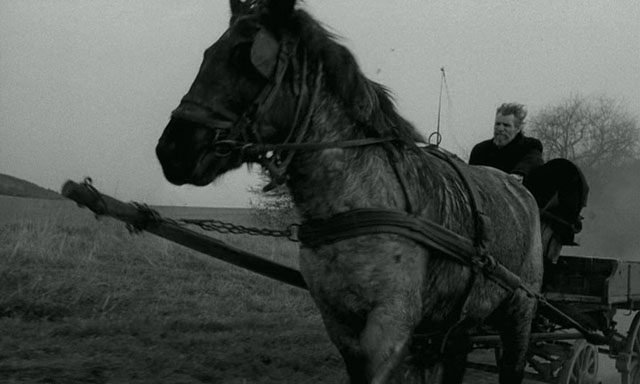
The Turin Horse by Béla Tarr.
Notes
sur d’autres films
review by Nicolas Azalbert (Cahiers,
December 2011, N.673).
How could the horse, which its owner beat and that was embraced
by Nietzsche at the Carlo Alberto place in Turin on January 3rd 1889, find its
way to an isolated farm in Hungary's countryside? If this starting point for
the new film by Béla Tarr doesn't hold up, it falsely allows the filmmaker to connect
himself with philosophy. Nietzsche stopped writing after his encounter with the
animal and Béla Tarr announced at the Berlin conference that he will stop
making films. By associating himself with the philosopher of the death of God
and the eternal return, Béla Tarr is trying to present himself like a
philosophical director. He takes these two concepts and makes them his own to
turn them into sad and repressive passions, when they were actually for
Nietzsche joyous and liberating. The grey cinematography of the film, the
silence and dejection of the abandoned father and daughter in a no man's
land, and the wind that ceaselessly blows are here the signs of the absence
of the divine. The quotidian repetitions throughout the six days that span the
film, from the dressing of the handicapped father by the daughter and the
dinner that consist uniquely of a potato, are the signs of an eternal return.
When Nietzsche defined art like the invention of new forms of life, the film of
Béla Tarr only represents the habit of repetition while taking suffering and
sadness as values. The philosophical imposture that consists of passing
Nietzsche off like a nihilist corresponds to an auteurial posture that consists
of passing off a caricature for the real thing. The simplification of the
traits has only the goal of enlarging the effect of the signature. The
long-take is henceforth a trademark deposited by Béla Tarr. Time is no longer
deployed, but instead only an idea of time and of style, which was already
there in Sátántangó, has erased
itself through the systematization of the process and a willingness to display.
That certain people cry that this is a masterpiece in front of this theatricalization
of misery only proves that the enterprise of falsification has well worked.
***
Leviathan by Lucien Castaing-Taylor and Véréna
Paravel. Notes sur d’autres films
review by Stéphane Delorme. (Cahiers,
September 2013, N.692).
 The pompous Leviathan
finally arrives here with its grand reputation, which it gleaned throughout its
festival run that lasted a whole year (cf.
Cahiers N.684). Once it failed on our screen, this documentary, which is
less experimental than formalist, reveals all of its vanity. The dispositif gives
the illusion of ten minutes of gripping real time, but it is incapable of
holding the viewer for its entire duration. There are a dozen of little cameras
that are harnessed on and around the boat to film... but to film what exactly?
There are those that compare Leviathan
to La Région Centrale (1971), but
the flowing masterpiece by Michael Snow explored a desert that was free of all
humans, with the genius of rhythm and a structure that didn't beg for holier
than though metaphysics. In love with their own images, the directors of Leviathan multiply their images without
any order and with inept angles as they embark as ethnologist to follow the
work of the fishermen. And on this account, the project feels wrong: the
fishermen are pushed back to the rank of the fish (in the credits they are
cited indistinctly) and they fall asleep, stunned in front of their television.
These aesthetes prefer to pretentiously entitle their "documentary" Leviathan, the biblical monster
designated in a haphazardly way to refer to the boat that is traveling the
waters. But what exactly is this infernal world that it's referring to? The
"modern world"? The "human condition"? We shiver in front
of such audacity. The interest of the directors is to keep everything sludgy with
their title that's spelled in gothic letters. But the most disagreeable thing
about this project, which does not have a tail or a head, is the place reserved
for the spectator. We are quickly emerged alongside the seagulls, going in and
out of the water (gurgle), or alongside detritus. The directors weren't there
themselves, and for no moment do they ask themselves if the audience would like
to be there. What will be their next project? Leviathan 2: the inside of a garbage truck.
The pompous Leviathan
finally arrives here with its grand reputation, which it gleaned throughout its
festival run that lasted a whole year (cf.
Cahiers N.684). Once it failed on our screen, this documentary, which is
less experimental than formalist, reveals all of its vanity. The dispositif gives
the illusion of ten minutes of gripping real time, but it is incapable of
holding the viewer for its entire duration. There are a dozen of little cameras
that are harnessed on and around the boat to film... but to film what exactly?
There are those that compare Leviathan
to La Région Centrale (1971), but
the flowing masterpiece by Michael Snow explored a desert that was free of all
humans, with the genius of rhythm and a structure that didn't beg for holier
than though metaphysics. In love with their own images, the directors of Leviathan multiply their images without
any order and with inept angles as they embark as ethnologist to follow the
work of the fishermen. And on this account, the project feels wrong: the
fishermen are pushed back to the rank of the fish (in the credits they are
cited indistinctly) and they fall asleep, stunned in front of their television.
These aesthetes prefer to pretentiously entitle their "documentary" Leviathan, the biblical monster
designated in a haphazardly way to refer to the boat that is traveling the
waters. But what exactly is this infernal world that it's referring to? The
"modern world"? The "human condition"? We shiver in front
of such audacity. The interest of the directors is to keep everything sludgy with
their title that's spelled in gothic letters. But the most disagreeable thing
about this project, which does not have a tail or a head, is the place reserved
for the spectator. We are quickly emerged alongside the seagulls, going in and
out of the water (gurgle), or alongside detritus. The directors weren't there
themselves, and for no moment do they ask themselves if the audience would like
to be there. What will be their next project? Leviathan 2: the inside of a garbage truck.
***
Story of My Death by Albert Serra. Notes sur d’autres film review by Jean-Philippe Tessé (Cahiers, October 2013. N.693).
 Albert Serra has realized two magnificent films, Honor de Cavelleria in 2006 and Birdsong in 2008. Two films that were
full of light, that expressed the flow of figures like Don Quixote or the three
kings in a cinema at dawn, which was radically new and that exploded in a
intelligent fantasy that was matched by a visual splendor. On top of being the
auteur of these two wonder, Albert Serra is also a sympathetic young man, funny
and smart, and, frankly, he is cool. Therefore there is everything to please,
everything to be in awe of. He is gracefully introduced by the international
film festival circuit, welcomed with open arms by the institution that is in
awe in front of his caprices (a film of 101 hours, retrospectives and carte
blanches pretty much everywhere), encouraged by the intelligentsia snob that
whispers in his ear that he's a genius… The Catalan has finally cracked.
You want some unclear hermetic genius? Here you go: with the pompous and
gratuitous title Story of My Death,
a film of 158 endless minutes that brings together Casanova and Dracula randomly
as if it could have potentially been about the marriage between Popeye and
Marie-Antoinette. These two and a half hours bring about a mortal boredom
(let's insist: mortal) and would perhaps only bring pleasure to fans that can't
wait to discuss it, just to prove that they are as clever as what is actually
an ineptitude that has nothing to impart, except for surely a despair, that
like the film by Serra, and are envious to die watching this bloated caricature of
radical chic cinema, which is as pretentious as it is insignificant. It's not
just that its content is bad and full of shocking puerile surprises (Casanova
shitting while laughing for five minutes: very interesting), what hits the
hardest is the ugliness of its lighting (the image is really ugly, underexposed
and incoherent) in a film that is wrongly framed (attention, its concept: Serra
filmed in 1:33 and then reframed it in Scope - result, it's ugly). The actors
are well casted, and there are some scenes that escape its carnage, and the
title, unfortunately rings true: for everything else, we can't but hope that
Serra, after such a disaster, will have the intelligence to question himself
again (Story of My Rebirth?) instead
pleasing himself in a greedy system where he is a permanent object where the
beneficiaries keep telling themselves at these cocktail parties worldwide that
they are the last of the underground.
Albert Serra has realized two magnificent films, Honor de Cavelleria in 2006 and Birdsong in 2008. Two films that were
full of light, that expressed the flow of figures like Don Quixote or the three
kings in a cinema at dawn, which was radically new and that exploded in a
intelligent fantasy that was matched by a visual splendor. On top of being the
auteur of these two wonder, Albert Serra is also a sympathetic young man, funny
and smart, and, frankly, he is cool. Therefore there is everything to please,
everything to be in awe of. He is gracefully introduced by the international
film festival circuit, welcomed with open arms by the institution that is in
awe in front of his caprices (a film of 101 hours, retrospectives and carte
blanches pretty much everywhere), encouraged by the intelligentsia snob that
whispers in his ear that he's a genius… The Catalan has finally cracked.
You want some unclear hermetic genius? Here you go: with the pompous and
gratuitous title Story of My Death,
a film of 158 endless minutes that brings together Casanova and Dracula randomly
as if it could have potentially been about the marriage between Popeye and
Marie-Antoinette. These two and a half hours bring about a mortal boredom
(let's insist: mortal) and would perhaps only bring pleasure to fans that can't
wait to discuss it, just to prove that they are as clever as what is actually
an ineptitude that has nothing to impart, except for surely a despair, that
like the film by Serra, and are envious to die watching this bloated caricature of
radical chic cinema, which is as pretentious as it is insignificant. It's not
just that its content is bad and full of shocking puerile surprises (Casanova
shitting while laughing for five minutes: very interesting), what hits the
hardest is the ugliness of its lighting (the image is really ugly, underexposed
and incoherent) in a film that is wrongly framed (attention, its concept: Serra
filmed in 1:33 and then reframed it in Scope - result, it's ugly). The actors
are well casted, and there are some scenes that escape its carnage, and the
title, unfortunately rings true: for everything else, we can't but hope that
Serra, after such a disaster, will have the intelligence to question himself
again (Story of My Rebirth?) instead
pleasing himself in a greedy system where he is a permanent object where the
beneficiaries keep telling themselves at these cocktail parties worldwide that
they are the last of the underground.
No comments:
Post a Comment