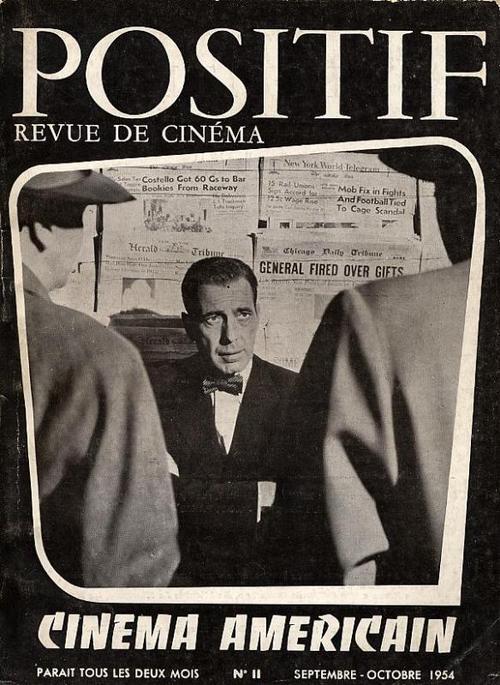
Monday, September 29, 2014

Adieu Godard?

Always an important cinematographic event, the new Godard, and Adieu au langage is just that, a glorious ‘period’ film, like the end of a sentence (or at least it feels that way) with its farewell title and in experimental 3D pyrotechnics, it feels like a gesture to retreat towards the next stage of life. With Godard’s dog Roxy (which has his wife’s last name, Miéville) digging and searching throughout a beautiful nature landscape. And with his cinematographer Fabrice Aragno they fulfill André Bazin’s Myth of Total Cinema by using these new filming cameras to see and record these pioneering new images of place and light for our times.

But is it necessarily his best film? Or how do you talk about Adieu au langage without falling in general hero-worship?

In terms of a poetic documentary on Godard’s surrounding Switzerland, I thought Lettre à Freddy Buache (1982) was a prettier, more concise documentary on the Lausanne, Romandy of the time. (Buache, who by the way, is fascinating in his recent Hors-champs interview on the subject of Godard; I, II). Chris Marker, in his late age, when he makes his video-essay The Case of the Grinning Cat (2004) it feels more politically committed than what Godard is doing here. Film Socialisme also felt more social as it's a contemporary look at a Europe in a state of economic and political crisis. And in Adieu when Godard makes the connection between the election of Hitler and the creation of television it’s the same argument that he’s been making since his Histoire(s) (1998)!  And even thought I really want to read Zoé Bruneau’s experiences working on the film (En Attendant Godard), and I understand the art history references, it still doesn’t sit right with me that he should have her be naked for most of her scenes. Even Bergman didn’t do that in his last film Saraband. And I don’t think he should necessarily be the center of gravity for French cinema, as he is for many, as for example, René Vautier (Afrique 50) has been too little known for too long and deserves more attention (c.f. Nicole Brenez on Vautier). And there are younger directors that are doing similar things which I think deserve more attention like Isiah Medina and his new film 88:88. And Godard speaks of making short videos on his cellphone – and how SMS’s stand for ‘Save My Soul’ – but I don’t know if in the era of YouTube how impressive it is incorporating these into his film. Do I really need to see an eight-second moving close-up of his bed? And I’ll be curious to see how Adieu compares with Michel Gondry documentary on Noam Chomsky (Is the Man Who Is Tall Happy?), another creative documentary on linguistics. But I guess where Godard fails in these other departments he succeeds elsewhere. Since Adieu au language still stands on its own as stunning object that shines by its imperfection. It’s the digital 3D equivalent of a painter’s draft of a self-portrait. Adieu.
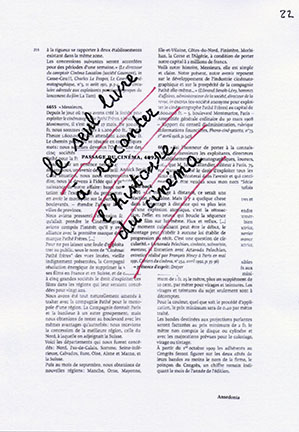
And Godard himself was more generous too with his interviews for Adieu. Where in the Eighties he was severe and sardonic with the press and media, now, without loosing any of his social criticism (though perhaps less people actually listen to him in his late age) he has a peaceful, generous and philosophical approach to his interviews. He complements certain critics that have been long-time supporters, he received Laure Adler for several interviews at his studio, and even in the press release for Adieu he shines a light on an impressive, though little-known, self-published book Passage du cinéma, 4992, which he describes as, “The only book to tell the history of cinema.”

Hopefully to hear, and discuss, more about late Godard Torontonians can come out to what sounds like a great roundtable discussion with leading Godard scholars Nicole Brenez, Daniel Morgan, Murray Pomerance and Jonathan Rosenbaum, who will probe such issues as the critical response to late Godard, the aesthetic and political development of his post-Weekend work, and the controversial themes that have preoccupied him over the last decades. 

Friday, October 3rd at 12:00pm at the TIFF Bell Lightbox.

Godard. Trolling. IRL.


The illustrated guide to IRL trolling with Jean-Luc Godard.

Sunday, September 28, 2014

Un Grand Petit Film: En Attendant Godard

Barbara Cornaud is a Masters student in Film Studies in Lyon. She’s known on social media as ‘Moustache de souris’ (@Barbabou) and she's well known for her impromptu thoughts, typically annoyed, about life and culture. Barbara’s areas of research include the philosophy of Gilles Deleuze and the films of Béla Tarr. One of the revelations, and cinematic highlights, of this weekend was the discovery of her earlier short film, En Attendant Godard (2010), which she co-directed. It’s about a young adolescent couple going about their afternoon as they squabble throughout cafés and the streets. He’s waiting for a meeting with Godard (he’ll be late, insists the director’s assistant) and she, enjoyably and frustrated, hangs around and experiences culture (reads Beckett and goes to the cinema). The directorial duo riffs on Godard though the film never feels like a pastiche. En Attendant Godard is closer to Yann Gonzalez’s Les rencontres d'après minuit in how it’s able to synthesize its sources to create something refreshingly original. En Attendant Godard begins with a static long-take filming a (home-made) tracking shot of small crew filming a young girl walking (a reference to Le Mépris) while the credits are read out loud. It also includes overlapping dialogue on top of a black screen, jump-cuts, and interesting re-working of the classic iconography of French cinema. While in terms of subject matter it’s full of the Bergmanesque Godard of arguments about relationships between couples and an existential dread. “Connard,” says the young women to her boyfriend after he says something stupid. Angry, to the point, and a little funny. En Attendant Godard est un grand petit film. Barbabou still has a lot to teach us.

Wednesday, September 24, 2014

Film Review: A Girl at My Door

A guest contribution by Lars Aumueller. - D.D.

July Jung’s A Girl at my Door shocked, moved, and enthralled me in equal measure. It is both a cri de coeur against all forms of violence against women, child abuse, and prejudice against members of the lesbian, gay, bisexual, transgendered and queer community, and a foreshadowing of more great work to come from its debuting writer-director.

The film starts with Young-nam, a female cop played by South Korean Bae Doona, having been reassigned to a rural post under murky circumstances. Notwithstanding the cloud of suspicion that surrounds her, she is clearly a good, experienced cop who quickly becomes an effective police chief for the town. Thus, she is compelled to act when she notices that the teenage girl Dohee (Kim Sae-ron) is being continuously abused by her stepfather. While Dohee’s father is clearly deserving of a stint in jail and Dohee of being cared for by child services, the authorities are hamstrung by the father’s status as the biggest employer in town as well as the fact that the girl’s mother has left town and shows no signs of returning. Young-nam becomes a de facto mother to Dohee, setting up a string of unforeseen consequences.

What sticks out about the film is that the director keeps a tight rein on its tone, which stops it from veering into cheap melodrama even as the script takes detours through some dark alleys. Secondly, despite her skillful portrayal of all of the complicated motivations behind the characters’ actions, Jung posits a solution made that much more eloquent and moving because it is simple: Young-nam’s and Dohee’s love for each other is something worth cherishing, celebrating, and the only thing that amounts to more than a hill of beans in this crazy world.

Lars Aumueller

Monday, September 22, 2014

Film Review: Eden

After contributing in past years reviews of his favorite festival films (Burning Bush, A Werewolf Boy, Himizu), I'm happy to receive Oded Aronson back and to post his review of Mia Hansen-Løve's great new film Eden. - D.D.

Imagine that flashing lights surround you in a room full of people barely conscious of what   they’re doing, pounding music knocks away at your brain and you’re lifted into a world of oblivion, magic thumps of the bass, and the screaming, shouting joy of dancing until falling to the ground nearly unconscious, dreaming of the music while the lights swirl around in your brain and you feel as though you’re floating into another universe. This is the world that Paul (Félix de Givry) and Cyril (Roman Kilinka), two men who form the electronic dance music group Cheers, strive to enter every day of their lives. Ever since hearing electronic dance music for the first time, they have felt the enormity of the music, understanding its primal power, and have strived to be DJs. Several years later, they have formed their group, and are touring around the US, hoping to become major DJs known throughout the world. Two acquaintances of theirs will eventually become Daft Punk, who will achieve that kind of   worldwide fame. As for Cheers, the love of music keeps them going, hoping only to achieve the feeling of power through music, and transferring that power to those who will go to the clubs whenever they play. 

However, when the neon lights fade out and daytime begins, there is a certain sadness and   desperation. When these same people are living their lives in the real world, all that gets them through their days is counting down the hours and minutes until they can enter the clubs again. The thought of holding jobs, marrying and having children, and handling their own finances terrifies them. So it is that everybody in the club scene is simultaneously freed and trapped by their own love for it. In the midst of it all, everybody tries to make some kind of connection, preferably with other people who frequent nightclubs so that they have at least one thing in common. Even if two people find each other amidst the chaos, there is no guarantee that they will actually like each other as people, or that their relationships will last. Still, people keep trying so that they don’t have to live alone. Many people go through relationship after relationship to such an extent that after a while they don’t even remember each other, or at least pretend not to remember so that they can live their lives without yet another thing to sadden them. 

Eden by Mia Hansen-Løve explicates the thoughts and feelings of people who live in the universe of clubs. Thoughtful, emotional and engaging insights about life and death fill every frame, and the actors play their roles in a brave, unflinching way, willing to embrace and illustrate both the likeable   and unlikeable elements of their characters. And then, of course, there’s the music. The original sets   by Cheers encapsulate the feeling that all DJs strive for; the excitement of the rhythm and the power   that leads to dancing. The joys and difficulties Cheers experiences in trying to secure live singers for their gigs ring true to life; anyone who has ever had to deal with real life talent could relate to the issues that Cheers experiences while trying to ensure the comfort and cooperation of one particular bullying diva. Of course, not all the talent is as unsavory; the joys of love, life and music are a major part of the lives of many characters the protagonists come across.  

The adventures of the characters when outside clubs are just as absorbing, but in a completely   different way. We can all identify with the struggle for people to make something of themselves, to   find someone they love who also loves them, and to deal with parents or other important figures who   fail to either understand or attempt to understand what gives them a reason to live. Eden is more than the story of what happens within nightclubs, or of only one particular genre of music; it is the story of anyone who has ever lived.

Oded Aronson

A Survey of American Social Films (Positif N.11)

Brecht at HUAC