Monday, October 8, 2012

Serge Daney: early Cahiers du Cinéma writing


Nous aurons été les dernier à vénéré Serge Daney…

There is a lot going on regarding the French film-critic Serge Daney: his life was recently celebrated by the Cinémathèque française with a series Serge Daney: 20 Ans Après. There was the publication by Edition P.O.L. of a new book of his collected writing: the third in the series La Maison cinéma et le monde - Les années Libé II (1986-1991). In Cahiers du Cinéma, where Daney played an important role as a writer between 1964 to 1981, - he left the monthly magazine, to have a more direct, daily relationship with his readers at Libération – the magazine ran a feature Hommage: Serge Daney (N.679). In a recent issue of Trafic (N.82), a journal that Daney co-founded, they published three essays by and/or about him: Marché de l’individu et disparition de l’experience by Serge Daney, a critique of publicity and television regarding the corruption of images; Appartions de Serge Daney by Pierre Eugène, which is a really clever essay – perhaps as reflexive as the En Couverture series over at Nightswimming – where Eugène takes the subject of so many Daney analysis, the image, and interrogates Daney’s manifestations on them (in documentaries, and such); and Serge Daney pour mémoire by Marcos Uzal, who describes an emotional and intellectual ciné-filitation that he has towards Daney, while also addressing this phenomenons larger social impact.


In the world of English-language film criticism, Daney is most readily associated with Jonathan Rosenbaum, who regularly brings up his old French friend (I’ve seen Jonathan talk twice on panels, and on both times he brought him up). It’s unfortunate that his only translated book, Postcards from the Cinema, is out-of-print. But to make up for the lack of official translations of his work, the internet has spoken: a few film-blogs – some of the best ones out there, in my opinion – have picked up the slack and their writers have taken up the role as unofficial Daney translators: these websites are Serge Daney in English, Steve Erickson’s website, Kino Slang, Diagonal Thoughts and My Gleanings.

Here is my attempt to contribute to this conversation: the following are my translations of Daney’s first three contributions to Cahiers, which I think are insightful to better understand the spirit of Cahiers and his legacy which lives on in the world of film-criticism.
*****
Petit Journal du Cinema: Retrospective Donskoy (Cahiers, April 1964, N.154)

The cinema of Mark Donskoy - as it was revealed at the retrospective at the Cinémathèque Française - affects us by its singular love for life. This tenderness which affects, this attachment towards everything alive, this predilection for kids: this is what separates him from the truisms of Soviet cinema. Donskoy, likewise for any great director, wouldn't mean anything to us if his tenderness didn't arise from cruelty, the tragedy of the pursuit of happiness alongside the suffocation of life.

Because he believes in the fatality of life, Donskoy shows what restrains and suffocates. Existence, feverish and precarious, always menaced, which is seized by a look of incomprehension on a child's face, brings us closer to Griffith then any other Russian filmmaker. He has a way to portray growing up by showings its contradictions and what prevents it - doing the subject justice - in regards to: political constraints (Mother, 1955), describing a stifling world (the Gorky Trilogy, 1938-39) and the condemned (Thomas Gordejev, 1959), a village of martyrs (Rainbow, 1943), the tragic tales of separated lovers, the injustice of man (The Horse That Cried, 1958). A thematic link between the films, but especially a major preoccupation for the filmmaker: it's when something is lost or when it's being fought for that it's truly there: hence, joy.

The same intention presides in the films form. If the constraint prides blossoming, only with discontinuity will we find any equilibrium. This is an art that affects us by its modernity: founded on oppositions, with ruptures of tone, a complexity of construction, and all of this without even mentioning the music. The cineaste goes as far as punctuating his films with interior rhythms, of camera-movements that respond to no other necessity then to establish a network of musical correspondences (Mother). An art whose effect, goes through breaks and dissonance, where one note, one melody, can cause a fervor: the final triumph of life: ultimate cavalcade (How The Steel Was Tempered, 1942), the rain on the tracts in Mother, the liberating combat that finishes Rainbow.

If sometimes this approach works to the detriment of Donskoy, in the less good films, misery that leads to boredom, this shouldn't take away from the merits of the filmmaker, but only should prove that for him, like with all inspired cineastes, beauty only stems from what’s going on in addition, independent of formulas. It is then in between an elegy and cruelty, between The Horse That Cried and Rainbow, where we need to place Mark Donskoy. If it's true, according to the cineaste, one must hate before one can love. - S.D.
*****
Petit Journal du Cinema: Sirk A Munich (Cahiers, June 1964, N.156)

After Imitation of Life we hardly ever heard from Douglas Sirk. What had happened to him? A long illness forced him to abandon two cinematographic projects, Lady X and Streets of Montmartre (about the life of d'Utrillo and Suzanne Valdon, supposedly starring Lana Turner). He then left Hollywood and the New World, to return to the Old World (Switzerland, where he would relax) but where he couldn't help returning to his first love: the theater. For Residenz-theater (the national theater) in Munich, his first mise-en-scène was Cyrano de Bergerac, which was unanimously praised by the critics (they spoke of a "literal opera of speeches"). Afterwards, he would take on Exit the King by Ionesco, in a version very faithful to the original text.

It's then under the green and pink sun in Munich, eating sausages with sauerkraut and drinking two giant beers, that we had a chance to assist one of these plays. Even though Sirk was still in recovery, he seemed absorbed in his work, with his eyes on the lookout, hiding in the shadows of the empty hall to better survey, then sliding out on the stage, to mime actions to the actors, demanding them to put more of themselves into their roles, pointing to the French text before stampeding off of the stage. The stage set is fantastique (it reminds us of the house in Written on the Wind) full of unreal purple tints; the actors (of reputation in Germany) that we certainly know in France, like Kurt Meisel (who has appeared on the screen numerous times, particularly good in A Time to Love and a Time to Die) brings to his role of the king his unsettling presence and conviction.

That Exit the King responds to specific Sirkian preoccupation is without a doubt: the mise-en-scène insists (and the play wonderfully lends itself) that there should be the the collapse of the palace, on the deterioration of the decor, that it be constricting and hostile all the way to the end, up until the king is literately dead, until it closes in on itself. We then understand the importance of this work for Sirk, a prolongation of his cinema oeuvre, and where he could finally emphasize a tragic dimension, that he couldn't put in his films (he confided this to us) due to commercial reasons. But, finally, he doesn't plan on giving it all up for the theatre, as Sirk confesses to us, Hollywood still attracts him: it's likely that he'll make Lady X, and certainly Streets of Montmartre, which seems to hold a strong place in his heart, with the first of these films for Universal, and the second for a smaller, less important company. But, especially, he hopes to film in Europe. - S.D. and J.-L. N.
*****
Frank Tashlin's Who's Minding The Store? : Frank and Jerry (Cahiers, June 1964, N.156)

Because cruelty and dryness always arises - a recurring Tashlin thematic - it's appropriate to imagine him differently: while he betrays more than when he liberates. Lets talk less about America, and talk more about Tashlin. It's true that America is always the subject of his films. Even more so than that, they are its foundation: the cineaste needs to put back in place what he has seen, which is the condition for a new movie. Also, the last one in a series (and the best one in a while) isn't an exception to the rule: it's exemplary of its aim, rigorous in its manner, disturbing in what escapes it.

Tashlin was never tender when he looked upon an inhuman world; when he wanted to denounce artifice, he resorted - in all sincerity - to satire and caricature.  Between when he started his career to his days with animation, his detachment was thin and the ambiguity was immense: if the "American way of life" is a caricature of real life, as far as the genre of satire is concerned: both of them only exist in relation to something which is preexisting. In that case, Tashlin exist because of, and for, the monsters that he plans on destroying.

Because he goes to war with false arms, his successes are always conditional. This vision of a mechanical world where humanity is slowly devoured and overrun with quarrels about differences, and where a complicity (like the jaded world of the comics in Artists and Models) is no longer possible. Between the man and the machine, the inventor and the invention, the relations are no longer about submission but of uncertainty: when the machines win their freedom, the men loose their maturity. It is this relation that Tashlin pursues and highlights with an unflagging precision, which makes his cinema a cinema of cranks and wheels and where all that matters is social climbing.

Betrayed by his mise-en-scène, Tashlin falls prey to the traps of all mechanisms (similar, to the cause and effect laws of animation). And what happens to the systems? They crash and destroy themselves by the same rhythm and movements that make them up and which they assimilate. They have their own laws, which one can follow, and are a creation of the human spirit: but what is created by man can also be destroyed by man. And the only way out of this infernal cycle, which traps, would be then to specifically include the uncontrollable: life, itself. An anarchistic behavior, externalizing itself at each instant; in short, everything in Tashlin's oeuvre with Jerry Lewis.

The role and the importance of Jerry Lewis got stronger as the two of them evolved, which is now in parallel to one another. Between their own films and their reunions, like this one, we have reached a point where Lewis started to reign over Tashlin. The moment where the director gave the star carte blanche is also the one where he reached the limit of his art: life itself, in its most anarchistic form, can’t be created, just like you can’t really direct Jerry Lewis. This is what is achieved in this film.

Here, in the framework of a scenario that authorizes everything and excludes nothing (a superstore), the register is that of a joyous feeling: Tashlin disposes of his tools, Lewis drops the ball. When everything drops, this disorder is that of poetry and the fantastique. It is in all innocence that Lewis no longer recognizes the mechanism of a world where – despite himself – he can only provoke catastrophe. An object of curiosity (here, the whims of Jill St. John), he is embarrassed by a world where he reflects its faults (and also its strengths) - a humanity descended into mimicry, where grimaces reflect a scandalous fading of energy.

Unflappable and indestructible because he isn’t a creation, but an incarnation of nature, the force unleashed by Tashlin is to exercise his personal demons: the worry of the fate of being submissive and condemned. Therefore the only possible positive movement belongs to Tashlin and that is of being a destructor. This paradox is the best explication of Tashlin's drama which is that of being able to grasp man by certifying that there is a disappearing progression or by evoking animalistic and monsterous forms (Jerry Lewis).  Always by failing or exceeding his objectives (jaded episodes even in the warm films like Artists and Models), he is now closer to the object and closer to the animal, which forces Tashlin to show what really alienates man: what really makes him a caricature and an animated drawing.

With a bitterness and precision, this is the triumph of their latest film. All that is left is the purity of the drawing with its relentless movements, which precipitates each sequence towards its natural outburst. Behind this exasperation, what is also brought to light, is that it shows a worry that might admit to that sterility which exists (Charles MacGivern). This is what gives this light-hearted film it's grave tone. – Serge DANEY

Tuesday, October 2, 2012

That Jack Ford yells very loud, he’ll make a great director


How should one start a blog-post about John Ford? Mention some of the great actors and actresses that he’s worked with like John Wayne, Henry Fonda, James Stewart, and Katharine Hepburn, Claudette Colbert, Maureen O'Hara? List many of his great films like The Informer, The Long Voyage Home, The Grapes of Wrath, How Green Was My Valley, When Willie Comes Marching Home, The Long Gray Home? Bring up how he made some of the most iconic Westerns like The Iron Horse, Stagecoach, My Darling Clementine, Fort Apache, The Searchers, Sergeant Rutledge, The Man Who Shot Liberty Valance? Bring up some of the seminal writing about him like Andrew Sarris’s entry in The American Cinema or his interview with Peter Bogdanovich?

Or try to describe why all of these old black-and-white films are as relevant as ever?

Today, in the early twenty-first century, when film production, distribution, and viewing is experiencing a seismic shift, accommodating itself to new technological changes; Ford’s cinema is a reminder of the great films that were being made in the Classical Hollywood studio era. Perhaps studying them might be rewarding to better understand and contextualize some of the films that are being made today? As Jean-Loup Bourget brings up in Hollywood, la norme et la marge, “the classical Hollywood forms are still alive in our time, even though, the truth is that they no longer have the same social function, nor without a doubt, the same significance.”

Eric Rohmer wrote about Westerns in Redécouvrir l’Amérique (Cahiers, N.54),
“There is certainly a touch of pedantry in evoking the Iliad while discussing a Western, but apart from the fact that certain commentators have had no qualms about comparing Chaplin or some Capra hero to the Percival of Arthurian legend, the obsession with antiquity is so flagrant in some masters of the American novel – Melville, James, Faulkner – that a parallel between the first colonizers of the Mediterranean and the pioneers of Arizona is no mere artifice of rhetoric.”
Rohmer is on the right path in bringing up the ancient Greek epic poem - along with highlighting terms like efficacy and elegance in discussing the form, and the genres preoccupation with destiny and morality - as in these Westerns, and especially Ford’s, these men, for their time, were experiencing the parameters of human experience. By choosing the colonizers of North America as his subjects, what we are being shown are the men and women that would go up against the empty abyss of a burgeoning country. They were literarily pushing the boundaries of their preconception of space. But there isn’t a rosy nostalgia to these pictures, as these social portraits hinge upon the collapse of civilized society into that of chaos or violence. One just thinks about the hold-up in Wagon Master, when this group of Mormons face exterior threats and a hold-up from within their group - the only way to fight back is with their guns. This is only one example of what’s particularly interesting about these films, and that is how the characters resolve these moral conflicts in face of humanity in extreme conditions.

The military seems to hold a strong place in Ford’s cinema. In Joseph McBride’s Searching for John Ford, McBride brings up that a young Jack Feeney as a young boy got all excited during his history classes. Ford felt proud when he discovered that a lot of Irish-American immigrants participated in the American Revolution (his father included). Joseph McBride, 
"His identification with the military ethos and his growing sense of himself as a national poet made him turn his postwar filmmaking efforts largely to themes of American history. [...] The result was a postwar body of work that became more nakedly individualistic, more deeply emotional, in many ways more pessimistic, fascinatingly and sometimes maddeningly self-contradictory, often defiantly quirky and self-indulgent to the point of perversity." 
One gets a sense that the military is viewed as a unifier of the population but also as a, perhaps, an inevitable period of misery and grief, before lighter times ahead. Just like how it takes a war and tragedy, in Drums Along the Mohawk, before there could be the creation of the American flag. So that there is something valedictory about how Lana (Claudette Colbert) would then compliment and admire it.
*****

For more information about Ford’s biography a great resource is his grandson’s Dan Ford’s biography Pappy: The Life of John Ford. But for starters, here is a brief account of his youth and his early career.

Ford was born on the first of February, 1895 into a large family and whose parents were Irish-American bootleg saloonkeepers in Portland, Maine. His father John Feeney moved to America from Ireland, following his nephew Michael Connoly, who had already been living there, living through exciting times.

When he was young, a young Jack Ford played on his high school football team, and worked at Portland's Jefferson theater, a prime stop for road companies. He then moved to join his brother's company, the Francis Ford Serial Company, which moved to the new studio Universal City in 1915, "the first truly modern studio," where he would make his first two-reelers The Tornado and The Scrapper (both 1917).

"Francis Ford was John's first great teacher and his first great professional influence,” writes Dan Ford, “but it was John's teaming with silent star Harry Carey that paved the way to his eventual success." Ford would make twenty-three films with Carey. Dan Ford writes about how this collaboration made John Ford, "a first-rate action director." On an assignment for Universal to make another two-reeler, Ford, with Carey, would make Ford’s first full-length feature, Straight Shooting (1917). Irving Thalberg really liked it, and tthe success of Straight Shooting convinced Universal to get Ford and Carey to make more of the same kind-of films billed as "Harrey Carey's and Jack Ford's Just Plain Westerns". Their last film together is Marked Men (1919).

John Ford’s reputation was improving and he left Universal for the William Fox studios, where his wage would increase to six-hundred dollars a week. His first two films there starred Buck Jones: Just Pals and The Big Punch (both 1919). Ford worked with Tom Mix "the hottest western star in Hollywood" on two pictures: Three Jumps Ahead and North of Hudson Bay (1922). Dan Ford describes Cameo Kirby (1923) as his "first truly mature film."

Around this time in 1920, Ford married Mary McBride Smith and had one son with her, Patrick. But this time of joy would not last long, as then the Irish Revolution got Ford interested again in his Irish roots and he went to visit his family in Galway, Ireland.
*****

Tag Gallagher does a good job at breaking up Ford’s career into different periods in his book John Ford: The Man and his Films. Gallagher divides Ford’s oeuvre into the following four categories: 1) The Age of Introspection (1927-1935), 2) The Age of Idealism (1935-1947), 3) The Age of Myth (1948-1961), and 4) The Age of Mortality (1962-1965). About these periods Gallagher writes,
"The first period tends to be relaxed, airy, concerned with being and with contemporary social life. The second period tends to be more manipulative, closed and formal, concerned more with mood and the past. The third period is brighter and more vital, formal but open, concerned with pilgrimage and subsistence. The fourth period, following a "season in hell," is eschatological, existentially and aesthetically."
It is also relevant here to bring up William K. Everson who in American Silent Film, in describing some of the more salient silent films, writes,
"The films of the early twenties concentrated more on beauty of camerawork and lighting - a beauty enhanced by the skilled utilization of tints and tones and by the increased and soon perfected use of gauzes, filters and glass shots. […] Through the twenties, the virtuosity of the purely pictorial aspect of film increased steadily, reaching its apex in 1927 and 1928 [...]  For quite certainly, the overall standards of the American film - both as entertainment and as art - were higher in the twenties then in any other period. It is in the twenties that we find the largest concentration of permanent classics of the American screen."
The films that Everson include in this group of “permanent classics” includes Ford's The Iron Horse and Four Sons, along with Borzage's Seventh Heaven, Griffith's Isn't Life Wonderful? and Orphans of the Storm, von Stroheim's Greed, Murnau's Sunrise, and von Sternberg's Docks of New York
*****

Since Ford's career has spanned for over fifty-years, from the teens to the late sixties, there are many filmmakers that one could classify as his contemporary. He is usually discussed in terms of being a classical Hollywood director, and thus could be associated with many directors of the time. Some examples: Cecil B. DeMille, as they both worked through the transition from silent to talkies, and in both eras made epic-scale spectacles; Alfred Hitchcock, for imbuing their films with a working-class social texture; Frank Capra and Preston Sturges, with Capra for a shared sentimentalist-optimism though Ford wasn't as preachy, and with both for how they re-used a stock company from film to film; Fritz Lang, both directors have made films that share very similar stories, but where Lang was a pessimist, Ford was a humanist; and Howard Hawks, for making Westerns and creating some of John Wayne's most iconic performances.

It is interesting to note what Ford admired about his friend Frank Capra's films,
"His genius has been applied not only to the art of but to the business of making great motion pictures, and his name on the credits has assured rich satisfactions to bankers, exhibitors, stars, feature players, extras, cameramen, crew, and the theatergoing public for more than half a century. This he has accomplished without compromising his own exacting sense of the good, the beautiful, and the appropriate; without ever losing a friend or having a scene censored."
It is interesting to note that the business-side of movies is one thing that Ford admires, because he openly voiced his frustration and anger towards his producers. But if one looks further into why Ford’s films stand out is that he too was able to mix the best of both worlds balancing personal expression with studio resources.

"Capra has not only achieved a place of distinction in that select company of really fine directors - men like Bill Wellman, Fred Zinneman, George Stevans, George Seaton, Billy Wilder, Henry Hathaway, the late Leo McCarey, and (abroad) Jean Renoir, Fellini, De Sica, Sir Carol Reed, and David Lean." Ford continues, from his foreword to Capra's The Name Above the Tile: An Autobiography, "He heads the list as the greatest motion picture director in the world."
*****

Ford’s films have a distinct style: the people in his films are characterized by more than just how they look and by their actions, but also by their behavior, glances and gestures; he usually films in long-shots so that there can be more things going on in the fore-, mid-, and background then just the primary action; there isn't too much editing and the camera movements - like dolly-shots to provide emphasis, or pans - are used sparingly (more like Ozu than Eisenstein). Ford continues in the tradition set forth by the D.W. Griffith of The Birth of a Nation by making films exploring the countries history and social problems. The French film-critic Jean-Loup Bourget refers to Ford as a “cinéaste classique par excellence,” and talks about his films as deriving their form from classical paintings. In Bourget's essay D’un classicisme l’autre: Poussin, Ford, Hawks, from the book Le classicisme hollywoodien, he writes, “It’s clear that the paintings that have been brought up by others aren’t “sources” (e.g. the paintings of the West by Frederic Remington, Winslow Homer) or punctual references, but more like that of similar world-views, that share an air of familiarity, where the reprisal of certain pictorial motifs are openly both visual and thematic.”

Ford is more than just as an auteur, but is a cineaste - a director conscious of making movies, and wanting to heighten their experience. One filmmaker that Ford admired and who had a great influence on him is F.W. Murnau. In the late twenties, Murnau was invited by the Fox Studios to come to Hollywood to shoot a movie Sunrise: A Song of Two Humans (1927). Ford who was at the studio at the time was impressed by its many-fold visual tricks and distorted realism. Gallagher writes about the Murnau influence on Ford that, "Ford found cinema could be completely poeticized; he discovered movies might be art."

The Informer (1935) with its angst-ridden protagonist, stark lighting, titled camera angles and distorted sets; is one of the early Ford films to be influenced by the German Expressionist filmmaker. Murnau's Nosferatu was also was influential on Ford. Especially the shock effect that comes from the revealing of Nosferatu (Max Schreck) from out of the shadows into the light - where he's looking like a mixture between a rat and a vampire. Ford would appropriate this device when he would present luminary figures revealing hidden truths. One can think of the many court-room scenes in Ford's films where in a moment of suspense the onlookers would be shocked by someone revealing important information. As well there is the Nosferatu dazed-like wandering - a tabula rasa which watches and absorbs - that seems to be the primary influence for Huw Morgan (Roddy McDowall), from How Green Was My Valley, whose unchanged stunned look remains on his face as he wanders around the misery of the Welsh mining community.
*****

The subject of American history plays a large role in Ford's cinema. A good description of his films could be that Ford gives life to history through the rituals of individuals within communities: marches getting ready and then taking place, ballroom dances in unison, military preparations and following orders, court-room procedures and so on and so on. Orson Welles said about Ford that at his best, "you feel that the movie has lived and breathed in a real world."

In discussing industrialization Tony Judt and Timothy Snyder, in Thinking the Twentieth Century, highlight that John Steinbeck and his book The Grapes of Wrath, “serves the function of creating an image of working class suffering, making society look different than it did before”. Where Steinbeck creates the social texture of the Great Depression through his prose, Ford presents the faces and the people going through these experiences. So in the film version of The Grapes of Wrath, Tom Joad (Henry Fonda) and his family put a face to the plight of the migrating farmers, which was caused by their property being allocated by the banks. And one could include How Green Was My Valley as one of the great proletariat films. In Ford's films, to use two other examples Mary of Scotland and Cheyenne Autumn, Ford gives precedent to the victims and the defeated. There is something almost modern about the social criticism imbued within his historical portraits.

Where a historian like Richard Hofstadter in The American Political Tradition describes the 19th century politician Abraham Lincoln in terms of being a self-made myth, both self-conscious of his poor and humble origins alongside being political ambitious. Lincoln’s views on slavery, as Hofstadter posits, was more a tool of electoral self-promotion then that of a humanitarian concern. While for Ford, in his rich, though perhaps naive, portrait of Lincoln: Ford emphasizes certain qualities of the Lincoln spirit, that of education, collectivity and the possibility of creating change. It’s almost a revolutionary spirit and you can see it in many of Ford’s films where Lincoln appears as a character or solely represented in a photograph (The Prisoner of Shark Island, the Calvary trilogy).

A good reference for discussing Ford's relation to the spirit of Lincoln is John Ford’s Young Mr. Lincoln, A collective text by the Editors of Cahiers du Cinema from August 1970, which is anthologized in Narative, Apparatus, Ideology. The essay is a Marxist-Freudian reading of the film, that analyzes it in the way that Walter Benjamin has insisted the discussion of arts as, “not as a reflection of the relations of production, but as having a place within these relations.” The Cahiers essay is useful for providing a brief history of the United States of America to contextualize Young Mr. Lincoln. Like how in 1938, under Democrat president Roosevelt, the fairly gloomy context of the Young Mr. Lincoln undertaking was that of “federal centralism, isolationism, economic reorganization (including Hollywood), strengthening of the Democrat-Republican opposition, new threats of internal and international crisis, crisis and restrictions in Hollywood itself." And that, “It is no doubt difficult, but necessary, to attempt to estimate the total and respective importance of these factors to the project and the ideological “message of the film.”"
*****

So what is Ford's influence on contemporary cinema? and how do we remember him today? In a political climate where the truism of the past are snatched from their original meaning to promote false claims and distorted ideals, and in a culture that fetishes the new and novelty to the disregard to the old. John Ford’s cinema stands out for its humanistic concern and as a relic of mainstream mid-century American cinema. His movies today both move and are moving.

From early on, even while he was still alive, his work was already influencing other filmmakers, especially in terms of how he presented communities and his treatment of landscapes. Some directors, from the past to the present, that show a marked influenced by Ford include: Orson Welles, Ingmar Bergman (the early, medieval films), Michelangelo Antonioni, Akira Kurosawa, Stanley Kubrick, Monte Hellman, Maurice Pialat (Van Gogh), Straub & Huillet, Martin Scorsese, Paul Schrader, Walter Hill, Peter Bogdanovich, Paul Thomas Anderson, Quentin Tarantino, José Luis Guerín (Innisfree), Pedro Costa, and Andrew Stanton (John Carter).

When the language of film criticism has yet to catch up with the new realities of the twenty-first century, there needs to be some understanding of the past to better understand how to move forward. Two directors that admirably keep on with the Classical Hollywood tradition which was personified by Ford that I would like to highlight are Steven Spielberg and Clint Eastwood. It is a shame then that some of their great new films like Lincoln and Trouble With The Curve are oddly dismissed as being anachronistic and out-of-date. While a regular, yearly output may lead to a variety in quality, the Hollywood tradition that Spielberg and Eastwood are engaging with; make me confident in the way that the movies are being made, and in the stories that they tell, and in the society that watches them.

David Davidson

Monday, September 24, 2012

John Ford Speaks!


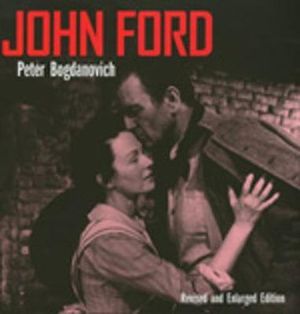
In Peter Bogdanovich's book, John Ford: Revised and Enlarged edition, the center-piece is an interview with Ford, where he discusses his entire career, along with four of Bogdanovich's early journalistic essays. In A Meeting at Monument Valley and My Name's John Ford. I Make Westerns, Bogdanovich describes his experience going to Monument Valley to visit the set of Cheyenne Autumn. In the essay, between reporting on how Ford filmed the movie and how he behaves on the set, are anecdotes about Ford by his collaborators. Two of them that stand out are: a discussion between Ford and Carroll Baker about Ingmar Bergman ("you mean the fella that called me the greatest director in the world."); and how during the McCarthy era at the Director's Guild, Ford defended Joseph L. Mankiewicz against Cecil DeMille who was accusing him  of being a communist.

A Poet and Comedian is how Orson Welles characterizes Ford, and Bogdanovich would add that in Ford's best films "these two sides of his personality are mixed." In the essay, Bogdanovich elaborates about Ford's  career development and themes within his films. "With Ford at his best, you feel that the movie has lived and breathed in a real world," said Welles, quoted by Bogdanovich, and who would add, "he has told the American saga in human terms and made it come alive." And that, "But the key to his work in the thirties lies in a personal struggle (no doubt unconscious) between two very different kinds of film, both of which interested him deeply: the dramas [...] and the lighter pictures of American life."

There is a moving and heart-felt memorial (Taps) and a annotated filmography, which is useful for the brief descriptions of his little-known silent films as well as uncompleted projects.

The following are some of my favorite remarks from the Ford interview, A Job of Work, which was taped at his home in the Fall  of 1966. What's illuminating about the interview is the framework it provides to better understand the realities of a classical Hollywood era studio director and the mediation of personal self-expression within larger commercial projects, as well as the interference and common-place alterations that ended-up shaping his films.

For more information about Ford there is the the great documentary Directed by John Ford, also by Bogdanovich, with a filmed interview with Ford, though he comes off as more gruff and less amicable then he does in the book. As well there is John Ford: Interviews, which is especially interesting for the interviews translated from French, where Ford is more outgoing and receptive. You can also find more of Bogdanovich's writing at his excellent blog Blogdanovich and there is a great interview with him where he speaks for over fifty-minutes about his writing, film-making and other projects at video-magazine The Seventh Art.
*****
Directors and Actors
D. W. Griffith, "influenced all of us. If it weren't for Griffith, we'd probably still be in the infantile phase of motion pictures. He started it all - he invented the close-up and a lot of things nobody had thought of doing before. Griffith was the one who made it an art - if you can call it an art - but at least he made it something worthwhile."

Henry B. Walthall
, "was one of the greatest actors of all time - a personality that just leaped out from the screen. He had nothing to do in that picture [Kentucky Pride] - but he had such a presence - like Barrymore had, but Walthall was a much better actor."

Will Rogers: "Well, no write could write for Will rogers, so I'd say to him, 'This is the script but this is not you - the words will be false coming from you. Just learn the sense of it, and say it in your own words.' Some of the lines he'd speak from the script but most of the time he'd make up his own; he'd stop and let people pick up their cues and then go on; he wouldn't write the lines down, but he'd work it out beforehand and then just get in front of the camera and get the sense of the scene in his own inimitable way."
 
Scripts and Directing
Men Without Women (1930), "I think it was the first picture Dudley Nichols and I did together. From then on, we worked together as much as possible, and I worked very closely with him. He had never written a script before, but he was very good, and he had the same idea I had about paucity of dialogue."

On screenplays: "Well, there's no such thing as a good script really. Scripts are dialogue, and I don't like all that talk. I've always tried to get things across visually. I don't like to do books or plays. I prefer to take a short story and expand it, rather than take a novel and try to condense. But it has become more difficult to get a good story."

Directors: "Certain directors go by fixed rules - they say you must have a close-up of everything. But we've got this big screen: instead of putting a lot of pock-marked faces on it - big horrible head, eye - I just don't like it - if I can play a scene in a two-shot, where you can see both faces very well, I prefer it that way. You see people instead of just faces. Of course, nowadays in pictures, you never even get a chance to look at anyone's face."

Directing: "Phil Dunne wrote the script and we stuck pretty close to it. There May have been a few things added, but that's what a director is for. You can't just have people stand up and say their lines - there has to be a little movement, a little action, little bits of business and things."

Multiple takes: "No-because the actors get tired, they get jaded and lose the spontaneity - so that they-re just mouthing words. But if you get the first or second take, there's a sparkle, an uncertainty about it; they're not sure of their lines, and it gives you a sense of nervousness and suspense."

Music: "Generally, I hate music in pictures - a little bit now and then, at the end or the start - but something like the Ann Rutledge theme belongs. I don't like to see a man alone in the desert, dying of thirst, with the Philadelphia Orchestra behind him."
Medium Specificity and Cinematography
Talkies: "I didn't feel anything about it - it was just a job of work."

His first color film, Drums Along the Mohawk (1939): " There was no change really. It's much easier than black and white for the cameraman; it's a cinch to work in, if you've any eye at all for colour or composition. But black and white is pretty tough - you've got to know your job and be very careful to lay your shadows properly and get the perspective right. In colour - there it is; but it can go awfully wrong and throw a picture off. There are certain pictures, like The Quiet Man, that call for colour - not a blatant kind - but a soft, misty colour. For a good dramatic story, though, I much prefer to work in black and white; you'll probably say I'm old-fashioned, but black and white is real photography."

Filming The Long Gray Line (1955) in CinemaScope: "I hated it. You've never seen a painter use that kind of composition - even in the great murals it still wasn't this huge tennis court. Your eyes pop back and forth, and it's very difficult to get a close-up."

Filming a part of How The West Was Won (1962) in Cinerama
: "It's worse than CinemaScope, because the ends curl on moving shots and the audience moves instead of the picture. You have to hold onto your chair. I didn't care for it."

Cameraman George Schneiderman; "Well, I like to have the shadows black and the sunlight white. And I like to put some shadows into the light. We would talk it over, and I'd say 'Right here, George,' and he'd say 'Fine - I'll move a little to the right.' I'd  say 'Go ahead.' We worked together - Never had an argument with a photographer."

Best cameramen: "Comparisons are odious, of course, but Gregg Toland and Joe August were really great cameramen, and so was Artie Miler. I think they stand out as three of the best I ever worked with."
 
Pictures
The Iron Horse (1924): "But the point is we had this simple little story come out as a so called 'epic', the biggest picture Fox had ever made. Of course, if they had known what was going to happen, they never would've let us make it."

Mother Machree (1927): "I had a lot of fun with that, but you didn't choose these things - they were thrown at you and you did the best you could with them."

Born Reckless (1930): "In those days, when the scripts were dull, the best you could do was to try and get some comedy into it."

Steamboat Round the Bend (1935)
, "should have been a great picture but at the time they had a change of studio and a new manager came in who wanted to show off, so he recut the picture, and took all of the comedy out."

The World Moves On (1934): "I pleaded and quit and everything else, but I was under contract and finally I had to do it, and I did the best I could, but I hated the damn thing. It was really a lousy picture - it didn't have anything to say - and there was no chance for any comedy. But what the hell, that was called 'being under contract.'"

Stagecoach (1939): "I still like that picture. It was really Boule-de-suif, and I imagine the writer, Ernie Haycox, got his idea from there and turned it into a Western story which he called 'Stage of Lordsburg.'"

Young Mr. Lincoln (1939): "They cut some nice things out of it. For example, I had a lovely scene in which Lincoln rode into town on a mule, passed by a theare and stopped to see what was playing, and it was the Booth Family doing Hamlet; we had a typical old-fashioned poster up. Here was this poor shabby country lawyer wishing he had enough money to go see Hamlet when a very handsome young boy with dark hair - you knew he was a member of the Booth Family - fresh, snobbish kid, all beautifully dressed - just walked out to the edge of the plank walk and looked at Lincoln. He looked at this funny, incongruous man in a tall hat riding a mule, and you knew there was some connection there. They cut it out - too bad."

How Green Was My Valley (1941): "I wanted to reprise the mother's song so I got the idea of bringing the cast back. In the theater I always like to see the cast come out - regardless of whether the guy's playing the messenger boy or the butler - I like to see him out and take his bow. That's probably where I got the idea."

My Darling Clementine (1946)
: "I knew Wyatt Earp. In the very early silent days, a couple of times a year, he would come up to visit pals, cowboys he knew in Tombstone; a lot of them were in my company. I think I was an assistant prop boy then and I used to give him a chair and a cup of coffee, and he told me about the fight at the O.K. Corral. So in My Darling Clementine, we did it exactly the way it had been. They didn't just walk up the street and start banging away at each other; it was a clever military manoeuvre."

The Fugitive (1947), "It came out the way I wanted it to - that's why it's one of my favorite pictures - to me, it was perfect. It wasn't popular. The critics got at it and evidently it had no appeal to the public, but I was very proud of my work."

Fort Apache (1948), "Yes - he was the colonel, and what he says - goes; whether they agree with it or not - it still pertains. In Vietnam today, probably a lot of guys don't agree with their leader, but they still go ahead do the job."

When Willie Comes Marching Home (1950)
: "Well, that was my racket for a while, and there wasn't anything funny about it. I wonder what s.o.b. will be the first to make a comedy about Vietnam?"

Wagon Master (1950), "I wrote the original story. Along with The Fugitive and The Sun Shines Bright, I think Wagon Master came closest to being what I wanted to achieve."

The Quiet Man (1952): "We had a lot of preparation on the script, laid out the story pretty carefully, but in such a way that if any chance for comedy came up, we could put it in - like Barry Fitzgerald bringing the crib into their bedroom on the morning after the wedding night, and seeing the broken bed."

The Sun Shines Bright (1953): "The Sun Shines Bright is my favorite picture - I love it. And it's true to life, it happened, Irvin Cobb got everything he wrote from real life, and that's the best of his Judge Priest stories."

The Searchers (1956): "Well, I thought it was pretty obvious - that his brother's wife was in love with Wayne; you couldn't hit it on the nose, but I think it's very plain to anyone with any intelligence. You could tell from the way she picked up his cape and I think you could tell from Ward Bond's expression and from his exit - as though he hadn't noticed anything."

The Wings of Eagles (1957): "I didn't intend it that way, but he did. I woke up one morning and my good hat was gone, my pipe and everything else; they'd taken all the Academy Awards and put them in the office set."

Sergeant Rutledge (1960), "Yes, that's the point. The Negro soldier, the regular, is very proud. They had always been a cavalry outfit, but in this last war, they were mechanized - they took their horses away, and they were broken-hearted. They were very proud of their outfit; they had great esprit de corps. I liked that picture. It was the first time we had ever shown the Negro as a hero."

The Man Who Shot Liberty Valance (1962
): "Well, Wayne actually played the lead; Jimmy Stewart had most of the scenes, but Wayne was the central character, the motivation for the whole thing. I don't know - I liked the both - I think they were both good characters and I rather liked the story, that's all. I'm a hard-nosed director; I get a script - if I like it, I'll do it. Or if I say, ' Oh, this is all right' - I'll do it. If I don't like it, I'll turn it down."

7 Women (1966)
, "I think it was a good story. And it was a good switch for me, to turn around and make a picture all about women. It didn't do well here, but it was a sensation in Europe. I thought it was a hell of a good picture."
Thoughts and Philosophy

The boastful Irish character: "I suppose the character is a composite of several people. My father, for instance. He would tell about the great things he'd done as a young man, such as the time he lifted a heavy boulder up out of the water, or how he swam Galway Bay. Of course, he was a damn liar, but he would entertain us kids."

The concept of the glory in defeat or noble failure that runs throughout Ford's films, "Well, I think that's coincidence - although it's a wonderful thing to think about. But I never realized that - I mean, it isn't something I've done consciously -  it may have been subconscious. But, then, I didn't write the stories."

The difficulty to finance small personal pictures: "Oh, you can't anymore - it's impossible. You've got to go through a series of commands now and you never know who the hell reads the scrips any more. You can't get an O.K. here in Hollywood for a script - it's got to go back to New York, and through a president and a board of directors and bankers and everybody else. What I used to do was try and make a big picture, a smash, and then I could palm off a little one on them. You can't do it any more."

The worth and importance of his films: "Well, that's presumption I can't accept. I never felt that way about it. I've always enjoyed making pictures - it's been my whole life. I like the people I'm around - I don't mean the higher echelons - I mean the actors, the actresses, the grips, the electricians. I like those people. I like to be on the set, and regardless of what the story is, I like to work in pictures - it's fun.
Harry Carey tutored me in the early years, sort of brought me along and the only thing I always had was eye for composition - I don't know where I got it - and that's all I did have. As a kid, I thought I was going to be an artist; I used to sketch and paint a great deal and I think, for a kid, I did pretty good work - at least I received a lot of compliments about it. But I have never thought what I was doing in terms of art, or 'this is great' or 'world-shaking', or anything like that. To me, it was always a job of work - which I enjoyed immensely - and that's it.

Monday, September 17, 2012

History of Film Criticism : Andrew Sarris on John Ford

‘History of Film Criticism’ is a new series that I will be starting to highlight important and/or influential film criticism essays. These pieces will be pulled from books and/or magazines, accessible or not, but which I think deserve more attention. They stand out due to their eloquent prose, critical position, and historical context.
For the first post in this series, which I would like to dedicate to the late Andrew Sarris, is his piece on John Ford – one of the fourteen Pantheon Directors – from The American Cinema – Directors and Directions: 1929 – 1968.
This is the first out of three blog-posts that I’m planning to post about John Ford. – D.D.
*****
John Ford (1895-1973)
If John Ford had died or retired at the end of 1929, he would have deserved at most a footnote in film history. The Iron Hourse and Four Sons attractyed some attention in their time, and seem to be the only Ford silents in the American museum repertory. The Iron Horse  is clearly influenced by Griffith, and Four Sons by Murnau. Neither work is a revelation in itself, though there are privileged moments in these films that belong to Ford alone. Above all, there is a nostalgia for lost innocence on the family level of history.  Ford’s technical competence has been established even at this early stage in his career, but up to 1929 he cannot be considered one of the major artists of the medium. His personal vision has not been developed to the level of a Lubitsch or a Lang at this stage of film history.
            If Ford hard died or retired at the end of 1939, he would have deserved at least a paragraph for The Informer and Stagecoach, the former allegedly the first creative American sound film, and the latter representing the renaissance of the Western. He would now be a faded, dated establishing figure like Marcel Carné, a vulnerable target for all the New Critics after Bazin. Dated also would be the calculated expressionism and maudlin sentimentality of The Informer.  Ford’s style stil lingered in the shadow of Murnau’s in 1935, but no one had seemed to notice Steamboat ‘Round the Bend and The Whole Town’s Talking that same year. Ford has never been sufficiently appreciated for the verve and snap of his visual storytelling. Critics of the thirties always joked about the fact that the Hollywood system compelled Ford to make three Wee Willie Winkies for every Informer. The joke, then as now, was on the critics. Despite the monstrous mythology of Shirley Temple, Wee Willie Winkie contains extraordinary camera prose passages from the wide-eyed point of view of a child. What the critical establishment of the thirties admired in Ford was his ability to avoid so-called woman’s pictures despite studio pressures. Nor was Ford too much interested in the fancier forms of sexual intrigue. Being Irish and Catholic and action-oriented to boot, he tended to gravitate to public places where men spoke their minds openly. The Left has always been puritanical, but never more so than in the thirties when Hollywood’s boy-girl theology threatened to paralyze the class struggle. In such an epoch, even an Irish-Catholic conservative like Ford could be mistaken for a progressive force.
Ford’s critical reputation reached its peak and then began its decline during the forties. The Grapes of Wrath, The Long Voyage Home and How Green Was My Valley firmly established Ford as the Hollywood director despite the extraordinary challenges of Orson Welles and Preston Sturges. The New Dealish propaganda of The Grapes of Wrath has dated badly, as has John Steinbeck’s reputation. Ford’s personal style was particularly inimical to Steinbeck’s biological conception of his characters. Where Steinbeck depicted oppression by dehumanizing his characters into creatures of abject necessity, Ford evoked nostalgia by humanizing Steinbeck’s economic insects into heoic champions of an agrarian order of family and community. By the time of How Green Was My Valley, Ford mastered his narrative style to the point that he could embroider it with those pauses and contemplations that expressed his feelings. Even in Tobacco Road, Charlie Grapewin’s Jeeter Lester was transformed from a greedy barnyard animal to a seedy but serious mainstay of tradition. Ford had more in common with Welles than anyone realized at the time. Ford was forty-six when he made How Green Was My Valley, and Welles was only twenty-five when he made Citizen Kane, but both films are the works of old men, the beginnings of a cinema of memory.
            Ford’s The Battle of Midway is ostensibly a documentary, but it is as personal a statement as any of his fiction films. He focuses her on the ordinary scale by which the most gallant heroes are measured. It is not the battle itself that intrigues Ford, but the weary faces of rescued fliers plucked out of the Pacific after days of privation. World War II was the last war to be endorsed by the intellectual establishment as a valid artistic subject. Ford proceeded into the fifties to photograph the Korean war, an act symptomatic of his downfall with the taste-makers.
            Only the Lindsay Anderson-Gavin Lambert generation of Sequence and Sight and Sound kept Ford’s reputation alive in the period beginning with They Were Expendable in 1945 and ending with The Sun Shines Bright in 1954.The British critics could appreciate Ford for the flowering of his personal style at a time when the rest of the world (this critic included) were overrating Carol Reed and David Lean for the efficient, impersonal technicians that they were. Finally, the New Critics in London and Paris rediscovered Ford after he had been abandoned even by the Sequence-Sight and Sound generation. The last champions of John Ford have now gathered around Seven Women as a beacon of personal cinema.
            The late André Bazin damaged Ford’s reputation with New Critics by describing Ford’s technique as a hangover from the scenario-dominated thirties. Bazin overrated the use of deep focus in The Little Foxes as the antithesis to Ford’s “invisible editing” in Stagecoach. What Ford had been evolving all through his career was a style flexible enough to establish priorities of expression. He could dispose of a plot quickly and efficiently when he had to, but he could always spare a shot or two for a mood that belonged to him and not to the plot. A Ford film, particularly a late Ford film, is more than its story and characterizations; it is also the director’s attitude toward his milieu and its codes of conduct. There is a fantastic sequence in The Searchers involving a brash frontier character played by Ward Bond. Bond is drinking some coffee in a standing-up position before going out to hunt some Comanches. He glances toward one of the bedrooms, and notices the woman of the house tenderly caressing the Army uniform of her husband’s brother. Ford cuts back to a full-faced shot of Bond drinking his coffee, his eyes tactfully averted from the intimate scene he has witnessed. Nothing on earth would ever force this man to reveal what he had seen. There is a deep, subtle chivalry at work here, and in most of Ford’s films, but it is never obtrusive enough to interfere with the flow of the narrative. The delicacy of emotion expressed here in three quick shots, perfectly cut, framed, and distanced, would completely escape the dulled perception of our more literary-minded film critics even if they deigned to consider a despised genre like the Western. The economy of expression that Ford has achieved in fifty year of film-making constitutes the beauty of his style. If it had taken him any longer than three shots and a few seconds to establish this insight into the Bond character, the point would not be worth making.  Ford would be false to the manners of a time and a place bounded by the rigorous necessity of survival.
            Ford’s major works can be traced in a rising parabola from Steamboat ‘Round the Bend to Seven Women, but even when Ford is in less than top form there are marginal compensations. His sentimentality extends to his casting not only of leads but also of the most minute bit roles. As Jean Mitry once observed, there is a John Ford world with a distinctive look to it. How Green Was My Valley established Maureen O’Hara as the definitive Ford heroine just as Stagecoach established John Wayne as the definitive John Ford hero. The extraordinary rapport of the Wayne-O’Hara team through Rio Grande, The Quiet Man, and Wings of Eagles adds a sexual dimension to Ford’s invocation of tradition in human experience. How Green Was My Valley is also notable for introducing Ford’s visual treatment of the past as a luminous memory more real than the present, and presumably more than the heroic future. Ford and Hawks, the directors closest to the Griffith tradition, project different aspects of Griffith’s personality: Ford the historical perspective and unified vision of the world, and Hawks the psychological complexity and innate nobility of characterization.
            Ford can never become fashionable again for the rigidly ideological critics of the Left. Too many of his characters wear uniforms without any tortuous reasoning why. Even the originally pacifistic What Price Glory is transformed by Ford into a nostalgic celebration of military camaraderie with the once-raucous Charmaine emerging from the dim shadows as an idealization of the Chivalric Code. As a director, Ford developed his craft in the twenties, achieved dramatic force in the thirties, epic sweep in the forties, and symbolic evocation in the fifties. His style has evolved almost miraculously into a double vision of an event in all its vital immediacy and yet also in its ultimate memory image of the horizon of history.
            Ford’s failures tend to be objective rather than subjective in that he tends to be faithful to his own feelings at the expense of his material. Mary of Scotland is patently biased in favor of Mary against Elizabeth even in Maxwell Anderson’s blank-minded verse version. Ford Completes the travesty of historical objectivity by treating Katharine Hepburn’s Mary as a soft focused, unfairly slandered Madonna of the Scottish moors. (Curiously, it is not until Seven Women that Ford can bear to look at women with a degree of sexual ambiguity.) When Willie Comes Marching Home seemed to be a Preston Sturges project that Ford directed with undue seriousness, and The Last Hurrah loosed much of its satiric sparkle in the transition from novel into film.  The Fugitive, like The Informer, runs counter to Ford’s sense of order. Graham Greene’s renegade priest and Liam O’Flaherty’s renegade informer are clearly beyond Ford’s comprehension and in both instances Ford’s causal Catholicism cannot grapple with the causal Catholicism in the two novels. Nor with the Left-wing politics of the two novelist. Cheyenne Autumn is a failure simply because Ford cannot get inside the Indians he is trying to ennoble.
            Ultimately, Ford’s cinema must be considered a continent full of mountain peaks and desert valleys. The Horse Soldiers is weakest when the characters are talking abstractly about war, but the march of the little boy soldiers lingers in the mind long after all the dialogues have been forgotten. Tyrone Power may have played very broadly in The Long Gray Line, but who can forget the first materialization of his family at the kitchen table or Maureen O’Hara’s standing in the doorway and watching a son-substitute go off to war. Ford is more than the sum of his great moments, however. A storyteller and poet of images, he made his movies both move and be moving.

Andrew Sarris