Showing posts sorted by relevance for query The Wrong Man. Sort by date Show all posts

Monday, September 29, 2014

Jean-Luc Godard on The Man Who Knew Too Much

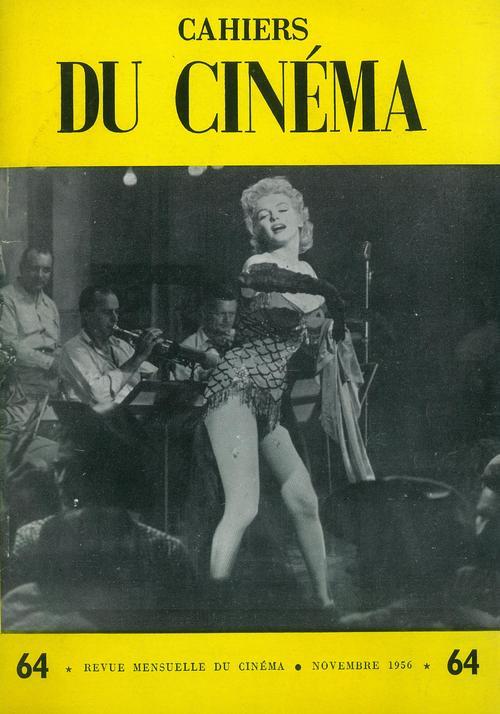
It’s on Ed’s blog Les Cahiers-Positifs that I discovered Godard also reviewed Hitchcock’s The Man Who Knew Too Much (1956). I thought he only reviewed Strangers on a Train and The Wrong Man by Hitch. I guess, I was wrong. It happens. Anyways, on the cover of the November 1956 issue of Cahiers (N.64) there is a still of Joshua Logan’s Bus Stop with Marilyn Monroe, which is reviewed by Jacques Doniol-Valcroze (a critic whose output deserves more attention). The early defining features of Cahiers are: André Bazin’s friendship with François Truffaut, the young critics fight to take over the magazine, and Hitchcock as a defining figure for the group. The Critiques were, and are, the most important section at Cahiers – their chronicle of the films, and the times – and these early Hitchcock reviews are the seeds that the magazine would grow out of. (More so than those on Nick Ray, whose affinity never really left the magazine). Even Truffaut and Godard, whose friendship broke in the post-’68 years (c.f. their last correspondence), would remain loyal to Hitchcock throughout their whole careers: the Hitchcock interview book for Truffaut and Godard, who would return more to narrative filmmaking after Truffaut’s death (a reconciliation?), in his Histoire(s) describes Hitchcock as the “greatest creator of form in the 20th century.” Hitchcock would also play a significant role when the magazine renewed itself in the Eighties through their critical appreciation of Brian dePalma and how his films interrogate Hitchcock’s impulses and artistry. And Hitchcock is also at the root of their current appreciation of Steven Spielberg and how he is able to mediate between personal projects within an industrial studio system. – D.D.
***
The Student’s Path

One market day an Allied secret agent, disguised, of course, as an Arab, is killed right in the middle of the crowd in Marrakech. An important diplomat is shortly to be assassinated. Before he dies, the spy manages to whisper his secret to an innocent witness to the crime, an American tourist who is then uncertain whether or not to pass it on in his turn to the (ex) French police in Morocco. A telephone call helps him make up his mind to say nothing. His little boy has been kidnapped, says a voice at the other end of the wire, and if he talks, he and his wife will never see their child again. An incredible but very real threat, which instantly fills our two Babbitts – James Stewert as a doctor from Indianapolis and Doris Day as a once-celebrated singer – with alarm. Neverless, like a modern Robinson family, they launch out into the unknown, following their adventure without losing heart. Where to? To London. They have reason to believe that the plot will unravel there. Zig and Puce on Dolly’s trail could not show more heroism or more commend sense. Chance it and trust to God. Que sera, sera. This is also the opinion of Scotland Yard, who are waiting as they leave the plane. An important official wants to take the affair in hand. He fears complications of the kind of French Cabinet calls ‘cosmic’. Is it worth the risk of aggravating an already tense international situation for a little boy? James Stewart and Doris Day say yes. Who can blame them? We, too, have little boys, or maybe little girls. But no matter – they must act. And, in fact, with a little luck – but they earn it – our amateur Perry Masons soon pick up the kidnappers’ trail, meanwhile unwittingly foiling the plot of a foreign Power which has once again tried to undermine the prestige of old England.
It is easy to see what is likely to shock the susceptible in this story: the touch of extravagance and, what obviously attracted Hitchcock, the introduction of this extravagance in lives as ordinary as yours and mine. This is perhaps the most improbable of Hitchcock’s films, but also the most realistic. What is ‘suspense’? Waiting, and therefore a void to be filled; and more and more Hitchcock loves to fill it with asides which have little bearing on the event.
When he leaves the studio to shoot on location, the director of To Catch a Thief allows his actors more freedom, lets his camera linger on a landscape, seizes neatly and firmly on every droll character or bizarre object to come his way. The scenes in the bedroom, the Arab café, the two police offices (French and English), the taxidermist’s shop, the Presbyterian chapel, the concert or the embassy ought, if they are logical, to make all the Buñuels and Zavattinis of this world pale with envy. Today Alfred Hitchcock looks all round his characters, just as he forces them to look round. Not that he ever loses interest without tenderness, he had never before stressed with such fierce irony the ridiculousness of the most natural. Everyday gestures. The characters in The Man Who Knew Too Much are not exactly puppets, they are at once more and less than the marionette described by Valéry.
All right, you will say, but what about the suspense? A booby-trap? I don’t think so, here even less than in the other films. Firstly, because the extraordinary serves as a foil for the ordinary, which, left to its own devices, would engender nothing but dullness. Secondly, one must admit, because Hitchcock believes in destiny. He believes with a smile on his lips, but it is the smile which convinces me. If the story were simply frightening, perhaps we would not be naïve enough to play along. Hitchcock cunningly presents us with a well-bred destiny, speaking the language of the drawing-room rather than of German philosophy. The clash of cymbals has the affection disguise itself, to sneak by without drawing attention to itself. People say Hitchcock lets the wires show too often. But because he shows them, they are no longer wires. They are the pillars of a marvelous architectural design made to without our scrutiny.
Que sera, sera: this time, whether you like it or not, it is explicit in the text. I know Hitchcock doesn’t believe it entirely, for the moral of the film is also ‘God helps those who help themselves.’ ‘When Stavrogin believes,’ wrote Dostoyevsky, ‘he does not believe that he believes, but when he does not believe, he still does not believe that he believes.’
But we can believe in Doris Day’s tears, and no other Hitchcock heroine’s tears seem so unlike face-pulling. We who know all, and know that her alarm is needless, perhaps we sympathize even more readily. Why does she weep? Why does she wail? What has she to do with this foreign diplomat? Is she so crazy, so imprudent? She is a woman, or rather she is like us all. We believe in suspense. We believe in destiny. Our anguish is increased by what we know, hers by what she does not know. We watch her with a touch of cruelty, a half-feigned terror, and a pity of which we did not know ourselves capable.
            This film by a supposedly misogynous director has as its sole mainspring = assuming one resolutely rejects metaphysics – feminine intuition. It is, like assuming one resolutely rejects metaphysics – feminie intuition. It is, like his preceding films, without self-indulgence, but the better displays its moments of grace and liberty. Sometimes, like the little boy held prisoner in the embassy who hears his mother’s voice as she sings in the salon, we are touched in the work of his caustic and brilliant man by a grace which may only come to us in snatches from afar, but which minds more immediately lyrical are incapable of dispensing with such delicacy.
            Let us love Hitchcock when, weary of passing simply for a master of taut style, he takes us the longest way round.

Jean-Luc Godard

Monday, April 7, 2014

Early Cahiers and Hitchcock: Rohmer on Vertigo

In Antoine de Baecque and Noël Herpe’s new biography on Eric Rohmer there is a fascinating section about his time at Cahiers. Rohmer was to replace Joseph-Marie Lo Duca (who never played a significant role) as the chief editor in March of 1957. In describing this period, De Baecque and Herpe highlight Rohmer’s Bazinian heritage, his important early texts, the Cahiers office that he ran like a salon, his friendship with Jean Douchet, and his eventual split with the magazine by way of his conflict with Rivette and the New Wave aesthetic direction of the magazine.

Rohmer describes his editorial position in his review of John Huston’s Moby Dick,
“From its beginning, Cahiers has followed the principle of critiquing “beauties.” The critique of a film is ordinarily assigned to the one among us who finds the most arguments in its favor. There is no question of our abandoning this method which, believe us, is the most equitable.
Some of our readers, however, have written to us saying that a disdainful silence is sometimes too generous and that certain “losers,” especially those favored by the public, merit a more severe punishment than a two-line execution on the monthly list of films, or several black dots from the Conseil des dix. That is why we have readopted the system of notes dedicated to works that seem of minor importance to us and that find only detractors or lukewarm advocates among our editorial staff. As for the rest, they have nothing to teach us, except as a part of French or foreign cinematic production that concerns only the industry, as Malraux would say.”
De Baecque and Herpe would describe the magazine under Rohmer as,
“The composition of a Cahiers issue under Rohmer had an unchangeable format. To start each issue there would be two or three main articles, the testimony or souvenirs from a filmmaker, or a lengthy interview with an auteur. Then there would be the Petit journal du cinema which includes information about film series, annotated photographs, and professional news. Then there is the Cahiers Critiques that reunite five or six lengthy reviews and the Notes sur d’autres films on the other films, which represents the current realities of film-going. On the last page there is the Conseil des dix which is table that gathers the rankings of ten Cahiers critics, in order of preference, ranked by a black-dot of hatred to four-stars which is a masterpiece. This is the fixed ritual of each issue. With Rohmer there was published a diversity of texts: from the communist George Sadoul writing on Dziga Vertov to the sardonic prose of the young MacMahon cinephiles – this “nursery fascism,” according to the expression of Louis Marcorelles.”
The following is Rohmer’s review of Vertigo (from The Taste for Beauty). Hitchcock was one of the important pillars at the magazine in the fifties and onwards. This critical appreciation of one of the most commercial Hollywood directors would prove to be an important achievement for Cahiers and its influence would be great. To cite the influence of this early classical cinephilia:

Rohmer and Chabrol’s book Hitchcock: The First Forty-Four films was translated into English, and it would be an influence on Raymond Durgnat’s Hitchcock scholarship. Chabrol’s films were also very Hitchcockian in terms of being psychological crime-police thrillers. Truffaut published his famous interview book Le Cinéma selon Alfred Hitchcock that would be re-titled Hitchcock/Truffaut, which acknowledged Truffaut’s own growing importance. In its updated introduction Truffaut discusses the New Wave infiltration of Hollywood as Hitchcock would cast Claude Jade (Baisers volés) in Topaz. This Cahiers relationship to Hollywood started with cine-clubs that invited American directors to France and then Cahiers would send some of its critics to the States for interviews (c.f. Cahiers' interview with Hawks). The visibility of this connection would culminate when Spielberg would cast Truffaut in Close Encounters of the Third Kind and Coppola’s Zoetrope would produce a film by Godard. The influence of Hitchcock’s films and his discussion of technique could also be seen in this period in the films of De Palma and Friedkin or more recently with Abrams and Vallée. One of Robin Wood’s earliest published reviews was in Cahiers on Psycho and he would then go on to publish Hitchcock’s Films, which he would revise several times. Andrew Sarris would rank Hitchcock in his auteurist pantheon and the influence of Sarris' evaluation can be seen on some of his heirs like Dave Kehr (When Movies Mattered). Bill Krohn would find new ways to discuss Hitchcock by deconstructing the myths surrounding his statements by revealing the realities behind his production notes in Hitchcock at Work. Even Deleuze discusses the Cahiers-Hitchcock relationship in the section The crisis of the action-image in The Movement-Image though in more negative terms (“There is, however, no need to make Hitchcock a Platonic and Catholic metaphysician, as do Rohmer and Chabrol, or a psychologist of the depths, as does Douchet.”). Another detractor includes Positif who in their early special on American cinema (N.11), in a text signed by the editorial staff, included him in their essay Quelque réalisateurs trop admirés along with Lang, Ray, Hawks and others; and instead championed America’s less well-known, more social and militant films. – D.D
***
L' hélice et l'idée by Eric Rohmer (Cahiers March ’59, N.93)

Itself, by itself, solely ONE everlastingly, and single. – Plato

We would have gladly pardoned Alfred Hitchcock for following the autere The Wrong Man with a lighter work, more of a crowd pleaser. Such was perhaps his intention when he decided to bring the novel by Boileau and Narcejac, D’entre les morts, to the screen. Now, the esoteric nature of Vertigo, so they say, repelled Americans. French critics, on the contrary, seem to be giving it a warm welcome. Our colleagues have now given Hitchcock the place we [at Cahiers] have always reserved for him. As a result, we are now deprived of the pleasurable task of defending him.

There is therefore no reason to measure his genius according to someone else’s standards. Hitchcock is sufficiently renowned to merit comparison with no one other than himself. I used as a preface to this critique a sentence by Plato, which Edgar Poe used at the beginning of “Morella” and whose argument, in certain respects, resembles that of Vertigo. I did this not because I mean to put our filmmaker on equal footing with Plato, nor even with Poe, but simply to propose a key that, in my opinion, is capable of opening more doors than others can. Too bad if it seems somewhat pretentious. We are not trying to make Hitchcock into a metaphysician. The commentator alone is responsible for the metaphysics, but he believes it to be both suitable and useful.

Vertigo seems to be third panel of a triptych, the first two being Read Window and The Man Who Knew Too Much. These three films are architectural films, first, because of the abundance of architectural motifs, in the proper meaning of the word, which we find in all three. In this case, the first half hour is even a kind of documentary on the urban setting of San Francisco. The backdrop is furnished by a number of turn-of-the-century homes, on which the camera lens likes to rest, just as it rested before in To Catch a Thief on the Cote d’Azur. Their immediate, pragmatic reason for existence is to create an impression of disorientation in time. They symbolize the past toward which the detective turns, at the same time as does the supposed madwoman.

In the course of the film, we find an older architecture, that of an eighteenth-century Spanish monastery, which is linked, this time very directly, by the tower above it, to the major theme of the story, vertigo. And her we are one step further in the analogy with the two films mentioned. In each one, the heroes are victims of a paralysis relative to movement in a certain milieu. The reporter in Rear Window is in a situation of forced immobility, the milieu being space. In The Man Who Knew Too Much, the doctor and his wife, in conforming with the title, knew too much about the future but, at the same time, too little: Their paralysis is ignorance, and the field is no longer that of space, but of time. In this film, the detective, once again acted by James Stewart )who in his corset, reminds us of the photographer in Rear Window), is also a victim of paralysis, that of vertigo. The milieu in this instance is constructed by time, but not that of premonition, oriented toward the future. Rather, it is directed toward the past: reminiscence.

Like the two others, Vertigo is film of pure “suspense,” that is, it is a constructed film. The motive for the action is no longer the march of passions or some tragic moral (as in (Under Capricorn, I Confess, or The Wrong Man), but a process that is abstract, mechanical, artificial, and external, at least in appearance. In these three films, man is not the driving element. It is not fate, either, in the meaning that the Greeks gave it, but, rather, the very shapes that the formal entities space and time acquire. We can, of course, quibble indefinitely about whether or not Hitchcock’s films contain “suspense.” In the general sense of the word – the ability to keep the audience breathless – we will always agree that they do, especially in this film, even though the detective’s key (which closes the novel) is revealed to us s half hour before the end. We already knew that Hitchcock’s secret passageways did not open onto the secrets of police machinations, clever as they may be. We wanted to more and more, as we learned more of the truth. The important thing is always that the solution to the enigma not burst the whole of the intrigue, which up until the last minute was busy expanding, like a soap bubble (a criticism we could have made, for example, about To Catch a Thief). Here, the suspense has a double effect: It not only sensitizes us to the future, but it also makes us reappraise the past. For the past in this case is not a mass of unknowns, which an author has the divine right to keep in reserve and which, when exposed, will untangle all the knots. When it reappears, the past tightens these knots even more. As the smoke of the story clears, a new figure appears whom we did not know as such but who was always present: the Madeleine believed to be real, yet whom we never really knew, who was, in any case, a real phantom, because she existed only in the mind of the detective, because she was only an idea.

Just like Rear Window and The Man Who Knew Too Much, Vertigo is a kind of parable of knowledge. In the first, the photographer turned his back on the true sun (meaning life) and saw only the shadows on the wall of the cavern (the courtyard). In the second, the doctor, who had too much faith in the police’s deduction, also missed his mark, although feminine intuition succeeded. Here, the detective, fascinated from the start by the past (represented by the portrait of Carlotta Valdes, with whom the phony Madeleine pretends to identify) is continually sent from one set of appearances to the next: in love not with a woman but with the idea of a woman. But at the time, just as in the two other parts of the trilogy, outside this intellectual meaning (I mean relative to knowledge) we can distinguish another one, a moral one this time. Here once again, Stewart is not only wretched and deceived but also guilty, “falsely guilty” as Hitchcock says, that is falsely innocent. A tribunal accuses him of being guilty, by his blunder, for the woman’s death. But although he did not in any way cause Madeleine’s death, this time, because of his perspicacity and his recaptured dexterity, he will certainly be responsible for Judy’s death, whom he falsely accused of complicity.

In using the term parable, I do not mean to accuse Vertigo or dry-ness or unreality. I no way is it a tale. At most, one discerns here and there, as in all of Hitchcock’s films, small distortions of verisimilitude – one might say the disdain for certain “justifications” – that in the past often disturbed some people. If Vertigo is bathed in a fairytale atmosphere, the fogginess and blurriness are in the mind of the hero, not of the director, and do not affect the ordinary realism of the tone. On the contrary, we should admire the artistry with which the filmmaker creates this fantastical impression by the most indirect and discreet means, and especially how much, in a subject close to that of Les Diaboliques, he is reluctant to play on our nerves. The impression of strangeness is produced not by hyperbole, but by attenuation: Thus, the first part is almost entirely filmed in wide shots. The distracting satirical episode (the relationship between the detective and the designer) is treated with a no less subtle humor and prevents our feet from ever leaving the ground. These casual asides are not simply meant as a balancing act: They help us better understand the character, by making his madness more familiar, changing it from a state of madness to a certain deviation of the mind, a mind whose nature may be to turn in circles. The passage in which Stewart becomes Pygmalion is admirable, to the point that we almost lose the thread of the story itself. All of Hitchcock’s depth is in his form, that is, in the “rendering.” Like Ingrid Bergman’s gaze in Under Capricorn, this removal of makeup – which is in fact an application – can be seen and not told.

Finally, in this silent, glossy film, which is actually a love story, more than the burning kiss between the detective and the woman he tries in vain to bring back from the dead, Stewart’s breathless final speech introduces a dimension that until then is curiously absent: passion. It is not a rhetorical sermon in the least, but a digression to discourse, as is Berman’s monologue in Under Capricorn. So what if this outburst comes late, as this film is characterized by an alternating current: Future and past incessantly switch positions. In the light of this vibrant act of accusation, the entire film takes on a new color: What was sleeping awakens, and what was living simultaneously dies and the hero, conquering his vertigo, but for nothing, once again finds only emptiness at his feet.

Of course, comparisons other than the ones I suggested can be made with the two films starring James Stewart. Allow me one more comparison, this time with Strangers on a Train. We know how much this film owed, not just in severity, but in lyricism, to the obsessive presence of a double geometrical motif, that of the straight line and the circle. In this case, the figure – Saul Bass draws it for us in the credits – is that of the spiral, or more specifically, the helix. The straight line and the circle are married by the intermediary of a third dimension: depth. Strictly speaking, we find only two spirals materially figured in all the film, that of the lock of hair at the nape of Madeleine’s neck, a copy of the one worn by Carlotta Valdes that, one must not forget, arouses the detective’s desire, and that of the stairway that leads up the tower. For the rest, the helix is suggested, by its revolving cylinder, which is represented by Stewart’s field of vision while following Novak’s car, by the arch of the trees over the road, by the trunks of sequoias, or by the corridor mentioned by Madeleine and that Scottie finds in his dream (a dream, I admit, whose flashy designs clash with the somber grace of the real landscapes), and many other motifs that can be detected only after several viewings. The shape of the thousand-year-old sequoia and the traveling shot that pivots (in fact the subject is pivoting) around the kiss still belong to the same family of ideas. It is a vast family that counts many relatives by marriage. Geometry is one thing, art is another. It is not a question of finding a spiral in each of the film’s shots, like the men’s heads proposed as a guessing game in sketches of leaves, or even like the crosses in Scarface (a bet magnificently kept, but a bet nonetheless). These mathematics must leave a door open to freedom. Poetry and geometry, far from crushing each other, travel together. We travel in space in the same way we travel in time, as our thoughts and the characters’ thoughts also travel. They are only probing, or more exactly, spiraling into the past. Everything forms a circle, but the loop never closes, the revolution carries us ever deeper into reminiscence. Shadows follow shadows, illusions follow illusions, not like the walls that slide away or mirrors that reflect to infinity, but by a kind of movement more worrisome still because it is without a gap or break and possesses both the softness of a circle and the knife edge of a straight line. Ideas and forms follow the same road, and it is because the form is pure, beautiful, rigorous, astonishingly rich, and free that we can say that Hitchcock’s films, with Vertigo at their head, are about – aside from the object’s that captive us – ideas, in the noble, platonic sense of the word.

Friday, July 6, 2012

"In Search Of Treasures" by Moen Mohamed

In Search Of Treasures by Moen Mohamed
IL CINEMA RITROVATO 2012
BOLOGNA, ITALY
Cinephiles, curators and programmers gather annually in darkened theatres to relish in the abundance of delights offered by one of the world’s most important and treasured film festivals.  Il Cinema Ritrovato is impossible to disappoint.  This year, an unsung master of French cinema was showcased.  How Jean Grémillon could have escaped my attention all these years is a mystery.  And why I never even came across his name in countless readings is an even bigger mystery.  Aside from the various programmes, there are the restorations.  Thus, herein lies the importance and significance of what they do here at the Restoration Laboratory at the Cineteca Bologna.

The length and breadth of the programming is remarkable.  Almost every print is from the national film archive of a country.  In this day and age, when everything has gone digital, these rare 35mm prints, some of which are quite pristine, make the trip amidst the sweltering European summer worth one's while.  But think not that it's all roses and perfume:  the heat in Bologna is akin to punishment - relentless and unbearable.  I drank 1.5 litres of water daily and that was insufficient.  There are projection issues some days; the air-conditioning is not always working in the cinemas - but I tell you, it’s all worth it. And then some. These complaints wither away with just one glance at the programme.

The masterpieces, chronologically:
MALDONE
35mm, 1927, France, 90 min, Jean Grémillon
A revelation. A young man, disgusted by his richness and life of comfort, abandons it and lives as a simple villager. Many years later, he is forced by circumstance to return and become the master of his estate, a position he still abhors. With brilliant acting and expert editing, Maldone is one of the most inexplicably unserenaded French films of all time. 

GARDIENS DE PHARE (LIGHTHOUSE KEEPERS)
35mm, 1929, France, 73 min, Jean Grémillon
Poetic realism at its shimmering best and a complete knockout. I have never seen anything like this film. An elderly man and his son are hired as keepers of the lighthouse on a remote post surrounded by water, and with no other human contact. Their loved ones are on the mainland. And then, there is a descent into madness. This is a unique film that defies explanations. It must be experienced on the big screen to appreciate its brilliance. Grémillon is a master of atmosphere, movement and lighting. 

RAILS
DCP, 1929, Italy, 75 min, Mario Camerini
If I were forced to select the best film I saw at the festival, this would be it. One of the last silent films made in Italy, and perhaps the best silent film of Italian cinema, Mario Camerini's Rails has been restored and rediscovered for all to bask in its greatness. Like Sunrise and Sonnenstrahl, Rails was made in between those two. These three films were made by different directors, but are so similar in theme and atmosphere, they feel like a trilogy of sorts. These are the first 10 minutes of the film:  On a dark, rainy night, a young man and woman walk to a run-down hotel, holding each other. They take a room, sit silently and regard each other as if in agreement. The sadness in their eyes is devastating.  The hotel is next to the railway station. The whistle of the train echoes loudly and the wind blows open the window. With stunning close-ups, Camerini lingers on the expressions of his two leads throughout the film, and allows those expressions to convey the state of mind, and not rely on inter-titles.  For me, this is one of the newly rediscovered masterworks of cinema. 

SONNENSTRAHL
35mm, 1933, Austria, 88 min, Pál Fejös
If Murnau's Sunrise was not made a few years earlier, Sonnenstrahl would probably have been the film in its place. With Gustav Fröhlich (Metropolis) in the lead, the film tells the tale of two lost souls on the streets of Vienna during The Great Depression as they find themselves thrown together.  Opening with a memorable sequence on the contemplation of suicide, we go on a journey of societal necessities, restrictions and conformity. Poetic and tender, Sonnenstrahl reiterates the importance of living life to the fullest. I am now anxiously looking forward to Lonesome, also directed by Pál Fejös.

The rest of my Top 25, chronologically:

THE GARDENER
35mm, 1912, Sweden, 33 min, Victor Sjöström
One of the best films of the festival is one-hundred years old, made and released in 1912. It is the first film of the great Victor Sjöström. The Gardener is a revelation, even at only 33 minutes. A young couple is separated by the boy's jealous father who has his eye on the young woman. Her father is the gardener (played by Sjöström) who works for the man and tends the roses in their greenhouse. After sending his son away, the boy's father shows his true intentions. And this is just the beginning of the film. Sjöström gives this film everything. After being an outcast of society, to show that she is no longer a good girl, there is a scene of her smoking a cigarette - very subtle for 1912, but revealing. I love that each year Bologna celebrates films from 100 years ago. Next year it’s 1913. I hope I will be around and able to go from 2020 to 2029, when the zenith and twilight years of silent cinema, 1920 to 1929, will be showcased. There will be countless treasures revealed over those 10 years.

THE FIRST-BORN
35mm, 1928, Great Britain, 93 min, Miles Mander
A beautiful restoration and a superb 35mm mint print of this drama of hypocrisy and devotion. Directed by and starring Miles Mander in a most unflattering role of a hypocritical cad who flirts and cheats on his wife, but cannot bear the thought that she is even friendly with another man. When he decides to leave his wife for a while as she is not getting pregnant, she takes matters into her own hands to provide him with the offspring he so desperately needs. 

MARY
35mm, 1930, Germany, 82 min, Alfred Hitchcock
Decades and decades later, when it became en vogue for popular foreign films to be remade in English, Alfred Hitchcock was doing the opposite some 80 years ago.  Shot entirely in German with a complete German cast, Mary is, for me, one of Hitchcock's great early achievements. There is so much of that special Hitchcockian touch in this 80-year old film. Sadly, I was not able to see Murder! (the English version) to compare and contrast. Awash in German Expressionism in terms of style and structure, one is reminded of the early sound films of Fritz Lang.

PRIX DE BEAUTE
DCP, 1930, France, 114 min, Augusto Genina
Louise Brooks pays the price for being beautiful and for wanting both worlds - glamour and fame; love and family.  Beautifully restored by the Bologna laboratory and screened in the Piazza with a full orchestra, Prix de beauté makes excellent use of Miss Brooks' talent.

THE NEIGHBOUR'S WIFE AND MINE
35mm, 1931, Japan, 56 min, Heinosuke Gosho
Deftly balancing comedy with social realism, The Neighbour’s Wife and Mine gently observes a traditional Japanese marriage. Every time you get the impression it is a comedy, you are quickly reminded it isn't by a quick gesture. The plot is simple - a playwright struggling with writer's block goes next door to investigate some very loud jazz music. He takes a very long time to return and his wife begins to worry, and with reason. After seeing only three of Heinosuke Gosho's films, I am certain a retrospective of his oeuvre will yield many treasures.

FIRST STEPS ASHORE
35mm, 1932, Japan, 88 min, Yasujiro Shimazu
Josef von Sternberg's great classic, The Docks of New York (1928) is reworked, scripted and transplanted to Yokohama. It is amazing how completely Japanized the film is. A sailor saves a suicidal woman from drowning and this begins their strange and dangerous affair of dependency. I am keen on learning more about Yasujiro Shimazu. He, like many of his contemporaries, never loses focus on the main elements of the story. And he knows how to direct his actors. It is important to note that The Docks of New York was named Best Foreign Film released in Japan in 1929 by Kinema Junpo. Another important note is that both Heinosuke Gosho and Keisuke Kinoshita worked as Yasujiro Shimazu's assistants before embarking on their own very successful careers.

NAMIKO
35mm, 1932, Japan, 54 min, Eizo Tanaka
A young couple is married, they go on their honeymoon. Soon after, she becomes ill and he goes off on a trip. While he is away, his family, fearing the scandal of the young wife’s previous relationship with a man, uses the pretext of infection and sends her away to her accepting parents. A simple story but studied with such precision that makes it stand out. This is yet another gem from the retrospective on early Japanese sound films.

WILD GIRL
35mm, 1932, USA, 80 min, Raoul Walsh
A young Joan Bennett stars as the wild and outspoken woman who lives in the woods (untamed California) and is relentlessly pursued by not one or two, but by four different men. One of whom is a young and dashing Ralph Bellamy. Three of them covet her body and one, her heart. Alas, the one who covets her heart must hang! Wild Girl deserves to be heralded as one of Raoul Walsh’s best films.

NEW EARTH
35mm, 1933, Holland, 30 min, Joris Ivens
A superb 35mm print of one of the all-time great short films. Programmed as part of the films on The Great Depression, what Joris Ivens achieved in just 30 minutes is outstanding. In the face of abject poverty and total economic collapse, the Zuider Zee project (farming new land for Holland), is akin to restarting life on earth. What is special about this film is how Ivens intelligently blends the footage of the construction with the politics of economics and the plight of human suffering during The Great Depression. Ivens shows the tragedy of class realities, starvation of millions while vulgar waste of priceless grain continues.

MAN'S CASTLE
35mm, 1933, USA, 71 min, Frank Borzage
Set in the ghetto of the homeless, Hooverville, the narrative is almost fairytale-like. Loretta Young (very, very young indeed) and Spencer Tracy play a couple thrown together by circumstances, when even getting food thrown to pigeons was one's way of surviving. A woman who is willing to give everything to stay with the man she loves. A man who refuses to compromise when it comes to any kind of affection. Man’s Castle is a standout from the retrospective of films on The Great Depression.  It also makes me want to discover more films of Frank Borzage.

LA TETE D'UN HOMME
35mm, 1933, France, 99 min, Julien Duvivier
Julien Duvivier's highly stylized policier is way ahead of its time. It took me by surprise. Based on the novel by Georges Simenon (La nuit du carrefour), we know whodunit from the start. There are no twists and turns, but the direction and the way the screenplay undulates is a twist in its own execution.  At the beginning, the film is told from the police's perspective. Then, it becomes the wrongfully accused man's story. Then, it is owned by the actual sickly criminal, played with ferocity by the magnetic Valéry Inkijinoff, who has more dimensions to his character than everyone else. His arrogance, anger at his illness and verbal jousting with the police are something to behold. Poignant is his obsesssion with a neighbour who sings (not unlike Edith Piaf) a song of remorse, lost love and grief.

A WOMAN OF TOKYO
35mm, 1933, Japan, 51 min, Yasujiro Ozu
I believe this may be one of Ozu's most overlooked films, if such a thing was possible. This gorgeous 35mm print from the archives was a treat on the last day of the festival. Scandal, truth and social realism are at the centre of this 51 minute film. A younger brother and older sister live together, with the sister taking care of the brother as he studies. He finds out that she may not be as good as she seems. The three scenes of confrontation are among the best Ozu has mounted. A Woman of Tokyo is expertly edited and superbly acted, with the sublime Kinuyo Tanaka in one of the lead roles.

GUEULE D'AMOUR
35mm, 1937, France, 93 min, Jean Grémillon
Jean Gabin stars as the titular Ladykiller and one expects him to make women swoon and pant throughout the film. Not under the auspices of Grémillon. In fact, the opposite happens. Jean Gabin is reduced to a vulnerable fool so hopelessly and uncompromisingly in love, one wonders where this film is headed. It is a performance and character from Gabin I have never seen. He is reduced to almost nothing. What is different here is that he is not clueless. He knows he is being played with, but he cannot curb the avalanche of emotions, nor his obvious obedience.

PURSUED
35mm, 1947, USA, 102 min, Raoul Walsh
Judith Anderson and Teresa Wright steal the show in this gem from Raoul Walsh. Robert Mitchum is a man haunted by childhood nightmares and cannot understand why he was adopted in a family that is beset with a legacy of hate and death. The key to the mystery is held firmly by Judith Anderson in a completely different performance that rivals her own Mrs. Danvers (Rebecca). Tragedy, remorse, revenge and a child's destiny all intertwined to create this wonderful concoction of classic Hollywood. Pursued is my personal favourite of the Walsh films I have seen so far.

PATTES BLANCHES (WHITE LEGGINGS)
35mm, 1948, France, 103 min, Jean Grémillon
Grémillon is a master of setting and atmosphere.  Nothing seems forced or fake in his films.  He has complete control of his material.  The scintillatingly scandalous Suzy Delair (Quai des Orfèvres) plays that sort of woman who is entangled in an affair of sex and materialism with a fishmonger.  He brings this worldly and carefree woman to his very small village where there is more than enough going on already. Dark family secrets; a self-sacrificial hunchback; a seemingly sickly man who is the illegitimate son of the count’s father; a naughty yet victimized Suzy Delair; the unwilling count of the manor who is never without his conspicuous white leggings. A delectable recipe?  Indeed. 

AFTER THE CURFEW
DCP, 1954, Indonesia, 101 min, Usmar Ismail
The aftermath of the Indonesian republican revolution which ended Dutch rule, and destroyed the administration of the Dutch East Indies, is explored in this passionate film about a new country, completely lost. This new society of angry and disillusioned young people is faced with the question:  Is this what we fought for? After The Curfew is not a big film about exciting, revolutionary skirmishes, but it is an intimate portrayal of a young man, and the challenges he faces after the revolution. He is a conflicted ex-revolutionary, trying to find his way in their newly created world.  Digitally reconstructed at the Bologna laboratory, using damaged 35mm prints, painstakingly restored frame by frame, After The Curfew is an important classic of Indonesian cinema. Kudos to Martin Scorsese (Chairman of the World Cinema Foundation) and his team for having selected this film for restoration. His advisory team includes, Abbas Kiarostami, Fatih Akin, Wong Kar-wai, Abderrahmane Sissako, Ermanno Olmi and many others. They are doing important work by creating a film preservation consciousness in developing countries, so that these countries can preserve their cinematic treasures, thus creating an international archive of restored classics to be seen and studied by generations to come. The World Cinema Foundation is the kind of organization that makes a significant contribution to the great heritage of international cinema.  Regretfully, I was not able to see Uday Shankar’s Kalpana (India 1948), also restored by the World Cinema Foundation and screened at the festival.

LA ROMANA (WOMAN OF ROME)
35mm, 1954, Italy, 92 min, Luigi Zampa
After the very successful retrospective at Il Cinema Ritrovato 2011, and seeing all of his classic films, I didn't think there were any other major films by Luigi Zampa to be discovered. I was wrong. Set in Rome 1935, a young girl is pushed into work that relies completely on her physical beauty. She is seduced, betrayed, compromised and finally becomes a prostitute. But she becomes a prostitute of her own volition, not because she is a poor victim. All of this happens in the first 30 minutes. Then the real trouble begins. Highly stylized, which is unusual for Zampa, La Romana is very blunt in its sexuality and frank discussions on matters of sex and prostitution. 

BAND OF ANGELS
35mm, 1957, USA, 127 min, Raoul Walsh
This film probably shouldn't work as well as it does, but Walsh creates such compelling character who keeps you to the end of their arduous journey. These are not quite likeable characters. Even Sidney Poitier comes across as slightly rough. At the onset of the civil war, a southern belle discovers publicly that she was borne of a Negro slave, and suddenly finds herself an outcast as a new slave because of her ‘tainted blood’. The woman decides to live as a white person, without identifying with the real slaves. For her, it is about survival and she doesn’t make it easy for anyone to like her, except the imperious and determined Clark Gable – plantation master, slave-owner and ex-slave trader with a whole lot of guilty conscience. 

THE CLOUD-CAPPED STAR
DCP, 1960, India, 126 min, Ritwik Ghatak
Of the many restorations at the festival, this is the most stunning of them all.  It retains that unique film-like quality that is so very difficult to reproduce even with the most pristine digitizing.  Amidst the melodrama of a struggling family and the suffering daughter, we experience a lyrical tale of self-sacrifice and resilience. There is such poetry and movement in the images and sounds that one is enraptured by the beauty of the images and devastated by the suffering. The opening shot of a tree is perhaps the most sublime shot of a tree that I have ever seen. It is not hard to see why The Cloud-Capped Star is considered one of the greatest films in all of Indian cinema.

REGARD SUR LA FOLIE (LOOKING AT MADNESS)
HD, 1961, France, 53 min, Mario Ruspoli
Long overdue for rediscovery, this film should be regarded as a classic of direct cinema and a pioneer work. In what may be the first film to be shot in an mental institution, with many sessions of patients and doctors, it does not feel like a documentary (as Jean-Paul Sartre said of the film), but it demands that the audience look at mental illness as if we are experiencing it ourselves. 

THE ANTI-MIRACLE
35mm, 1965, Italy, 84 min, Elio Piccon
A rare discovery. It is noted in the programme book that Elio Piccon is one of the most overlooked Italian filmmakers, and it is obvious why. Part fiction, part ethnographical documentary, this film is brutal and demanding. It was dismissed upon release and largely forgotten. With echoes of Las Hurdes and Araya, coupled with a loose narrative, The Anti-Miracle is simply miraculous. Elio Piccon moves to this very remote village and lived there for months before shooting. Over the course of a year, whilst still living there, he films the inhabitants as they tell and act out their own stories, in their dialect. The clearing of a large marshland by hand in the dry season to create a river to await the rainy season in order for eel-fishing to resume, is an astounding feat of labour. 

Other noteworthy favourites, chronologically:

PADRE (rediscovered and restored)
35mm, 1912, Italy, 44 min, Giovanni Pastrone

THE CHALICE OF SORROW (restoration)
35mm, 1916, USA, 70 min, Rex Ingram

PILLARS OF SOCIETY
35mm, 1916, USA, 54 min, Raoul Walsh

THE IMMIGRANT (restoration)
DCP, 1917, USA, 24 min, Charles Chaplin

EASY STREET (restoration)
DCP, 1917, USA, 26 min, Charles Chaplin

AFTER THE VERDICT
35mm, 1929, Great Britain, 70 min, Henrik Galeen

ME AND MY GAL
35mm, 1932, USA, 80 min, Raoul Walsh

THE PARTY CARD
35mm, 1936, USSR, 99 min, Ivan Pyr'ev

THE STRANGE MR. VICTOR
35mm, 1937, France, 99 min, Jean Grémillon

6 PM AFTER THE WAR
35mm, 1944, USSR, 100 min, Ivan Pyr'ev

JUNE 6TH AT DAWN (restoration)
35mm, 1945, France, 56 min, Jean Grémillon

THE BIG KNIFE
35mm, 1955, USA, 103 min, Robert Aldrich

POINT BLANK (restoration)
35mm, 1967, USA, 92 min, John Boorman

TESS (restoration)
DCP, 1979, Great Britain, 171 min, Roman Polanski

ONCE UPON A TIME IN AMERICA (Restoration, Director’s Cut)
DCP, 1984, USA, 250 min, Sergio Leone

Until 2013…
Monday, April 7, 2014

Early Cahiers and Hitchcock: Godard on Strangers on a Train

As Edouard Sivière’s Tumblr account Les Cahiers Positifs beautifully illustrates: The early years of Cahiers was a fascinating period for film criticism, which was very literary and built upon the beau langage du dix-huitième, but whose heterogeneity, aside from broad interests like Italian neo-realism or the role of women in cinema, took a while to unify into a singular editorial position. Antoine de Baecque describes the magazine in these years as an outlet for the variety and eclecticism of post-war Parisian cinephilia.

The transition for Cahiers to refine their editorial line came with Hitchcock. Jacques Doniol-Valcroze would label this group of Hitchcocko-Hawksiens the ‘école Schérer’ and it would consist of Rohmer, Godard, Rivette, Chabrol and Truffaut. The first apparition of this turn came with Godard’s review Suprématie du sujet of Strangers on a Train (which I transcribed below from Godard on Godard), which he reviewed under his pseudonym Hans Lucas (German for Jean-Luc). It’s an important early text just like how later would be Truffaut’s Une certaine tendance du cinéma français (Jan ’54, N.31).

André Bazin’s interest in American cinema lied more towards Welles and Wyler and he participated in important public debates on the importance of Hollywood films to gain it respectability. This shift towards Hitchcock and Hawks, under the influence of Alexandre Astruc, would bring an emphasis on mise en scene and the film’s formal elements, as well as canonize two of the magazine’s most important filmmakers. Rohmer would create continuity between both generations with his essay De trois films et d'une certaine école (Aug-Sept ’53, N.26) by writing about Renoir, Rossellini (two of Bazin’s favorites) and Hitchcock, and highlighting their religious beliefs and formal mastery.

Godard is in interesting case. He was never too close with Bazin and was introduced into the magazine by Rohmer and Rivette, who he would follow in judgments. Godard would write two important Hitchcock Critiques (the other one is on The Wrong Man). His writing was challenging and iconoclastic. For example, he was one of Cahiers’ early champions of John Ford who was not liked in this period (see: Leenhardt’s A Bas Ford, Vive Wyler). And finally, Godard's writing would identify an emerging cinematic modernism which he would later bring to his own filmmaking starting with À bout de souffle. – D.D.
***
The supremacy of the subject by Jean-Luc Godard (Cahiers March ’52, N.10)

Hitchcock’s most recent film will doubles arouse controversy. Some critics will say it is unworthy of the director of The Thirty-Nine Steps and Shadow of a Doubt, others will find it mildly amusing and praise its qualities until they take on an air of false modesty. But those who have for Alfred Hitchcock, for Blackmail as much as Notorious, a vast and constant admiration, those who find in this director all the talent necessary for good cinema, can be counted on the fingers of one hand. Outrageously decried by some while the rest ignore him – what is it about Hitchcock that merits attention?
            Here is the subject of Strangers on a Train: a young tennis champion, already well known, in love with a Senator’s daughter and wanting a divorce meets a stranger on a train who offers to get ride of his wife – she refuses to divorce him – on condition that the tennis champion does away with his hated father. As soon as the tennis-player leaves the train he forgets his strange companion. But the latter, believing himself pledge, strangles the more than flighty wife and insists that the tennis-player fulfill his side of the bargain he believes was made in the train. Now free, but terrified by the stranger’s audacity, the tennis-player eventually manages to convince the police of his innocence and marries the girl he loves.
            This subject owes so little to anecdote or the picturesque, but is instead imbued with such lofty ambition, that probably only the cinema could handle it with so much dignity. I know no other recent film, in fact, which better conveys the condition of modern man, who must escape his fate without the help of the gods. Probably, too, the cinema is particularly suited to recording the drama, to make the best not so much of the myth of the death of God (with which the contemporary novel, alas, is by no means backward in taking liberties, as witness Graham Greene) as the baleful quality it suggests.
            However, it was necessary that in the sign – in other words, that which indicates something in whose place it appears; in this case, a conflict of wills – the mise en scene should respect the arabesque which underlines its effect, and like Dreyer or Gance, should use it with delicate virtuosity; for it cannot shock through mere empty exaggeration. The significant and the signified are here set so high (if the idea is involved in the form, it becomes more incisive, but is also imprisoned like water in ice) that in the exploits of this criminal, Hitchcock’s art cannot but show us the promethean image of his murderous little hand, his terror in face of the unbearable brilliance of the fire it steals.
            (Let me make myself plain: it is not in terms of liberty and destiny that cinematographic mise en scene is measured, but in the ability of genius to batten on objects with constant invention, to take nature as a model, to be infallibly driven to embellish things which are insufficient – for instance, to give a late afternoon that Sunday air of lassitude and well-being. Its goal is not to express but to represent. In order that the great effort at representation engulfed in the Baroque should continue, it was necessary to achieve an inseparability of camera, director and cameraman in relation to the scene represented; and so the problem was not – contrary to Andre Malraux – in the way one shot succeeded another, but in the movement of the actor within the frame.)
            Look at these stretches of heath, these neglected homes, or the somber poetry of modern cities, those boats on a fairground lake, those immense avenues, and tell me if your heart does not tighten, if such severity does not frighten you. You are watching a spectacle completely subjected to the contingencies of the world; you are face to face with death. Yes, invention holds sway only over language, and mise en scene forces us to imagine an object in its signification; but these clever and violent effects are so only to transmit the drama to the spectator at its highest level – I refer, of course, to the strangling in the wood and the struggle on the merry-go-round, scenes which contain so many astonishing realities, such depth in their fantastic frenzy, that I fancy I breathe in them a gentle odor of profanation. The truth is that there is no terror untempered by some great moral idea. Should one reproach this renowned filmmaker for flirting with appearances? Certainly the camera defies reality, but does not evade it; if it enters the present, it is to give it the style it lacks.
            ‘It is useless to pretend that human creatures find their contentment in repose. What they require is action, and they will create it if is not offered by life.’ Could not these words by Charlotte Bronte equally well have been written by Kleist or Goethe? Today the most German of transatlantic directors offers us the most vivid, brilliant paraphrase of Faust – combining, I mean, lucidity and violence. Since The Lodger, Hitchcock’s art has been profoundly Germanic, and those who accuse him of reveling in false and pointless bombast, those mean spiritis who are foolish enough to applaud the contemptible – whether in the work of Bunuel or Malaparte – should consider Hitchcock’s constant preoccupation with constructing his themes: he makes persuasion, a very Dostoievskian notion, the secret mainspring of the drama. From German expressionism, Hitchcock consciously retains a certain stylization of attitude, emotions being the result of a persistent purpose rather than of impetuous passion: it is through his actions that the actor finally becomes simply the instrument of action, and that only this action is natural; space is the impulse of a desire, and time its effort towards accomplishment.
            I wager that the pen of Laclos could not have bettered a look of hatred from Ingrid Bergman, the Australian of Under Capricorn, lips flushing with disgust, less with self-shame than from a desire to make others share her degradation; or a shot from Suspicion where Joan Fontaine, hair wild, face drawn, feeling that she might be happier and that it would be better to lose her husband than witness his inconstancies, resents feeling consideration and even love for him, resents feeling his arms hold her gently, offering him her mouth, exposing herself to danger without the secret desire to do so, wondering if she is loved enough. She prefers to grieve, to weep tears, to languish under offences, to consent to them, make an effort to yield her heart, be upset because she does so, weave an incalculable number of difficulties in the certainty of illuminating her doubts instead of living drearily with them.
            One cannot call the director of The Paradine Case and Rebecca a descendant of the Victorian novel. This is why I would also not compare him to Griffith – even though I find in both directors the same admirable ease in the use of figures of speech or technical processes; in other words they make the best use of the means available to their art form – but instead class him with Lang and Murnau.*
            Like them, he knows that the cinema is an art of contrast, whether it describes life in society or in the heart. Murnau’s Faust also revealed this incessant change in which the actor transcends his powers, taxes his senses, falls prey to a torrent of emotions in which extravagance yields to calm, jealousy becomes aversion, ambition becomes failure, and pleasure, remorse. If Shadow of a Doubt is in my opinion Hitchcock’s least good film, as M was the least good of Lang’s, it is because a cleverly constructed script is not enough to support the mise en scene. These films lack precisely what Foreign Correspondent and Man Hunt are criticized for. Is so rare a gift really to be questioned? I believe the answer lies in the innate sense of comedy possessed by the great filmmakers. Think of the interlude between Yvette Guilbert and Jannings in Faust, or on more familiar ground, of the comedies of Howard Hawks. The point is simply that all the freshness and invention of American films springs from the fact that they make the subject the motive for the mise en scene. The French cinema, on the other hand, still lives off some vague idea of satire; absorbed in a passion for the pretty and the picturesque, in a perusal of Tristan and Isolde, it neglects truth and accuracy and runs the risk, in a word, of ending nowhere.
            Certain critics, having seen Strangers on a Train, still withhold their admiration from Hitchcock, the better to lavish it on The River. Since they are the same persons who criticized Renoir so loud and long for remaining in Hollywood, and since they demonstrate so lively a taste for parody, I would ask them: do not these strangers on a train represent them in the exercise of their trade?

* Might not the astonishing success of German directors in Hollywood be explained – for the benefit of our sociological critics – by the strongly international character which enabled the quest for universality in these mystics to expand freely?

Tuesday, July 16, 2013

Hunting For Hidden Gold by Moen Mohamed

IL CINEMA RITROVATO, JUNE 29 – JULY 6, 2013
BOLOGNA, ITALY

The annual gathering of classic cinema worshippers was once again a resounding success.  To have an entire festival devoted to the revival of cinema past, with many restorations, retrospectives and one-of-a-kind programming​, it is hard for Il Cinema Ritrovato (Cinema Rediscovered) to have an average, much less weak year.  It is indeed a festival of treasures.  As our modern age has gone almost completely digital, it is a special treat to have films projected in glorious  35mm.  Many of the prints are imported from archives and film institutions.  Beautiful and pristine were the DCP restorations of Falstaff (Chimes at Midnight) (Orson Welles, 1965), Richard III (Laurence Olivier, 1955), Il Miracolo (Roberto Rossellini, 1948), Rome Open City (Roberto Rossellini, 1945), La Pointe-Courte (Agnes Varda, 1955), Borom Sarret (Ousmane Sembene, 1963).  As much as this is a festival that looks back on the history of cinema, it also serves as a reminder as to where we are presently in contemporary cinema.  Is the progress of modern cinema extraneous and independent from methods of the past?

​This year, yet another unsung director was given the spotlight - the Films of Allan Dwan are refreshingly witty and bursting with energy.  Like the Jean Grémillon showcase in 2012, I wondered again how is it that I never heard about Dwan although he has directed hundreds of film.  The 2013 edition focused on the films of 1913, Vittorio de Sica (Actor & Director), European Cinemascope, Pre-War 1938-1939, Silent Films by Hitchcock in brand new 35mm restorations, 60s Czech Cinema, 1930s Japanese Cinema, Homage to Burt Lancaster and Russian pioneer Olga Preobrazenskaya.  There was a Master Class with Jonathan Rosenbaum; lectures and demonstrations of the restorations; In Conversation with Joanna Lancaster (Burt Lancaster’s daughter); Dialogue with Thierry Frémaux (Cannes Delegate) on Digital & Film - A Future for the Past; lecture on The History of the Criterion Collection by the founders; and a Master Class with Alexander Payne, who came to see many of the films I saw.  Sitting not far from me in the same row, I gathered from his discussions with others  that he, like most directors, is an ardent cinephile and a fan of classic cinema.

However, the most entertaining and invigorating event was saved for last - the closing night in the Piazza Maggiore, where 5,000 spectators were treated to the music of, in my opinion, cinema’s greatest music composer in a special homage to Bernard Herrmann.​  Perfectly executed by the Orchestra del Teatro Communale di Bologna, this full orchestral serenade was the cherry on the pie as the festival was brought to a close.  I can still recall my goosebumps when they played ever so beautifully, every bit of music from Vertigo.  Piercing, penetrating and provocative is Bernard Herrmann's haunting compositions. 

Out of the 45 feature films I saw, these are my favourites from this year's banquet, in order of preference:

UNE SI JOLIE PETITE PLAGE
DCP | 1949 | France | 90 min | ​Yves Allé​gret | Programme: Rediscovered & Restored
A revelation.  ​It seems the spirit of ​Jean Grémillon still lingers a year later at the festival​.  A young man (who appears to be sickly) goes to a small seaside village with "such a pretty little beach" he is told.  But it becomes apparent that he is overwhelmed by a great sadness of something that has happened in his life, but we do not know what.  Certain facts are hinted at and we are intrigued by his behaviour towards the few inquisitive but interesting people who live and work at the tiny inn where he is staying.  Covered with a gloomy atmosphere and foreboding, the landscape itself becomes an oppressive character.  There is a sense of thick humidity amidst the almost incessant rainfall.  He is told by the landlady that the village is not good for the lungs as she probes for more information as to whether he is suffering from tuberculosis.  Without any flashbacks or urgency to disclose the young man's history, this film builds to a climax with even more precipitation and angst.  Much of the film’s success should be credited to the heartbreaking performance of Gérard Philipe, a beloved actor who, in a short career, worked with directors Claude Autant-Lara, Luis Bunuel, Max Ophüls, René Clair, Marcel Carné, René Clément, Jacques Becker and Sacha Guitry.  Sadly, he died of cancer 10 years after Une si jolie petite plage, at the age of 36.

LETTRE A LA PRISON
35mm | 1969 | France | 73 min | Marc Scialom | Programme: Rediscovered & Restored
This is why I love coming to Bologna, to discover a great film that was discarded by its own director after being disillusioned by lack of support.  Made with the help from family and friends and without a producer, shot in Tunis, Marseille and Paris, Lettre à la prison is the most experimental film I saw at the festival and it addresses the painful subject of post-colonialism and racism.  This non-narrative masterful film loosely tells the story of a young Tunisian man travels to France to meet his brother who is in jail after being accused of killing a white woman.  The soundtrack of the film is the voice-over reading of 2 letters, one by each brother, both recollecting their origin, childhood and feelings of their new country.  Scialom was not supported by his fellow French filmmakers, including Chris Marker and ironically, this film resembles Le joli mai.  Scialom is a Tunisian born of Jewish and Italian heritage.  He moved to France after the Nazi persecution in Tunisia.  Obviously, the themes of this film resonate with him.  40 years after he had abandoned the film in a drawer, his daughter stumbles on the film and the discovery is to our benefit with the restoration done by the L'Immagine Ritrovata di Bologna.  This is a special film that deals with the painful and irreparable loss of cultural and personal identity.

INGEBORG HOLM​
35mm | 1913 | ​Sweden | 72​ min | ​Victor Sjöström | Programme: The Films of 1913​
​Another film by Victor Sjöström that left me shaken only reinforces my regret in missing his retrospective at Cinematheque Ontario many years ago.  This film from 100 years ago is as noble as the great works of Mizoguchi and Ozu.  It is tough in its social commentary.  A woman has been separated from her three children after the death of her husband.  She is unable to provide for them due to her ongoing illness.  The film comments on the laws of society not from a sentimental angle, but it realistically shows both sides without the use of overt melodrama.  When she learns one of her children given away to foster parents falls severely ill, she escapes from the workhouse where she is forced to stay and makes the long and dangerous journey just to see her child.  This journey runs most of the second half of the film and it is unhurried and tense.  I may be wrong here but I don't think any director up to that time in 1913, had ever achieved what Sjöström does with Ingeborg Holm, in which the individual is fully realized with multiple mental layers.  An absolute poetic ​gem​ of film.

MANILA IN THE CLAWS OF DARKNESS​
DCP | 19​75​ | Philippines | 126​ min | ​Lino Brocka | Programme: Rediscovered & Restored​
​Finally, I understand what I have been hearing about Lino Brocka for so many years.  A noir-melodrama infused with realism, poetry, beauty and grittiness, all unfolding in the unforgiving and cruel streets of Manila.  Yet, this film is an original as it is hard to classify although there are similarities to Pasolini and Fassbinder.  Brocka is an artist who understands Filipino culture and way of life.  He cuts deep into the social fabric of the lower classes and gives us a film of many dimensions and substance.  One hardly gets a chance to breathe when the next onslaught descends.  Brocka has something vital to say about his culture and he has made a film that succeeds on all levels.  A young man comes to Manila in search of his girlfriend who has been whisked away by a shady woman with promises of a job.  A simple story that is anything but, with many unforgettable sequences.  The long diversion into a gay brothel is at times hilarious but realistic.  This is one of the newly rediscovered masterworks of cinema.  Martin Scorsese's World Cinema Foundation has done well.

THE ​LAST JUDGEMENT​
35mm | 1961 | Italy | ​101 min | Vi​ttorio de Sica | ​Programme: Vittorio de Sica, Actor & Director​
One of the best films of the festival was reviled and shredded by critics and audiences upon its release.​  ​Written by the great Cesare Zavattini (Bicycle Thieves, Shoeshine, The Children Are Watching Us, Two Women, The Garden of the Finzi-Continis, Umberto D.), De Sica considered this film to be among his best work.  Somewhat of a religious fantasy told with dark humour, the film crackles with wit and fun about what would happen if we were given a few hours before the world ended and we stand trial for the final judgment.  A voice booms from the sky in Naples announcing that the last judgment will commence at 6 pm.  People go about their daily routine - a skirt-chaser who is trying to find a replacement for his wife how died the day before, a procurer who sells Italian children to rich Americans, an ambassador insults a waiter who demands an apology, a French socialite who travels to Naples to see the statues and when she realises that the world is coming to an end, she declares that "instead of seeing the statues, I am in a hotel room with a man - like a slut!"  She is promptly offered cocaine to calm herself.  Hilarious is Vittorio Gassman’s turn as a dandy whose hat gets tomatoed by a boy.  De Sica tackles hypocrisy and cruelty inherent in human nature and I think the reason the film failed is because it was way ahead of its time.  Any society that believes in the final judgment as really and truly THE FINAL JUDGEMENT, may not understand that De Sica was not making fun of a religious doctrine, but he was making fun of the weakness and natural behaviour of human beings.  Like many spectacular failures, this one has a cast to end all ensemble casts:  Alberto Sordi, Jack Palance, Vittorio Gassman, Silvana Mangano, Vittorio de Sica, Ernest Borgnine, Anouk Aimée, Melina Mercouri, Lino Ventura, Paolo Stoppa and Lamberto Maggiorani from Bicycle Thieves.  A strange, brilliant, unsettling and fascinating experiment of a film.
LADY ON THE TRACKS​
35mm | 1966 | ​Czechoslovakia | 8​0 min | Ladislav Rychman | Programme: 1960s Czech Cinema​
This time-filler turned out to be one of the festival's most entertaining experiences and a delightful surprise.  The Cinemascope frame can barely contain the glamour, drama and sweet vengeance of this musical about a middle-aged female streetcar driver (not unlike Cabiria) who, one day on her usual route, sees her husband kissing a young blonde on the street.  She abandons her streetcar and passengers.  Hurt and enraged, she then goes to the bank to withdraw all their money.  She makes herself over, changes her wardrobe, not to win her husband back, but she does it for herself.  This is what makes this film so special.  Her foray into a nightclub as she eyes and flirts only with the beautiful young men is simultaneously sad and funny.  Thus begins a tale of morality and equality with many surprises with the biggest one at the very end of the film.  The songs are not very many and are realistically staged as part of the heroine's conscience and inner thoughts, with no elaborate costumes and sets.  One special song is by her neighbours who sing and remind her constantly that "A woman must learn to suffer, it is in her nature."  The other is a glamourous knock-out number, "Feminina Femininae Femininum" set in a beauty salon.  And a runway haute couture show with a number punctuated with only oohs, aahs, sighs and gasps from the female socialite gathering.

THE ELDER FERCHAUX (L'AINE DES FERCHAUX)​
35mm​ | 1963 | France | 95​ min | ​Jean-Pierre Melville | Programme: European Cinemascope​
It is inexplicable how a film by the great Melville could be so obscure that it is almost completely forgotten by all and sundry.  The usual suspects of gangsters and gamblers are nowhere to be seen but the two male leads, plus an assortment of supporting male characters are definitely Melvillian.  His themes and ideas gradually become apparent as the film unfolds.  It explores the relationships among men, this time even more acutely than many of his previous more well-known and successful films.  Jean-Paul Belmondo plays an amateur boxer who takes the job of a private secretary to escort a corrupt French banker to South America, giving him safe conduct.  The titular banker is played sardonically by the great Charles Vanel.  As they travel south, they end up stuck in the Louisiana backwoods and a game of dependency, fear and spite is played.  It is there the men’s loyalty and indifference are tested.  This may be Melville's most personal and cruel film.
NINE LIVES
35mm | 19​57 | Norway | 95 min | Arne Skouen​ | Programme: Rediscovered & Restored​
Nominated for the Academy Award for Best Foreign Language film, Nine Lives takes place during World War II and is based on the real-life experiences of a resistance fighter’s escape from the Nazis after he and a small group of men on a sabotage mission to blow up a German ship, are attacked.  Alone, pursued by the Germans, he attempts to make the dangerous journey from Northern Norway across treacherous territory and over the mountainous and snowbound border to Sweden.  The landscape and snow become characters as he navigates his way across the merciless terrain.  He gets help from the villagers, but must remain buried in the snow via a makeshift snow tent as the Germans close in.  A  fascinating sequence is the blindness he experiences as a result of all that snow.  Man and nature are at the fore-front and background of this excellent film.  Beautifully shot on location, with minimal dialogue and a few tense and very real mountain scenes, Skouen creates a vivid portrait of the enduring spirit of a human being and the kindness of strangers.  When death is inevitable if you reveal yourself to anyone, how do you know in whom you can trust?

UP IN MABEL'S ROOM​
35mm | 19​44 | ​USA | 76 min | Allan Dwan | Programme: The Films of Allan Dwan​
A young couple’s marriage is put to the test when the husband realizes that he must retrieve a certain piece of lingerie he gave to a former fling whilst on vacation in Mexico.  Hilarity ensues as this farce goes into overdrive about mistaken identities, hiding under beds, getaways, blackmail and all kinds of shenanigans.  Dwan’s direction is deft and he keeps the actors on their toes.  The film is fast-paced, witty and very funny.  Made during the war, I am sure it provided much relief to the audiences.  The opening statement on the screen says: “Make no mistake, this is a war film, fighting the Nazis and the Japanese is no easy task, but brother, have you ever tried keeping a secret from your wife?  Now, that’s war!”
THE WOMEN OF RYAZAN​
35mm | 19​27 | ​Soviet Union | 81 min | Olga Preobrazhenskaya & Ivan Pravov | ​Programme: Focus on Preobrazhenskaya​ & Pravov
Considered by many critics to be Olga Preobrazhenskaya’s best film, The Women of Ryazan is a melodrama at heart and its soul is the silent suffering of a beautiful young bride who becomes prey to her lascivious father-in-law as he torments her for her youth and body after his son is called away to World War I.  However, the real villain of this moving film is not the father-in-law, but the women of the village of Ryazan who are insufferably unfeeling and spiteful towards the young bride who is an orphan.  Prejudice leads the way for slander and gossip which brings about nothing but destruction and chaos.  The French title, The Village of Sin, is perhaps better-suited for the film.  We are told in an introduction to the film that Eisenstein and Vertov disliked Preobrazhenskaya and her work.  She was, after all, a female pioneer in the Russian film industry and although this film does not come across as feminist, it is an exceptional film about human conflict.

IL GENERALE DELLA ROVERE
35mm | 1959 | Italy | 138 min | Roberto Rossellini | Programme: Vittorio de Sica, Actor & Director​
In a role he was born to play, De Sica brilliantly captures the character of petty thief with a deep sense of benevolence.  His dignified approach to the character makes this film a joy to behold.  He swindles money from families of the arrested partisans with the promises of release as he lies about his connections with the German army.  But he really believes that he can help and it is that sincerity that makes his character so compelling.  His encounter with a high-ranking German official leads to mutual respect and a friendship of convenience.  De Sica is asked by the German official to impersonate a certain Generale Della Rovere believed to be captured by the Germans.  His job in prison would be to get the identity of a key partisan fighter.  Rossellini keeps the focus clearly on this flawed human being who changes and grows before our eyes as the film progresses.  It is hard to believe that this film was De Sica's only success after Rome Open City made 14 years before.  He was not to be forgiven for his affair with Ingrid Bergman until he awakened the nation's conscience with this film.  Winner of the Golden Lion at Venice and nominated for the Academy Award for Best Screenplay, Il Generale Della Rovere is one of the great films of the festival.   

BLACK HAIR
DCP | 1964 | South Korea | 107 min | Lee Man-hee | Programme: Rediscovered & Restored
I had no idea what to expect from this rare screening.  Old South Korean films are a rarity to be screened so my interest was piqued.  This is a captivating film set in the world of pimps, prostitutes and some very bad men.  With its dark streets, smoky bars, 1960s cabarets, Black Hair is film-noired to the maximum.  The boss of a gang suspects his wife of adultery and decrees that she be punished according to the rules he made himself.  The punishment is the jagged edge of a broken bottle to the face.  After her disfigurement, she wears her black hair across her cheek to hide the scar.  So far in this film, we have seen this scenario before in other 1960s Asian films.  But here's why Black Hair is special and one of my favourites of the festival:  From the moment of her punishment, the rest of the film plays like a grand Shakespearean tragedy as the boss is filled with remorse, guilt and shame.  He wanders the rest of the film like a man preparing to die but who desperately needs to do penance.  With a climax worthy of any of the Bard's tragedies, replete with declarations and speeches about regret, love and loss, Black Hair is an inky black & white Cinemascope treat.

BLACKMAIL
35mm | 1929 | Great Britain | 90 min| Alfred Hitchcock | Programme: The Silent Films of Hitchcock
This is the best of all the silent Hitchcock films I saw at the festival.  It does show indications of later Hitchcockian themes.  It is beautifully crafted, very stylistic with excellent use of shadows and light.  But most importantly, it is exquisitely directed.  The murder scene is shown only by the scuffling behind closed curtains and then the shadow of a fist.  As with any Hitchcock film, one shouldn't say much.  This is a film to be relished and discovered from start to finish.    

INO AND MON​
35mm | 193​5 | Japan | ​60​ min | Sotoji Kimura | ​Programme: 1930s Japanese Cinema​
A young woman has fallen to ill-repute after being impregnated by her lover.  She now works as a geisha or prostitute in the city and visits her family from time to time.  These visits spark tension and volatile fights between the brother and sister.  The mother, father and younger sister try to make peace but the fracture is irreparable.  A visit from the former lover changes the course of the film and reveals the true nature of the brother's antagonism towards his sister.  This is a strikingly beautiful film about the fractured relationship between a brother and sister and ultimately about sacrifice.  

THE INSIDE STORY
35mm | 1948 | USA | 87 min | Allan Dwan | Programme: The Films of Allan Dwan​
What a wonderful surprise the films of Allan Dwan are!  His films are filled with great spirit and optimism in humanity.  I am impartial to comedies and light romances, but when the writing and direction are as sharp as in the works of Dwan, then I am front-in-line.  This cautionary and not surprisingly relevant tale set during the Depression years, reminds us of the need to keep the economy alive by the circulation of cash.  The appearance of $1,000 in cash at a tiny New England hotel leads to a series of misunderstandings that result in the $1,000 being circulated with confusion in the small community.  There is an air of beauty and magical fairy-tale like quality to this film (as in most of Dwan's films from this period).  The cast is superb, handling pages and pages of dialogue that sparkles with witty one-liners.  A waitress is asked if the coffee is fresh, to which she replies, "If it were any fresher, it'd be insulting!"  A greedy shopkeeper tells his landlady after paying rent he owes, "I hope I never see your face again!"  She replies, "Well, I have a very good memory for faces and I hope I never see either of yours again!"

AND QUIET FLOWS THE DON​
35mm | 193​0 | ​Soviet Union | 125 min | Olga Preobrazhenskaya & Ivan Pravov​ | Programme: Focus on Preobrazhenskaya & Pravov​
Based on what is considered a masterpiece of Soviet literature by Mikhail Sholokhov, who won the Nobel Prize for Literature in 1965, this ethnographic melodrama is relentless in plot development.  The first 30 minutes set the tone of the film as a Cossack soldier returns from war to his tiny village and brings along his veiled Turkish bride.  Racism, intolerance and hatred set the stage for tragedy.  We are then thrust forward two decades and the focus is now on the grandson of the Cossack soldier and his tumultuous relationship with his father.  He falls in love with the wife of another villager and they elope.  Murder, hate, loyalty, seduction, suspicion, jealousy, civil war, the Ukrainians et al intertwine to create a film of passions and fury.   What is most impressive is how confidently the film is directed in spite of all that narrative material.  It seems at times that the frame could not control the overflow of emotions and drama.  

RENDEZVOUS WITH ANNIE
35mm | 1946 | USA | 89 min | Allan Dwan | Programme: The Films of Allan Dwan​
Different from his comedies, Dwan shifts gear with this lyrical and romantic film about an air force clerk in World War II who decides to go AWOL with the help of his friends who are pilots, to travel from England to America to visit his young bride.  Some months later he is discharged and returns home, happy to be reunited with this wife.  But the town has changed their attitude towards him and it is only after he discovers his wife has just given birth to a baby, he understands the reason for the small town's discomfort.  He now has the task of trying to prove that he did indeed come back for one night 9 months ago to be with her, but alas, there are no witnesses.  The pilots will not reveal what happened as they will be court-martialed.  Bristling with joyful energy and great performances, especially Gail Patrick as a nightclub singer, Rendezvous With Annie is an overlooked gem.

EXPERIMENT IN TERROR
DCP | 1962 | USA | 123 min | Blake Edwards | Programme: Rediscovered & Restored​
Never before has asthmatic wheezing been used more effectively in cinema.  To hear the terrorizer say "Hello Kelly" amidst gasps of breath, sends chills up your spine.  It is hard to believe this taut thriller and excellent policier was directed by Blake Edwards, but his filmography is diverse.  The opening 10 minute scene is rivetting with just the shadow of a wheezing man as he frightens Kelly after clutching her from behind and covering her mouth with his hand.  Steeped in voyeurism, this film is relentless in the pursuit of a man who threatens destruction and death to Kelly (played with strength and vulnerability by the wonderful Lee Remick), if she does not help him rob the bank where she works.  But this is not a caper or heist film.  The identity of the psychotic killer is revealed early in the film and there is (mercifully) no  explanation of motive and attempt to psycho-analyze his character.  Edwards keeps the focus strictly on the coldness of terror and the uncertainty of the next move.  A wonderful discovery and a great opening score by Henry Mancini.

F​IVE MEN FROM THE CIRCUS​
35mm | 193​5 | Japan | ​65​ min | ​Mikio Naruse | Programme: 1930s Japanese Cinema​
We are treated to the international premiere of this rare Naruse film, which was never screened outside of Japan since its release in 1935.  Unsuccessful and a critical failure, one tries to understand why and how this film is any different from other Naruse films of the same period.  Although it is a film about the five travelling band players, Naruse focuses on the many women the players encounter on the road and how their relationships with these women affect their lives.  

FIFTEEN MAIDEN LANE​
35mm | 19​36 | ​USA| 65 min | Allan Dwan​ | ​Programme: The Films of Allan Dwan​
Allan Dwan’s edgy romance set in the world of the New York diamond business at the titular location is about a suave jewel thief and his newly acquired accomplice.  During an escape, he slips a precious jewel into her purse.  She plays along as she is completely aware of what has happened, all the while baiting him.  Well-structured and excellently edited, this fast-paced film is funny and unpredictable.  Cesar Romero is fantastic as the no-nonsense thief who lets his guard down for his beautiful partner-in-crime.  Double-cross after double-cross, twists and turns, all perfectly assembled by Dwan.

Until 2014...