Tuesday, August 6, 2013

Spielberg on his Career

Richard Schickel's great new book Steven Spielberg: A Retrospective offers a unique perspective into the films of Steven Spielberg. Unlike other books, what makes this one so unique, is that Spielberg participated in the making of it by giving Schickel, his friend and collaborator, lengthy interviews as well as by writing its Foreword (which I transcribed bellow).

On Spielberg as an interviewer Schickel writes,
“There is, however, a tone here that I think is unique – a willingness to diverge from the subject at hand, for instance, a willingness to speak anecdotally that I don’t find very regularly in other sources. He does not give very many interviews – at least compared to most other directors – and he tends to stick narrowly to the point of the occasion.”
And on the book Schickel writes,
“This is, then, a short working portrait of a man I find likable and whose work – particularly in its range and technical finesse – I find astonishing and rewarding and in important respect still undervalued. He is really too fecund for his own good, which is not to say that he lacks for wealth, prizes, and the general high regard of the moviegoing mankind.”
Schickel is right when he says that Spielberg doesn't give too many interviews (he rarely comes up on online film-criticism aggregation sites). But when he does speak about his work, whether on DVD special features or the rare public appearance, he offers great insight into his working process, career evolution, and artistic aims. 

For example, his comments in memorial publications (e.g. E.T., Schindler's List) are revelatory and more recently the foreword to Lincoln: A Cinematic and Historical Companion offers great insight regarding the problematic nature of hero-worship while portraying a historical figure (it's more serious in tone then the otherwise great DVD making-of). The DVDs of his films usually come with a wealth of supplementary material, like introductions and making-of documentaries, with some of the highlights being Munich, War Horse, Amistad, Jurassic Park: The Lost World, and the Indiana Jones series.

Another great resources is Paul Bullock's website From Director Steven Spielberg, where you can find a plethora of information about the director, ranging from memorabilia to reviews of the films, to, and one of its great finds, the speech Spielberg gave at the 149th anniversary of Lincoln’s Gettysburg Address.

In the following Foreword Spielberg comes off as both modest and humble, very conscious of his position within the industry, balancing between entertainment and artistic films, while bringing a certain moral seriousness, with the hope of raising the standards of what is a popular art-form. In one word, he's classic. - D.D.
***
Steven Spielberg's Foreword
There are a couple of things this book is not. It is not a full-scale biography or a disguised autobiography. It does, however, consist of excerpts from a number of interviews Richard Schickel has conducted with me over the years since we first met. In them, I have commented on the movies I’ve made in a career that began with some television shows I directed in 1969 at Universal.
I have been fortunate to have had commercial success and a certain amount of critical favor. I have made movies that I’ve been proud of; and those that turned out to be less than I meant them to be did not sidetrack me for long. More important – far more important – I have had an extraordinarily happy life. I have done the things I love best to do – directing movies (28 of them over the course of four decades) and, above all, have enjoyed the blessings of a loving family life.
Family is not a matter that greatly concerns this book. My conversations with Richard have centered around the films I have made (and some that for one reason or another, I decided not to make), and that’s as it should be, I think. Richard agrees that what someone of public prominence owes to his audience is an accounting of those activities – in my case movies – that he offers to them for their approval. They may, or may not, be interested in why certain choices were made over the course of my career, which is now starting to surprise me with its longevity. I am not ruling out the possibility of someday writing some sort of memoir about my life, but I don’t think that I’ll be doing that in the very near future. I love making movies, whether I’m directing them myself or producing the works of younger directors with pictures that interest me – and I think will interest a larger audience. I can honestly say that I am as enthusiastically committed to film today as I was all those years ago when I first began making my amateur pictures when I was in high school.
In fact, my commitment has probably grown, as my techniques and ambitions have inevitably expanded. I still like to make movies of the Indiana Jones and Jurassic Park variety. They present more challenges to me as a director than may seem obvious to some people. They’re fun to make and, apparently, fun for audiences to see. But there’s no doubt in my mind that, from the time of The Color Purple, I’ve been increasingly drawn to darker material. As you grow older, you just naturally want to turn to stories that take up more serious subjects than, say, big sharks and even bigger dinosaurs.
This does not mean that I disown any of my films, even the ones I now realize that I might have done better. We can sometimes, maybe perversely, love our failures as much as we do our successes – if only because we can learn more from them than we do from our hits.
That, however, leaves out of the conversation the matter of luck, of which I have had a good share. It begins with the mentors I was fortunate to acquire very early in my career.  I cannot say enough about men like Sid Sheinberg, Lew Wasserman, and Richard Zanuck, who saw something in me that I didn’t fully see in myself. I was lucky, too, in that I did not have to undergo a long apprenticeship. I was making television shows at Universal when I was in my early twenties and I directed Duel, a made-for-TV film that was later released here and there as a feature, when I was 24. Four years later, when Jaws was bedeviled by all the difficult conditions that shooting on water imposes – not to mention a mechanical shark that refused to behave – it was Sid who stood by me when almost everyone else wanted to shut down the production, or, at the very least, fire the director. The first time Sid and I talked about my working at Universal he had said he would stand by me in good times and bad, and he was true to his words. The picture was finished – belatedly – and it was a success. I will always have ambivalent feelings about, because it was such hard and scary work. But there is no question in my mind that it was Sid’s grace under pressure that permitted me to continue my life as a director when the issue was very much in doubt.
So, yes, luck. And the instinct to avoid certain pitfalls and to embrace certain opportunities. And enough knowledge to realize acceptably most of the jobs I took on – understanding that disappointments are inevitable and not to be whine about.
I hope this book turns out to be part of my good luck. I have never, in the past, cooperated with books about me. But the author is a friend and occasional colleague, and we seem to talk easily and he makes no pretense of being definitive – and I respect his judgment. Within his narration he has simply recorded a number of my thoughts about the work I have been pursuing for so long. There are more, but I these are enough for the interested reader to get an idea of how I try to approach my work, and the pleasure I unfailingly derive from it. Although normal retirement age is around the corner, I want to go on working forever as, apart from anything else, directing movies is both my purest passion and my greatest pleasure.

Monday, August 5, 2013

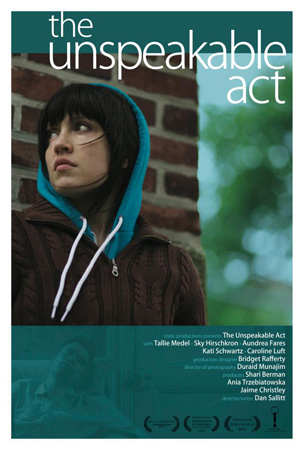
The Unspeakable Act at Double Double Land (Monday August 5th)

On Monday, August 5th at 8:30 pm MDFF is presenting a special free screening of Dan Sallitt's The Unspeakable Act at Double Double Land.

Wednesday, July 31, 2013

Bernard Chardère on 60 Years of Positif

“And perhaps there is also, in this, a reluctance to let us English-readers in on the juicier details of Positif's colourful history: it's easier by far to sweepingly sketch a fifty-year canon of great directors than to explain to a foreign (and sometimes frankly indifferent) audience the intricate divisions between factions of the French Left in the '50s, or the evolution of Surrealism as a cultural movement beyond the arty, glory days to which it is too often reduced.” – Adrian Martin on Positif 50 Years.

Positif, with its eleven issues a year, produces far more writing than any other film criticism magazine. Its large paper size and small margins allow it to cram far more into one page and entire issue than it even seems possible. (Its quantity might also have to do with its writer's pro bono work). Even though its party line is less strict than Cahiers, and there are variation in prose to account for its over-fifty member's writing style, there are historical factors to account for its humanistic, literary, philosophical, political and surrealist perspective.  

Positif with each new issue creates a hierarchy by prioritizing its film reviews, by placing them at the front of the magazine, in order of importance: review and an interview, review, notes. Its many other sections (e.g. Bloc-Notes, festival coverage, DVD and book reviews, Cinéma retrouvé etc.) offer an expansion of what is the actuality of cinema, aside from solely Parisian new releases, while also giving it room to impose its editorial position on alternative film-related projections and texts.

But there is a language barrier that is preventing it from being better known in the English world (cf. Cineaste's Review for some historical factors).

In Jonathan Rosenbaum's article Everyone's a Critic he brings up some of the differences between English and French film writing, highlighting that the European tradition builds upon the intellectual tradition of continental philosophy while in the U.S., industry journalism along with an anti-intellectualism democratization of media outlets restrict the discourse on difficult and foreign films.

In this setting, from the perspective of English film criticism, Positif appears as a untainted oasis, especially in contrast to the wide emergence of shallow and quickly-written film writing that pops up all of the time on the internet.

But it might seem beyond the point to be championing a mostly inaccessible French film magazine (cf. Positif's reception in North America) and to rag on English film writing, especially since it's not in a good state (e.g. jobs are being lost, there are less ones available etc.).  

Positif isn't perfect either: it can be too generous and not critical enough, it doesn't do enough to support small scale festival films that could really benefit from favorable reviews - French film criticism actively rails against a lot of these experimental narrative feature films - or young French cinema that struggles to get even made and then seen (cf. Jeunes cinéastes français).

But I still think that it is important to write about Positif ... so I will continue to do so.

For Positif's sixtieth anniversary they updated a little their classic format: First off they changed publishers from éditions Scope in Paris to Actes Sud at the Institut Lumière in Lyon (cf. Positif by Actes Sud), they slightly altered the magazine's format and layout, and they finally updated to color. Like usual these issues were of high quality (cf. Positif's sixieth Anniversary).

To correspond with Positif's sixtieth anniversary, its founder Bernard Chardère, contributed two essays back to back, after not having written in the magazine since 2005 (with the exception of an Hors-Séries about Cannes in 2007).

In Positif N.615, which has a still of Alain Resnais' Vou n'avez encore rien vu on its cover, Chardère has a nice dossier Les 60 ans de Positif: Notre travelingue en arrière et en couleurs which, in a laissez-faire graphic design, includes: a nice text, pictures of its first fifteen covers ("Je ne m'en suis occupé qu'à partir d'ici ... jusque-là."), portraits of its first group of writers (along with the names of their favorite filmmakers), old photographs of its comity sitting around a table, an advertisement for the new re-editions of its earliest issues, and a promotion for events celebrating its sixtieth anniversary.

In Chardère's text Ah, Quel Titre?! he discusses what he sees as the secret for the long life of Positif and the genesis of its title. Since Chardère's writing, like that in Positif in general, is more about writing style and tone (cf. Positif N.500: Bernard Chardère's Contribution) here is what he wrote in its original French because I would not even know how to translate such wonderful and wild writing, which he would push further in his Bloc-Notes Mai en Cinéma: 60 ans, verte jeunesse (Positif N.617-18). - D.D.
***
Ah, Quel Titre?! 
Il m'étonnera toujours, cet oiseau-là. Ce n'est pas qu'il renaît inlassablement de ses cendres - car le Phoenix, lui-même, avait été carbonisé, alors que Positif est resté parfois muet, mais vivant toujours - c'est qu'il parvient à changer déditeur sans la moindre solution de continuité, d'une livraison l'autre, tel un prestidigitateur tirant de son chapeau ce qu'il y a mis : le prochain numéro.
Cela, répété au fil du temps, une bonne douzaine de fois. Les éditeurs de la revue éclosent comme la fleur des champs, fondent comme neige au soleil, prospèrent, dépérissent... La revue, quoi qu'il en soit, quoi qu'il en coûte, poursui sur sa lancée, telle la flèche de Zénon (d'Élée. Bien que « les positivistes » préfèrent l'autre, de Celtium, plus social).
Ainsi les rayons du lecteur-type finissent-ils par ployer.
À ce propos, je devine qu'on attend de moi la révélation du secret du fondateur: comment avez-vous fait, il y a 60 ans? D'où tirez-vous (les premiers) cette vitalité, digne de La Revue des Deux Mondes (ou plutôt du Magasin Pittoresque, dont en saint-simonien véritable, j'ai la série dans ma bibliothèque)? Bien sûr, qu'il y ait une recette, un tour de main, comment le nier, mais l'essentiel fut simplement l'esprit d'équipe dans une incontestable suite dans les idées. Sans omettre la fidélité à un principe: la réunion du dimanche; inutile de chercher plus loin.
À coeur ouvert, récapitulons: solution de continuité, secret du fondateur, tour de main, esprit d'équipe, suite dans les idées, réunion du dimache. Qu'ajouter encore?
Ah, j'allais oublier...
Oui, j'allais oublier de divulguer, enfin, Le secret: quel titre?
Nous hésitions de concert, avril 1952; l'imprimerie s'impatientait. Je me revois - avais-je quitté mon duffle-coat? - arpentant de long en large la pièce exigüe où Guy Jacob avait rassemblé Irène Giraud, François Michel (ceux-ci peuvent encore témoigner), les Ottavi, Madeleine, Vivè-Pomme bien sûr, assurant que le plus inattendu, significatif, polysémique, était bien « Positif ».
Comme si vous y aviez été:
∙ de la pellicule négative on tire un positif...
∙ de même faudra-t-il, dans les films dont nous parlerons, souligner le meilleur...
∙ le reste - progressistes étaient nos coeurs juvéniles - à l'avenant.
Avec l'impression diffuse que l'on mécoutait dans un silence anormal. Les petits camarades, en effet, avaient rempli notre bouteille de marc du Bugey de quelque chose d'autre - pétrole lampant? vomito negro? - et au lieu de prêter attention à mes raisonnements, tous guettaient l'instant où je terminerai une phrase en vidant mon verre...
Ce petit fait vrai survint, salué avec applaudissements, brouhaha, et haut-le-coeur; du même coup, l'affaire fut entendue. Toutes objections oubliées; victoire à l'arraché: on l'appellerait décidément Positif.
Quel titre!
En nota bene, quelques clins d'oeil, à bons entendeurs salut, depuis le siège de la revue, retrouvé après 600 numéros. Il est vrai qu'en 1984 déjà, le responsable du transfert situait en 300 pages Les années lyonnaises de Positif dans L'Histoire contemporaine.
Acceptons-en l'augure et ajoutons aux maître-mot, à côté de marc du Bugey: Histoire contemporaine. Il ne tardera guère, le N°1000. Il n'y a plus qu'à l'écrire: le titre est là.

Positif: Le cinéma retrouvé

The Le cinéma retrouvé section in Positif consist of extended film reviews of major re-releases of old films in theaters and/or new DVD releases usually in updated restored formats. It's a great way to discover a couple of new films each month and to read a lengthy review of it that contextualizes the film historically, places it alongside the director's body of work,  and deems it socially important as a valuable work of art.

The section works best if there is only two films that are reviewed and that will be released on DVD soon. It offers an outlet to write more thoroughly about these old films and provides a mise en hauteur compared to the reviews in the Notre sélection DVD section. The reviews are an additional homage to the films, which might have been written about as critiques in their first theatrical release, and the new reviews expand upon the former, further championing the director and/or film, while the prose reflects the style of that new individual writer.

When Positif changed publisher they updated their website, where instead of putting the regular editorial, usually by Michel Ciment, on the home-page beside the table of content, the two of them can now be found via links at the bottom of the page as a sleek .pdf document. For a full listing of the Le cinéma retrouvé they can be found via Positif's archieve. I can’t pinpoint what issue that the section started, or all of the films that have been featured, but I can list some recent ones, which I tried to make sure to watch and then read about, sometimes having to wait a few months to watch the film, since the French releases are a few months ahead of the North American one's.

To highlight some of the good recent Le cinéma retrouvé film reviews: Pierre Eisenreich contrasts’s seeing Michael Cimino’s Heaven's Gate in both in print and on DCP and reads the story as a dream and Lætitia Mikles’s reviews Le Joli Mai that will become available in North America in the fall (N.628); Marc Cerisuelo’s discusses the production history of  Ernst Lubitsch’s masterpiece To Be or Not to Be and Pierre Berthomieu’s discusses the use of split screen and genre in Robert Aldrich’s  Twilight's Last Gleaming (N.627); Adrien Gombeaud offers a sensitive reading of Hou Hsiao-hsien’s Dust in the Wind, and Bernard Génin’s speaks of Martin Rosen’s unique animation style in The Plague Dogs (N.625); Philippe Rouyer proposes Kubrick’s Fear and Desire as his first non-verbal visual experience, and Laurent Vachaud’s offers a delirious take on Kubrick’s relations with the Illuminati in Kubrick: Le secret de la pyramide (N.623).

Monday, July 29, 2013

Positif N.500: Bernard Chardère's Contribution

To celebrate the 50th anniversary of Positif, for their 500th issue (Oct. 2002), the editors prepared a special issue. In it, the feature section was full of previously unpublished documents from famous filmmakers (e.g. Kubrick, Marker, Kiarostami, Cronenberg etc.), reflections by 87 collaborators on their participation with the magazine, and their favorite ten films from this period. The impressive roster of contributors included: Bernard Chardère, Gilles Jacob, Bertrand Tavernier, Michel Ciment, Michael Henry Wilson, Philippe Rouyer, Laurent Vachaud, Pierre Berthomieu, and others.

A noteworthy contribution to the section Cinquante Ans de Cinema is Bernard Chardère’s (which I translated below, along with his top ten). These early issues of Positif that he describes have long been shrouded in mystery since they are unavailable in Canada (cf. Positif in Canada). Luckily, they were recently re-printed as Les nouvelles éditions de Positif (Nouvelles Éditions Jean-Michel Place): Positif n° 1 à 15 and Positif n° 16 à 31. Now we just need to get them over here! - D.D.

***
1952: Bernard Chardère
For the sake of the cause (Cosa Nostra), if I had to evoke the year 1952, where to start? Perhaps with the projections "with a presentation and discussion," the heirs of the "conferences with a projection" from the times of the magic lanterns.The first orders for Positif came from the dense network of cine-clubs that were spread across the country (which dried out all of the original versions). In Paris, the profession was organized with an iron fist, without velvet gloves, by the unions, and for anyone interested in joining they would have had to first go through the L'Institut des hautes études cinématographiques (IDHEC). Another thing to take into consideration, in regards to discoveries I mean, would be the lines of inquiry around the cinema, and there were two major camps: the Catholics, who went about it in their traditional ways - morality, censorship, etc. - looked for an emancipation, at least aesthetic (Téléciné, Henri Agel ...), and there were the communists, guided by historian Georges Sadoul and the French weekly L'Écran français, who professed their faith to denounce, in a herculean effort, any Hollywood production. The only exception, Orson Welles, who was both loved at a time, without reticence, by Positif and Cahiers.
 
The table of contents from the issues of this era are filled with a majority of texts about Italian Neorealism, English comedies, and the rediscovery of Soviet and German classics. While also highlighting the incredible mass of mediocre French films: it wasn't famous, our own Saturday night cinema. In the streets and in print, with a critical point of view such was our intellectual responsibility (Leenhardt, Astruc, Kast ...), to consider the unfortunate state of our cinema. What to do? But to escape with Avalanche (Segard), Le bagnard (Rozier) Bel Amour (Campaux), Bille de clown (Wall), Boite de nuit (Rode), Boniface somnambule (Labro), Bouquet de joie (Cam).

Let's stick to the letter B: for example, to highlight some directors that we championed. What to do, if not, to fall into the arms of American cinema? (which we are offered in France, only which that is deemed "worthy" to export, let's remember).

So in this context we decided to take out our pens. In the six issues from 1952, Positif devoted articles to L'Auberge rouge (Autant-Lara), L’Ange bleu (Sternberg) La Carrose d'or (Renoir), Le Christ interdit (Malaparte), Deux sous d’espoir (Castellani), La Grande Vie (Schneider), Le Fleuve (Renoir), Miracle à Milan (De Sica), Los Olvidados (Buñuel), Orphée (Cocteau), Othello (Welles), Pas de paix sous les oliviers (De Santis), Rashomon (Kurosawa), Subida al cielo (Buñuel), Les Vacances de M. Hulot (Tati). There was equally major studies on the national cinemas of Spain, Italy, Russia; articles on Bresson and Renoir, Donskoï, Duvivier, Epstein, Vigo, Welles and an entire issue on Huston (African Queen, The Asphalt Jungle, The Treasure of Sierra Madre, The Red Badge of Courage, We Were Strangers).

"You were the first, really, to liberate films from the intellectual empire of the Critics, to open them up towards life, and into the real world," reassures us today an obsever without any indulgences, Georges Goldfayn. It's true though that we believed in cinema as a generous humanism, which we put to use, in a random order, to discover life, and as a way to improve it, and at the same time, with a crazy love for this unique form of expression, and an appetite to learn its many-fold components and masters.

Positif's layout and format was conceived spontaneously.
There were excesses, omissions, blunders, certainly: the failings of youth. What has been done is done! Our choices as an emerging magazine must have corresponded to ... something: incomplete, they would contribute, one stone at a time, or if not towards a definition of a "general line", or at least to the creation of a common spirit. This all just happened as we were putting together more issues after its initial launch, it continues to be enriched today, as it was fifty year ago, a great response to the most skeptical of its founders.

Well we want to authorize this, after this message, the archaeology, to draw a personal reverence to film criticism, saluting, the chef editor Ciment, and the publisher Paul Louis Thirard and everyone else on the team, that I would have had the pleasure to read during the first few years of the second century of the cinema. The first years: always the best...
***
Bernard Chardère's ten favorite films of the past fifty years, in no order: Il Grido (Antonioni), Él (Buñuel), The Dead (Huston), Hamlet (Kosintzev), 8 ½ (Fellini), Lancelot du Lac (Bresson), The Night of the Hunter (Laughton), Smiles of a Summer Night (Bergman), 3 Women (Altman), Les vacances de Monsieur Hulot (Tati).

Kubrick & The Illuminati by Laurent Vachaud

Monday, July 22, 2013

Positif by Actes Sud

Since the main reason Anglophone cinephile's don't know about Positif is because of its language barrier, which has led to its physical and editorial marginalization (cf. Positif's North American reception), I've decided to try to ameliorate this situation at Toronto Film Review by discussing it more. The following is a translation of Positif's unsigned description, which is really good and accurate, from its publishers Actes Sud's webpage. - D.D.
***

This is the story of a group of peers from diverse backgrounds who, united by their love of the seventh art, meet every Sunday for three hours, for the last sixty years, to discuss the latest news about cinema, among other things.They determine the content of the next issue of the magazine, read texts that were sent to them from potential guest contributors, and develop future projects. Positif has no chief-editor, the writers are not paid and decisions are made by a committee, composed of members representing different generation of writers who have succeeded each other, since its inception all of the way to its more recent arrivals. This coexistence of generations creates a perpetual dialogue, lively and sometimes contradictory, which makes Positif a magazine that we can truly say has a "spirit" or "tone" that has evolved with its new writers, rather than replacing one group by the direction of an other. This decentralized operation, "eccentric", has probably something to do with the fact that the magazine was not born in Paris but in a smaller city. In this case it is Lyon, where its founder, Bernard Chardère, will later create the Institut Lumière, which is now the current co-editor of Positif with Actes Sud!

Today our editorial policy in terms of artistic curiosity, historical information and critical analysis is motivated by a strong reaction to the promotional hype and to the steady space reduction allocated to film criticism in the press general. For us, a sharp appreciation of aesthetics is more compelling, especially compared to other newspapers that have turned their cultural pages into more or less open commentaries, dictated by the "market" and its "targets", about the performance of films at the box-office. In recent years, the landscape of film periodicals has changed dramatically. Magazines prefer zapping, short capsule reviews, the "people" profiles, and business or financial information. At the same time, there has been the development of more advanced research publications, theoretical or historical, often remarkable, but for a scholarly readership. 

Positif, a monthly film magazine that is available in kiosks and specialty book stores as well as libraries, persists still in the midst of all of the hazards of the publishing world, to proclaim itself a "movie magazine" against all odds, just like it did during its infancy and perhaps in a more singular way. With the breakout of information on the internet and the new ways of distributing movies, we feel more than ever the need for well-informed choices, as a way to sort through this continuous stream of images.

Being published jointly by the Institut Lumière and Actes Sud, Positif confirms its shift not only geographical, but also "moral", vis-à-vis a way of thinking that is necessarily Parisian and culturally correct. Independence is our keyword, and we are confident that there will always be new battles to fight for the cinema that we love. That is why this joint publication is both a sign of a homecoming and a faith in the future.