Saturday, August 23, 2008

A Great Date In Barcelona Or We'll always have Rhiota.

Vicky Christina Barcelona (Woody Allen, 2008)
*** (A Must See)


Vicky (Rebeca Hall) and Christina (Scarlett Johansson) disembark in Barcelona for a sunny summer stay with family friends Judy (Patricia Clarkson) and Mark (Kevin Dunn) Nash. Vicky is in Barcelona to further her postgraduate work on Catalan and the architect of Antoni Gaudí and Christina is there for love. Christina meets a well known painter in the arts community Juan Antonio (Javier Bardem). He is introduced at his nihilistic best; we find out about his devastating ex-wife who shot him, he is all by himself and he is looking gloomy drinking wine. The two girls go on a weekend trip in Rhiota with Juan Antonio where Christina accidently gets sick. Hesitantly Vicky goes out with Juan and they indulge in beautiful Catalan wine, cuisine, classical guitar to accompany private intellectual and emotional conversations. Maria Elena (Penélope Cruz) returns and gets back together with Juan Antonio just as a blooming relationship with Christina is emerging. The film contrast the relationships of the two leads Vicky with her stable and secure relationship with an Allen prototypical New York intellectual Doug (Chris Messina) and Christina with her spontaneity and excitement in her love affair with Juan Antonio and Maria Elena. Underneath it all there is a study of compromise in relationships, everyone has their own regrets and desires that are fulfilled or neglected. As Vicky is trying to come to terms with her shrewd night with Juan Antonio the film meditates on fleeting joyful encounters and concealing sadness with alleged cheerfulness. Woody Allen has always been trying to combine the froth with the serious and this film offers many of pleasures that are reminiscent of his good old days. The cast is gorgeous, cute, beautiful, sexy, and sells itself but what makes the film so much greater are the hilarious wisecracks; Great, just what we needed a Rorschach blotch.

Vicky Christina Barcelona is Woody Allen's the latest film from his prolific career as a writer-director that started in 1969 with his directional debut Take the Money and Run. His last feature to show in Ottawa was Scoop (2006). "Well, Scoop I found to be a trivial little Kleenex of a film..." Woody Allen proclaimed in a recent interview with The Village Voice. Cassandra’s Dream (2007) did not even make it to repertories in Ottawa. Point is: Vicky is the best Allen you can get. Vicky Christina Barcelona will be playing at the AMC and SilverCity and more comfortably at the Bytowne in October. To get ready for the Bytowne premiere their playing, my favorite Woody Allen film, Manhattan (1979) on September 23rd and 24th. If you still want more his next film Whatever Works is scheduled for release next year and will be starring Seinfeld and Curb Your Enthusiasm creator Larry David and if your going to be in Los Angeles next summer he will be directing his first ever opera Puccini’s Gianni Schicchi.-David Davidson

(Bytowne Cinema, 324 Rideau Street, 10/02-10/05)

Sunday, August 17, 2008

A Community of Extremities

Encounters At the End of the World (Werner Herzog, 2007)
*** (A must see)


This is Werner Herzog latest documentary since Grizzly Man (2005). Mr. Herzog deals with the country as a whole, geographically, geologically as well as historically. Encounters At the End of the World is a documentary film about the southernmost continent Antarctica and its inhabitants. In Encounters you get to be over and under Antarcticas 14 million km² of ice. The untethered ice diving mood is filled with awe and fright with its gloomy aqua palette knowing the risk that goes along with such a dangerous trip. The continent snow-white landscapes are extraordinary in size and show the Transantarctic Mountains for all its beauty. The inhabitants are penguins, fur seals, different types of lichen and algae and its human population. Their are scenes where you are just hanging out with the scientist listening to their stories that are all interesting. Their is a philosopher/fork-lift driver, a journeyman plumber who believes he is from Aztec royalty, a Russian refugee, an eccentric Harvard scientist that wears tweed jackets in homage to the first turn of the century explores and a man who has been studying penguins for the last 20 years who doesn't really talk much. While their not doing research they spend their time watching old sci-fi movies, they go out to bars to see locals performing schticks, grow plants in a green house and wonder where they will go to next. Like Herzog with Encounters he has now filmed a feature on every continent and like these researchers they are drifters of the planet. As one scientist puts it "If you take everyone who is not tied down, they fall to the bottom of the planet". They give a caution about the consequences of global warming and how the melting continent might break off some monstrous icebergs that would have a disastrous impact.-David Davidson

(Bytowne, 324 Rideau Street, 08/15-08/21 & Mayfair Theatre, 1074 Bank Street, 08/23-08/24)

Friday, August 8, 2008

Blue Velvet and Lost Highway

Blue Velvet (1986) and Lost Highway (1997) are going to be playing together as a double bill at the Mayfair on August 25th and 26th. These esoteric films come from one of the most talented post surrealist filmmaker David Lynch. David Lynch has a bizarre naturalist gift to create ugliness and darkness in the most ordinary places. Blue Velvet was filmed after the commercial failure Dune (1984) and leads him to his most well known television series Twin Peaks while Lost Highways is his most structurally innovated film since his breakthrough picture Eraserhead (1977).

Blue Velvet takes place in a white picket fence suburb and tells the unusual story of Jeffrey Beaumont (Kyle MacLachlan) attempt to solve a murder mystery with intimate's to old film noirs. The film is renowned for his closet-voyeurism scene where he horribly discovers Dorothy Vallens masochistic sexuality. Jeffreys romantic interest is the detectives blonde, innocent daughter Sandy (Laura Dern). She is a light woman there to contrast the dark Dorothy Vallens (Isabella Rossellini) a night-club singer Femme Fatale who sings Bobby Vinton’s Blue Velvet (the inspiration for the film). There is also the psychotic Dennis Hopper who represents repressed desires and ugliness and that are hidden in society.

Lost Highway is like a serpent swallowing its own tail. The film is hallucinatory in the way it twists all events together. The cyclical narrative structure reverts to the one of Eraserhead dealing with multiple-personality disorder in a bewildering manner fusing characters together. The film puts together powerful sound and image together to create spattered expressionistic effects. The film floats on adolescent subjects such as aggressively, manliness and dirty sex. Some of these events work while others are compelling tick off including the beating of a motorist for tailgating that seem excessive but their attributed to deadbeats anyway. In a film where the characters are more like interchangeable entities the thrill of it is in the perplexing rhythm structure.

(Mayfair Theatre, 1074 Bank Street, Monday and Tuesday, August 25 and 26, 6:30 and 8:50)-David Davidson

Tuesday, August 5, 2008

Hong Kong Sorrow

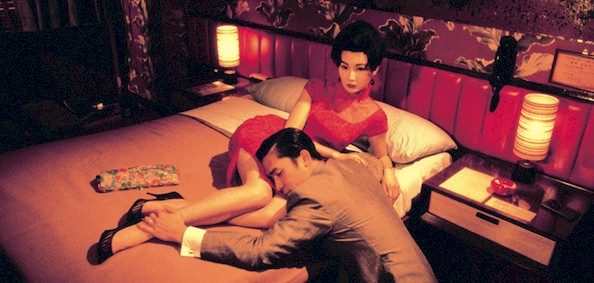
In The Mood For Love (Wong Kar-Wai, 2000)
*** (a must see)


He remembers those vanished years. As though looking through a dusty window pane, the past is something he could see, but not touch.

Set largely in Hong Kong and partly in Singapore between 1962 and 1969. In the Mood for love is about the pinings of two neighbors Mrs.Chan (Maggie Cheung) and Chow Mo-wan (Tony Leung). Their spouses are suspected to be having affairs with each other and are always away. Christopher Doyle the director of photography catches glimpses from doorways and behind windows transforming the location to the forefront of the filmic space. The film is told as if it were a romantic memory revisiting the same apartments, streets and offices fusing simultaneous events in vivid montages. As the two neighbors learn more about each other they do not compromise their morals and stay true to their partners. One day Chow Mo-wan take a journalism position in Singapore. This forces them to decide on if they want to be together. Circumstances leads them to part ways and the two decide not to revisit each other even when the situation arises. The film ends in a scene where Chow Mo-wan whisper inaudibly something into a wall. This secret is a metaphor for the things we leave behind in our lives. Then we are brought back to reality with a newsreel of de Gaulle visiting Cambodia and the film ends.

(The Criterion Collection, 2-Disc Set, $31.96)

Tuesday, July 29, 2008

The World of Today Yesterday

Play Time (Jacques Tati, 1967)
****(Mastepiece)

The revered French filmmaker Jacques Tati film Play Time is generally considered as his masterpiece. The film takes place in contemporary Paris and deal with Mr.Hulot (Jaquest Tati) copping with the world. In Play Time the immediate environment takes precedence over the tourist and inhabitance. The grandeur of Play Times modernist Paris had to be created instead of using natural location as their filming conditions turned out to difficult to overcome. The cost of production for the film in itself bankrupted Tati who personally financed the picture.

What is so enjoyable about the film is the scope of the world it presents. The film shot in 70mm, unlike most films that are shot in 35mm, allowed for a more developed mise-en-scéne. This allows for a wider and sharper image and sound. In a single scene there would be unbridled events occurring at once. Everything would be going on smoothly in the frame until eventually interlocking the scene together. It serenely plays out more like a tableau vivant than it does a story.

Play Time succeeding Les Vacances de Mr. Hulot (1953) and Mon oncle (1958) offers a much smaller role for Mr.Hulot. The character of Mr.Hulot was suppose to be a one time role but since his creation has become more important then his creator. Tati wanted to kill off Mr.Hulot but keep the Mr.Hulot paradigm present through out the film. His charming bumbling persona returns by others resembling him or by nondescript pantomimes. This was done to infer there is a little Hulot in all of us.

The Canadian Film Institute has been running Playtime: The Cinema of Jacques Tati for the last month. The festival ends next Saturday with Tati’s last film Trafic (1971).

National Archives Auditorium, 395 Wellington Street, Saturday, August 9th, 7:00.

Friday, July 25, 2008

The Conscious Balloon

Flight of the Red Balloon (Hsiao-hsien Hou, 2007)
*** (A must see)

Hou Hsiao-hsien, the Twaiwanese film-maker was commissioned to remake Albert Lamorisse Le Ballon Rouge (1956) by the Musée D`Orsay. Mr.Hou is one of the greatest narrative filmmakers and his structural innovations focus on a contemplative model instead of a conservative narrative by focusing on impression, gestures, moments and moods. The story takes place in a contemporary Paris. Suzanne is a performer in an adult puppeteer theatre and lives humbly in her small bourgeois apartment. The two principle characters are the realistic Suzanne (Juliette Binoche) who is trying to attain an emotional equilibrium and her charming son Simon (Simon Iteanu). Their characters are developed through melodrama as Suzanne fights with one of her tenants and her ex-husband while Simon learns to play the piano, plays and goes about his day. The hired nanny Song (Fang Song) observes the family. She is a film student who has a deep appreciation for life and genuinely enjoys the time she spends with Simon. Like the balloon she is a calm, self-contained observer. Red Balloon is beautifully shot with a subliminal style using window reflections, shallow focus and long tracking scenes due to the director of photography Mark Lee. From an unreachable height the balloon represents a free floating metaphor. In my humble opinion it represents transcendence. The potential self-realization that can be achieved that is always present in ones life. The sincerity of the performances showcases each characters inner emotion, feelings and thoughts.

The film is playing July 25th to August 4th at the Bytowne Cinema.

Wednesday, July 23, 2008

Today’s Dark Knight

The Dark Knight (Christopher Nolan, 2008)

Heath Ledger passed away tragically due to a drug overdose in January. His performance in Dark Knight since then has been praised in the industry. Now finally being able see it is both superb and sad. He had a subconscious way of bringing the inner life of characters into the roles he played. His part in the film is genuinely unnerving and his Joker is intensely evil. He is no longer playing a super villain but a modern day terrorist. He outlines moral dilemmas where either choice results in someone’s death. He goes into his past explaining the scars around his mouth came from being cut up from his father who asked him "Why so serious?" before cutting his face. At the same time it is a shame that it will be one of his last performances. There is talk of maybe a posthumous Oscar nomination and he has an upcoming role in Terry Gilliam`s The Imaginarium of Doctor Parnassus that is now in post-production.

Christopher Nolan and his brother Jonathan Nolan have been working together since Christ’s first feature film Memento that was based on a short story Memento Mori by Jonathan. They collaborated again in 2006 for The Prestige and finally on the screenplay for Dark Knight based on the DC Batman Comics. Bob Kane the creator of Batman inspiration for the Joker is from Paul Leni’s German Expressionism film The Man Who Laughs (1928). The comic-book hero had several big screen adaptations prior to Nolan’s films. There was the 1966 cinematic transfer with Adam West taking up again his campy performance from the television show of the time and Tim Burton revamped the superhero with his more gothic and perverse 1989 Batman.

The new series is a lot darker then any of the previous films. This sequential film in Nolan’s Batman series has the Bruce Wayne character (Christian Bale) is already developed. In Batman Begins through a series of flashbacks involving Bruce we learn his true motivation and fears. As a child he falls down a hole and there he is attacked by bats. The idea and thought of bats scare him right into his adulthood. After that he leaves the theater earlier with his parents who then get accidentally murdered while being mugged. He channels his grief into a revenge plot to take down the criminals. Then through vigorous training that resembles something out of Star Wars and the best high-tech equipment Wayne Enterprise can buy he faces his fears and the Gotham City criminal world. The film is full of exciting action sequence, awe-inspiring scenes of Batman flying thought Gotham City, actually Chicago, and effective one-liners.

Dark Knight starts with a bank heist. There is a group of criminals all wearing clown mask who try to pull off the perfect heist. The mask the men are wearing was influenced by the ones worn by the gangsters in The Killing (1956). The clowns turn off the alarm, take everyone as hostages, and shoot the vigilante bank manager then get way with the money. As these events progress they are slowly turning on each other due to orders from the organizer, a sociopath who wears make-up and calls himself the Joker. The Joker turns out to be in the group. He betrays the clowns that aren’t dead yet then gets away by driving away in a school bus in between a caravan of other busses while the police arrive at the scene to late. This sequence here depicts the view the Joker has on the world. He believes that as long as things are in order instead of chaos whether it is good or evil is irrelevant.

The Gotham city in the Dark Knight is the one of the 21st century. The city is darker, nihilistic, swamped with corruption and crime and the citizens are unsympathetic and afraid. The city no longer is in its own confined existence as the film switches to Hong Kong to emphasize its global economic and moral connections. The Joker plays a terrorist who is devastating the city with high explosives, political assassination and destroying buildings including a hospital. Batman is now an antihero in between good and evil. He tortures to get information and creates a wiretap information center to locate the hiding spot of the Joker. The film has political implication echoing the society we live in now by skillfully putting together images that have cultural value.

The Jokers action poses moral problems for Batman and the citizens of Gotham City. He puts two ferry boats loaded of passengers, one boat civilians and the other boat of felons, against each other to blow the other ferry or be blown. To offset the pessimism of destroying the good-will of The White Knight district attorney Harvey Dent (Aaron Eckhart) into the murderous Two-Face. The film rejoices with the humanism of one the criminal on board one of the ferry’s who convinces the warden to give him the detonator and he throws it out into the water instead of sacrificing the other boat.

There are excellent performances from Michael Caine returning as Bruce Waynes faithful butler, Maggie Gyllenhaal with a heartbreaking performance as Rachel Dawes, Gary Oldman as the understanding Lt. James Gordon and Morgan Freeman as Lucius Fox Wayne Enterprises technical adviser.

The film is playing at all major theaters and make sure to get there early since screenings have been selling out.